 by Tom Gurney
Tom Gurney BSc (Hons) is an art history expert with over 20 years experience
Published on February 15, 2026 / Updated on May 16, 2026
Email: tomgurney1@gmail.com / Phone: +44 7429 011000
Claude Monet in Paris
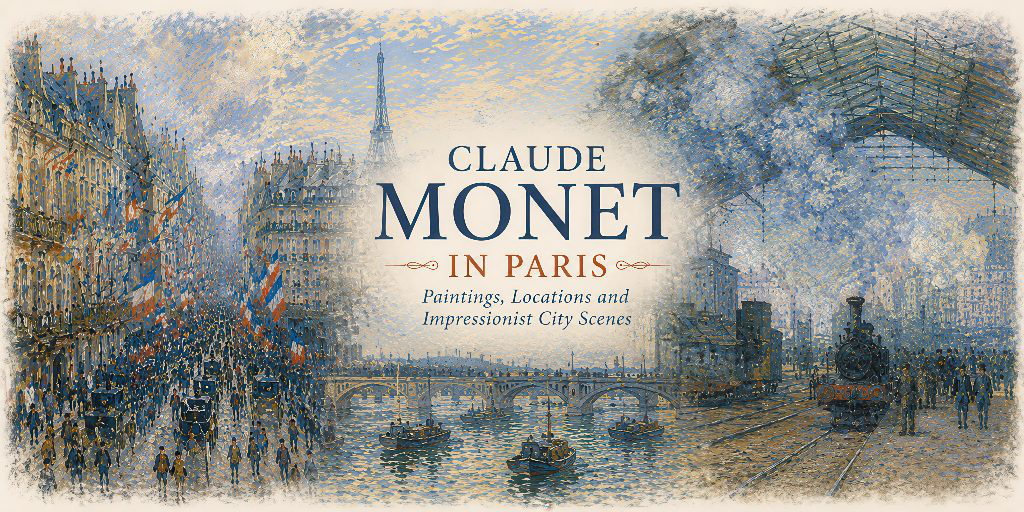
Paris was where Claude Monet's Impressionism was forged. It was here — amid the boulevards, bridges, railway stations, exhibitions, and riverbanks — that Monet invented and developed the methods that ultimately redefined modern painting.
Introduction
When Monet arrived in Paris in the early 1860s, the city was undergoing one of the most dramatic urban transformations in European history. Under Baron Georges-Eugène Haussmann neighbourhoods were demolished in large numbers, before being replaced with boulevards, stunning facades, public parks and modern infrastructure - it was a time of change in the truest sense of the word. [12]
This widening of roads and movement away from medieval infrastructure ensured light would flood into the city, changing everyone's experience when walking the streets. There was also an opening up of viewpoints, bringing new angles and interest right across these regenerated areas. All of these changes would suit Monet's artistic mind and inspire a number of paintings across Paris.
Claude Monet studied in Paris, briefly at the Académie Suisse, before entering the studio of Charles Gleyre. It was here that he came across a number of artists who shared his broad artistic principles, such as Pierre-Auguste Renoir, Alfred Sisley and Frédéric Bazille. [1] They shared a drive to move French art on from the academic structure which they found stifling and outdated.
At the time of Monet's arrival in Paris the Salon had a long history of choosing mythological and other traditional themes when approving work. They also encouraged polished finishes, which aligned with specific artistic educational practices which had been taught for centuries. Monet's group, which would ultimately lead to the formation of the Impressionist movement, were not inspired by this, and were willing to push against the academic barriers in order to instill their own ideas across Paris and beyond.
With Paris having recently been modernised, it was time for artists to update their own methods. Leisure, industry, suburban leisure culture and the shifting conditions of light would draw in Monet and this article exposes all the elements of Paris that impacted his work.
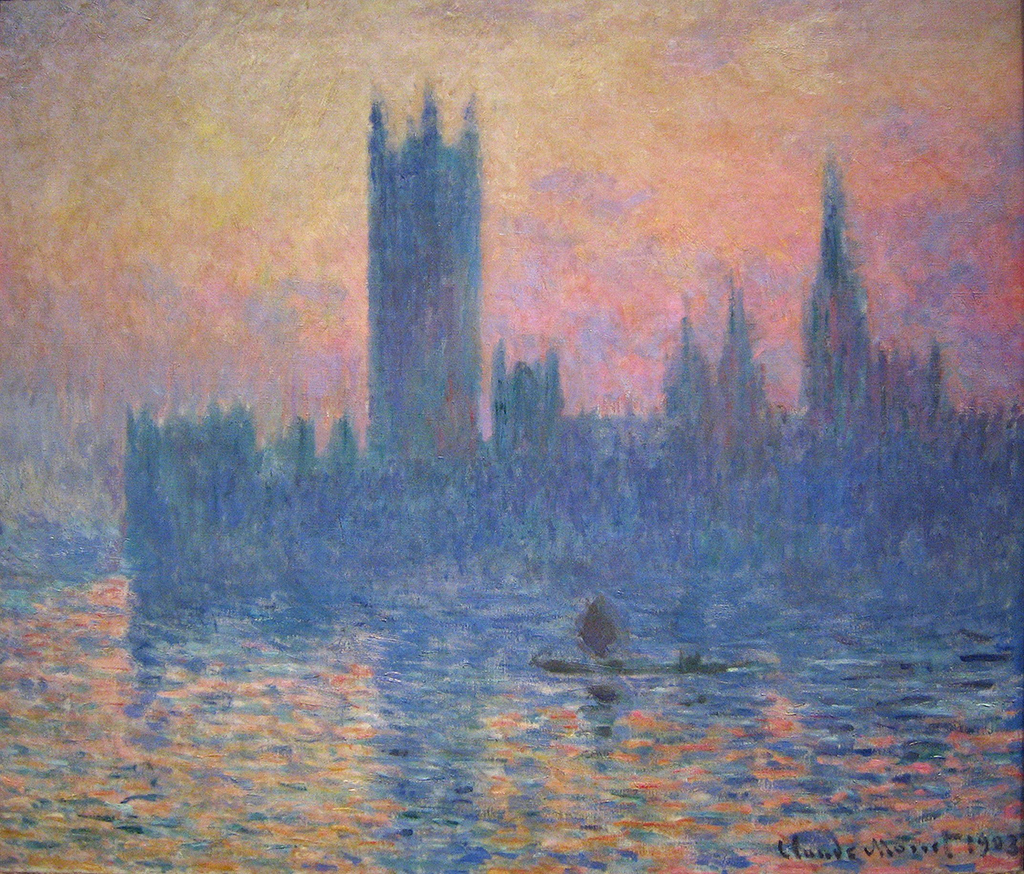
While Paris introduced Monet to modern urban life, it was in London that he transformed these ideas into a sustained study of fog, light and atmosphere. [3]
Monet immediately started to paint outdoors, and this allowed him to really absorb city life into his work - smoke, fog, reflections, light and motion would direct his brushwork, with many artworks completed entirely outside the comfort of his studio.

Paris is the spiritual home of Impressionism.
- Primary Location Paris, France
- Main Working Period 1860s - 1870s
- Key Subjects Boulevards, Seine River, Bridges, Festivals
- Major Series Gare Saint-Lazare (1877)
- Important Works Rue Montorgueil · Boulevard des Capucines · Pont de l'Europe
- Art Movement Impressionism
- Thematic Focus Modern Life & Urban Atmosphere
- Legacy Foundation of Serial & Urban Impressionism
Table of Contents
- Introduction
- The Boulevards and Modern Spectacle
- Timeline of Monet in Paris
- Interactive Map of Monet's Paris
- Monet's Most Famous Paris Paintings Explained
- The Seine: Paris as a River City
- Gare Saint-Lazare and Industrial Modernity
- Monet and Haussmann's Paris
- Legacy of Monet's Paris
- Complete List of Claude Monet's Paris Paintings
The Boulevards and Modern Spectacle
Monet's boulevard paintings stand among the most dynamic images of 19th-century Paris. The artist took advantage of all manner of angles and elevations in order to capture this stunning city at its finest. Painted from elevated vantage points — balconies, rented apartments, or hotel windows — they translate urban movement into vibrating color. [6]
By lifting the viewer above street level, Monet transforms crowds into patterns and traffic into rhythmic flow. Carriages become dark brushstrokes; pedestrians dissolve into flickering touches of paint. The city is not described — it is experienced, perfectly in line with the principles of Impressionism, and others such as Pissarro would do similar.
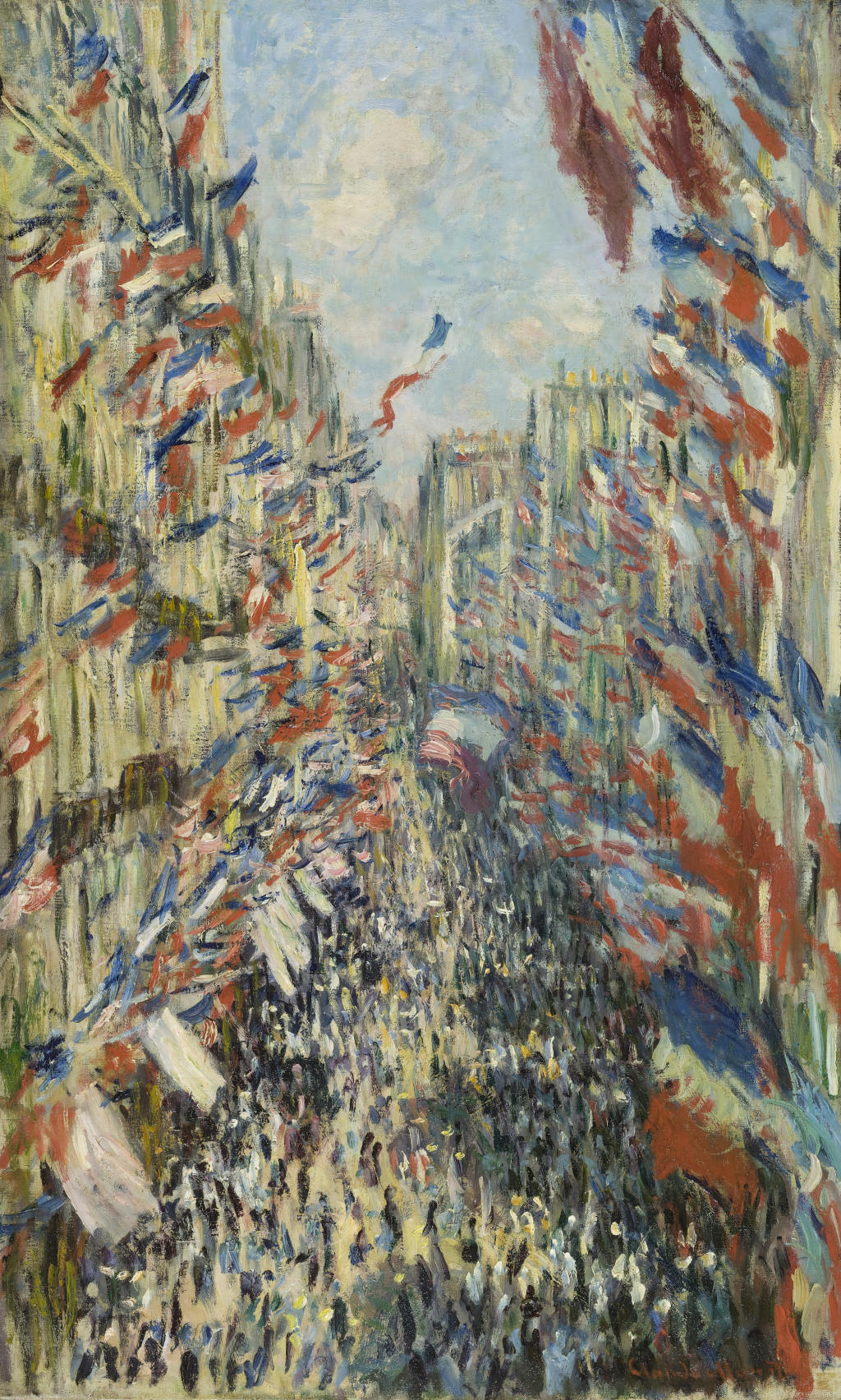
His depictions of the national celebrations of June 30, 1878, marking the Exposition Universelle, are the best examples of this approach. Streets such as Rue Montorgueil and Rue Saint-Denis erupt with tricolor banners suspended between buildings. The excitement and energy is perfectly captured by Monet. [4] [5]
In a similar manner to his London and Rouen series, architecture, though structurally precise, becomes secondary to atmosphere. Facades flicker through veils of color; windows appear and vanish in painterly haze. Monet was less interested in topographical accuracy than in collective sensation — the emotional and visual energy of public festivity. His method received pushback by Paris academics for a long period, before finally they began to be persuaded as to the merits of the Impressionist movement, along with the public.
These Paris events were all about a moment in time, lasting just a few days, and Monet was concentrating on this concept as content, whilst also wanting to take advantage of the many beautiful aspects of the city of Paris.
Timeline of Monet in Paris
This visual timeline follows Claude Monet's development in Paris, from his early arrival in the city and training with Charles Gleyre to the boulevard paintings, the first Impressionist exhibition, the Gare Saint-Lazare series and the festival scenes of 1878.
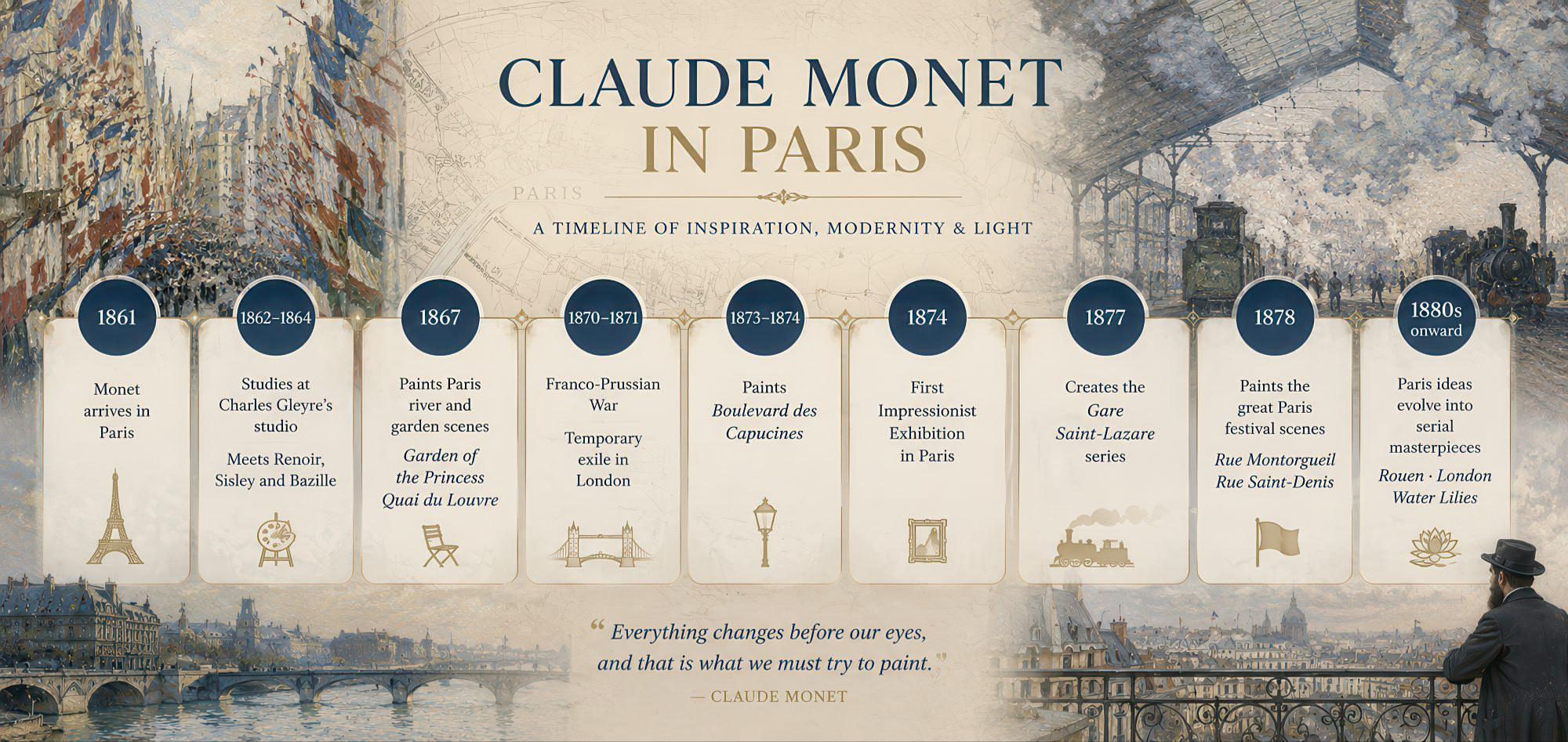
Timeline of Claude Monet in Paris, showing how the city shaped his development from student painter to leading Impressionist. The timeline connects his early Paris years, boulevard scenes, the first Impressionist exhibition, the Gare Saint-Lazare series and the festival paintings of 1878.
Interactive Map of Monet's Paris
Explore the locations that shaped Claude Monet's Impressionism, including the Boulevard des Capucines, Gare Saint-Lazare, the Seine embankments, Pont de l'Europe and the streets painted during the great festival celebrations of 1878. This interactive map traces Monet's movements across Paris and connects many of his paintings to their original viewpoints.
Follow the Monet Paris Trail
Walk through the streets, bridges, railway stations and river viewpoints that shaped Impressionism.This self-guided trail connects Monet's paintings with their original Paris locations.
Most Famous PARIS Paintings Explained
Claude Monet's Paris paintings show the modern city in motion: flags, crowds, bridges, railway smoke, river reflections and new Haussmann boulevards. These works reveal how Paris helped shape Impressionism, giving Monet subjects that were urban, atmospheric and unmistakably modern.
Rue Montorgueil, Paris, Festival of June 30, 1878
Date: 1878
Location depicted: Rue Montorgueil, Paris
Current location: Musée d'Orsay, Paris [4]
This is Monet's most famous Paris festival painting. Instead of carefully describing every window, flag or figure, he turns the street into a vibrating field of colour. The tricolour flags ripple across the buildings, while the crowd below becomes a moving pattern of dark and light brushstrokes.
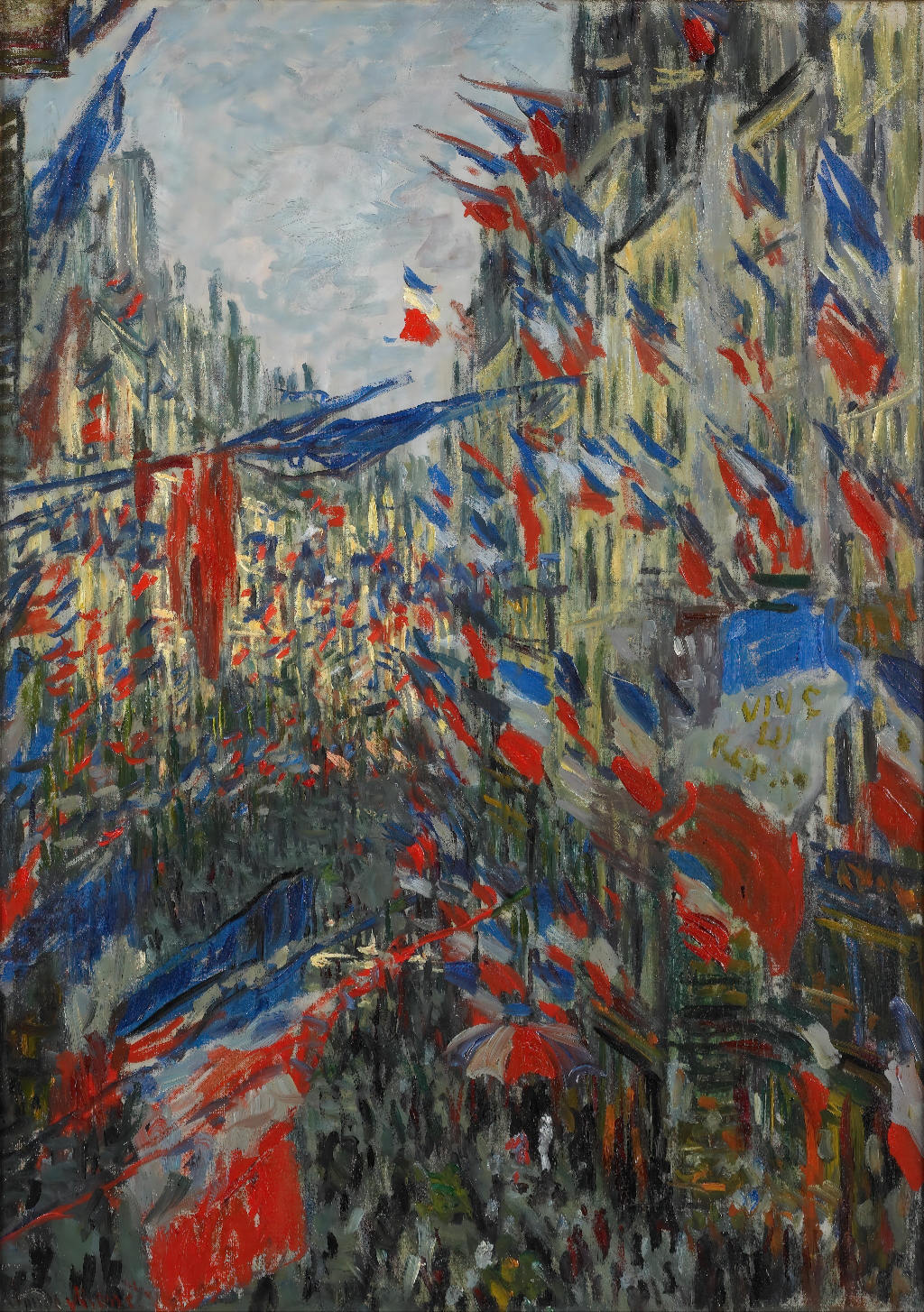
Rue Saint-Denis, Paris, Festival of June 30, 1878
Date: 1878
Location depicted: Rue Saint-Denis, Paris
Current location: Musée des Beaux-Arts, Rouen [5]
Painted during the same national celebrations as Rue Montorgueil, this work gives a slightly different view of Parisian spectacle. The street narrows into depth, but Monet is less interested in architecture than in the sensation of flags, crowds and sunlight filling the city.
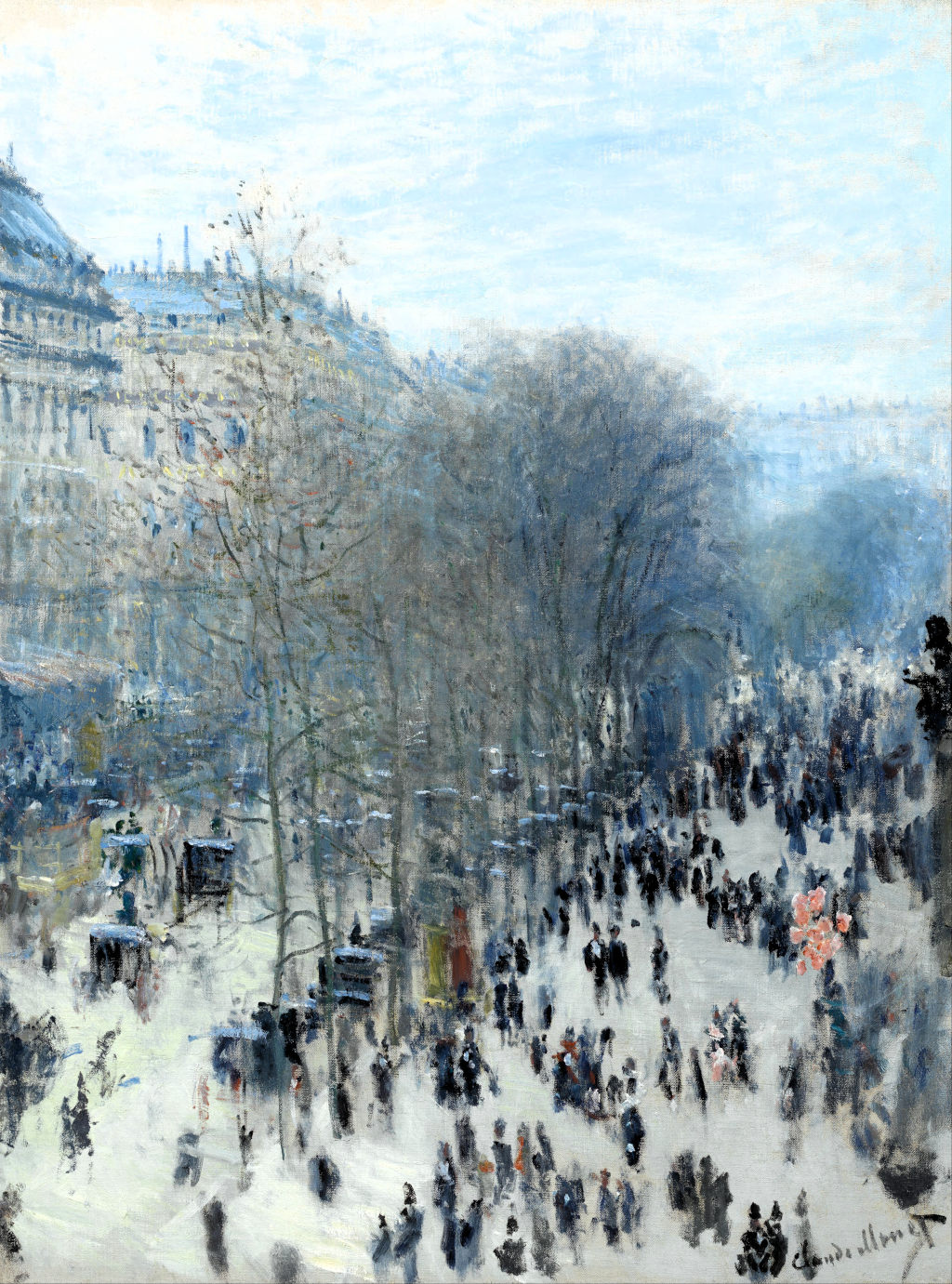
Boulevard des Capucines
Date: 1873-1874
Location depicted: Boulevard des Capucines, Paris
Current location: Nelson-Atkins Museum of Art, Kansas City [6]
This is one of Monet's great paintings of modern Paris. Seen from above, the boulevard becomes a pattern of trees, carriages, pedestrians and winter light. The elevated viewpoint turns the crowd into movement itself, making the city feel restless, optical and alive.
Boulevard des Capucines
Date: 1873-1874
Location depicted: Boulevard des Capucines, Paris
Current location: Pushkin State Museum, Moscow [13]
Monet painted more than one view of the Boulevard des Capucines. This version is useful because it shows how he returned to the same urban motif in changing light and atmosphere. The boulevard is recognisable, but the real subject is the flicker of modern life.
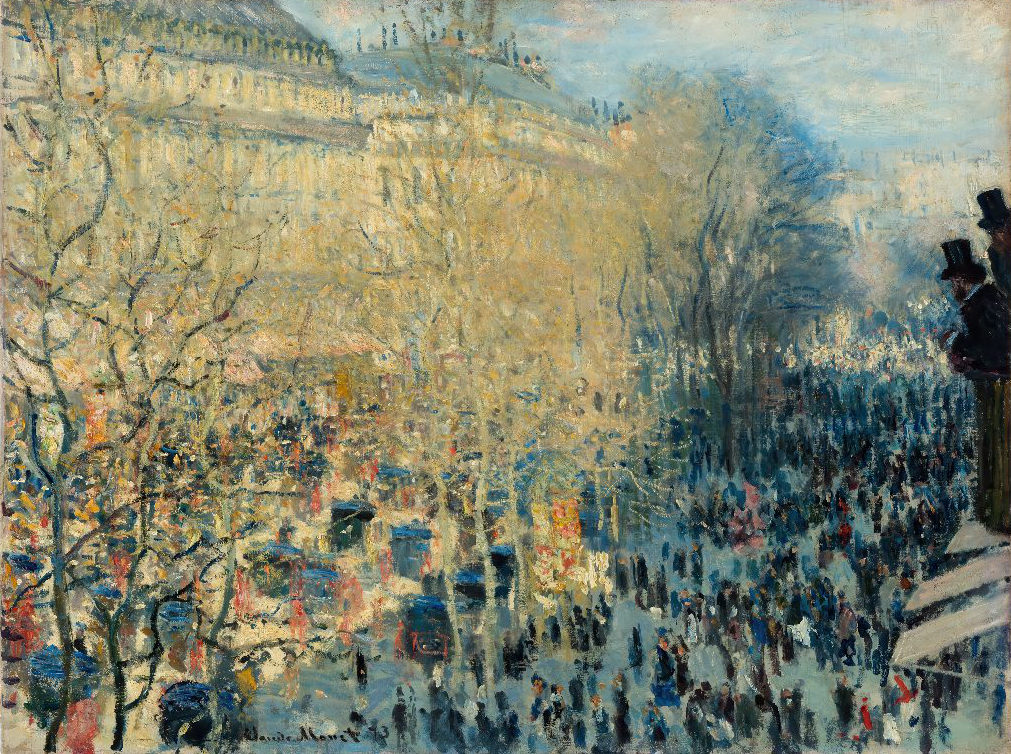
Gare Saint-Lazare
Date: 1877
Location depicted: Gare Saint-Lazare, Paris
Series: Gare Saint-Lazare paintings [7]
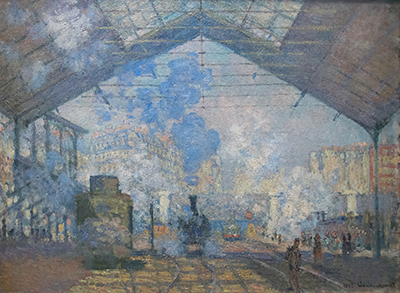
The Gare Saint-Lazare series transformed a railway station into one of Monet's most radical modern subjects. Steam, iron, glass and sunlight merge into a clouded atmosphere. The station becomes less a piece of engineering than a changing environment of vapour and light.
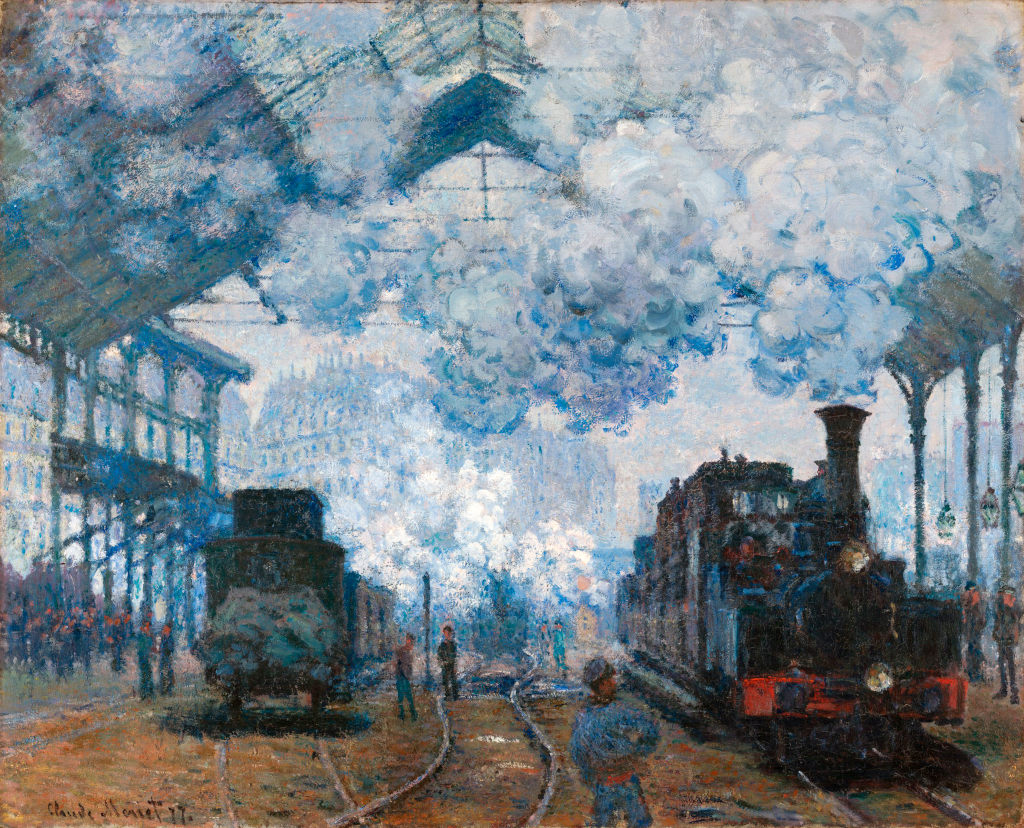
Pont de l'Europe
Date: 1877
Location depicted: Pont de l'Europe, Paris
Current location: Musée Marmottan Monet, Paris [8]
The Pont de l'Europe gave Monet a subject where modern engineering and atmospheric painting could meet. Its iron structure cuts across the view, while smoke and light soften the forms around it. This is Paris as an industrial, changing, modern city.
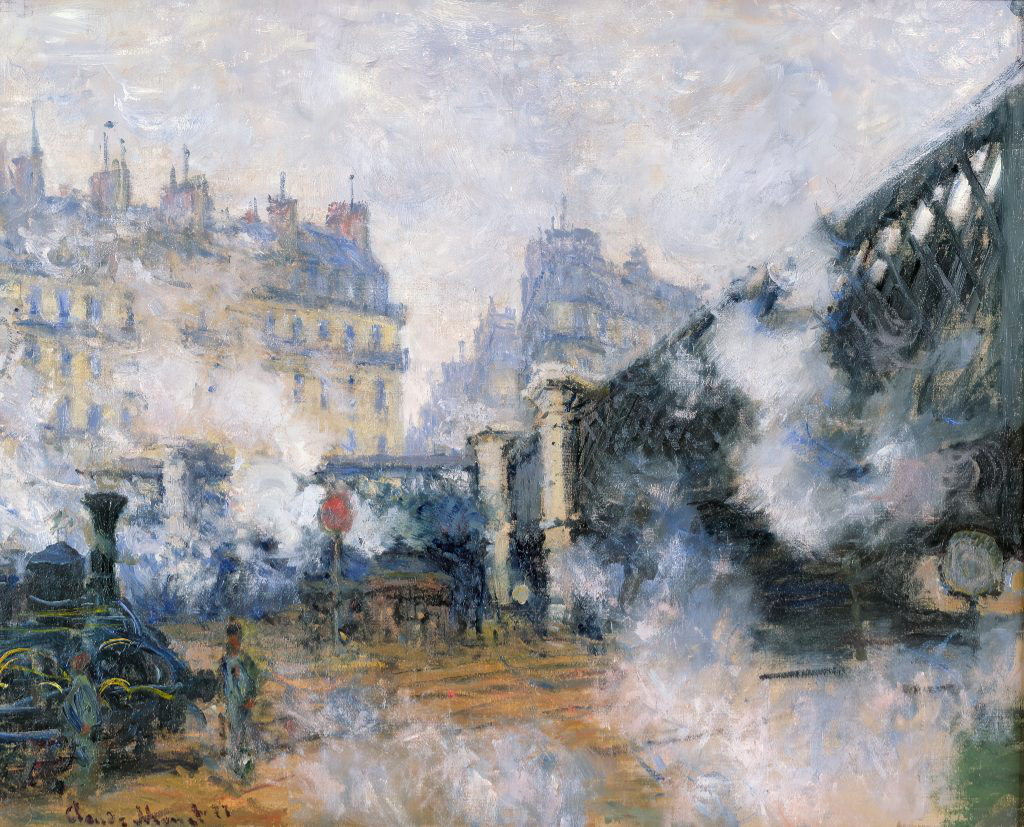
The Garden of the Princess
Date: 1867
Location depicted: Tuileries Gardens, Paris
Current location: Allen Memorial Art Museum [9]
This early Paris painting shows Monet already experimenting with high viewpoints, public gardens and the relationship between city and open air. The Tuileries setting allowed him to paint Paris not as a historic monument, but as a living space of leisure, movement and light.
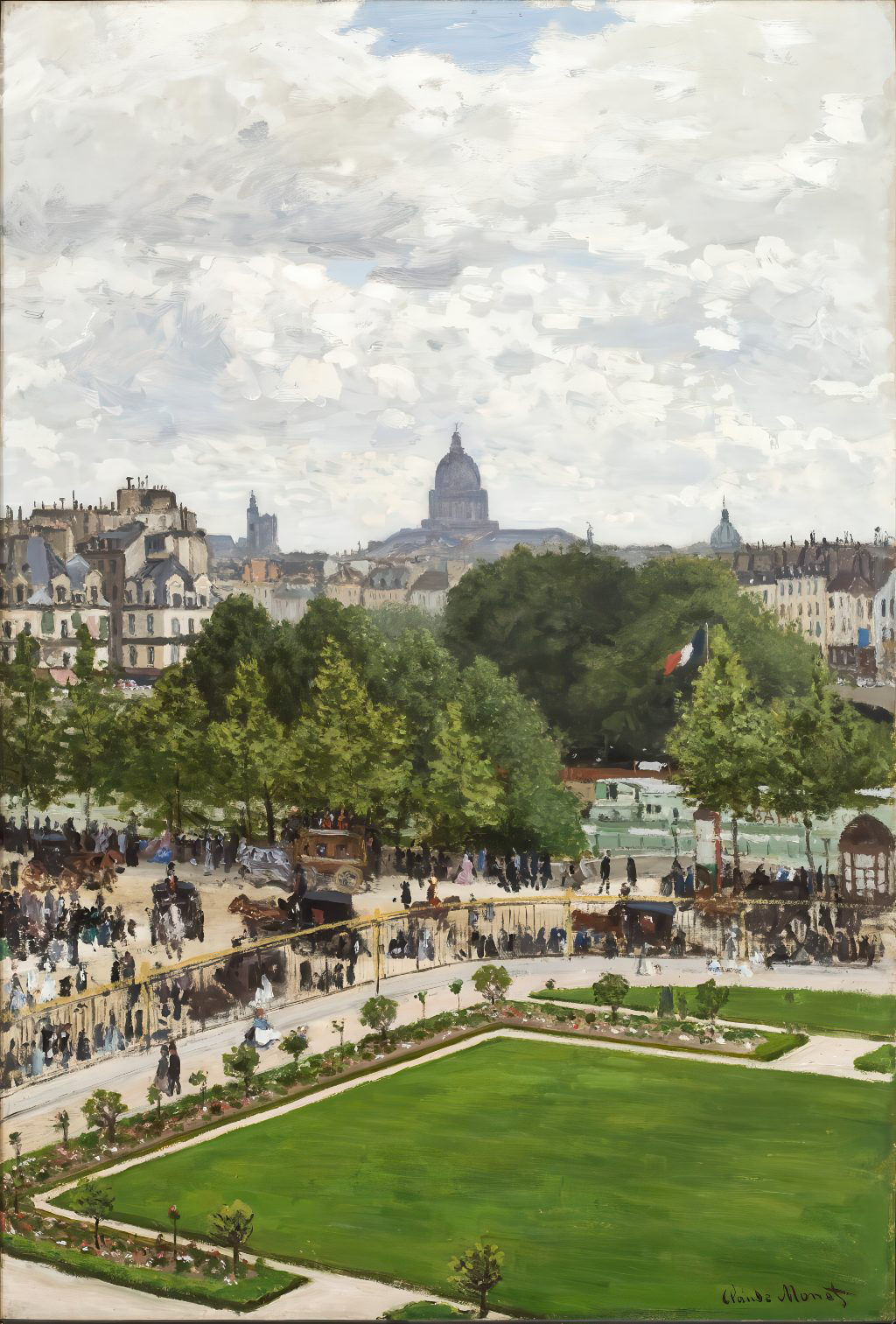
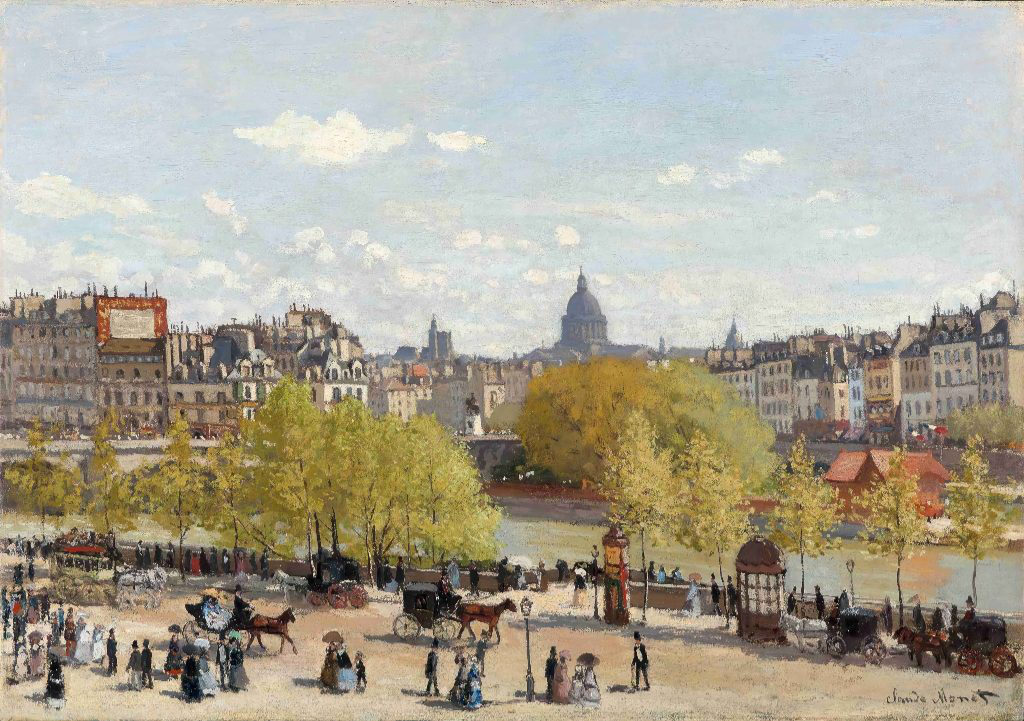
The Seine at the Louvre
Date: 1867
Location depicted: Louvre embankment and Seine
Current location: Kunstmuseum Den Haag [14]
Here Monet treats central Paris as a river city. Architecture, boats, water and sky are brought together through reflections and atmosphere. The painting anticipates his later fascination with rivers, bridges and modern light in Argenteuil, London and Venice.
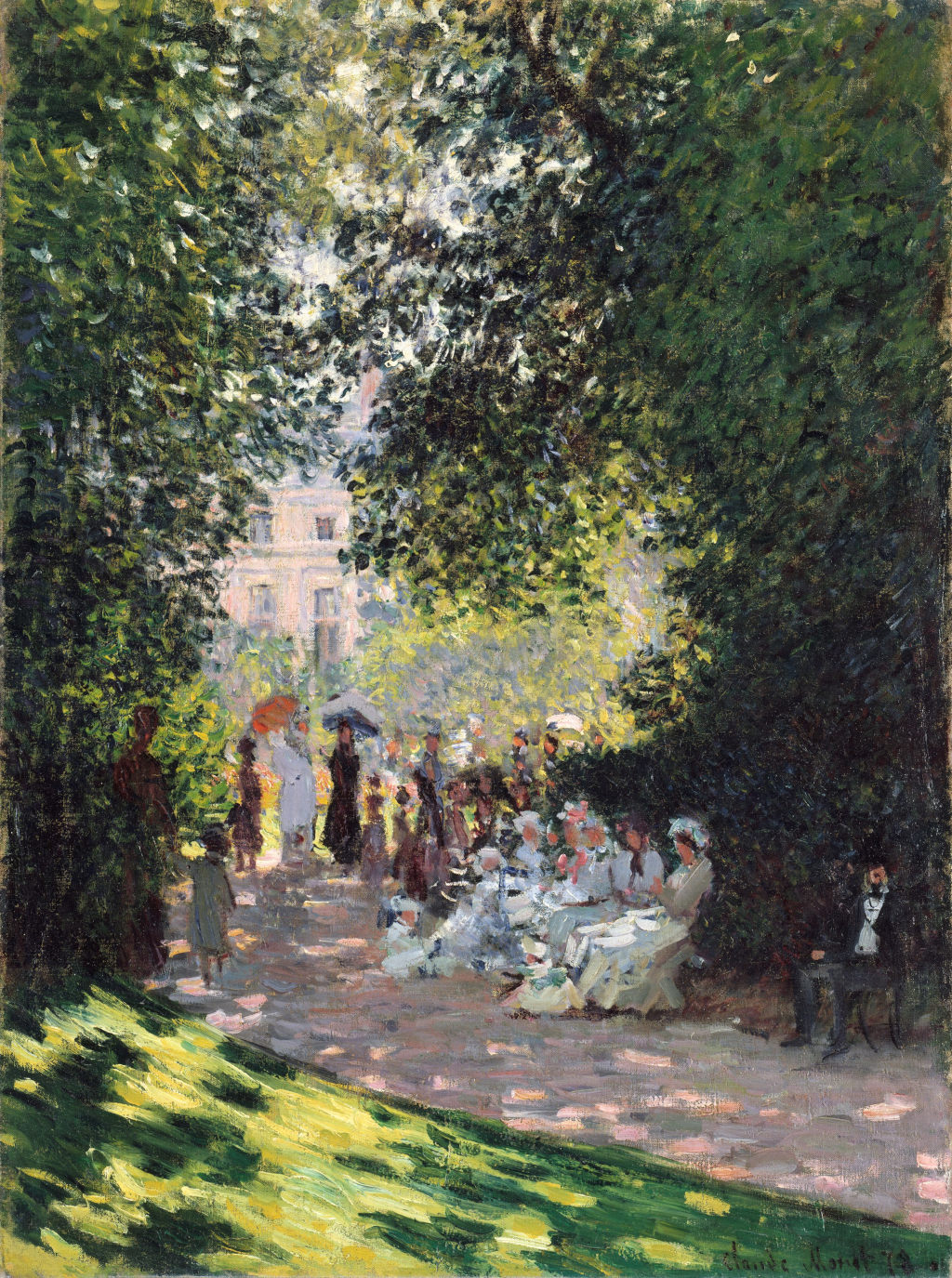
The Parc Monceau
Date: 1878
Location depicted: Parc Monceau, Paris
Current location: Metropolitan Museum of Art, New York
Monet's Parc Monceau captures one of the fashionable public parks created during Haussmann's transformation of Paris. Sunlight filters through trees while elegantly dressed figures move across the garden paths, revealing Monet's fascination with modern leisure and shifting urban light.
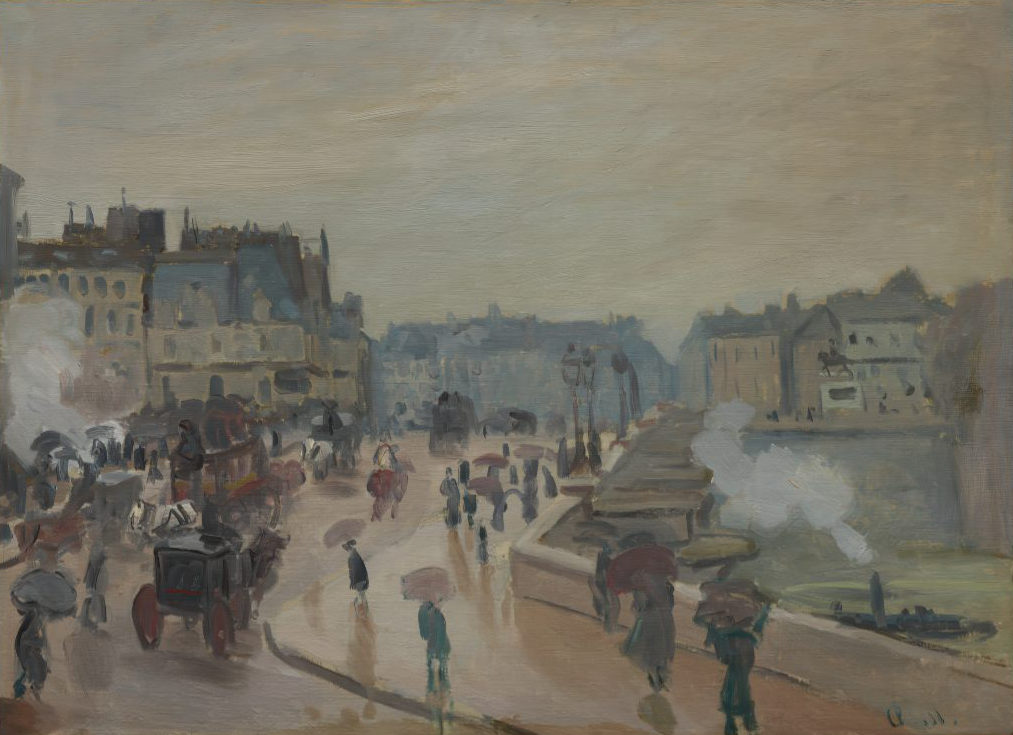
The Pont Neuf
Date: 1871
Location depicted: Pont Neuf, Paris
Current location: Dallas Museum of Art [11]
Monet's Pont Neuf connects his Paris work with his wider interest in bridges, rivers and modern viewpoints. The bridge is one of the oldest in Paris, but Monet treats it through the fresh language of Impressionism: light, movement, water and an immediate sense of place.
Featured Paintings from Claude Monet's Paris Series
Rue Saint Denis in Paris, Festival of June 30, 1878, Claude Monet
Rue Montorgueil in Paris, Festival of June 30, 1878, Claude Monet
Paintings of Paris by Related Artists
Monet was not alone in turning Paris into a subject for modern painting. Several artists associated with Impressionism and urban Realism explored the transformed capital during the second half of the 19th century, each bringing a distinct visual approach to the modern city.
Jean Béraud focused on fashionable Parisian society, cafés and boulevards, often painting with greater narrative clarity than Monet. Gustave Caillebotte emphasised perspective, geometry and urban structure, while Camille Pissarro became increasingly interested in elevated boulevard views filled with crowds, smoke and shifting light.
Together, these artists created a broader visual record of Haussmann's Paris and the emergence of modern urban life within French art.
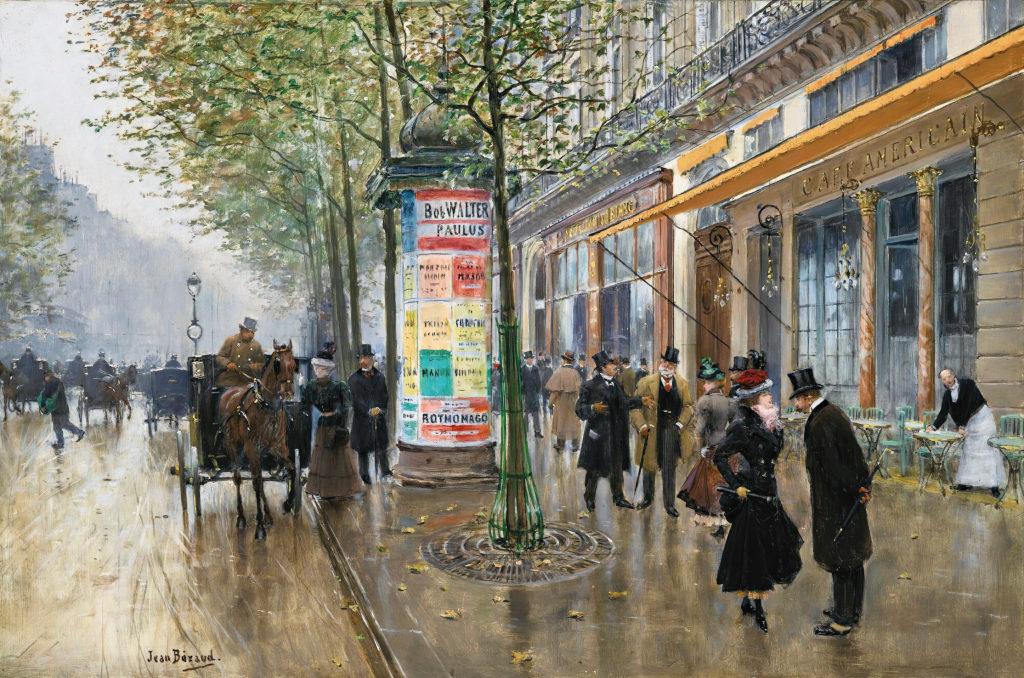
Les Grands Boulevards (Café Américain), Jean Béraud
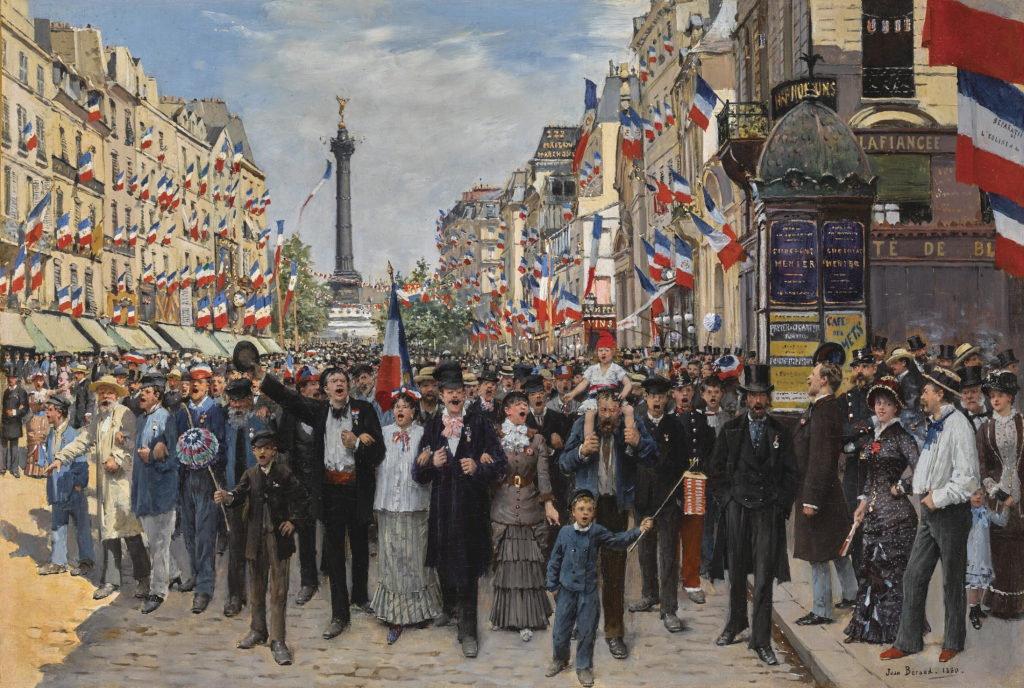
La Marseillaise, Jean Béraud, 1880
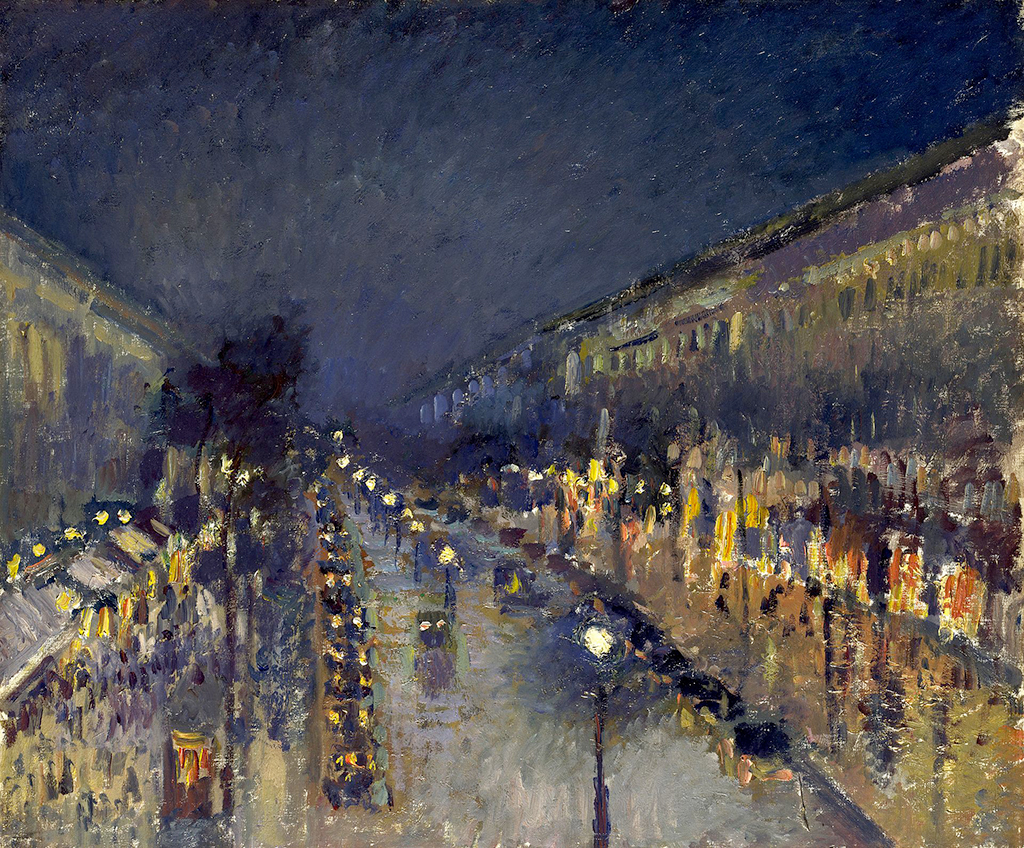
The Boulevard Montmartre at Night, Camille Pissarro, 1897
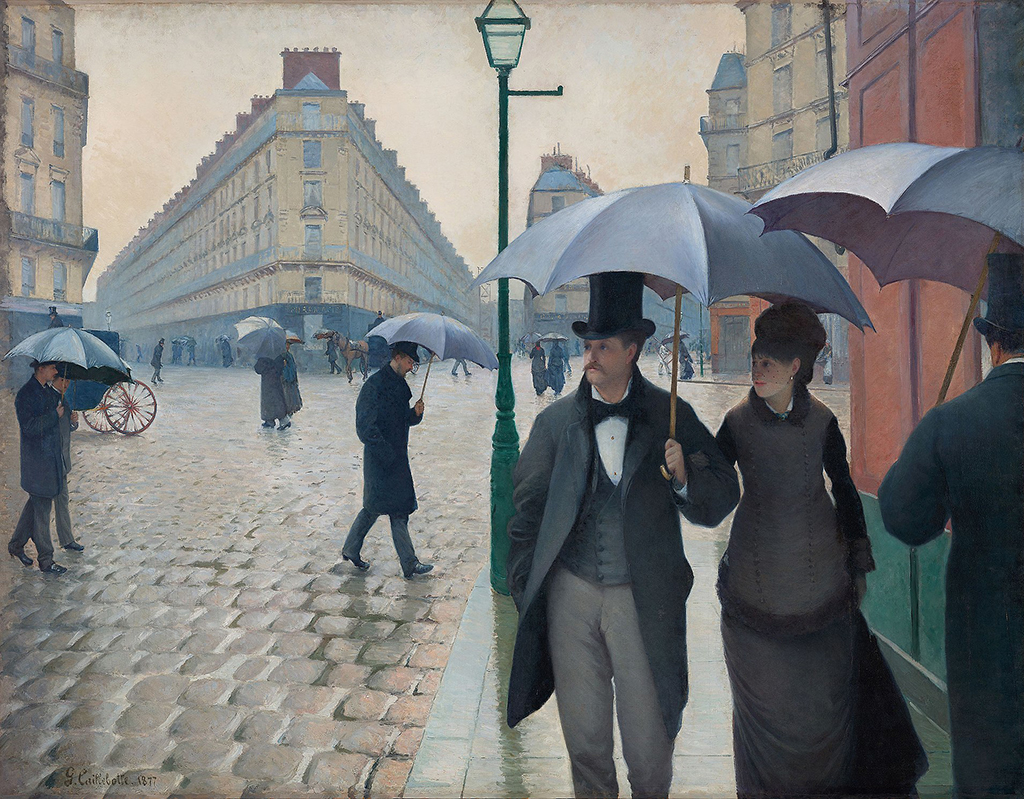
Paris Street, Rainy Day, Gustave Caillebotte, 1877
Monet's Paris Compared to Gustave Caillebotte
Although Monet and Gustave Caillebotte both painted modern Paris during the 1870s, their artistic approaches differed significantly. Caillebotte focused more heavily on structure, perspective and the geometry of Haussmann's rebuilt city, while Monet prioritised atmosphere, movement and optical sensation.
Caillebotte's famous painting Paris Street, Rainy Day presents Paris with remarkable spatial clarity and architectural precision. Figures appear carefully positioned within the composition, emphasising urban order and modern social life. [16]
Monet's boulevard paintings, by contrast, dissolve crowds and buildings into flickering brushwork. Rather than constructing stable space, Monet attempted to capture the sensation of movement, weather and changing light across the city. Camille Pissarro explored yet another interpretation of urban Paris. His later Boulevard Montmartre series combined Monet's atmospheric interests with a stronger structural framework, often viewed from elevated hotel windows overlooking busy streets.
Together, Monet, Caillebotte and Pissarro created some of the most important visual records of modern Paris during the late 19th century, each revealing different aspects of urban experience through Impressionism.
The Seine: Paris as a River City
The Seine river provided the perfect stage to Monet's work, and he would focus on it both in Paris and beyond.
Its variety offered the artist both nature and industry, as well as rural and city life. The river was not merely a scenic feature — it was an artery of commerce, transport, and leisure.
From its quays Monet observed barges, ferries, laundry boats, and pleasure craft. Smoke from factories drifted across the water, merging industrial activity with changing weather and atmosphere. Reflections fractured architecture into fluid color. Outside of Paris, such as in Argenteuil, Monet would even work from boats, getting as close to his environment as possible.
The Seine also enabled Monet to soften the boundary between urban and rural. Trees lining the embankments, sky mirrored in water, and distant suburbs blurred the distinction between metropolis and landscape. These river scenes anticipate his later serial studies of the Thames in London and the canals of Venice.
Gare Saint-Lazare and Industrial Modernity
No subject better embodies Monet's engagement with modernity than the Gare Saint-Lazare. Painted in 1877, the series transforms a railway station into a theatre of steam, light and movement. [7]
Rather than emphasizing mechanical detail, Monet focused on atmosphere. Locomotives appear as shadowed masses, partially obscured by vapor. Sunlight filtering through the station's iron and glass canopy fractures into luminous clouds of blue, violet, and white.
The paintings challenge traditional hierarchies of subject matter. Industry — often viewed as antithetical to beauty — becomes the source of visual poetry. Steam replaces mist; iron replaces Gothic stone.
Monet worked directly within the station, securing permission to paint on site. Trains arrived and departed as he worked, forcing rapid execution. This urgency contributed to the immediacy of the brushwork. [7]
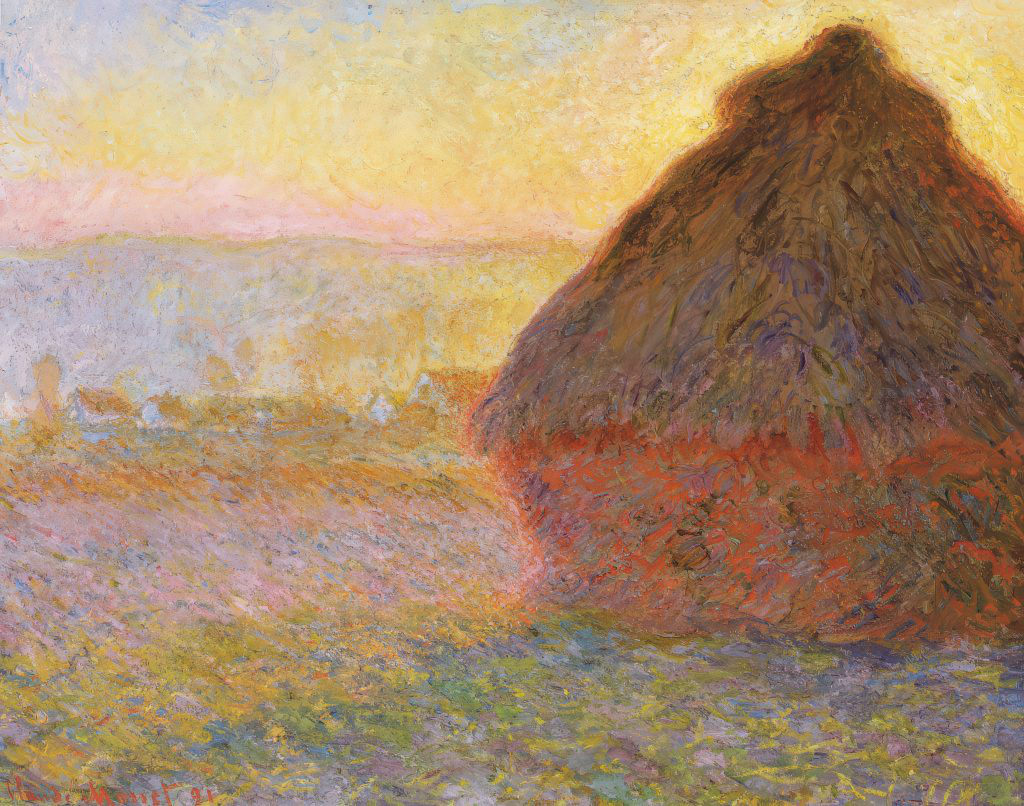
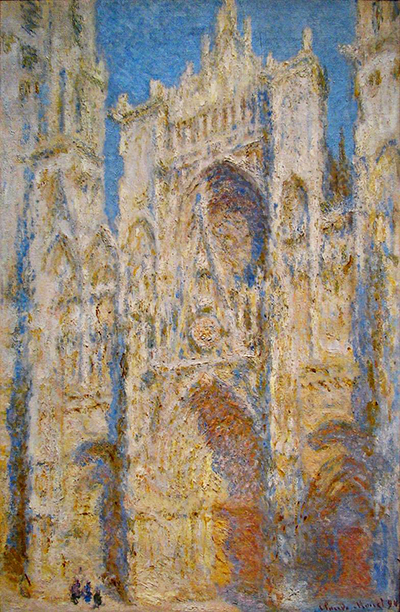
Importantly, the Gare Saint-Lazare paintings also represent one of Monet's earliest sustained serial investigations. By repeatedly returning to the same motif under varying atmospheric conditions, he began developing the artistic method that would later define the Haystacks, Rouen Cathedral and Water Lilies series.
On 17 January 1877, he announced that he was moving into 17 Rue de la Moncey, close to the station... This allowed the painter to receive clients who found it difficult to travel to Argenteuil. It also offered him a base for his major painting "campaign" on the platforms of the Gare Saint-Lazare and all around the station, on the Pont de l'Europe and in the cutting and tunnel of Batignolles.
Daniel Wildenstein, Monet: The Triumph of Impressionism, PP133, [2]
The railway, which had transformed France in Monet's lifetime, was the emblem of industrial materialism. Monet dematerialized that brute fact into phantasmagoria, weightlessness, indefinable smoky effects, whilst also depicting might and movement with an intensity of mark-making, a graphic briliance of streaked, scribbled strokes, open brushwork, and blue-grey arabesques rising from the massive engines.
Jackie Wullschläger, Monet: The Restless Vision, PP184, [3]
Monet and Haussmann's Paris
When Claude Monet arrived in Paris during the 1860s, the city itself was being rebuilt. Under the direction of Baron Georges-Eugène Haussmann, vast areas of medieval Paris were demolished and replaced with wide boulevards, open vistas, public parks, railway stations and uniform stone facades. The transformation was one of the largest urban redevelopment projects in European history. [12]
For Monet and the emerging Impressionists, this new Paris provided an entirely different visual experience from the narrow, shadowed streets of the old city. Sunlight flooded through widened avenues, reflections appeared across wet pavements and windows, and crowds moved continuously through newly modernised public spaces.
Haussmann's redesign also created elevated viewpoints that suited Monet's compositional interests. Balconies, upper-floor apartments and hotel windows allowed him to observe urban movement from above, transforming pedestrians and carriages into rhythmic patterns of colour and motion.
Bridges, Architecture and Urban Form
Paris's bridges offered Monet structural counterpoints to atmospheric flux. The Pont de l'Europe, spanning the railway yards near Saint-Lazare, exemplified modern engineering with its iron spans and industrial geometry. [8]
Monet used such structures to explore tension between solidity and dissolution. Girders slice the composition into angular segments, yet smoke and light soften their edges. The result is a visual dialogue between permanence and transience.
Haussmannian facades likewise fascinated him. Their repetitive balconies and regimented windows formed rhythmic grids that could be destabilized through color modulation. Stone surfaces shimmer under changing daylight, transforming mass into vibration.
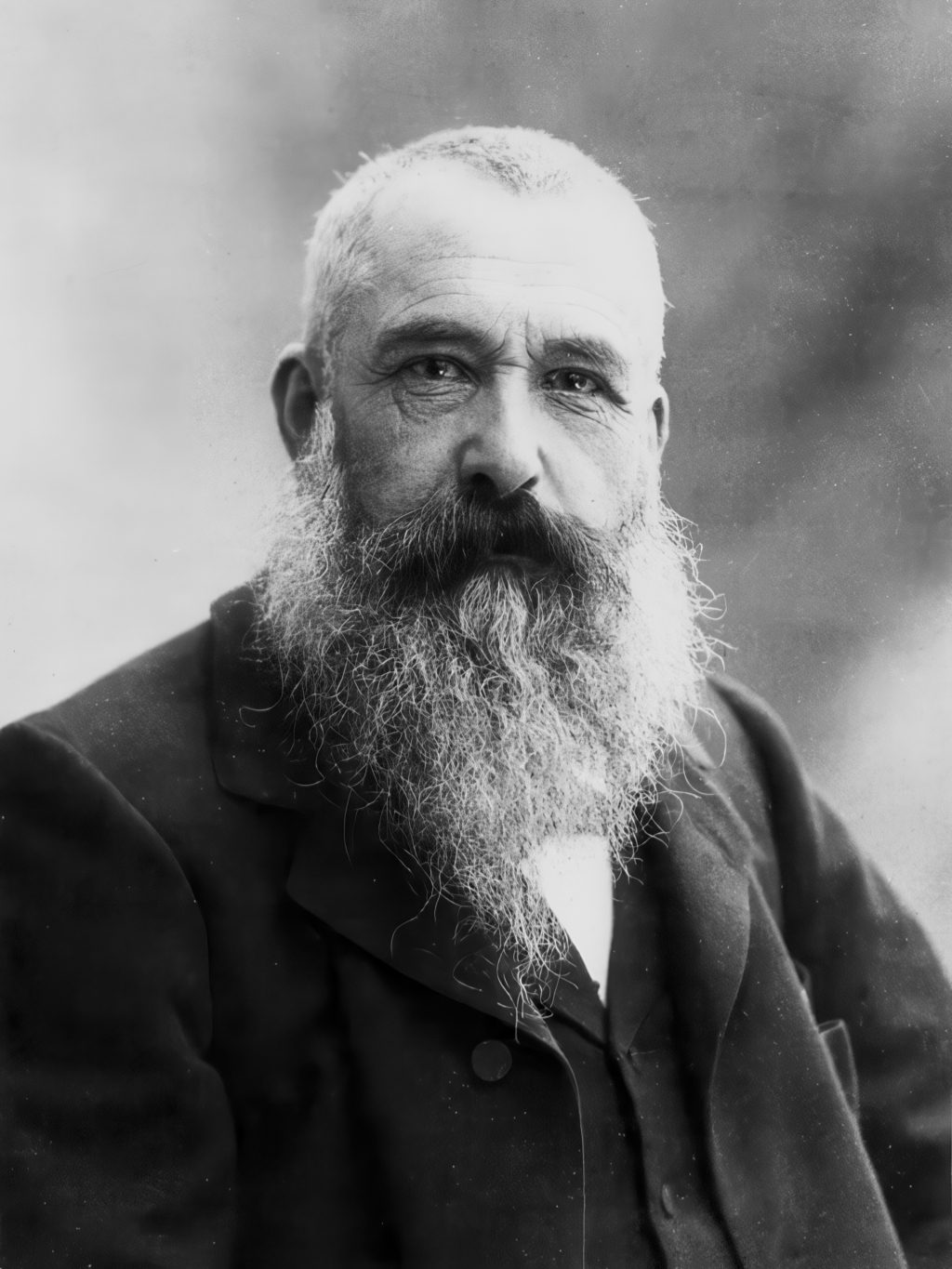
Every day I discover more and more beautiful things. It's enough to drive one mad.
Exhibitions and Critical Reception
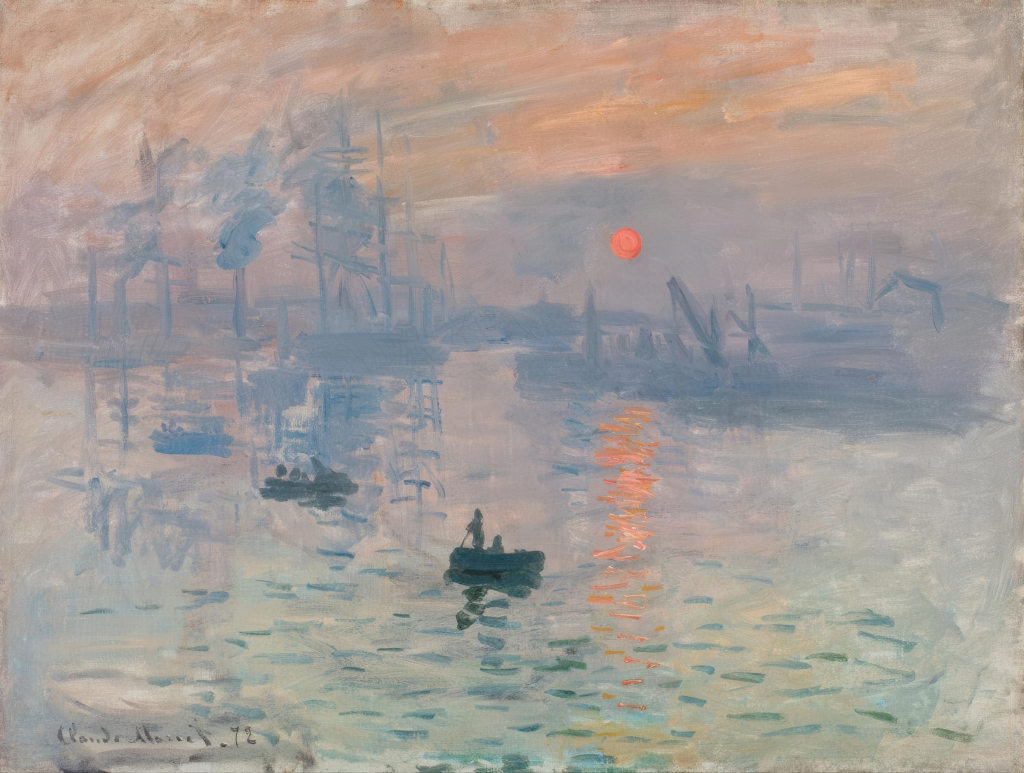
Paris was not only Monet's subject but also the arena in which his reputation was contested. The first Impressionist Exhibition of 1874, held in the former studio of photographer Nadar, introduced his work — including Impression, Sunrise — to a skeptical public. [15]
The dealer Paul Durand-Ruel proved instrumental in stabilizing Monet's career. By purchasing works in bulk and promoting them internationally — particularly in London and New York — he expanded the market for Impressionism. Gradually, Monet's Paris paintings shifted from controversial experiments to canonical images of modernity.
Legacy of Monet's Paris
Through flags, steam, reflections and crowds, Monet dissolved Paris into atmosphere. Streets become currents; stations become weather.
His vision bridges Realism and abstraction, observation and sensation. Later movements — from Post-Impressionism to Abstract Expressionism — would inherit this liberation of paint from strict representation.
In painting Paris, Monet did more than record a place. He redefined how modern life itself could be seen — fleeting, luminous, and perpetually in motion. He also laid the foundations for his later focus on series of paintings in which he observed the same motifs under different conditions.
Most significantly, of course, was the critical role of the city of Paris in building the foundations of the Impressionist movement, with Claude Monet spearheading this groundbreaking artistic movement.
How Paris Changed Monet's Technique
Paris fundamentally transformed Monet's painting technique. The city's changing weather, industrial haze and crowded streets demanded a faster, more responsive method of working than traditional studio painting allowed. He found a method which combined the merits of en-plein air and studio work, completing his works in phases.
The artist worked more frequently outdoors, painting rapidly to capture temporary effects before they disappeared. He would work on multiple canvases before later completing them in the comfort of his studio. This allowed him to achieve a spontaneous look, within a highly polished finished artwork.
In Paris, Monet used increasingly fragmented brushwork and coloured shadows. Instead of using black or brown to model form, he layered blues, violets, greens and warm highlights directly beside one another. Forms became less fixed and more dependent on surrounding light.
From Paris to London and Venice
Together, Paris, London and Venice form a remarkable artistic sequence: the transformation of Monet from observer of modern life into one of the most influential painters of atmosphere and perception in Western art. In Paris, the city's boulevards, bridges and railway stations introduced him to modern atmosphere and shifting light.
In London, Monet expanded these discoveries further. Fog and industrial smoke along the Thames dissolved architecture even more dramatically than in Paris, allowing him to focus increasingly on atmosphere rather than physical structure. By the time Monet reached Venice in 1908, his paintings had moved even closer toward abstraction. Palaces, canals and reflections merged into luminous fields of colour and vibration, continuing a progression that had begun decades earlier in Paris.
Complete List of Claude Monet's Paris Paintings
| Title | Wildenstein No. | Date | Location Depicted | Current Collection |
|---|---|---|---|---|
| Rue Montorgueil, Paris. Festival of June 30, 1878 | W434 | 1878 | Rue Montorgueil | Musée d'Orsay, Paris [4] |
| Rue Saint-Denis, Paris. Festival of June 30, 1878 | W433 | 1878 | Rue Saint-Denis | Musée des Beaux-Arts, Rouen [5] |
| Boulevard des Capucines | W292 | 1873-74 | Boulevard des Capucines | Nelson-Atkins Museum of Art [6] |
| Boulevard des Capucines (Variant) | W293 | 1873-74 | Boulevard des Capucines | Pushkin Museum, Moscow [13] |
| The Garden of the Princess | W157 | 1867 | Tuileries Gardens | Allen Memorial Art Museum [9] |
| View of Paris from the Tuileries | 1867 | Tuileries | Private Collection | |
| The Seine at the Louvre | W168 | 1867 | Louvre Embankment | Kunstmuseum Den Haag |
| Quai du Louvre | W169 | 1867 | Seine Riverbank | Art Institute of Chicago [10] |
| The Pont Neuf | W191 | 1871 | Pont Neuf | Dallas Museum of Art [11] |
| Pont de l'Europe | W439 | 1877 | Near Gare Saint-Lazare | Musée Marmottan Monet [8] |
| Pont de l'Europe (Study) | 1877 | Pont de l'Europe | Private Collection | |
| The Seine at Bercy | 1878 | Bercy Riverfront | Private Collection | |
| Boats on the Seine, Paris | 1867 | Seine River | Private Collection | |
| The Seine near the Pont d'Iéna | 1870 | Pont d'Iéna | Private Collection | |
| The Embankment at the Pont de l'Alma | 1867 | Pont de l'Alma | Private Collection | |
| The Tuileries Gardens in Winter | 1876 | Tuileries Gardens | Private Collection | |
| Paris Seen from a Balcony | 1867 | Central Paris | Private Collection | |
| The Seine and the Louvre (Evening) | 1867 | Louvre / Seine | Private Collection | |
| River View with Boats, Paris | 1867 | Seine | Private Collection | |
| The Pont Royal | 1867 | Pont Royal | Private Collection |
Catalogue compiled from: Wildenstein Institute Monet Catalogue Raisonné; Musée d'Orsay database; Musée Marmottan Monet archives; Art Institute of Chicago; Nelson-Atkins Museum; Pushkin State Museum collection records.
FAQs
References
Key Scholarly Books on Claude Monet
Readers seeking deeper insight into Monet's technique, exhibition history and critical reception may wish to consult the following authoritative studies, widely regarded as essential references within Impressionist scholarship.
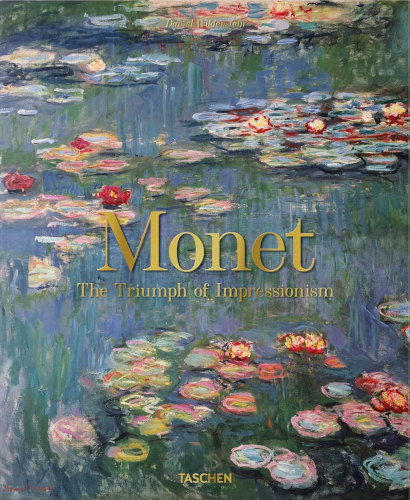 Monet. The Triumph of Impressionism, Daniel Wildenstein, Taschen, 2022
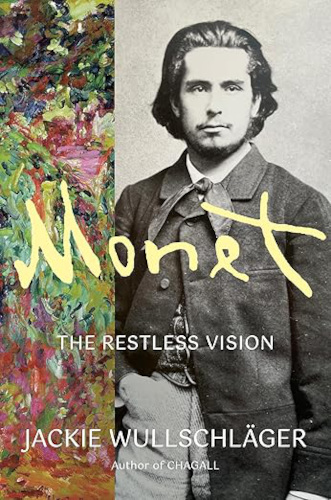 Monet: The Restless Vision, Jackie Wullschläger, Allen Lane, 2023
Additional Sources
- Daniel Wildenstein, Gilles Néret, Monet: Catalogue Raisonné, Cologne: Wildenstein Institute and Taschen, 1996.
- Daniel Wildenstein, Monet: The Triumph of Impressionism, Cologne: Taschen, 2015.
- Jackie Wullschläger, Monet: The Restless Vision, Milton Keynes: Allen Lane, 2023.
- Musée d'Orsay, “La rue Montorgueil, à Paris. Fête du 30 juin 1878,” Musée d'Orsay, View source.
- Musée des Beaux-Arts de Rouen, “Rue Saint-Denis, Celebration of 30th June 1878,” Musée des Beaux-Arts de Rouen, View source.
- The Nelson-Atkins Museum of Art, “Claude Monet, Boulevard des Capucines, 1873-74,” French Paintings and Pastels, 1600-1945, View source.
- The National Gallery, London, “Claude Monet, The Gare St-Lazare,” The National Gallery, View source.
- Musée Marmottan Monet, “Le Pont de l'Europe, Gare Saint-Lazare,” Musée Marmottan Monet, View source.
- Allen Memorial Art Museum, “Garden of the Princess, Louvre,” Allen Memorial Art Museum, Oberlin College, View source.
- Wikimedia Commons, “Quai du Louvre, 1867, by Claude Monet,” Wikimedia Commons, View source.
- Dallas Museum of Art, “The Pont Neuf, Claude Monet,” Dallas Museum of Art Collection, View source.
- Library of Congress, “Exploring Haussmannian Paris,” Library of Congress Blogs: Maps, View source.
- Joel Isaacson, “Monet: Le Boulevard des Capucines en Carnival,” Nineteenth-Century Art Worldwide, View source.
- Art in Words, “Den Haag | Kunstmuseum: Impressionismus in Paris,” Art in Words, View source.
- National Gallery of Art, “Paris 1874: The Impressionist Moment,” National Gallery of Art, View source.
- The Art Institute of Chicago, “Paris Street; Rainy Day,” The Art Institute of Chicago, View source.
- The Guardian, “Light fantastique: Paris through the eyes of the impressionists,” The Guardian, View source.
- Goodreads, “Claude Monet Quotes,” Goodreads, View source.