


 by
Tom Gurney
Tom Gurney BSc (Hons) is an art history expert with over 20 years experience
Published on October 6, 2016 / Updated on October 23, 2026
Email:
tomgurney1@gmail.com
/ Phone:
+44 7429 011000
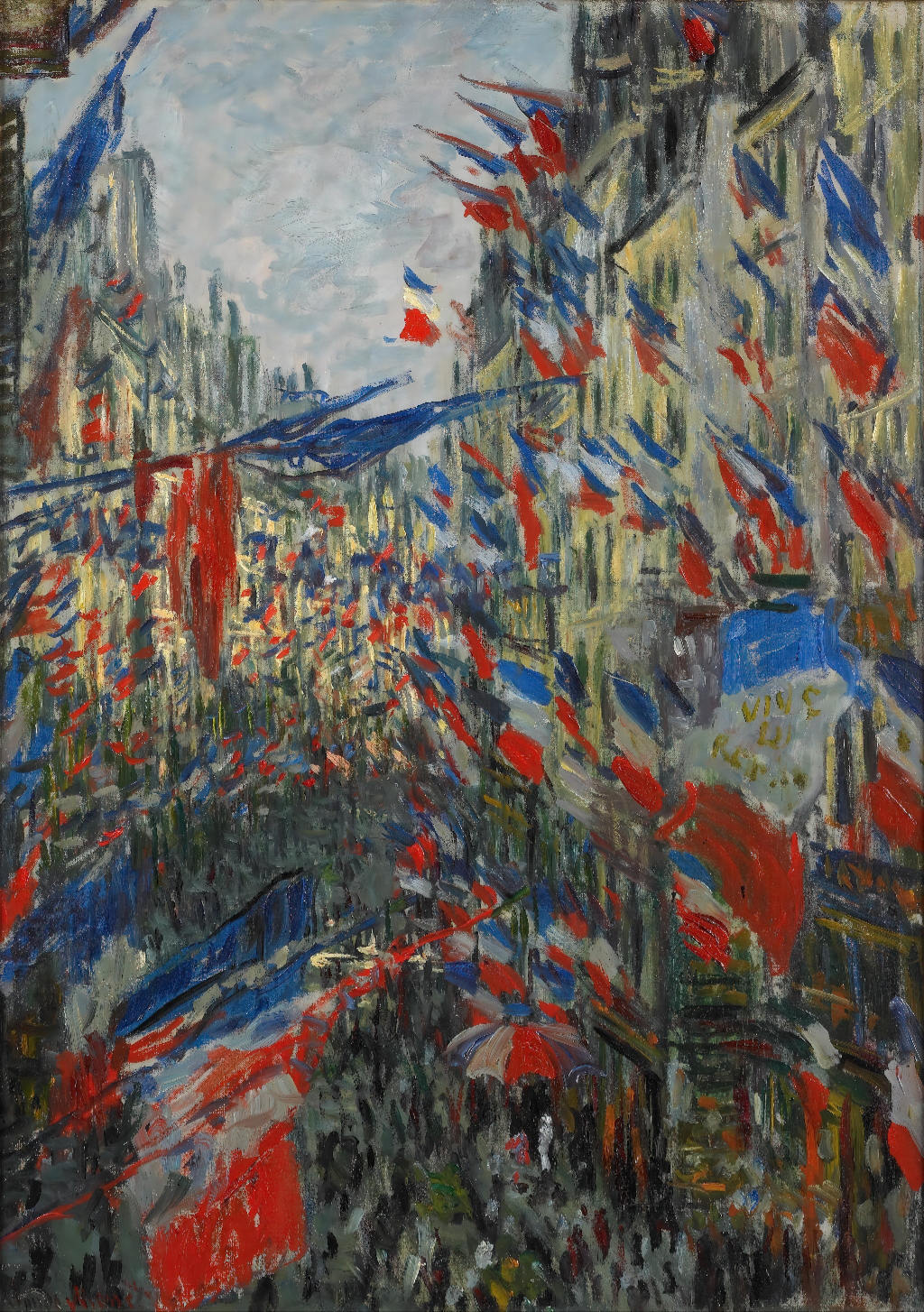
Rue Saint-Denis, Festival of 30 June 1878
Monet's Rue Saint-Denis turns a crowded Paris street into a restless field of flags and colour. Painted in 1878, it belongs to the Musee des Beaux-Arts in Rouen, inventory 909.1.34. The scene records the festival of 30 June, not the later annual celebration of 14 July. [1] [3]
At a Glance
Looking down into the celebration
The elevated viewpoint lets the eye follow the street into the distance. Buildings on either side narrow towards the centre, while a widening wedge of sky opens above them.
The crowd fills the lower passage. Individual people appear mainly as dark strokes and small changes of colour rather than recognisable portraits. Their concentration makes the street feel occupied from edge to edge.
Closer flags interrupt this recession. Some stretch across the view, others project from the facades, and a large tricolour at the right pushes towards the viewer.
The catalogue identifies a view north along rue Saint-Denis from a balcony near the junction with rue de Turbigo. [4]
This gives the apparent tumult a definite urban framework. The painting is not an undirected scattering of marks: the street's converging lines hold the flags and figures together.
The Paris overview follows Monet's different approaches to the capital. Here, a familiar street is temporarily transformed by a public event.
Why the festival took place on 30 June
The celebration belonged to the festivities surrounding the Paris Universal Exhibition of 1878. It was dedicated to peace and work and offered a public demonstration of national recovery after the defeat of 1870 and the upheavals that followed. [3]
The exhibition had opened on 1 May. The June festival was therefore not its closing ceremony. Historian Chantal Georgel places the event within the effort to strengthen a Republic whose political position was still contested after the crisis of 1877. [5]
This context explains the abundance of flags without making every participant's beliefs identical. Public decoration could express official purpose, popular enthusiasm and the immediate pleasure of a holiday at the same time.
It is also important not to substitute a more familiar anniversary. The annual national holiday of 14 July was established in 1880, two years after this painting. [3]
Monet's title preserves the specific date. The tricolours may now evoke a general image of French celebration, but the work began with a particular occasion.
Flags that seem to occupy the air
Red, white and blue recur at many scales. Large foreground passages establish the colours strongly, while smaller flags break into short flickers farther along the street.
Their angles vary. One edge bends down, another points across the scene, and several blue sections form long diagonals. These differences suggest fabric moving rather than rigid banners pinned flat.
The architectural walls provide a contrasting rhythm. Windows and vertical divisions remain comparatively steady behind the flags, even when Monet abbreviates their details.
Warm light on the right-hand buildings intensifies the reds and separates the flags from the darker recesses. The left side becomes more compressed as it recedes.
Near the bottom, the large red area does not read as a complete, neatly outlined object. Its scale and cropped edge make us feel close to the decorations.
Monet repeatedly balances recognition with fragmentation. A few broad colour relationships identify a flag, while broken edges keep the whole surface from becoming static.
Words within the spectacle
Rouen's museum guide identifies two inscriptions. The white part of a flag at the right carries Vive la Rep[ublique] in golden lettering. A banner towards the left reads Vive la France in blue. [2]
These words are easy to miss when the painting is first encountered as colour and movement. Once noticed, they give the decorations a more explicit civic meaning.
The letters also belong to the painted surface. They are interrupted by folds, changes of light and the surrounding brushwork, so reading them requires attention rather than a glance at a perfectly printed slogan.
The inscriptions strengthen a republican interpretation of the celebration. They do not, by themselves, provide a complete account of Monet's private political commitments or those of everyone in the crowd.
The painting's interest lies partly in that difference between a public sign and an individual observer. Monet can show the enthusiasm of a decorated street without turning each figure into a political portrait.
A crowd made from small marks
At street level, the dark strokes compress together in the distance. Closer to the foreground they become longer and more separated, allowing some sense of bodies and movement to emerge.
A red-and-white parasol offers a small, conspicuous shape among them. It gives the eye a temporary stopping point before the surrounding marks draw attention back into the larger gathering.
No exact headcount can be obtained from this treatment. The impression of multitude comes from density, repetition and the way the figures occupy the narrowing space.
The observer remains above the crowd rather than moving at its level. This separation makes it possible to see both the architecture and the public gathering as one arrangement.
GrandPalaisRmn's analysis of the companion Rue Montorgueil places such high viewpoints within Monet's interest in observing the city from a distance. [8]
The Gare Saint-Lazare article offers another encounter with modern Paris, where moving people, buildings and changing atmosphere create a different kind of urban spectacle.
Not the same painting as Rue Montorgueil
Monet painted a second flag-filled street view during the same celebration. Rue Montorgueil belongs to the Musee d'Orsay, inventory RF 1982 71, and has different proportions: 81 x 50 cm. [3]
The shared date and subject explain why reproductions are sometimes confused. They do not make the two works identical. The street alignment, arrangement of flags and balance between buildings and sky need to be examined separately.
The Rue Montorgueil article concerns that companion. In the Rouen canvas, the conspicuous inscribed flag at the right and the foreground decorations give the view a particularly crowded, projecting character.
Georgel records that both paintings appeared at the fourth Impressionist exhibition in 1879. [5]
Seen together, they show how one event could produce distinct pictorial solutions. A street festival supplies the shared occasion; framing and colour distribution determine the individual experience of each canvas.
Another artist's view of the holiday
Manet also painted flags on 30 June 1878. In The Rue Mosnier with Flags, now at the Getty, a much quieter street is seen from his second-floor window. Its foreground includes a man on crutches, commonly understood in relation to the recent war. [6]
The comparison does not require one painter to represent celebration truthfully and the other falsely. Each chooses a different view, different figures and a different distribution of attention.
Monet's crowd is collective and difficult to separate into individual stories. Manet's comparatively open roadway makes the solitary figure more noticeable. The same national colours can therefore belong to markedly different accounts of the day.
The Monet and Manet article follows their relationship without treating their work as interchangeable. Their festival pictures are useful precisely because a common occasion does not erase individual decisions.
What appears to be a straightforward record of a holiday is also a selection of what will be visible, distant, crowded or left open.
Chabrier, Depeaux and the Rouen collection
The composer Emmanuel Chabrier acquired the painting in August 1878. It subsequently entered Francois Depeaux's collection and became part of his 1909 donation to Rouen. [1] [2] [4]
The museum's account of Depeaux presents a collector closely connected with Impressionist artists and the art market, whose gifts helped bring these works into public collections. [7]
That history adds another scale of time to a picture associated with one day. The festival was temporary; the canvas passed through years of private ownership before becoming a museum work.
Its vitality does not depend on our recognising every inscription or knowing every collector. Those details deepen an effect that remains immediate: the compressed street, the bright flags and the repeated touches that make a public celebration feel both structured and in motion.
Frequently Asked Questions
No. The subject is the festival of 30 June 1878. [3]
The Musee des Beaux-Arts in Rouen, inventory 909.1.34. [1]
No. Rue Montorgueil is a separate canvas in the Musee d'Orsay. [3]
Through Francois Depeaux's donation in 1909. [2]
Discussion
Look again at the images and ideas explored in Rue Saint-Denis, Festival of 30 June 1878. These editorial prompts invite your observations.
Reader Insights
Follow the street's perspective beneath the crossing flags.
Look for the two inscriptions identified by the museum.
Compare the crowded Rouen view with other artists' responses to the same holiday.
Join the Conversation
Share a detail, comparison or question about Rue Saint-Denis, Festival of 30 June 1878 below.
References
- Musee des Beaux-Arts, Rouen , Rue Saint-Denis, fete du 30 juin 1878, 909.1.34; exact work and early collection history. View source .
- Reunion des Musees Metropolitains Rouen Normandie , Parcours chefs-d'oeuvre, Rue Saint-Denis section; the celebration, inscriptions and 1909 donation. View source .
- Musee d'Orsay , La Rue Montorgueil, a Paris. Fete du 30 juin 1878, RF 1982 71; distinct companion, festival context and the later 14 July holiday. View source .
- Daniel Wildenstein / Wildenstein Plattner Institute , Monet catalogue raisonne, volume II, printed pages 188-189, entry 470; dimensions, viewpoint and provenance. View source .
- Chantal Georgel / Histoire par l'image , 30 juin 1878, une fete vraiment nationale, 2016; historical context and the two canvases' 1879 exhibition. View source .
- J. Paul Getty Museum , Edouard Manet, The Rue Mosnier with Flags, 1878, 89.PA.71; a separate response to the same festival. View source .
- Musee des Beaux-Arts, Rouen , Francois Depeaux, l'homme aux 600 tableaux, 2020; the collector's relationships and public gifts. View source .
- GrandPalaisRmn / Panorama de l'art , La Rue Montorgueil, a Paris. Fete du 30 juin 1878, 2014; the high viewpoint and companion street scene. View source .







