 by Tom Gurney
Tom Gurney BSc (Hons) is an art history expert with over 20 years experience
Published on May 21, 2026 / Updated on May 27, 2026
Email: tomgurney1@gmail.com / Phone: +44 7429 011000
Claude Monet and the Influence of J.M.W. Turner
Although Claude Monet and J.M.W. Turner belonged to different generations and never met, Turner became one of the most important artistic predecessors to Monet's Impressionism. Both artists were fascinated by atmosphere, changing light, reflections, weather and the visual instability of the modern world.
Monet first encountered Turner's paintings during visits to London, particularly during the Franco-Prussian War of 1870-1871 and later during his famous London painting campaigns around 1900. Turner had already transformed British landscape painting through his increasingly atmospheric treatment of fog, rain, sunlight and industrial modernity.
The similarities between the two artists are especially striking in their depictions of rivers, bridges, steam, mist and urban atmosphere. Turner's late paintings dissolved solid form into shimmering colour and light, anticipating many qualities later associated with Impressionism. Art historians have frequently linked Monet's London paintings to Turner's earlier studies of fog and atmospheric effects over the Thames.
Both artists also explored the visual impact of industrialisation. Turner painted steamships, railways and polluted skies during the Industrial Revolution, while Monet became fascinated by the fog-filled atmosphere of London, describing the city as beautiful precisely because of its mist and smoke.
Despite these connections, important differences remained. Turner's art was often rooted in Romanticism and the sublime power of nature, while Monet approached atmosphere through serial observation and direct visual perception. Yet the relationship between the two artists remains one of the clearest links between Romantic landscape painting and Impressionism.
Today, Turner is widely regarded as one of Monet's most significant artistic predecessors, helping lay the foundations for modern painting through his radical treatment of light, colour and atmosphere.
- Artists Claude Monet · J.M.W. Turner
- Main Connection Atmosphere, Fog & Light Effects
- Movements Romanticism & Impressionism
- Key Themes Fog · Rivers · Steam · Weather · Reflections
- Important Shared Subject London & the River Thames
- Shared Artistic Interest Atmospheric Observation & Modernity
- Major Difference Turner Emphasised the Sublime While Monet Pursued Serial Observation
- Important Turner Work Rain, Steam and Speed
- Important Monet Series Houses of Parliament · Waterloo Bridge · Charing Cross Bridge
- Legacy Turner Helped Lay the Foundations for Impressionism and Modern Art
Table of Contents
Turner and Monet Compared
The clearest way to understand Turner's importance for Monet is through direct visual comparison. Turner had already made fog, steam, sunlight, water and industrial atmosphere central subjects of painting before Monet developed his own Impressionist language. Monet did not simply copy Turner, but he inherited a world in which light and atmosphere could dissolve solid form and become the true subject of modern landscape.
These five comparisons show how Turner anticipated many of Monet's greatest subjects: steam, fog, sunrise, rivers, reflections, Venice and the dissolution of form into light.
Turner and MONET Compared
Turner and Monet both transformed landscape painting by making light, atmosphere and visual instability more important than solid description. Turner approached these effects through Romantic drama and the sublime; Monet developed them through repeated observation and Impressionist colour.
Turner: Rain, Steam and Speed
Turner's Rain, Steam and Speed makes industrial modernity atmospheric. Train, bridge, rain and vapour merge into a rushing field of energy, showing how modern technology could be painted through light and weather rather than hard outline.[4]

Monet: Waterloo Bridge
Monet's London bridge paintings similarly turn modern architecture into atmosphere. Waterloo Bridge becomes less a structure than a veil of fog, smoke, water and coloured light, especially during his London campaigns around 1899-1901.

Turner: The Fighting Temeraire
The Fighting Temeraire shows the old warship being towed along the Thames to be broken up. The National Gallery describes the ship's final journey from Sheerness toward Rotherhithe, with sunset and steam power transforming the scene into an image of history, atmosphere and modern change.[5]

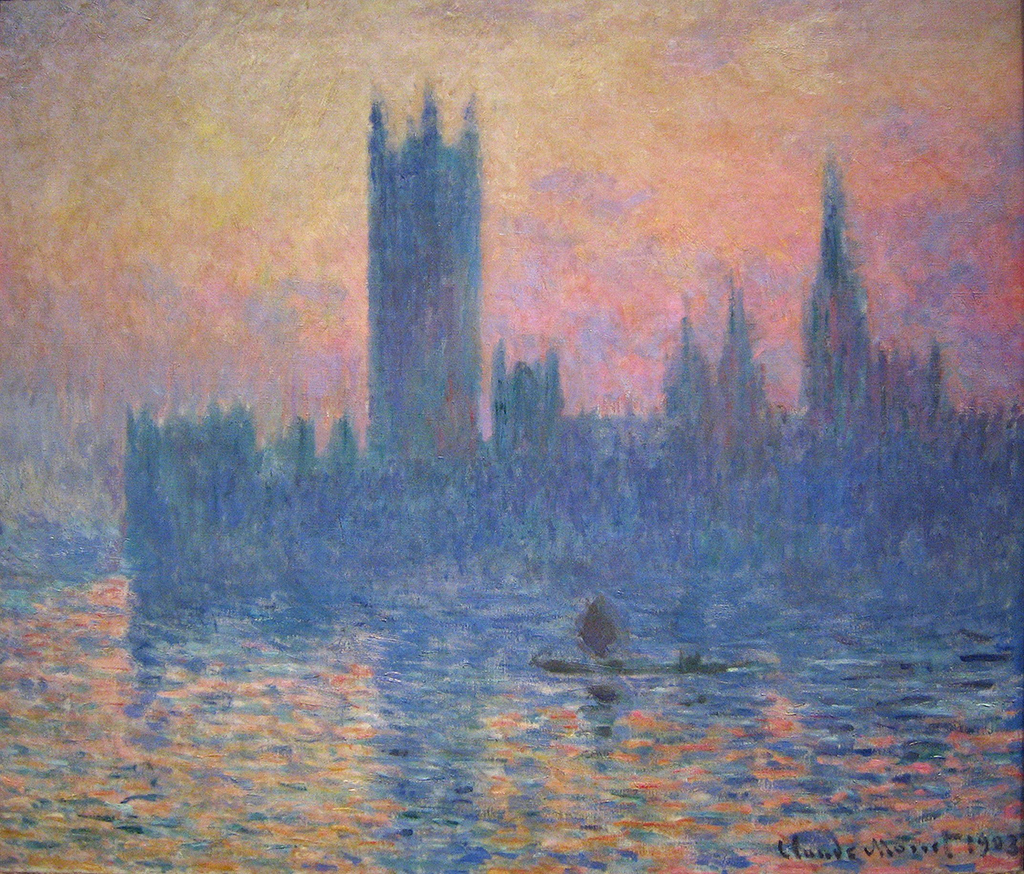
Monet: Houses of Parliament
Monet's Houses of Parliament series also turns the Thames into a stage for atmosphere. The Musée d'Orsay notes that Monet's London production was dominated by changing light and the famous London fog, especially in autumn and winter.[6]

Turner: Norham Castle, Sunrise
In Norham Castle, Sunrise, Turner pushes landscape toward pure light. The castle is barely held in place by atmosphere, while sunrise dissolves architecture into colour and haze. Tate identifies the work as part of the Turner Bequest and one of Turner's most celebrated late atmospheric paintings.[7]

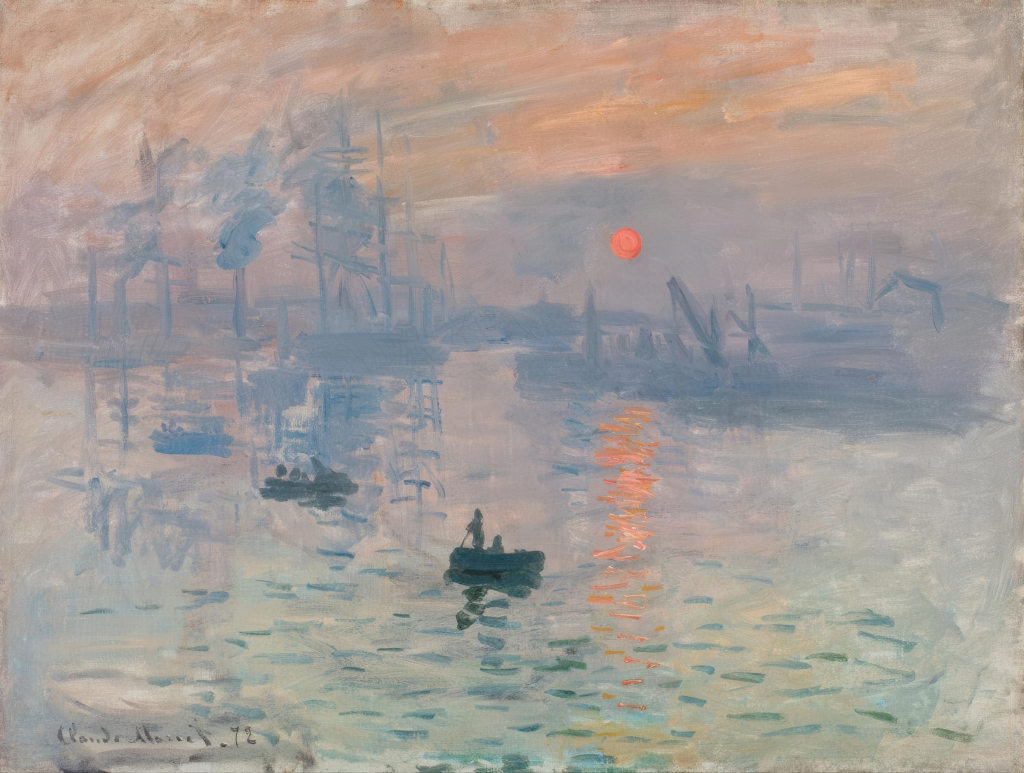
Monet: Impression, Sunrise
Monet's Impression, Sunrise similarly reduces harbour, boats and industrial forms to atmosphere. The Musée Marmottan Monet notes that the painting was made from Monet's hotel window at Le Havre and became the work that gave Impressionism its name.[8]
Turner: Venice and Water
Turner's Venetian subjects explore water, haze, architecture and reflection as unstable visual experiences. Venice allowed him to treat buildings as forms dissolving into colour, mist and light.

Monet: Venice
Monet's Venice paintings continue this atmospheric tradition. Water, reflection and architecture become inseparable, with buildings appearing through haze and colour rather than hard descriptive outline.

Turner: Sea, Storm and Instability
Turner's marine paintings often make weather itself overwhelming. Sea, sky and storm blur together, creating a Romantic sense of instability, danger and sublime natural force.

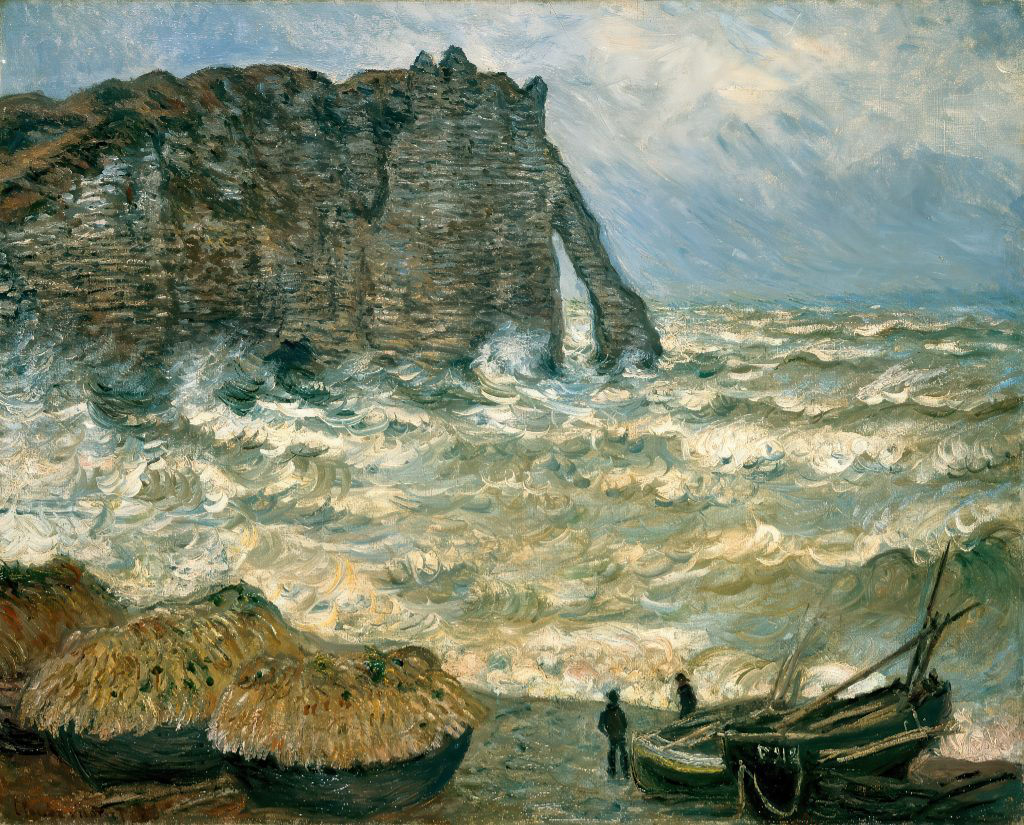
Monet: Sea and Weather
Monet's Normandy coast paintings also make sea and weather active subjects. Unlike Turner's sublime drama, Monet tends to study the visual effects of light, spray, cliff, water and changing atmosphere through direct observation.
From Romanticism to Impressionism
Turner and Monet belong to different artistic worlds. Turner was a Romantic painter whose art often explores the sublime: overwhelming nature, historical change, storm, fire, sea, steam and cosmic light. Monet was an Impressionist whose mature art depended on repeated observation, outdoor painting, serial structure and the changing appearance of ordinary motifs.
Yet the line from Turner to Monet is one of the most important continuities in nineteenth-century landscape painting. Turner helped loosen the traditional solidity of landscape. Monet then pushed this looseness further, making atmosphere not just dramatic or symbolic, but something that could be studied again and again under changing conditions.
| Turner | Monet |
|---|---|
| Movement: Romanticism | Movement: Impressionism |
| Atmosphere: dramatic, sublime, often visionary | Atmosphere: observed, repeated and compared through series |
| Light: emotional, symbolic and cosmic | Light: optical, temporal and situational |
| Modernity: steamships, railways, industrial change | Modernity: bridges, stations, smoke, fog and urban leisure |
| Water: sublime force, danger, reflection and instability | Water: surface, reflection, colour and perception |
| Form: dissolved by drama and atmosphere | Form: dissolved by light, repetition and direct perception |
Turner's Romantic Atmosphere
Turner made landscape painting more unstable, more luminous and more modern. In works such as Rain, Steam and Speed, the subject is not simply a train or a bridge, but the experience of modernity passing through weather, speed and industrial vapour.[4] In The Fighting Temeraire, the Thames becomes a symbolic theatre of historical transition, as sail gives way to steam.[5]
This Romantic intensity is different from Monet's Impressionism, but it prepared the ground for it. Turner demonstrated that fog, steam, glare and reflection could carry the emotional weight of a painting. He also showed that solid objects could be partially sacrificed in order to make light and atmosphere more powerful.
Monet's Impressionist Transformation
Monet took this atmospheric inheritance and made it observational. Instead of using fog or sunset primarily for drama, he studied them as changing visual facts. His London series is the clearest example. The Musée d'Orsay notes that Monet's views of Parliament, Waterloo Bridge and Charing Cross Bridge were dominated by variations in light and atmosphere caused by London fog.[6]
This is where Monet differs most from Turner. Turner often turns atmosphere into drama; Monet turns it into sequence. A bridge, cathedral, haystack or lily pond becomes a stable motif through which changing light can be examined repeatedly.
Why Turner Matters for Monet
-
1. Turner made atmosphere a serious subject
Fog, steam, rain, sunlight and haze could dominate the painting rather than merely surround the subject. -
2. Turner dissolved solid form before Impressionism
Late works such as Norham Castle, Sunrise show architecture and landscape merging into light.[7] -
3. Turner painted modernity through weather
Trains, steamships and the industrial Thames appear as atmospheric phenomena, not just mechanical subjects. -
4. Monet transformed Turner's drama into serial observation
The London series shows Monet applying repeated Impressionist study to fog, bridges and urban atmosphere. -
5. Both artists helped modern painting move toward abstraction
By making light and atmosphere more important than outline, Turner and Monet opened a path toward later modern art.
London as the Shared Laboratory
London formed one of the strongest connections between Turner and Monet. Both artists became fascinated by the River Thames, industrial smoke, fog, bridges, sunsets and the unstable atmospheric effects created by the modern city. Although they belonged to different generations, London provided each painter with a laboratory for exploring how light and weather could transform urban space.
Turner spent much of his career painting the Thames and the changing atmosphere of Britain. Steamships, bridges, docks and industrial haze became central features of his mature work.[9] Monet later arrived in London under very different circumstances during the Franco-Prussian War in 1870-1871, when he fled France and encountered the city that would later inspire his great London series.[10]
Turner's Industrial Thames
Turner was one of the first major artists to treat industrial modernity as visually compelling rather than ugly. Steamships, factories, railways and smoke appear repeatedly in his later paintings, often merged with weather and sunset into turbulent atmospheric visions.
In works such as Rain, Steam and Speed, the railway becomes almost inseparable from rain, vapour and speed itself.[11] Turner does not simply document modern technology; he transforms it into a dramatic sensory experience.
The Thames also became one of Turner's great recurring subjects. In The Fighting Temeraire, sunset and industrial smoke turn the river into a symbolic image of transition from sail to steam, tradition to modernity.[12]
Monet Discovers London Fog
Monet's first stay in London came during the Franco-Prussian War, but his deepest engagement with the city occurred later, during the painting campaigns of 1899, 1900 and 1901.[13] Working primarily from the Savoy Hotel and St Thomas' Hospital, Monet painted Waterloo Bridge, Charing Cross Bridge and the Houses of Parliament repeatedly under changing atmospheric conditions.
Unlike many visitors, Monet loved London's fog. He famously remarked:
"Without the fog London would not be a beautiful city. It is the fog that gives it its magnificent breadth."
Claude Monet [14]
For Monet, fog transformed London into a city of shifting colour and atmosphere. Buildings dissolved into haze, bridges floated within coloured mist and the Thames became a reflective surface of changing light. This atmospheric fascination strongly recalls Turner's earlier Thames visions, even though Monet approached them through serial observation rather than Romantic drama.
Both Turner and Monet discovered that London fog could dissolve architecture into atmosphere, turning the modern city into a landscape of colour, smoke and light.
London, Fog and the THAMES Compared
Turner and Monet both transformed London into a city of atmosphere, where bridges, smoke and river traffic dissolve into fog and changing light.
Turner: Industrial Atmosphere
Turner's Thames scenes often merge smoke, sunset, steam and river traffic into dramatic atmospheric visions of modern Britain.
Monet: Fog and Reflection
Monet's London paintings turn bridges and Parliament into shifting forms within coloured fog. Reflection and atmosphere become more important than architectural detail.
The Thames as Modern Subject
For both Turner and Monet, the Thames represented modernity itself. The river connected industry, trade, transport, fog, steam and urban expansion. Rather than treating these changes as unsuitable for art, both painters transformed them into some of the most atmospheric images in Western painting.
This is one reason Turner is often considered a precursor to Impressionism. He had already shown that smoke, haze and unstable weather could become the primary subject of landscape painting. Monet later systematised this approach through repeated serial studies of changing conditions.
Did Monet Actually See Turner?
One of the most debated questions surrounding the relationship between Turner and Monet is whether Monet directly studied Turner's paintings in depth. The influence is visually compelling, especially in the London paintings, but historians remain cautious about claiming a simple or direct line of influence.
Monet in London
Monet first arrived in London during the Franco-Prussian War in 1870. During this stay he encountered not only British landscape painting but also the art dealer Paul Durand-Ruel, who would later become one of the great supporters of Impressionism.[15]
It is highly likely that Monet saw works by Turner during his London visits, particularly at the National Gallery. However, exactly which works he studied, and how consciously he absorbed them, remains uncertain.[16]
What matters most is not whether Monet copied Turner directly, but that both artists explored remarkably similar visual problems:
-
Fog and atmospheric instability
Both artists dissolve architecture and landscape into mist and coloured light. -
The Thames as a modern subject
River traffic, smoke, bridges and industrial haze become central visual motifs. -
The dissolution of solid form
Objects become secondary to atmosphere, reflection and optical experience. -
Modernity through atmosphere
Steam, smoke and weather are treated as visually powerful rather than merely descriptive.
Turner as a Precursor to Impressionism
Many historians and critics have described Turner as a precursor to Impressionism because of the extraordinary looseness and luminosity of his late work. John Ruskin famously defended Turner as a painter of truth to nature, especially in his treatment of light and atmosphere.[17]
Yet Turner remained fundamentally a Romantic artist. His paintings often pursue emotional drama, historical symbolism and the sublime power of nature. Monet's art is generally more observational and less symbolic. He studies fog not as metaphor, but as a changing optical condition.
This distinction is important. Turner anticipates Impressionism visually, but he arrives there through Romanticism rather than through scientific observation or serial analysis.
Turner and Monet are connected less by direct imitation than by a shared fascination with atmosphere, instability and the transformation of modern life through light.
Atmosphere and INFLUENCE Compared
Turner and Monet approached atmosphere differently, yet both dissolved solid form into light, weather and unstable visual sensation.
Turner: Romantic Atmosphere
Turner's late paintings often transform landscape into dramatic fields of light, storm and sublime emotional intensity.
Monet: Impressionist Observation
Monet transforms atmosphere into systematic observation, repeatedly studying the same motif under changing conditions of light, fog and time.
Why the Turner-Monet Connection Matters
-
1. Turner anticipated atmospheric modern painting
His late works dissolved form into weather, steam, fog and light before Impressionism fully emerged. -
2. Monet transformed atmosphere into serial observation
The London paintings repeatedly analyse fog and changing light over the Thames. -
3. Both artists modernised landscape painting
Industry, bridges, smoke and urban rivers became serious artistic subjects. -
4. Their connection bridges Romanticism and Impressionism
Turner prepared the way for many of the visual possibilities Monet later expanded. -
5. Both artists helped move painting toward abstraction
Atmosphere increasingly became more important than clear descriptive form.
Turner and Monet: Technical Comparison
Turner and Monet are often linked because both artists dissolved solid forms into light, weather and atmosphere. Yet their techniques were not identical. Turner usually approached atmosphere through Romantic drama, emotional intensity and the sublime, while Monet treated atmosphere as something to be observed, compared and repeated under changing conditions.
This distinction is important because it prevents the Turner-Monet connection from becoming too simple. Turner did not become an Impressionist before Impressionism, and Monet did not simply imitate Turner. Instead, Turner opened up possibilities that Monet later transformed through plein-air observation, serial painting and optical analysis.[18]
| Technique | J.M.W. Turner | Claude Monet |
|---|---|---|
| Light | Dramatic, radiant, often symbolic or sublime | Observed through changing time, weather and season |
| Fog and mist | Used for mystery, drama and atmospheric intensity | Studied as a recurring optical condition, especially in London |
| Colour | Expressive, visionary and often emotionally charged | Comparative, optical and built from repeated observation |
| Modernity | Steamships, trains, industrial change and the sublime force of progress | Railway stations, bridges, smoke, fog, leisure and modern urban atmosphere |
| Brushwork | Loose, turbulent and increasingly abstract in late works | Broken, responsive and increasingly systematic across series |
| Form | Dissolved by storm, fire, sunlight, steam and movement | Dissolved by light, reflection, fog and repeated perception |
| Purpose | To evoke awe, energy, transition and the sublime | To record changing appearances and sensations of light |
Turner's Dramatic Dissolution of Form
In late works such as Rain, Steam and Speed, Turner allows train, bridge, weather and landscape to merge into a single visual experience. The National Gallery describes the painting as showing a locomotive crossing the Maidenhead Railway Bridge through rain and vapour, with the modern train rushing toward the viewer.[19] The subject is not simply technology, but the atmosphere of modern speed itself.
Turner's brushwork often intensifies instability. Forms are partially obscured by steam, spray, glare or storm, creating a sense that the world is in motion. This is Romantic rather than Impressionist: the viewer is meant to feel the overwhelming power of nature, history and modernity.
Monet's Observational Dissolution of Form
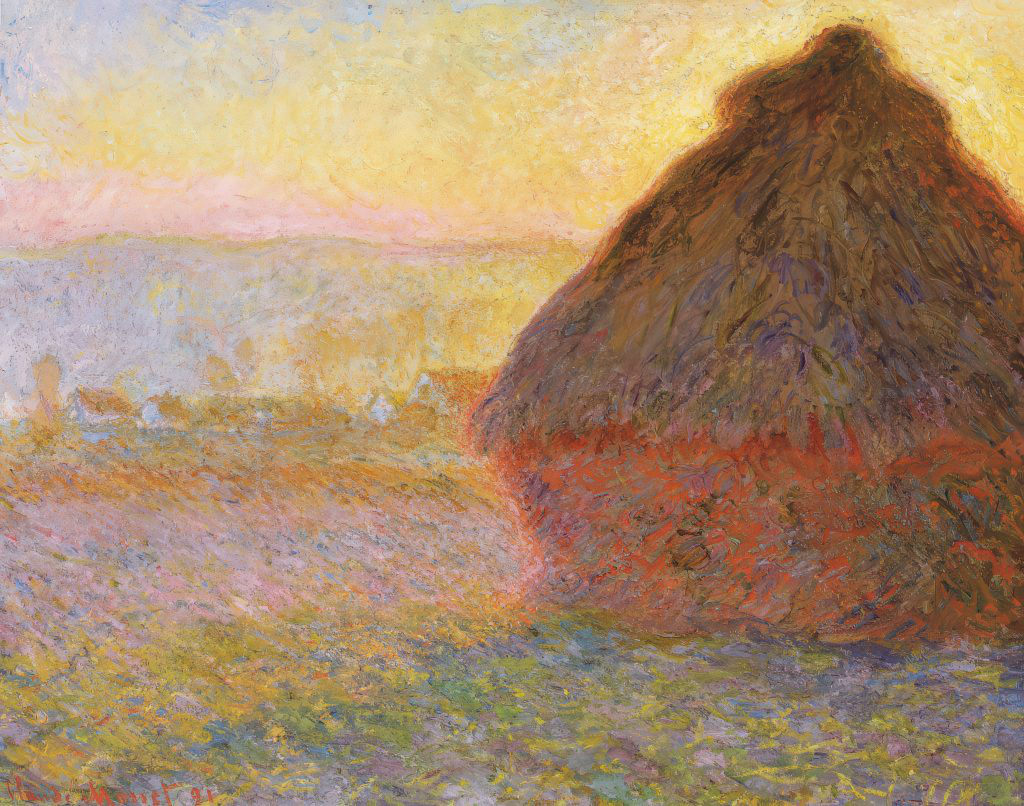
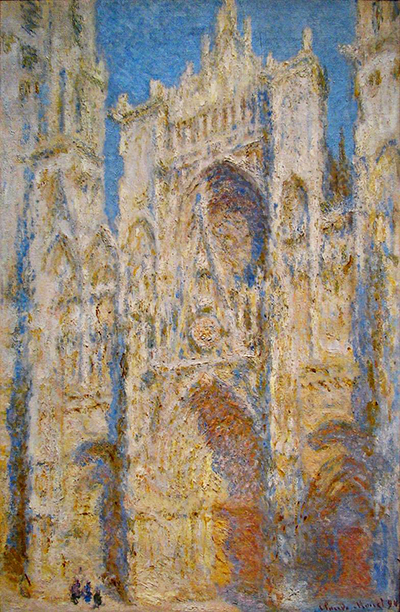
Monet also dissolved solid forms, but usually through repeated observation rather than dramatic symbolism. His views of London, Rouen Cathedral, haystacks and the Water Lilies depend on returning to the same motif under different conditions. The motif remains stable, but its appearance changes constantly.
The Musée d'Orsay notes that Monet's London paintings were dominated by fog and changing light, especially in his views of the Houses of Parliament.[20] Where Turner often uses atmosphere to heighten emotion, Monet uses it to compare visual states: morning, sunset, fog, smoke, haze, winter light and reflections across the Thames.
Shared Technical Lessons
-
1. Atmosphere can dominate the subject
Both artists allow fog, steam, rain, sunlight and haze to become more important than architectural or topographical description. -
2. Colour can replace outline
Turner and Monet both weaken traditional drawing, allowing colour and light to organise the image. -
3. Modernity can be atmospheric
Trains, bridges, smoke and industrial cities are not treated as dry documentary subjects, but as sensory experiences. -
4. Water multiplies visual instability
Rivers, seas and reflections allow both artists to blur the boundary between object and atmosphere. -
5. Form can dissolve without disappearing completely
In both artists, recognisable objects remain, but they are transformed by air, weather and light.
These shared technical concerns explain why Turner became such an important predecessor for Monet. Turner made atmosphere powerful; Monet made it analytical, serial and central to Impressionism.
Why Fog Connected Turner and Monet
Fog is one of the strongest links between Turner and Monet. For both painters, fog was not a nuisance that obscured the view, but a visual force that transformed the world. It softened outlines, merged buildings with sky, turned water into reflection and converted the modern city into a field of changing colour.
Turner repeatedly explored mist, haze, smoke and vapour in his views of rivers, harbours, steamships and industrial subjects. Monet later made London fog one of the great subjects of Impressionism, especially in his paintings of Waterloo Bridge, Charing Cross Bridge and the Houses of Parliament.
"Without the fog London would not be a beautiful city. It is the fog that gives it its magnificent breadth."
Claude Monet, quoted in Monet: The Triumph of Impressionism [21]
This remark is crucial. Monet recognised that fog did not merely hide London; it gave the city its beauty. The fog widened space, unified architecture and river, and allowed colour to appear in unexpected ways. What many people saw as dirt or gloom, Monet saw as pictorial possibility.
Turner made fog dramatic; Monet made fog serial. Together, they helped turn atmosphere into one of the central subjects of modern painting.
Fog and ATMOSPHERE Compared
Fog allowed Turner and Monet to weaken hard outlines, merge architecture with weather and make the modern city appear unstable, luminous and mysterious.
Turner: Fog, Steam and Motion
Turner's industrial atmospheres combine rain, steam and speed. Fog and vapour turn modern technology into a Romantic spectacle of movement and uncertainty.
Monet: London Fog
Monet's London paintings repeatedly study how fog changes the colour, scale and structure of the city. The bridge or Parliament remains visible, but atmosphere becomes the true subject.
Fog as a Modern Subject
Fog became especially important in nineteenth-century painting because it was connected to modern urban life. London fog was not purely natural: it was intensified by smoke, industry, coal fires and river humidity. For Turner and Monet, this created a uniquely modern atmosphere.
Turner responded to this world with Romantic energy. Monet responded with serial discipline. But both recognised that the modern city could not be painted only through architecture; it had to be painted through air.
What Fog Allowed Both Artists to Do
-
1. Remove hard outlines
Fog softened buildings, bridges and riverbanks, allowing colour to replace drawing. -
2. Merge sky, water and architecture
The Thames became a continuous atmospheric field rather than a divided landscape. -
3. Make modern pollution visually beautiful
Smoke and industrial haze became sources of colour, depth and visual mystery. -
4. Turn the city into changing perception
London looked different from hour to hour, encouraging Monet's serial method. -
5. Move painting closer to abstraction
As form dissolved into atmosphere, colour and light became increasingly independent.
Turner, Monet and the Language of Atmosphere
The relationship between Turner and Monet becomes especially powerful when viewed through the words of artists, critics and historians. Across the nineteenth century, writers increasingly recognised that Turner had transformed the role of light and atmosphere in painting, while Monet later pushed those ideas toward Impressionism and modern abstraction.
Turner was admired for making weather, steam, fog and sunlight emotionally overwhelming. Monet later treated many of those same elements as changing visual conditions that could be studied repeatedly through serial painting.
Monet on London Fog
One of the clearest statements connecting Monet to Turner's atmospheric world is Monet's famous remark about London fog:
"Without the fog London would not be a beautiful city. It is the fog that gives it its magnificent breadth."
Claude Monet [22]
This quotation reveals how Monet understood atmosphere not as an obstacle to vision, but as the source of visual beauty itself. Fog enlarged space, softened architecture and transformed the city into a field of coloured light. Turner had explored similar effects decades earlier in his Thames paintings and industrial scenes.
Ruskin on Turner and Truth to Nature
The critic John Ruskin became Turner's great defender during the nineteenth century. Ruskin argued that Turner's apparently loose and atmospheric painting was actually rooted in a profound truthfulness to light and natural effects.[23]
"He is the only man ever yet who could paint the true nature of mist."
John Ruskin, Modern Painters [23]
This defence of atmosphere and unstable weather helped prepare audiences for later developments in Impressionism. What had once appeared unfinished or vague gradually became understood as a serious attempt to paint visual experience itself.
Critics Connecting Turner and Impressionism
Many later historians recognised that Turner's late works anticipated aspects of Impressionism. His dissolving forms, luminous colour and atmospheric instability often appear strikingly modern when compared with Monet's London paintings or late Water Lilies.
Art historians frequently point to Turner's late atmospheric works such as Rain, Steam and Speed and Norham Castle, Sunrise as examples of painting moving beyond strict topographical description toward immersive sensation and optical instability.[24]
Turner made atmosphere emotionally overwhelming; Monet made atmosphere observational and serial.
Light and ATMOSPHERE Compared
Turner and Monet both transformed landscape through atmosphere, yet they used light for different artistic purposes.
Turner: Atmospheric Drama
Turner's late works often use light, fog and storm to create emotional intensity and sublime drama. Atmosphere becomes powerful, unstable and overwhelming.
Monet: Atmospheric Observation
Monet repeatedly studies how fog and light alter perception. Atmosphere becomes something to analyse through time, weather and serial painting.
Why These Quotations Matter
-
1. They show how atmosphere became central to modern painting
Fog, steam and light were no longer secondary effects but major subjects in themselves. -
2. They reveal continuity between Romanticism and Impressionism
Turner prepared many of the visual possibilities Monet later expanded. -
3. They explain why Turner appeared radically modern
His late works already dissolved form through atmosphere decades before Impressionism. -
4. They help explain Monet's fascination with London
Fog transformed the city into a constantly changing atmospheric experience. -
5. They connect both artists to later abstraction
As atmosphere replaced solid outline, painting moved closer toward modern abstraction.
Turner, Monet and Industrial Modernity
One of the most striking similarities between Turner and Monet is their willingness to paint modern industrial life. Earlier generations of landscape painters often preferred rural scenery, classical ruins or idealised nature. Turner and Monet instead recognised that railways, bridges, smoke, steam and urban rivers had become defining features of the modern world.
This was revolutionary. Industrialisation transformed nineteenth-century Europe visually as well as economically, and both artists responded by turning modern technology into atmospheric painting.
Turner and the Railway Age
Turner's Rain, Steam and Speed remains one of the great paintings of the Industrial Revolution. The train surges through rain and steam across the Maidenhead Railway Bridge, while landscape, weather and machinery merge together into a single field of motion.[25]
Importantly, Turner does not paint industry coldly or mechanically. The railway becomes dramatic, luminous and almost sublime. Steam and speed transform the landscape itself.
This reflects a broader Romantic fascination with the power and instability of modernity. Industrialisation appears exciting, overwhelming and transformative rather than merely technological.
Monet and Modern Paris
Monet inherited a world even more transformed by industrial modernity. Railways, bridges and urban expansion had reshaped Paris during the nineteenth century, especially under Baron Haussmann.
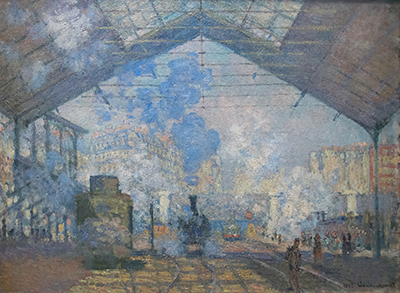
In the Gare Saint-Lazare series, Monet painted steam engines, iron structures and clouds of smoke directly inside one of Paris's busiest railway stations.[26] The Musée d'Orsay notes that Monet deliberately chose the station because of the visual effects created by steam, light and industrial movement.
Unlike Turner, Monet approaches modernity less as Romantic drama and more as optical experience. Smoke becomes colour; steam becomes atmosphere; iron structures dissolve into light.
Turner painted the emotional power of industrial modernity; Monet painted its changing visual effects.
Industry and MODERNITY Compared
Turner and Monet both transformed industrial subjects into atmospheric painting, helping modernise the language of landscape art.
Turner: Steam and Speed
Turner's train scenes combine machinery with weather and movement, turning industrial progress into a Romantic spectacle of energy and instability.
Monet: Gare Saint-Lazare
Monet transforms railway smoke into Impressionist colour and atmosphere. Steam softens iron structures and fills the station with changing light.

Modernity Through Atmosphere
Both Turner and Monet understood that modern life changed how the world looked. Steamships, trains, factories and urban smoke altered atmosphere itself. Instead of resisting these changes, both artists embraced them as new visual possibilities.
This is one reason both painters became so influential for modern art. They demonstrated that modernity could be represented not only through subject matter, but through atmosphere, instability and changing perception.
Why Industrial Modernity Matters in Their Art
-
1. Both artists modernised landscape painting
Industrial rivers, railways and smoke became worthy artistic subjects. -
2. Steam transformed atmosphere itself
Smoke and vapour altered light, visibility and colour. -
3. Turner treated industry as Romantic spectacle
Modern technology became dramatic, sublime and emotionally powerful. -
4. Monet treated industry as optical experience
Railway stations and bridges became studies of colour and changing atmosphere. -
5. Both artists helped prepare the way for modern art
Their atmospheric handling of industry weakened traditional landscape description.
Turner, Monet and the Birth of Modern Painting
The connection between Turner and Monet matters because it reveals one of the most important transitions in the history of Western art: the movement from Romantic landscape painting toward Impressionism and eventually modern abstraction.
Turner expanded the emotional and atmospheric possibilities of landscape painting during the early nineteenth century. Monet later transformed those possibilities into a new visual language based on perception, repeated observation and changing light. Together, the two artists helped redefine what painting itself could be.
From Landscape to Atmosphere
Before Turner, European landscape painting often prioritised stable composition, clear drawing and carefully organised space. Turner gradually destabilised these conventions through fog, fire, storm, steam and overwhelming light. In many late works, atmosphere becomes more powerful than the objects within it.[27]
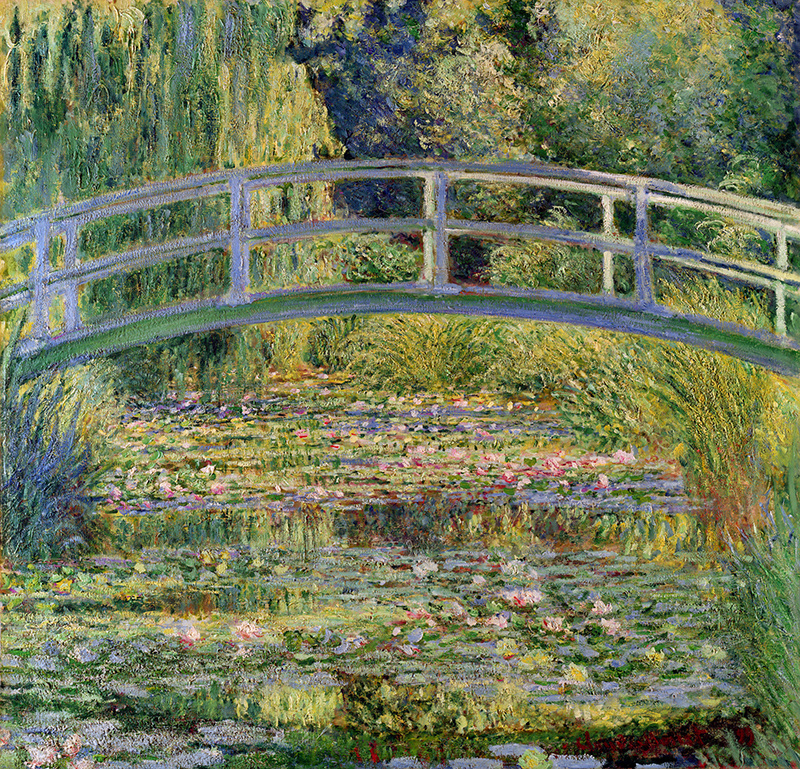
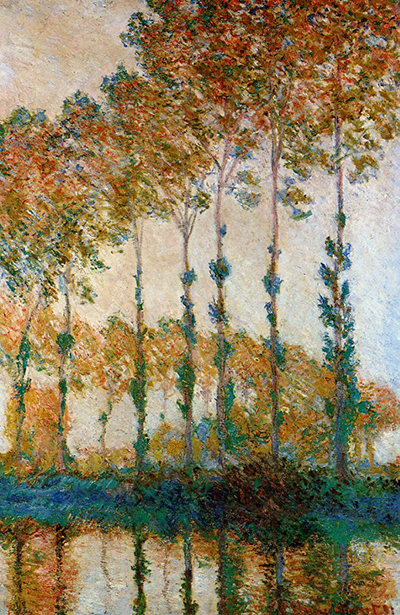
Monet inherited this atmospheric possibility and pushed it further. His serial paintings of haystacks, poplars, Rouen Cathedral, London and the Water Lilies repeatedly show how the same motif changes under different conditions of light and weather.[28]
This shift was revolutionary. The subject of painting increasingly became perception itself rather than stable description.
The Road Toward Abstraction
Both Turner and Monet are now frequently connected to the origins of abstraction because they allowed colour and atmosphere to weaken the dominance of traditional outline and form.
Turner's late paintings often appear astonishingly modern, especially works such as Snow Storm - Steam-Boat off a Harbour's Mouth or Norham Castle, Sunrise, where objects seem partially submerged within luminous atmosphere.[29]
Monet's late Water Lilies pushed this even further. Horizons disappear, reflections merge with sky and the viewer becomes immersed within floating surfaces of colour and light. The Museum of Modern Art has noted the importance of Monet's late paintings for later modern artists, especially Abstract Expressionists such as Mark Rothko and Jackson Pollock.[30]
Turner dissolved landscape into atmosphere; Monet dissolved atmosphere into immersive perception.
From Romanticism to MODERNISM Compared
Turner and Monet helped transform landscape painting into a modern exploration of light, atmosphere and visual instability.
Turner: Romantic Dissolution
Turner's late paintings dissolve ships, sky and sea into turbulent fields of colour and atmosphere, anticipating aspects of later modern abstraction.
Monet: Immersive Atmosphere
Monet's late Water Lilies remove stable horizon and structure, immersing the viewer within reflection, colour and changing atmospheric perception.

Two Different Paths Toward Modernism
Although Turner and Monet are often linked together, they arrived at modernity through different traditions.
-
Turner
Worked through Romanticism, the sublime and emotional intensity. His atmosphere is often dramatic, symbolic and overwhelming. -
Monet
Worked through Impressionism, direct observation and serial repetition. His atmosphere is optical, temporal and perceptual.
Yet despite these differences, both artists weakened the authority of rigid form. Colour, light and atmosphere increasingly organised the painting more strongly than line or narrative.
The Influence on Later Artists
The impact of Turner and Monet extended far beyond their own lifetimes. Twentieth-century painters repeatedly looked back to both artists when exploring abstraction, colour-field painting and immersive atmosphere.
Turner's late paintings impressed many later modernists because of their extraordinary looseness and luminous colour. Monet's Water Lilies, meanwhile, became especially important after large-scale exhibitions in the twentieth century revealed how radically immersive his late works truly were.[31]
This legacy explains why Turner and Monet continue to be discussed together. They represent different stages in the transformation of landscape painting from description toward sensation.
Why the Turner-Monet Relationship Matters
-
1. Turner anticipated atmospheric modern painting
His late works weakened outline and prioritised atmosphere, weather and light. -
2. Monet transformed atmosphere into serial observation
Repeated studies of light and weather became central to Impressionism. -
3. Both artists modernised landscape painting
Steam, fog, rivers and industrial atmosphere became worthy artistic subjects. -
4. Both helped open pathways toward abstraction
Colour and atmosphere increasingly became more important than stable form. -
5. Together they reveal a major shift in art history
The movement from Romanticism to Impressionism helped transform the future of modern painting.
Conclusion
Turner and Monet never met, and they belonged to different generations and artistic movements. Yet their paintings remain deeply connected through atmosphere, water, fog, steam, reflection and the unstable effects of modern light.
Turner made atmosphere emotionally overwhelming. Monet made atmosphere analytical and immersive. Together, they transformed landscape painting from the representation of places into the experience of seeing itself.
References
- The National Gallery, London, “Joseph Mallord William Turner: Rain, Steam, and Speed - The Great Western Railway,” The National Gallery Collection, View source.
- The National Gallery, London, “Joseph Mallord William Turner: The Fighting Temeraire,” The National Gallery Collection, View source.
- Musée d'Orsay, “Claude Monet: Londres, le Parlement. Trouée de soleil dans le brouillard,” Musée d'Orsay Collection, View source.
- Tate, “Joseph Mallord William Turner: Norham Castle, Sunrise,” Tate Collection, View source.
- Musée Marmottan Monet, “Claude Monet: Impression, Sunrise,” Musée Marmottan Monet Collection, View source.
- Tate, “Joseph Mallord William Turner,” Tate Artists, View source.
- Jackie Wullschlager, Monet - The Restless Vision, Milton Keynes: Allen Lane, 2023.
- The National Gallery, London, “Rain, Steam, and Speed - The Great Western Railway,” The National Gallery Collection, View source.
- The National Gallery, London, “The Fighting Temeraire,” The National Gallery Collection, View source.
- Paul Hayes Tucker, Claude Monet: Life and Art, New Haven: Yale University Press, 1995.
- Claude Monet, quoted in: Daniel Wildenstein, Monet: The Triumph of Impressionism, Cologne: Taschen, 2015.
- Sue Roe, The Private Lives of the Impressionists, London: HarperCollins, 2006.
- John House, Monet: Nature into Art, New Haven: Yale University Press, 1986.
- John Ruskin, Modern Painters, London: Smith, Elder & Co., 1843-1860.
- John House, Monet: Nature into Art, New Haven: Yale University Press, 1986.
- The National Gallery, London, “Joseph Mallord William Turner: Rain, Steam, and Speed - The Great Western Railway,” The National Gallery Collection, View source.
- Musée d'Orsay, “Claude Monet: Londres, le Parlement. Trouée de soleil dans le brouillard,” Musée d'Orsay Collection, View source.
- Claude Monet, quoted in: Daniel Wildenstein, Monet: The Triumph of Impressionism, Cologne: Taschen, 2015.
- Claude Monet, quoted in: Daniel Wildenstein, Monet: The Triumph of Impressionism, Cologne: Taschen, 2015.
- John Ruskin, Modern Painters, London: Smith, Elder & Co., 1843-1860.
- Andrew Wilton, Turner in His Time, London: Thames & Hudson, 1987.
- The National Gallery, London, “Rain, Steam, and Speed - The Great Western Railway,” The National Gallery Collection, View source.
- Musée d'Orsay, “Claude Monet: La Gare Saint-Lazare,” Musée d'Orsay Collection, View source.
- Andrew Wilton, Turner in His Time, London: Thames & Hudson, 1987.
- Daniel Wildenstein, Monet: The Triumph of Impressionism, Cologne: Taschen, 2015.
- Tate, “Joseph Mallord William Turner: Snow Storm - Steam-Boat off a Harbour's Mouth,” Tate Collection, View source.
- The Museum of Modern Art, “Claude Monet: Water Lilies,” MoMA Collection, View source.
- Marianne Mathieu, Monet: The Water Lily Obsession, Paris: Musée Marmottan Monet, 2018.