 by Tom Gurney
Tom Gurney BSc (Hons) is an art history expert with over 20 years experience
Published on May 21, 2026 / Updated on May 30, 2026
Email: tomgurney1@gmail.com / Phone: +44 7429 011000
Claude Monet and the Influence of Édouard Manet
Claude Monet and Édouard Manet shared one of the most important artistic relationships in nineteenth-century French painting. Although very different in temperament and style, the two artists became close friends during the rise of Impressionism and helped shape the direction of modern art together.
When Monet first emerged during the 1860s, Manet was already one of the most controversial painters in Paris. Works such as Le Déjeuner sur l'Herbe and Olympia had challenged the traditions of the French Salon, introducing a new approach to modern life, simplified form and direct observation.
Monet admired Manet's boldness and independence, while Manet became increasingly interested in Monet's outdoor painting methods and atmospheric treatment of light. Their relationship developed into a mutual exchange of ideas rather than a simple master-and-student influence.
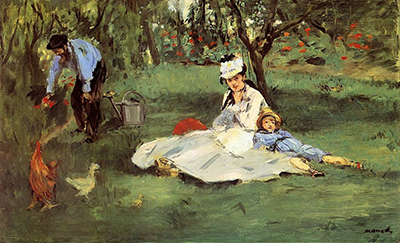
The two artists painted many similar subjects, including rivers, gardens, boating scenes and contemporary Parisian leisure. Manet even visited Monet at Argenteuil and painted the famous work The Monet Family in Their Garden at Argenteuil, showing Monet, Camille and their son Jean within the domestic world that helped inspire many Impressionist paintings.
Although Manet never fully embraced Impressionism in the same way as Monet, he supported many of the Impressionists personally and artistically. Their friendship helped bridge the gap between Realism, modern urban painting and the more radical outdoor vision associated with Impressionism.
Today, the relationship between Monet and Manet is regarded as one of the defining artistic friendships of the nineteenth century, linking two of the most influential painters in the development of modern European art.
- Artists Claude Monet, Édouard Manet
- Main Connection Friendship & Shared Modern Subjects
- Movement Impressionism & Modern French Painting
- Key Themes Modern Life, Gardens, Rivers, Boating, Paris
- Major Difference Monet Focused More Fully on Light & Atmosphere
- Legacy Two Central Figures in the Development of Modern Art
Table of Contents
- Manet vs Monet: Key Differences
- Argenteuil: Where Manet Met Monet's World
- The Monet Family in Their Garden
- Monet's Studio Boat
- Boating, Leisure and Modern Life
- Who Influenced Whom?
- Monet and Manet Timeline
- Family, Friendship and the Impressionist Circle
Manet vs Monet: Key Differences
Édouard Manet and Claude Monet are often confused because of their similar names, but their artistic roles were different. Manet was already a controversial figure in Paris during the 1860s, challenging academic expectations through modern subjects and a flatter, more direct handling of paint. Monet, by contrast, became the leading painter of outdoor light, river scenery, gardens and atmospheric change.
| Édouard Manet | Claude Monet |
|---|---|
| Older artist, already controversial in the 1860s | Younger artist, emerging as Impressionism developed |
| Focused strongly on modern figures, cafés, portraits and urban subjects | Focused increasingly on landscape, rivers, gardens, light and atmosphere |
| Often remained connected to the Salon and studio tradition | Worked more consistently outdoors and later in repeated series |
| Flattened forms and challenged academic finish | Dissolved form through broken colour and changing light |
| Influenced Monet through modern subject matter and anti-academic boldness | Influenced Manet through plein-air methods, brighter colour and river subjects |
Argenteuil: Where Manet Met Monet's World
The most important setting for the Monet-Manet relationship was Argenteuil, where Monet lived during the 1870s. This riverside suburb became one of the great laboratories of Impressionism: close to Paris by train, fashionable for boating and leisure, and visually rich in reflections, sails, bridges, gardens and modern suburban life.
In 1874, Manet spent time at Gennevilliers, just across the Seine from Argenteuil, and often visited Monet and Renoir there. [4] This was a crucial moment because Manet began to engage more directly with the open-air subjects and lighter palette associated with the younger Impressionists. Argenteuil therefore became a meeting point between Manet's modern realism and Monet's increasingly atmospheric Impressionism.
The Monet Family in Their Garden
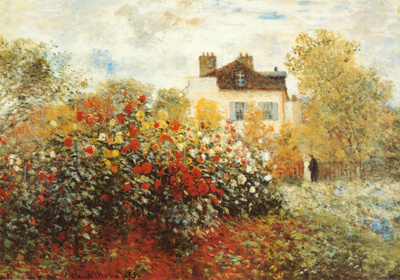
Manet's The Monet Family in Their Garden at Argenteuil is one of the clearest records of the friendship between the two artists. Painted in 1874, it shows Camille Monet, Jean Monet and Claude Monet himself in the garden at Argenteuil. [5] It is also one of Manet's most important experiments with Monet's world: family life, garden setting, outdoor light and informal modern leisure.
Manet entered Monet's domestic world at Argenteuil and translated it through his own sharper, more figure-centred style.
Garden and FAMILY Compared
Manet's portrait of the Monet family shows how closely the two artists' worlds overlapped at Argenteuil, while also revealing the difference between Manet's figure-led modernism and Monet's atmospheric garden painting.
Manet: The Monet Family
Manet presents Monet's family in the garden at Argenteuil, combining portraiture, outdoor light and modern domestic life. The figures remain central, giving the scene a social and human emphasis.
Monet: Garden and Atmosphere
Monet's own Argenteuil works often place garden, river or outdoor space ahead of portrait likeness. The emphasis shifts from identity toward colour, light and the fleeting sensation of place.
Monet's Studio Boat
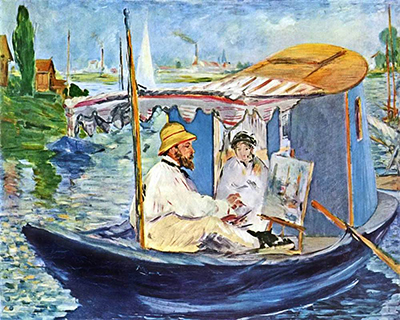
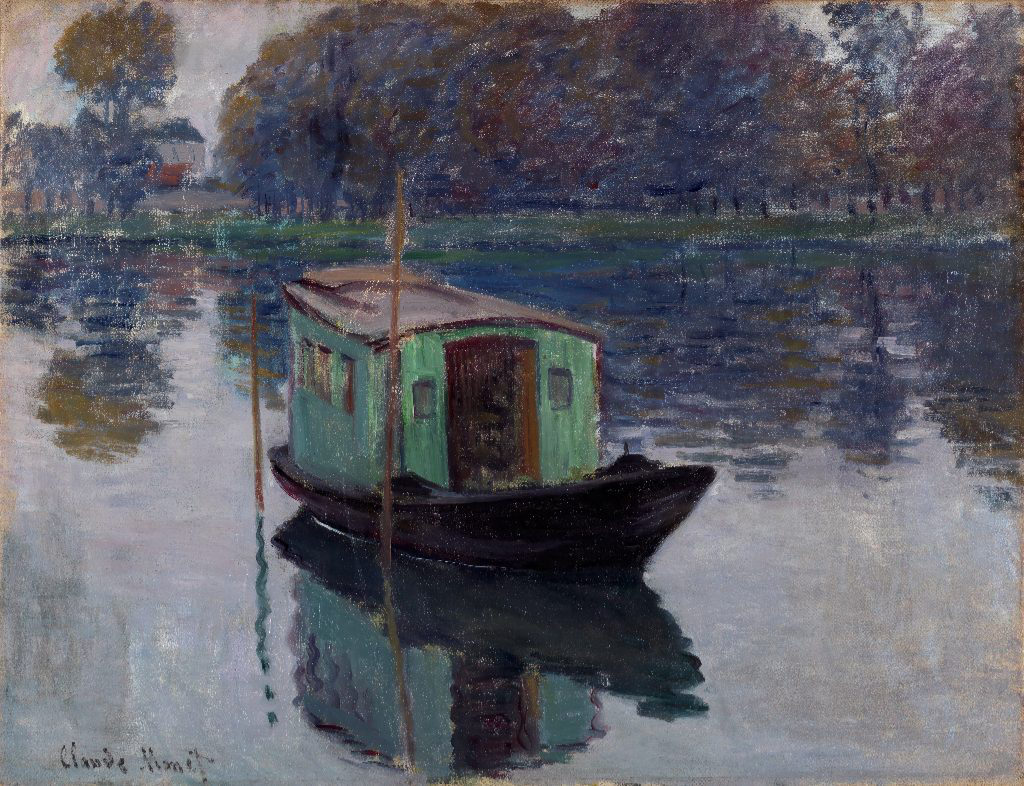
One of the most revealing points of contact between the two artists is Monet's studio boat. Monet used a boat as a floating studio on the Seine, allowing him to paint from the water and study reflections, river traffic and changing light from unusual positions. The Kröller-Müller Museum identifies Monet's Studio-Boat as an 1874 work, while Manet also painted Monet working in his studio boat that same year.[6]
This subject is especially valuable because it shows Manet responding to Monet's method. Manet does not simply paint a portrait of his friend; he paints Monet as a working artist, using the floating studio that made his river observations possible.
The Studio BOAT Compared
The studio boat turns Monet's method into a subject. It also shows how Manet became interested in the practical machinery of Impressionist observation.
Manet: Monet Painting
Manet shows Monet painting from his floating studio. The image is part portrait, part record of Impressionist practice: the artist working directly from river, light and atmosphere.
Monet: The Studio Boat
Monet's own image of the studio boat places the vessel within the landscape itself. The floating studio becomes part of the river environment, linking work, water and observation.
Boating, Leisure and Modern Life
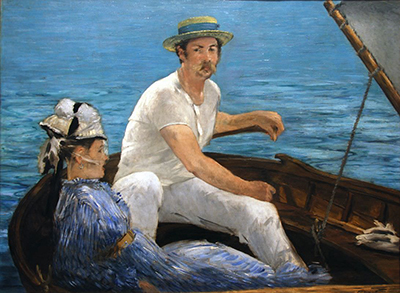
Manet's Boating was painted at Argenteuil in 1874, during the same summer in which he spent time near Monet and Renoir. The Metropolitan Museum of Art notes that Manet adopted a lighter touch and palette from his younger Impressionist colleagues, while also using broad planes of colour and strong diagonals associated with Japanese prints.[4]
This makes Boating a key work for the Monet-Manet relationship. It shows Manet absorbing elements of Impressionism without becoming Monet. The subject is modern leisure on the Seine, but the composition remains controlled, bold and graphic in a distinctly Manet-like way.
Boating and ARGENTEUIL Compared
Monet and Manet both painted the Seine at Argenteuil, but they approached the subject differently: Manet emphasised modern figures and design; Monet pursued light, reflections and movement.
Manet: Boating
Manet's boating scene is bright, bold and modern. The figures are strongly present, while the flat blue water and diagonal forms show how he adapted Impressionist colour to his own graphic style.
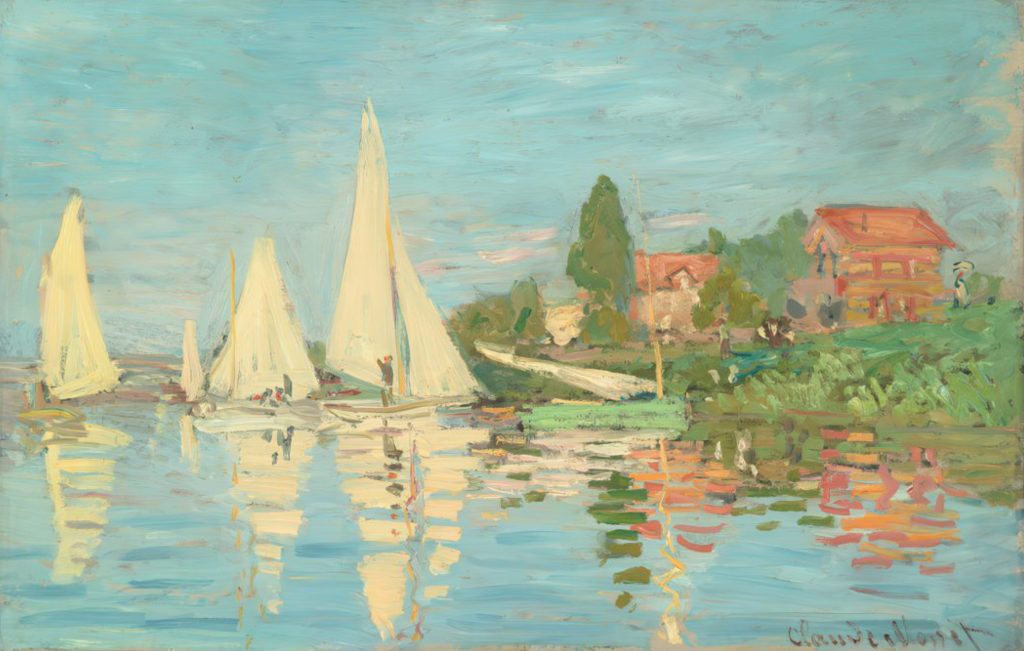
Monet: Regatta at Argenteuil
Monet's regatta scenes turn the same river culture into a study of movement, reflection and light. Boats, water and sky are broken into shifting colour.
Who Influenced Whom?
The relationship between Manet and Monet is best understood as mutual influence. Manet influenced Monet first by proving that modern life could be a serious subject for ambitious painting. His rejection of academic polish and his commitment to contemporary experience helped create the conditions in which Impressionism could emerge.
Monet then influenced Manet in return. At Argenteuil, Manet saw how the younger Impressionists were painting outdoors, using brighter colours and treating river leisure, gardens and reflections as modern subjects. Manet's own works from 1874 show this shift clearly, especially Boating and The Monet Family in Their Garden at Argenteuil. [4] [5]
-
What Monet learned from Manet
Modern subject matter, anti-academic confidence, simplified form and the courage to challenge Salon taste. -
What Manet learned from Monet
Brighter colour, outdoor observation, river subjects, looser handling and the possibilities of Impressionist light. -
What they shared
Interest in modern life, leisure, gardens, boating, contemporary Paris and the transformation of everyday subjects into serious painting.
Monet and Manet Timeline
- 1860s: Manet becomes one of the most controversial modern painters in Paris, challenging academic expectations with works such as Le Déjeuner sur l'Herbe and Olympia.
- Early 1870s: Monet settles at Argenteuil and develops some of his most important river, garden and boating subjects.
- 1874: Manet spends time near Argenteuil and paints works connected to Monet, including The Monet Family in Their Garden at Argenteuil and Boating. [4] [5]
- 1874: Monet participates in the first Impressionist exhibition, while Manet remains outside the independent Impressionist group.
- Late 1870s: Manet continues to absorb aspects of Impressionist colour and outdoor modern life without fully becoming an Impressionist painter.
Family, Friendship and the Impressionist Circle
The relationship between Monet and Manet extended far beyond artistic influence alone. Their friendship developed within a wider network of family connections, shared households, social visits, riverside leisure and artistic collaboration that linked many of the major Impressionists together during the 1870s.
Argenteuil became one of the central meeting places for this circle. Monet lived there with Camille Monet and their son Jean, while Manet stayed nearby at Gennevilliers during the summer of 1874. [4] Renoir also frequently visited the area, and the Seine became a social as well as artistic environment in which artists painted, boated, dined and exchanged ideas together.
Berthe Morisot and the Manet Family
One of the most important figures linking the wider Impressionist circle was Berthe Morisot. Introduced to Édouard Manet in 1868 through Henri Fantin-Latour, Morisot quickly became both a close artistic colleague and one of Manet's most significant models. [9] Manet painted her repeatedly during the late 1860s and early 1870s, including in The Balcony and Berthe Morisot with a Bouquet of Violets. [10]
The connection later became familial when Berthe Morisot married Manet's younger brother, Eugène Manet, in 1874. [11] This marriage effectively merged Morisot into the Manet household and strengthened the social connections between the Impressionist artists even further.
Many historians have suggested that the relationship between Édouard Manet and Berthe Morisot involved unusually strong emotional intensity, reflected in the extraordinary number of portraits Manet made of her and the warmth of their correspondence. [12] Whether romantic or not, Morisot clearly became one of the most important artistic figures within the Manet family circle.
Julie Manet and the Next Generation
The connections between the families continued into the next generation through Julie Manet, the daughter of Berthe Morisot and Eugène Manet. Julie grew up surrounded by Impressionist painters and became one of the best-documented children in modern art history.
She posed not only for her mother, but also for Renoir and other artists connected to the Impressionist circle. [13] Through Julie's diaries and memoirs, historians have gained valuable insight into the personal relationships between many of the Impressionists after the deaths of Manet and Monet's earlier generation.
The Impressionists therefore formed something closer to an extended artistic family than a loose movement of isolated painters. Marriages, friendships, shared holidays and collaborative exhibitions all helped sustain the group socially as well as artistically.
Camille Monet and the Domestic World of Impressionism
Camille Monet also played a central role within this social network. She appeared repeatedly in Monet's paintings during the 1860s and 1870s and became closely associated with the domestic and outdoor world of early Impressionism.
Manet's The Monet Family in Their Garden at Argenteuil is especially important because it records not simply a friendship between two painters, but a shared domestic environment. Camille, Jean and Claude Monet appear together within the garden setting that had become one of the centres of Impressionist social life.[5]
The painting therefore acts almost like a group portrait of the Impressionist circle itself: family life, leisure, outdoor painting and modern suburban existence merged together within a single image.
Women and the Impressionist Network
The family relationships around Monet and Manet also reveal how important women were to the development of Impressionism. Berthe Morisot was not simply a muse or model but one of the movement's most innovative painters, exhibiting in nearly all the Impressionist exhibitions between 1874 and 1886.[14]
Camille Monet similarly became one of the defining figures of early Impressionist imagery, appearing in garden scenes, interiors, promenades and outdoor landscapes. Suzanne Manet, the wife of Édouard Manet, also formed part of the wider household structure surrounding the artists.[15]
These family and social connections remind us that Impressionism developed not only in studios and exhibitions, but within homes, gardens, marriages and friendships. The movement emerged through everyday human relationships as much as through formal artistic theory.
The Batignolles Circle
Before Impressionism fully emerged, many of these artists already formed part of the so-called Batignolles group, centred around Manet in Paris during the 1860s. [16] Artists including Monet, Renoir, Degas, Fantin-Latour, Bazille and Morisot gathered in cafés and studios to debate modern painting and challenge Salon conventions.
In this sense, the Monet-Manet relationship was never isolated. It belonged to a much wider social and artistic ecosystem in which friendships, rivalries, marriages and collaborative influence all shaped the birth of modern art.
Painting One Another
One remarkable feature of the Impressionist circle is how frequently the artists painted one another and each other's families. Manet painted Monet and his family at Argenteuil; Morisot posed repeatedly for Manet; Renoir painted many fellow Impressionists and their children; and Monet himself repeatedly painted Camille and Jean.
This creates an unusually interconnected visual archive. The Impressionists were not simply colleagues observing the modern world around them — they were also constantly observing one another.
References
- Daniel Wildenstein, Gilles Neret, Monet: Catalogue Raisonne, Cologne: Wildenstein Institute and Taschen, 1996.
- Daniel Wildenstein, Monet: The Triumph of Impressionism, Cologne: Taschen, 2015.
- Jackie Wullschlager, Monet - The Restless Vision, Milton Keynes: Allen Lane, 2023.
- The Metropolitan Museum of Art, “Édouard Manet: Boating,” The Met Collection, View source.
- The Metropolitan Museum of Art, “Édouard Manet: The Monet Family in Their Garden at Argenteuil,” The Met Collection, View source.
- Kröller-Müller Museum, “Claude Monet: Monet's Studio-Boat,” Kröller-Müller Museum Collection, View source.
- Musée d'Orsay, “Claude Monet: Régates à Argenteuil,” Musée d'Orsay Collection, View source.
- Musée des Beaux-Arts de Tournai, “Édouard Manet: Argenteuil,” Musée des Beaux-Arts de Tournai Collection, View source.
- Berthe Morisot, Encyclopaedia Britannica, View source.
- Wikipedia, “Berthe Morisot with a Bouquet of Violets,” View source.
- Wikipedia, “Eugène Manet,” View source.
- The Fine Arts Museums of San Francisco, “5 Things to Know about the Friendship of Manet and Morisot,” View source.
- Isabella Stewart Gardner Museum, “Manet: A Model Family,” View source.
- The New Yorker, “Berthe Morisot, ‘Woman Impressionist,’ Emerges from the Margins,” View source.
- Isabella Stewart Gardner Museum, “Families are Complicated: Édouard Manet's Family,” View source.
- Wikipedia, “Édouard Manet,” View source.