



 by Tom Gurney
Tom Gurney BSc (Hons) is an art history expert with over 20 years experience
Published on June 19, 2020 / Updated on October 30, 2026
Email: tomgurney1@gmail.com / Phone: +44 7429 011000
Berthe Morisot with a Bouquet of Violets by Édouard Manet: Introduction
The flowers are easy to miss. A tall black hat, loose brown hair and a pair of dark eyes make the first impression; the small cluster of violets appears lower down, almost absorbed by the clothing. Its modest presence gives a name to a portrait whose force comes from much larger relationships between darkness, pale light and a face.
Édouard Manet painted Berthe Morisot with a Bouquet of Violets in 1872. The canvas now belongs to the Musée d’Orsay in Paris.[1] It shows a fellow painter whose appearances in his work were part of an exchange between two artists, as well as a succession of encounters between painter and model.
At a Glance
- ArtistÉdouard Manet
- Date1872
- MediumOil on canvas
- Dimensions55.5 × 40.5 cm
- SitterBerthe Morisot
- CollectionMusée d’Orsay, Paris
- Inventory numberRF 1998 30
- InscriptionSigned and dated “Manet 72” at the upper right
- AcquisitionPurchased in 1998[1]
This work across Édouard Manet’s career
Contents
- The Face beneath the Hat
- Black as Shape, Surface and Interval
- The Small Bouquet
- A Pale Ground and a Close Encounter
- A Painter Who Also Posed
- The Portrait Reconsidered in Print
- A Later Portrait and a Changing Frame
- From Duret’s Collection to the Musée d’Orsay
- Annotated details
The Face beneath the Hat
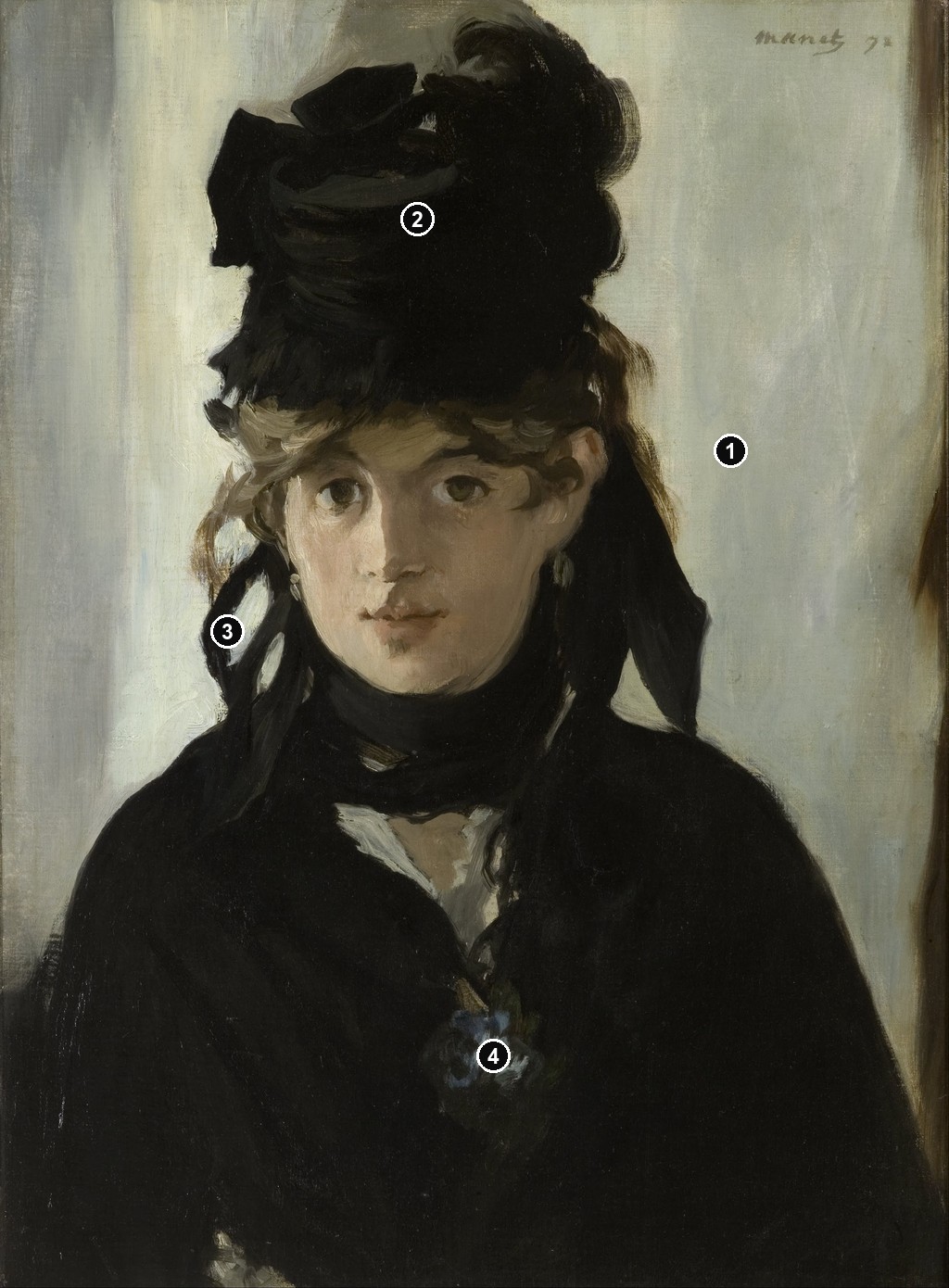
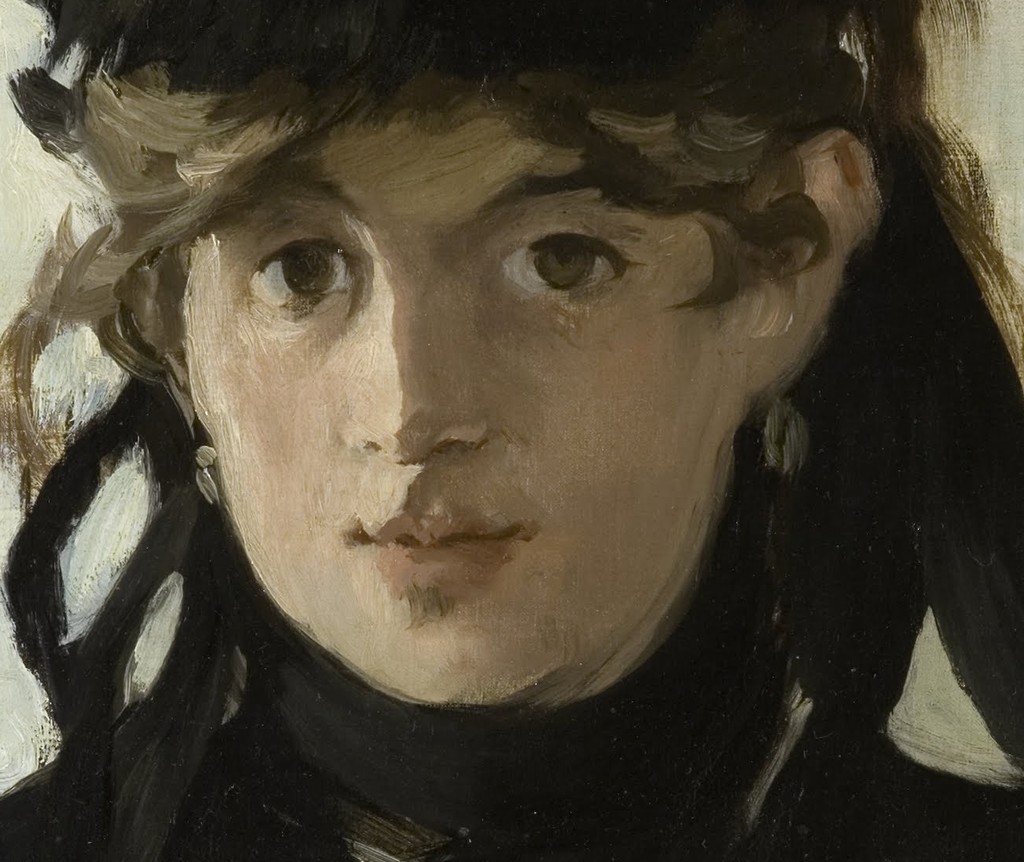
Morisot’s face occupies a relatively small area within the silhouette of hat and shoulders. Her head is almost frontal, with a slight turn that makes the two sides unequal. Brown hair crosses the forehead in curved strands, interrupting the boundary between skin and the darkness above.
Light falls most strongly on the viewer’s left. It opens the forehead and cheek, continues down one side of the nose and reaches the chin. The other side of the face is warmer and more shaded, with changes around the cheek and eye that make its form less immediately available. The face seems to emerge through these unequal degrees of illumination.
The eyes remain conspicuous on both sides. Dark irises sit within small pale areas, beneath strongly marked brows. Their near-frontal direction creates an encounter that is hard to avoid even when attention wanders towards the hat or flowers. The mouth adds a warmer accent, its lips separated by a fine dark interval.
The Musée d’Orsay notes that Manet painted Morisot’s eyes black although they were green.[1] The alteration belongs to an image in which dark accents carry exceptional weight. The eyes participate in the same broad organisation as the hat, scarf and clothing, while remaining the most particular points within the face.
The handling varies as we move across it. Small transitions give the nose and cheeks their volume, but the hair is described through more expansive, curling marks. A strand can begin clearly and fade into a neighbouring shadow. The difference keeps the face distinct without enclosing it in an equally precise outline on every side.
Her expression is correspondingly difficult to fix. The eyes appear attentive, the mouth quiet, the head poised beneath its elaborate covering. These elements can suggest different attitudes to different viewers. Their power lies in how insistently they hold our interest while revealing little about the circumstances of the sitting.
Black as Shape, Surface and Interval
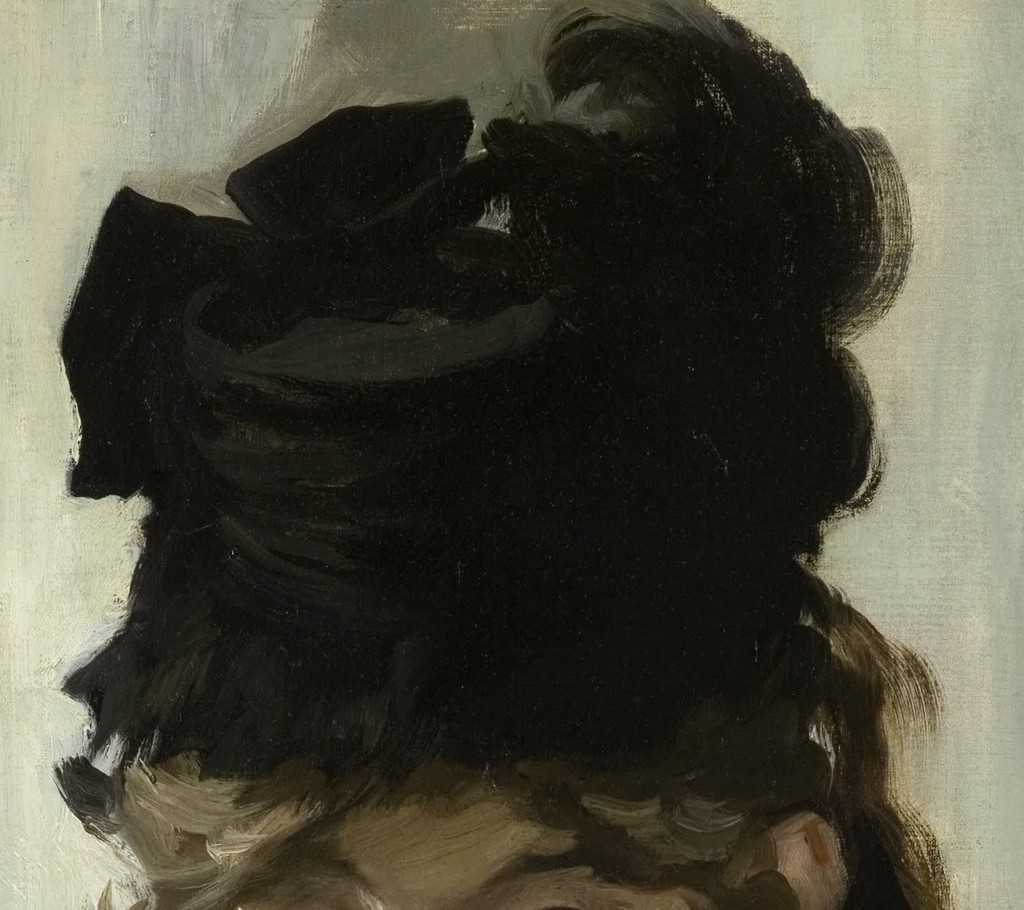
The hat supplies the portrait’s largest departure from a simple human outline. It rises high above Morisot’s forehead, with folded forms projecting on the left and rounded loops gathering on the right. The mass is broad enough to compete with the shoulders below, creating a second substantial dark shape above the face.
Within it, black changes from one passage to another. Some areas are densely opaque; others carry brown or grey suggestions that make folds visible. A sweeping stroke can follow a curved surface before disappearing into a darker patch. The hat remains legible through these limited differences, even as much of its construction stays loosely described.
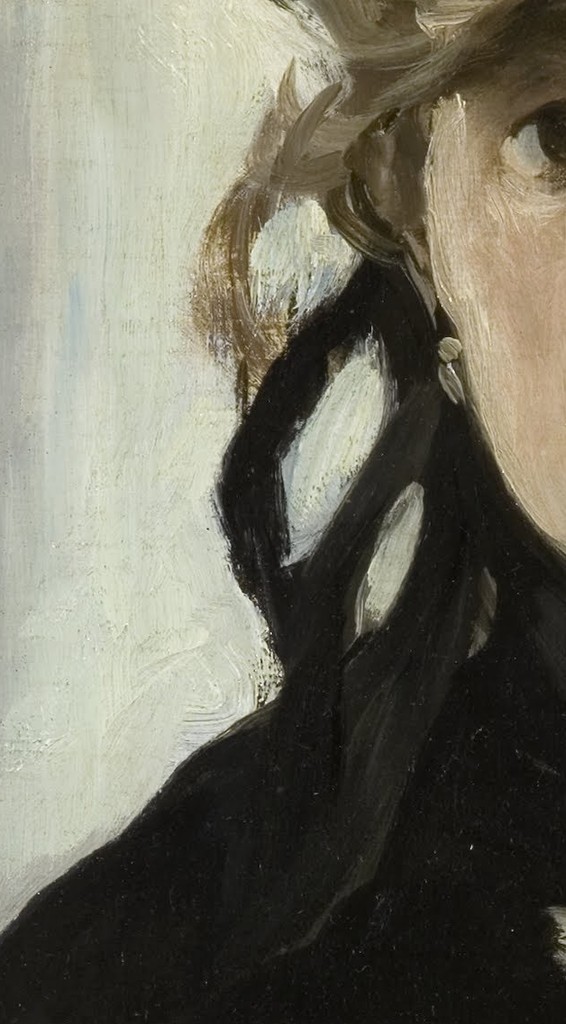
The ribbons beside the head behave differently. On the viewer’s left, they form an open arrangement through which the pale background can be seen. On the right, a broader dark length descends beside the hair and ear. The asymmetry makes the face’s framing feel mobile, with loops and hanging strips extending beyond its calmer central form.
A scarf or broad ribbon encloses the neck. Its upper edge follows the jaw closely, while lower folds turn towards the shoulders. Beneath it, a small pale opening breaks the continuity of the clothes. White and warm tan make a roughly triangular shape that leads attention down from the chin towards the flowers.
The shoulders spread out more quietly. Their dark surface reaches the sides and bottom of the canvas, with only slight changes indicating folds and the fall of fabric. Seen from a little distance, this lower area becomes almost continuous. Moving closer restores the small differences through which paint gives it material presence.
The black passages perform several jobs at once. They describe fashionable clothing, establish the figure’s silhouette and create intervals of varying depth around the skin. Each return to the face changes the balance: what looked like a broad dark field becomes a hat, a folded ribbon or the edge of a shoulder.
The Small Bouquet
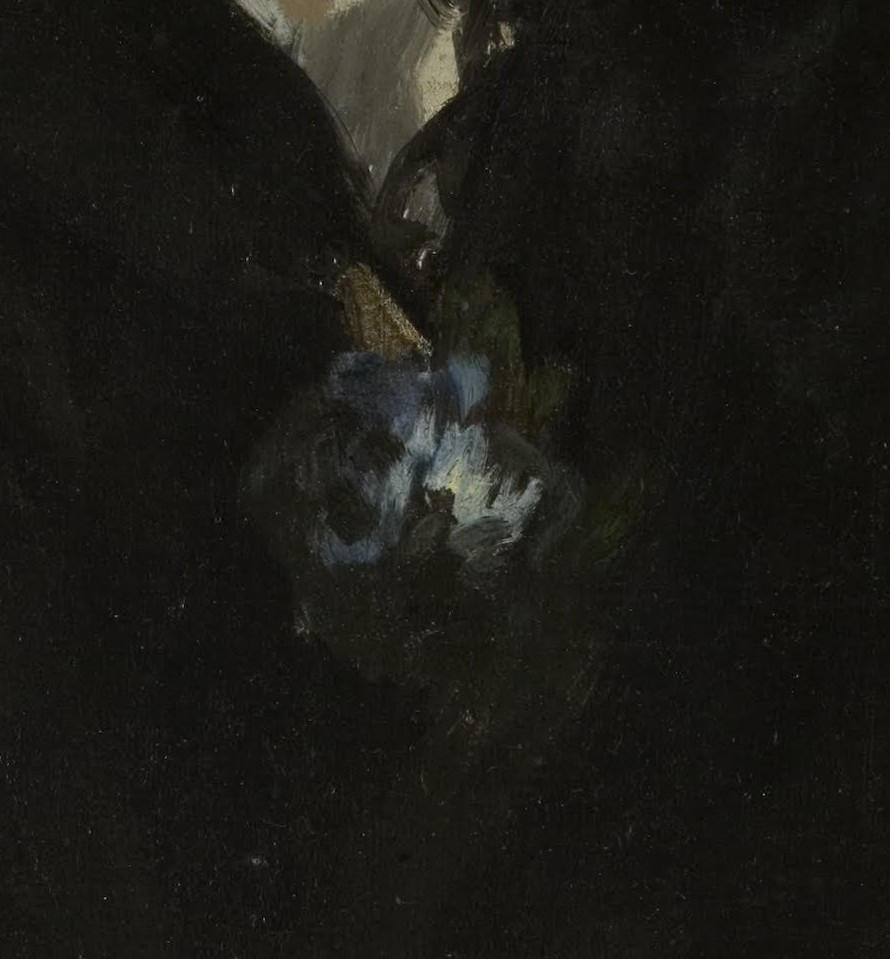
The violets sit below the neckline, near the centre of the chest. Blue and blue-violet marks gather around lighter touches, with green leaves beside and above them. Their scale is small enough for the flowers to remain subordinate to the face, yet their colour makes a distinct event within the lower half of the painting.
They reward a different pace of looking from the eyes. The gaze establishes itself quickly; the bouquet takes longer to separate from the surrounding darkness. Once discovered, it becomes a point to which the viewer can return, linking the broad clothes to something more delicate and perishable.
The flowers’ edges are uneven. Small light marks suggest petals without requiring every blossom to be counted or individually resolved. Green and blue approach the neighbouring black closely enough for parts of the cluster to remain uncertain. Recognition depends on the relation between the marks, their colours and their place on the clothing.
This modest emphasis changes how the title works. It invites us to search for a detail that the composition does not immediately advertise. A few coloured touches become important through the name of the picture, while the picture itself continues to give its strongest attention to head, hat and face.
The bouquet also draws the eye along a vertical sequence: dark eyes, pale neckline, small flowers. These points sit within larger masses that can otherwise feel difficult to penetrate. The flowers give the clothing a centre without making it as descriptive or expressive as the face above.
A Pale Ground and a Close Encounter
The background is a field of pale grey-green and warmer light tones. Vertical changes suggest hanging fabric, with a narrow brown strip at the far right. The signature and date occupy the upper-right corner, away from the eyes and the more complicated shapes of the hat.
That surrounding light gives the dark silhouette room to be understood. A projecting fold of the hat becomes clear where it meets the pale field. The spaces within the ribbons acquire definite shapes. Even a loose strand of hair can be followed for a moment before it returns towards the face.
The background also differs from the white opening at the throat. The latter is a small, concentrated interruption within the clothes; the former surrounds the whole figure. Together they keep the portrait from becoming a single block of black, providing light both outside and within its silhouette.
The close framing makes these distinctions consequential. Hat, head and shoulders occupy nearly all the available height, with the lower body continuing beyond the canvas. Attention stays within a limited group of relationships: how the face meets its coverings, how those coverings meet the ground, and how small accents emerge from the larger shapes.
Morisot’s presence develops through that concentration. The face is available to scrutiny, but the surrounding forms repeatedly redirect the eye. Looking becomes an exchange between recognition of a person and awareness of the painting that makes her visible.
A Painter Who Also Posed
Morisot had established a place in artistic life before this portrait. She and her sister Edma trained as painters and began exhibiting at the Salon in 1864. The Musée d’Orsay’s account of their circle describes a family environment in which artists, musicians and writers discussed art and politics.[2]
Her appearances in Manet’s work therefore show an artist entering another artist’s pictures. In The Balcony, she occupies the foreground among several figures; here the arrangement contracts around her head and shoulders. The changing format gives a familiar sitter a different degree of intimacy and attention.
The relationship also extended beyond portrait sittings. Heather Lemonedes Brown’s account for the Cleveland Museum of Art emphasises mutual collecting and artistic exchange, including the influence Morisot’s colour and handling later exerted on Manet.[3] This context gives the portrait a place within a continuing conversation between painters.
It also encourages care about what a single image can establish. The dark clothes and small bouquet are part of Manet’s construction of the portrait. They provide abundant material for looking, while the circumstances of affection, rivalry or artistic intention require evidence beyond a painted expression. The broader exchange is considered in Manet and Berthe Morisot.
Morisot married Édouard’s brother Eugène Manet in 1874.[2] The 1872 portrait belongs to the years before that marriage, when she was both a practising painter and a recurring model in Édouard’s work.
The Portrait Reconsidered in Print
Manet returned to the image through printmaking. Colta Feller Ives connects the 1872 painting with an etching and two lithographs, stressing how the prints developed their own balance of line, black and white.[4] A likeness could remain recognisable while its means of presentation changed substantially.
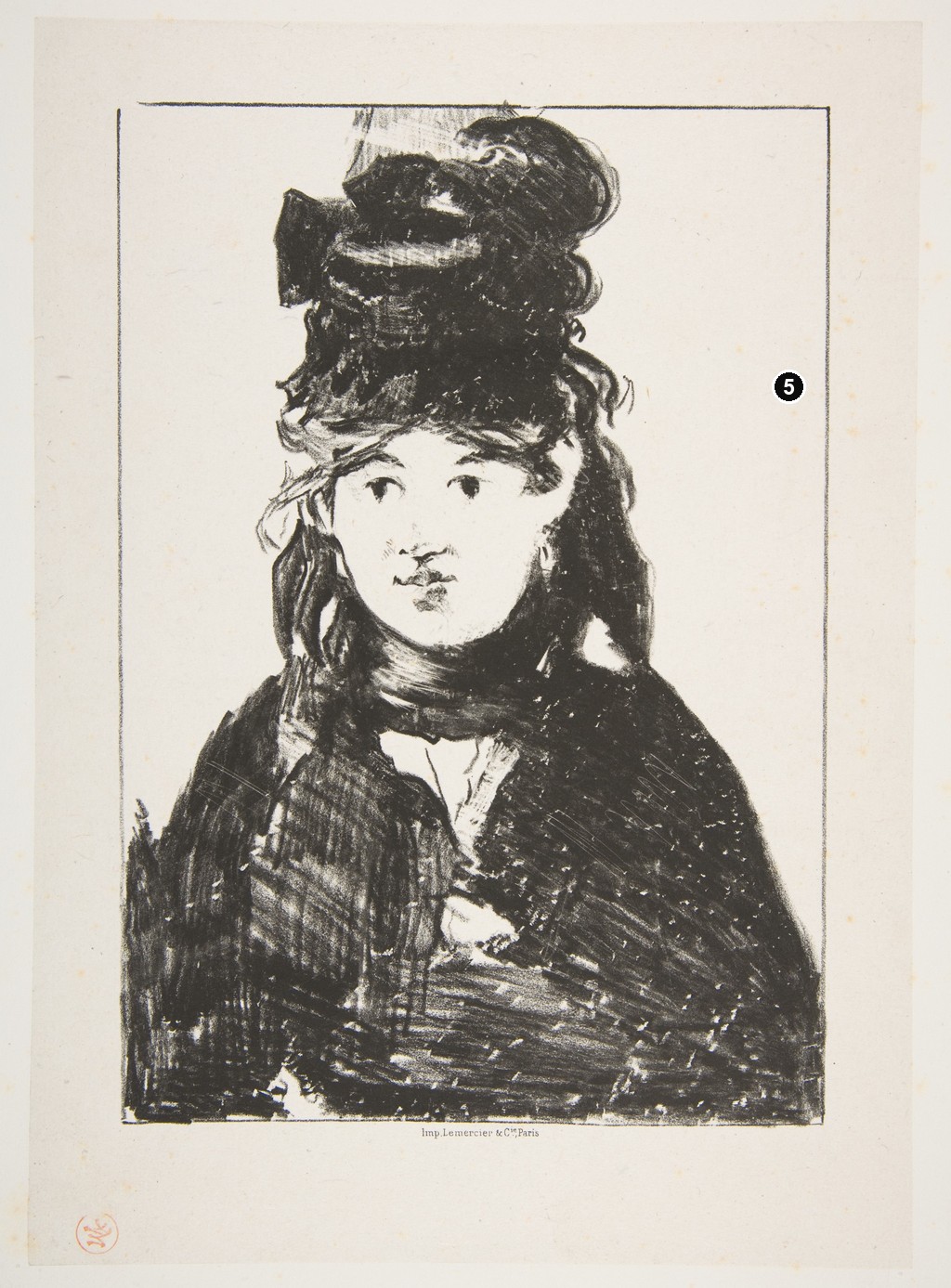
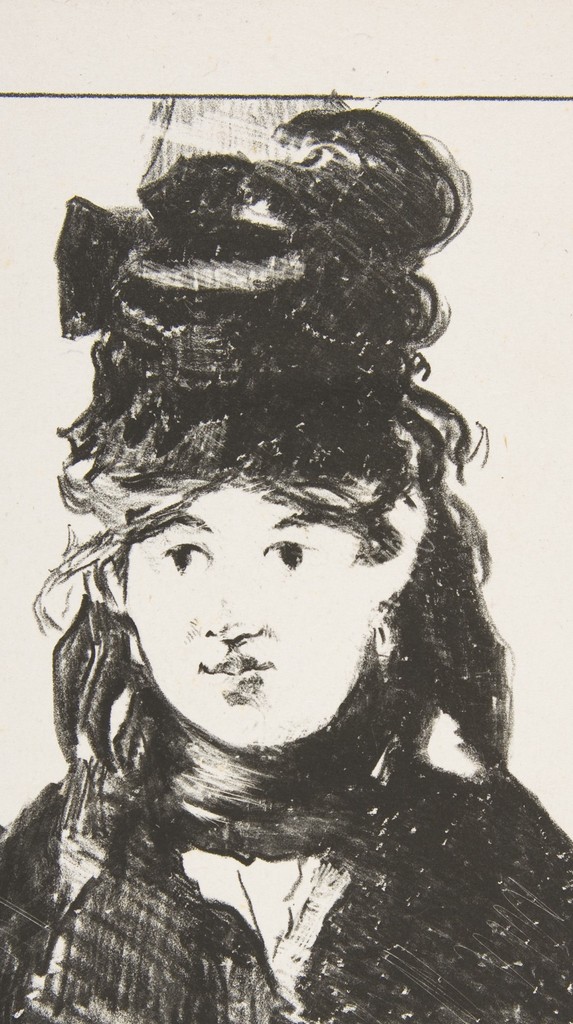
The Metropolitan Museum holds a lithograph titled Berthe Morisot (in Black), dated 1872–74 and published in 1884. Its impression is catalogued as the second of two states, printed and published by Lemercier & Cie. on chine collé.[5] The publication date belongs to the print’s history, separate from the painting’s date of 1872.
The hat retains its conspicuous silhouette, and the face keeps broadly the same orientation. But the printed face depends much more strongly on the light paper. Small dark marks establish eyes, nostrils and lips, while relatively open areas replace many of the oil’s gradual changes of colour and shadow.
The clothes become active in a different way. Broken black marks, pale streaks and changes of direction articulate surfaces that are more continuous in the painting. The hat looks both solid and worked over, with light openings interrupting its dark mass. Drawing makes its own rhythm within the familiar shape.
The lower figure changes more noticeably. Hands and a horizontally held fan occupy the foreground, extending the image beyond the arrangement of clothes and small violets in the oil. The fan gives the lower half a set of long directional marks that pull against the more upright head and hat.
Ives suggested that the closeness of the main contours might indicate Manet’s use of a traced photograph when preparing the lithograph.[4] That remains a proposed explanation of the resemblance. The visible result shows both continuity and invention: the face and hat identify the image, while paper, line and the reworked lower figure create another encounter with it.
The Met impression’s 1884 publication followed Manet’s death in 1883.[5] Its survival gives the painted likeness a further history in another medium, where the opposition of black and light can be explored with different resources.
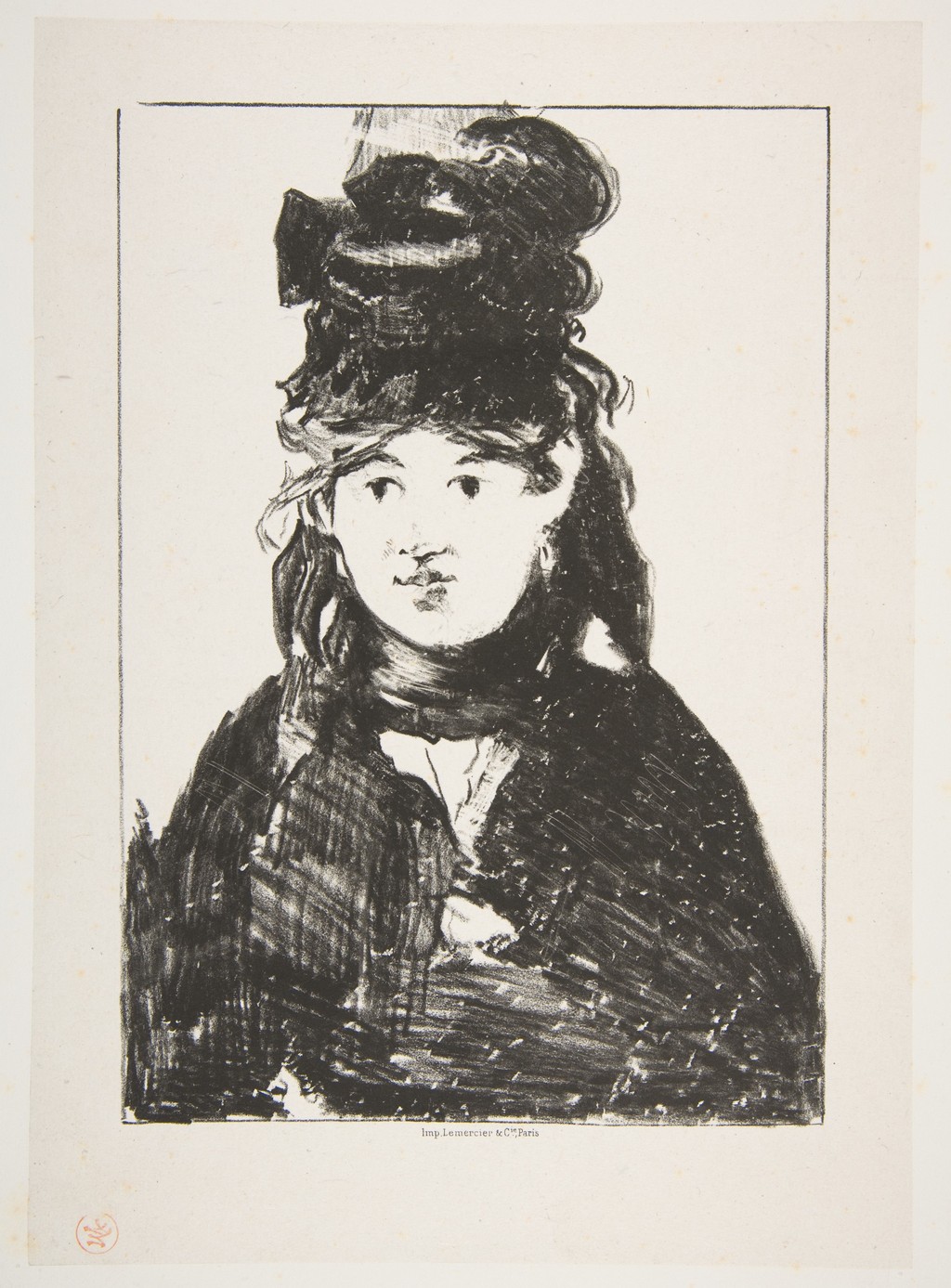
Édouard Manet, Berthe Morisot (in Black), 1872–74, published 1884. Lithograph on chine collé, state II/II. The Metropolitan Museum of Art, 23.21.22. Harris Brisbane Dick Fund, 1923. Image source. CC0 / Public domain.
A Later Portrait and a Changing Frame
The concentration on Morisot’s face continued in other pictures. The Musée Marmottan Monet owns Portrait de Berthe Morisot étendue, dated 1873. The museum records it as the surviving bust section of a larger painting of her reclining on a sofa, reduced by Manet. It entered the collection through Annie Rouart’s bequest in 1993.[6]
That history makes framing itself part of the portrait’s subject. A larger arrangement could be shortened until the head and bust carried its presence. The Violets portrait achieves its concentration through its own tall hat, broad shoulders and limited setting, keeping the face within a carefully weighted field of dark forms.
The comparison also places the 1872 painting within a sustained practice. A sitter could return, the pose and format could change, and the painter could reconsider how much surrounding information the image required. Familiarity provided opportunities for variation across separate works.
From Duret’s Collection to the Musée d’Orsay
The portrait belonged to Théodore Duret before Morisot acquired it at his sale on 19 March 1894. It then passed through her daughter Julie Rouart and the family. The Musée d’Orsay purchased it in 1998, with contributions from public and private supporters.[1]
Writing for the 1932 Orangerie retrospective, Paul Valéry placed no other Manet above this portrait, a judgement recalled by the Musée d’Orsay.[1] His praise came sixty years after the painting was made.
The picture can sustain that admiration through remarkably concentrated means. A face emerges from a broad arrangement of black; loose hair interrupts the hat’s weight; small flowers make colour briefly visible near the chest. Returning to the bouquet after studying the eyes changes its importance. What first seemed almost hidden becomes one of the details through which the portrait keeps drawing us back.
Annotated Details from Berthe Morisot with a Bouquet of Violets
The numbered points identify visible features discussed in this article. Return from each detail to the whole composition. Each caption identifies the work shown.
Berthe Morisot with a Bouquet of Violets
Édouard Manet, Berthe Morisot with a Bouquet of Violets, 1872. Musée d’Orsay, Paris, RF 1998 30. Musée d’Orsay / Google Art Project via Wikimedia Commons. Image source. Public domain.
Berthe Morisot in Black — Lithograph
Édouard Manet, Berthe Morisot (in Black), 1872–74, published 1884. Lithograph on chine collé, state II/II. The Metropolitan Museum of Art, 23.21.22. Harris Brisbane Dick Fund, 1923. Image source. CC0 / Public domain. Numbers added to a separate resized whole supplied overview. Detail crops from the unchanged original; no enlargement, retouching or colour alteration.
Details from BERTHE MORISOT WITH A BOUQUET OF VIOLETS
Follow the numbered details back to the complete images above. Each caption identifies the work shown.
Berthe Morisot with a Bouquet of Violets
The face beneath the brim
The eyes look outward beneath the low dark brim. Lighter and darker strokes divide the face without softening every transition.
The hat against the pale ground
Loops, folds and a curved feather give the black hat an uneven outline. The pale ground makes its changing silhouette easy to follow.
Openings between the ribbons
Dark ribbons fall beside the face. Small openings allow the pale ground to appear between them, separating several narrow black shapes.
The small bouquet
A few blue-violet and pale touches identify the bouquet near the lower centre. Its small coloured area is surrounded by the much larger dark clothing.
Berthe Morisot in Black — Lithograph
Face beneath the Tall Hat
Dark marks gather in the tall hat and ribbons around the pale face of the separate lithograph.
Artworks directory
Explore selected paintings, drawings and prints by Édouard Manet. Search by title or another recorded name.
Frequently Asked Questions
Yes. She and her sister Edma exhibited at the Salon from 1864, and Berthe developed her own career alongside her appearances in Manet’s portraits.[2]
The small blue-violet bouquet is attached near the centre of her chest, below the pale opening at the neckline.
She married his brother Eugène in 1874.[2]
It belongs to the Musée d’Orsay in Paris, which acquired it in 1998.[1]
Discussion
Look again at the images and ideas explored in Berthe Morisot with a Bouquet of Violets by Édouard Manet. These editorial prompts invite your observations.
Reader Insights
Compare the pale spaces inside the ribbons with the pale opening at the throat.
Follow the edge of the hat where it meets the background, then look for places where its folds nearly disappear into black.
In the lithograph, notice how light paper takes over some of the work done by skin colour and shadow in the oil.
Join the Conversation
Share a detail, comparison or question about Berthe Morisot with a Bouquet of Violets by Édouard Manet below.
References
- Musée d’Orsay. “Berthe Morisot au bouquet de violettes,” 1872, RF 1998 30. Current object details, provenance and commentary on the eyes and Valéry’s 1932 praise. View source. (in French).
- Musée d’Orsay. “Berthe Morisot, modèle d’Édouard Manet.” 7 March 2025; extract from the 2023 Manet / Degas exhibition presentation. Training, Salon appearances, artistic circle and the 1874 marriage. View source. (in French).
- Heather Lemonedes Brown. “Manet & Morisot: An Artistic Friendship.” Cleveland Museum of Art, 11 February 2026. Reciprocal artistic exchange and collecting. View source.
- Colta Feller Ives. French Prints in the Era of Impressionism and Symbolism. The Metropolitan Museum of Art Bulletin 46, no.1, Summer 1988, p.10. The related prints and a proposed explanation of their contours. View source.
- The Metropolitan Museum of Art. “Berthe Morisot (in Black),” 1872–74, published 1884, 23.21.22. Current lithograph record, state, medium, printer and publisher. View source.
- Musée Marmottan Monet. “Portrait de Berthe Morisot étendue,” 1873, inventory 6086. The cropped canvas and its family history. View source. (in French).
- Splash image, Édouard Manet, Berthe Morisot with a Bouquet of Violets, 1872. Musée d’Orsay, Paris, RF 1998 30. Musée d’Orsay / Google Art Project, via Wikimedia Commons. Image source. Public domain.


