


 by Tom Gurney
Tom Gurney BSc (Hons) is an art history expert with over 20 years experience
Email: tomgurney1@gmail.com / Phone: +44 7429 011000
Édouard Manet Family and Models: Introduction
A pianist at her instrument, a child carrying a sword and a fellow painter in a black hat belong to different kinds of picture. They also belong to the network of people who sustained Édouard Manet's work. His family offered money, companionship and repeated opportunities to paint. Professional models and artist friends brought other experiences into the studio. Several people crossed these boundaries during their lives.[1]
Following those relationships changes what a familiar face can mean. Suzanne Leenhoff had a musical career; Victorine Meurent painted and exhibited; Berthe Morisot developed an independent approach to modern life. Léon Leenhoff grew from a child model into a keeper of Manet's records. Their appearances in paintings form one part of a larger history of work, family and friendship.
At a Glance
- ParentsAuguste Manet and Eugénie-Désirée Fournier
- BrothersEugène and Gustave Manet
- WifeSuzanne Leenhoff, a Dutch pianist; married Manet in 1863
- StepsonLéon Leenhoff, Suzanne's son, born in 1852; biological father remains unidentified
- Artist and modelVictorine Meurent
- Model documented in a notebookLaure, whose surname is unknown
- Artist colleague and sister-in-lawBerthe Morisot, who married Eugène in 1874.[1]
Édouard Manet in context
Édouard Manet
1832–1883Edgar Degas
1834–1917Claude Monet
1840–1926Berthe Morisot
1841–1895Pierre-Auguste Renoir
1841–1919Contents
- The Household Behind the Studio
- Suzanne Leenhoff and the Life of a Musician
- Léon Leenhoff: Child, Character and Stepson
- Victorine Meurent as Model and Painter
- Laure: A Name Beside an Address
- Berthe Morisot: Colleague and Sister-in-Law
- Keeping the Work After Manet's Death
- Annotated details
The Household Behind the Studio
Manet came from a prosperous family. His father, Auguste, worked in the French justice system, while income and property on both sides of the family helped establish a comfortable household. Édouard was the eldest of three sons; Eugène and Gustave followed him. Diana Seave Greenwald's account of the family places these resources beside the more visible contributions of relatives as models and companions.[1]
That financial background gave Manet room to pursue paintings that attracted controversy and found few buyers. Materials, a working space and time to revise a large canvas all had practical costs. The family's support helped make artistic independence possible even when public recognition and sales lagged behind his ambitions. The familiar image of a painter confronting the Salon therefore rests partly on resources supplied outside the exhibition room.
His mother, Eugénie-Désirée, also connected the household with the artistic circle. Greenwald describes her invitations to Henri Fantin-Latour and her continuing role as a hostess. Family and artistic friendship met in the same rooms. Home and café were overlapping parts of his artistic life.[1]
Relatives were close at hand when a composition needed bodies, faces or costumes. Their recurring appearances also made them familiar to the painter over time. The Gardner Museum's family exhibition shows how such encounters could continue across paintings, drawings and prints, with an image being cropped, reversed or reworked for a different medium.[2]
This intimacy did not make every family picture an informal record of an ordinary afternoon. A known person could adopt an unfamiliar pose or wear historical clothes. Recognising the sitter gives the image a biographical connection, while the chosen setting and activity establish the character that the painting presents. Manet's biography supplies the wider chronology; the relationships help explain who was available to make those pictures possible.
Suzanne Leenhoff and the Life of a Musician
Suzanne entered the Manet household through music. A Dutch pianist living in Paris, she was hired as a teacher in 1849. The surviving evidence leaves uncertainty about precisely which of the brothers she taught. She gave birth to Léon in 1852 and married Édouard in the Netherlands in 1863.[1] Her connection with the family thus preceded the marriage by many years.
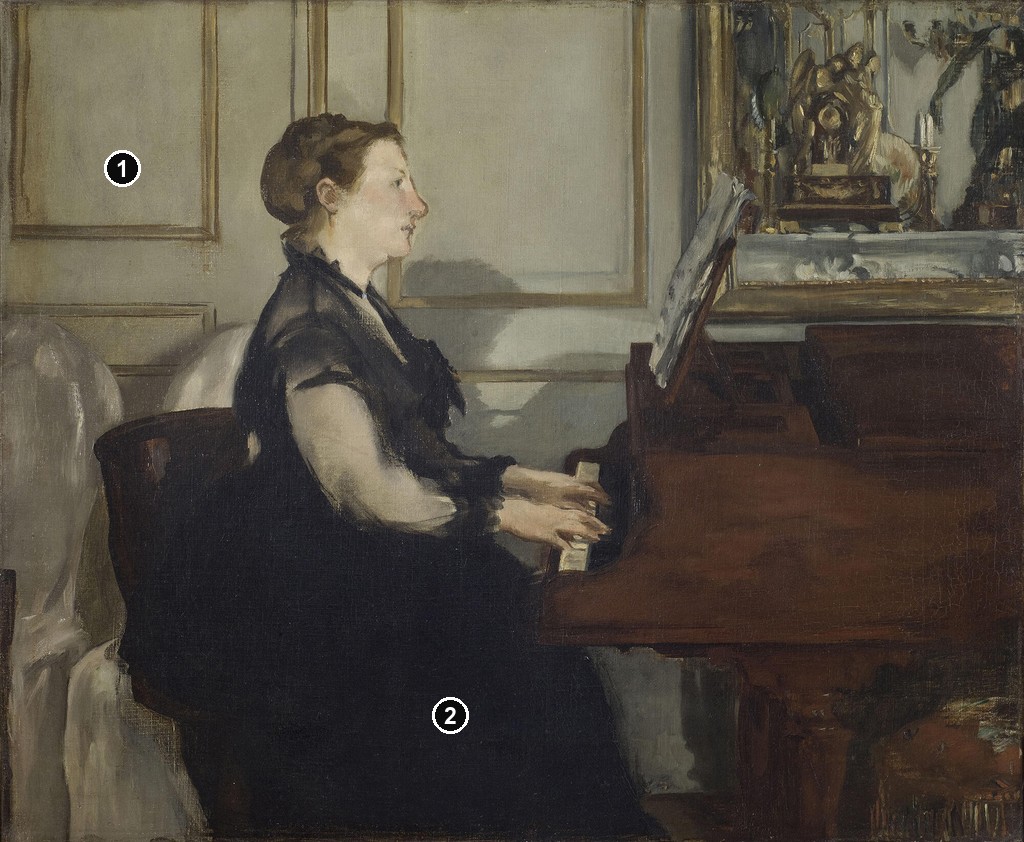
The piano offered Manet a subject rooted in her own accomplishment. In Madame Manet at the Piano, dated 1868 by the Musée d'Orsay, Suzanne faces the music stand with both hands at the keyboard. The small oil painting measures 38.5 cm high by 46.5 cm wide.[3] Its scale brings us close to an activity rather than presenting a grand public performance.
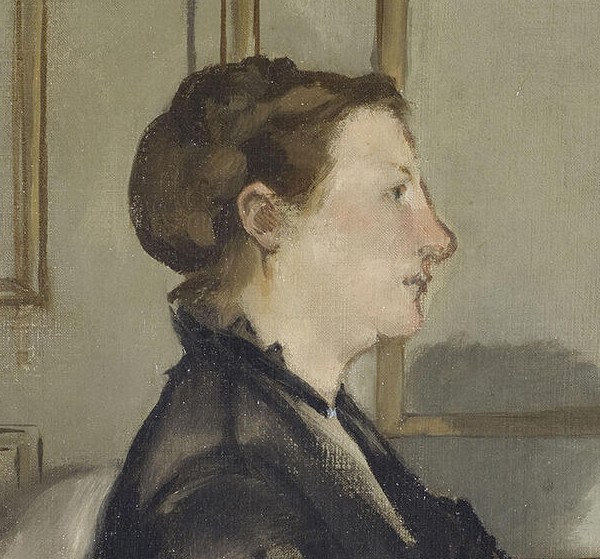
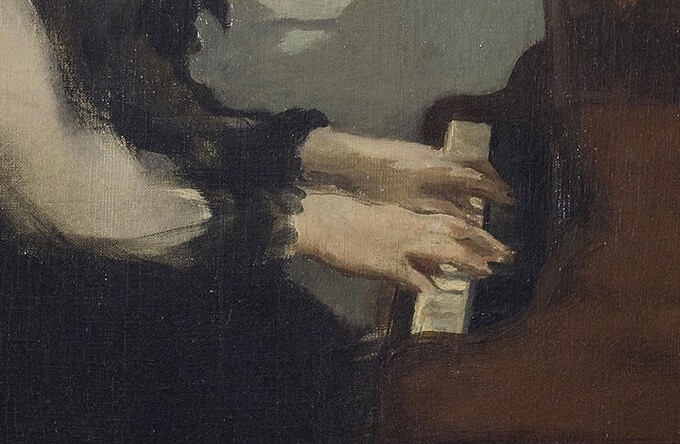
Her profile is clear against the pale wall. Below it, the black dress forms a substantial dark mass, with the forearm and fingers carrying light towards the keys. The brown instrument extends across the foreground and occupies almost as much attention as the figure. Face, hands and piano work together: the likeness is embedded in the act of reading and playing.
The pages on the stand remain unidentified. What can be followed is the direction of her attention and the connection between her body and an instrument she knew how to use. Those visible relationships give the painting its musical specificity without requiring the viewer to imagine a particular tune.
Music was one of Suzanne's contributions to gatherings around the Manets. Greenwald describes her playing for the company while Eugénie retained much of the household's hosting role.[1] These were different forms of participation in the same social world. The piano portrait gives Suzanne's contribution a bodily presence: she reads, sits and places her hands, rather than merely furnishing a room with the idea of culture.
Her appearances elsewhere are more varied. Manet could place Suzanne within compositions drawing on older art as well as depict her in contemporary clothing. Greenwald traces this range through the drawings and paintings in which she posed.[1] The instrument therefore offers one especially direct link between an image and her independent skill. It cannot account for every role she took before her husband's easel.
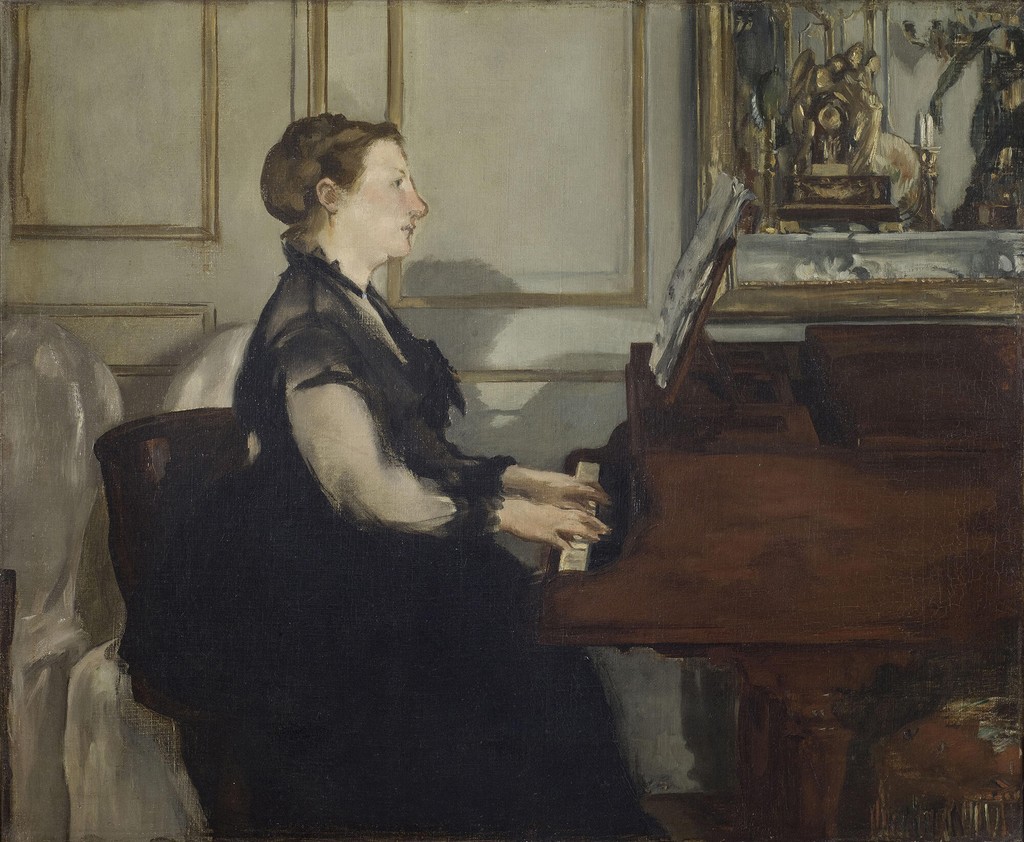
Édouard Manet, Madame Manet at the Piano, 1868. Musée d’Orsay, Paris, RF 1994. Musée d’Orsay; faithful public-domain reproduction via Wikimedia Commons. Image source. Public domain.
Léon Leenhoff: Child, Character and Stepson
Léon's place in the household is the subject of a long-running biographical debate. He was Suzanne's son, born in 1852, and became Manet's stepson when the couple married. His biological father's identity has not been established. Greenwald reviews the competing explanations and the uneven documentary evidence without making a certain identification.[1]
This unresolved question has sometimes overshadowed the much more tangible record of his participation in Manet's work. A child repeatedly available to pose could become a boy in historical costume, an attendant at the edge of a scene or a prominent adolescent in modern clothes. Each appearance belongs to a composition with its own demands. Similarity to an adult's face or position within a painted group cannot settle the missing biological evidence.
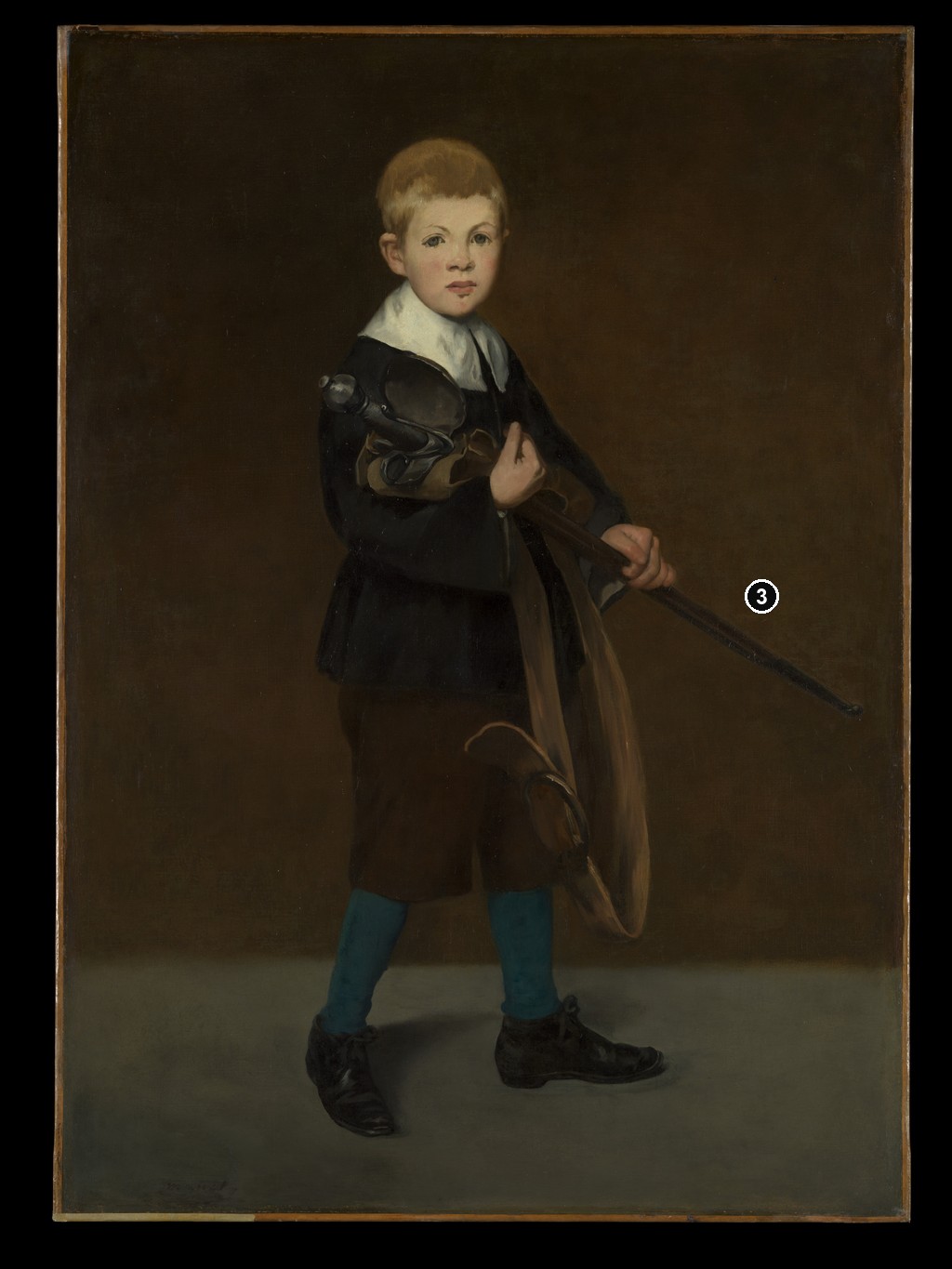
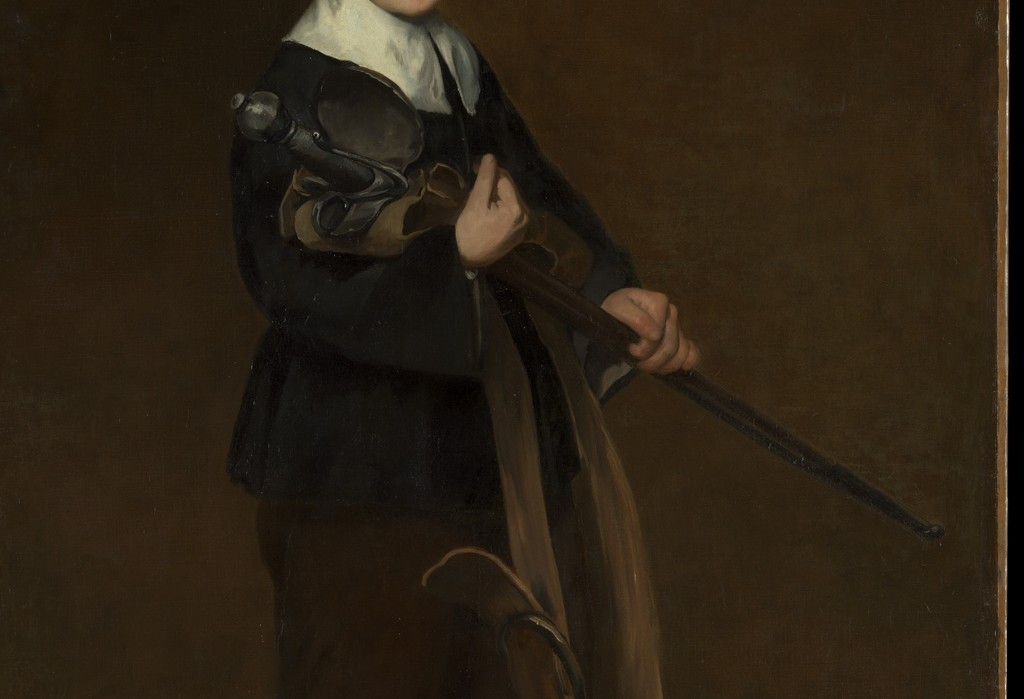
The Metropolitan Museum identifies Léon in Boy with a Sword, painted in 1861, and reports his later recollection of posing. It describes a seventeenth-century costume and a period sword used as a prop.[4] The clothes and weapon establish an encounter with the art of an earlier age, even though the person wearing them belonged to Manet's immediate world.
The oversized sword supplies much of the picture's movement. Léon's hands hold it across his body, and the long sheath leads towards the right. His pale collar makes a crisp shape beneath his face; the broad brown clothing and blue stockings distinguish the small body from the dark background. The costume gives him pictorial importance while leaving his youth conspicuous.
The prop is also a physical problem for a child to manage. The hands gather the sword and its hanging straps while the feet are planted apart below. The effect depends on the relationship between the boy's size and what he carries. The historical role remains visibly something being performed.
Léon appears differently in the 1868 Luncheon in the Studio. Greenwald places this painting within the changing prominence given to him as he grew older.[1] Contemporary clothes and his position near the foreground replace the earlier costume, while other figures share the interior. His recurring presence lets us compare the painter's choices across time, rather than read the pictures as an uninterrupted family snapshot album.
Printmaking extended the life of these appearances. The Gardner labels describe Manet returning to Léon's sword-bearing image, reversing and modifying it for circulation in print.[2] A pose originating with a child in the studio could acquire a second public life on paper. Léon's contribution was therefore repeated through the artist's work even when the original sitting was over.
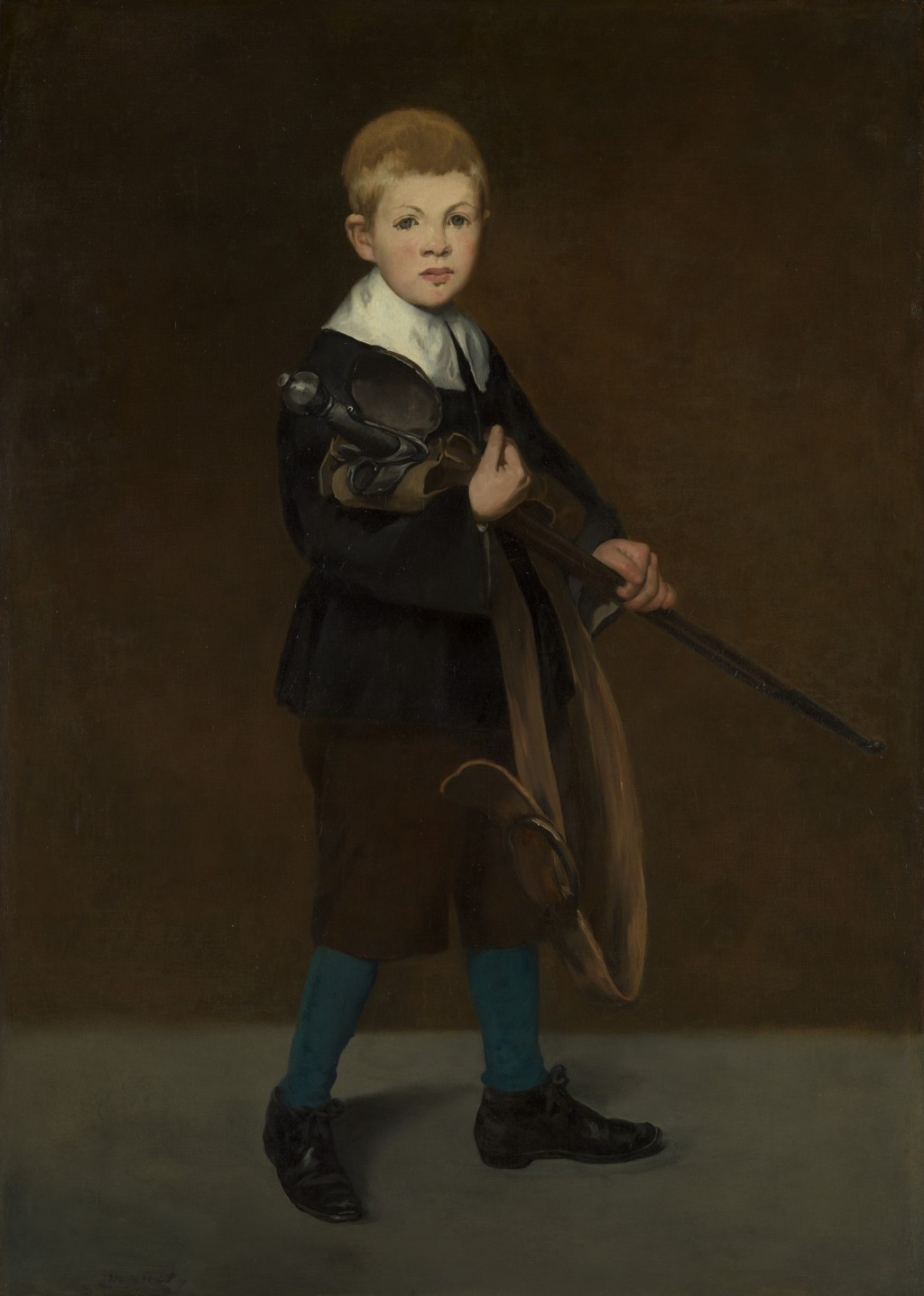
Édouard Manet, Boy with a Sword, 1861. The Metropolitan Museum of Art, New York, 89.21.2. Gift of Erwin Davis, 1889. Image source. CC0 / Public domain.
Victorine Meurent as Model and Painter
Victorine Meurent brought a different relationship to the studio. The Museum of Fine Arts, Boston, identifies her as a professional model and an artist who exhibited at the Paris Salon in 1876 and subsequently. Its portrait, dated about 1862, introduces the face that would recur in several of Manet's most consequential pictures.[5] Her work as a painter belongs beside her contribution as a sitter.
In the portrait, the strong reddish hair and pale face stand against a dark ground. A narrow black tie descends from the neck, while the light blouse offers a contrast with the more closely described features. Her head is turned slightly, and her eyes meet the viewer. The relatively spare setting makes the encounter depend on the face rather than an elaborate professional or domestic environment.
The same sitter could enter very different pictorial circumstances. Street Singer places a standing figure with a guitar before us; Olympia presents a reclining nude; The Railway gives a clothed woman a book and a place beside a child. These changes of clothing, objects and setting are part of what Manet makes with a model. They do not provide a sequence of occupations in Victorine's life.
Her own painting career changes the significance of the word “model.” It identifies one form of artistic work she undertook, alongside another in which she produced and exhibited pictures herself. The MFA's account restores this broader professional identity.[5] It does not require us to assign undocumented decisions in Manet's compositions to her. Posing already involved the practical contribution of a person whose body and attention made the represented encounter possible.
Nor does recognising her face make every story about her equally secure. A recurring likeness is useful visual evidence, but the distinction between a sitter's history and a character's role remains necessary. The woman in a painting can be a courtesan, musician or reader without determining the model's private circumstances. Victorine's documented Salon participation supplies a firmer way to extend her history beyond those roles.
A letter also connects her with the household after Manet's death. Morgan curator Sal Robinson identifies a letter of 31 July 1883 from Victorine to Suzanne, now in the museum's Manet collection.[6] Its survival places the professional model and the artist's widow within the same documentary history. The two women who appear so differently across the paintings were also people who could address one another outside them.
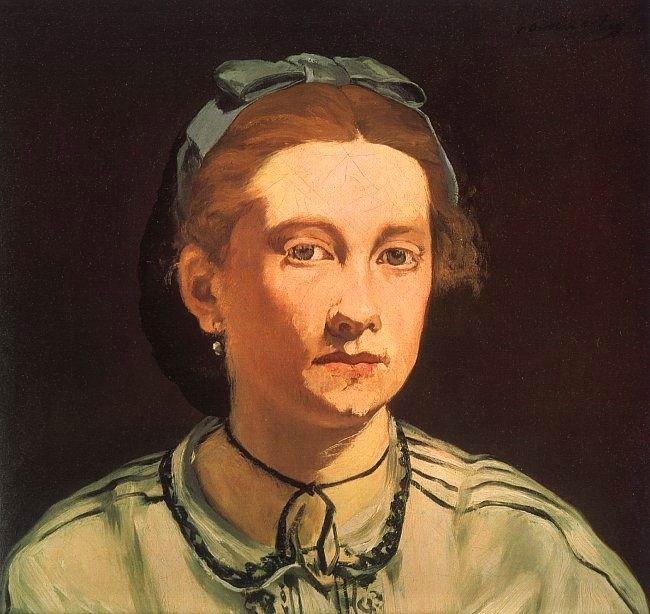
Édouard Manet, Victorine Meurent, about 1862, supplied portrait detail. Museum of Fine Arts, Boston, 46.846. This reproduction omits the lower portion of the painting. Museum of Fine Arts, Boston; faithful public-domain reproduction via Wikimedia Commons. Image source. Public domain. Resized from the supplied cropped detail; no additional cropping. The signature and lower ground are outside this supplied view.
Laure: A Name Beside an Address
Laure's surviving history is much thinner, but one small document gives it a precise foothold. In Manet's notebook of 1860–62, he recorded her name with an address at 11 rue de Vintimille. Colin B. Bailey discusses the entry in the Morgan Library's account of the notebook.[7] A working note brings a named woman into the geography of the artist's Paris.
The handwriting is modest evidence with considerable force. A forename and a street address belong to contact between people; they are different from the generic labels later attached to an image. The note establishes neither Laure's surname nor a complete account of her background. Its value lies partly in preserving an individual connection where so much of the person's history has been lost.
The separate Portrait of Laure in the Pinacoteca Agnelli, Turin, offers another encounter. The owning collection dates this oil painting to about 1862 and gives its dimensions as 61 cm high by 50 cm wide. Its collection booklet argues for considering the work as an independent portrait, rather than automatically treating it as a preparatory sketch for Olympia.[8]
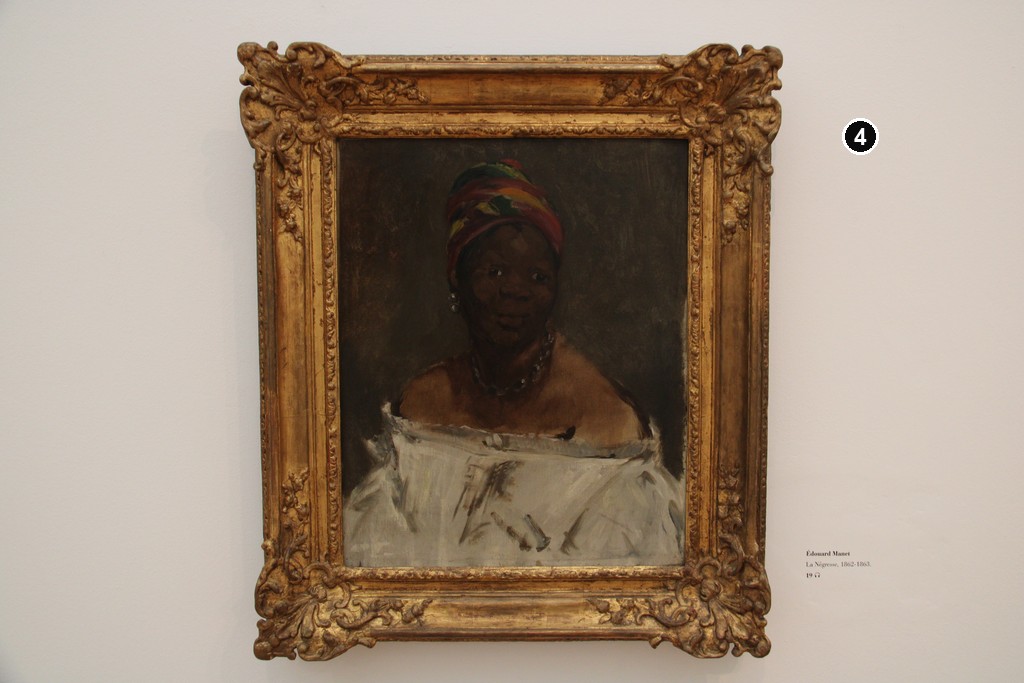
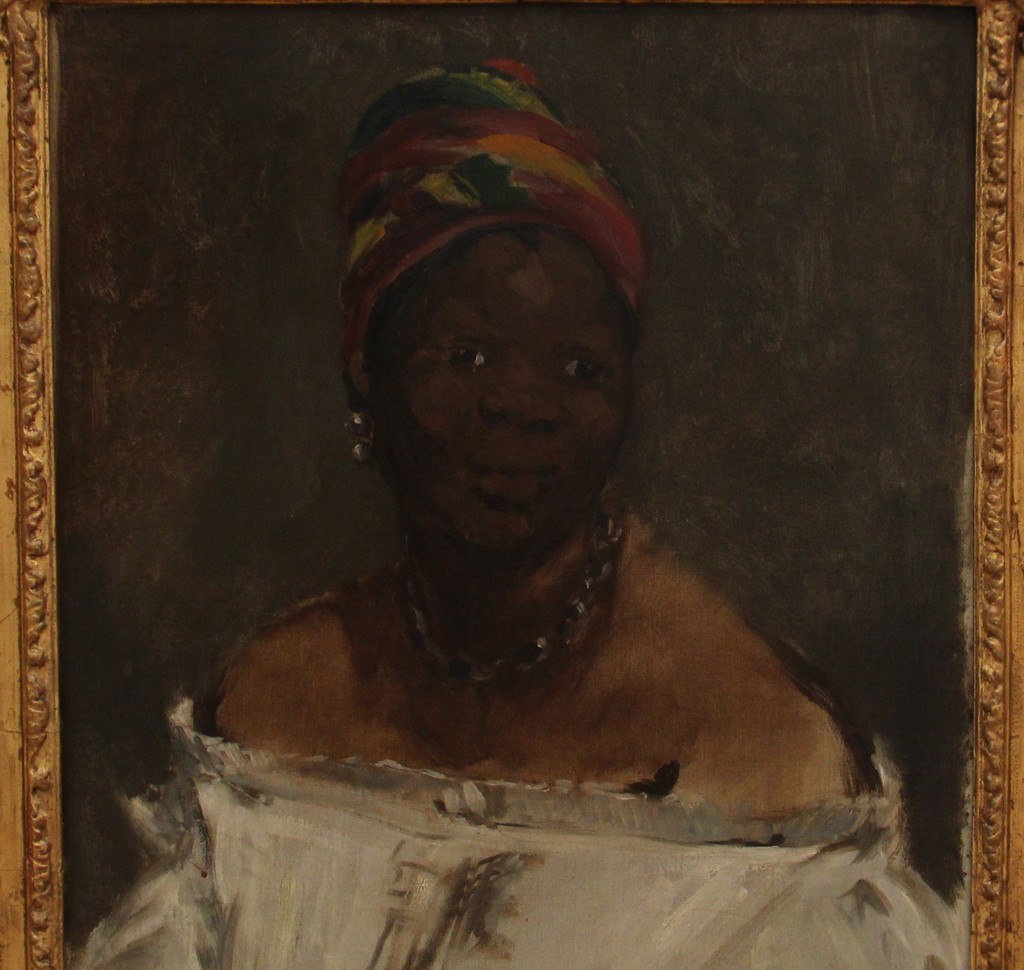
Laure turns slightly towards the right against a dark background. A patterned headwrap rises above her face, while a necklace and earrings create small bright accents. The broad pale garment fills the lower part of the picture. Its loose, darkly interrupted strokes differ from the more concentrated modelling of the head. The composition gathers attention around a particular face while allowing the clothing to remain conspicuously painted.
Seen this way, the portrait offers more than a means of identifying a secondary figure in a larger canvas. The sitter occupies the whole work. The relationship between her dark skin, the headwrap, jewellery and pale fabric establishes the portrait's own arrangement of colour and light. Her face is its centre of attention, rather than a detail encountered while looking elsewhere.
In Olympia, Laure stands beside the reclining Victorine and carries a bouquet. The Musée d'Orsay's Le modèle noir exhibition text interprets the depicted servant through racial and colonial conventions, including the role such a figure could play in indicating the courtesan's social standing.[9] That reading concerns the construction and history of the painted scene. It does not establish that Laure worked as a maid in life.
The comparison between portrait and large composition is especially useful because the same person is given such different responsibilities. In one, her face and upper body provide the complete subject; in the other, she participates in an exchange involving flowers, another woman and an implied visitor. Following her across those settings makes the difference between an individual and a pictorial role visible.
The notebook preserves a contact; the portrait presents a likeness. Together they bring Laure into view as a named person, while leaving much of her life undocumented.
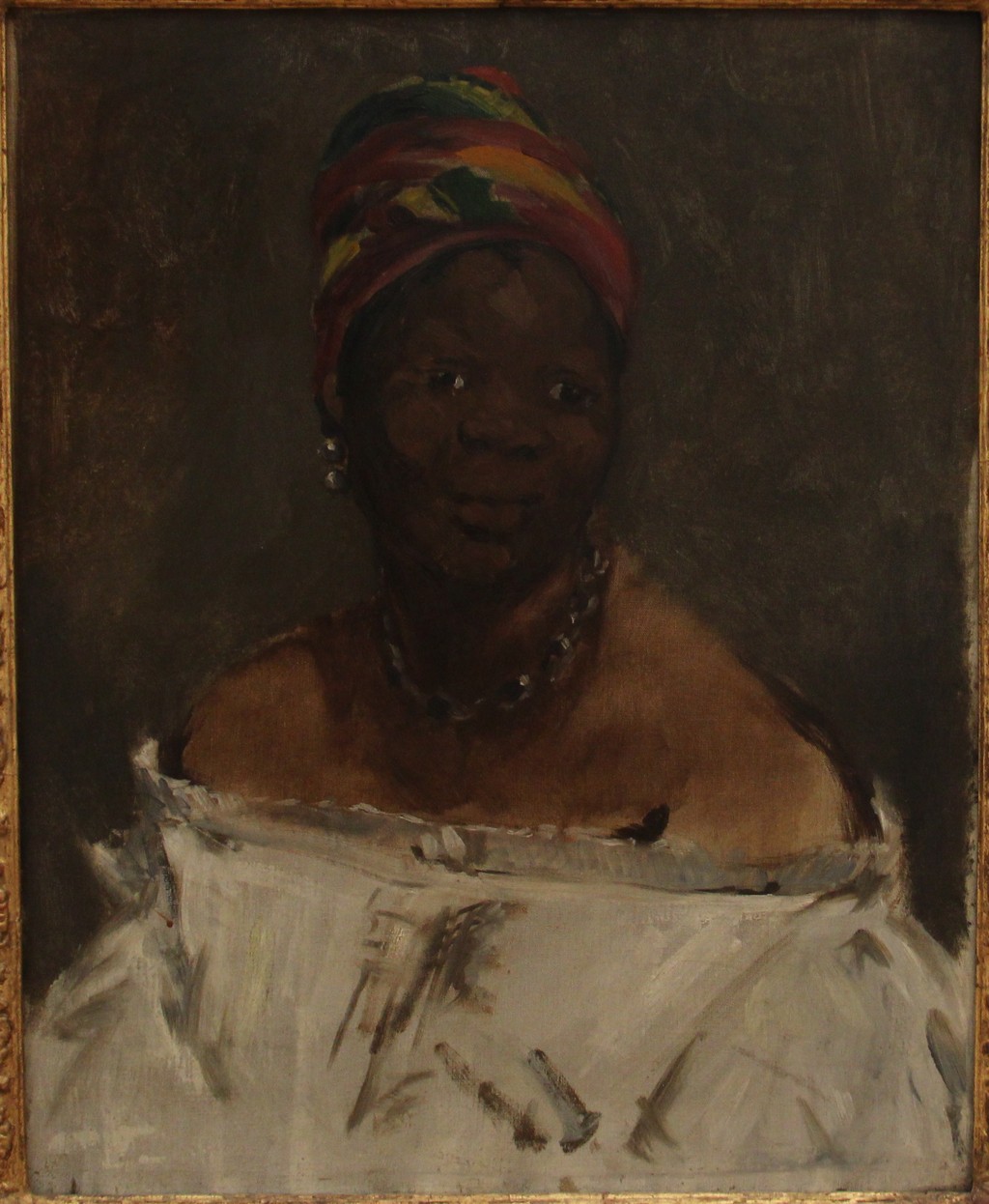
Édouard Manet, Portrait of Laure, about 1862. Pinacoteca Agnelli, Turin. Photograph: Mongolo1984 / Wikimedia Commons. Image source. CC BY-SA 4.0. Photograph by Mongolo1984, CC BY-SA 4.0. Cropped from the framed view and resized; narrow inner edge retained to preserve the painting.
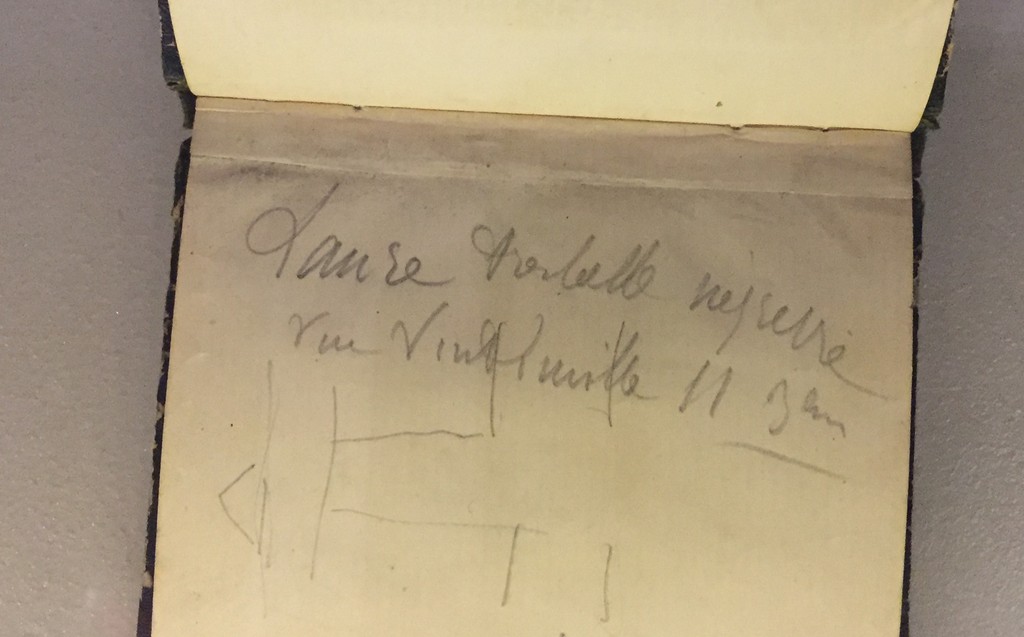
Édouard Manet, notebook of 1860–62, written leaf recording Laure, with part of the opposite blank leaf. The Morgan Library & Museum. Supplied partial book view. Photograph: Chris93 / Wikimedia Commons. Image source. CC BY-SA 4.0. Photograph by Chris93, CC BY-SA 4.0, resized without additional cropping. This supplied view is not a complete two-page spread.
Berthe Morisot: Colleague and Sister-in-Law
Berthe Morisot was already a practising painter with Salon experience when she met Manet in 1868. She began posing for him soon afterwards, and in 1874 she married his brother Eugène. Their relationship combined professional exchange, friendship, repeated sittings and eventually family membership.[1] The order matters: she arrived as an artist before becoming his sister-in-law.
Heather Lemonedes Brown's account for the Cleveland Museum of Art emphasises the exchange in both directions. Morisot looked to Manet for encouragement and responded to his work, while he came to admire and draw upon aspects of her subjects, colour and handling. They also collected one another's paintings.[10] This account gives a fuller picture than a one-way progression from master to pupil.
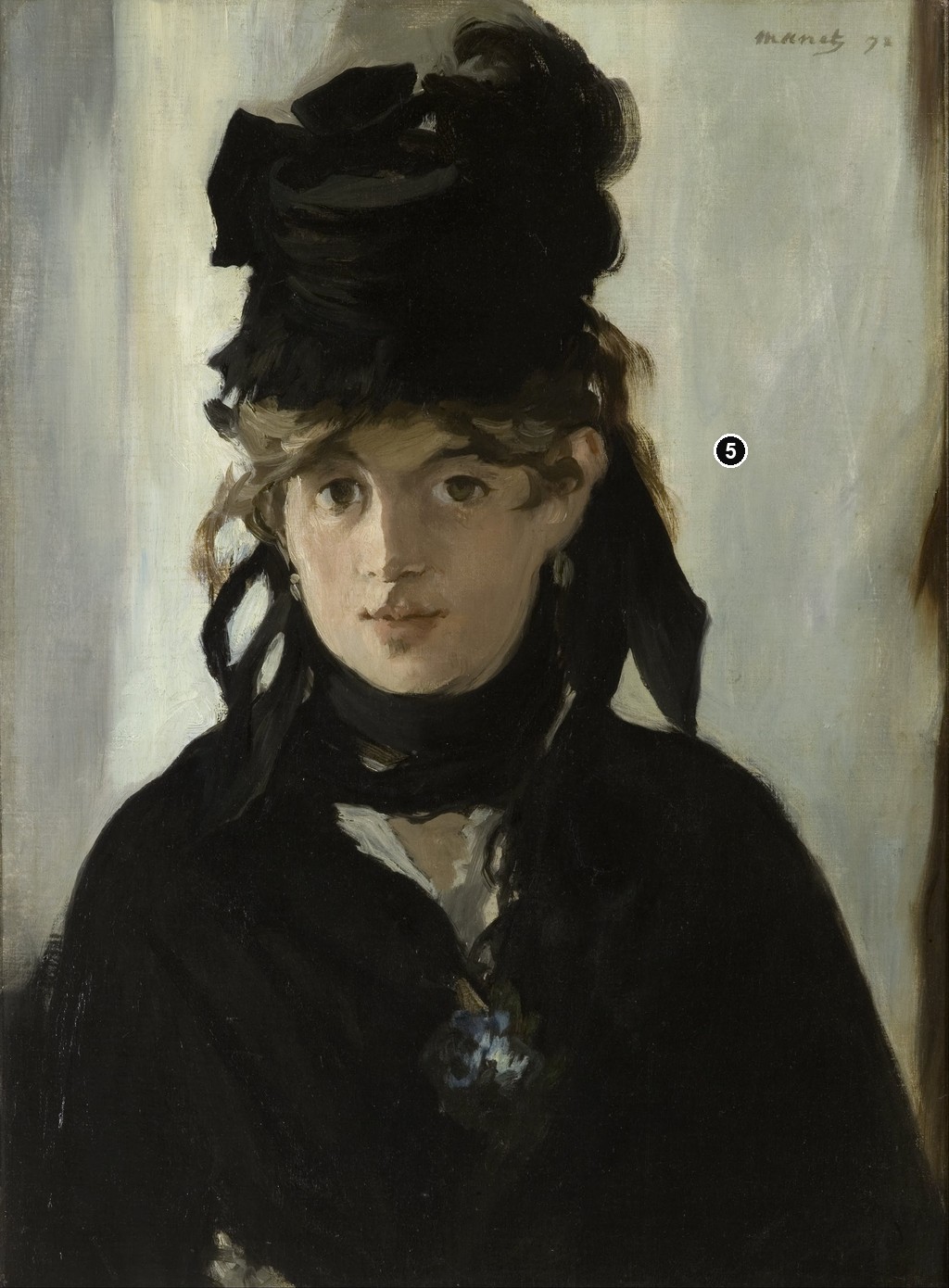
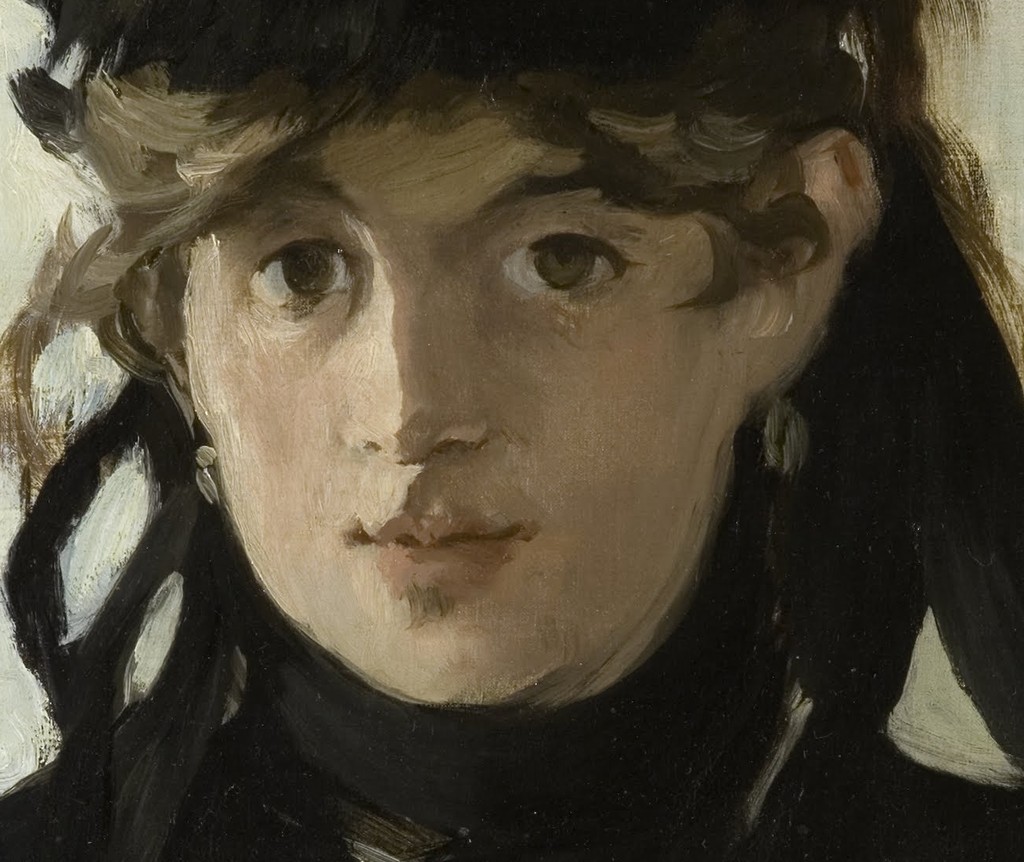
The portraits remain an extraordinary record of their encounters. In Berthe Morisot with a Bouquet of Violets, dated 1872 by the Musée d'Orsay, the large black hat, ribbons and clothing surround a comparatively small area of exposed face. The oil painting measures 55.5 by 40.5 cm.[11] It was made two years before her marriage to Eugène.
The black shapes seem substantial at first, but looking longer reveals different edges and densities. The hat's ribbons gather above the forehead; a loose curl breaks the contour beside the cheek; small violets appear low against the clothing. Light from the left divides the face, giving the features an intensity quite different from Suzanne's even profile at the piano.
These pictorial differences do not rank the women's personalities or reveal a private romantic story. They show Manet choosing a particular encounter with each sitter. Morisot's direct look and concentrated setting can be considered alongside her own awareness of painting, without turning the expression into a record of thoughts she never wrote down.
Her marriage did not end her career. Greenwald describes Eugène's support and Morisot's continuing participation in the Impressionist exhibitions.[1] Her paintings developed alongside those of the artists with whom the Manets socialised. Being part of a family connected her to that world, while her own decisions about subject and execution gave her an individual place within it.
Looking from the portrait to Morisot's wider relationship with Manet changes the scale of the story. The painted sitter becomes an artist who could look back critically, choose a different composition and pursue another effect. Her presence in his work belongs to a conversation sustained through paintings, letters and collecting.
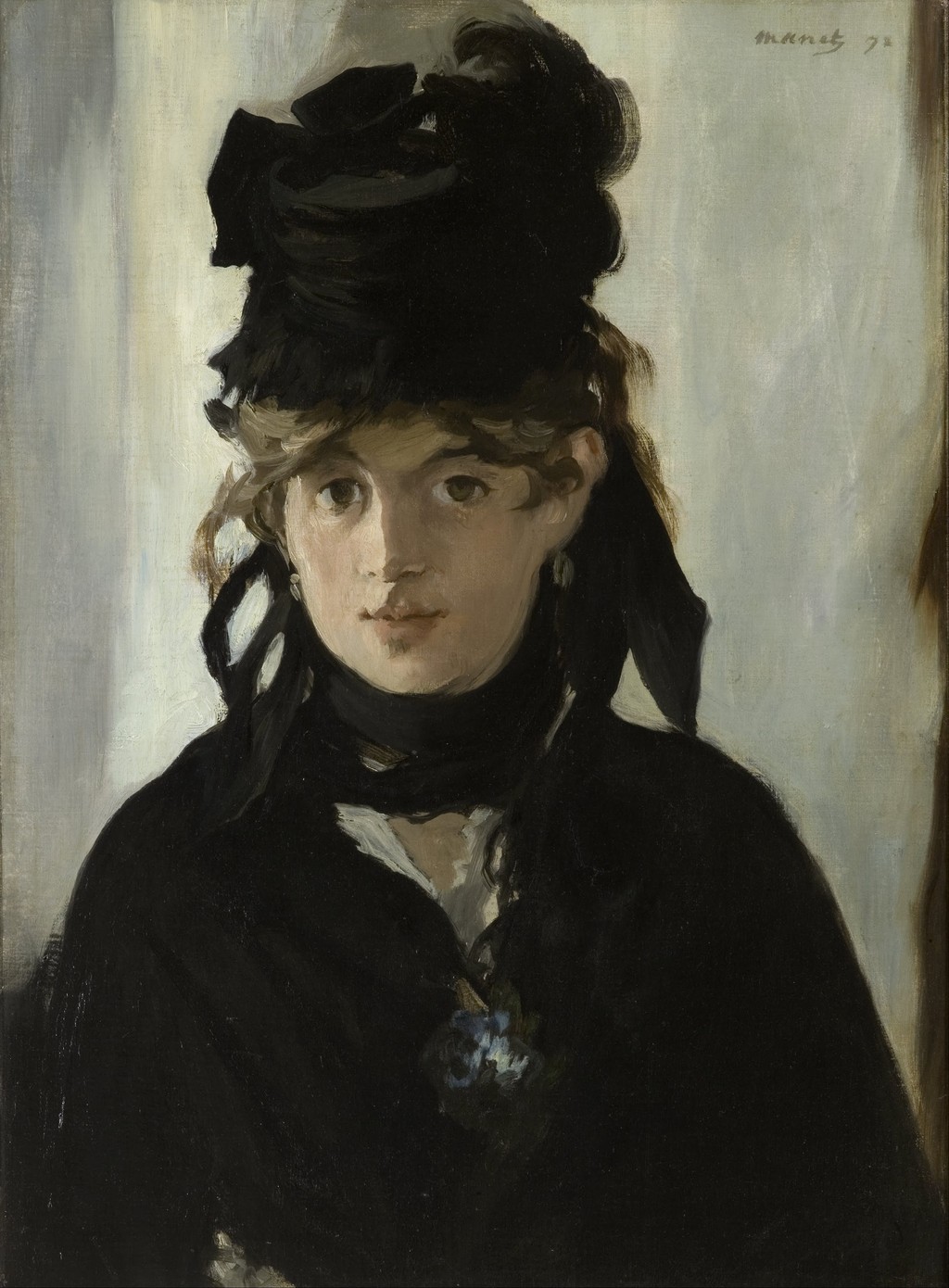
Édouard Manet, Berthe Morisot with a Bouquet of Violets, 1872. Musée d’Orsay, Paris, RF 1998 30. Musée d’Orsay / Google Art Project, via Wikimedia Commons. Image source. Public domain.
Keeping the Work After Manet's Death
The family's contribution continued after Manet died in 1883. Greenwald describes relatives helping with the posthumous exhibition and sale, retaining some pictures and acquiring others. Suzanne and Léon faced financial pressure and sold works from what they held.[1] Objects that had belonged to the household began to enter different collections through those decisions.
Suzanne's account notebook makes this practical responsibility unusually concrete. The Gardner exhibition identifies it as a record used between 1892 and 1900 and connects its entries with her finances and sales of paintings. Its display beside Léon's photographic inventory brings two forms of work into view: keeping track of money and keeping track of the art.[2]
Léon assembled photographs with annotations to document the studio's contents. The Gardner labels describe the cards subsequently being bound into albums.[2] The child who had once stood holding a sword thus helped create a different kind of image record. These photographs and notes made objects identifiable and allowed information to travel beyond the people who had seen them in Manet's rooms.
His recollections and the papers he preserved also contributed to later scholarship. Greenwald singles out his work with Adolphe Tabarant and Étienne Moreau-Nélaton, whose studies helped shape the account of Manet available to subsequent readers.[1] An inventory and a remembered conversation are different sorts of evidence, but both became part of the artist's afterlife through Léon's participation.
That stewardship was difficult. Greenwald records financial tensions and problems surrounding the later sale of retouched works and copies.[1] These complications belong to the history of the objects as they left the household. They make the family's work a subject for scrutiny as well as gratitude, while leaving its documentary contribution substantial.
Manet's family and models can consequently be followed through several kinds of activity. They posed, performed music, painted, hosted, bought, sold and preserved. A portrait captures one encounter within those longer lives. Returning to Suzanne's hands at the keyboard, Léon's cumbersome prop, Victorine's face, Laure's separate portrait and Morisot's concentrated gaze allows those lives to remain present alongside the painted roles.
Annotated Details from Manet’s Family and Models
The numbered points identify visible features discussed in this article. Return from each detail to the whole composition. Each caption identifies the work shown.
Madame Manet at the Piano — Manet
Édouard Manet, Madame Manet at the Piano, 1868. Musée d’Orsay, Paris, RF 1994. Musée d’Orsay; faithful public-domain reproduction via Wikimedia Commons. Image source. Public domain. Numbers added to a separate resized whole supplied overview. Detail crops from the unchanged original; no enlargement, retouching or colour alteration.
Boy with a Sword
Édouard Manet, Boy with a Sword, 1861. The Metropolitan Museum of Art, New York, 89.21.2. Gift of Erwin Davis, 1889. Image source. CC0 / Public domain. Numbers added to a separate resized whole overview retaining the supplied edges and margins. Detail crops from the immutable original; no enlargement or retouching.
Portrait of Laure — Framed Photograph
Édouard Manet, Portrait of Laure, about 1862. Pinacoteca Agnelli, Turin. Framed photographic view of the painting. Photograph: Mongolo1984 / Wikimedia Commons. Image source. CC BY-SA 4.0. Numbers added to a separate resized whole supplied photographic overview, retaining the frame and wall margins. Detail crop from the unchanged photograph by Mongolo1984 / Wikimedia Commons, under CC BY-SA 4.0; no brightening, reconstruction, enlargement or retouching.
Berthe Morisot with a Bouquet of Violets
Édouard Manet, Berthe Morisot with a Bouquet of Violets, 1872. Musée d’Orsay, Paris, RF 1998 30. Musée d’Orsay / Google Art Project, via Wikimedia Commons. Image source. Public domain. Numbers added to a separate resized whole supplied overview. Detail crops from the unchanged original; no enlargement, retouching or colour alteration.
Details from MANET’S FAMILY AND MODELS
Follow the numbered details back to the complete images above. Each caption identifies the work shown.
Madame Manet at the Piano — Manet
Profile and Dark Hair
Suzanne’s profile turns towards the piano above the dark collar and gathered hair.
Two Hands at the Keyboard
The two hands extend from dark cuffs towards the pale keys.
Boy with a Sword
The Hands, Guard and Scabbard
The two hands meet the elaborate guard and long scabbard at different heights, setting the sword’s diagonal across the costume.
Portrait of Laure — Framed Photograph
Headwrap and Pale Clothing
A striped headwrap rises above the face, while broad pale clothing gathers below the shoulders.
Berthe Morisot with a Bouquet of Violets
The face beneath the brim
The eyes look outward beneath the low dark brim. Lighter and darker strokes divide the face without softening every transition.
Artworks directory
Explore selected paintings, drawings and prints by Édouard Manet. Search by title or another recorded name.
Frequently Asked Questions
He married Suzanne Leenhoff, a Dutch pianist, in 1863. She had entered the family's circle as a piano teacher in 1849.[1]
Léon was Suzanne's son and became Manet's stepson through the marriage. His biological father's identity remains unresolved.[1]
Yes. The Museum of Fine Arts, Boston, identifies her as a painter who exhibited at the Paris Salon in 1876 and afterwards, as well as a professional model.[5]
Discussion
Look again at the images and ideas explored in Édouard Manet Family and Models. These editorial prompts invite your observations.
Reader Insights
Follow the relationships between Suzanne's face, the score and her hands in the piano portrait. Which parts make her musical activity clearest?
Consider Laure as the sole subject of a portrait and as a participant in Olympia. How does the change of setting direct your attention?
How does knowing that Victorine and Morisot made paintings themselves affect your response to their appearances in Manet's work?
Join the Conversation
Share a detail, comparison or question about Édouard Manet Family and Models below.
References
- Diana Seave Greenwald, “Édouard Manet: A Family Story,” in Manet: A Model Family, 2024, pp. 13–33, especially pp. 13–16, 23–28 and 30–32 (in English). View source.
- Isabella Stewart Gardner Museum, Manet: A Model Family, large-print exhibition labels, 2024, PDF pp. 25–26 and 54–58; family models, prints and archival records (in English). View source.
- Musée d'Orsay, Madame Manet au piano, 1868, RF 1994; collection record (in French). View source.
- The Metropolitan Museum of Art, Boy with a Sword, 1861, 89.21.2; sitter, costume and prop (in English). View source.
- Museum of Fine Arts, Boston, Victorine Meurent, about 1862, 46.846; portrait and the sitter's career (in English). View source.
- Sal Robinson, “Manet at the Morgan: A Processing Project,” The Morgan Library & Museum, 2024; Victorine's letter to Suzanne (in English). View source.
- Colin B. Bailey, Édouard Manet: A Notebook, Introduction, The Morgan Library & Museum, 2019; Laure's entry on p. 98, fol. 110 (in English). View source.
- Pinacoteca Agnelli, collection booklet, printed November 2023, Portrait of Laure, pp. 16–17; object details and independent-portrait interpretation (in Italian and English). View source.
- Musée d'Orsay, Le modèle noir, de Géricault à Matisse, 2019 press dossier, “Autour d'Olympia,” PDF pp. 25–26 (in French). View source.
- Heather Lemonedes Brown, “Manet & Morisot,” Cleveland Museum of Art, 11 February 2026; reciprocal artistic exchange (in English). View source.
- Musée d'Orsay, Berthe Morisot au bouquet de violettes, 1872, RF 1998 30; collection record (in French). View source.
- Splash image, Édouard Manet, Madame Manet at the Piano, 1868. Musée d’Orsay, Paris, RF 1994. Musée d’Orsay; faithful public-domain reproduction via Wikimedia Commons. Image source. Public domain.


