


 by Tom Gurney
Tom Gurney BSc (Hons) is an art history expert with over 20 years experience
Email: tomgurney1@gmail.com / Phone: +44 7429 011000
Édouard Manet at the Salon: Introduction
Édouard Manet's public career unfolded through repeated encounters with the Paris Salon. Its juries admitted some pictures, refused others and eventually awarded him a medal. Critics could praise his ability while disputing his choices of subject, colour or finish. A work that won a place on the wall might still provoke laughter in the galleries and satire in the press.
Following those encounters makes the changing reception of his paintings more intelligible. Early recognition, the notoriety of Olympia, Zola's advocacy and the success of Spring belong to different moments. Each involved a particular picture and a particular audience, with no certainty that one favourable response would secure the next.
At a Glance
- First Salon recognitionAn honourable mention in 1861 for The Spanish Singer
- Salon des RefusésLe Déjeuner sur l'herbe exhibited as Le Bain in 1863
- Official Salon controversyOlympia, admitted in 1865
- Independent exhibitionManet's own display in 1867
- Later recognitionSecond-class Salon medal and Légion d'honneur appointment in 1881
- Final Salon pairA Bar at the Folies-Bergère and Jeanne, also called Spring, in 1882
Édouard Manet in context
Édouard Manet
1832–1883Edgar Degas
1834–1917Claude Monet
1840–1926Berthe Morisot
1841–1895Pierre-Auguste Renoir
1841–1919Contents
- Why the Salon Mattered
- The Spanish Singer and Early Recognition
- Two Different Exhibitions in 1863
- Olympia Was Admitted to the Salon
- A Painting Recast as a Caricature
- Refusal in 1866 and Zola's Defence in 1867
- Castagnary Wanted the Figures to Explain Themselves
- Remaining at the Salon While Friends Exhibited Independently
- Official Recognition in 1881
- Two Paintings at the Salon of 1882
Why the Salon Mattered
The Salon offered access to a large public and to the professional notice that could follow exhibition. Selection, hanging and awards helped establish an artist's standing. Jason Rosenfeld's account of nineteenth-century exhibition institutions also stresses that challenging work repeatedly appeared within official venues.[1] Their walls contained disagreements as well as accepted conventions.
For an artist, admission opened the possibility of being seen alongside competitors and predecessors. For a viewer, a large exhibition invited comparison: one painting's surface, scale or subject could look especially striking beside another. Critics extended those encounters into print, describing pictures for readers who might subsequently visit or might know the exhibition only through reports.
Manet continued to pursue this audience throughout his career. His repeated submissions gave the Salon an enduring place in his biography, even as galleries and independent exhibitions offered other routes to visibility. Refusal was a practical obstacle, but admission itself could begin a fresh dispute. The jury's selection and the responses of critics were separate events.
The Spanish Singer and Early Recognition
Manet's first refusal was followed by a conspicuous success. Juliet Wilson-Bareau contrasts the rejection of The Absinthe Drinker in 1859 with the acceptance of The Spanish Singer at the Salon of 1861. The latter painting received an honourable mention and was moved to a better position on the walls.[2] The official system had recognised him early, before the pictures that would make his name notorious.
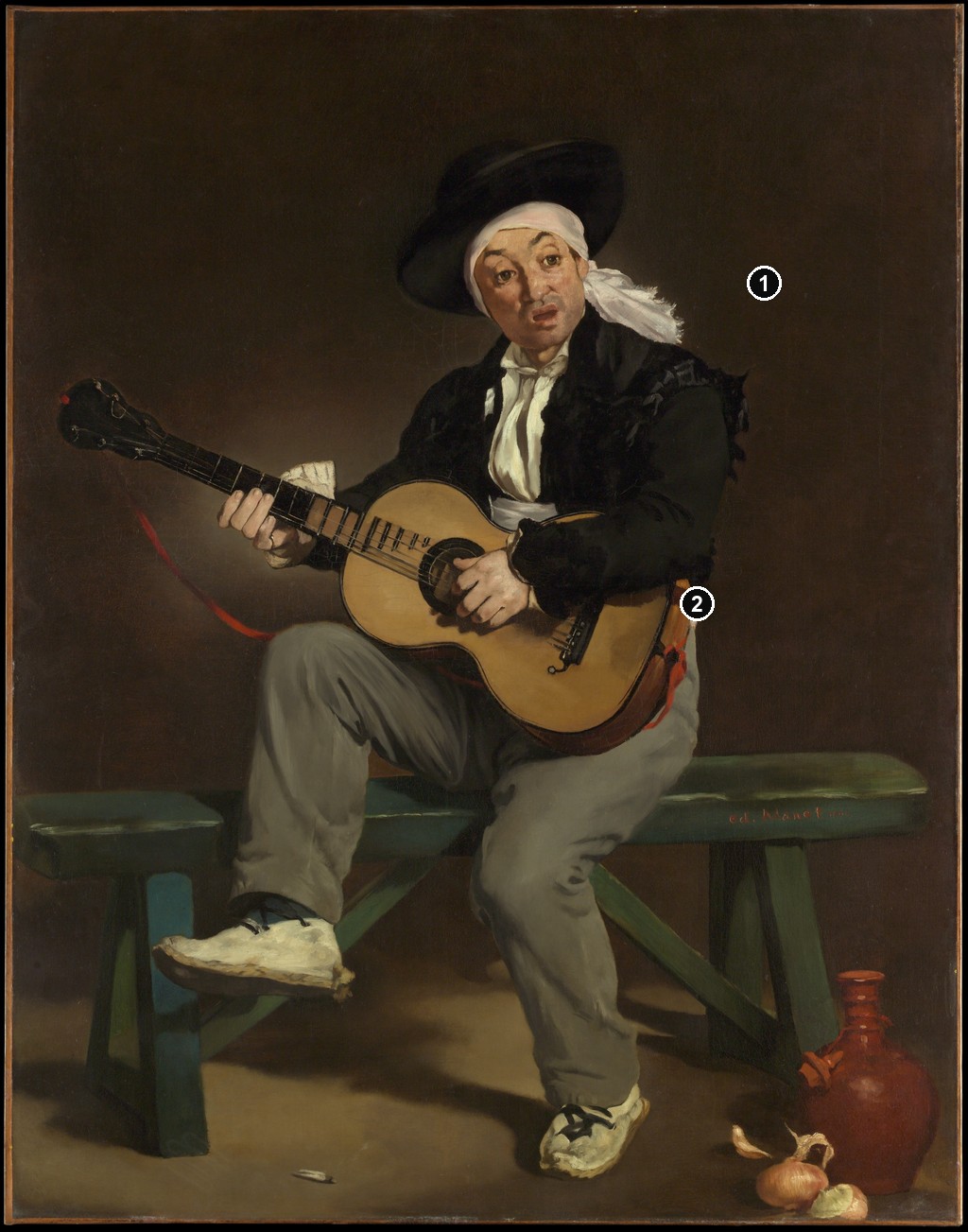
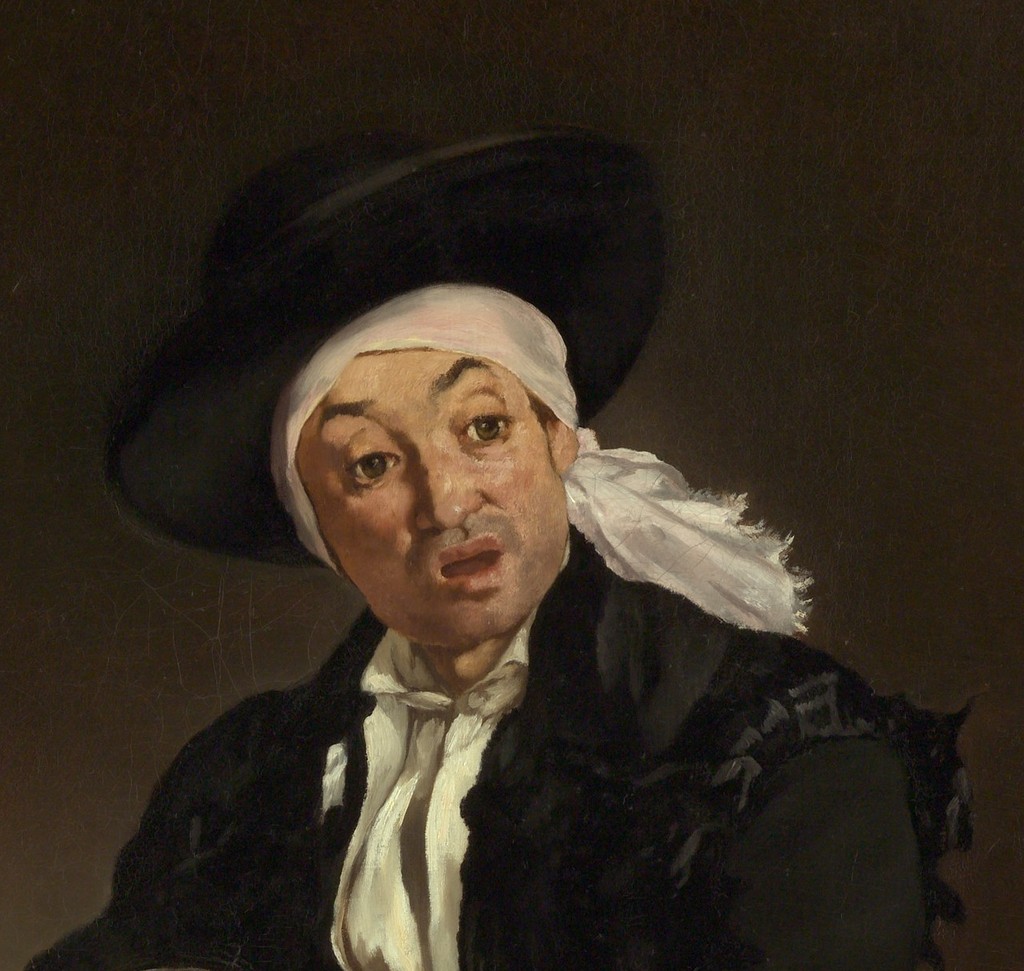
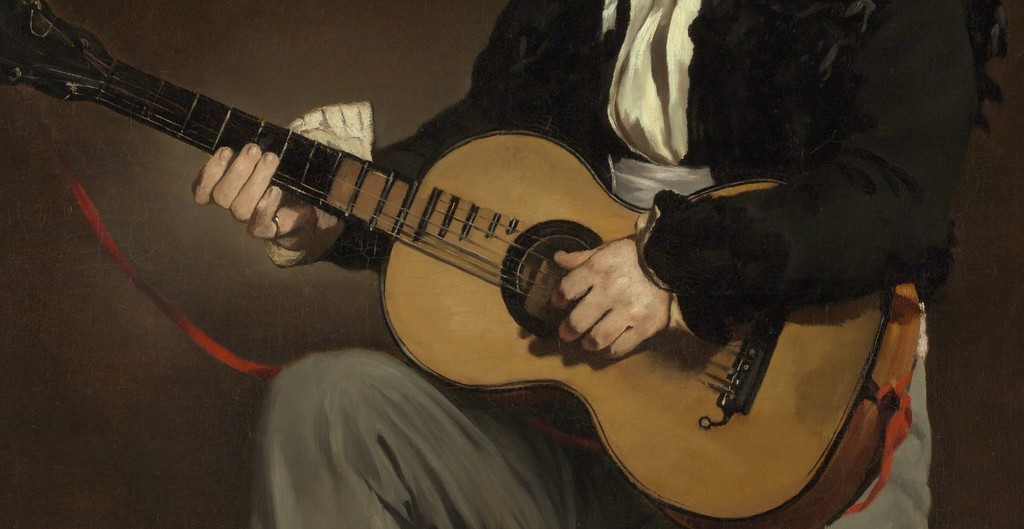
Painted in 1860, the singer offers an emphatic figure against a quiet brown background. White cloth around the head and neck catches the eye above the broad grey trousers. A guitar crosses the torso, its warm wood standing out against the black jacket. The green bench and small objects near the feet give the figure a setting without surrounding him with a complicated narrative.
The composition's apparent directness coexists with a constructed identity. Wilson-Bareau describes the Spanish costume as an assembly of studio props and notes the mismatch between the instrument's stringing and the player's left-handed position.[2] The staged figure could display the painter's command of colour and form.
This success later became a point of comparison. In his 1867 defence, Émile Zola observed that Manet's earlier pictures were being used against his newer ones. He admired their strength and delicacy but preferred the more uncompromising handling of Olympia.[3] An early success could therefore become a demand that the artist repeat an approach he had already begun to change.
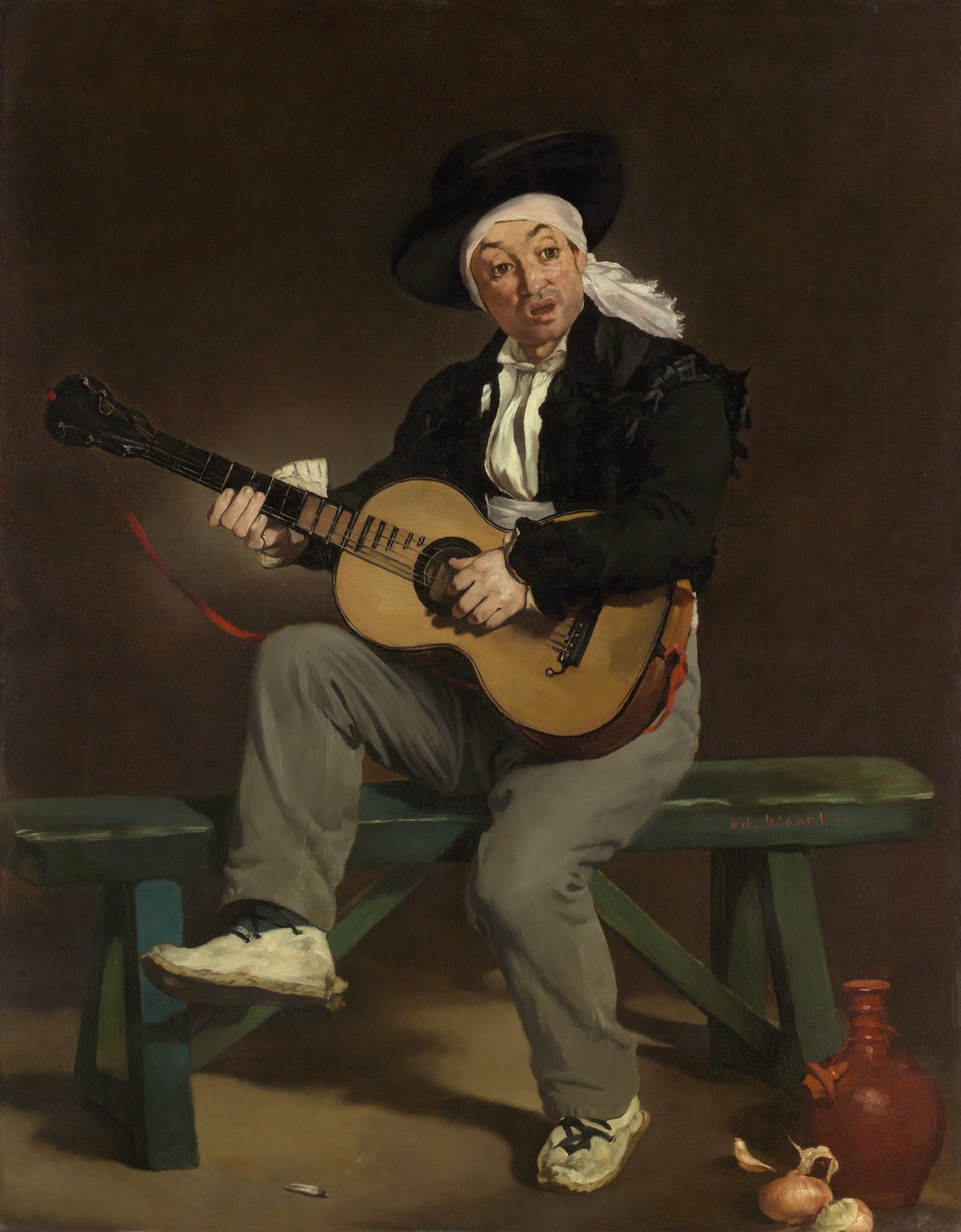
Édouard Manet, The Spanish Singer, 1860; exhibited at the Salon of 1861. The Metropolitan Museum of Art, New York, 49.58.2. Gift of William Church Osborn, 1949. Image source. CC0 / Public domain.
Two Different Exhibitions in 1863
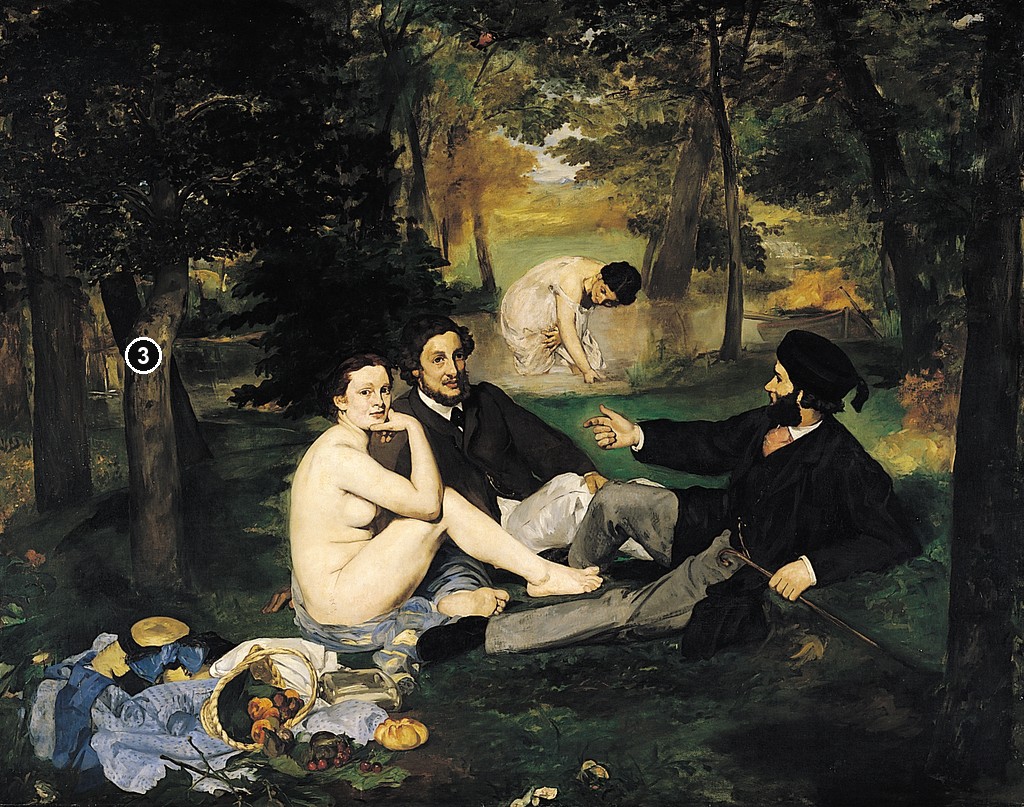
In 1863, Le Déjeuner sur l'herbe was refused by the official Salon and shown as Le Bain at the Salon des Refusés. The Musée d'Orsay identifies objections to both its contemporary subject and its abrupt treatment of light and shadow.[4] The exhibition of refused works made a rejection publicly visible, placing the jury's decision beside the pictures themselves.
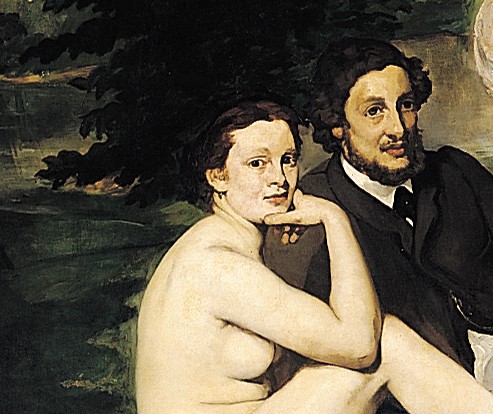
The scene offered several points of friction. A nude woman sits with clothed men in a woodland foreground; another woman bends towards water farther back. The seated woman's pale body meets the dark jackets without the gradual transitions that might soften their contrast. Her direct look also makes the viewer part of the encounter. The painting gives familiar elements—figures, landscape, food—a disconcerting relationship.
Manet's showing at the Galerie Martinet that year was a separate occasion. Zola's later account discusses Music in the Tuileries, Lola de Valence and other pictures in that gallery before turning to the Déjeuner.[3] Keeping the venues distinct helps explain how different works entered public discussion. Not every reported reaction in 1863 concerned the same canvas or the same exhibition.
Zola defended the Déjeuner by redirecting attention towards its arrangement of painted masses. For him, the subject offered an opportunity to paint flesh, fabric and landscape; the viewer should consider the whole ensemble rather than stop at the nude woman's presence.[3] This was an argument for a way of looking. It did not remove the social questions raised by a modern scene in which dress and undress were so conspicuously unequal.
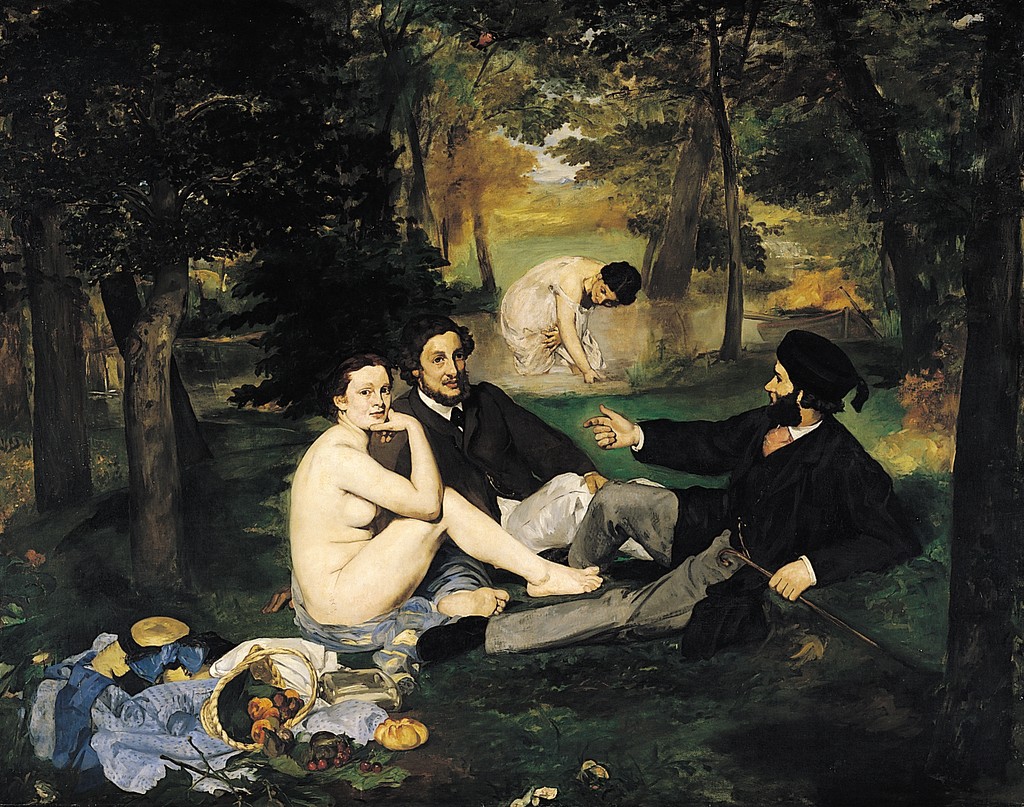
Édouard Manet, Le Déjeuner sur l’herbe, 1863. Musée d’Orsay, Paris, RF 1668. Exhibited as Le Bain at the Salon des Refusés. Musée d’Orsay; faithful public-domain reproduction via Wikimedia Commons. Image source. Public domain.
Olympia Was Admitted to the Salon
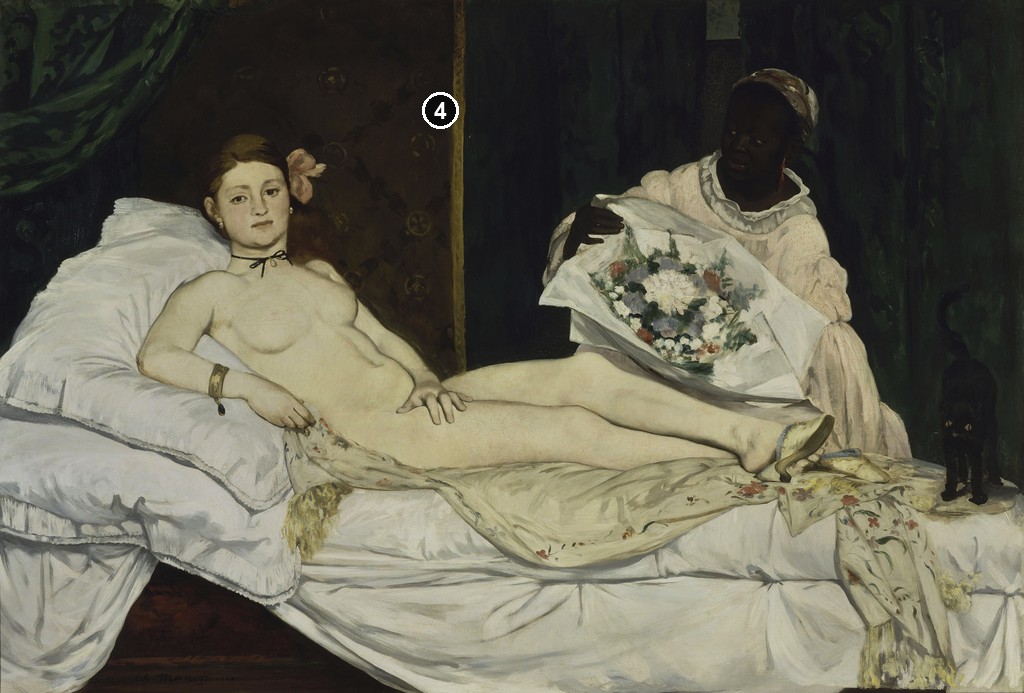
The circumstances of Olympia were different. Painted in 1863, it appeared at the official Salon in 1865. The Musée d'Orsay connects its controversy with the contemporary courtesan subject and the directness of its handling.[5] The reclining woman addresses the viewer without the distance supplied by an idealised goddess.
The Salon's recorded entries place Olympia beside Jesus Mocked by the Soldiers among Manet's accepted works that year.[6] Its presence was consequently the result of admission, even though the responses it generated were hostile. Confusing it with the 1863 Refusés turns two different encounters with official selection into a single episode.
In the painting, the pale figure and bed linen occupy much of the lower canvas. A woman carrying a bouquet stands towards the right, while a black cat raises its tail near the foot of the bed. These elements create a tightly organised exchange of looks, objects and contrasts. Their painted roles organise the scene without supplying a literal history of the people who posed.
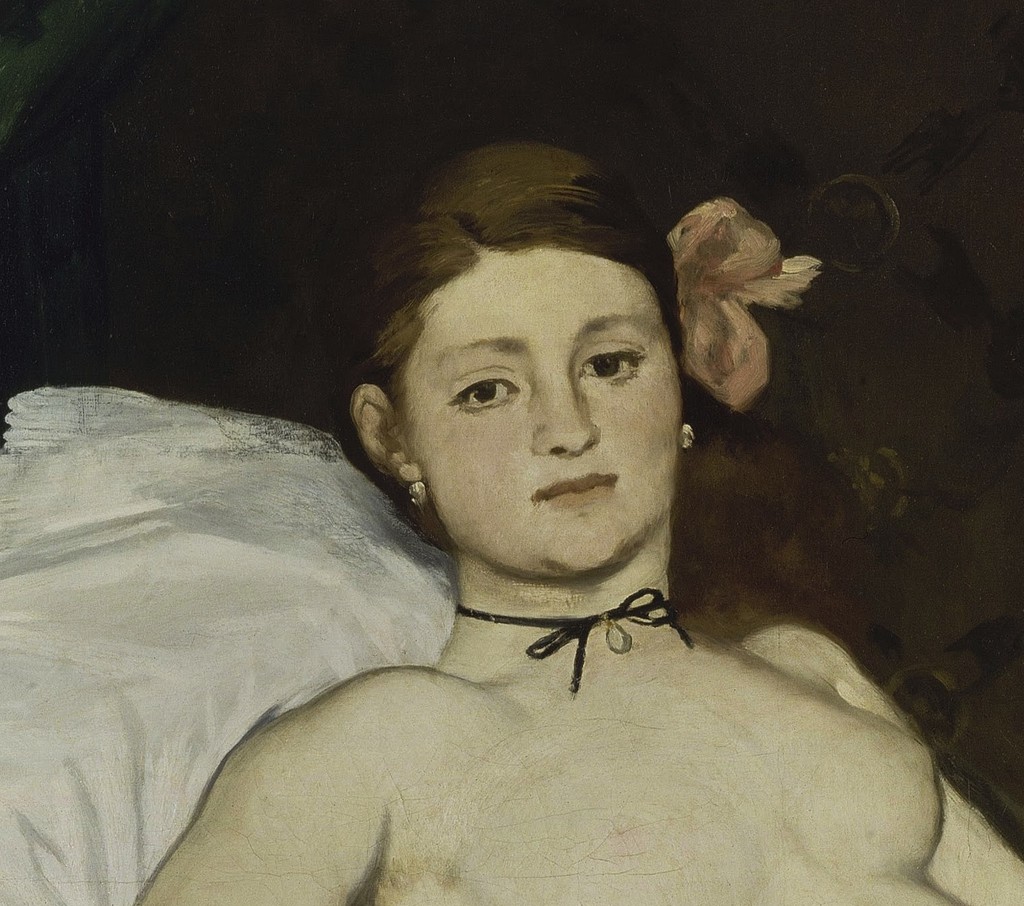
The combination gave viewers more to respond to than a general category of nudity. The gaze, slippers, jewellery, flowers and attendant placed the body within a recognisably modern social setting. Meanwhile, the broad pale areas made the handling unusually exposed. For critics accustomed to more idealised flesh and smoother transitions, subject and execution could reinforce one another as grounds for objection.[5]
Zola's subsequent defence accepted precisely those painted relationships as evidence of Manet's ability. He described the varied whites of the linen and the way the bouquet's separate colour patches cohere when seen from farther away.[3] The same surface could be taken as an affront to finish or as a demonstration of a forceful eye.
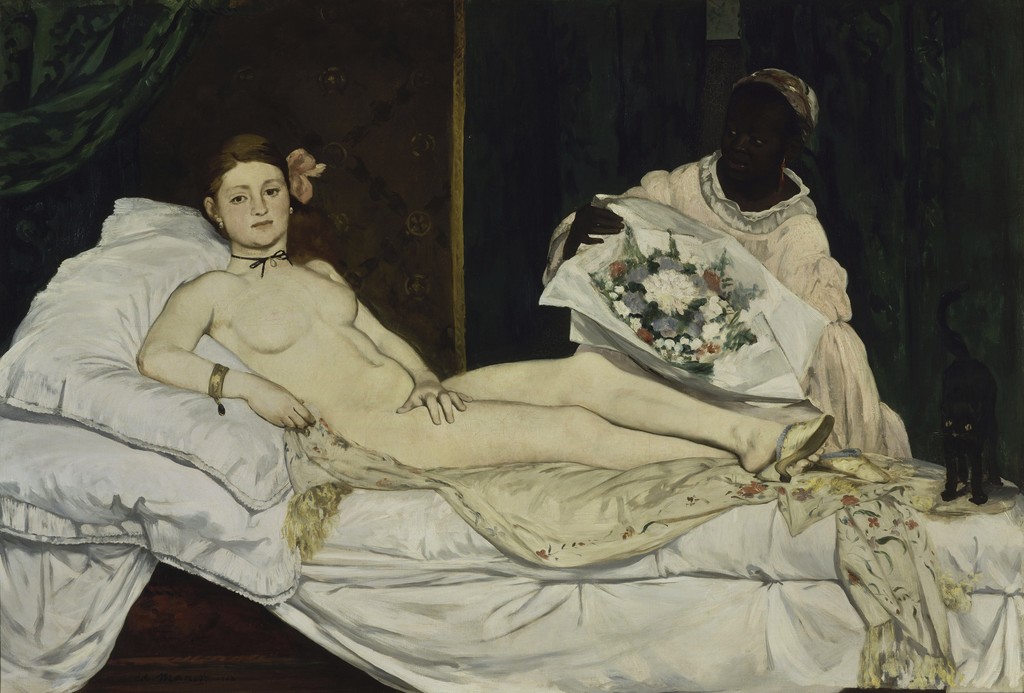
Édouard Manet, Olympia, 1863; admitted to the Salon of 1865. Musée d’Orsay, Paris, RF 644. Musée d’Orsay / Google Arts & Culture, via Wikimedia Commons. Image source. Public domain.
A Painting Recast as a Caricature
Satire gave criticism another form. Élodie Desserle's study for the Institut national d'histoire de l'art identifies Cham's parody of Olympia in Le Charivari on 14 May 1865. She places it within the broader practice of Salon caricature, whose targets included successful pictures, controversial works, juries and spectators.[7] Ridicule had its own publications and visual conventions.
Cham's image preserves enough of the painting to make the target unmistakable. A reclining nude occupies the left, a bouquet rises near the centre and the cat stands at the right. But the proportions and features have been exaggerated: the body becomes awkwardly angular, the bouquet dominates the exchange and the cat's thin legs and tall tail acquire an absurd prominence. The catalogue number 1428 remains visible below.
The accompanying caption adds another layer of mockery. Picture and words work together, transforming the painting into a compact joke that could circulate beyond the exhibition room. The drawing is evidence of an attack on Manet's image; its distortions also show why it cannot serve as a straightforward account of the people who posed for him.
Comparing the caricature with the painting makes the operation visible. Cham selects a few recognisable relationships and intensifies them until they become comic. That process differs from a review which describes the handling at length, but both can direct the reader's attention before a personal encounter with the canvas. Reception could take place through a printed substitute as well as before the original.
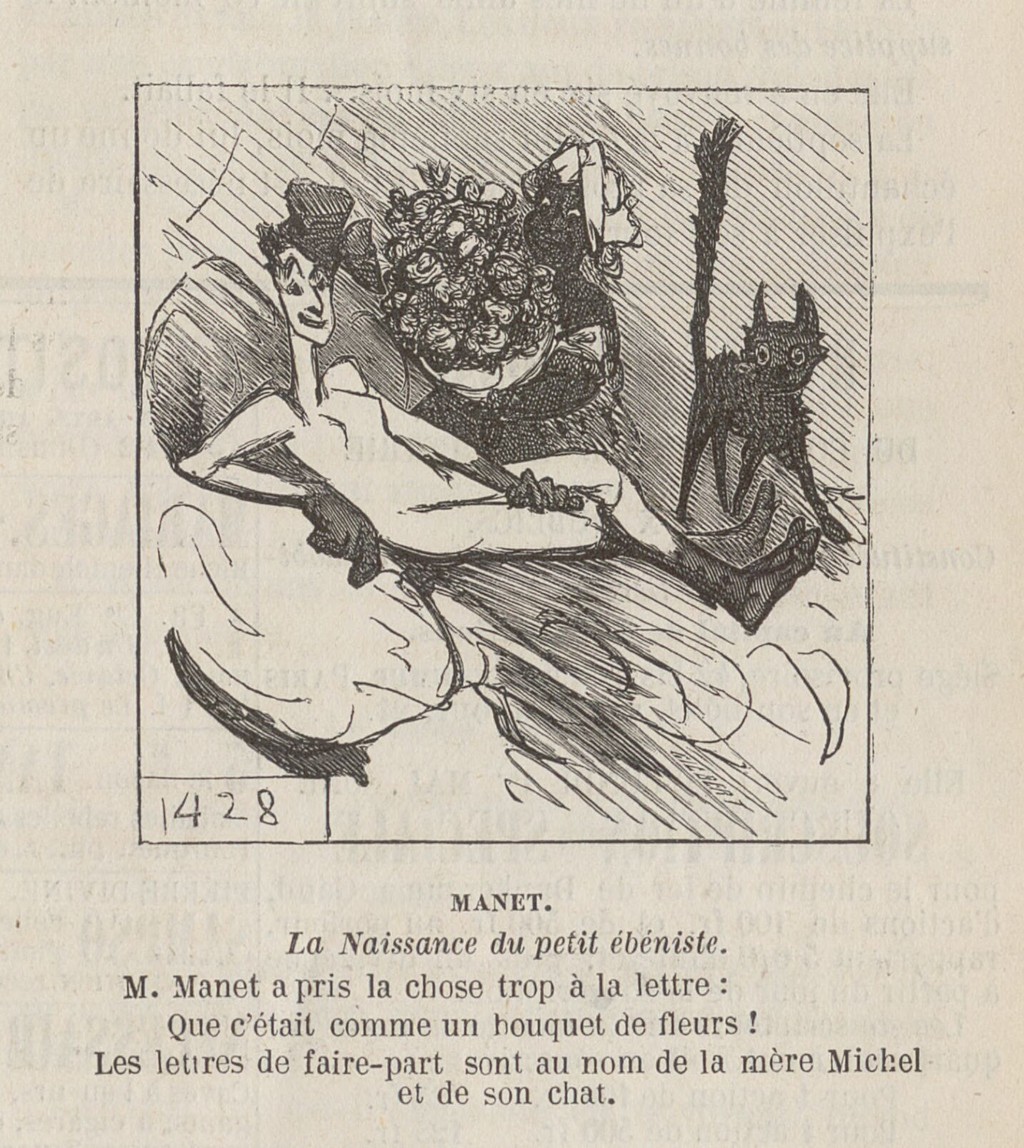
Cham, caricature after Manet’s Olympia, Le Charivari, 14 May 1865. Supplied captioned vignette, cropped from the newspaper page. Cham; Bibliothèque nationale de France / Gallica, via Wikimedia Commons. Image source. Public domain. Resized from the complete supplied captioned vignette; the French caption and exhibition number 1428 are retained. This is not the full newspaper issue.
Refusal in 1866 and Zola's Defence in 1867
The admission of Olympia did not secure the next submission. The Fifer was refused by the Salon jury in 1866. The Musée d'Orsay describes the bold simplification of its figure and setting and connects the painting with Zola's enthusiasm for Manet.[8] Here the subject was an anonymous military boy, presented with a prominence usually reserved for a more distinguished sitter.
In Zola's account, the uniform becomes an arrangement of broad coloured areas: dark tunic, red trousers and yellow trim. He turns a reported comparison with a costumer's sign into a means of defending the picture's simplicity.[3] An image that appeared insufficiently modelled to one observer could appear clear and coherent to another. The disagreement involved what a painting should do with its subject.
Zola's extended essay first appeared in the Revue du XIXe siècle on 1 January 1867. A brochure followed in May, when Manet organised his own exhibition. In its preface, Zola explains that the essay preceded the decision to hold that display and that he retained the earlier argument.[3] His prediction of success belongs to the advocate's expectations, rather than a report of how visitors actually responded.
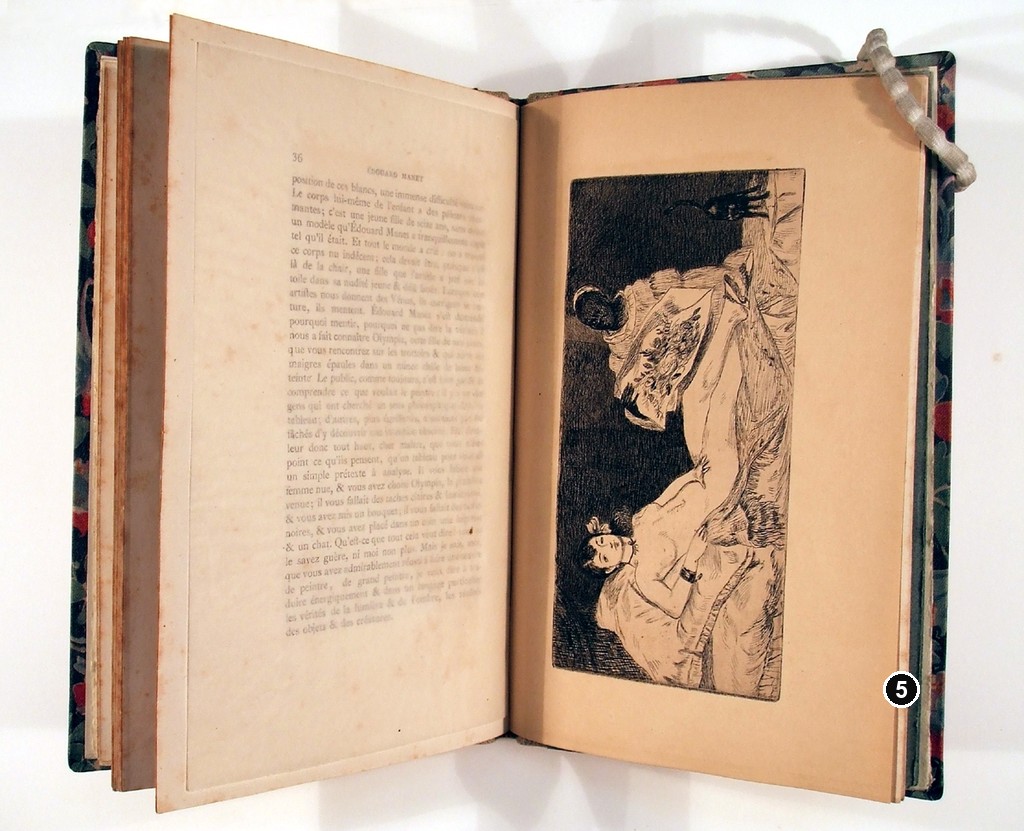
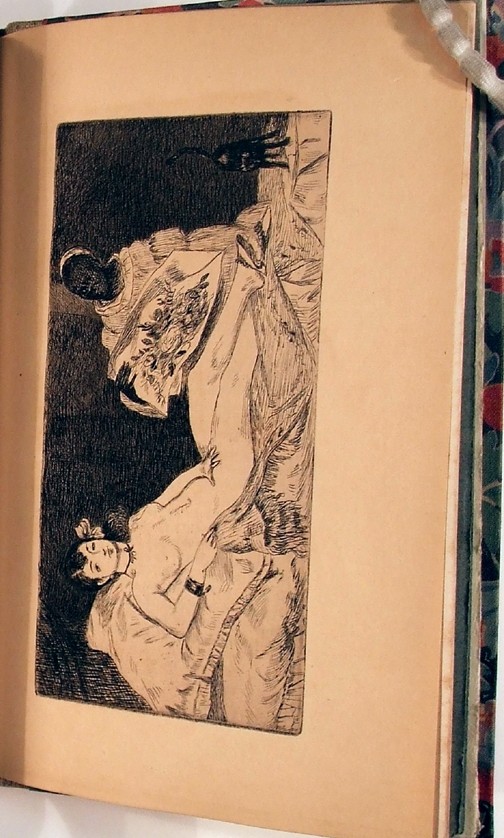
The brochure joined argument and image. Zola thanked Manet for supplying an etching after Olympia, allowing readers to encounter an example of the painter's work beside the defence. Reproduction made the disputed composition available in a different medium. A reader could move between the critic's account of the painting and a printed arrangement of its figures and contrasts.
His final section, devoted to the public, begins by acknowledging that Manet had supporters and that their number was increasing. Zola then attacks the habits through which spectators, caricaturists and critics perpetuate ridicule. He argues that unfamiliarity can prevent viewers from recognising a new artistic personality.[3] The defence contains a theory of how judgement forms, as well as praise for individual pictures.
It is an energetic and partial account. Zola treats form as the central issue and gives Manet the place of an original artist confronting habitual expectations. His language is itself a contribution to the dispute. Read beside the caricature, it shows rival efforts to shape what people would notice and what conclusions they would draw from seeing it.
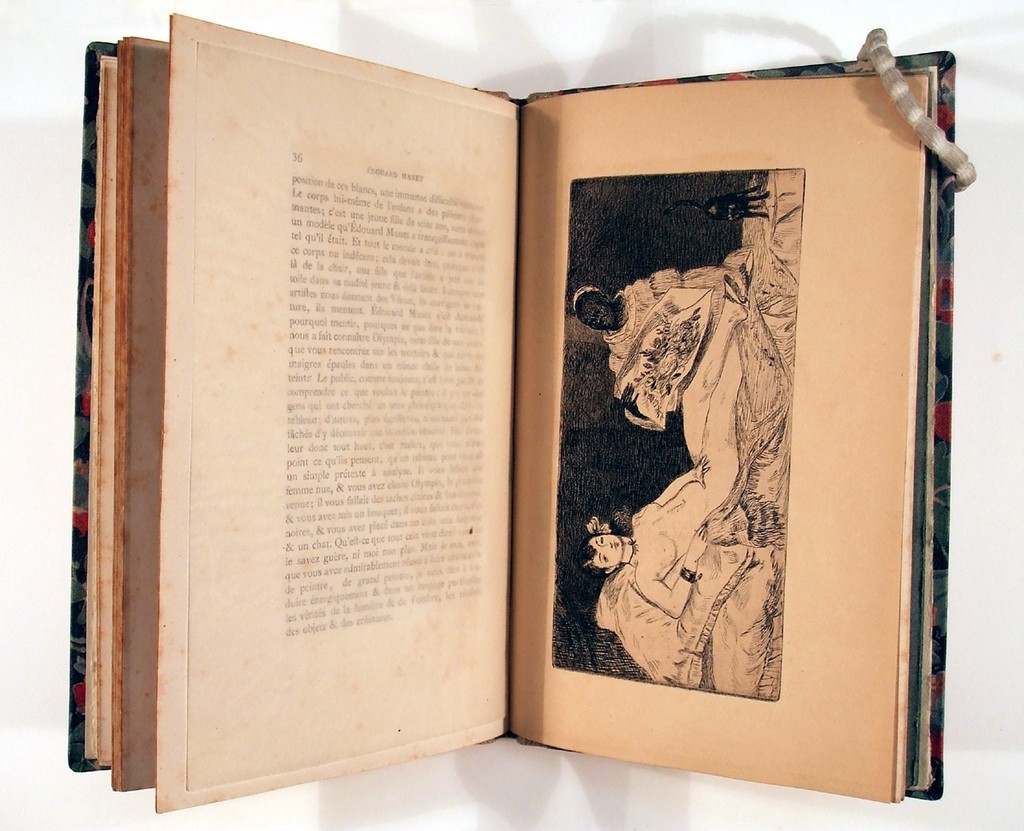
Émile Zola, Édouard Manet, 1867, copy open beside Manet’s etched Olympia. The Metropolitan Museum of Art, New York, 32.91. Harris Brisbane Dick Fund, 1932. Image source. CC0 / Public domain. Complete supplied open-book view, resized without cropping.
Castagnary Wanted the Figures to Explain Themselves
A different set of expectations appears in Jules-Antoine Castagnary's review of the 1869 Salon. He calls Manet a real painter and praises his still lifes and ability with colour, yet finds fault with the organisation of his scenes. Discussing Luncheon in the Studio, he asks why fresh oysters and a partly peeled lemon belong on a table where coffee has been served. He also questions the young man's position in relation to the table and the viewer.[9]
His objections extend to The Balcony. The apparent relationships between the women, and the difference between one sitting and another preparing to leave, do not resolve themselves for him. Castagnary wants each figure to fulfil a legible function within the whole composition. He can admire individual passages while finding the scene insufficiently motivated.[9]
This criticism identifies something still arresting in Manet's pictures. The people occupy the same space, but their activities do not always join into an easily retold incident. The viewer encounters a grouping before understanding a story. For Castagnary, that uncertainty exposed an arbitrary arrangement; for a later viewer, it can prolong the experience of looking.
The review is therefore more useful than a simple verdict of approval or rejection. It shows which kind of coherence the critic expected and where he thought Manet failed to provide it. His complaint also differs from an objection to the nude in the Déjeuner of 1863. The Déjeuner he discusses in 1869 is the later Luncheon in the Studio, a different painting with a different problem of interpretation.
Remaining at the Salon While Friends Exhibited Independently
Manet's pursuit of the Salon continued as artists around him tried other arrangements. In 1874, Monet, Degas and Morisot were among those who joined the exhibition later known as the first Impressionist exhibition. Rebecca Rabinow's account notes that Manet declined to participate in that show and in the group's subsequent seven exhibitions.[10]
This choice places him within the circle of modern painters while keeping his exhibition history distinct from theirs. A shared interest in contemporary life or an exchange between artists did not require the same route to an audience. The official Salon remained a place where Manet could put his work before viewers, critics and other painters.
Joris-Karl Huysmans's response to the 1879 Salon shows how an advocate could make that encounter productive. He welcomed both In the Conservatory and Boating. In the latter, he defended the vivid blue water against people who objected that water could not have that colour. His argument was that its appearance changes with conditions and that painters should look rather than impose an inherited formula.[11]
The dispute makes a large field of blue consequential. It might be judged against an expected way of painting a river or accepted as a particular colour relationship seen and selected by the artist. Huysmans also noticed the boat's abrupt cropping and compared it with Japanese prints.[11] Colour and framing together offered him evidence of a modern approach.
His praise did not require a detailed story about the couple or the boatman's identity. It rested on the figures' placement, the surrounding light and the force of the water. Where Castagnary had asked whether figures cohered as an intelligible incident, Huysmans could find conviction in an arrangement of bodies and colour. Their reviews reveal different demands made upon a painting.
Official Recognition in 1881
The institutional setting itself changed. The French Ministry of Culture's account of 1881 explains that, following Jules Ferry's announcement in December 1880, artists took over the organisation previously managed by the state. The Salon des artistes français succeeded the earlier Salon. Both Manet's portrait of Henri Rochefort and his portrait of Eugène Pertuiset, the lion hunter, were admitted, and Manet received a second-class medal.[12]
He was also appointed a chevalier of the Légion d'honneur in 1881.[10] These distinctions gave formal recognition to a painter whose submissions had repeatedly been disputed. They belong alongside the earlier honourable mention of 1861, rather than marking the first occasion on which the Salon had acknowledged his work.
The award and the critical response to an individual painting could still diverge, as the following year's exhibition demonstrated.
Two Paintings at the Salon of 1882
Manet's final Salon pair offered strikingly different encounters. A Bar at the Folies-Bergère presented a working woman, a counter laden with objects and an expansive reflected interior. Jeanne, also called Spring, concentrated on a fashionable young woman in profile, framed by flowers, foliage and a parasol. Getty curator Scott Allan describes Jeanne as an unusually strong critical success within Manet's career.[13]
The smaller portrait allows the face, hat and dress to share a coordinated decorative setting. Flowers gather above the forehead; the parasol rises behind the head; patterns on the pale clothing meet the surrounding greenery. Its poised arrangement gives the viewer several closely connected pleasures of looking. The contrast with the crowded bar is considerable, even though both paintings concern contemporary Parisian life.[13]
Huysmans's discussion of the Bar contains admiration and frustration within the same account. He recognises the modern subject and finds the decision to place the woman within her surroundings ingenious. Yet he questions the daylight-like illumination in a venue associated with night and notes the uncertain accuracy of the reflected relationship.[14]
The objection concerns the credibility of the whole setting. If the light seems wrong, Huysmans argues, the place itself becomes unconvincing. Nevertheless, he praises the figure's presence and the crowd's life, and ultimately regards the picture as the Salon's most modern and interesting work. He also warmly acknowledges the companion portrait.[14]
His reservations remain part of an admiring judgement. The painting asks the critic to negotiate between the force of a modern subject and his expectations about how that subject should be lit and arranged. The same work could sustain both responses.
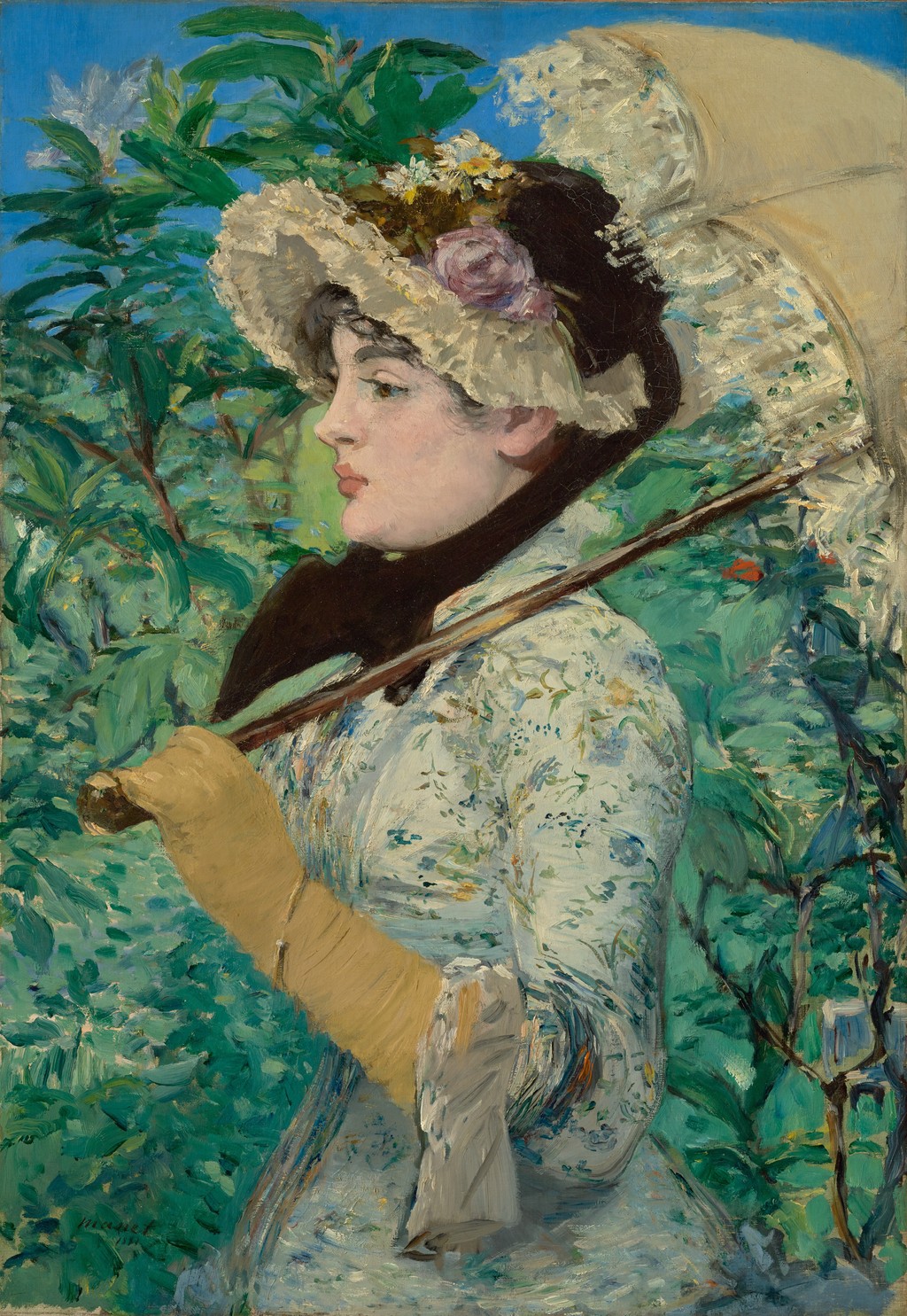
Édouard Manet, Jeanne (Spring), 1881; exhibited at the Salon of 1882. J. Paul Getty Museum, Los Angeles, 2014.62. Image source. CC0 / Public domain.
Reception Continued in Collections
A painting's public history could also change through ownership and display. In 1890, Olympia entered the French state collection through a public subscription organised on Claude Monet's initiative. It went to the Musée du Luxembourg and was assigned to the Louvre in 1907.[5] The canvas that had provoked scandal at the Salon acquired another kind of public standing.
Those later settings do not erase the earlier encounters. The Singer's honourable mention, Cham's parody, Zola's defence, Castagnary's questions and Huysmans's changing judgements remain particular responses to particular works. They give us ways to return to the paintings: to look for the broad colour masses an advocate admired, the unexplained gesture a critic questioned or the awkward relationship a caricaturist exaggerated.
Annotated Details from Manet and the Salon
The numbered points identify visible features discussed in this article. Return from each detail to the whole composition. Each caption identifies the work shown.
The Spanish Singer
Édouard Manet, The Spanish Singer, 1860; exhibited at the Salon of 1861. The Metropolitan Museum of Art, New York, 49.58.2. Gift of William Church Osborn, 1949. Image source. CC0 / Public domain. Numbers added to a separate resized whole provided overview. Detail crops from the immutable original; no enlargement, retouching or colour alteration.
Le Déjeuner sur l’herbe
Édouard Manet, Le Déjeuner sur l’herbe, 1863. Musée d’Orsay, Paris, RF 1668. Exhibited as Le Bain at the Salon des Refusés. Musée d’Orsay; faithful public-domain reproduction via Wikimedia Commons. Image source. Public domain. Numbers added to a separate resized whole supplied overview. Detail crops from the unchanged original; no enlargement, retouching or colour alteration.
Olympia
Édouard Manet, Olympia, 1863; admitted to the Salon of 1865. Musée d’Orsay, Paris, RF 644. Musée d’Orsay / Google Arts & Culture, via Wikimedia Commons. Image source. Public domain. Numbers added to a separate resized whole supplied overview. Detail crops from the unchanged original; no enlargement, retouching or colour alteration.
Édouard Manet — A Surviving 1867 Book
Émile Zola, Édouard Manet, 1867, copy open beside Manet’s etched Olympia. The Metropolitan Museum of Art, New York, 32.91. Harris Brisbane Dick Fund, 1932. Image source. CC0 / Public domain. Numbers added to a separate resized whole supplied overview. Broad crop of the right-hand page in the Met’s separate surviving copy; no enlargement, retouching, page rotation or colour alteration.
Jeanne (Spring) — Companion Painting
Édouard Manet, Jeanne (Spring), 1881; exhibited at the Salon of 1882. J. Paul Getty Museum, Los Angeles, 2014.62. Image source. CC0 / Public domain. Numbers added to a separate resized whole overview retaining the supplied edges. Detail crops from the immutable original; no enlargement, retouching or colour alteration.
 — Companion Painting.jpg)
Details from MANET AND THE SALON
Follow the numbered details back to the complete images above. Each caption identifies the work shown.
The Spanish Singer
Face, Headcloth and Broad Hat
The open mouth and pale headcloth sit beneath the broad dark hat, with the face turned towards the viewer.
Two Hands around the Guitar
One hand meets the neck while the other rests near the round sound hole. The warm guitar crosses the dark jacket.
Le Déjeuner sur l’herbe
The outward look
The seated woman looks out from the group. Her pale face and raised forearm stand against the darker trees and the nearby man’s black coat.
Olympia
The direct gaze
The reclining woman looks towards us. The dark ribbon at her neck and the flower beside her hair punctuate the pale face and upper body.
Édouard Manet — A Surviving 1867 Book
The Etching in a Surviving 1867 Copy
The right-hand page carries the etching after Olympia in the Met’s separate surviving copy of Zola’s publication.
Jeanne (Spring) — Companion Painting
Spring’s Profile, Bonnet and Parasol
The flowered bonnet and pale parasol surround the turned profile.
 — Companion Painting Detail 06 spring-s-profile-bonnet-and-parasol.jpg)
Artworks directory
Explore selected paintings, drawings and prints by Édouard Manet. Search by title or another recorded name.
Frequently Asked Questions
He did not participate in their eight group exhibitions, despite his close relationships with several of the artists.[10]
Discussion
Look again at the images and ideas explored in Édouard Manet at the Salon. These editorial prompts invite your observations.
Reader Insights
Compare the broad light and dark areas of Olympia with the features Cham exaggerates. Which relationships remain recognisable in the caricature?
Read Castagnary's demand for a clear role for each figure beside Huysmans's defence of the blue water in Boating. What does each critic want a painting to accomplish?
Does learning that a picture was admitted, mocked or awarded a medal change how you look at it? Which response seems most connected to what you can see?
Join the Conversation
Share a detail, comparison or question about Édouard Manet at the Salon below.
References
- Jason Rosenfeld, “The Salon and the Royal Academy in the Nineteenth Century,” The Metropolitan Museum of Art, October 2004; exhibition institutions and modern art (in English). View source.
- Juliet Wilson-Bareau, catalogue no. 131, The Spanish Singer, in Manet/Velázquez: The French Taste for Spanish Painting, edited by Gary Tinterow and Geneviève Lacambre, 2003, p. 485; early refusal, recognition and studio construction (in English). View source.
- Émile Zola, Ed. Manet: étude biographique et critique, 1867, May preface and sections II–III; criticism, advocacy and the public (in French). View source.
- Musée d'Orsay, Le Déjeuner sur l'herbe, 1863, RF 1668; refusal, exhibition title and commentary (in French). View source.
- Musée d'Orsay, Olympia, 1863, RF 644; 1865 Salon, commentary and provenance (in French). View source.
- Musée d'Orsay, Base Salons, Manet artist record; transcribed exhibition titles and entries (in French). View source.
- Élodie Desserle, “Cham, l'Offenbach de la caricature,” Institut national d'histoire de l'art, updated 26 December 2024; Salon satire and the 14 May 1865 Olympia caricature (in French). View source.
- Musée d'Orsay, Le Fifre, 1866, RF 1992; simplified handling and Salon refusal (in French). View source.
- Jules-Antoine Castagnary, 1869 Salon review, section VI on Manet, reprinted in Salons, tome I, 1892, pp. 364–365; composition, colour and narrative relationships (in French). View source.
- Rebecca Rabinow, “Édouard Manet (1832–1883),” The Metropolitan Museum of Art, October 2004; Salon participation, independent exhibitions and honours (in English). View source.
- Joris-Karl Huysmans, Le Salon de 1879, collected in L'Art moderne, 1883; In the Conservatory and Boating (in French). View source.
- Ministère de la Culture, “1881 – Sixième exposition,” section “Le Salon”; changed organisation, Manet's two portraits and second-class medal (in French). View source.
- The J. Paul Getty Museum, Manet and Modern Beauty exhibition account, 2019, including commentary by Scott Allan on Jeanne and the 1882 Salon (in English). View source.
- Joris-Karl Huysmans, L'Art moderne, 1883, “Appendice”; 1882 Salon discussion of A Bar at the Folies-Bergère and its companion portrait (in French). View source.
- Splash image, Édouard Manet, The Spanish Singer, 1860; exhibited at the Salon of 1861. The Metropolitan Museum of Art, New York, 49.58.2. Gift of William Church Osborn, 1949. Image source. CC0 / Public domain.


