


 by Tom Gurney
Tom Gurney BSc (Hons) is an art history expert with over 20 years experience
Email: tomgurney1@gmail.com / Phone: +44 7429 011000
Édouard Manet Style and Technique: Introduction
Édouard Manet's paintings often make the act of looking feel immediate. A face turns towards us, a pale sleeve catches the light or a figure enters a crowded space. The brush marks remain conspicuous, giving the image a sense of having just come into being. Yet that effect could emerge through very different ways of working. Technical examination suggests rapid wet-in-wet painting in his Cologne asparagus still life, while the London café-concert painting contains extensive revisions and changes to its support.[1][2]
Understanding Manet's technique involves looking at both scales: the organisation of the whole image and the material decisions within it. Large areas of light and dark establish an encounter before individual strokes describe fabric, flesh or glass. Beneath those strokes, a prepared surface or an earlier passage of paint may continue to affect what we see.
At a Glance
- ArtistÉdouard Manet
- FocusOil painting, composition, colour and revision
- Technical examplesThe Cologne Bunch of Asparagus and London's Corner of a Café-Concert
- Key termsGround, wet-in-wet, impasto and paint cross-section
- Looking closelyCompare the arrangement of shapes with differences in paint thickness and edges
Contents
- Light and Dark Shapes
- Old Compositions in Modern Scenes
- The Ground Beneath the Image
- Wet Paint and Local Revisions
- Colour Mixtures and Black Paint
- Different Blues within One Smock
- Cutting and Extending the Canvas
- Reading the Order of Changes
- Studio Work and Outdoor Painting
- What Technical Examination Reveals
Light and Dark Shapes
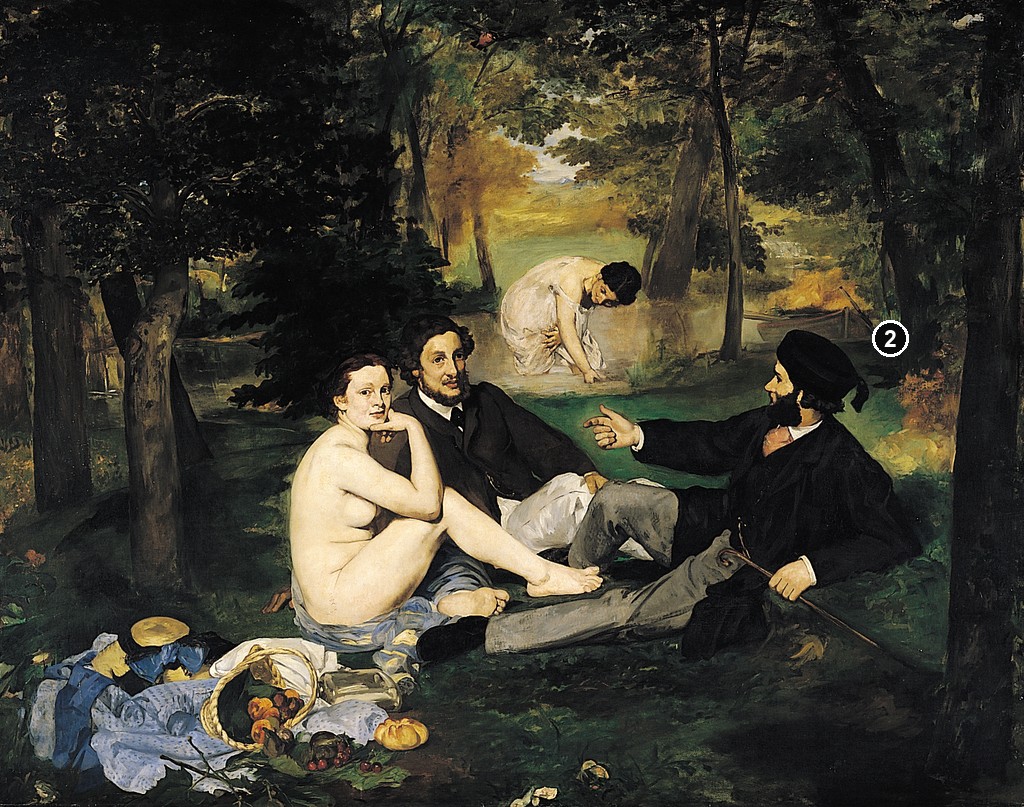
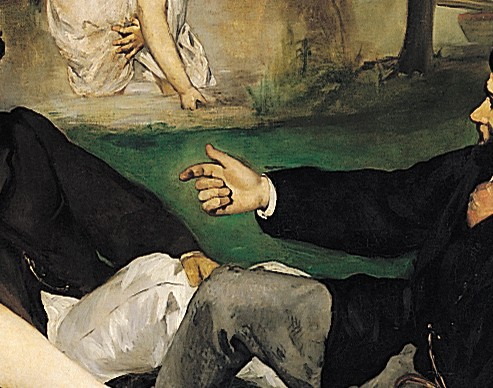
In Le Déjeuner sur l'herbe, painted in 1863, the pale body of the seated woman stands out against dark clothing and woodland. The men's jackets form substantial dark areas, interrupted by a white collar, grey trousers and exposed hands. Before the individual faces become familiar, these large relationships have already organised the foreground. The Musée d'Orsay identifies the abrupt light and shadow contrasts as an important part of the painting's challenging handling.[3]
The contrasts also direct attention. The woman's face and upper body form a light area near the centre, while her extended leg carries that brightness towards the right. Below, pale cloth and scattered food create a separate, busier group of lights. These areas have different textures and subjects, but their relative brightness connects them across the picture.
Manet varies the degree of description within this structure. The outlines of the seated figures are readily distinguishable against their surroundings. In the woodland, marks gather into broad dark passages, with lighter strokes suggesting openings and foliage. Looking from one area to another changes the amount of information available. The picture invites recognition of a place while keeping the painted relationships unusually exposed.
The interest lies partly in changes of emphasis: where a shape becomes firm, where an edge relaxes and where a few strokes carry a large area. A hand and a loosely stated background need not perform the same task within the composition.
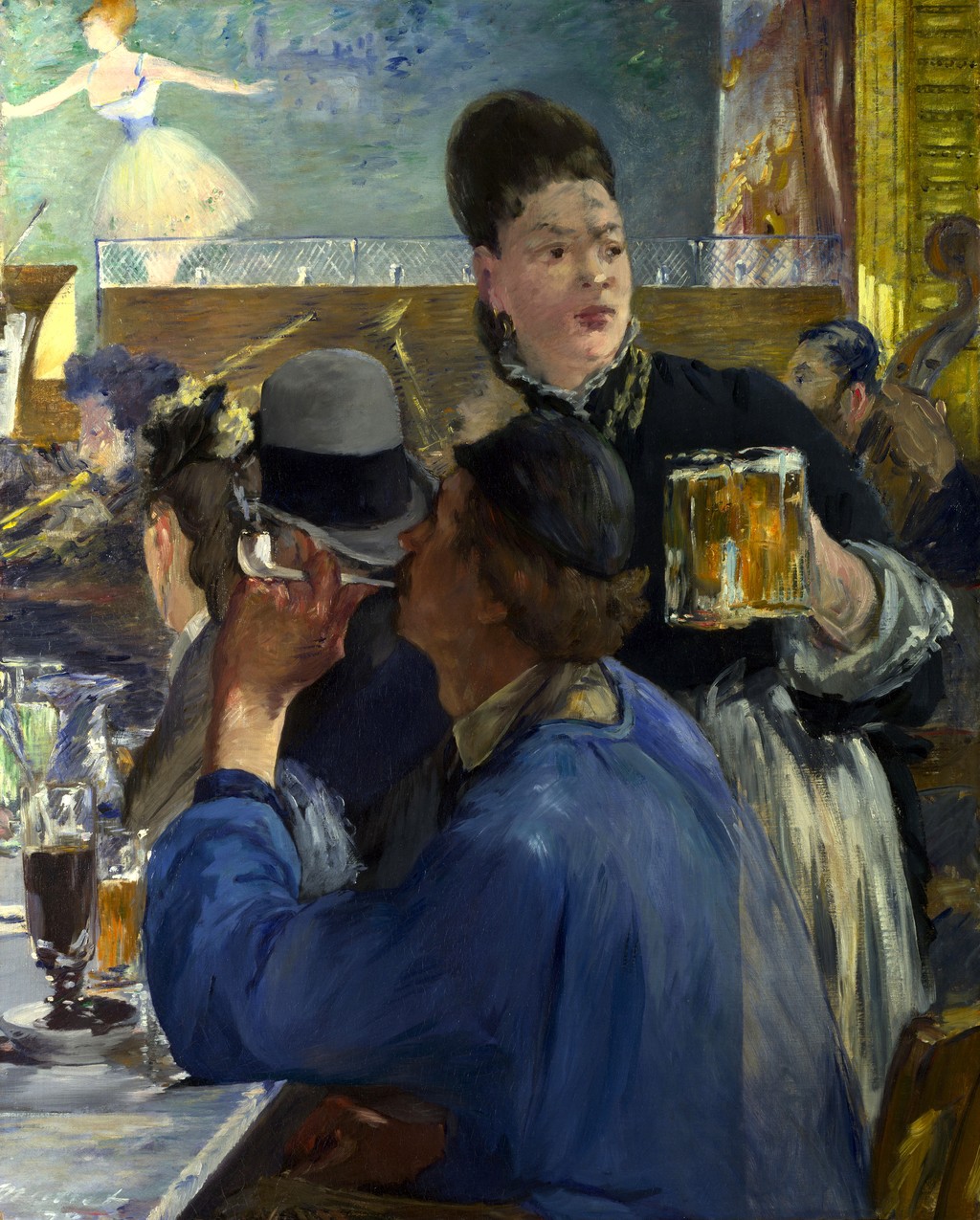
Édouard Manet, Corner of a Café-Concert, probably 1878–80. The National Gallery, London, NG3858. The National Gallery, London; faithful public-domain reproduction via Wikimedia Commons. Image source. Public domain.
Old Compositions in Modern Scenes
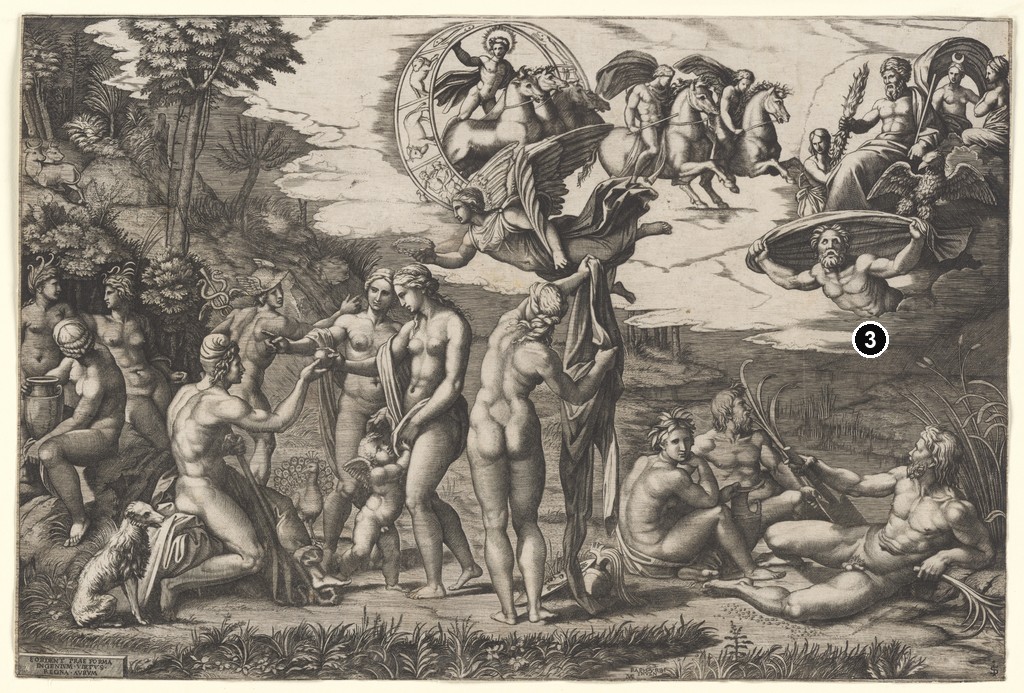
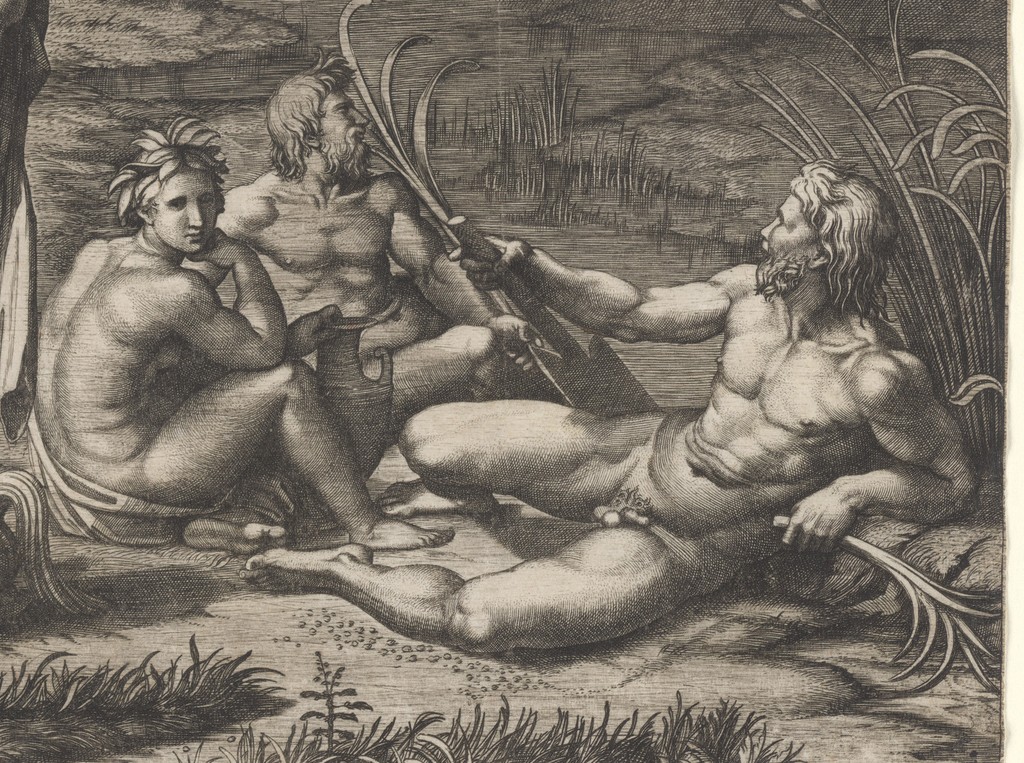
Manet's arrangement also has a history beyond the people and woodland it depicts. The Musée d'Orsay connects the central group with an engraving after Raphael's design for The Judgment of Paris.[3] In Marcantonio Raimondi's print, dated about 1510–20 by the Metropolitan Museum of Art, two river gods and a naiad occupy the lower-right corner of a much larger mythological gathering.[4]
The whole engraving makes the transformation particularly clear. The judgement itself unfolds on the left, while gods and other figures occupy the upper register. The three figures later associated with Manet's composition belong near its margin. Their seated bodies form a compact arrangement within that wider world.
Manet brings a comparable grouping into the centre of a large painting and changes its social terms. The two men wear contemporary clothing, while the unclothed woman looks towards the viewer. The arrangement retains the authority of an older compositional pattern, but the encounter no longer has the engraving's mythological setting. Recognition of the source makes the changes in dress, gaze and prominence more striking.
This comparison concerns the construction of an image. It does not require every limb to match exactly. Manet could take an arrangement that worked pictorially and give its parts different responsibilities. An inherited grouping becomes a way of staging the present, rather than simply a historical quotation placed within it.
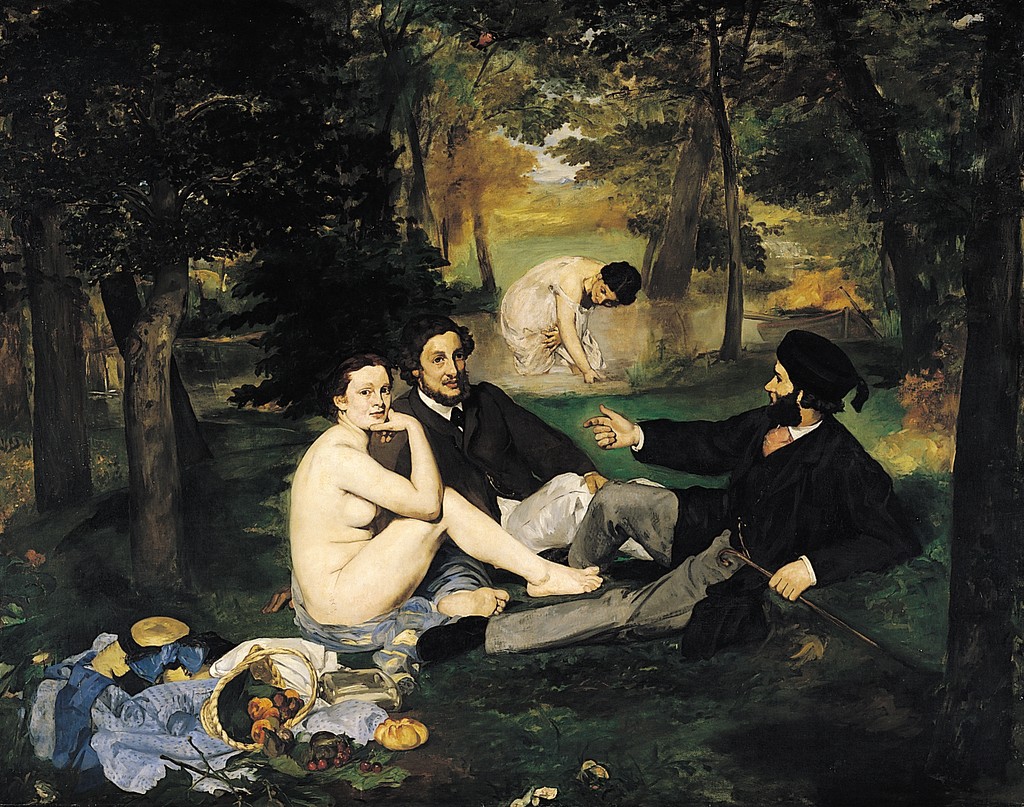
Édouard Manet, Le Déjeuner sur l’herbe, 1863. Musée d’Orsay, Paris, RF 1668. Musée d’Orsay; faithful public-domain reproduction via Wikimedia Commons. Image source. Public domain.
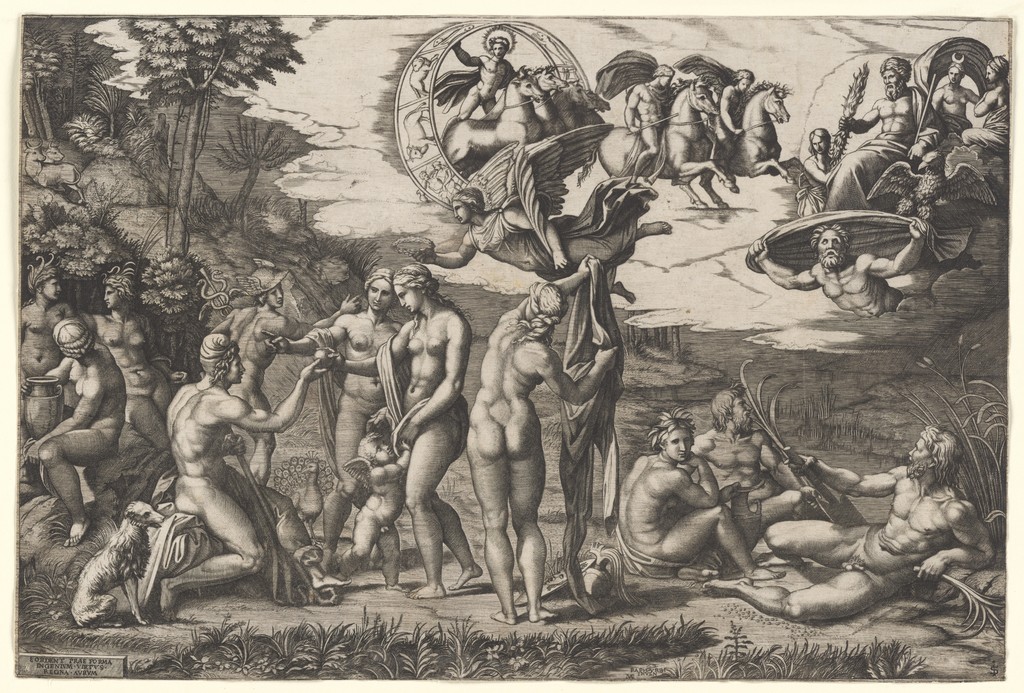
Marcantonio Raimondi after Raphael, The Judgment of Paris, about 1510–20. Engraving. The Metropolitan Museum of Art, New York, 19.74.1. Image source. CC0 / Public domain.
The Ground Beneath the Image
A painting begins to acquire its appearance before the depicted objects are added. The ground is the preparatory layer on the support. Its colour and texture can affect later paint, especially where that paint is thin or where small intervals remain uncovered. A light passage in a finished painting may therefore involve the preparation beneath the brush marks as well as paint applied above them.
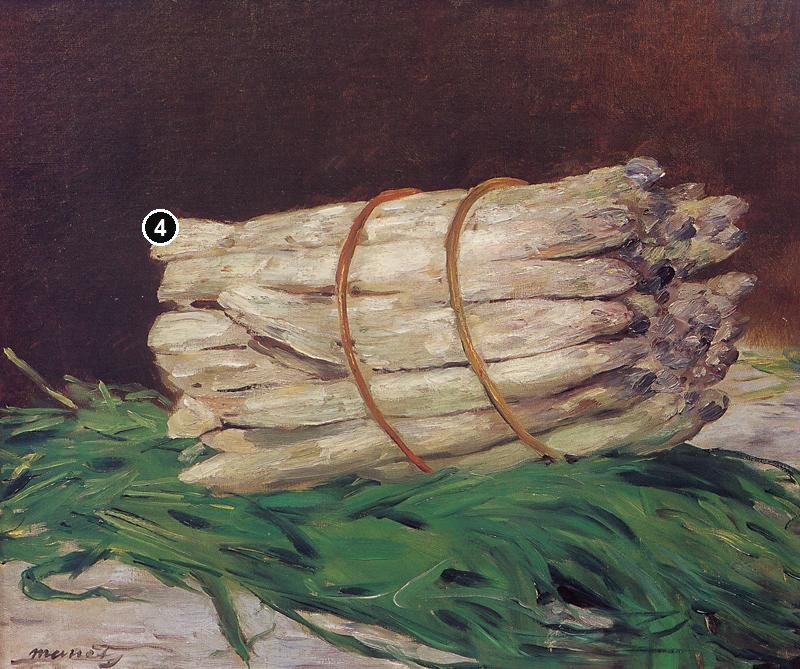
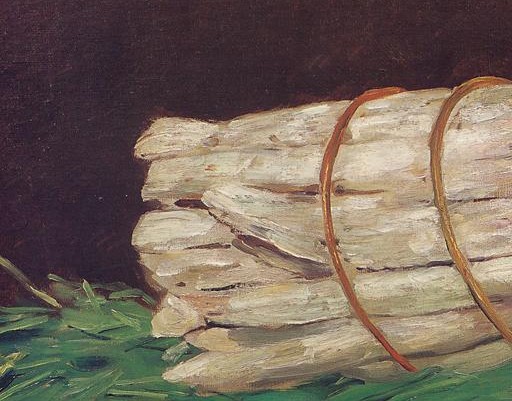
Iris Schaefer's technical report on the Cologne Bunch of Asparagus describes a fine, preprimed canvas with a pale grey ground. Dated about 1880, the still life incorporates that preparation into the bunch, allowing it to remain visible between and within the painted stalks.[1] These openings belong to an already prepared surface.
The effect is economical but varied. Pale strokes run along the stalks, while darker marks distinguish their tips and the intervals between them. The curved brown bindings cross the bundle, gathering the separate lengths into one object. Below, green leaves spread in overlapping directions. The grey preparation contributes to a picture in which closely related light tones still suggest different surfaces.
The report also identifies different consistencies of paint. Thin, partly transparent brown applications occupy the background; more substantial strokes and dabs articulate the asparagus and greenery.[1] Impasto describes paint thick enough to form a raised surface. Beside thinner passages, such marks can give the depicted object an additional physical presence.
This variation helps explain why a small still life can sustain close attention. The background recedes through relatively quiet handling, while the bunch is built from more assertive strokes. The preparation participates wherever Manet allows it to show. Covering every part of the canvas with equally opaque paint would produce a different set of relationships.
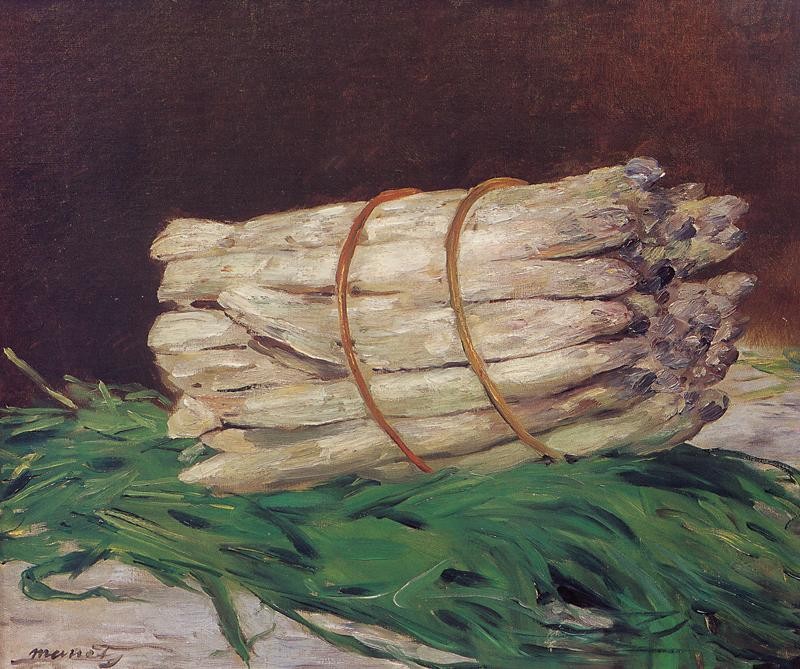
Édouard Manet, A Bunch of Asparagus, 1880. Wallraf-Richartz-Museum & Fondation Corboud, Cologne, WRM Dep. 318. Wallraf-Richartz-Museum & Fondation Corboud; faithful public-domain reproduction via Wikimedia Commons. Image source. Public domain.
Wet Paint and Local Revisions
Schaefer's examination finds wet-in-wet working in the Cologne still life and suggests that it was executed rapidly. In this method, a brushstroke meets paint that has not yet dried, allowing colours to mingle at their contact.[1] The result can preserve the direction of the brush while softening a boundary or drawing one colour into another.
Rapid working still allowed adjustment. Small ochre lines beside the two willow bindings suggest changes to their course, possibly including a broader wrapping. Near the picture's edges, scraping with a brush handle or similar tool exposed the pale ground again. Some final touches cross these scraped passages, placing those accents later in the sequence.[1]
These are small interventions with different effects. Changing the angle of a binding alters how the bundle is held together pictorially. Scraping removes paint and exposes a lighter layer, creating a different kind of mark from one made by adding another stroke. A final touch can then cross the exposed area and reconnect it to the painted surface.
The examination leaves the first order of the main colour fields open. The initial paint for the bunch, brown background and greenery meets without overlapping; later applications mingle where those fields touch. That evidence does not establish which of the three was painted first.[1] The finished relationships are clearer than the opening sequence.
The support has an earlier history too. Paint unrelated to the still life survives near the lower edge and lower-right corner, indicating that the canvas came from a larger, partly painted piece. Most of the surface appears to have been unpainted when Manet began the asparagus.[1]
The signature was added while the paint remained wet.[1] Together with the intermingled strokes, it contributes to the report's account of rapid execution. The evidence offers a way of understanding this particular still life, while the café-concert painting presents a much more layered history of making.
Colour Mixtures and Black Paint
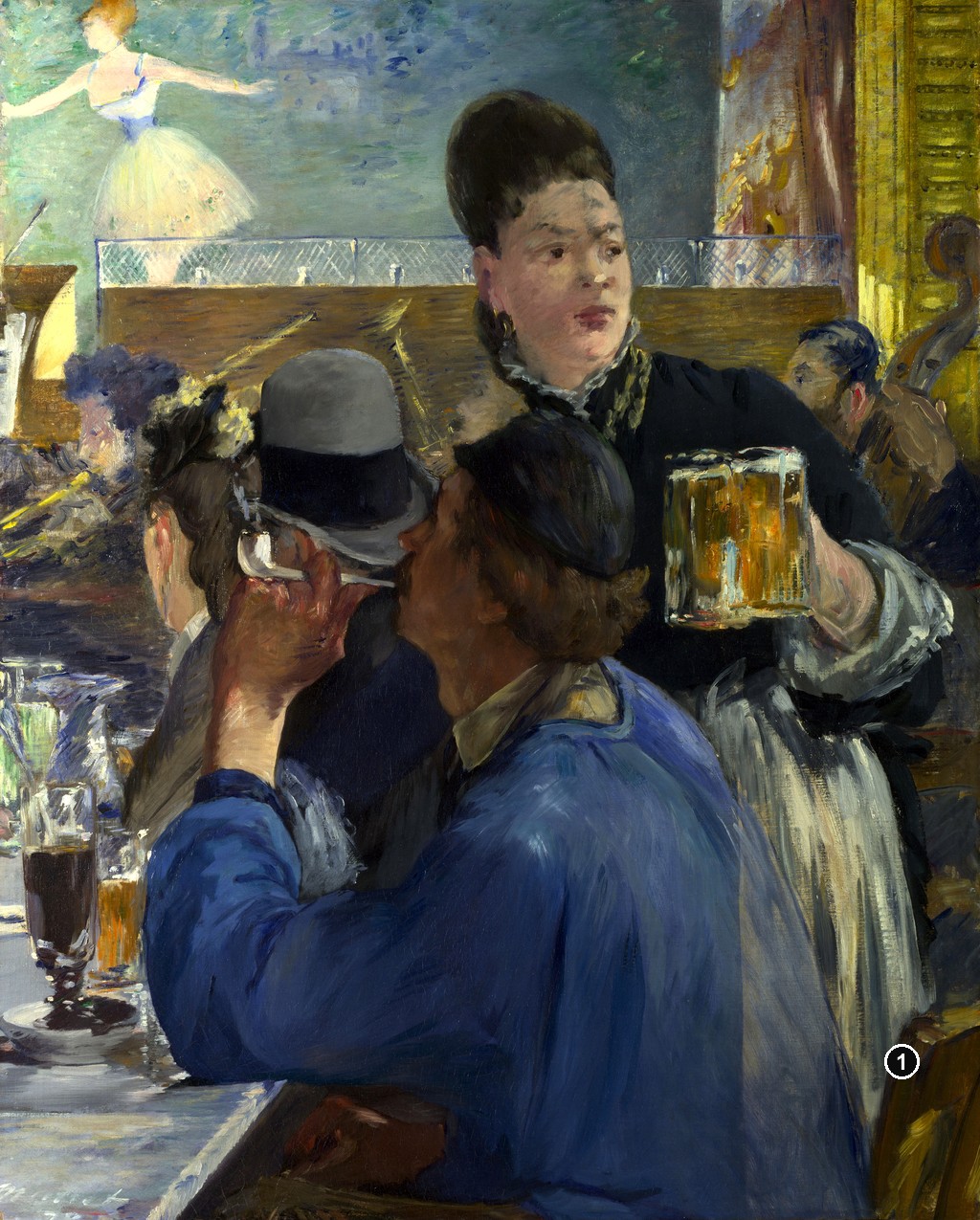
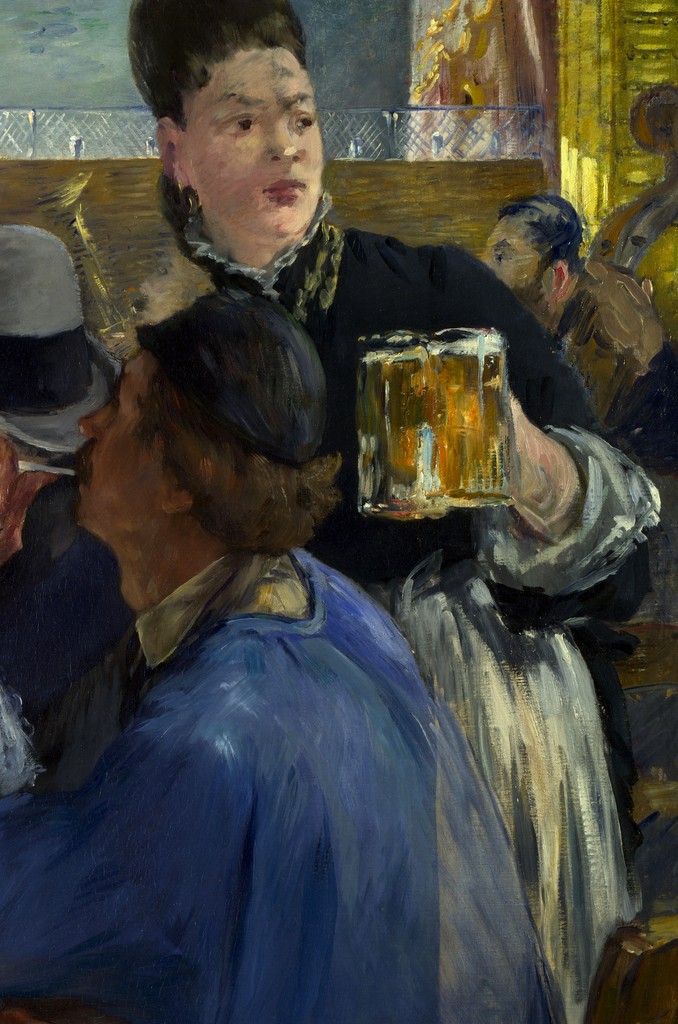
In Corner of a Café-Concert, a waitress carries glasses of beer behind a seated man in a blue smock. The National Gallery dates the painting probably 1878–80.[5] Dark clothing, pale glass highlights and bright blue paint establish conspicuous contrasts. The handling changes markedly between the foreground figures and the stage behind them.
Ashok Roy's contribution to the 1983 National Gallery study examines the painting under its earlier title, The Waitress. He describes thick paint, multiple applications and impasto touches across a much altered composition.[2] The surface's lively marks are part of a painting that was repeatedly worked over.
The analysis also complicates any assumption that a freely handled colour must be chemically simple. An orange-brown sample from the stage front contained at least eight, and possibly ten, pigments within one paint layer. Elsewhere, some bright dabs were largely composed of a single pigment.[2] A relatively subdued brown could involve a more elaborate mixture than an emphatic touch nearby.
The distinction matters when looking at the stage. Brown passages link areas across the background, while scattered brighter marks give the distant performance its flickering presence. Their visual roles differ from the number of ingredients in the paint. What looks unified from a normal viewing distance can become heterogeneous under a microscope.
Black also forms part of the examined palette. Roy identifies ivory or bone black in the waitress's dark blouse, mixed with other pigments.[2] The dark garment gives the pale face, cuffs and amber glasses their strength, but its material composition extends beyond an undifferentiated area of black. Dark paint participates in the same network of mixtures as the more immediately colourful passages.
Not every identification was equally certain. The analysis did not establish the dyestuff in the red lake, and some yellow and violet identifications remained unresolved.[2] A published pigment list therefore contains degrees of confidence. The strongest account of Manet's colour keeps those distinctions attached to the samples examined.
Different Blues within One Smock
The seated man's smock offers a comparison within a single depicted object. Broad blue strokes carry the shoulder and back, while narrower dark marks reinforce the outline. Towards the right, the handling becomes thinner and more open, allowing pale areas to interrupt the blue. The garment remains recognisable across that change in density.
Roy's analysis gives the visible difference a material explanation. In the thicker paint on the original left section of canvas, cobalt blue plays an important role within complex mixtures. On the added right-hand strip, synthetic ultramarine and white have a greater role in thinner, discontinuous paint. Some pale highlights there are exposed lead-white ground.[2]
The distinction involves both pigment and application. A white highlight can be a stroke laid over darker paint, or an opening that reveals preparation below. The eye receives a pale accent in either case, but the surface has been constructed differently. The smock makes these alternatives part of the same continuous form.
The blues do not divide into two exclusive territories. Roy also found some cobalt on the right, while ultramarine occurs in underpaint on the left.[2] The important change is in their relative use and the structure of the paint. Describing one half simply as cobalt and the other as ultramarine would lose that complexity.
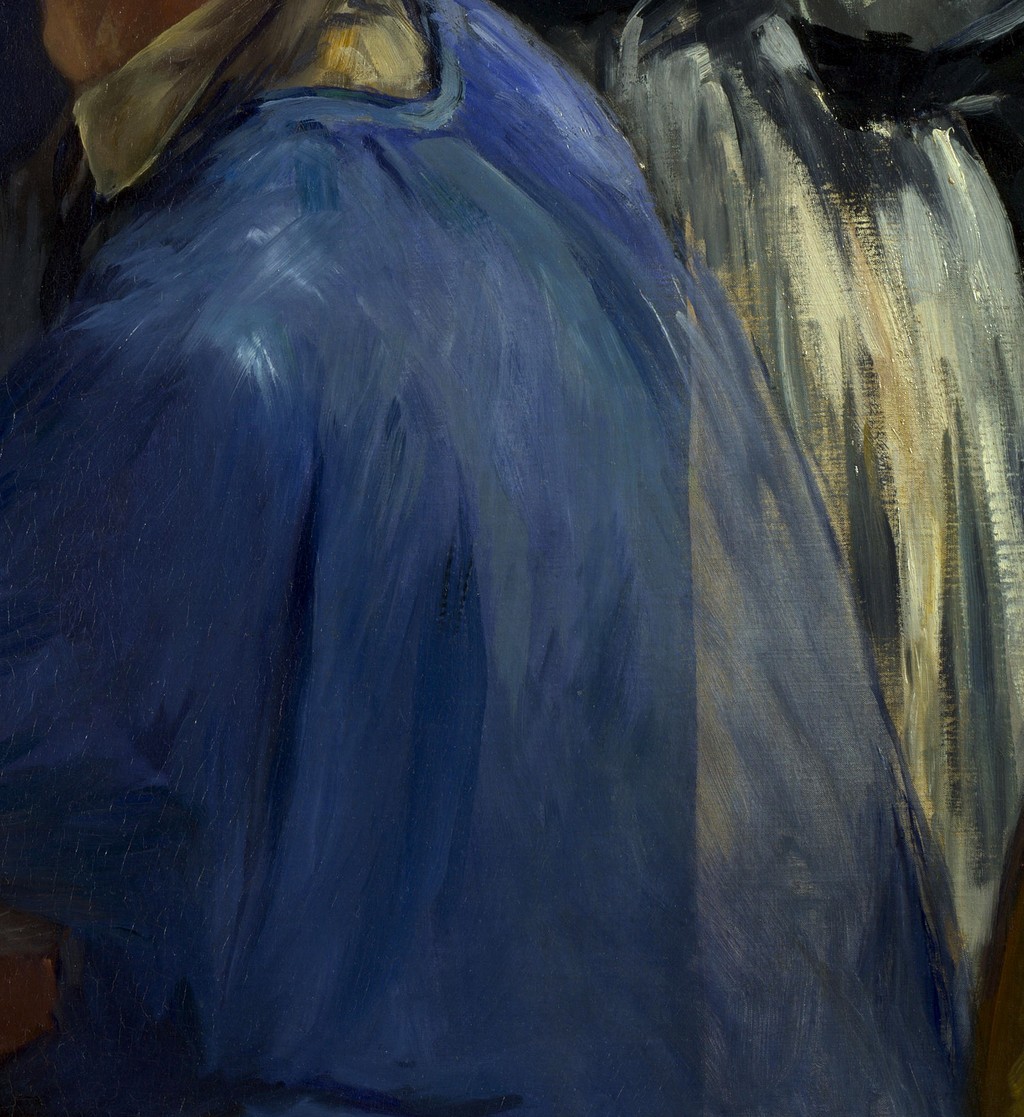
Detail of Édouard Manet’s Corner of a Café-Concert, probably 1878–80. The National Gallery, London, NG3858. Visible variation in the blue smock; pigment findings come from the published technical examination. The National Gallery, London; faithful public-domain reproduction via Wikimedia Commons. Image source. Public domain.
Cutting and Extending the Canvas
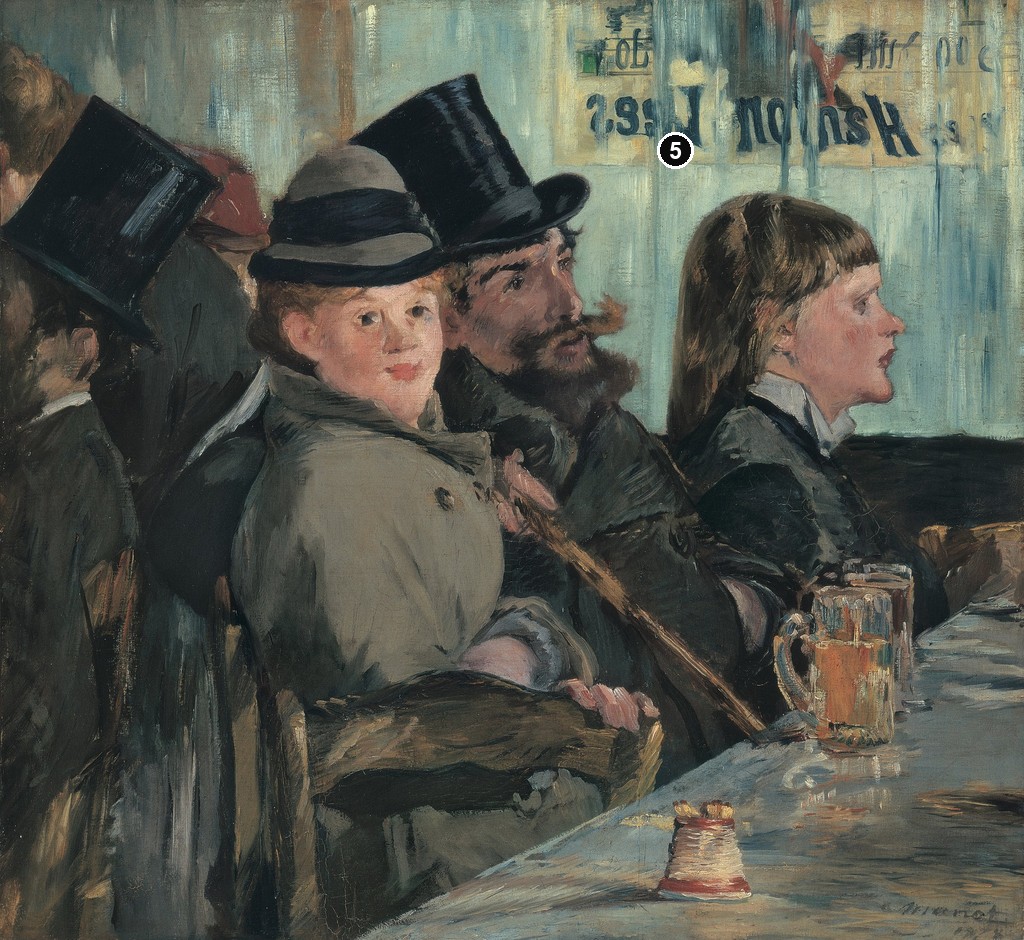
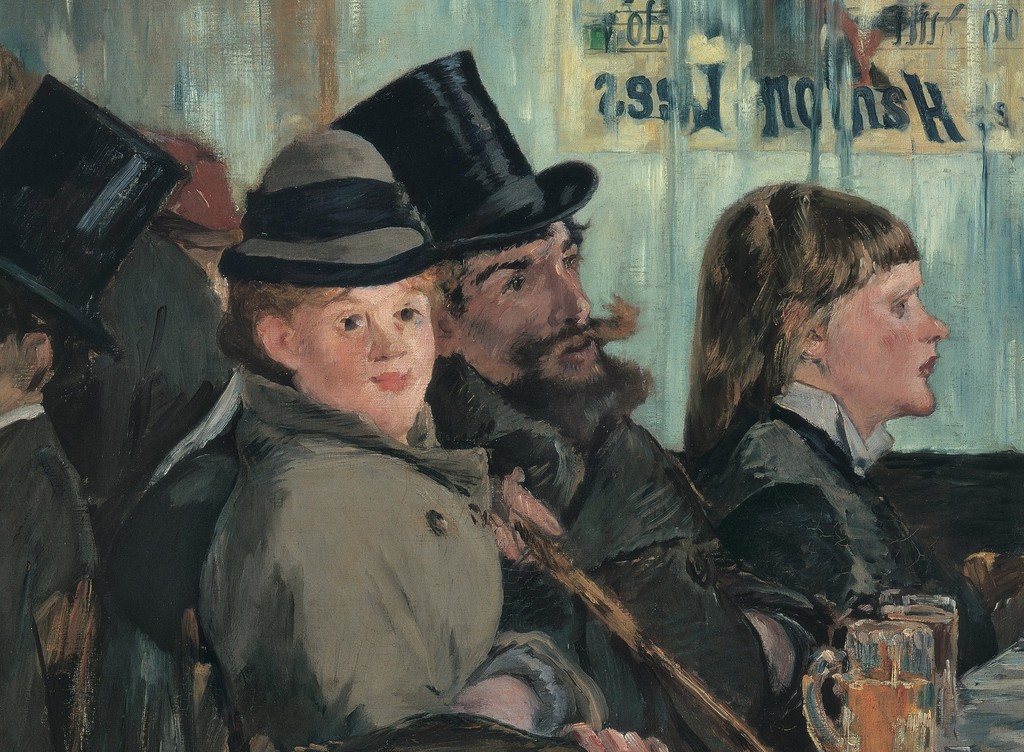
The café-concert's framing was itself revised. The London picture and At the Café in Winterthur were once parts of a larger composition, cut apart and subsequently reworked. The London portion received a new strip of canvas on its right, moving the waitress towards the centre of its enlarged field.[5]
The National Gallery locates the join through the man's blue smock, roughly in line with the satin curtain above.[5] What now appears as a continuous figure thus crosses a physical addition to the painting. The variation in blue paint occurs within this history of extension.
This changes the meaning of a cropped or partial view. Figures and objects pressed against a picture's edge can make the spectator feel close to a busy room. Here, however, the boundaries also emerged through cutting, addition and repainting. The apparent glimpse has a substantial history of reconstruction behind it.
The Winterthur portion underwent a different operation: it was itself cut and rejoined, as David Bomford explains in the same technical study.[2] The present paintings are therefore altered objects in their own right. Simply placing their current rectangular reproductions side by side would not restore the original composition.
Their relationship nevertheless remains visible through shared kinds of detail. Tables and glassware establish the foreground, while figures crowd the space behind. The technical study connects surviving table lines, shadows and other fragments across the two paintings.[2] Such correspondences help recover the earlier relationship without pretending that every present edge once fitted another.
Physical support can seem secondary when attention centres on subject and brushwork. In this case it directly affects both. Widening the London fragment changed the waitress's position within the image and required the man's garment to continue onto new canvas. Composition and paint handling developed together through a material intervention.
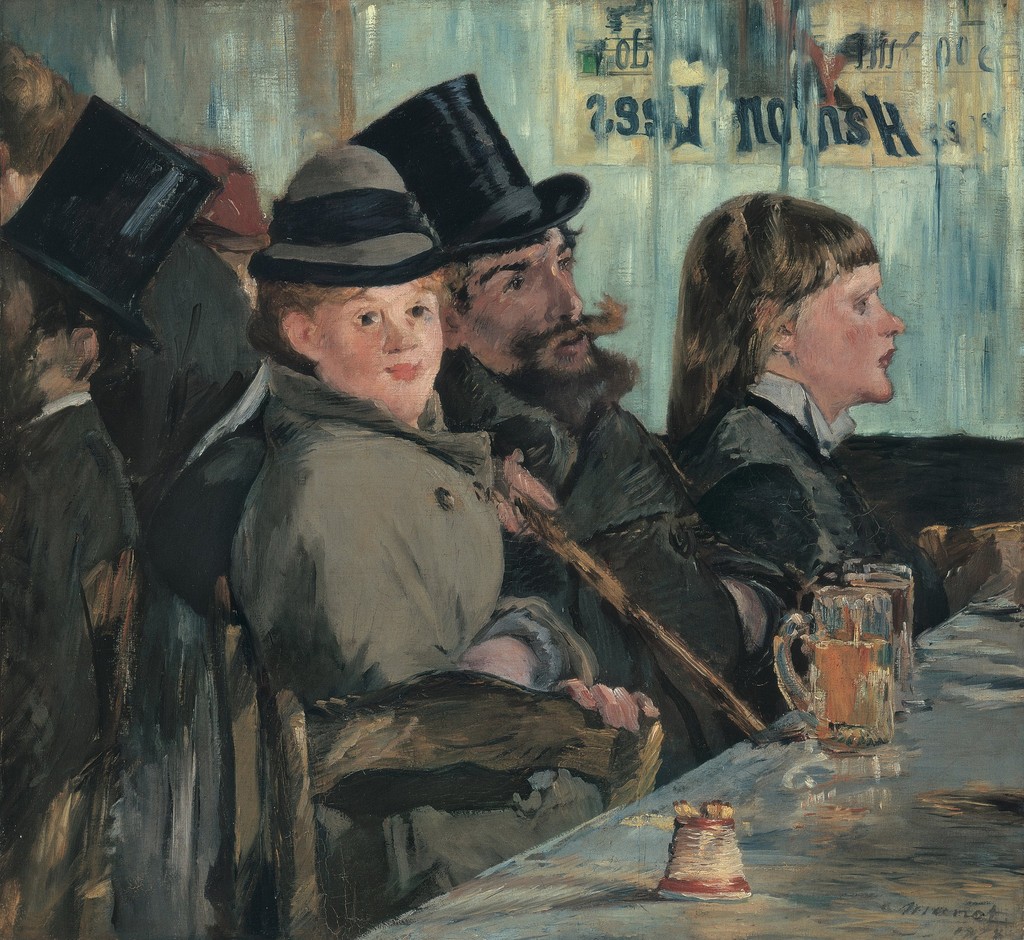
Édouard Manet, At the Café, 1878. Kunst Museum Winterthur, Sammlung Oskar Reinhart «Am Römerholz». A related, separately cut and reworked canvas; the supplied view omits some outer support edges. Sammlung Oskar Reinhart «Am Römerholz», Winterthur; faithful public-domain reproduction via Wikimedia Commons. Image source. Public domain.
Reading the Order of Changes
The London painting also preserves evidence of a changed background. Roy's examination of samples from its left edge supports a painted-over window, corresponding to evidence in radiographic images and to the related Winterthur setting. Light blue and pale mixed layers survive beneath later paint at sampled positions within that area.[2]
Layer order can establish that one operation preceded another. Matching brown stage paint across the canvas join indicates that the continuous passage was painted after the sections had been joined. The surface could then unite material that had previously been separate.[2]
Brown paper edging supplies another revealing sequence. In one sampled passage, the layers run from lead-white ground through pale paint associated with the former window, then paper and finally the brown paint of the prompter's box. Comparison with adjacent paint supports the study's conclusion that Manet continued painting after the lining and paper edging had been added.[2]
The argument depends on the relationship between layers, materials and composition. Paper beneath a continuous painted passage has a different significance from paper simply attached over a finished image. The sample preserves the order locally, while comparison across the painting helps explain the operation more broadly.
This is also why a cross-section must remain attached to its location. A sample above the former window has a different sequence from samples within it.[2] One tiny stack of paint cannot stand for every part of the canvas. Following the changes requires several kinds of evidence to be brought into relation.
Studio Work and Outdoor Painting
Place adds another dimension to Manet's methods. A picture of modern entertainment might draw on visits and sketches, then be developed with a model in the studio. An outdoor subject could involve working beside fellow painters. The setting represented in a painting and the place where it was made are related questions, with different answers for individual works.
The Courtauld describes A Bar at the Folies-Bergère, completed in 1882, as painted in Manet's studio. He had made sketches at the music hall, and the barmaid Suzon came to pose for the final work.[6] Observation at the venue and a controlled sitting contributed to the construction of the same image.
This helps explain the coexistence of encounter and arrangement. The barmaid appears within an animated place of entertainment, but the final painting gave Manet another setting in which to work on her figure. The studio formed part of the process of representing modern public life.
A different working situation appears in The Monet Family in Their Garden at Argenteuil of 1874. The Metropolitan Museum describes the frequent meetings between Manet and Monet that summer and recounts Renoir positioning himself beside Manet to paint Camille Monet and her son.[7] Here, a shared outdoor setting linked separate paintings and painters.
The garden and the studio each offered particular conditions for looking and arranging. Working beside another painter also made the same people available to different choices of framing and emphasis. These examples place Manet's technique within practical situations, rather than making the brightness or looseness of a painted surface alone determine where it was produced.
What Technical Examination Reveals
Different forms of examination answer different questions. A photograph records the visible surface. A radiographic image can provide evidence of underlying forms and structural changes. A paint cross-section exposes the layers at a tiny sampled location. Pigment analysis addresses the material constituents of selected paint.[2]
The methods sometimes use related scientific terms for quite different operations. Roy used X-ray diffraction to help identify pigments in samples; that identification is distinct from the radiographic images used to investigate the composition.[2] One concerns the material in a sample, while the other contributes an image of the object beneath its visible surface.
The most useful findings bring those scales together. In the café-concert, the blues of the smock connect pigment mixtures with application and an added support. The brown stage paint contributes to the order of revisions. In the asparagus still life, examination explains the role of the ground and wet paint while leaving the first order of the principal colour fields unresolved.[1][2]
For close looking, begin with a whole painting's distribution of light, dark and colour. Then follow a particular edge or object: a binding around the asparagus, the man's shoulder or the waitress's cuff. Notice where paint becomes substantial, where the surface opens and where a few strokes hold a form together. These changes reveal how much of Manet's pictorial force resides in the relationship between the represented thing and the marks that make it visible.
Annotated Details from Manet’s Style and Technique
The numbered points identify visible features discussed in this article. Return from each detail to the whole composition. Each caption identifies the work shown.
Corner of a Café-Concert London
Édouard Manet, Corner of a Café-Concert, probably 1878–80. The National Gallery, London, NG3858. The National Gallery, London; faithful public-domain reproduction via Wikimedia Commons. Image source. Public domain. Numbers added to a separate resized overview. Detail crops from the supplied public-domain reproduction; no enlargement or retouching.
Le Déjeuner sur l’herbe
Édouard Manet, Le Déjeuner sur l’herbe, 1863. Musée d’Orsay, Paris, RF 1668. Musée d’Orsay; faithful public-domain reproduction via Wikimedia Commons. Image source. Public domain. Numbers added to a separate resized whole supplied overview. Detail crops from the unchanged original; no enlargement, retouching or colour alteration.
The Judgment of Paris — Raimondi after Raphael
Marcantonio Raimondi after Raphael, The Judgment of Paris, about 1510–20. Engraving. The Metropolitan Museum of Art, New York, 19.74.1. Image source. CC0 / Public domain. Numbers added to a separate resized whole supplied overview. Detail crops from the unchanged original; no enlargement, retouching or colour alteration.
Bunch of Asparagus
Édouard Manet, A Bunch of Asparagus, 1880. Wallraf-Richartz-Museum & Fondation Corboud, Cologne, WRM Dep. 318. Wallraf-Richartz-Museum & Fondation Corboud; faithful public-domain reproduction via Wikimedia Commons. Image source. Public domain. Numbers added to a separate resized whole overview retaining the supplied edges and margins. Detail crops from the immutable original; no enlargement or retouching.
At the Café — Winterthur
Édouard Manet, At the Café, 1878. Kunst Museum Winterthur, Sammlung Oskar Reinhart «Am Römerholz». A related, separately cut and reworked canvas; the supplied view omits some outer support edges. Sammlung Oskar Reinhart «Am Römerholz», Winterthur; faithful public-domain reproduction via Wikimedia Commons. Image source. Public domain. Numbers added to a separate resized overview of the complete supplied reproduction, retaining its existing edges. Detail crops from the immutable original; no enlargement or retouching.
Details from MANET’S STYLE AND TECHNIQUE
Follow the numbered details back to the complete images above. Each caption identifies the work shown.
Corner of a Café-Concert London
The London Serving Gesture
The London waitress holds the glasses above a broad pale apron.
Le Déjeuner sur l’herbe
The speaking hand
The man on the right extends one hand into the gap between the figures. Its bent fingers make a small, sharply lit shape at the end of his dark sleeve.
The Judgment of Paris — Raimondi after Raphael
Three Figures at the Lower Right
A seated woman looks outward beside a back-turned figure and a reclining bearded man.
Bunch of Asparagus
Cut Ends and Curved Bindings
Pale cut ends gather on the left. Two warm, curved bindings cross the longer strokes of the stalks.
At the Café — Winterthur
Winterthur’s Hats and Pale Window
The three seated figures gather under dark hats against pale window passages, while their faces keep separate directions.
Artworks directory
Explore selected paintings, drawings and prints by Édouard Manet. Search by title or another recorded name.
Frequently Asked Questions
Yes. Roy's examination identifies ivory or bone black in the dark blouse in Corner of a Café-Concert, alongside other pigments in its mixtures.[2]
Discussion
Look again at the images and ideas explored in Édouard Manet Style and Technique. These editorial prompts invite your observations.
Reader Insights
Compare the dense blue shoulder with the thinner handling towards the right of the smock in Corner of a Café-Concert.
Look at the lower-right group in Raimondi's Judgment of Paris, then return to the central figures in Le Déjeuner sur l'herbe. How do their new surroundings change the encounter?
Which changes your reading of a painting more: seeing its brush marks closely or learning how its composition was revised?
Join the Conversation
Share a detail, comparison or question about Édouard Manet Style and Technique below.
References
- Iris Schaefer, Edouard Manet — Spargel-Still-Leben, technical report, Cologne, 2008, pp. 1–7 and illustration captions (in German; English companion also consulted). . English version. View source 1. View source 2.
- David Bomford and Ashok Roy, “Manet's ‘The Waitress’: An Investigation into its Origin and Development,” National Gallery Technical Bulletin 7, 1983, pp. 3–19, especially Roy's paint analysis, pp. 13–19 (in English). View source.
- Musée d'Orsay, Le Déjeuner sur l'herbe, current collection record and commentary (in French). View source.
- The Metropolitan Museum of Art, Marcantonio Raimondi after Raphael, The Judgment of Paris, about 1510–20, engraving, 19.74.1 (in English). View source.
- The National Gallery, Corner of a Café-Concert, current collection record and in-depth account (in English). View source.
- The Courtauld, A Bar at the Folies-Bergère, collection highlight (in English). View source.
- The Metropolitan Museum of Art, The Monet Family in Their Garden at Argenteuil, current collection overview (in English). View source.
- Splash image, Édouard Manet, Corner of a Café-Concert, probably 1878–80. The National Gallery, London, NG3858. The National Gallery, London; faithful public-domain reproduction via Wikimedia Commons. Image source. Public domain.


