


 by Tom Gurney
Tom Gurney BSc (Hons) is an art history expert with over 20 years experience
Email: tomgurney1@gmail.com / Phone: +44 7429 011000
Autumn (Portrait of Méry Laurent) by Édouard Manet: Introduction
Méry Laurent turns towards the left, her pale face rising above a dark fur collar. Behind her, flowers scatter across a blue textile. The contrast is immediate: a large, nearly continuous mass of brown clothing holds against a light ground broken by small, colourful marks. Her profile becomes the meeting point of these different surfaces.
Manet's Autumn, also titled Portrait of Méry Laurent, belongs to the Musée des Beaux-Arts de Nancy. The French national collections record dates it to 1882 and gives its dimensions as 72 cm high by 51.5 cm wide.[1] It was one of two paintings made for an unfinished project representing the seasons through fashionable Parisian women.[2] Within that decorative idea, Manet portrayed someone who also mattered to him as a friend and collector.
At a Glance
- ArtistÉdouard Manet
- TitleAutumn, or Portrait de Méry Laurent; L'Automne
- Date1882
- MediumOil on canvas
- Canvas dimensions72 cm high × 51.5 cm wide
- CollectionMusée des Beaux-Arts de Nancy
- Inventory number1071.[1]
This work across Édouard Manet’s career
Contents
- A Face Above the Fur
- Méry Laurent as Friend and Collector
- A Japanese Robe Behind the Model
- The Planned Four Seasons
- Comparing Autumn with Spring
- Laurent in a Black Hat
- An Unfinished Painting and Its Later Home
- Annotated details
A Face Above the Fur
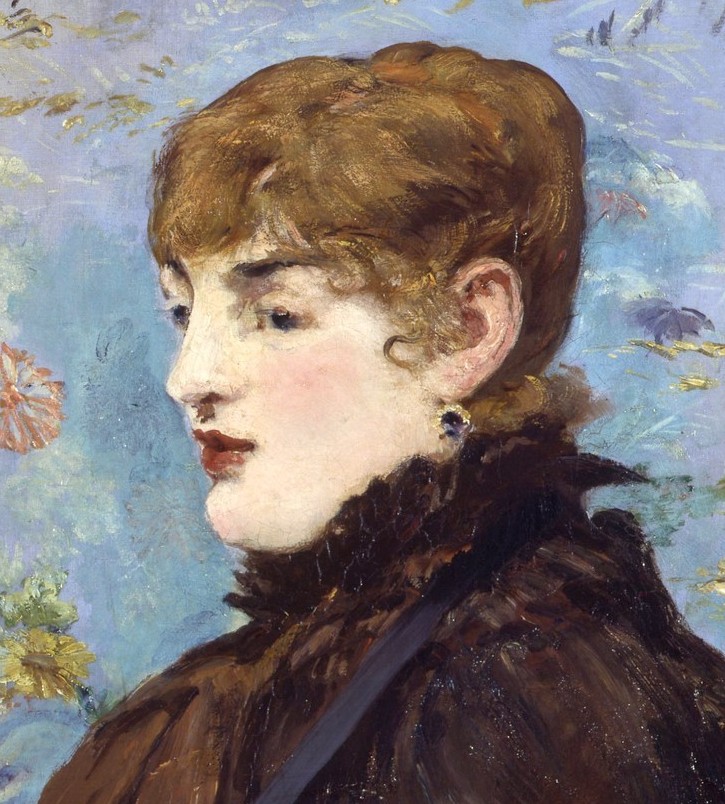
Laurent's face occupies a relatively small part of the canvas, but its lightness makes it the first area to draw attention. Her forehead, nose, lips and chin form a clear edge against the blue. A dark eyebrow and eye give definition within the pale shape, while pink warms the cheek and ear. The red-brown lips provide a concentrated accent beneath the nose.
Her head is turned further to the left than her shoulders. That slight difference gives the pose movement without requiring an action or a narrative setting. The body remains substantial and enclosed, while the face seems to extend beyond the collar towards the open area beside it. Her gaze follows the same direction, passing across the flowered ground rather than meeting the viewer.
The hair introduces a warmer range of colour above and behind the face. Russet and golden-brown strokes build the fringe and the rounded mass gathered at the back. A curl near the ear softens the transition between hair and skin. The earring catches small pale highlights around a blue-dark centre, linking the head to the cooler colour behind it.
These small distinctions are supported by much broader shapes. The dark collar rises beneath the jaw, making the cheek and chin appear especially bright. Along the shoulder, streaks of brown and black suggest the direction and sheen of fur. The face gains clarity because the clothing around it can remain comparatively broad and loosely described.
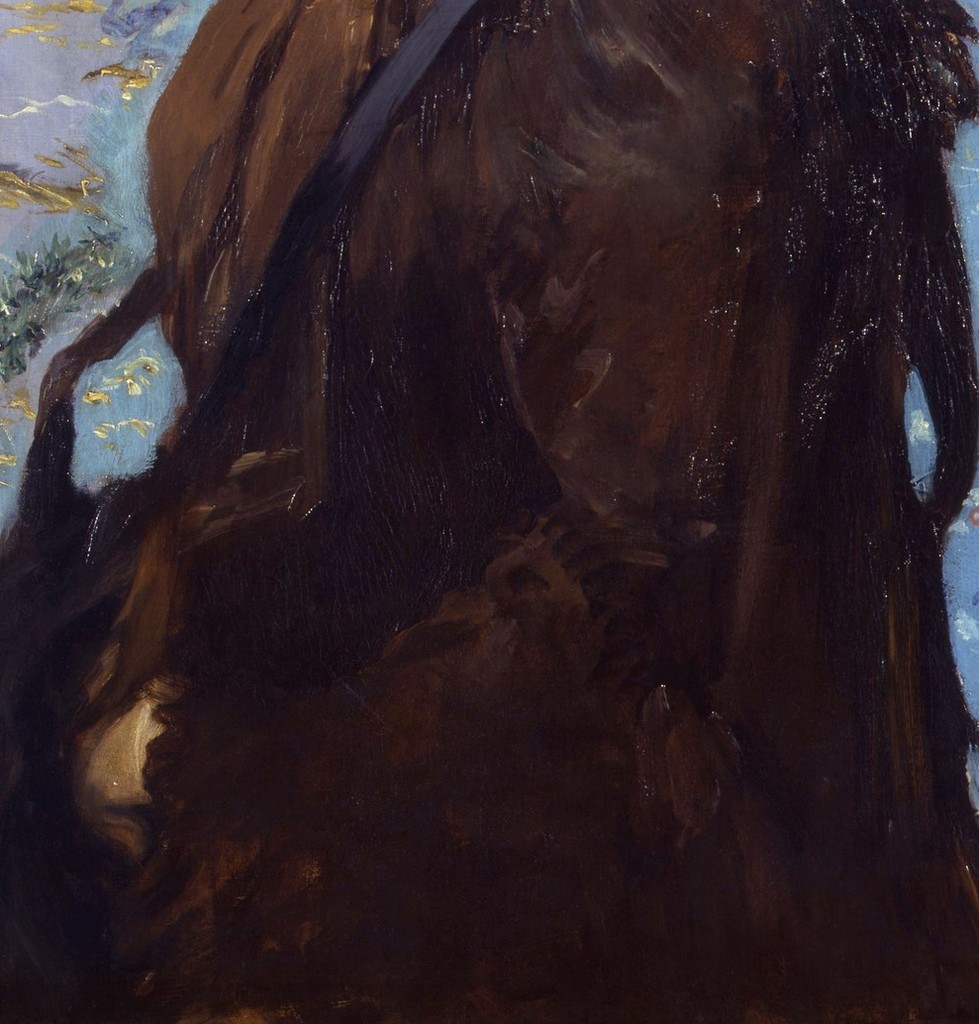
Looking down the canvas changes the balance. The fur occupies more space than the head, spreading across the torso and towards the lower edge. Some passages are warm brown, others almost black, with occasional lighter strokes breaking the surface. The shoulder's rounded outline provides a firm boundary against the textile, while long, curling dark forms extend away from the body. These details give the wrap variety without dissolving its overall weight.
The painting's narrow format intensifies this relationship. Laurent fills much of its height, and the coat approaches both lower corners. The background is most expansive around her head, where it gives the profile room to register. Clothing, face and setting therefore have different kinds of prominence: the fur dominates by size, the face by light, and the textile by its repeated changes of colour.
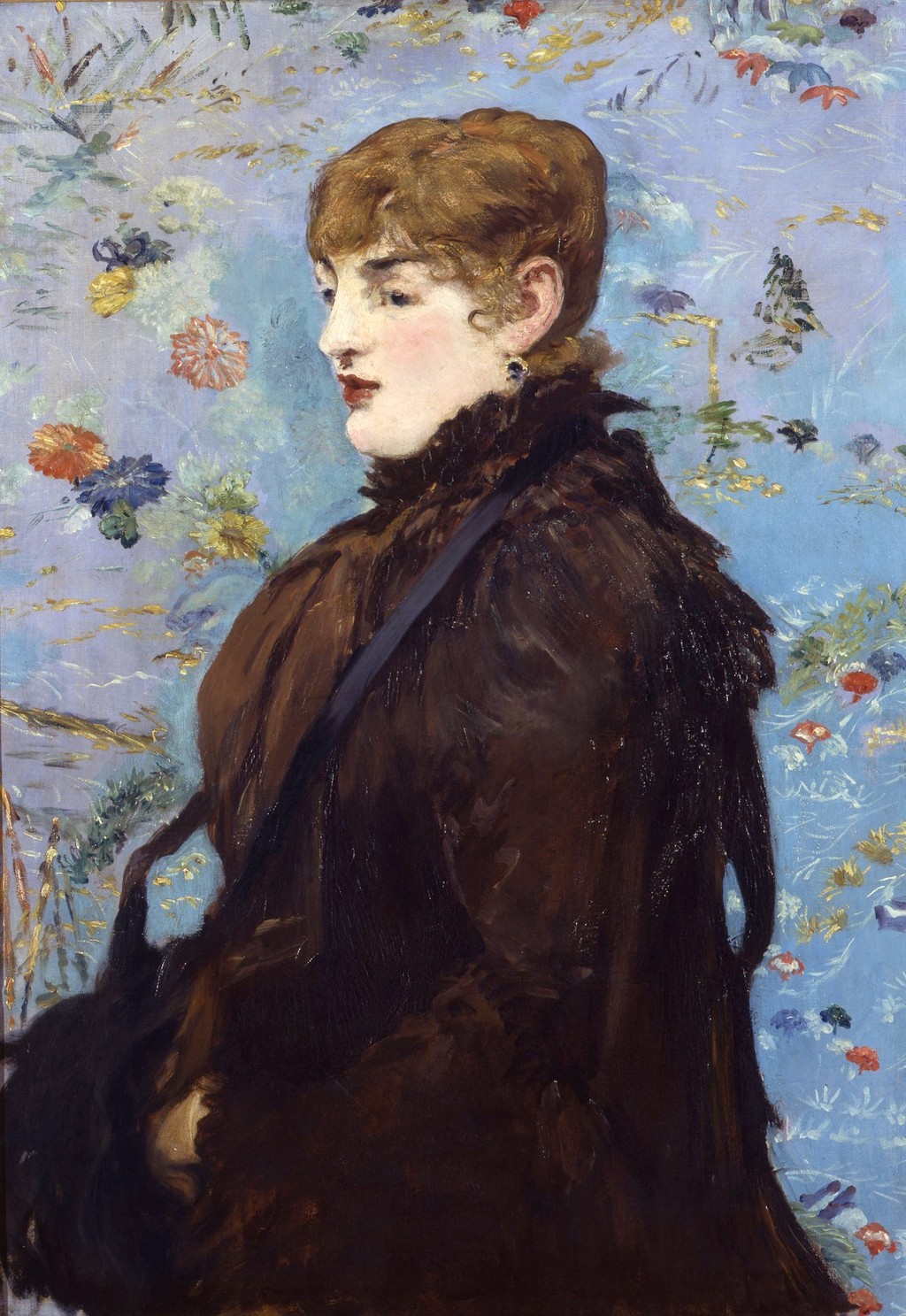
Édouard Manet, Autumn (Portrait of Méry Laurent), 1882. Musée des Beaux-Arts de Nancy, 1071. Musée des Beaux-Arts de Nancy; faithful public-domain reproduction via Wikimedia Commons. Image source. Public domain. Whole supplied reproduction resized within native dimensions; no enlargement, retouching or colour alteration.
Méry Laurent as Friend and Collector
Méry Laurent was born in Nancy in 1849 as Anne-Rose Suzanne Louviot. A former actress, she became a close friend of Manet and collected his work. Getty scholars Scott Allan and Emily A. Beeny describe her role in connecting him with potential patrons as well as posing for him.[3] Her place in his late career extended beyond the sittings recorded in individual pictures.
Laurent also belonged to a literary circle. She hosted a salon and was close to Stéphane Mallarmé, who dedicated poems to her. The Musée départemental Stéphane Mallarmé describes her as a cultivated confidante and an important presence in the poet's later life.[4] Manet's model was thus part of a network in which painting, writing, conversation and collecting overlapped.
Laurent was about thirty-three in 1882. Her role as Autumn belongs to the seasonal arrangement rather than identifying her as an elderly woman. The portrait gives her an autumnal character through the weight and warmth of clothing, set against the brighter, lighter costume of its companion. Its associations emerge from the comparison between the pictures and from the things represented within them.
A Japanese Robe Behind the Model
Allan and Beeny identify the background as a Japanese robe lent to Manet by Antonin Proust, with a pattern of chrysanthemums.[3] The garment provides the setting behind Laurent; she wears the dark fur in front of it. A piece of clothing has become a decorative field, bringing another kind of textile into the portrait.
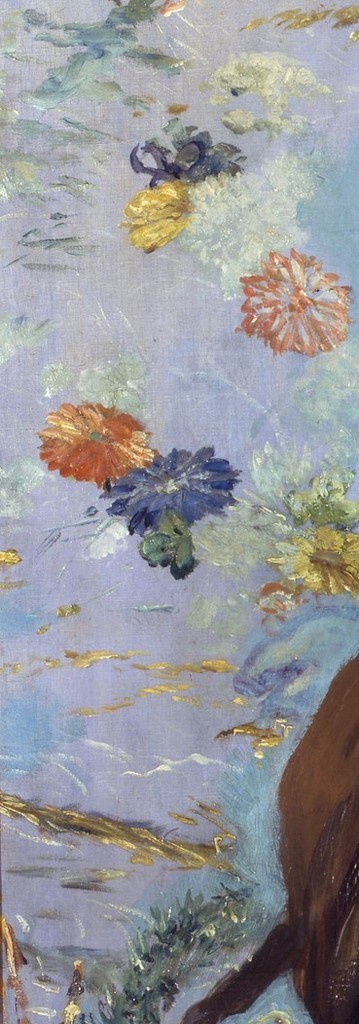
The background has no horizon or distant view. Its blue continues around Laurent's head and shoulders, keeping the surrounding space shallow. Flowers and stems appear in small clusters, some strongly coloured and others scarcely separated from the ground. Their scattered arrangement provides many possible paths for the eye, in contrast with the single, readily followed outline of the face.
Red and yellow flower heads offer warmer interruptions within the blue. White and pale-green touches sometimes nearly merge with it. A few darker marks give the pattern sharper accents. At the left of the profile, a reddish flower sits near the level of Laurent's mouth; elsewhere, smaller motifs approach the edges of the hair and coat. The pattern remains present even where the figure takes up most of the canvas.
The different surfaces work together. Hair and fur have directional strokes that follow rounded forms. The floral motifs spread laterally across the flatter ground. The face, placed between them, is more continuous and softly varied. Moving from one area to another makes the contrast between skin, hair, fur and decorated fabric unusually apparent.
The textile also changes how the seasonal subject can be read. Flowers, fabrics and the weight of clothing bring autumn into a constructed portrait setting, giving seasonal associations to the materials around Laurent.
The Planned Four Seasons
The Getty's account of the project describes Manet's seasonal women in relation to contemporary fashion and decorative painting. Antonin Proust reportedly commissioned the series, but its beginnings remain uncertain: Manet may have planned the cycle from the outset or developed it after the success of Jeanne, the painting also called Spring, at the Salon of 1882.[2]
Proust acquired Spring and encouraged Manet's interest in decorative art. Only that work and Autumn were painted for the proposed cycle; the four-part scheme remained incomplete.[2] The two surviving pictures nevertheless show how the idea could connect a named individual with a seasonal identity.
Laurent's likeness has to carry both purposes. Her head, hair and earring make the portrait specific, while the coat and floral backdrop contribute to a broader decorative arrangement. The season supplies a relationship with another painting, rather than replacing the sitter's identity. The double title, Autumn and Portrait of Méry Laurent, preserves those two ways of approaching the canvas.
The large dark shape of her clothing would also make a strong contrast when placed beside the lighter companion. Looking at the pair shifts attention from the details of one costume to differences of weight, brightness and texture across two similar formats. A seasonal sequence can be suggested through these pictorial changes even though the full set was never realised.
Comparing Autumn with Spring
The Getty dates Jeanne (Spring) to 1881. It measures 74 × 51.5 cm, close to Autumn in height and equal in width. Its model is the aspiring actress traditionally known as Jeanne Demarsy, shown with a parasol, bonnet and flowered dress. The painting appeared at the Paris Salon in 1882.[5]
Both women face left. In each painting, the head appears above a broad area of clothing, with foliage or floral decoration filling the space around it. Their similar orientation makes the changes of costume and setting especially easy to see. The comparison has a common structure, even though the two likenesses remain distinct.
In Spring, the bonnet expands around Jeanne's face, its flowers and pale trimming reaching into the greenery. The parasol occupies the upper right and sends its shaft diagonally towards the gloved hand. The light dress carries small coloured touches that echo the leaves and blossoms around it. Many of the picture's forms overlap through related colours, drawing clothing and setting into a lively surface.
Autumn concentrates more of its brightness in the face and background. Laurent's dark coat establishes a much larger division between the figure and the blue textile. Her uncovered hair becomes a warm band around the upper head, while the collar brings the darkest tones close to the jaw. The coat's breadth gives the pose a heavier presence than Jeanne's light ensemble.
The patterns have different functions too. Jeanne's dress is itself flowered, allowing the decoration on her clothing to answer the foliage behind her. Laurent's coat is comparatively continuous; its shifting browns and blacks stand against the small, separate flowers of the backdrop. In the first picture, patterned dress and setting repeatedly meet. In the second, the larger dark body gives the background pattern a more distinct boundary.
The pair therefore offers more than a change from light to dark clothing. It explores how a profile can be framed by a bonnet or exposed hair, how a hand and parasol can animate a pose, and how a broad coat can establish weight. The particular choices of dress determine the rhythm of each portrait as much as their seasonal titles guide the comparison.
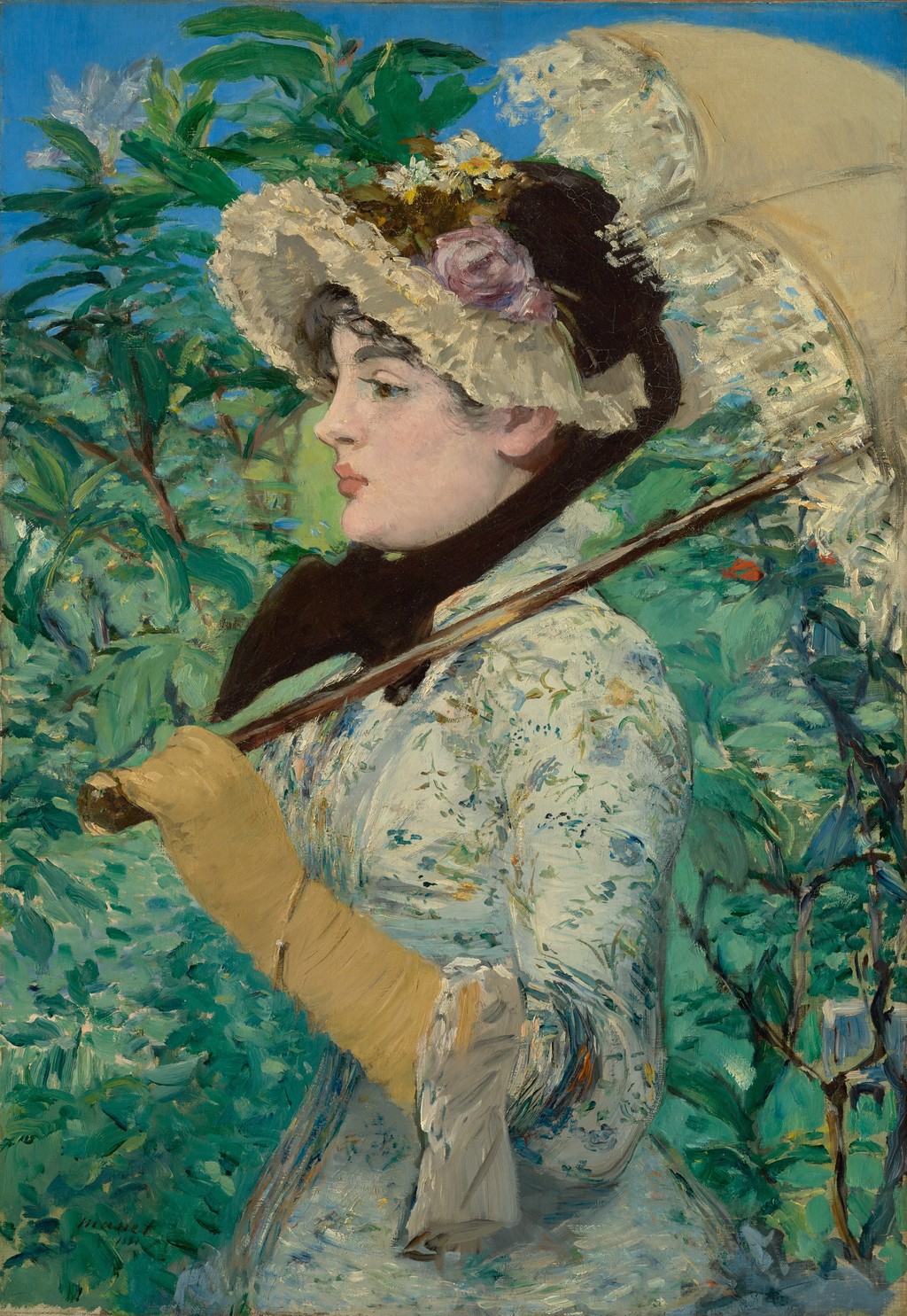
Édouard Manet, Jeanne (Spring), 1881. J. Paul Getty Museum, Los Angeles, 2014.62. Image source. CC0 / Public domain. Whole supplied reproduction resized within native dimensions; no enlargement, retouching or colour alteration.
Laurent in a Black Hat
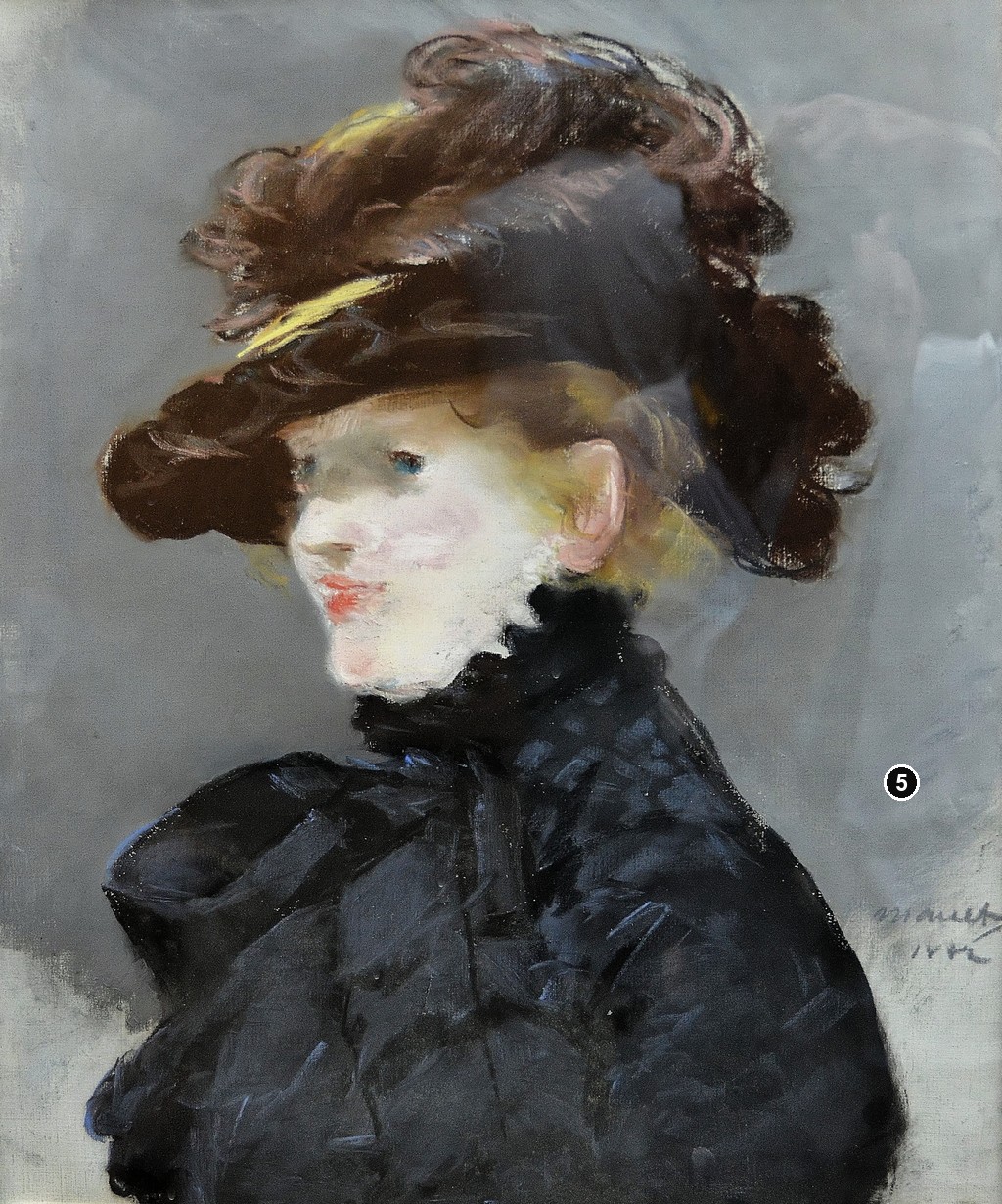
A separate Portrait of Méry Laurent in the Musée des Beaux-Arts de Dijon offers a useful comparison. Dated 1882, it is a pastel on canvas measuring 56 × 46.3 cm. The museum records that Albert Robin acquired it from Manet and that it entered the collection through Robin's bequest in 1930.[6]
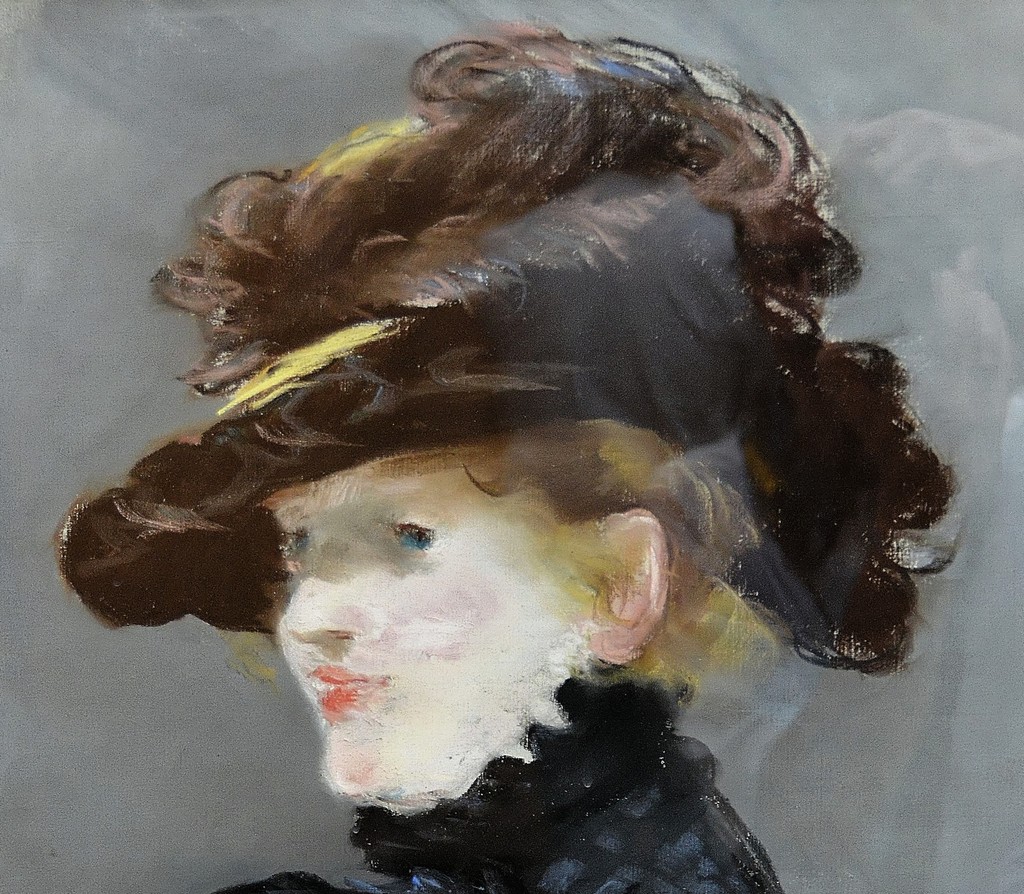
Here Laurent wears an enormous dark hat above a high collar and bow. Its elaborate trimming spreads sideways, giving the head a much wider silhouette than in Autumn. Brown, pink and yellow touches interrupt the dark trimming, while the face remains pale beneath the brim. A grey ground gives fewer competing details around the figure.
The hat changes the portrait's emphasis. In the oil, the uncovered hair offers a rounded, compact shape above the collar. In the pastel, the projecting brim creates a second broad mass, balancing the dark clothes below. Laurent's face sits between them, with the light cheek and chin bordered by the shadow of the hat and the high neckline.
The two pictures make different uses of fashionable accessories while retaining the recognisable relationship between a pale complexion and dark clothing. The pastel is an independent portrait, with its own medium, format and collecting history. Seeing it beside Autumn shows how extensively a change of hat and background can alter the presentation of the same model.
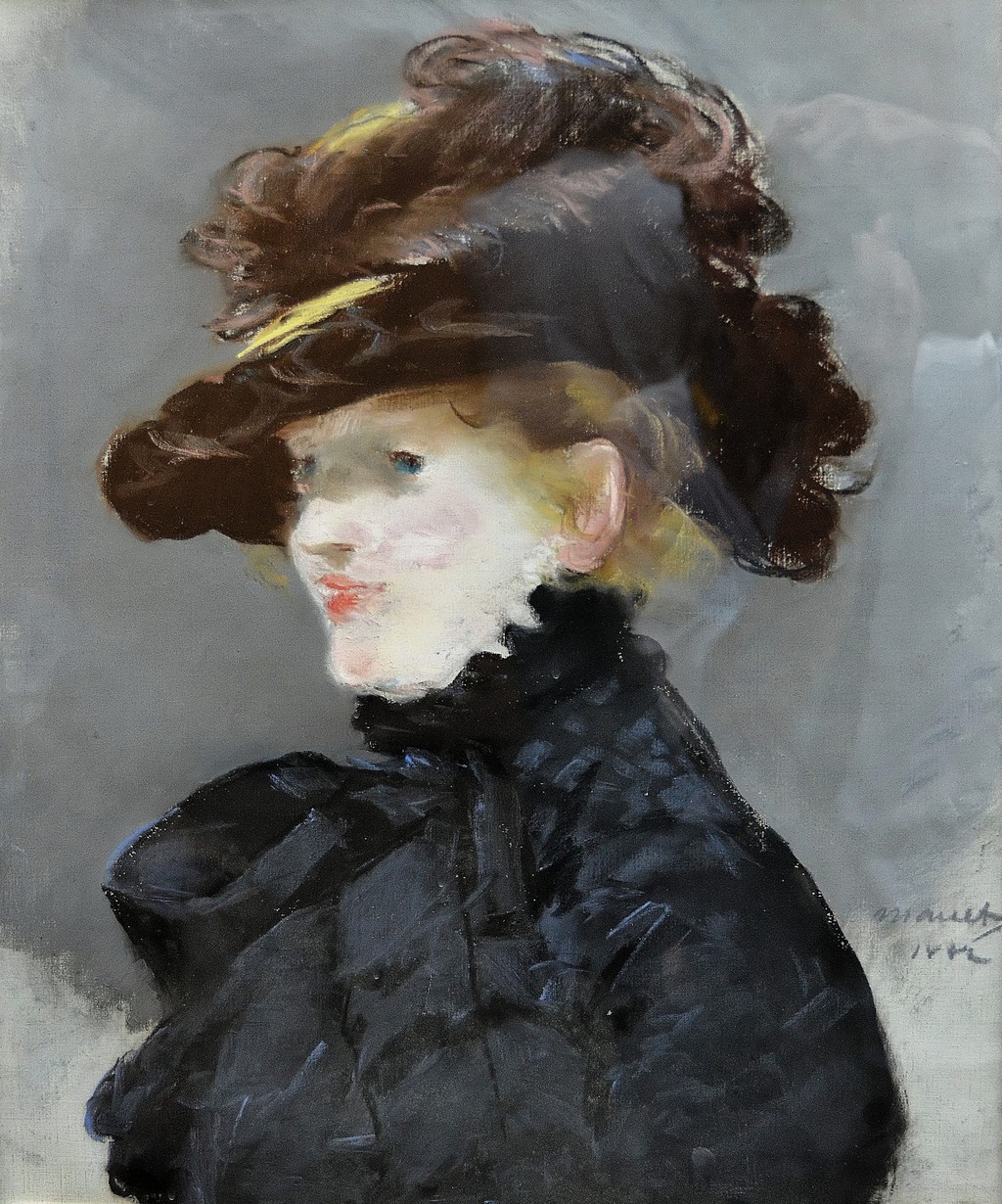
Édouard Manet, Portrait of Méry Laurent, 1882. Pastel on canvas. Musée des Beaux-Arts de Dijon, 2958 a. Separate portrait; visible glass reflections remain in the reproduction. Photograph Patrick Monchicourt / Morio60, via Flickr and Wikimedia Commons; Musée des Beaux-Arts de Dijon. Image source. CC BY-SA 2.0. Photograph Patrick Monchicourt / Morio60, CC BY-SA 2.0. Whole supplied view resized; glass reflections retained, no enlargement, retouching or colour alteration.
Annotated Details from Autumn: Fur, Flowers and a Related Pastel
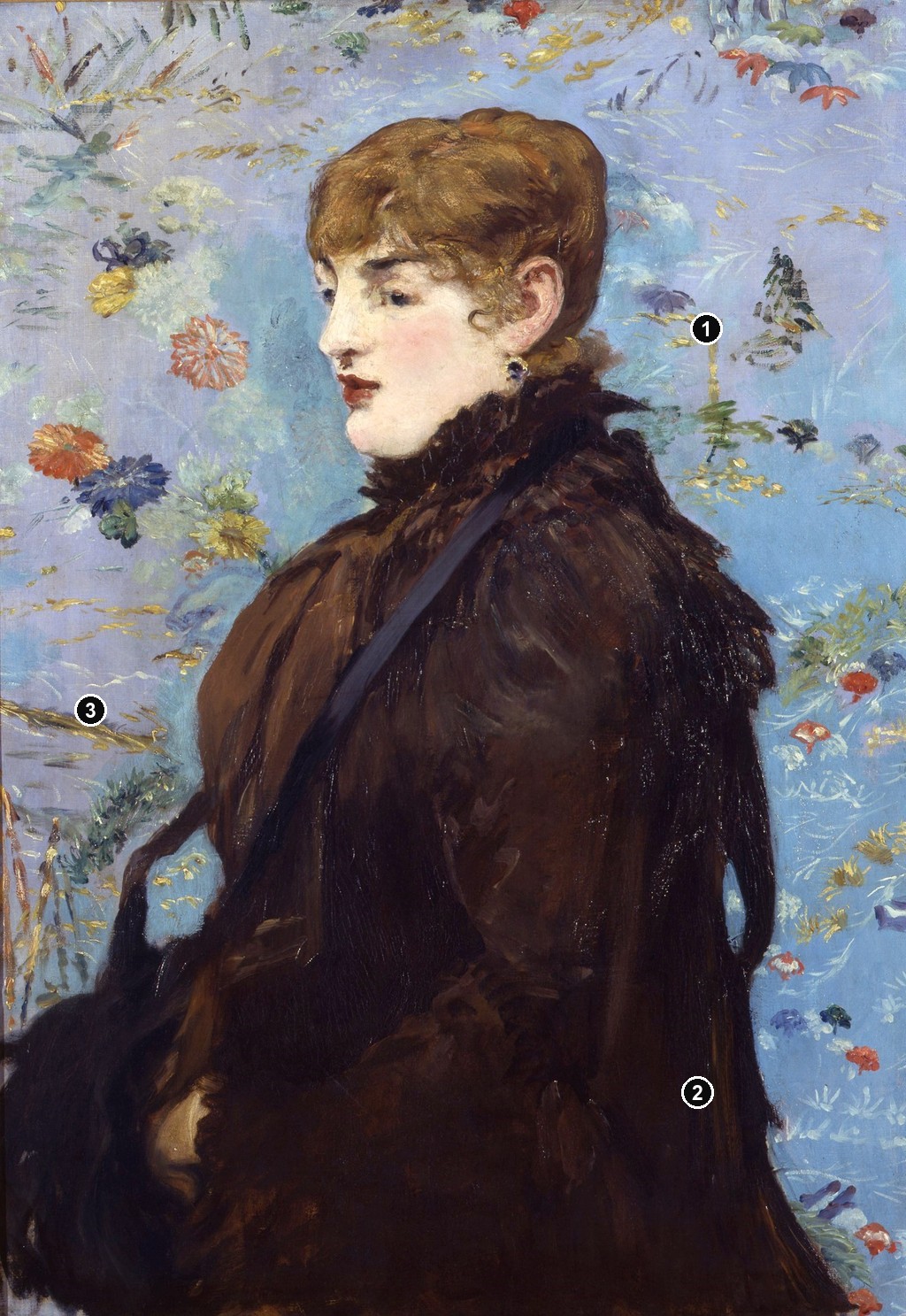
The numbered points identify visible features discussed in this article. Return from each detail to the whole composition. Each caption identifies the work shown.
Autumn — Portrait of Méry Laurent
Édouard Manet, Autumn (Portrait of Méry Laurent), 1882. Musée des Beaux-Arts de Nancy, 1071. Musée des Beaux-Arts de Nancy; faithful public-domain reproduction via Wikimedia Commons. Image source. Public domain. Numbers added to a separate resized whole overview retaining the supplied edges. Detail crops from the immutable original; no enlargement, retouching or colour alteration.
Jeanne (Spring) — Companion Painting
Édouard Manet, Jeanne (Spring), 1881. J. Paul Getty Museum, Los Angeles, 2014.62. Image source. CC0 / Public domain. Numbers added to a separate resized whole overview retaining the supplied edges. Detail crops from the immutable original; no enlargement, retouching or colour alteration.
 — Companion Painting.jpg)
Méry Laurent in a Black Hat — Dijon Pastel
Édouard Manet, Portrait of Méry Laurent, 1882. Pastel on canvas. Musée des Beaux-Arts de Dijon, 2958 a. Separate portrait; visible glass reflections remain in the reproduction. Photograph Patrick Monchicourt / Morio60, via Flickr and Wikimedia Commons; Musée des Beaux-Arts de Dijon. Image source. CC BY-SA 2.0. Photograph Patrick Monchicourt / Morio60, CC BY-SA 2.0. Number added to a separate resized whole overview; one detail crop from the photograph. Visible glass reflections retained; no enlargement, retouching or colour alteration.
Details from AUTUMN: FUR, FLOWERS AND A RELATED PASTEL
Compare the face, dark wrap and scattered flowers with Spring’s bonnet and parasol. The separate Dijon pastel brings a broader black hat around the turned face.
Autumn — Portrait of Méry Laurent
Hair and Face above the Fur
Warm brown hair rises over the pale turned face, with the dark collar gathered beneath the chin.
Dark Wrap and Curling Ribbons
Long dark ribbons descend beside the broad brown wrap, with lighter strokes interrupting the surrounding darkness.
Flowers beside the Dark Silhouette
Separate flower shapes on the pale blue field interrupt the edge of the dark clothing.
Jeanne (Spring) — Companion Painting
Spring’s Profile, Bonnet and Parasol
The flowered bonnet and pale parasol surround the profile, contrasting with Autumn’s uncovered head and dark fur.
 — Companion Painting Detail 04 spring-s-profile-bonnet-and-parasol.jpg)
Méry Laurent in a Black Hat — Dijon Pastel
Black Hat and Turned Face
The broad feathered hat spreads beyond the pale face. Reflections in the supplied photograph remain visible.
An Unfinished Painting and Its Later Home
Autumn has a different history of completion from its Salon companion. Allan and Beeny report that it remained unfinished when Manet died in 1883 and was sent to another painter for retouching before the studio sale in February 1884. They tentatively associate parts of the embroidered background with that later work.[3] The account leaves the retoucher unnamed, and particular strokes cannot securely be divided between painters simply by looking at a reproduction.
The painting was sold after Manet's death and subsequently belonged to Laurent. She died in 1900; the Nancy collections record dates the museum's acquisition through her bequest to 1905.[1][3] Her home city became the eventual destination of a portrait made within her Parisian artistic circle.
Artworks directory
Explore selected paintings, drawings and prints by Édouard Manet. Search by title or another recorded name.
Frequently Asked Questions
The French national collections record dates it to 1882.[1]
It belongs to the Musée des Beaux-Arts de Nancy, inventory 1071.[1]
Scott Allan and Emily Beeny report that it remained unfinished at Manet’s death in 1883 and was retouched by another painter before the studio sale in 1884.[3]
Discussion
Look again at the images and ideas explored in Autumn (Portrait of Méry Laurent) by Édouard Manet. These editorial prompts invite your observations.
Reader Insights
Compare the pale profile with the dark fur collar directly beneath it. Notice the changes of edge and texture where face, hair and clothing meet.
Follow the small flowers across the blue background, then look at the broader browns of the coat. How does each surface establish its shape?
Compare Autumn with Spring and the separate Dijon pastel. Look at how exposed hair, a bonnet and a large hat change the space around each face.
Join the Conversation
Share a detail, comparison or question about Autumn (Portrait of Méry Laurent) by Édouard Manet below.
References
- Ministère de la Culture, Portrait de Méry Laurent; L'Automne, Joconde record 05120001048, inventory 1071; current object details and acquisition history, updated 26 November 2024 (in French). View source.
- J. Paul Getty Museum, “The Four Seasons Project,” Manet and Modern Beauty, 2019; the proposed seasonal series and its uncertain beginnings (in English). View source.
- Scott Allan and Emily A. Beeny, “The Women behind Manet's Seasons,” Getty Magazine, Fall 2019, pp.22–25; Laurent, the borrowed backdrop and the unfinished painting's retouching and ownership (in English). View source.
- Musée départemental Stéphane Mallarmé, “Un mardi avec Méry: la muse de Mallarmé,” 12 February 2024; Laurent's literary circle and relationship with the poet (in French). View source.
- J. Paul Getty Museum, Jeanne (Spring), 1881, 2014.62; object details, costume and 1882 Salon exhibition (in English). View source.
- Dijon Musées, Portrait de Méry Laurent, 1882, inventory 2958 a; medium, dimensions and Albert Robin bequest (in French). View source.
- Splash image, Édouard Manet, Autumn (Portrait of Méry Laurent), 1882. Musée des Beaux-Arts de Nancy, 1071. Musée des Beaux-Arts de Nancy; faithful public-domain reproduction via Wikimedia Commons. Image source. Public domain. Whole supplied reproduction resized within native dimensions; no enlargement, retouching or colour alteration.


