


 by Tom Gurney
Tom Gurney BSc (Hons) is an art history expert with over 20 years experience
Email: tomgurney1@gmail.com / Phone: +44 7429 011000
Édouard Manet's Late Years: Introduction
In the final years of his life, Édouard Manet painted fashionable women, crowded places of entertainment and flowers standing in clear glass. He also made pastel portraits and sent friends letters illustrated with fruit, animals and plants. These works bring us close to the people and objects around him while showing an artist still choosing how to present modern life.
His circumstances were becoming harder. Walking grew difficult, treatment took him away from Paris, and sustained work at an easel demanded more than his body could always manage. Yet public ambition remained strong: his last Salon appearance, in 1882, included both A Bar at the Folies-Bergère and Jeanne, better known as Spring. Manet died the following April, aged fifty-one. His late years were the end of a relatively short career, with projects still developing.[1]
At a Glance
- PeriodThe later 1870s to Manet's death on 30 April 1883
- Public exhibitionsA solo show at La Vie Moderne in 1880; continued participation in the Salon
- Changing mediaOil painting alongside an expanding practice in pastel and watercolour
- Treatment staysBellevue in 1880, Versailles in 1881 and Rueil in 1882
- Last Salon pairA Bar at the Folies-Bergère and Jeanne (Spring), shown in 1882
- Unfinished projectA Four Seasons cycle, with Autumn left incomplete
Édouard Manet in context
Édouard Manet
1832–1883Edgar Degas
1834–1917Claude Monet
1840–1926Berthe Morisot
1841–1895Pierre-Auguste Renoir
1841–1919Contents
- An Artist Seeking an Audience
- Pastel and the Fashionable Portrait
- Bellevue and the Illustrated Letter
- A Plum, a Snail and a Supply of Paper
- Recognition in 1881 and the Salon of 1882
- The Seasons Project Left Open
- Flowers Brought Close
- Work Continuing into 1883
- Annotated details
An Artist Seeking an Audience
Manet's subjects around 1880 connected the studio with fashionable Paris. A hat, a glove or the angle of a seated figure could locate a person within contemporary social life. Portraiture let him concentrate these observations into an individual presence. His sitters came from friendships, family relationships, artistic circles and the theatre, giving him access to many different ways of dressing and appearing in public.[2]
He continued to seek an audience at the Salon while also using other exhibition spaces. In 1880 he presented work at the gallery attached to La Vie Moderne, a magazine concerned with fashion and culture. The display brought café and entertainment subjects together with portraits, including pastels. The Getty's account of the exhibition describes a response divided between objections to some subjects and admiration for the painter's abilities.[2]
One picture in that show reaches back several years. Boy in Flowers, painted in 1876, was conceived as an overdoor decoration for Ernest Hoschedé's house at Montgeron. The National Museum of Western Art in Tokyo identifies the child as Jacques Hoschedé and records the painting's appearance at La Vie Moderne in April 1880. It had remained unfinished in Manet's studio.[3]
That history gives the later decorative projects a longer setting. A child absorbed into a garden and a fashionable woman embodying a season belong to different pictures, but both bring a figure into a surrounding arrangement of colour and vegetation. The older work also shows how an unfinished canvas could remain available for reconsideration and exhibition. Its incomplete state preceded the most severe restrictions of Manet's final illness.
Pastel and the Fashionable Portrait
Pastel became increasingly important to Manet during the later 1870s. The Getty relates this interest to his changing health and to exchanges with Edgar Degas, Berthe Morisot and his former pupil Eva Gonzalès. Many of these portraits were made on prepared canvas. The support allowed a portrait in dry colour to share something of an oil painting's presence while retaining the marks and softer transitions of pastel.[2]
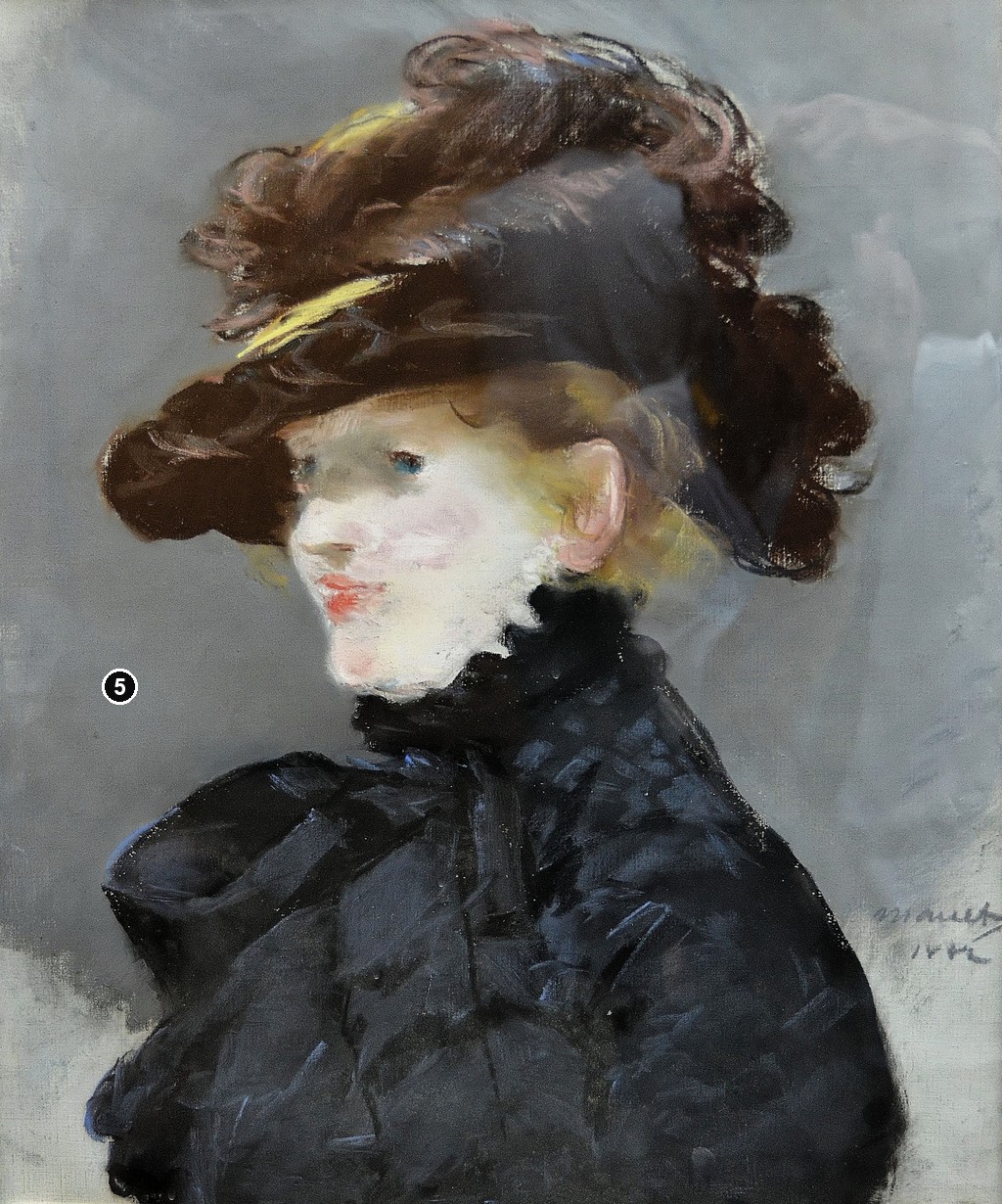
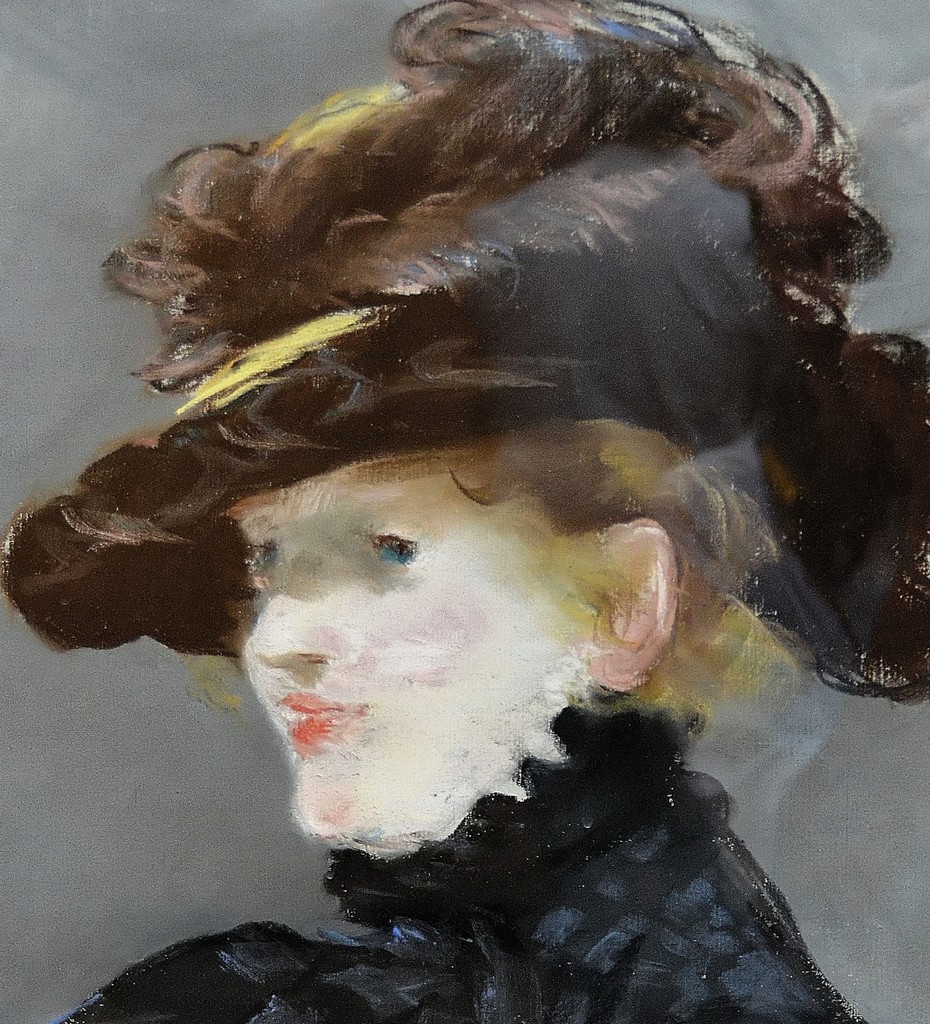
The medium gave particular scope to clothes, faces and accessories. In the Dijon Portrait of Méry Laurent, dated 1882, a broad dark hat occupies almost as much attention as the pale face beneath it. Warm touches run through its folds and feathers. Blue strokes articulate the dark clothing below, while the grey surroundings leave the figure exposed and distinct. Dijon records the work as pastel on canvas, measuring 56 by 46.3 centimetres.[4]
Here fashionable dress helps construct the portrait. The hat extends the sitter's silhouette, the collar surrounds her face, and the dark bodice gives the light skin an emphatic setting. The eye moves between the likeness and the arrangement of fabrics. Dijon's commentary places the emphasis on Laurent's elegance and Manet's interest in varied outfits; it offers a reading of the picture rather than a record of the sitter's private mood.[4]
Laurent herself helped sustain the world represented in these works. Scott Allan and Emily Beeny describe her as a collector, confidante and social intermediary who introduced Manet to potential patrons and encouraged interest in his pastels and flower paintings. Early biographers credited her with bringing flowers and encouraging these subjects.[5] Her contribution included collecting, conversation and practical connections as well as the time she spent posing.
The relationship belongs beside Manet's exchanges with professional women artists. Berthe Morisot and Eva Gonzalès offered examples of practice with which he could engage. The late pastel portraits emerged from an active artistic and social circle, even as his movements outside it became increasingly difficult.[2]
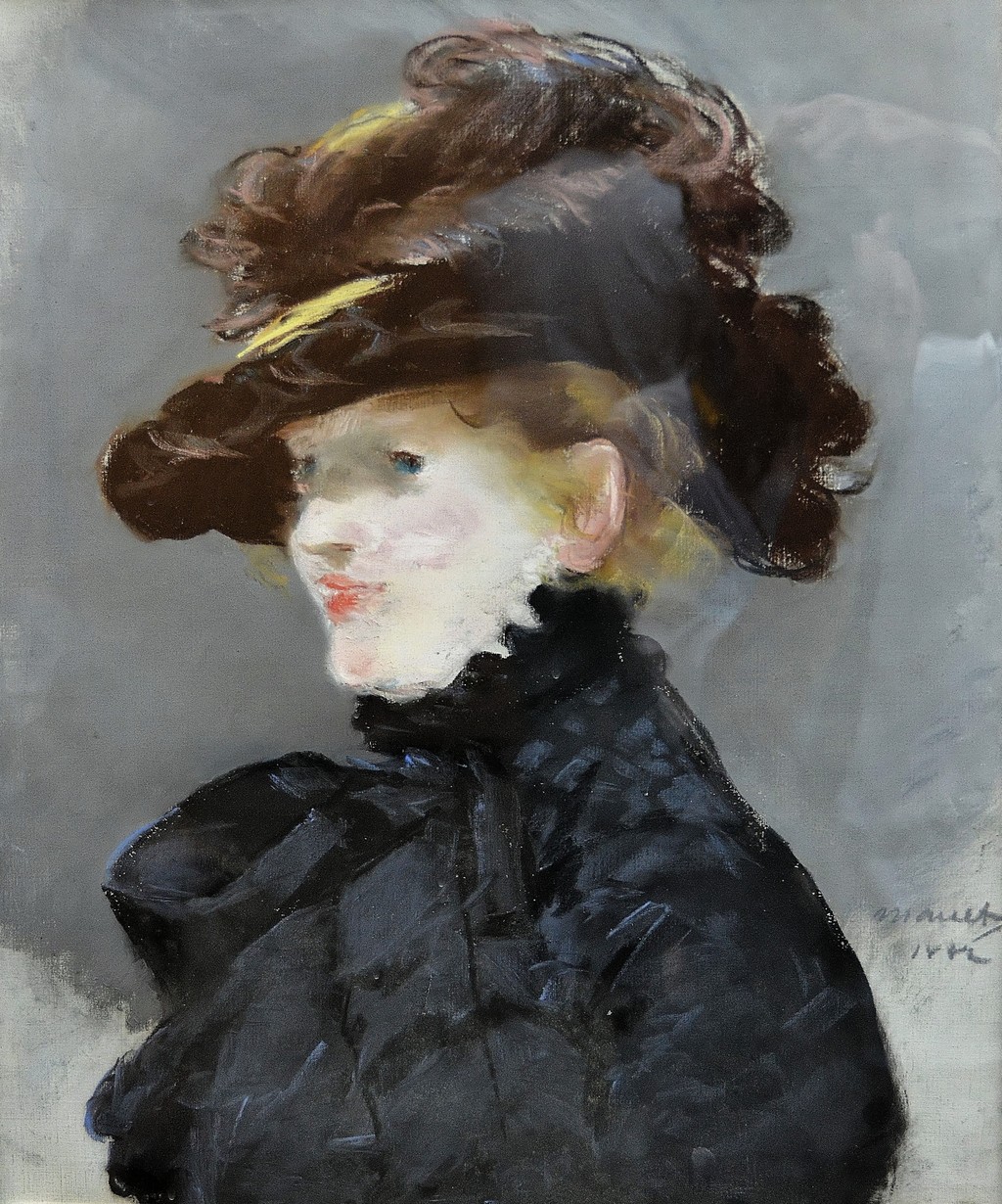
Édouard Manet, Portrait of Méry Laurent, 1882. Pastel on canvas. Musée des Beaux-Arts de Dijon, 2958 a. Photograph Patrick Monchicourt (Morio60), via Flickr and Wikimedia Commons; original photograph released under CC BY-SA 2.0. Image source. Public domain. Resized from the supplied photograph; no cropping.
Bellevue and the Illustrated Letter
In 1880 Manet went to Bellevue for medical treatment. Further stays followed at Versailles in 1881 and Rueil in 1882. The increasing pain and stiffness in his left leg limited his mobility. Getty curator Scott Allan places these restrictions within an account of an artist who continued to make decisions about subjects and media as his physical circumstances changed.[1]
Bellevue brought gardens, plants and fruit close to hand. It also created a distance from friends in Paris and elsewhere. Family accompanied Manet, but correspondence provided another means of maintaining contact. He filled letters with small watercolours, using the sheet as a place where a written message and a painted object could meet.[2]
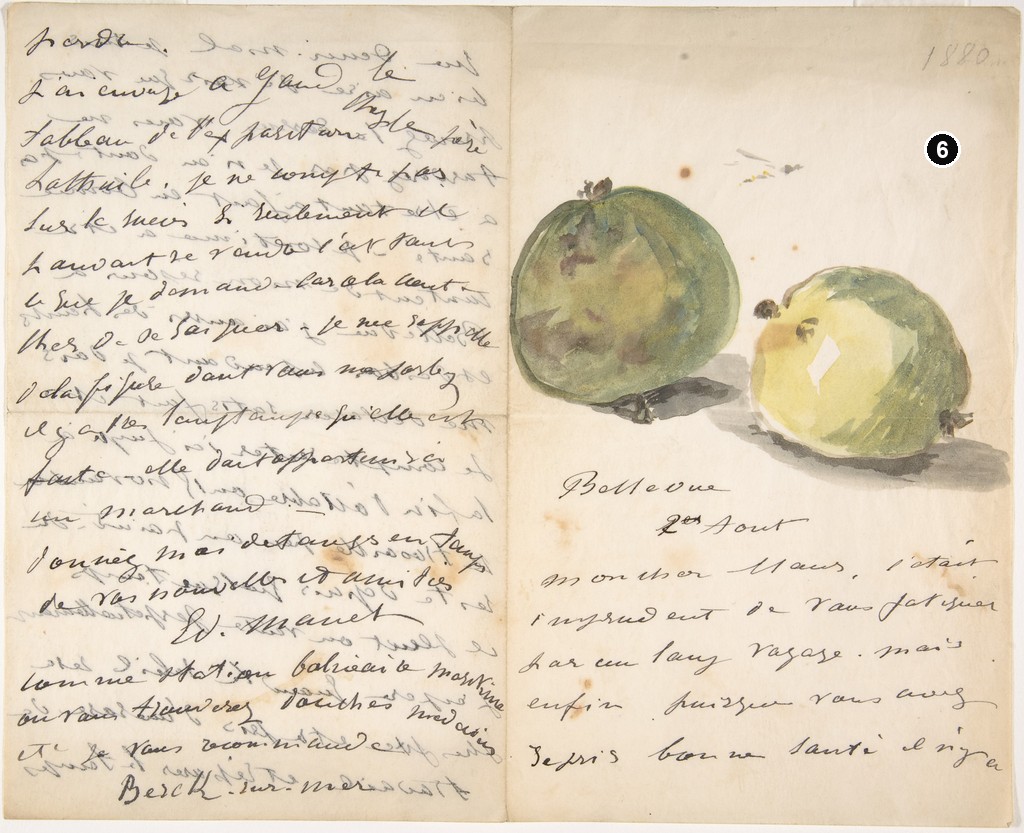
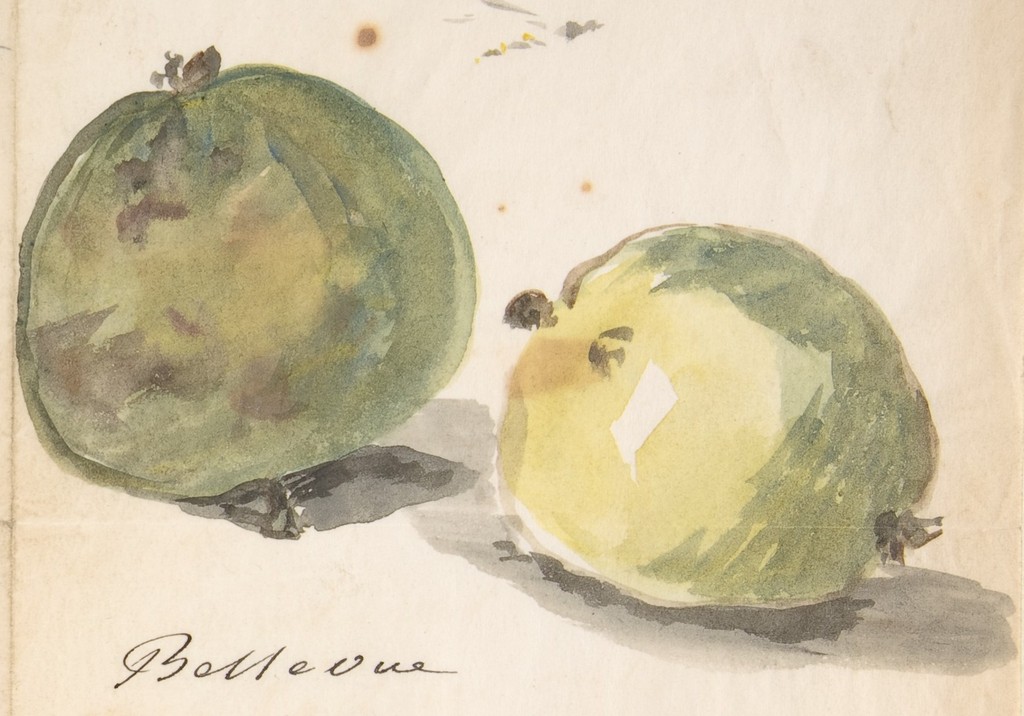
The letter to Eugène Maus dated 2 August 1880 combines this intimacy with professional business. Two greenish-yellow apples occupy the upper part of one page, their grey shadows giving them weight on the pale sheet. The handwriting begins below them and continues across the folded paper. The Metropolitan Museum identifies the letter's concern as Manet's submission of Chez le Père Lathuille to the exhibition in Ghent that year.[6]
The painting concerned was a substantial modern-life scene, made in 1879. Its mention in a letter from Bellevue connects Manet's temporary surroundings with the public career pursued from his studio. The apples and the exhibition discussion belong to the same act of correspondence. The sheet carries a small example of his painting to another painter while also asking for attention to a larger work.
Its physical format matters. A single sheet was folded to make four pages; the watercolour and the text share that portable object.[6] The reader could turn between Manet's words and the fruit. Unlike a painting placed on an exhibition wall, the letter was encountered through the ordinary actions of opening, unfolding and reading. Its scale gave the image a personal address.
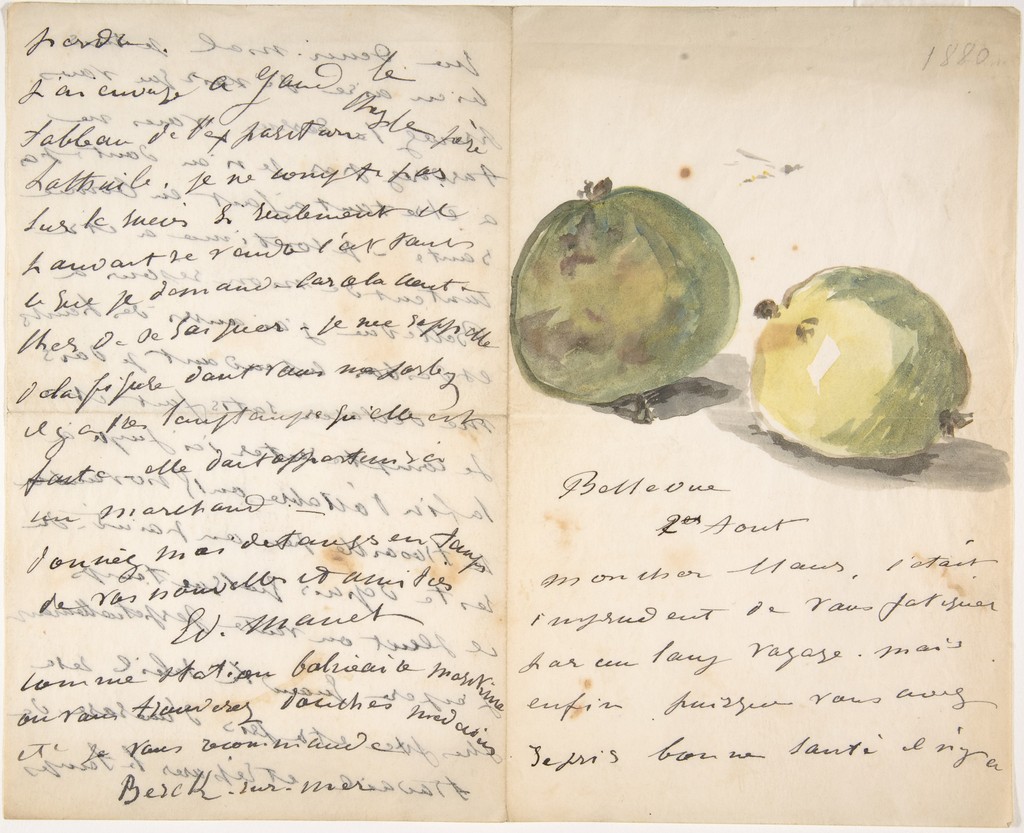
Édouard Manet, A Letter to Eugène Maus, Decorated with Two Apples, 2 August 1880. The Metropolitan Museum of Art, 2003.1. Purchase, Guy Wildenstein Gift, 2003. Image source. CC0 / Public domain.
A Plum, a Snail and a Supply of Paper
A shorter letter from Bellevue makes a gift its subject. Above a few lines of writing, a rounded plum balances on a small grey shadow. The brown, green and purple washes give it a mottled surface, with the long stem reaching upwards. Manet recalls having sent the first plum from his garden and now offers the last to his correspondent.[7]
The recipient's identity remains uncertain. Museum Boijmans Van Beuningen, which holds the sheet, suggests Madame Jules Guillemet. Its record dates the work to 1880 and identifies brown ink and watercolour as the media.[8] The combination of a particular fruit and a particular message gives the image its force: the little still life is also a gesture towards someone at a distance.
Another letter, now at the Getty, pairs a snail on a leaf with a request for English paper. Emily Beeny's study explains the work that went into its apparent simplicity. A preliminary application of grey watercolour helped organise the design before the more fluid coloured washes. Manet was managing the movement of water and colour within a small area, while the note asked for the material that would let him continue.[9]
Beeny leaves the addressee open, suggesting Madame Guillemet as a possibility through related correspondence. The request itself is clear enough to reveal a practical exchange: paper could be brought from Paris by visitors. Artistic work depended on supplies and contact, including in a form as modest as a letter decorated for a friend.[9]
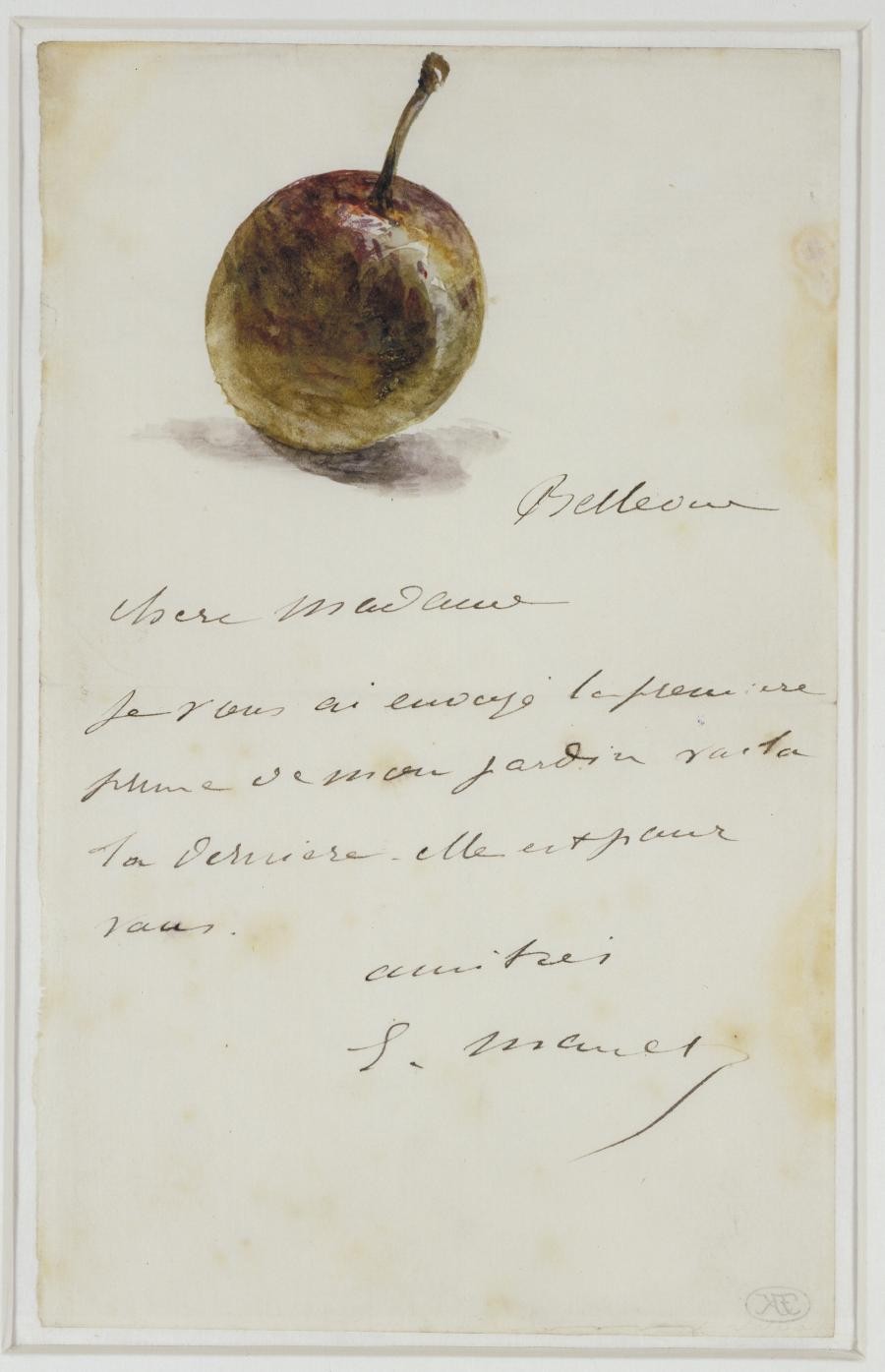
Édouard Manet, A Plum with an Accompanying Letter, 1880. Brown ink and watercolour. Museum Boijmans Van Beuningen, FII 73. Image source. Public domain.
Recognition in 1881 and the Salon of 1882
Public recognition also changed during these years. Both the portrait of Henri Rochefort and the portrait of Eugène Pertuiset were accepted for the Salon of 1881, and Manet received a second-class medal.[10] He was appointed a chevalier of the Légion d'honneur later that year.[1] These distinctions acknowledged an artist who had continued to seek a place within the official exhibition system.
His next Salon appearance brought together two very different pictures. A Bar at the Folies-Bergère places a woman behind a counter, with bottles and fruit in front and a great expanse of reflected activity behind. The Courtauld identifies the model as Suzon, a barmaid who came to Manet's studio to pose. He had made sketches at the venue, but the final painting was produced in the studio.[11]
That method preserved his access to a bustling public subject through a controlled working situation. The reflected crowd, bright objects and upright figure form a densely organised composition. The woman stands close to us while the mirror creates an apparently extensive interior around her. The picture's relationship between the directly seen and the reflected remains one of its absorbing uncertainties.
Beside it at the 1882 Salon was Jeanne (Spring), painted in 1881. The Getty describes a carefully constructed studio portrait in which Manet brought a fashionable outfit together with a setting of luxuriant foliage. The model, later known on stage as Jane Demarsy, appears in profile beneath a flowered bonnet, with gloves and a parasol completing the ensemble.[12][5]
Different kinds of handling coexist in the picture. Small touches describe flowers on the pale dress, the face is more smoothly brought together, and broad strokes establish the greenery. The parasol's curve frames the bonnet, while its shaft makes a diagonal across the figure. Dress and surrounding plants echo one another without becoming a single continuous surface.
The Getty identifies this picture as an especially favourable critical success in Manet's Salon career.[12] Its elegance offered one concentrated version of contemporary life; the Bar presented a more complicated encounter with labour, consumption and spectatorship. Together they show how much the late exhibition work could encompass. Manet was still developing pictures intended for a large public while making the intimate portraits and letters that circulated through his friendships.
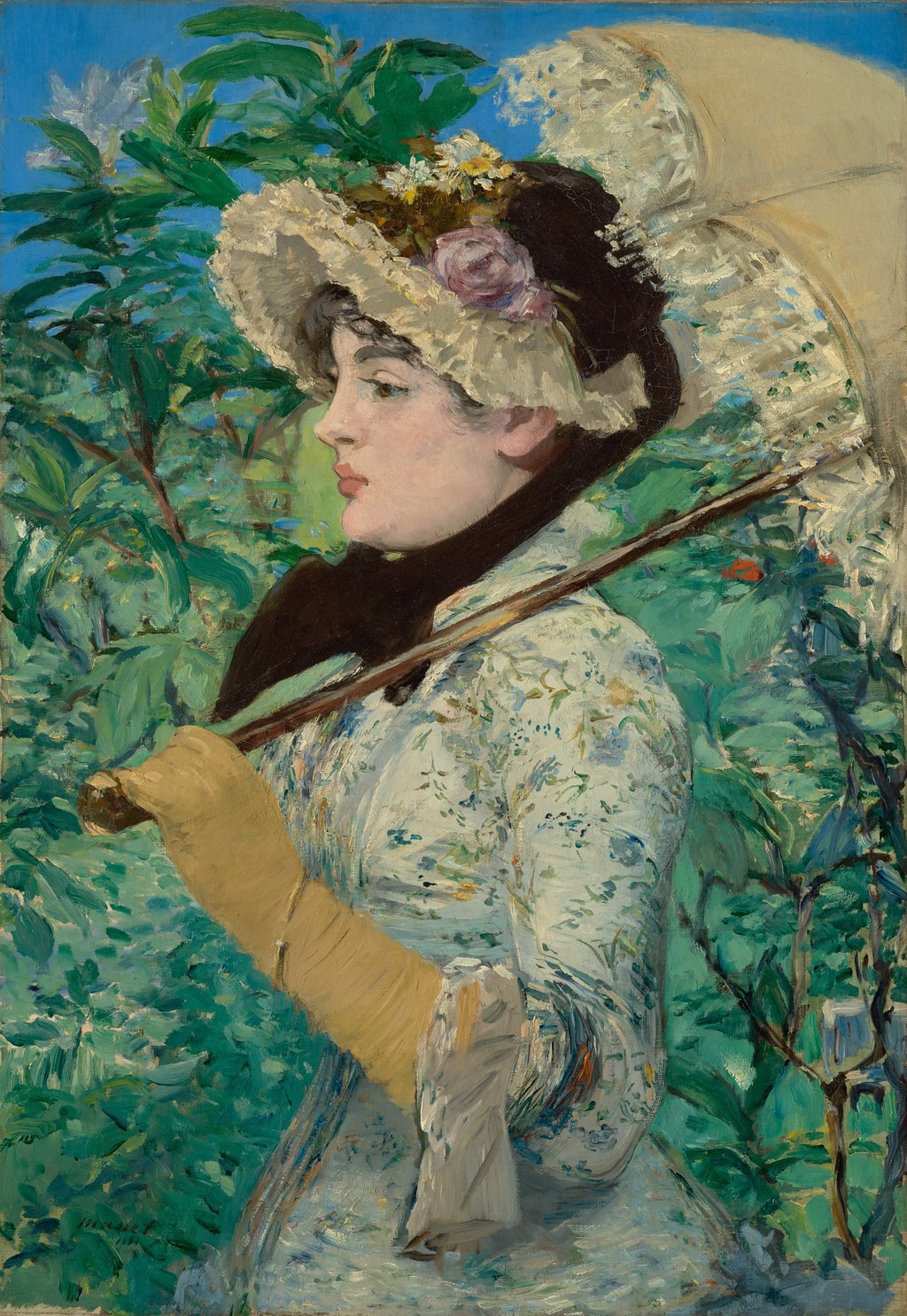
Édouard Manet, Jeanne (Spring), 1881. The J. Paul Getty Museum, Los Angeles, 2014.62. Image source. CC0 / Public domain.
The Seasons Project Left Open
Spring became associated with a planned cycle of the four seasons, each represented by a fashionably dressed woman. Antonin Proust, Manet's friend and a supporter of decorative art, was connected with the project and acquired Spring. The Getty leaves open whether Manet intended the series from the beginning or developed it after the picture's success in 1882.[2]
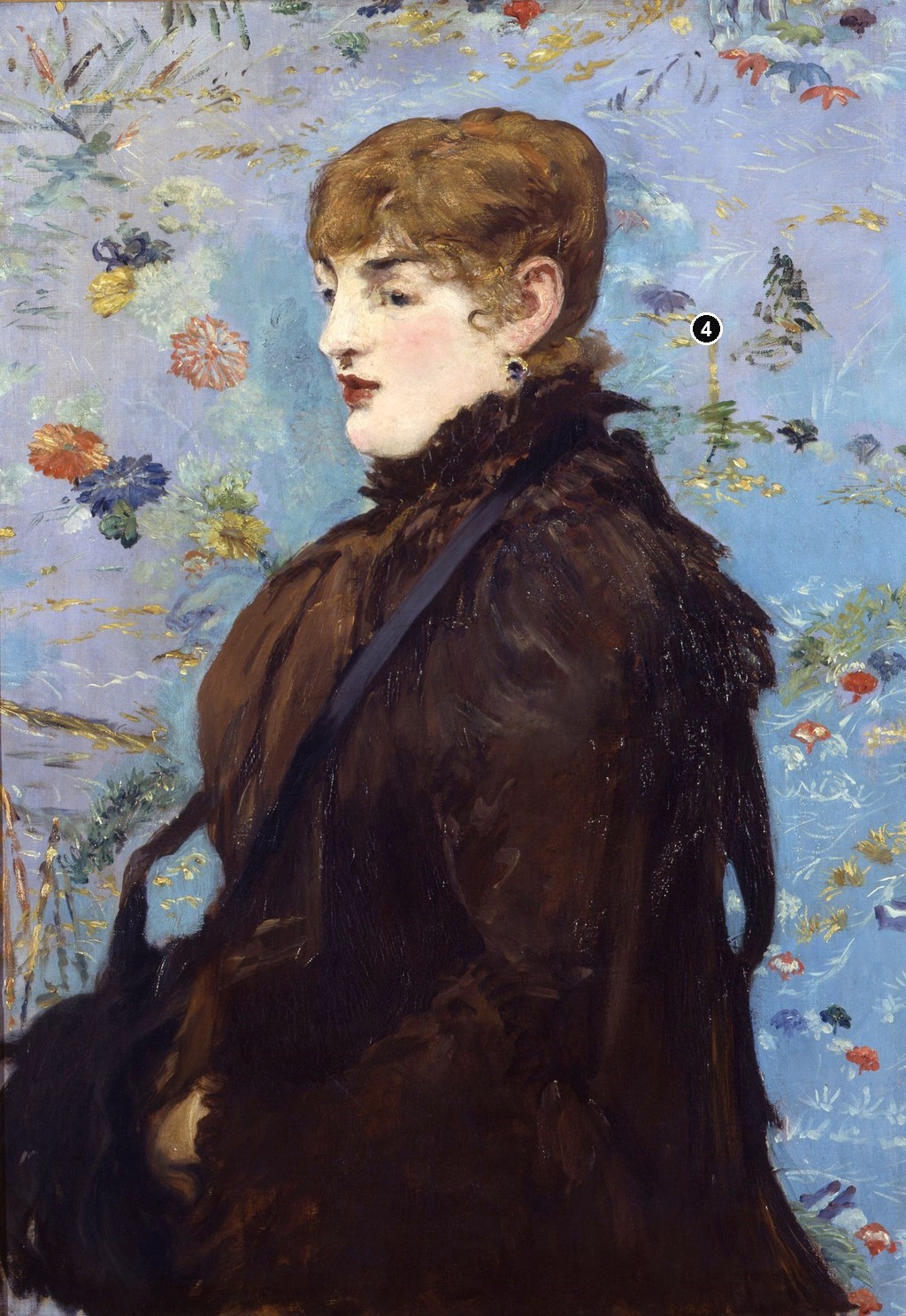
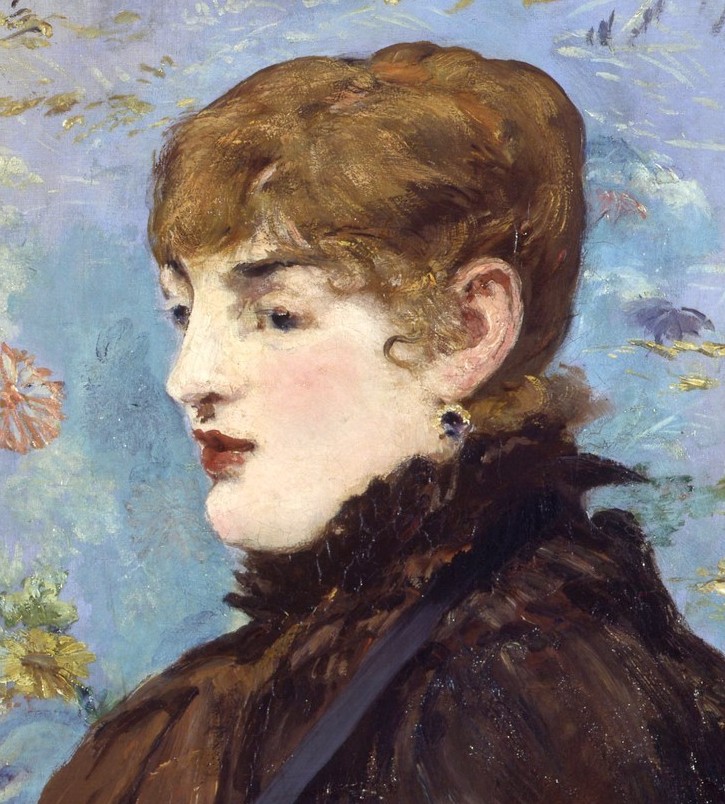
The other executed season was Autumn, a portrait of Méry Laurent now in Nancy. The current French national museum record dates it to 1882.[13] Laurent's russet hair and pale profile rise above a broad dark wrap. Behind her, embroidered flowers spread across a light blue textile. Allan and Beeny identify this background as a Japanese robe lent by Proust.[5]
The flowers here belong to a textile rather than a garden, extending Manet's decorative interest through another material. Laurent's dark silhouette gives the patterned background room to unfold, while the warm hair and light face establish a concentrated area of attention. The picture offers a seasonal role through clothing and surroundings, with a different weight and colour from the pale ensemble of Spring.
Its completion history was also different. Allan and Beeny report that Autumn remained unfinished when Manet died and was sent to another painter for retouching before the sale of his studio contents in 1884.[5] The surviving canvas therefore carries a history extending beyond the artist's work upon it. Laurent later owned the portrait, and her bequest brought it to Nancy in 1905.[13]
The unfinished Amazona de frente in Madrid has sometimes been proposed as Summer. Clara Marcellán's account for the Thyssen-Bornemisza Museum treats that identification cautiously and notes the early biographer Edmond Bazire's statement that the summer and winter pictures were never painted. The museum also reports that the rider was intended for the Salon of 1883.[14] It preserves evidence of another projected public work while leaving its place within the seasonal scheme uncertain.
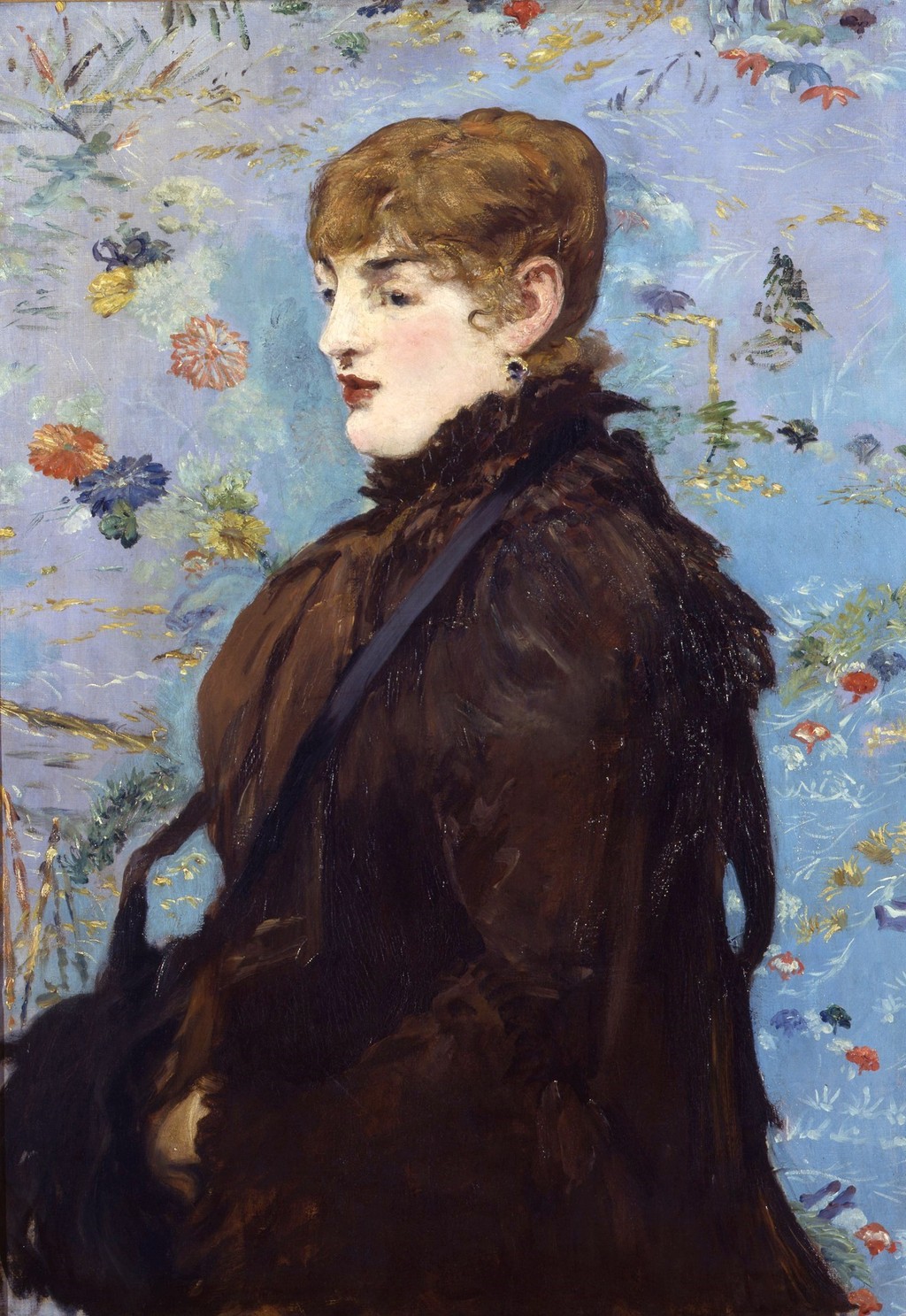
Édouard Manet, Autumn (Portrait of Méry Laurent), 1882. Musée des Beaux-Arts de Nancy, 1071. Image source. Public domain.
Flowers Brought Close
During the treatment stays and the periods of increasingly restricted movement, flowers and gardens gave Manet subjects within reach. Visitors also brought flowers to his studio. The resulting still lifes could circulate among collectors or be given to friends, joining the social exchanges already visible in his illustrated letters.[2][5]
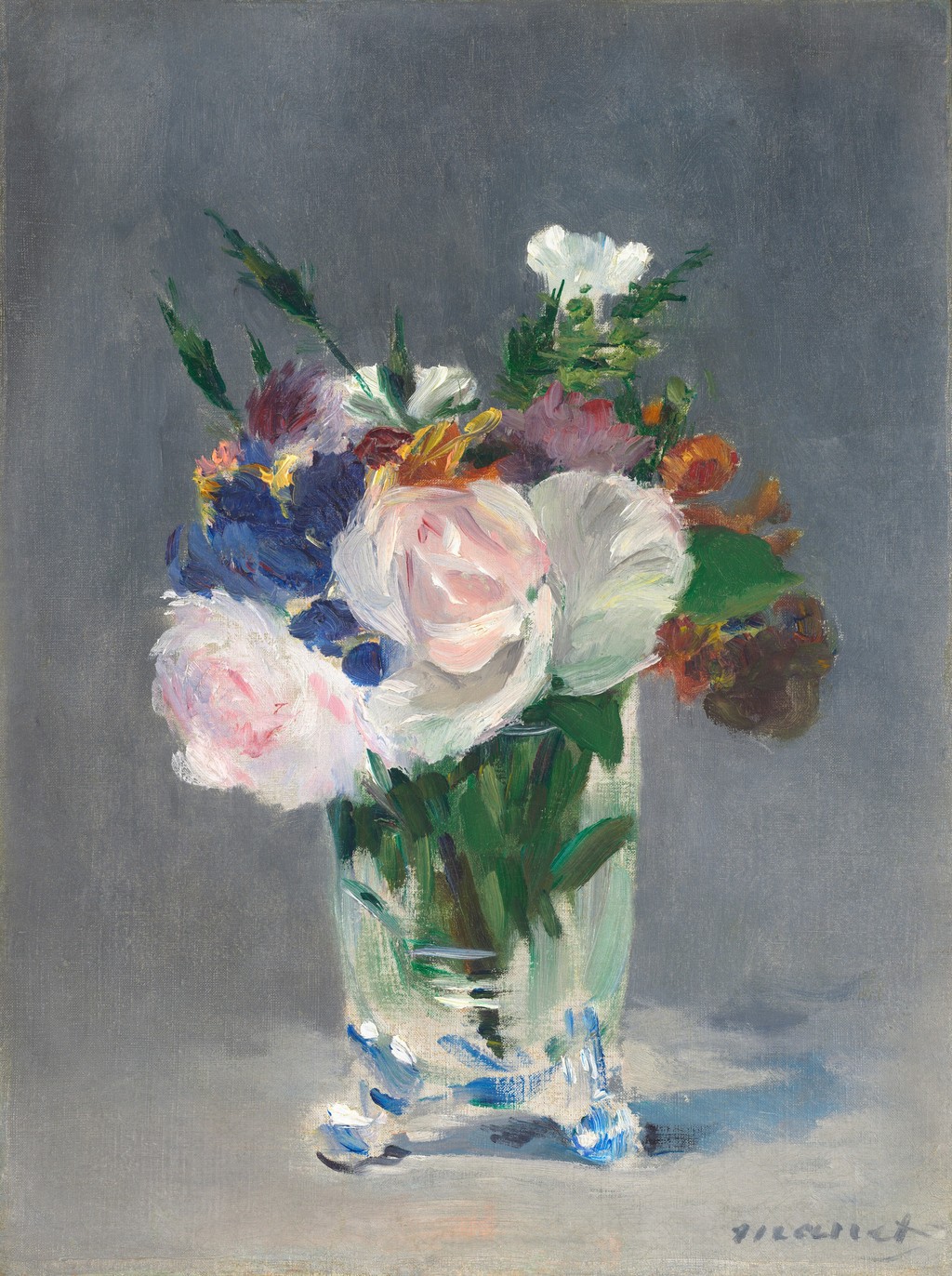
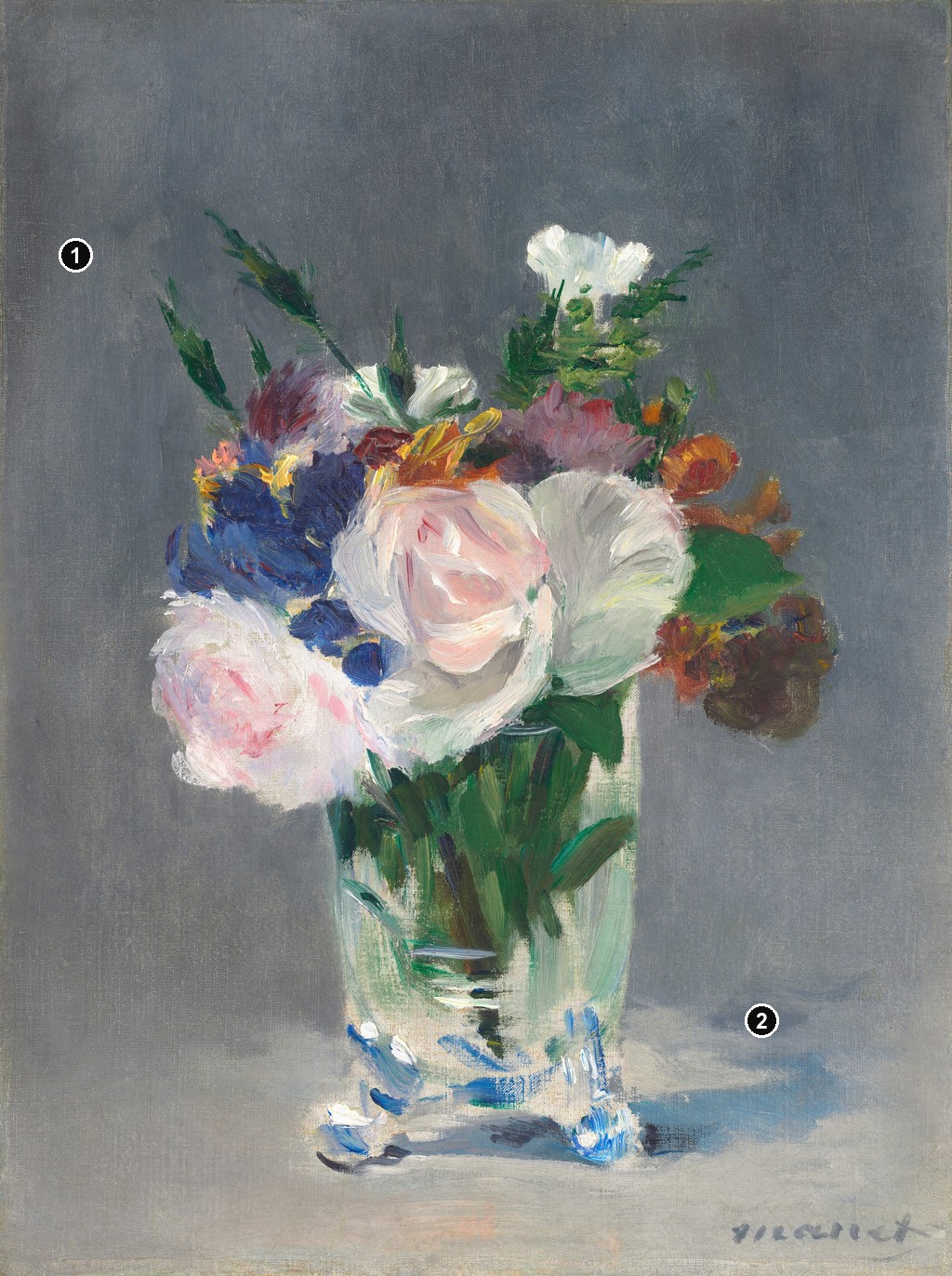
In Flowers in a Crystal Vase, now in Washington, a clear glass vessel gathers a bouquet against a quiet grey ground. The National Gallery of Art dates the oil to about 1882; the canvas is only 32.7 centimetres high. Its provenance records an account that Manet offered it as a New Year's gift to an unidentified woman.[15]
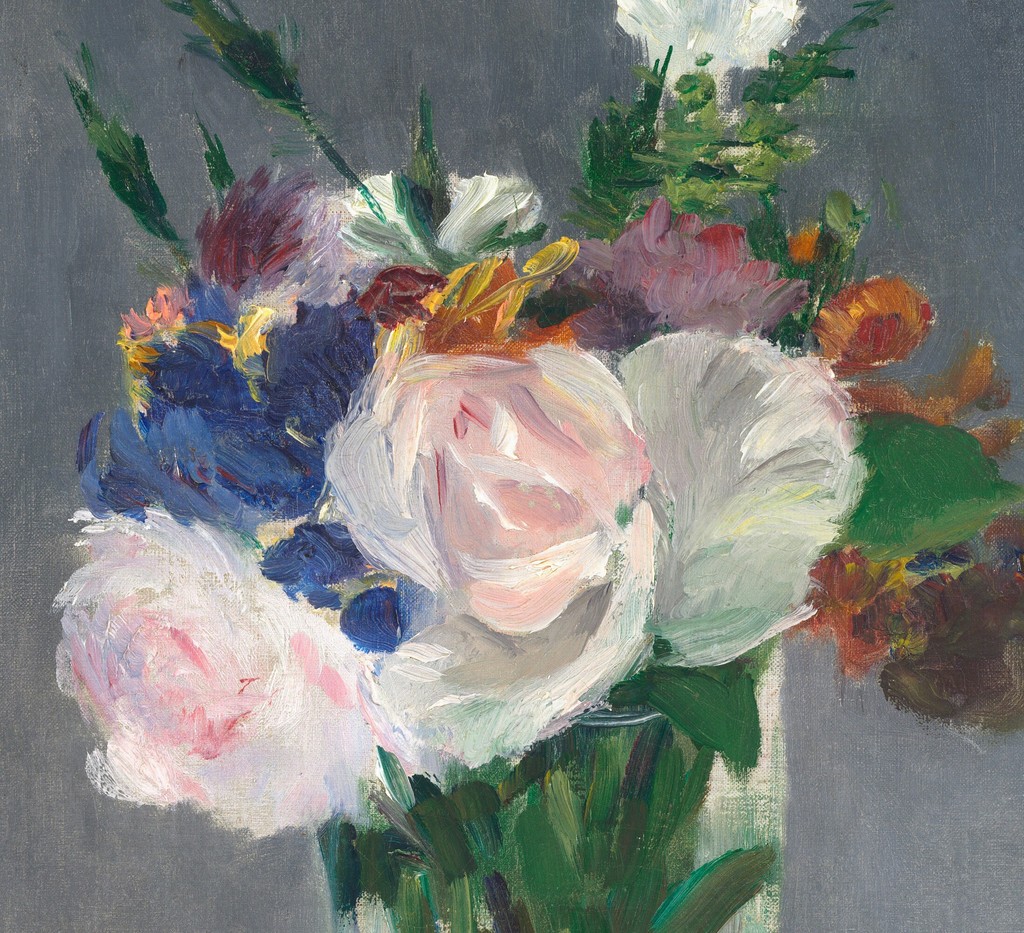
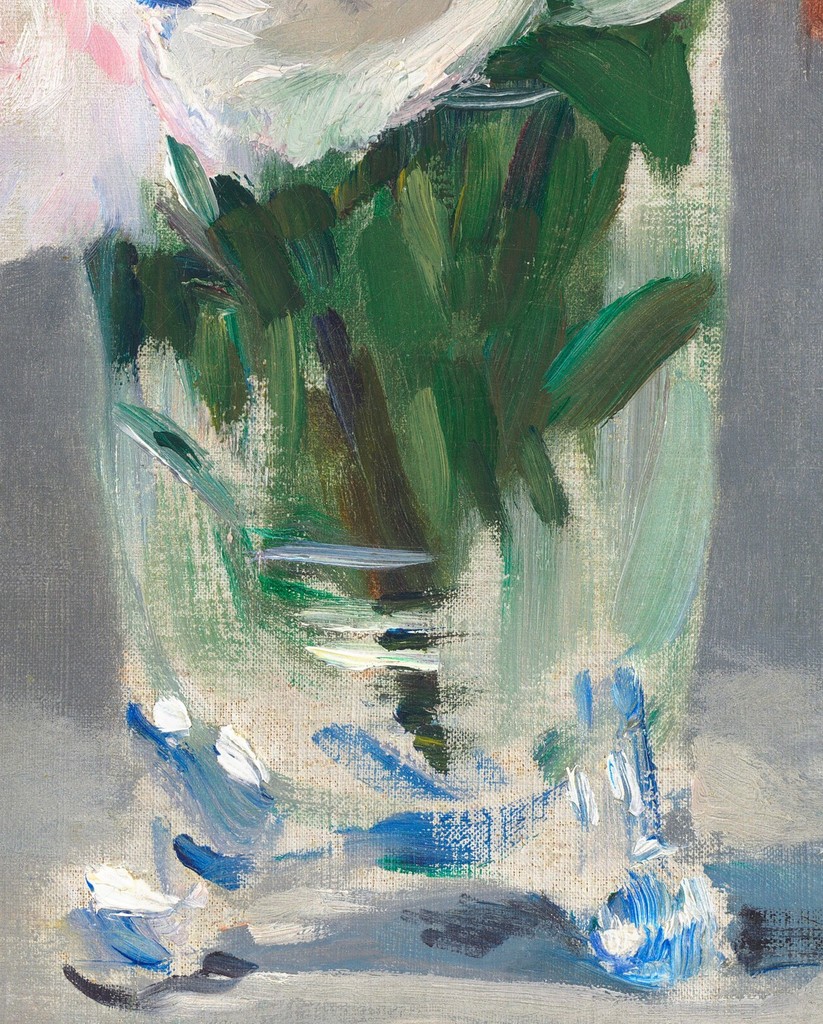
The small scale still permits a surprising range of marks. Curving pale strokes open into the large pink-white flower at the centre. Blue and orange touches interrupt the bouquet's lighter areas, while upright and crossing greens continue down into the glass. Near the bottom, white and blue accents describe the vessel's feet and reflections. A broader blue shadow extends to the right across the supporting surface.
Glass links the separate parts of the image. The stems remain visible through it, and its pale edges meet the grey background with an economy quite different from the fuller flower heads. The bouquet can be recognised at once, yet individual strokes continue to announce how it was painted. Looking moves between the arrangement of flowers and the handling that gives them their presence.
The Clark's Moss Roses in a Vase, dated 1882, provides evidence of the stages that could underlie such direct effects. Its catalogue relates the flower paintings to gifts and friendship. The technical report describes much of this particular oil as painted wet into wet, with further work after earlier passages had dried: the upper background overlapped dried plant forms, the vase outline was repainted, and the signature followed once the underlying paint had set.[16]
Those findings give substance to the act of looking. A picture can communicate an immediate encounter through work that includes pauses and later adjustments. The Clark catalogue also proposes Rueil as a possible setting for Moss Roses, retaining the uncertainty about exactly where the flowers and vessel were found.[16]
Work Continuing into 1883
By the spring of 1883, Manet's condition had become severe. Gangrene led to the amputation of his leg, and he died on 30 April.[1] The last paintings and drawings belong to these difficult circumstances, although the sequence of his final attempts cannot be reduced to one securely identifiable farewell image.
The unfinished seasonal project and the intended Salon picture preserve plans that his death interrupted.[5][14] Beside them, the small flower paintings retain the particulars on which he concentrated: a glass rim, a stem crossing water, a patch of pink against grey.
Annotated Details from Manet’s Late Years
The numbered points identify visible features discussed in this article. Return from each detail to the whole composition. Each caption identifies the work shown.
Flowers in a Crystal Vase
Édouard Manet, Flowers in a Crystal Vase, circa 1882. National Gallery of Art, Washington, 1970.17.37. Ailsa Mellon Bruce Collection; courtesy National Gallery of Art, Washington. Image source. CC0 / Public domain. Numbers added to a separate resized whole supplied overview. Detail crops from the unchanged original; no enlargement, retouching or colour alteration.
Jeanne (Spring) — Companion Painting
Édouard Manet, Jeanne (Spring), 1881. The J. Paul Getty Museum, Los Angeles, 2014.62. Image source. CC0 / Public domain. Numbers added to a separate resized whole overview retaining the supplied edges. Detail crops from the immutable original; no enlargement, retouching or colour alteration.
 — Companion Painting.jpg)
Autumn — Portrait of Méry Laurent
Édouard Manet, Autumn (Portrait of Méry Laurent), 1882. Musée des Beaux-Arts de Nancy, 1071. Image source. Public domain. Numbers added to a separate resized whole overview retaining the supplied edges. Detail crops from the immutable original; no enlargement, retouching or colour alteration.
Portrait of Méry Laurent in Dijon
Édouard Manet, Portrait of Méry Laurent, 1882. Pastel on canvas. Musée des Beaux-Arts de Dijon, 2958 a. Photograph Patrick Monchicourt (Morio60), via Flickr and Wikimedia Commons; original photograph released under CC BY-SA 2.0. Image source. Public domain. Numbers added to a separate resized overview. Detail crops from the supplied public-domain reproduction; no enlargement or retouching.
A Letter to Eugène Maus — Two Apples
Édouard Manet, A Letter to Eugène Maus, Decorated with Two Apples, 2 August 1880. The Metropolitan Museum of Art, 2003.1. Purchase, Guy Wildenstein Gift, 2003. Image source. CC0 / Public domain. Numbers added to a separate resized whole supplied overview. Detail crops from the unchanged original; no enlargement, retouching or colour alteration.
Details from MANET’S LATE YEARS
Follow the numbered details back to the complete images above. Each caption identifies the work shown.
Flowers in a Crystal Vase
Flower Heads against the Grey Ground
Pale pink and white blooms overlap darker blue and green shapes against the open grey ground.
Stems, Water and the Glass Foot
Long green stems cross inside the pale glass above the bright curved foot and its shadow.
Jeanne (Spring) — Companion Painting
Spring’s Profile, Bonnet and Parasol
The flowered bonnet and pale parasol surround the turned profile.
 — Companion Painting Detail 03 spring-s-profile-bonnet-and-parasol.jpg)
Autumn — Portrait of Méry Laurent
Hair and Face above the Fur
Warm brown hair rises over the pale turned face, with the dark collar gathered beneath the chin.
Portrait of Méry Laurent in Dijon
Hat, Fringe and Exposed Neckline
The Dijon portrait shows a broad hat, blond fringe and exposed ear above the ruffled neckline. Glass reflections remain visible.
A Letter to Eugène Maus — Two Apples
The Two Painted Apples
Two rounded green and yellow apples sit above small grey shadows on the letter’s right-hand leaf.
Artworks directory
Explore selected paintings, drawings and prints by Édouard Manet. Search by title or another recorded name.
Frequently Asked Questions
No. Spring and Autumn were executed, but Autumn remained unfinished at his death, according to Getty scholars Allan and Beeny. Its later retouching was posthumous.[5]
Discussion
Look again at the images and ideas explored in Édouard Manet's Late Years. These editorial prompts invite your observations.
Reader Insights
Follow the green stems down through the vase in the Washington bouquet. Which strokes describe the flowers, and which describe the glass surrounding them?
Consider the apples in the Maus letter beside the bouquet in oil. How does the sheet's function as a personal message change the encounter with its image?
Which late work most expands your view of Manet: a fashionable portrait, a small illustrated letter, an unfinished decorative picture or a flower still life?
Join the Conversation
Share a detail, comparison or question about Édouard Manet's Late Years below.
References
- Scott Allan, “Exhibition Manet and Modern Beauty Explores the Artist's Last Years,” Getty, 26 May 2019; late career, health, honours and final Salon (in English). View source.
- The J. Paul Getty Museum, Manet and Modern Beauty, “Explore,” 2019; La Vie Moderne, portraits, pastels, Seasons, Bellevue and flowers (in English). View source.
- National Museum of Western Art, Tokyo, Boy in Flowers (Jacques Hoschedé), 1876, P.1982-0001; object commentary and exhibition history (in Japanese). View source.
- Dijon Musées, Portrait de Méry Laurent, 1882, 2958a; pastel, canvas support, dimensions and interpretation (in French). View source.
- Scott Allan and Emily A. Beeny, “The Women behind Manet's Seasons,” Getty Magazine, Fall 2019, pp. 22–25; Laurent, the seasonal project and posthumous retouching (in English). View source.
- The Metropolitan Museum of Art, A Letter to Eugène Maus, Decorated with Two Apples, 2 August 1880, 2003.1; object details and the Ghent exhibition concern (in English). View source.
- Édouard Manet, autograph text of the plum letter, 1880, FII73(PK), Museum Boijmans Van Beuningen; digital facsimile (in French). View source.
- Museum Boijmans Van Beuningen, Een pruim met een begeleidende brief, 1880, FII73(PK); probable recipient and materials (in Dutch). View source.
- Emily A. Beeny, “Snail Mail: A Letter from Édouard Manet,” Getty, 26 March 2019; watercolour preparation, paper and uncertain recipient (in English). View source.
- Ministère de la Culture, “1881 – Sixième exposition,” section “Le Salon”; the two portraits and Manet's second-class medal (in French). View source.
- The Courtauld, A Bar at the Folies-Bergère, 1882; Suzon, studio execution and the reflected interior (in English). View source.
- The J. Paul Getty Museum, Jeanne (Spring), 1881, 2014.62; studio construction, handling and the 1882 Salon (in English). View source.
- Ministère de la Culture, POP/Joconde, Portrait de Méry Laurent; L'Automne, 1882, Nancy 1071, record 05120001048; current object facts and bequest (in French). View source.
- Clara Marcellán, Amazona de frente, circa 1882, Museo Nacional Thyssen-Bornemisza, 659 (1980.5); unfinished state and the proposed Seasons connection (in Spanish). View source.
- National Gallery of Art, Washington, Flowers in a Crystal Vase, circa 1882, 1970.17.37; dimensions, description and qualified gift account (in English). View source.
- Sarah Lees, editor, and the Sterling and Francine Clark Art Institute, Nineteenth-Century European Paintings, 2012, cat. 207, Moss Roses in a Vase, pp. 479–481; catalogue entry and oil technical report (in English). View source.
- Splash image, Édouard Manet, Flowers in a Crystal Vase, circa 1882. National Gallery of Art, Washington, 1970.17.37. Ailsa Mellon Bruce Collection; courtesy National Gallery of Art, Washington. Image source. CC0 / Public domain.


