


 by
Tom Gurney
Tom Gurney BSc (Hons) is an art history expert with over 20 years experience
Published on October 6, 2016 / Updated on October 23, 2026
Email:
tomgurney1@gmail.com
/ Phone:
+44 7429 011000
The Studio Boat
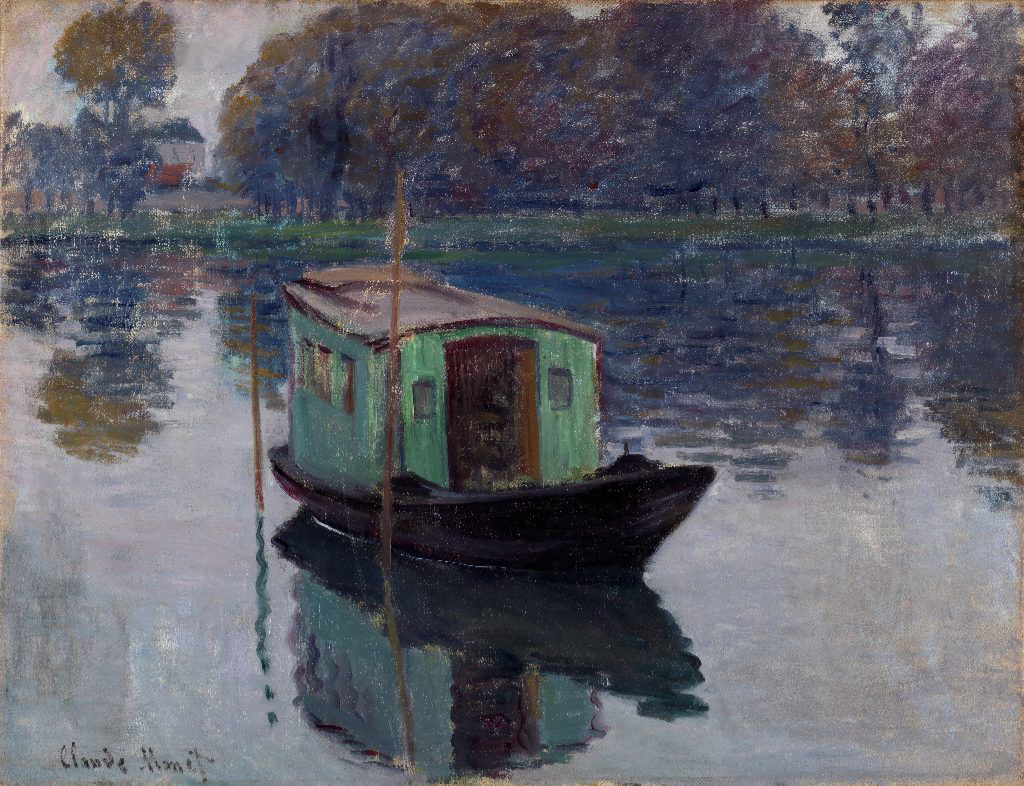
The Studio Boat is Claude Monet's 1874 painting of his floating workshop on the Seine at Argenteuil. It belongs to the Kroller-Muller Museum. [1] A small green cabin occupies the centre of the river scene, its dark hull and reflected shape giving the quiet water a strong point of focus.
At a Glance
A small workshop on the river
The boat is substantial enough to read as a working object rather than a distant accent. Its green cabin has small windows, a dark open doorway and a low, curved roof. Beneath it, the hull forms a broad dark shape, with the near end projecting towards the right.
Two upright poles interrupt the view. Their straight lines contrast with the cabin's roof and the curved edge of the boat. They also connect the vessel with its reflection, drawing the eye down into the lower part of the canvas.
The holding museum describes the craft as moored between two poles and identifies the faint figure inside as probably Monet. [1] That qualification is useful: the dark interior does not allow a detailed reading of a face, costume or activity.
The cabin's doorway is especially effective because it opens a small area of deep shadow within a coloured exterior. Light strikes the green walls, while the opening remains difficult to penetrate. The contrast gives the boat a sense of physical depth without requiring a complete description of everything stored inside.
Why paint from a boat?
A floating workshop offered a practical way to change the relationship between painter and river. From the bank, the artist looks across the water. From a boat, the water can surround the working position, and the opposite shore can be approached from a different angle.
The cabin also provides a place for materials and some protection. It makes the boat more than an ordinary pleasure craft, although its modest size remains clear. The picture does not present a grand studio transported intact onto the Seine.
A Van Gogh Museum gallery text points out a useful reversal: for this painting, Monet returned to the bank to depict the boat and its reflection. [6] The apparatus that enabled him to work from the water had itself become the subject of a view made from outside it.
This changes the emphasis of the scene. The boat can be understood both as equipment and as a shape within a landscape. Its use belongs to Monet's working life, while its green walls, dark hull and reflected image belong to the colour and structure of the painting.
Daubigny's example
Charles-Francois Daubigny had established an important precedent. Simon Kelly's Nelson-Atkins study records his studio boat, Le Botin, constructed in 1857, and the 1862 Voyage en Bateau etchings that described life and work afloat. The same study connects Daubigny's example with Monet's decision to use a studio boat. [3]
The connection is practical as well as artistic. Painting from a vessel opened viewpoints that were unavailable from a fixed path, while a cabin made longer periods of work on the river more manageable. It also made the painter's own movement part of the process of selecting a subject.
Daubigny was not simply a name attached retrospectively to a resemblance. Kelly also discusses his support for younger painters and his introduction of Monet to Paul Durand-Ruel during their London period of 1870-1871. [3]
Even so, influence does not require the two artists' pictures to look identical. The studio boat was a method of access, not a ready-made style. Monet could adopt a useful working arrangement while continuing to make his own decisions about framing, colour and the relation between water and shore.
The boat and its reflection
Much of the foreground is water. The cabin reappears below the hull, but its reflected shape is darker and less stable than the object above. Small horizontal interruptions prevent it from becoming a perfectly symmetrical duplicate.
The reflection of the roof and walls also broadens the boat's presence. A comparatively compact vessel occupies a much larger visual area once its image in the river is included. The scene's centre therefore extends downwards, rather than remaining confined to the cabin.
The wooded bank supplies another rhythm. Upright trunks and patches of foliage are reflected across the upper water, while the lighter passages near the foreground allow the boat to stand apart. A small building appears through the trees at the left.
These elements make the river a meeting place of different kinds of form. The cabin is built from clear planes and openings; the trees are irregular masses; the water receives both and changes their appearance. Monet makes the reflected world recognisable without giving it the firmness of the objects that produce it.
Monet's picture and Manet's portrait
Edouard Manet painted Monet working aboard his boat in 1874. The Neue Pinakothek's Die Barke includes Monet and his wife, Camille, and presents the painter absorbed in his activity. [4]
That is a separate work by a different artist. It should not be used as a detailed description of the green-cabin painting shown here. In Monet's own composition, the vessel and reflected landscape dominate; the figure is barely discernible.
The comparison is nevertheless revealing. Manet makes the working artist a substantial human presence, while Monet allows the boat to take the role usually given to a sitter or principal object. One picture shows a person painting; the other makes the place of painting part of the river landscape.
Both belong to the artistic activity around Argenteuil , where painters could encounter one another's subjects and working methods. The Pinakothek's account places Manet's repeated visits in the summer of 1874 alongside the presence of other Impressionist friends. [4] That social context is more specific than an imagined story of Monet working in complete isolation.
Other versions and the painting's history
Monet returned to the studio-boat subject. The Barnes Foundation owns a separate, vertical painting dated 1876, BF730. Its collection account explains the vessel's role as a mobile working place, sometimes anchored and sometimes drifting. [5]
The existence of another version makes title alone an unreliable guide to identity. The horizontal composition here, with its green cabin and two mooring poles, is the Kroller-Muller work, W323. Its catalogue history records an 1876 sale to Dr Georges de Bellio under the title La Gondole, followed by later dealers and its acquisition for the museum in 1915. [2]
The boat's attraction as a subject is easy to understand. It combines a plain, useful construction with a constantly changing setting. The cabin remains comparatively still, but light and reflected forms prevent the water around it from becoming visually inactive.
Within Monet's boating pictures , The Studio Boat is unusually direct about the means of making art on the river. It shows neither a luxurious vessel nor an elaborate portrait scene. A modest workshop, placed close to the surface that absorbed so much of Monet's attention, becomes the centre of a carefully balanced landscape.
Frequently Asked Questions
Claude Monet, in 1874. [1]
The Kroller-Muller Museum, inventory KM 111.222. [1]
The holding museum identifies the faint figure as probably Monet, not with complete certainty. [1]
No. Manet made a separate 1874 painting of Monet and Camille aboard the boat. [4]
Discussion
Look again at the images and ideas explored in The Studio Boat. These editorial prompts invite your observations.
Reader Insights
How much of the boat's visual weight comes from its reflection?
Does the dark doorway suggest a working interior without showing its details?
What changes when a painter's equipment becomes the main subject?
Join the Conversation
Share a detail, comparison or question about The Studio Boat below.
References
- Kroller-Muller Museum , Monet's Studio-Boat, 1874, KM 111.222. View source .
- Daniel Wildenstein , Monet: Catalogue raisonne, 1996, volume II, W323, pp. 135-136, Wildenstein Plattner Institute digital edition. View source .
- Simon Kelly , Charles Francois Daubigny, The Banks of the Oise at Auvers, Nelson-Atkins scholarly catalogue: studio-boat practice and Monet. View source .
- Bayerische Staatsgemaldesammlungen - Neue Pinakothek , Edouard Manet, Die Barke, 1874, inventory 8759. View source .
- Barnes Foundation , The Studio Boat, 1876, BF730, a separate version. View source .
- Van Gogh Museum , Impressionism exhibition gallery texts: Monet, Studio-Boat, 1874. View source .







