


 by
Tom Gurney
Tom Gurney BSc (Hons) is an art history expert with over 20 years experience
Published on October 6, 2016 / Updated on October 23, 2026
Email:
tomgurney1@gmail.com
/ Phone:
+44 7429 011000
Boating in Claude Monet's Paintings
Boats gave Claude Monet a subject that joined human activity with the changing surface of water. They could carry holidaymakers, wait at anchor, depart for work or provide the artist himself with a floating studio. The differences are important: a regatta, a resort landing and a fishing beach do not represent the same use of the water, even when sails, hulls and reflections offer related shapes to paint. [1] [2] [6] [8]
At a Glance
- Resort example La Grenouillere, 1869 [2] [3]
- Regatta setting Argenteuil's wide Seine basin attracted racers and spectators [1]
- Boats at rest The Orangerie's Argenteuil, 1875 [4]
- Floating studio Monet's Studio-Boat, 1874; Kroller-Muller Museum [6]
- A separate boat-studio canvas The Studio Boat, 1876; Barnes Foundation [7]
- Coastal example The Departure of the Boats, Etretat, 1885; Art Institute of Chicago [8]
Argenteuil: a river used for recreation
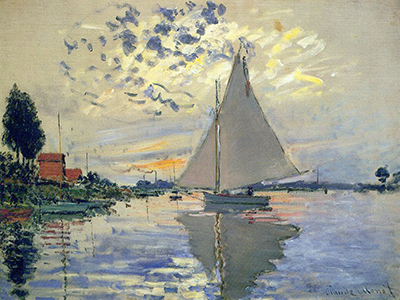
The Orsay's account of Regattas at Argenteuil , dated around 1872, explains why the town became an important boating centre. The Seine widened into a basin suitable for racing, while railway access from Paris brought competitors and Sunday spectators. [1]
Boating was therefore not merely an attractive motif added to a landscape. It belonged to the changing use of the suburban river, with recreation organised around a particular stretch of water.
Monet lived at Argenteuil from late 1871 until 1878. [1] His proximity to the river allowed repeated encounters with its craft, banks and bridges rather than a single visit to a picturesque attraction.
A sail has a strong shape even when little detail is supplied. It can catch the light, interrupt a bank or establish a vertical accent above a low hull. Several sails can create intervals across a wide scene.
The regatta setting combines these pictorial possibilities with a specific modern activity. A reliable reading keeps both aspects in view: the boats are coloured forms, but they are also evidence of people using a shared public environment.
La Grenouillere: landing, bathing and watching
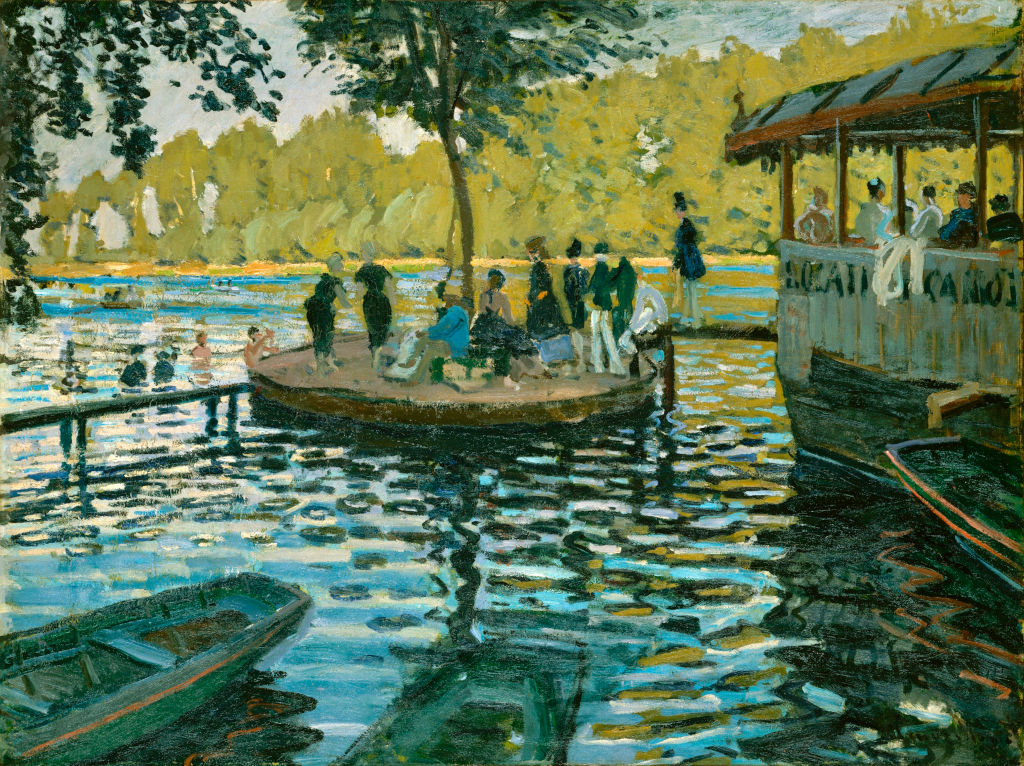
At La Grenouillere in 1869, Monet and Renoir worked at a boating and bathing resort on the Seine. The Met's canvas belongs to that shared campaign, before Monet's Argenteuil years. [2]
A resort brings several activities into proximity. Boats provide access or recreation, people gather on landings, and water separates groups while also connecting them. The setting cannot be understood as a race simply because boats are present.
The National Gallery's separate Bathers at La Grenouillere places foreground rowing boats in relation to a narrow walkway and the activity beyond. Its account stresses the resort's accessibility and mixture of leisure pursuits. [3]
This arrangement gives the boats more than a decorative function. Their directions lead the eye towards the place where people meet. The water opens a gap between the viewer and the gathering, while the walkway supplies a different kind of connection.
The scene's social character also changes the meaning of Monet's abbreviated figures. A few marks can register a person within a crowded recreational environment without turning each individual into a separate portrait.
Anchored boats do not need to imply a race
In the Orangerie's Argenteuil of 1875, sailing boats at anchor organise the composition. The museum draws attention to vermilion hulls, blue water and sky, green vegetation and the rhythm of the masts. [4]
The boats are at rest, yet the painting remains active. Vertical masts divide the space, hulls provide strong coloured shapes, and their reflections change below the waterline.
That distinction between physical motion and pictorial movement is useful. A moored craft can give the eye a route across the canvas, while a patch of rippling colour can make the surrounding water feel less stable.
The Orangerie also notes the unusual perspective, with lines appearing to diverge rather than settling into a strict conventional construction. [4] Recognisable boats need not occupy a space organised like an architectural diagram.
Comparison with a regatta shows that the same kind of vessel can support another mood and arrangement. Its presence does not by itself establish racing, speed or a particular story about its occupants.
The specific painting matters more than a general idea of boating as cheerful movement on a summer river.
Bridges, moorings and a quieter palette
The National Gallery of Art's Bridge at Argenteuil on a Gray Day , dated about 1876, places small boats and riverside structures beneath the long span of a bridge. Its silvery, blue and lavender water offers a different colour setting from the vivid anchored boats at the Orangerie. [5]
The bridge gives the scene a broad horizontal structure. Boats occupy the lower space, while moorings and buildings connect them to the bank. The river is a place where fixed construction and floating objects meet.
A quieter palette does not make the subject less specific. Differences of tone and small accents can distinguish a hull, a reflected form or a riverside building without the strong contrast of a bright white sail.
This kind of comparison guards against reducing Monet's boating pictures to one weather condition. Light and atmosphere affect the relationships among objects, not only the general brightness of the canvas.
It also reveals how much the surrounding infrastructure contributes. The boats become part of a river landscape shaped by bridges, access and mooring, rather than isolated symbols of leisure.
A boat could also be a place to work
Monet's interest extended beyond painting other people's vessels. The Kroller-Muller Museum's Monet's Studio-Boat , dated 1874, shows the craft he used to work from the river. The museum places it in the tradition of Charles-Francois Daubigny's earlier floating studio. [6]
In this canvas the boat is moored between poles, with a small cabin and a barely distinguishable figure. The museum cautiously identifies that figure as probably Monet. [6] It is not necessary to turn an indistinct mark into a fully documented portrait.
The boat changed the conditions of looking. A viewpoint on the water could make the relationship between the near surface and the bank different from that offered by a conventional riverside easel.
The Barnes Foundation holds another painting, The Studio Boat , dated 1876. Its record explains the practical role of the craft and distinguishes anchoring from work undertaken while drifting. [7]
These are separate objects, not one canvas divided between collections. Together they show the boat as both a subject and a working tool, without proving that every river view was made from it.
That difference is essential: the presence of a studio boat in Monet's practice does not supply the viewpoint for every picture.
Fishing and the coast offer another boating world
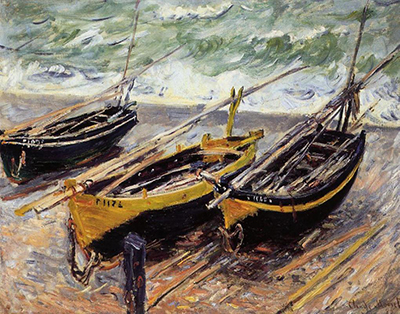
The Art Institute of Chicago's The Departure of the Boats, Etretat , dated 1885, belongs to a coastal setting rather than the suburban leisure basin. Its boats, figures and shore structures form a scene of maritime activity. [8]
A coast can make the relationship between craft and land especially visible. Boats may be drawn up, prepared, moved or seen beyond the edge of the beach. The shore becomes a working place, not simply a frame for open water.
The painting's technical report also records compositional changes. [8] The apparent record of activity was shaped through decisions about placement and definition, not merely copied as a complete arrangement in one instant.
This widens the subject beyond an image of effortless recreation. Fishing craft and pleasure boats may share sails and hulls while belonging to different activities and conditions of use.
Etretat provides a place-focused context for the cliffs and campaigns. In a comparison of boating subjects, its value lies in showing how the purpose of a vessel can change the scene around it.
Monet's interest in water did not require him to treat every person using it as a holidaymaker.
The title Boating can also refer to a different artist
The Met's painting titled Boating , dated 1874, is by Edouard Manet, not Claude Monet. It was painted in the Argenteuil setting where Manet spent time with Monet and Renoir. [9]
The distinction matters because the artists' names are similar and their river subjects overlap. A shared place or activity does not make a picture by Manet part of Monet's own output.
Manet's composition concentrates on a boat and two occupants, using strong diagonals and cropped forms. [9] That approach can be compared with Monet's wider river arrangements, but the comparison works only when each object retains its own authorship.
The broader Monet and Manet relationship is therefore useful context rather than permission to exchange their facts. Dates, collections and figure identifications belong to particular paintings.
Looking across artists can illuminate different solutions to a modern leisure subject. It should make those differences more visible, not dissolve them into a general Impressionist scene.
What to compare across Monet's boating pictures
Begin with what the boat is doing. Is it moving, anchored, stored on shore or serving as a working platform? The answer changes the role of people, banks and surrounding structures.
Then consider its pictorial function. A mast can divide the sky, a hull can introduce a strong colour, and an angled rowboat can lead towards another part of the scene. A reflection may repeat a form while loosening its outline.
Finally, compare the boat with the space around it. An open basin permits broad intervals; a resort landing compresses activities; a coastal beach introduces a different relationship between land, craft and sea.
These distinctions keep the paintings grounded in specific settings. They also explain why the subject offered so much variety. Monet could study water and reflections while attending to how people travelled, worked, rested and looked from the river.
The resulting paintings are connected by boats, but not reduced to one uniform series or one mood. Their strength lies in the different relationships they construct between human activity and a changing environment.
Boating Painting Pages
Frequently Asked Questions
It is by Edouard Manet, a different artist. [9]
Discussion
Look again at the images and ideas explored in Boating in Claude Monet's Paintings. These editorial prompts invite your observations.
Reader Insights
Compare boats at anchor with a scene of departure.
Consider how a viewpoint from the water differs from looking from the bank.
Distinguish the practical purpose of a boat from its compositional role.
Join the Conversation
Share a detail, comparison or question about Boating in Claude Monet's Paintings below.
References
- Musee d'Orsay , Regattas at Argenteuil, about 1872, RF 2778; the basin, rail access and spectators. View source .
- The Metropolitan Museum of Art , La Grenouillere, 1869, accession 29.100.112; resort and shared painting campaign. View source .
- National Gallery, London , Bathers at La Grenouillere, 1869, NG6456; modern leisure and the landing. View source .
- Musee de l'Orangerie , Argenteuil, 1875, RF 1963 106; anchored boats, colour and composition. View source .
- National Gallery of Art , Bridge at Argenteuil on a Gray Day, about 1876, accession 1970.17.44. View source .
- Kroller-Muller Museum , Monet's Studio-Boat, 1874, KM 111.222; the floating working platform and Daubigny context. View source .
- Barnes Foundation , The Studio Boat, 1876, BF730; a separate canvas and its working context. View source .
- Art Institute of Chicago , Kimberley Muir, Monet scholarly catalogue, Cat. 23, The Departure of the Boats, Etretat, 1885, accession 1922.428; technical and compositional evidence. View source .
- The Metropolitan Museum of Art , Edouard Manet, Boating, 1874; a distinct artist and work in the Argenteuil context. View source .







