


 by
Tom Gurney
Tom Gurney BSc (Hons) is an art history expert with over 20 years experience
Published on October 6, 2016 / Updated on October 23, 2026
Email:
tomgurney1@gmail.com
/ Phone:
+44 7429 011000
Three Fishing Boats
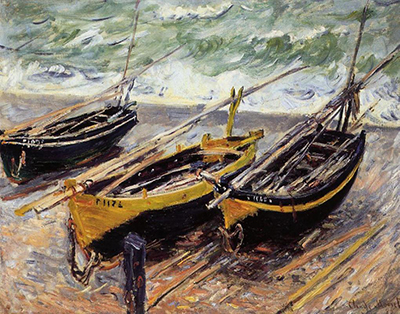
Three Fishing Boats belongs to the Museum of Fine Arts, Budapest, inventory 436.B. It shows three vessels drawn up on a beach, with a restless sea immediately beyond them. The museum dates the oil painting to 1886; Wildenstein's catalogue places it under 1885. [1] [2]
At a Glance
Boats resting beside a moving sea
The two nearest hulls occupy much of the lower half of the canvas. Their bows turn towards the viewer, while a third vessel sits farther back at the left. They are not sailing towards a distant harbour.
A heavy post and looping ropes in the foreground reinforce the impression of boats held on land. Long spars lie or lean diagonally through the composition, tying the vessels to the sloping beach.
Behind them, broad white crests interrupt green-blue water. The sea appears active precisely because the boats remain comparatively still. One set of forms has weight and position; the other seems continually to break apart.
There is little room between the stranded hulls and the advancing foam. That compression makes the shore feel exposed, without requiring an invented account of a particular storm or fishing expedition.
The Boating overview follows Monet's wider interest in vessels. Here the subject is the pause between journeys, rather than the spectacle of boats under sail.
A high viewpoint and a crowded foreground
Monet lets us look into the boats. Their dark interiors, benches and raised edges make them substantial objects rather than silhouettes on the horizon.
The nearest bows are offset. The yellow-sided vessel projects towards the lower left, while the darker boat at the right presents a narrower, more pointed front. Their different angles prevent the grouping from becoming a regular row.
The third boat establishes another interval of space, but not a deep recession into the distance. All three remain close enough for their outlines to overlap with the long poles around them.
Ferenc Toth's museum commentary draws attention to the elevated viewpoint and its compression of the scene. [1] The effect is visible in the large share of the canvas given to beach and hulls, rather than open sky.
Look along the diagonal spars and then across the band of surf. The two directions pull against one another. This is a strongly organised picture, not evidence that Monet abandoned composition in favour of an unconsidered glance.
Yellow, black and the colours of the beach
The brightest yellow lies on the nearest left-hand boat. It is set against a dark lower hull, allowing a relatively narrow band of warm colour to carry considerable force.
A thinner yellow stripe curves around the boat at the right. Repeating the colour creates a relationship between the two vessels without making them identical.
The dark paint is not an empty gap. It helps describe the thickness of the hulls, the shadowed interiors and the places where one structural part meets another.
Around these clearer shapes, the beach breaks into strokes of ochre, pale grey, blue and muted violet. Its surface is more agitated than a smooth strip of sand would be. Some strokes echo the long diagonal poles; others move across them.
The foam contains both bright and cooler passages, so white does not become a single uniform line. The Painting Water article considers this distinction between the shape of a wave and the changing colour through which it becomes visible.
Two recorded preparatory studies
Wildenstein identifies two drawings as studies for this painting. They are recorded in the Musee Marmottan sketchbook numbered 5131, on folios 25 verso and 26 recto. [2]
That is unusually useful evidence for a picture whose brushwork can look immediate. A lively painted surface does not mean that the arrangement first occurred to Monet at the instant he put down the final strokes.
The record does not supply a complete, timed sequence from each drawing to each passage of paint. It would be misleading to reconstruct one without examining further evidence.
What it does establish is a relationship between drawing and this particular canvas. The three hulls and their intersecting lines belonged to a subject Monet could investigate in more than one form.
The Drawings guide discusses this often neglected part of his practice. Three Fishing Boats provides a concrete reason to resist the familiar opposition between a supposedly spontaneous Impressionist and an artist who plans.
A Normandy setting, with a dating caution
The Budapest record and the catalogue raisonne agree on the painting's identity but not its year. The collection number, image and approximate dimensions make the match secure even while the dating remains inconsistent. [1] [2]
There is also a reason to be cautious about the precise town. The museum's published essay discusses Etretat, whereas the 2024 Osaka exhibition checklist labels this loan with Trouville. A Normandy-coast description is safer than silently turning either contextual label into an uncontested location. [1] [3]
Nothing in the picture identifies a bustling Le Havre departure. The boats are beached, and the composition gives no panoramic harbour view through which to establish that claim.
These qualifications do not make the subject vague. We can still see how Monet organised working vessels, shore and surf into a close encounter between solid forms and unstable water.
The Etretat article offers broader coastal context; it should not replace the object-specific evidence for the Budapest painting.
What another beach painting can reveal
The Art Institute of Chicago owns a different work, Boats on the Beach at Etretat, dated 1885 and numbered 1947.95. Kimberley Muir's technical report documents substantial changes to its boats during painting. [4]
Some boats were covered by paint representing water and subsequently reintroduced. Examination also distinguishes wet paint interactions from strokes added over drier passages. [4]
Those are findings about the Chicago canvas, not X-ray results for the Budapest work. Their value here is comparative: a vigorous coastal painting could involve revision rather than a single uninterrupted performance.
Combined with the recorded drawings for Three Fishing Boats, that comparison gives a more credible view of Monet's practice than the claim that he simply renounced preparation. Different kinds of evidence answer different questions.
The Technique article explores that distinction. Brush marks can suggest speed to a viewer, while drawings, technical examination or documents may reveal a more extended process behind the finished appearance.
An individual canvas among related boats
Similar titles can disguise important differences. Seattle Art Museum's Fishing Boats at Etretat is a separate 1885 painting, inventory 92.88. Its collection history and catalogue identity must not be transferred to the Budapest canvas. [5]
Wildenstein records Three Fishing Boats as number 1029 and traces its history through the Depeaux and Herzog collections before its acquisition in Budapest in 1945. Those details help distinguish it from neighbouring boat pictures. [2]
The distinction also improves looking. Instead of treating every coastal vessel as an interchangeable example of Impressionism, we can attend to this arrangement: the forward yellow bow, the curved dark hull at the right and the smaller boat set behind them.
The spars draw a network across the scene, but the band of surf repeatedly interrupts that order. The painting's energy comes from the relationship between these elements, not from a detailed story about the fishermen.
Three Fishing Boats is therefore more than an attractive maritime motif. It tests how much movement a picture can contain while its principal objects remain firmly on shore.
Frequently Asked Questions
It belongs to the Museum of Fine Arts, Budapest, inventory 436.B. [1]
No. They are drawn up on a beach, with rough water behind them.
Wildenstein records two studies in the Musee Marmottan sketchbook 5131, folios 25 verso and 26 recto. [2]
Discussion
Look again at the images and ideas explored in Three Fishing Boats. These editorial prompts invite your observations.
Reader Insights
Follow the diagonal spars against the horizontal band of surf.
Compare the yellow passages on the two nearest boats.
Consider how the elevated viewpoint brings the hulls close to the viewer.
Join the Conversation
Share a detail, comparison or question about Three Fishing Boats below.
References
- Museum of Fine Arts, Budapest / Ferenc Toth , Three Fishing Boats, published through Google Arts & Culture; object record and curatorial commentary. View source .
- Daniel Wildenstein / Wildenstein Plattner Institute , Monet: Catalogue raisonne, volume III, 1996, W1029, printed pages 386-389; date, drawings and provenance. View source .
- Nakanoshima Museum of Art, Osaka , Monet: Journey to Series Paintings, 2024 exhibition checklist, item 40; Budapest loan and location label. View source .
- Kimberley Muir / Art Institute of Chicago , Cat. 22, Boats on the Beach at Etretat, 1885; technical report on a distinct painting. View source .
- Seattle Art Museum , Claude Monet collection listing and Fishing Boats at Etretat, 1885, object 92.88; distinct related work. View source .







