


 by Tom Gurney
Tom Gurney BSc (Hons) is an art history expert with over 20 years experience
Published on October 6, 2016 / Updated on April 13, 2026
Email: tomgurney1@gmail.com / Phone: +44 7429 011000
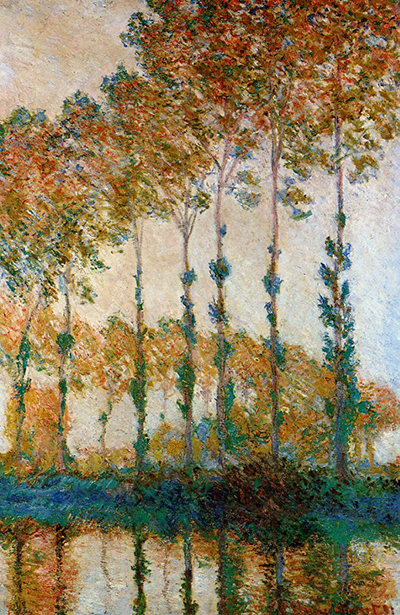
Poplars is Claude Monet's celebrated series of paintings of tall poplar trees along the River Epte, created in 1891.
By returning to the same line of trees under changing light, weather, and seasonal conditions, Monet transformed an apparently simple riverside motif into a study of rhythm, reflection, colour, and perception. [8]
In the Poplars series, Monet was not merely recording trees. He was exploring how repeated vertical forms could shift in mood and appearance from one canvas to the next, and how water, sky, and atmosphere could turn an ordinary landscape into something luminous and unexpectedly modern.
Table of Contents
- Monet and the Poplars Series
- Why Monet Painted the Poplars Repeatedly
- The Trees Were Almost Cut Down
- Where Precisely Were Monet's Poplars Located?
- Where the Paintings Are Today
- Selected Views
- How Monet Worked on the Series
- Composition and Rhythm
- Water, Reflection, and Atmosphere
- A Closer Look at the Paintings
- How Monet uses Colour
- Standout Versions from the Series
- Why the Poplars Series Matters
- Why the Poplars Series Feels Modern
- Complete List of Monet's Poplars Paintings
- FAQs
- Artist: Claude Monet
- Date: 1891
- Movement: Impressionism
- Medium: Oil on canvas
- Subject: Poplar trees along the River Epte
- Location: Various collections worldwide
- Significance: Study of repetition, light, reflection, and serial painting
Monet and the Poplars Series
Monet began painting the Poplars series in 1891 near his home at Giverny. The trees stood beside the River Epte [8] in a graceful line, giving him a subject that was at once simple and remarkably flexible. Their tall trunks created a strong repeated structure, while the river below doubled and softened those forms through reflection.
As with his Haystacks series, Monet was drawn to the tension between repetition and variation. The trees remain recognisable from one canvas to the next, yet their appearance changes constantly according to season, weather, and hour of the day. In some versions they appear radiant and airy; in others they become darker, more solemn, or almost abstract in their rhythmic arrangement.
The result is a series that feels both calm and experimental. Monet took an ordinary fragment of the landscape and treated it as a subject capable of endless transformation.
Monet's Poplars paintings reveal a striking tension between appearance and process. While they present the illusion of a fleeting moment of light, their surfaces are in fact heavily worked, built up through layers of paint over time. This contrast between immediacy and labor is characteristic of Monet's serial method, seen also in the Haystacks, Rouen Cathedral, and Water Lilies series.
Why Monet Painted the Poplars Repeatedly
At first glance, a line of riverside trees may seem less dramatic than a cathedral, a city, or a famous bridge. Yet this modesty is part of what made the subject so useful to Monet. Because the trees are slender, repeated, and strongly vertical, even subtle changes in light or atmosphere become highly visible.
The Poplars series allowed Monet to test how a simple motif could produce a wide range of pictorial effects. The trunks establish order, but the leaves, reflections, and changing sky prevent the compositions from becoming rigid. Repetition is therefore never monotonous. It becomes the foundation for variation.
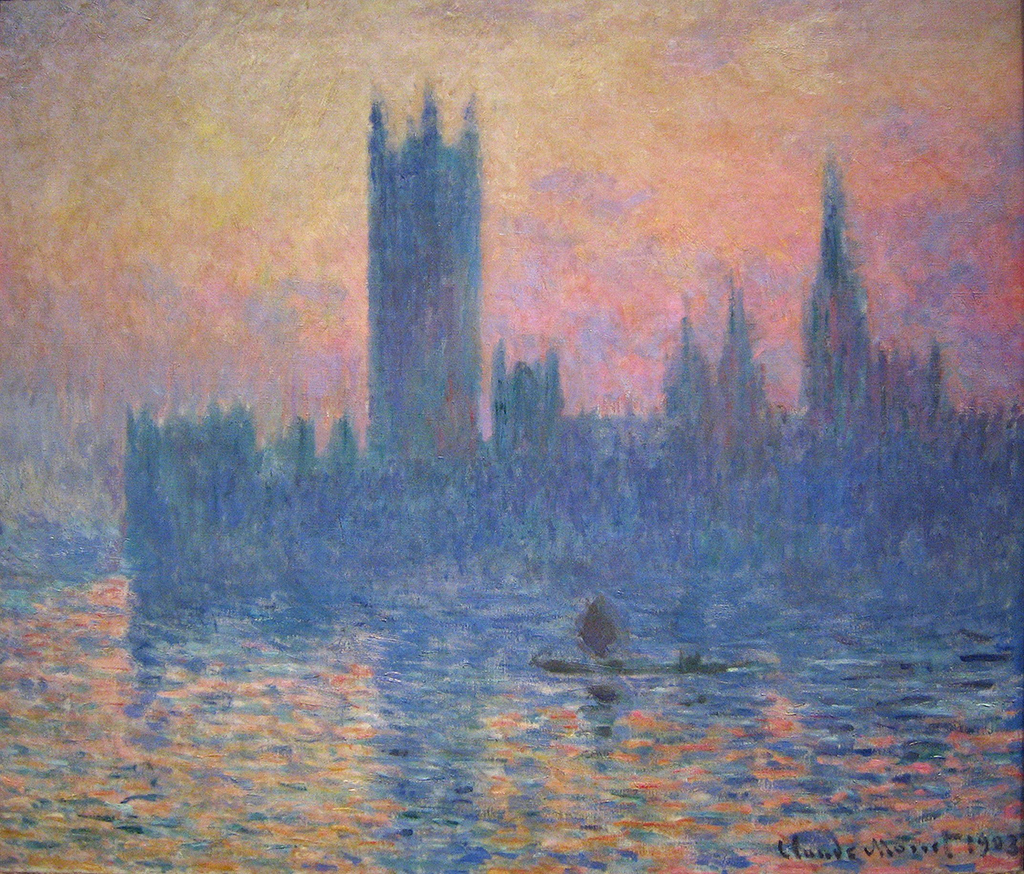
This method of working in series would reach a new level in Monet's London works, where changing fog and light made each canvas radically different from the last.
Monet was also interested in how nature could be organised visually without losing its vitality. In the Poplars paintings, the trees form a kind of rhythm across the surface, so that the series often feels almost musical in its alternation of sameness and difference.
I painted, in the past, anything that pleased me, regardless of whether it could be turned into a series or not. Now it is only a long, intertwined effort that satisfies me, and it must be an important motif, one that is sufficiently compelling.
Claude Monet [3]
The Trees Were Almost Cut Down
One of the most memorable aspects of the Poplars series is the practical difficulty behind it. While Monet was working on the paintings, he discovered that the trees were due to be sold and cut down. Rather than abandon the project, he arranged for them to remain standing long enough for him to continue painting them. [4] [7] [8]
This gives the series an unusual underlying tension. Monet was not simply studying a landscape at leisure; he was working against time, aware that the motif itself might disappear. The poplars therefore become more than a picturesque subject. They are also temporary forms, held in place just long enough to be transformed into art.
That urgency adds another dimension to the paintings. They are about observation, but they are also about preservation. The series fixes in paint something that might otherwise have vanished from the landscape altogether.
Where Precisely Were Monet's Poplars Located?
We can determine, fairly accurately, where these different scenes were located thanks to a wealth of documentary evidence which has been uncovered from the artist's life.
Firstly, an auction took place on the 2nd of August 1891, which concerned "a part of the poplars and trees in commune-owned property in Le Carouge, and the marshland, along the banks of the river Epte." This included the very same poplars captured by Monet, the sale of which he became involved in order to protect his own series of paintings.
Additionally, correspondence by J.P. Hoschedé, places the location around two kilometres from Monet's house, and he would have travelled up the Epte by rowing boat, just beyond where the Limetz branch of the river forks off. [2]
The Epte formed a quieter setting than the busy modern scenes of his earlier career, yet it offered exactly the kind of changing water, light, and atmosphere that suited his developing interest in serial painting.
The location mattered because it gave Monet both stability and variety. He could return to the same stretch of river repeatedly, yet never see it in exactly the same way twice. Reflections shifted with the current, the sky altered the mood of the water, and the poplars themselves changed with season and hour.
Unlike a grand urban monument, this was a modest riverside subject close to home. That intimacy is part of what makes the series so compelling. Monet turned a local, familiar landscape into one of the clearest demonstrations of how repetition and observation could become the basis of modern painting.
Where the Paintings Are Today
Claude Monet's Poplars series consists of more than twenty paintings created in 1891, each showing the same line of trees under different visual conditions. The works are now dispersed across museums and collections around the world, and are often discussed alongside the Haystacks and Rouen Cathedral series as major examples of Monet's serial method.
Seen together, the paintings demonstrate how a simple natural motif could sustain one of Monet's most elegant and inventive investigations into light, rhythm, reflection, and atmosphere.
Selected Views from the Poplars Series
The Poplars paintings are best understood side by side, because their deeper meaning emerges through comparison. Seen together, the changes in light, colour, spacing, and reflection reveal how Monet could transform a single line of trees into a wide range of visual experiences.
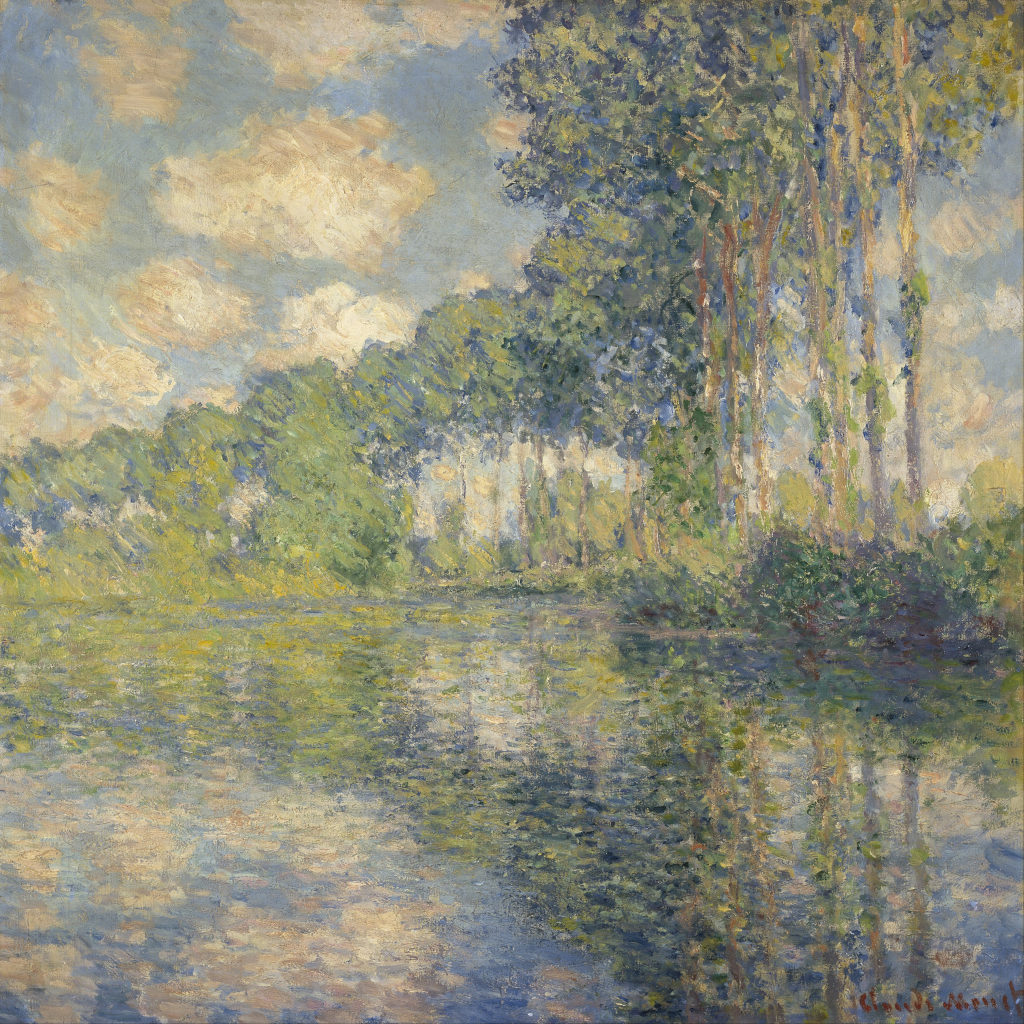
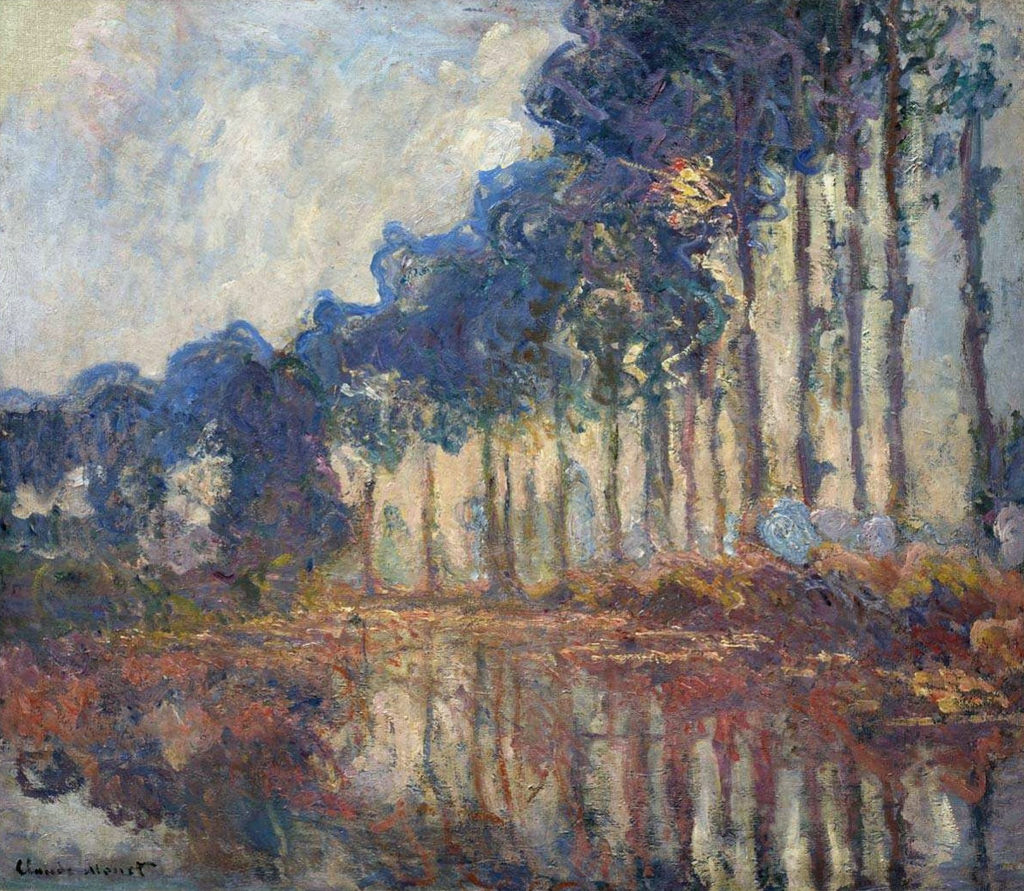
Poplars on the Banks of the Epte
A graceful arrangement in which the trees curve along the riverbank, emphasising rhythm and repetition.
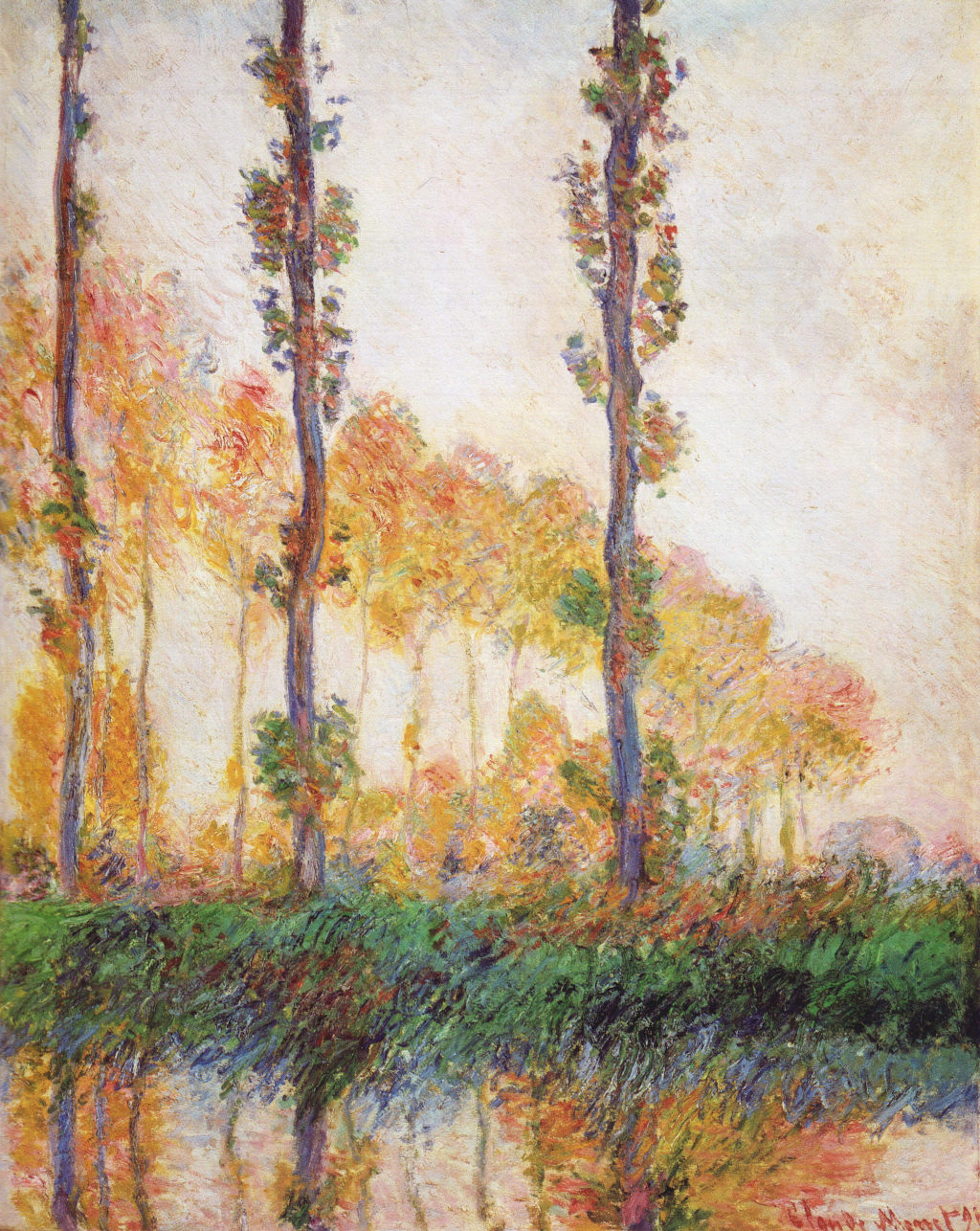
Three Trees in Autumn
A more concentrated composition, where the vertical trunks stand out against richer autumn colour.
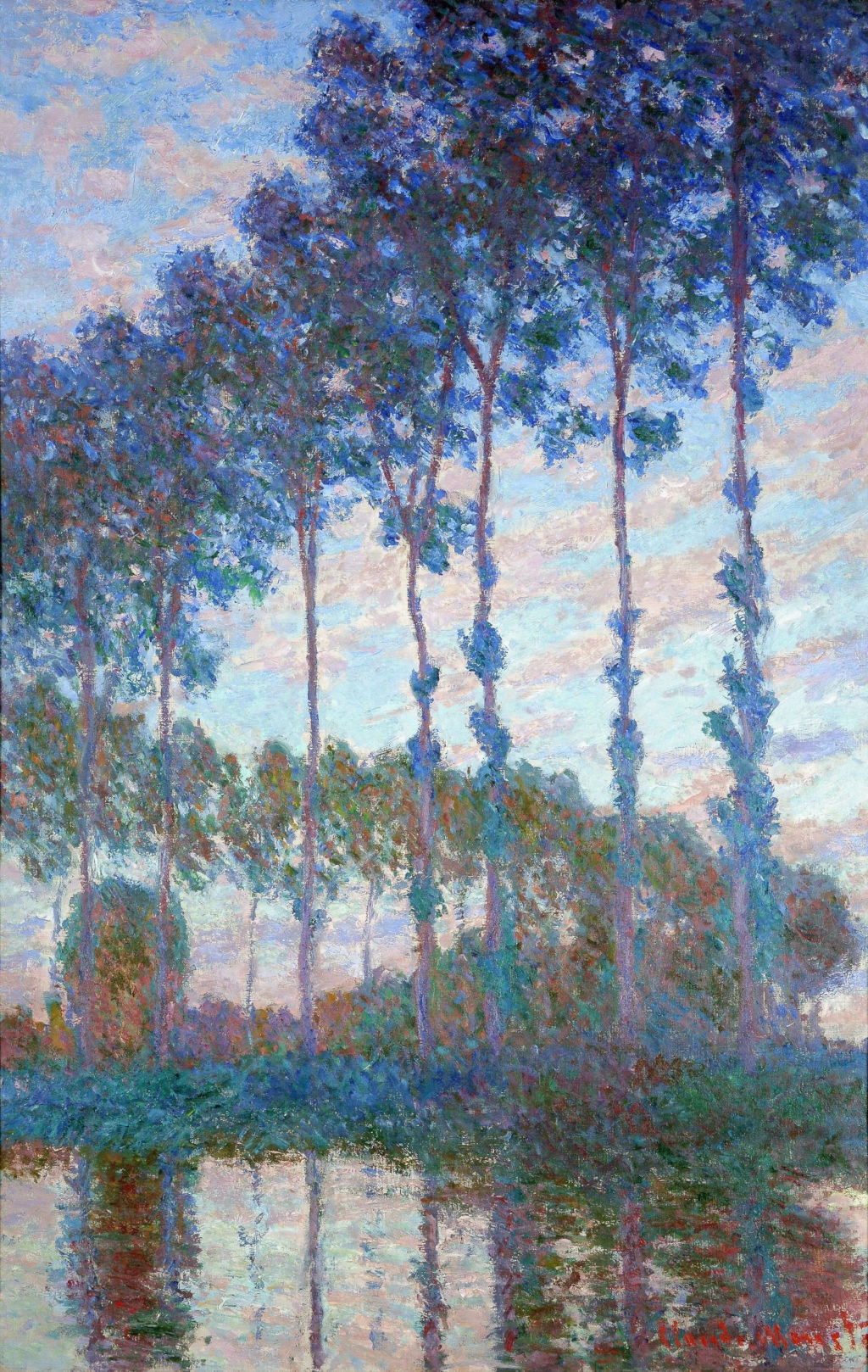
Evening
A quieter, more atmospheric version in which fading light softens both the trees and their reflections.
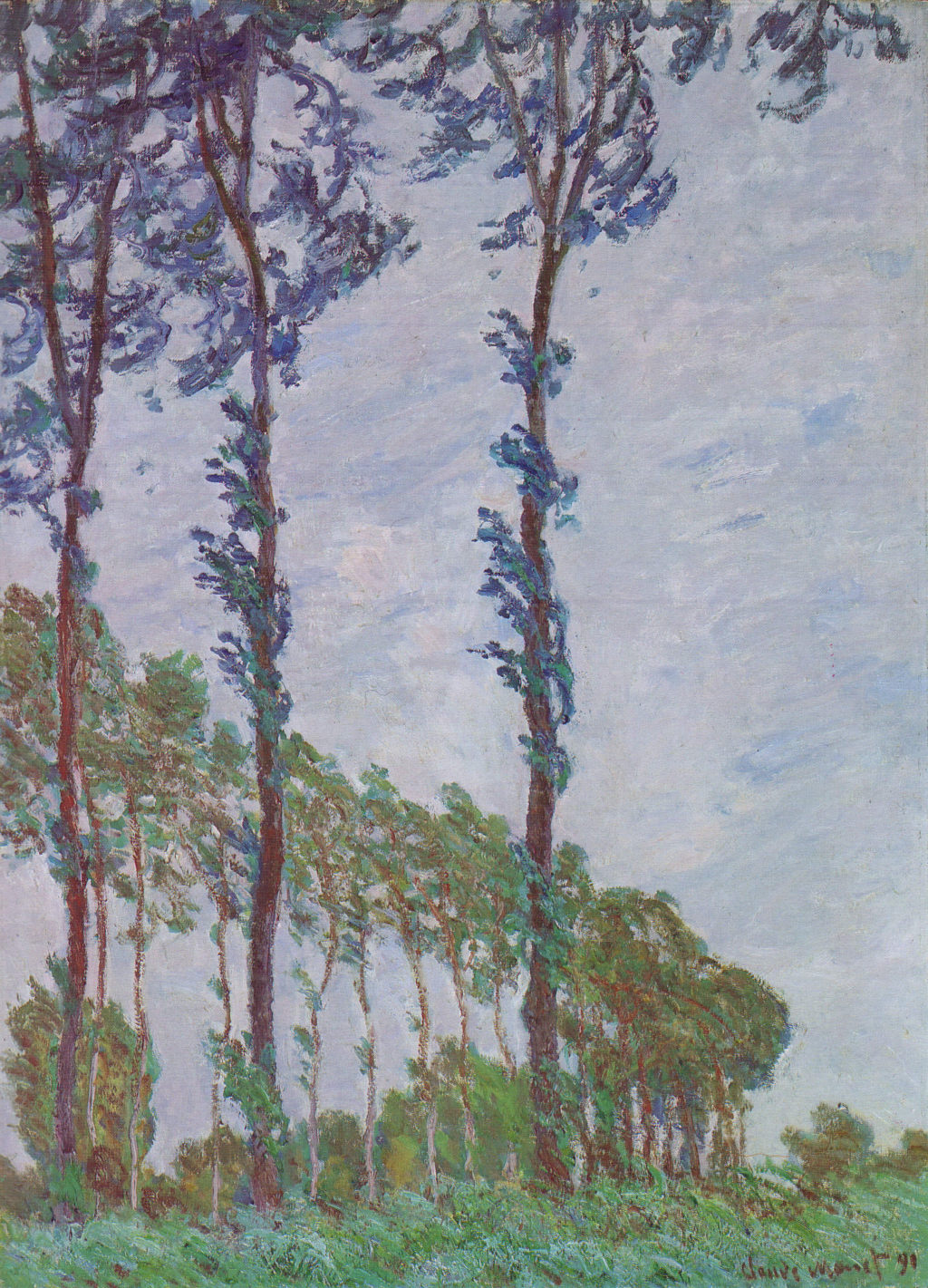
Wind Effect
A more animated version where broken brushwork and shifting reflections suggest movement through the trees and water.
How Monet Worked on the Series
Monet did not paint the Poplars as isolated works conceived one by one. Instead, he approached them as part of a larger serial project, working across multiple canvases and changing from one to another as conditions shifted.
He painted some views from the riverbank and others from a floating studio on the water [7]. This movable working position allowed him to adjust his vantage point and to observe the trees from slightly different angles. It also helps explain the variety within the series. Some compositions are tightly ordered and frontal, while others curve more freely into space.
Monet... rowing daily to Limetz, two kilometres away, to paint the row of poplars lining the Epte where the river bends back into an S curve... Assured of his trees, he settled into his studio boat, equipped with grooves to hold multiple canvases, and from the middle of the river completed twenty three paintings of the poplars, from dawn to dusk, beneath warm sun or grey skies, brilliant blue and verdant green as the wind blows through them, rose and gold when the sun falls hard on the trunks.
Jackie Wullschlager, Monet - The Restless Vision[3]
Like the Haystacks and later the Rouen Cathedral series, the Poplars paintings depend on comparison. No single canvas fully explains the project. Their deeper meaning emerges through sequence, difference, and repetition.
For me, the subject is of secondary importance; what I want to reproduce is what exists between the motif and me.
Claude Monet [12]
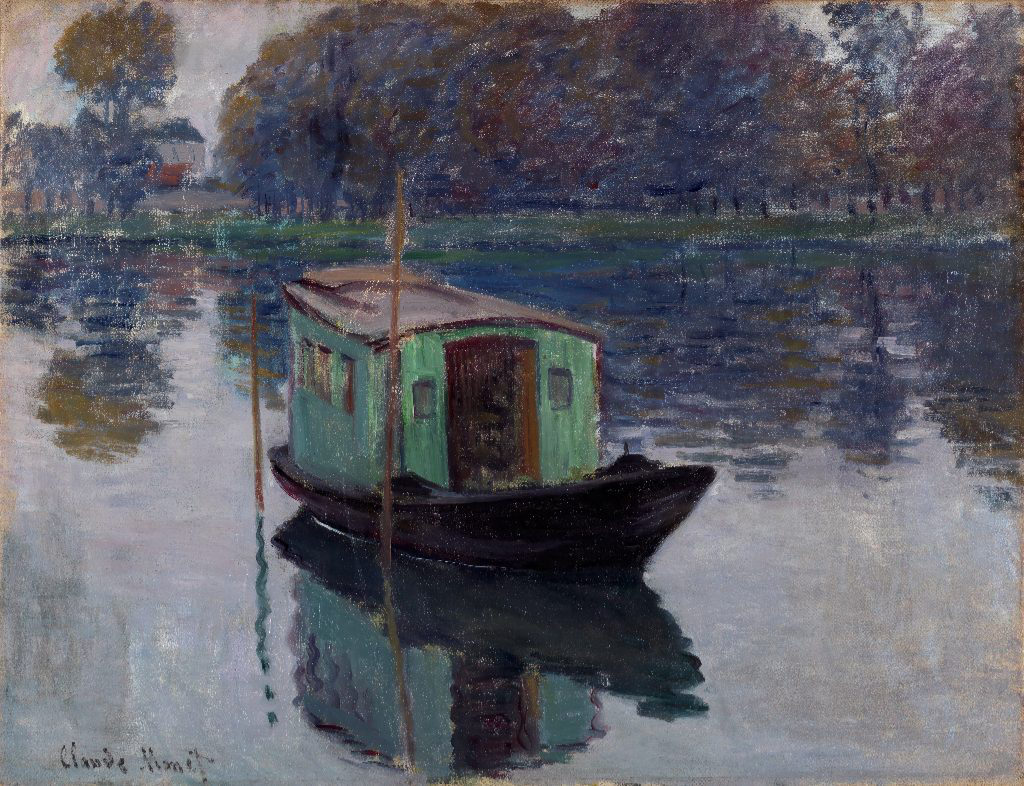
The Studio Boat, Claude Monet, 1874, Kröller-Müller Museum
Documentary Video on Monet's Poplars Series
Composition and Rhythm
One of the most striking qualities of the Poplars series is its sense of rhythm. The repeated trunks rise like visual beats across the surface, creating order without stiffness. Monet often arranges them so that they advance or curve gently through the composition, leading the eye from foreground to distance.
This rhythm is one reason the paintings feel so carefully composed despite their apparently natural subject. The trees are not merely copied from life. They are arranged pictorially so that spacing, height, reflection, and movement all work together [4]. In some versions the line bends elegantly across the riverbank; in others it seems to pulse upward against the sky.
The effect is both decorative and observational. The paintings remain rooted in a real place, yet they also show Monet thinking in terms of pattern, interval, and surface harmony.
Water, Reflection, and Atmosphere
The river plays a central role in the Poplars series. Without the water, the trees would remain striking, but they would lose much of the visual complexity that makes the paintings so memorable. Reflection allows Monet to repeat the vertical forms below as well as above, turning the scene into an interplay of structure and shimmer.
These reflections are never exact mirror images. They are softened, broken, and disturbed by movement on the water's surface. This gives the paintings a sense of instability that contrasts with the upright firmness of the trunks. The eye moves between the solid trees and their shifting doubles, between permanence and fluctuation.
Atmosphere deepens this effect. Changes in sky, season, and weather alter not only the colour of the trees themselves, but also the tone of the water and the relationship between land and air. In this way, Monet turns a narrow stretch of riverbank into a complete world of optical change.
Close Visual Analysis
At first glance, the paintings may seem straightforward: a line of trees beside a river. Yet on closer inspection, the series reveals considerable sophistication. The trunks establish a strong underlying framework, but the branches, leaves, and reflections complicate that structure with broken colour and irregular movement.
Monet rarely treats the trees as isolated botanical studies. Instead, he lets them merge into a broader visual field in which sky, water, bank, and foliage all interact. The repeated poplar forms become anchors within a surface animated by flickering brushwork and changing light.
This balance between order and instability is central to the achievement of the series. The paintings feel disciplined, but never mechanical. They retain the freshness of direct observation while moving toward a more decorative and rhythmic conception of nature.
Colour in the Poplars Series
Colour is one of the main ways Monet distinguishes one Poplars canvas from another. The same trees can appear cool and silvery under soft daylight, warm and glowing in late sun, or more subdued and melancholy under cloudier conditions.
Rather than using colour merely to describe local appearance, Monet uses it to construct mood. Blues, greens, violets, yellows, and golds [5] are balanced differently from one painting to the next, so that each version becomes a distinct visual event. Sometimes the trees stand out clearly against the sky; sometimes they melt into a broader harmony of land, water, and air.
This sensitivity to colour helps explain why the series remains so compelling. The subject is repeated, but the emotional and optical effect is never exactly the same.
Standout Versions from the Series
Although the Poplars paintings are best understood as a group, certain versions stand out for the clarity with which they express Monet's aims. In some, the line of trees curves elegantly across the riverbank, creating a strong sense of musical movement through the landscape. In others, the reflections take on greater prominence, so that the relationship between vertical trunks and broken water becomes the central focus.
Some of the most memorable versions are those in which the trees are lit by warm afternoon or evening light. Here the poplars seem almost to glow, while the water echoes those colours in softened form below. Other paintings are cooler and quieter, emphasising structure, spacing, and atmosphere rather than brilliance.
Taken together, these variations show how flexible the motif was for Monet. A single line of trees could yield paintings that feel serene, luminous, decorative, or even unexpectedly solemn.
Why the Poplars Series Matters in Monet's Career
The Poplars series occupies an important place in Monet's development because it sits between the earlier Haystacks and the more intense serial projects that followed in the 1890s. It demonstrates how fully he had embraced the idea that a painting series could reveal more than a single canvas ever could.
Here Monet refines several concerns that would become central to his later work: repetition, changing light, unstable perception, and the decorative possibilities of natural form. The subject remains recognisable, yet the paintings increasingly invite the viewer to notice rhythm, colour, and surface as much as the motif itself.
For that reason, the series is often seen as an important step in Monet's move toward a more modern kind of painting, one in which sensation and visual structure begin to rival straightforward description.
By the early 1890s, Monet had come to understand that no single canvas could capture the full experience of a motif. Instead, he explored how repeated views could reveal the subtle and continuous changes of light, atmosphere, and perception.
Paul Hayes Tucker, Monet scholar [10]
Why the Series Feels Modern
The Poplars paintings still feel modern because they treat landscape not simply as scenery, but as a field of repeated forms, shifting sensations, and surface relationships. The trees are real, but Monet asks us to see them not only as objects in space, but as rhythms of colour and vertical movement across the canvas.
This is one reason the series feels so fresh today. The paintings remain faithful to observation, yet they also point toward later art in which pattern, repetition, and visual structure become central concerns. Monet does not abandon nature, but he shows that nature can be reorganised through seeing.
In the Poplars series, a modest riverside subject becomes the basis for something much larger: a meditation on repetition, change, and the act of perception itself.
Monet's later series are less about describing objects than about recording the changing effects of light and colour across time, so that the motif itself becomes secondary to the experience of seeing.
John House, Monet: Nature into Art [11]
Complete List of Monet's Poplars Paintings
Claude Monet's Poplars series consists of a concentrated group of paintings created in 1891 along the River Epte near Giverny. Unlike many of his earlier works, these paintings were conceived from the outset as a unified series, each canvas capturing subtle variations in light, season, and atmospheric conditions.
According to Daniel Wildenstein's catalogue raisonné, the series comprises twenty-three paintings, numbered W1291 to W1313. These works are now dispersed across museums and private collections worldwide, but together they form one of the clearest demonstrations of Monet's serial method.
The table below lists the known paintings from the Poplars series, including their Wildenstein numbers, commonly used titles, dates, and current locations where known.
| Image | Wildenstein No. | Title | Date | Location |
|---|---|---|---|---|
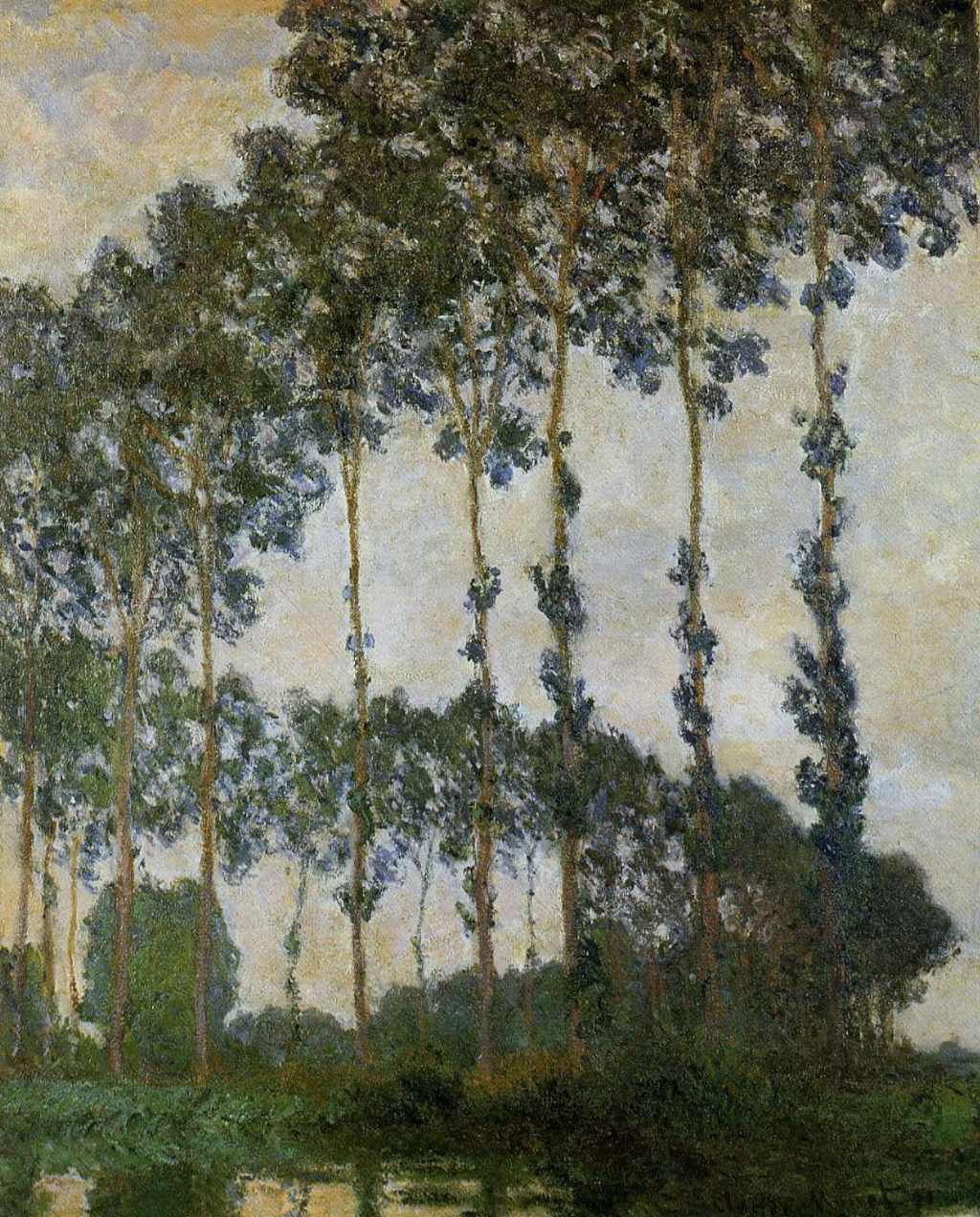 |
W1291 | Poplars on the Banks of the River Epte, Overcast Weather [1] | 1891 | MOA Museum of Art, Atami |
|
W1292 | Poplars on the Banks of the River Epte, Evening Effect [1] | 1891 | Private Collection |
| W1293 | Poplars [1] | 1891 | Philadelphia Museum of Art | |
| W1294 | Poplars [1] | 1891 | Private Collection | |
| W1295 | Poplars, Autumn [1] | 1891 | Private Collection | |
| W1296 | Poplars [1] | 1891 | Private Collection | |
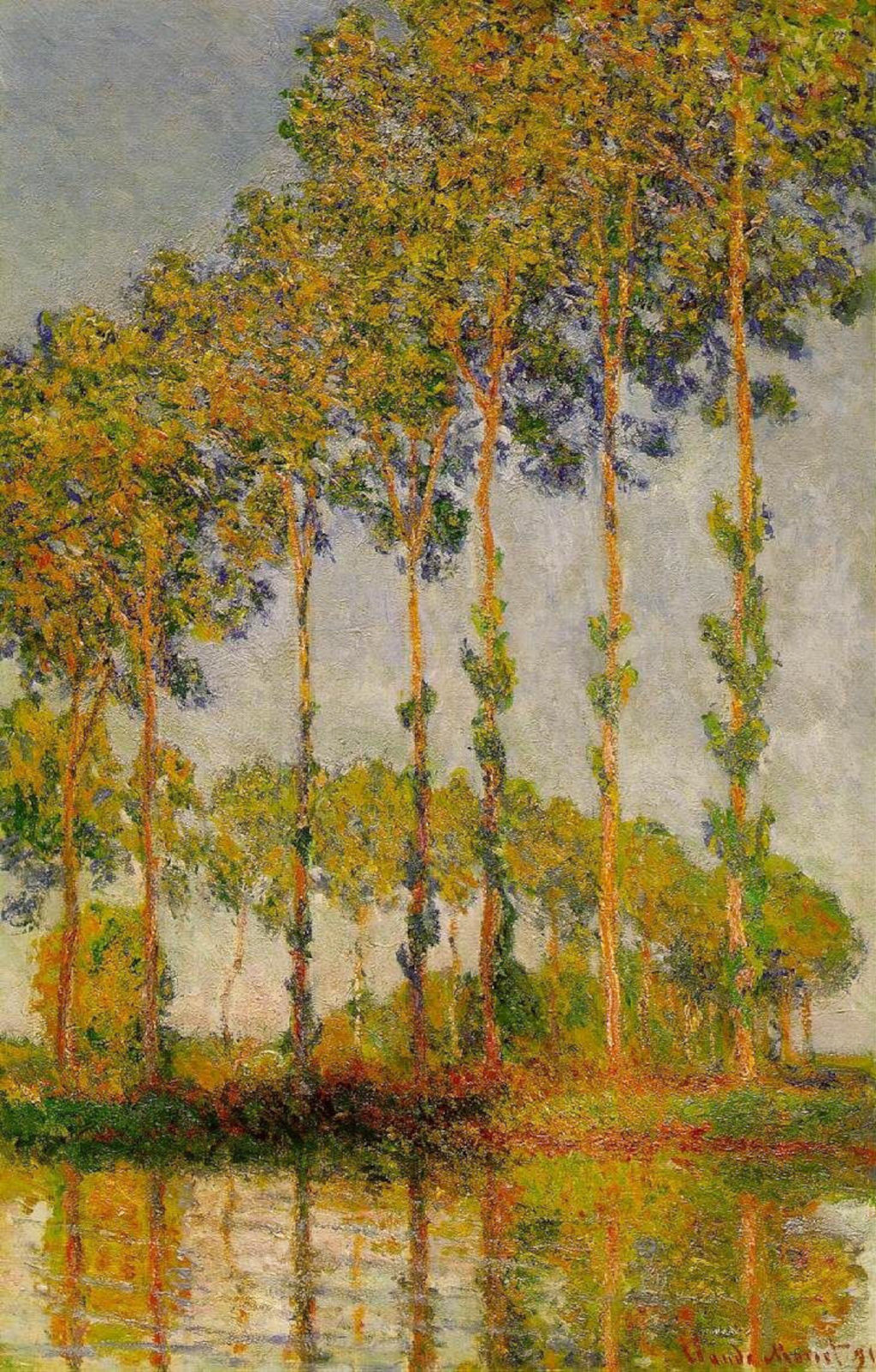 |
W1297 | Row of Poplars in Autumn [1] | 1891 | Private Collection |
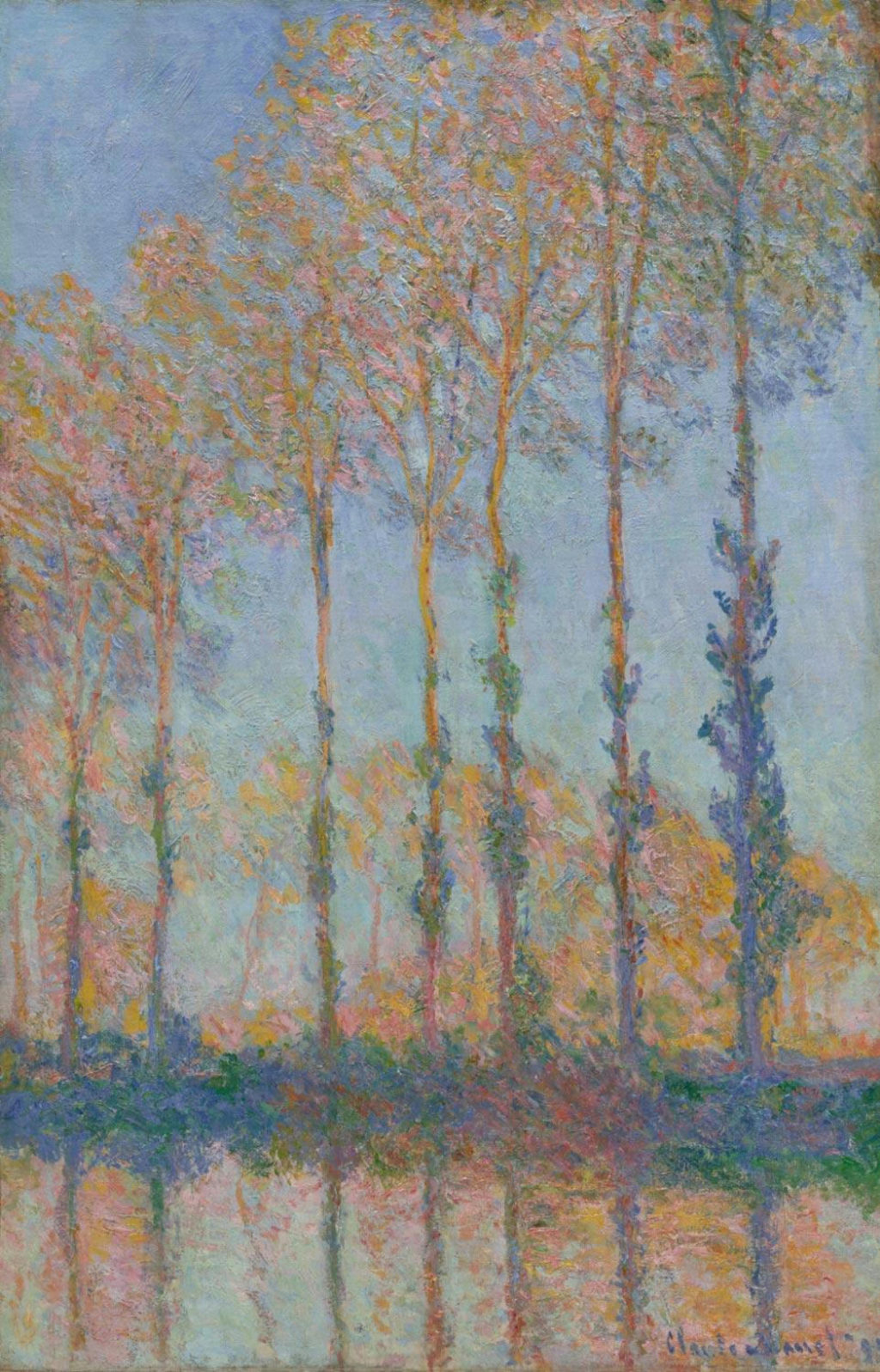 |
W1298 | Poplars on the Banks of the Epte [1] | 1891 | Philadelphia Museum of Art |
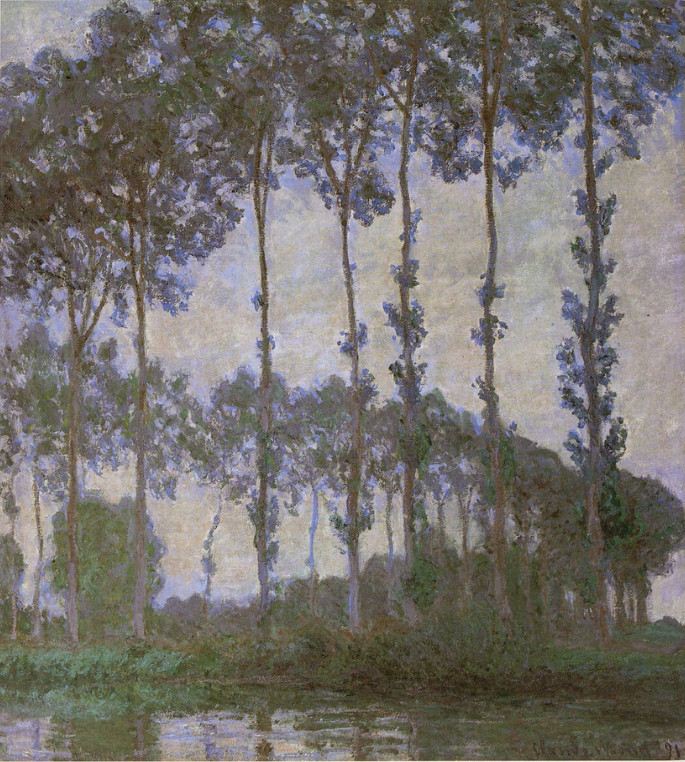 |
W1299 | Poplars on the Bank of the Epte, Overcast [1] | 1891 | Private Collection |
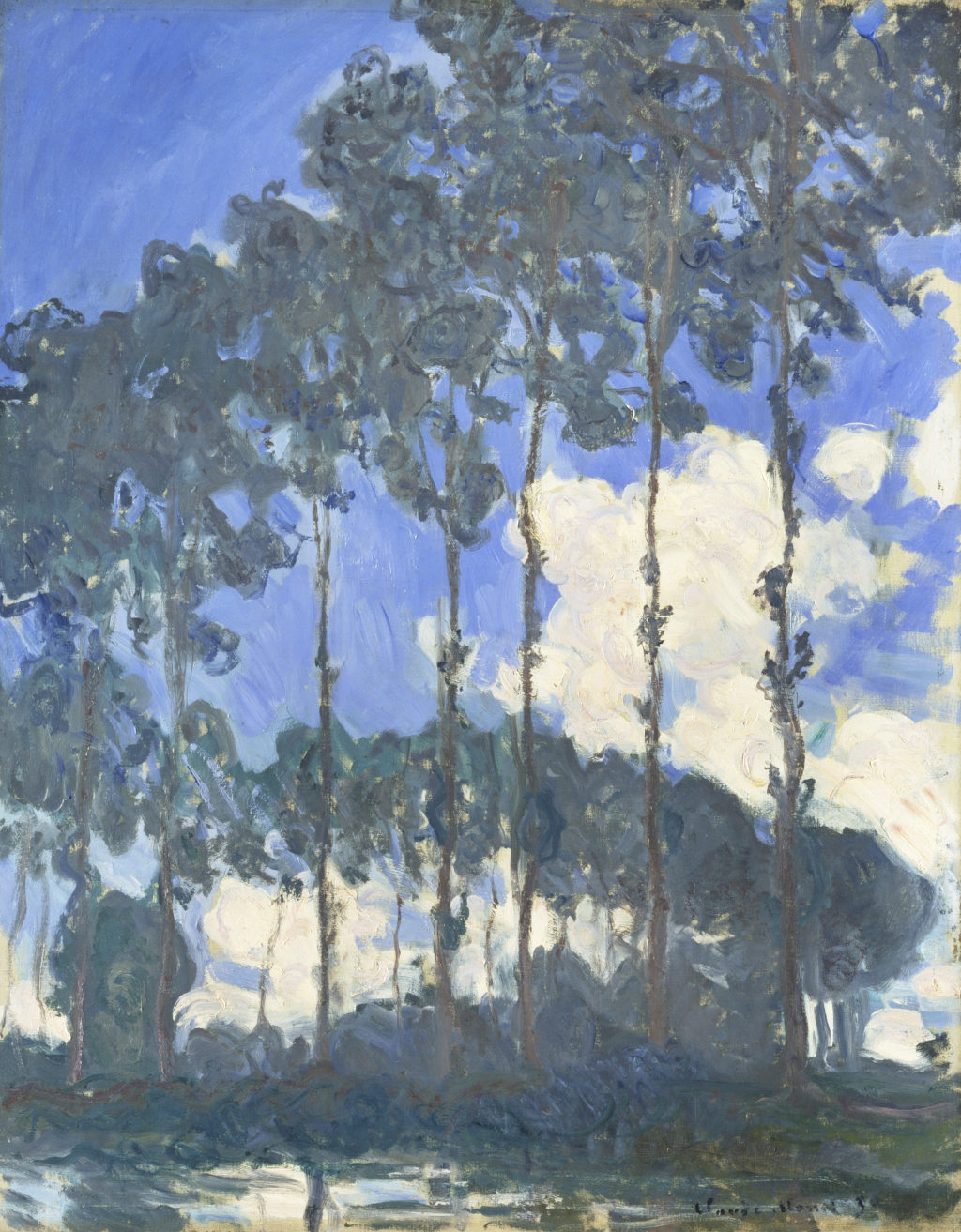 |
W1300 | Poplars on the Epte [1] | 1891 | Tate Britain, London |
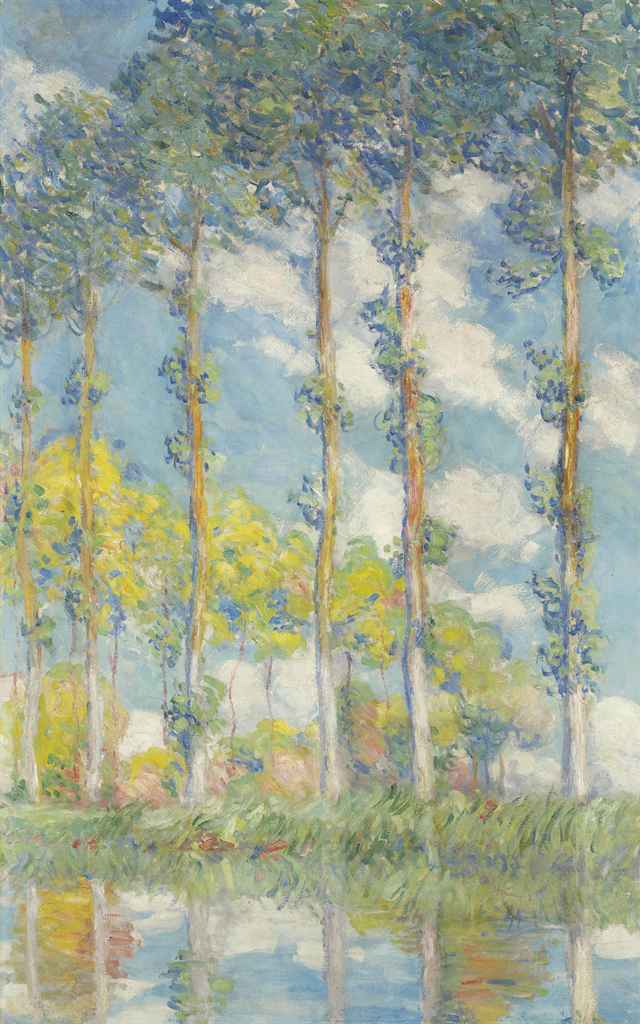 |
W1301 | Poplars [1] | 1891 | Private Collection |
|
W1302 | Poplars, Wind Effect [1] | 1891 | Private Collection |
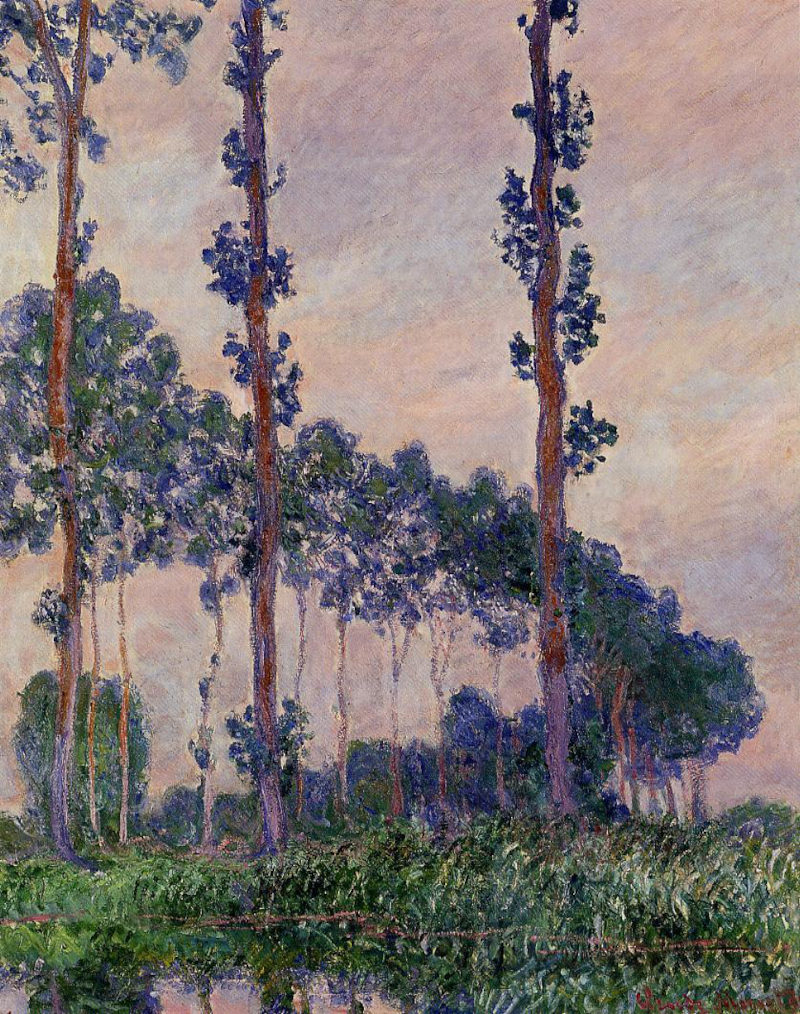 |
W1303 | Three Trees in Grey Weather [1] | 1891 | Private Collection |
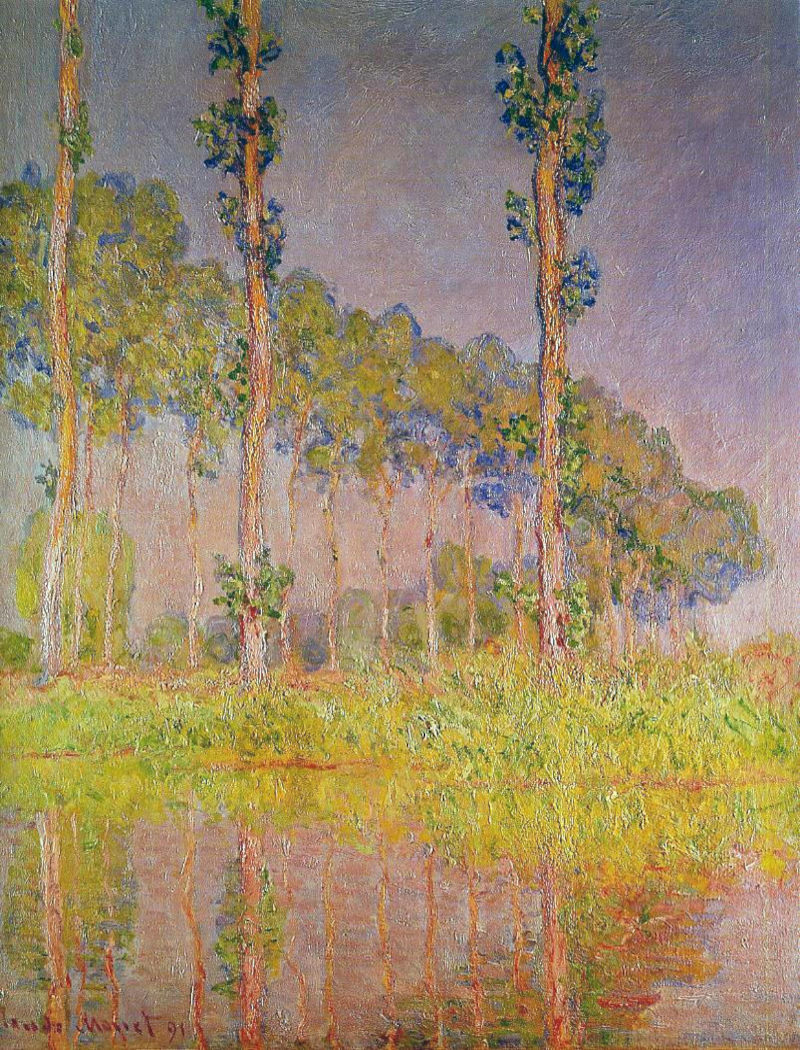 |
W1304 | Three Trees in Spring [1] | 1891 | Private Collection |
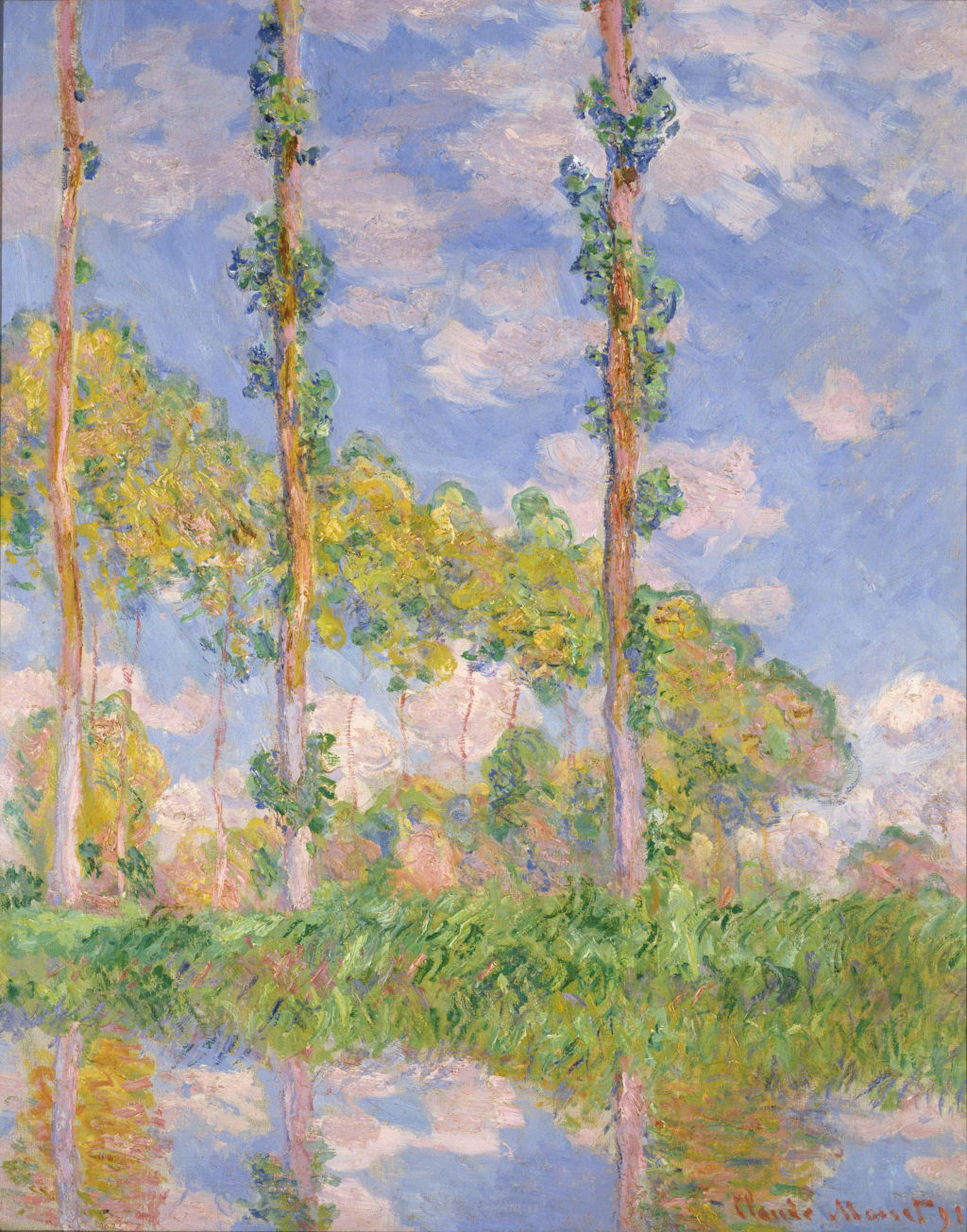 |
W1305 | Poplars in the Sun (Three Trees in Summer) [1] | 1891 | National Museum of Western Art, Tokyo |
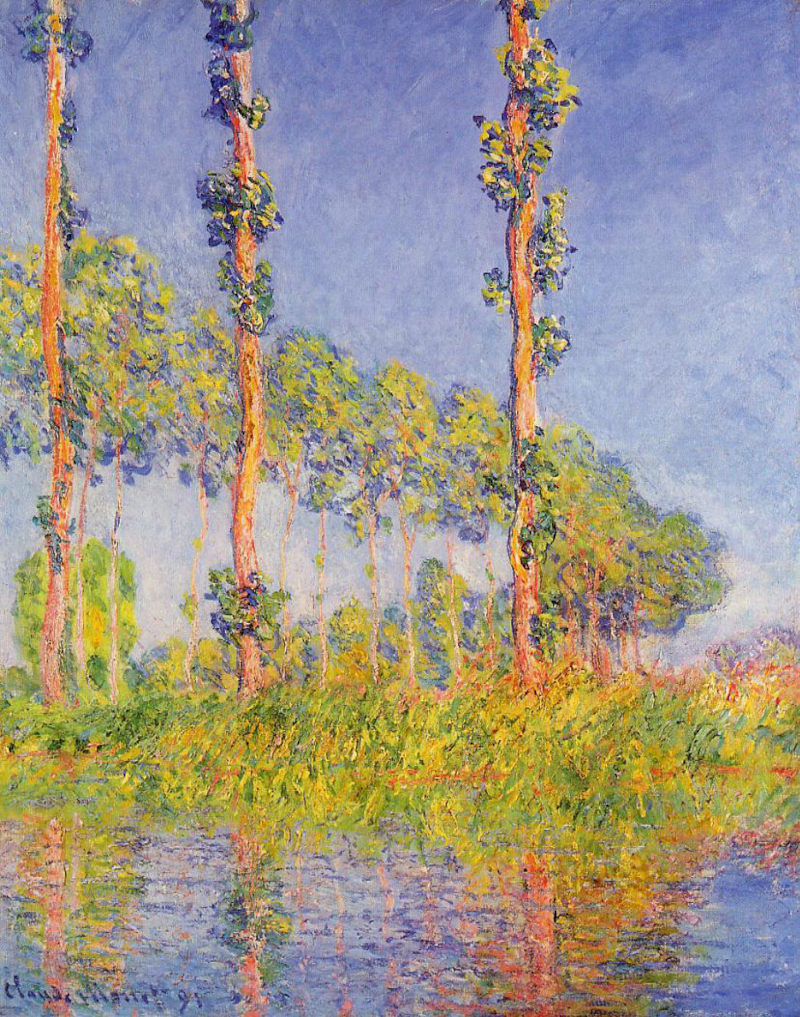 |
W1306 | Three Trees in Autumn [1] | 1891 | Private Collection |
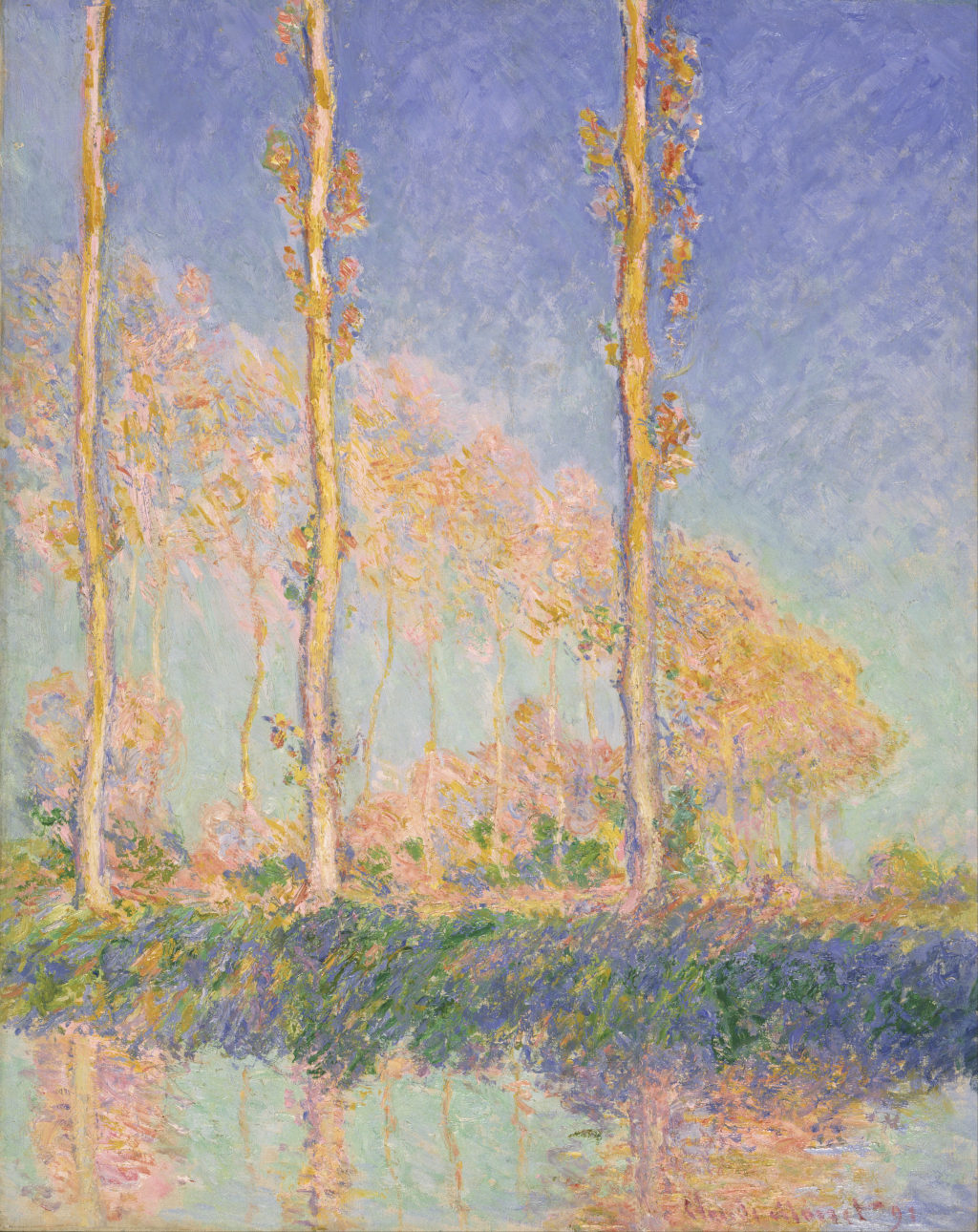 |
W1307 | Three Poplar Trees, Autumn Effect [1] | 1891 | Philadelphia Museum of Art |
|
W1308 | Three Poplar Trees in the Autumn [1] | 1891 | Private Collection |
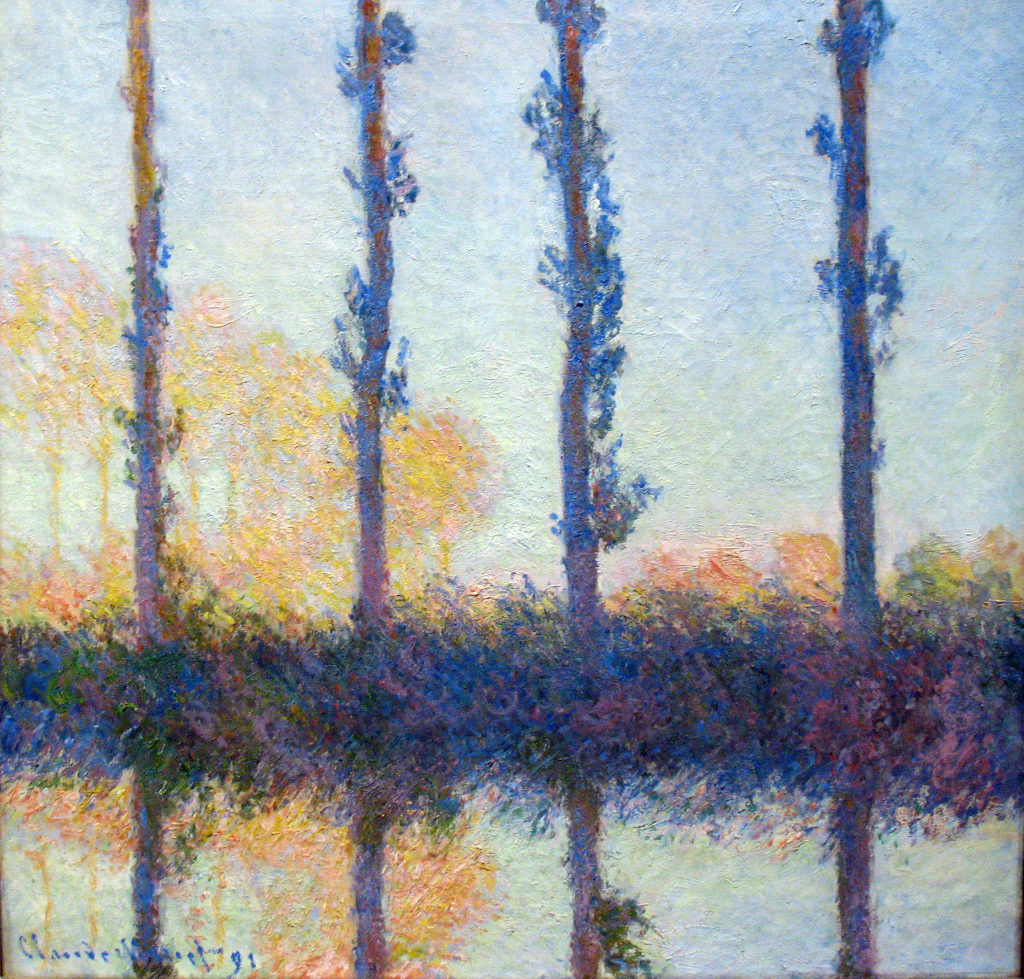 |
W1309 | Four Trees [1] | 1891 | Metropolitan Museum of Art, New York |
|
W1310 | Poplars on the Banks of the River Epte [1] | 1891 | National Galleries of Scotland, Edinburgh |
 |
W1311 | The Poplars, Autumn [1] | 1891 | Private Collection |
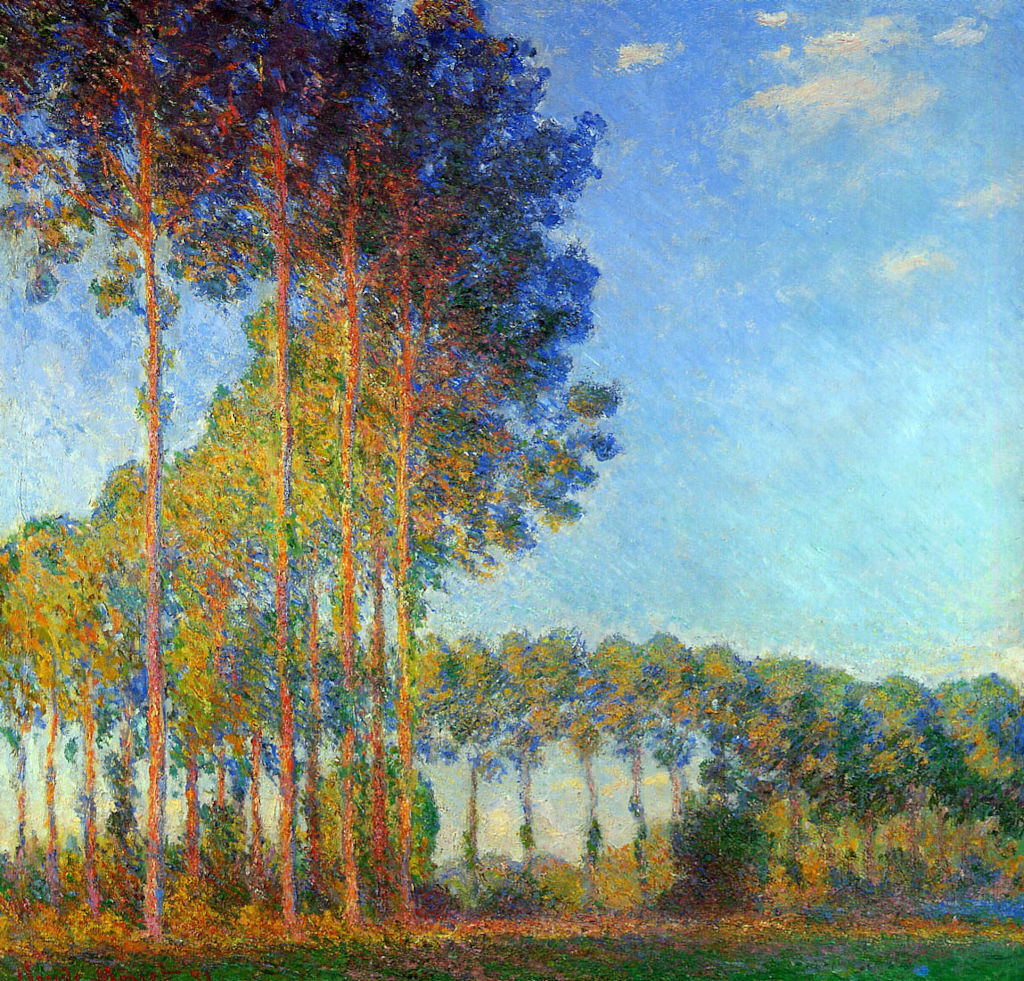 |
W1312 | Poplars on the Banks of the River Epte, Seen from the Marsh [1] | 1891 | Private Collection |
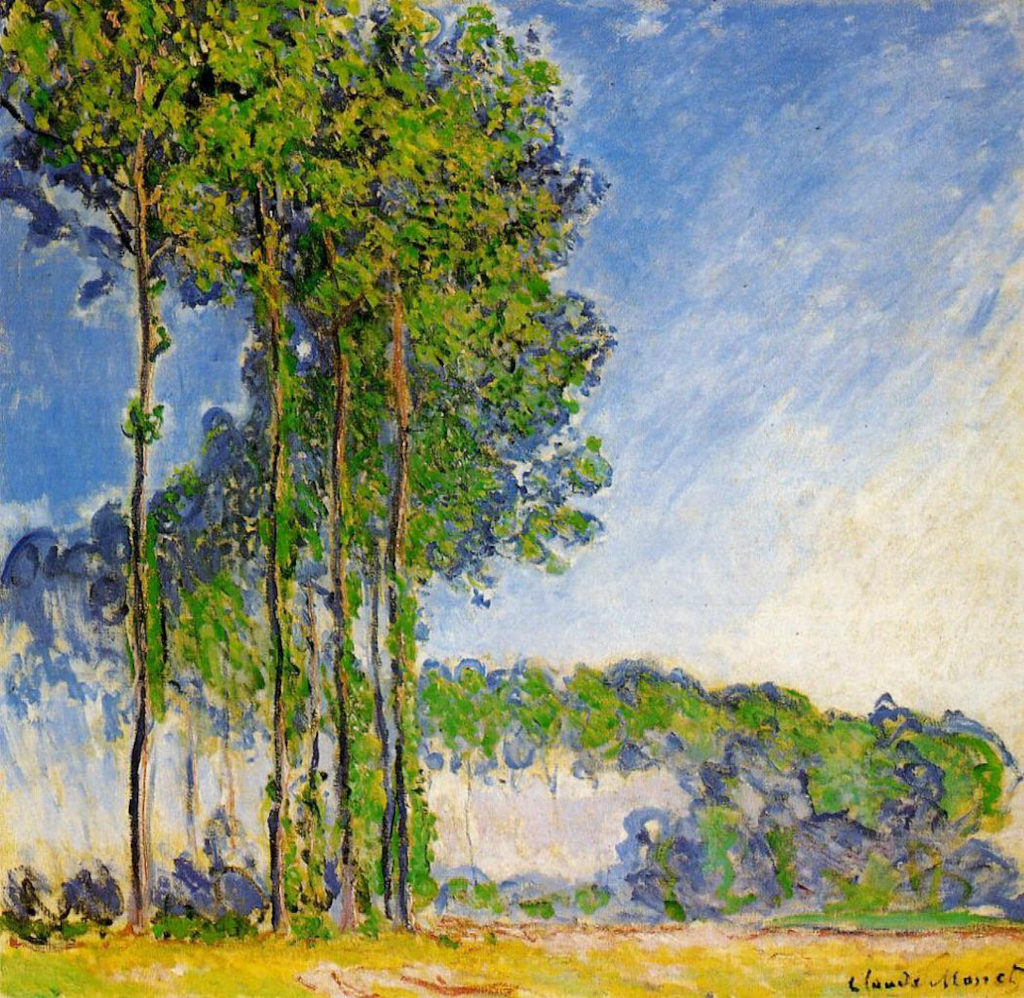 |
W1313 | Poplars, View from the Marsh [1] | 1891 | Fitzwilliam Museum, Cambridge |
3 Things Most People Miss
- The trees are really a study of rhythm: Monet was not simply painting poplars as natural objects. He used their repeated vertical forms to create a visual rhythm that moves across the canvas almost like music.
- The reflections are as important as the trunks: the river doubles the trees, but never exactly. This tension between solid forms above and broken reflections below gives the series much of its subtle energy.
- The subject was unexpectedly fragile: Monet painted the trees while they were under threat of being cut down, which gives the series an added sense of urgency and makes it feel like both an observation and a rescue.
Conclusion
The Poplars series shows how far Monet had moved beyond simple landscape painting. What begins as a line of trees becomes an exploration of rhythm, time, and perception, where repetition reveals difference rather than sameness.
In these works, Monet demonstrates that even the most modest subject can become a vehicle for profound visual experimentation — a principle that would define much of modern painting.
FAQs
References
- Daniel Wildenstein, Gilles Neret, Monet: Catalogue Raisonne, Cologne: Wildenstein Institute and Taschen, 1996.
- Daniel Wildenstein, Monet: The Triumph of Impressionism, Cologne: Taschen, 2015.
- Jackie Wullschlager, Monet - The Restless Vision, Milton Keynes: Allen Lane, 2023.
- The National Gallery, "Poplars on the Epte", View source.
- The Fitzwilliam Museum, "Poplars", Cambridge University, View source.
- National Galleries of Scotland, "Poplars on the Epte", View source.
- The Metropolitan Museum of Art, "The Four Trees", View source.
- Wikipedia, "Poplars (Monet series)", View source.
- Dr. Steven Zucker and Dr. Beth Harris, "Claude Monet, Poplars", Smarthistory, View source.
- Paul Hayes Tucker, Monet in the 1890s: The Series Paintings, Museum of Fine Arts, Boston.
- John House, Monet: Nature into Art, Yale University Press.
- Claude Monet, quoted in various letters and interviews, late 19th century.
- Tamsin Pickeral, Monet - The World's Greatest Art, London: Flame Tree Publishing, 2011.
- Birgit Zeidler, Monet - Art in Focus, Florence: Konemann, 2005.
- Stephen Farthing, 1000 Paintings You Must See, Beijing: Cassell Illustrated, 2008.
Discussion
Claude Monet's Poplars series continues to fascinate viewers because it transforms a simple riverside subject into something structured, lyrical, and deeply modern. Rather than presenting trees as mere background scenery, Monet turns them into repeated forms through which light, reflection, and atmosphere can constantly change.
The series often prompts discussion about repetition, rhythm, and the relationship between observation and design. Do you see these paintings primarily as landscapes, or as studies of pattern and visual structure?
Reader Insights
Light & Reflection: The reflections make the series feel more unstable and alive. The trees seem firm above, but in the water they become broken, softer, and more atmospheric.
Question: Do you think Monet was more interested here in painting actual trees, or in using them as a repeated structure for exploring light, colour, and change?
Join the Conversation
Have a thought or observation about Poplars? Share it below — selected insights may be featured on this page.

Observation: What strikes me most is how musical the paintings feel. The repeated poplars rise like notes across the surface, so the landscape seems organised by rhythm as much as by nature.