 by Tom Gurney
Tom Gurney BSc (Hons) is an art history expert with over 20 years experience
Published on May 22, 2026 / Updated on May 26, 2026
Email: tomgurney1@gmail.com / Phone: +44 7429 011000
Claude Monet and the Influence of Hiroshige
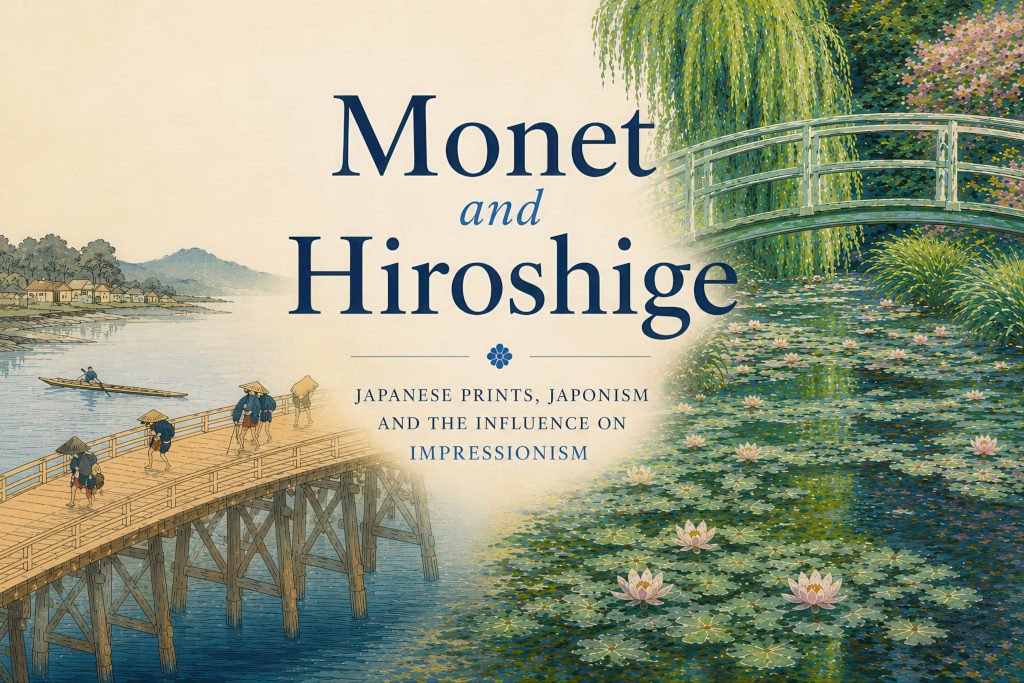
Among all the Japanese artists admired by Claude Monet, Utagawa Hiroshige may have been the closest to Monet in spirit. Hiroshige's lyrical landscapes, changing weather effects, bridges and seasonal atmospheres strongly resonated with Monet's own artistic interests during the rise of Impressionism.
Like many French artists of the late nineteenth century, Monet encountered Japanese ukiyo-e prints after Japan reopened trade with the West during the 1850s. These prints introduced radically different approaches to composition, perspective and atmosphere compared to traditional European painting.
Monet became an enthusiastic collector of Japanese prints and eventually displayed hundreds of them throughout his home at Giverny. Hiroshige's works were especially admired for their poetic treatment of rain, snow, rivers, bridges and fleeting moments in nature.
The connection between Hiroshige and Monet can be seen in many areas of Monet's mature work. Both artists favoured asymmetrical composition, cropped viewpoints, reflective water surfaces and scenes shaped by weather and season. Hiroshige's famous bridge prints also helped inspire Monet's own fascination with Japanese bridge motifs at Giverny.
Rather than treating landscape as a grand historical subject, both artists focused on atmosphere and visual experience. A shower of rain, mist across water, reflections in a river or changing seasonal colour could become the true subject of the image.
Today, the relationship between Monet and Hiroshige is regarded as one of the clearest examples of Japanese influence on European modern art, linking ukiyo-e printmaking directly with the development of Impressionism and later modern painting.
- Artists Claude Monet, Utagawa Hiroshige
- Main Influence Japonism & Impressionism, Japanese Ukiyo-e Landscape Prints
- Important Hiroshige Series One Hundred Famous Views of Edo
- Important Monet Connections Japanese Bridge, Water Lilies, Giverny
- Artistic Influence Asymmetry, Cropping & Atmospheric Effects
- Monet's Collection Hundreds of Japanese Prints at Giverny
- Shared Subjects Rain, Rivers, Atmosphere, Bridges, Gardens & Seasons
Table of Contents
- Hiroshige, Atmosphere and the Passing Moment
- Rain, Fog and the Modern Bridge
- From Edo Bridges to Giverny
- Snow, Silence and Seasonal Mood
- Cropping, Asymmetry and Modern Space
- Hiroshige and the Late Water Lilies
- What Monet Learned from Hiroshige
Hiroshige, Atmosphere and the Passing Moment
If Hokusai helped Monet rethink structure, drama and bold design, Hiroshige offered something slightly different: atmosphere, weather, bridges, snow, rain and the poetry of the passing moment. This distinction is useful because it prevents Monet's Japanese influence from becoming too general. Hokusai's importance is often most visible in forceful composition and serial structure; Hiroshige's is clearer in mood, weather, asymmetry and the emotional charge of fleeting natural effects.
Monet's interest in Hiroshige was not speculative or casual. The Fondation Claude Monet records that Monet's Japanese print collection included 48 works by Utagawa Hiroshige, alongside 23 by Hokusai and 46 by Utamaro. [4] Hiroshige was therefore not a marginal figure in Monet's visual world, but one of the Japanese artists whose prints surrounded him at Giverny.
Hiroshige's landscapes often present a world seen at a particular instant: a sudden shower, a snowy evening, a bridge crossed in passing, or a view glimpsed through trees, rain or mist. This interest in temporary conditions has obvious parallels with Monet's own painting. Monet repeatedly returned to the same motifs because he was less interested in fixed objects than in how they changed under light, weather and time.
Rain, Fog and the Modern Bridge
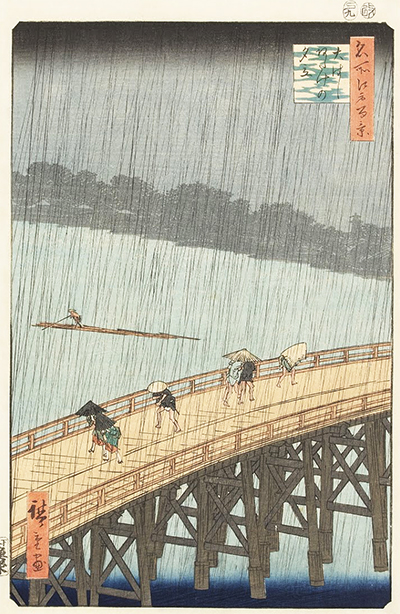
One of Hiroshige's most celebrated designs, Sudden Shower over Shin-Ohashi Bridge and Atake, turns rain into the main subject of the image. The Metropolitan Museum of Art notes that the print uses a difficult criss-crossing pattern of fine rain lines, superimposed across the bridge and river. [5] The result is not simply a view of Edo, but a study of atmosphere itself.
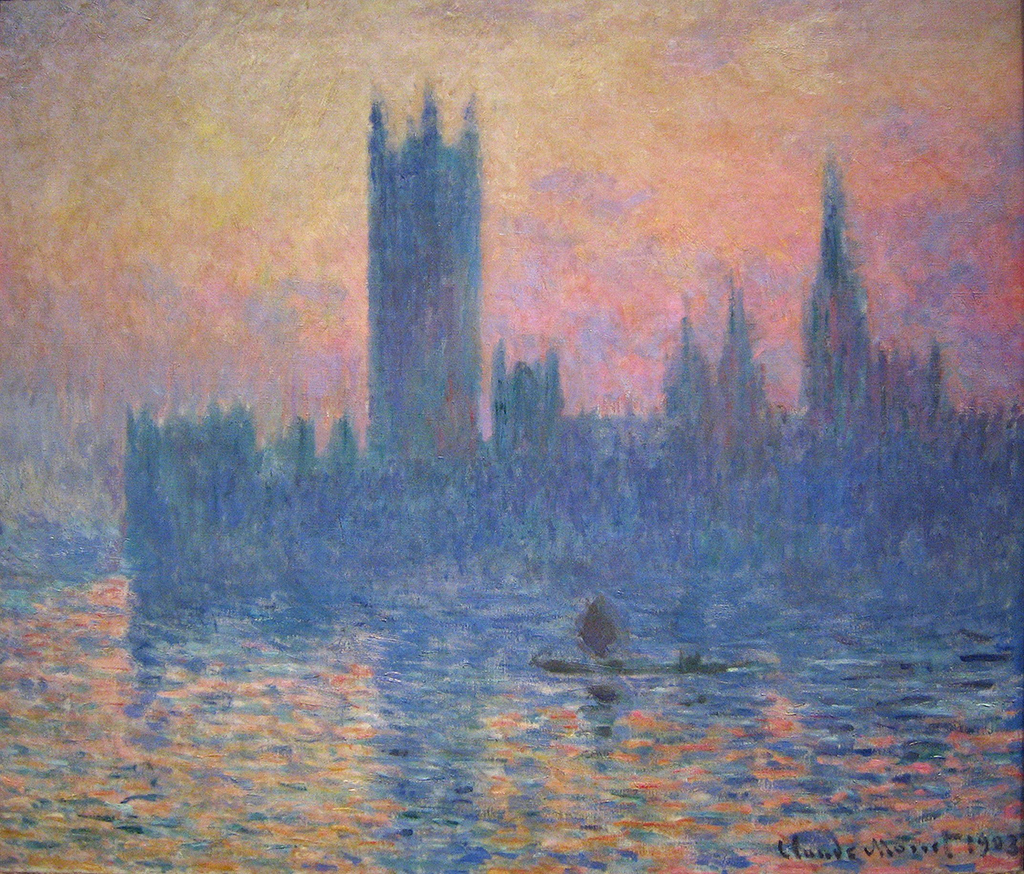
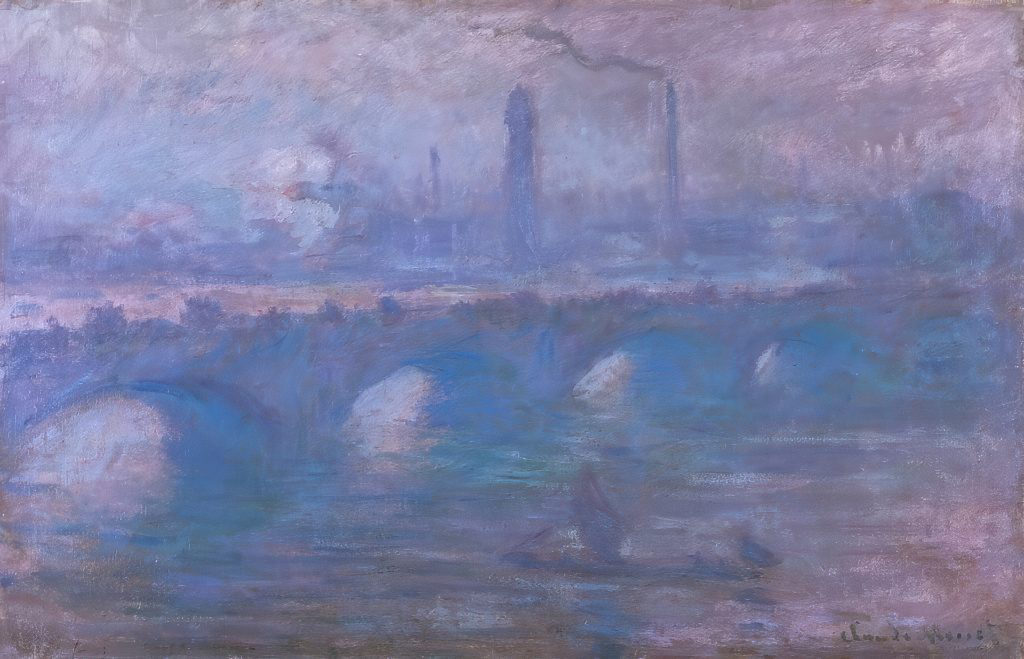
This offers a powerful comparison with Monet's London paintings. In his views of Waterloo Bridge and Charing Cross Bridge, the architecture often dissolves into fog, smoke and coloured haze. Like Hiroshige, Monet treats weather as an active visual force. The bridge remains present, but atmosphere becomes the true subject.
Hiroshige's rain and Monet's fog both transform bridges into atmospheric events rather than simple architectural subjects.
Rain and FOG Compared
Hiroshige and Monet both use weather to soften structure, compress space and make atmosphere the central subject of the image.
Hiroshige: Sudden Shower
Hiroshige's bridge is partly hidden by diagonal rain. The scene is immediate and temporary: figures hurry across the bridge as the weather suddenly transforms the city.
Monet: Waterloo Bridge in Fog
Monet's bridge is also filtered through atmosphere. Smoke, mist and reflected colour blur the city, turning London into an image of light and weather.
From Edo Bridges to Giverny
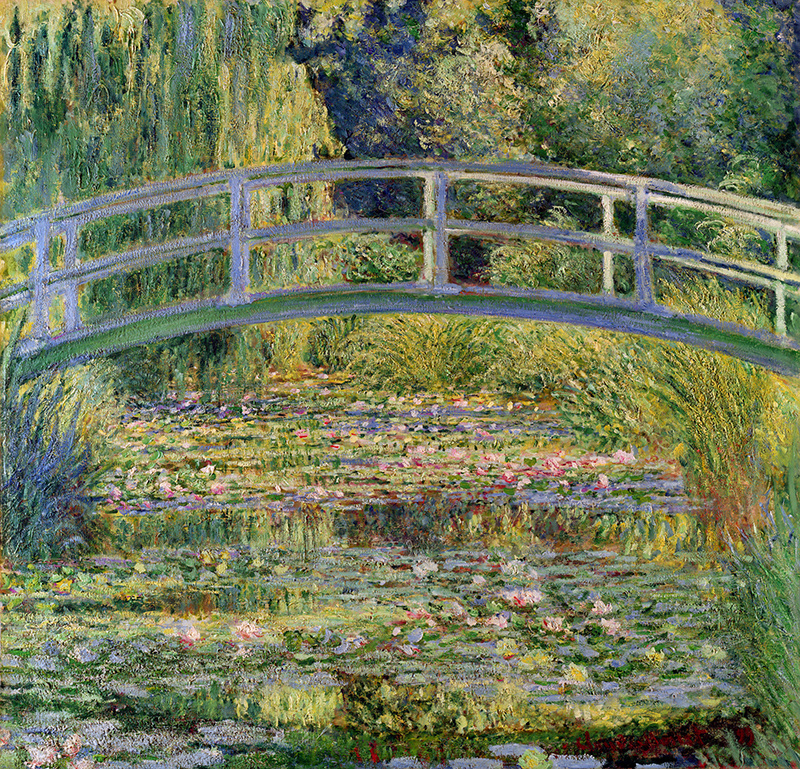
Bridges are one of the clearest links between Hiroshige and Monet. Hiroshige repeatedly used bridges as compositional devices: they cut across space, frame distant views, introduce asymmetry and create a point of passage between foreground and distance. Monet later made the Japanese bridge at Giverny one of the central motifs of his late career.
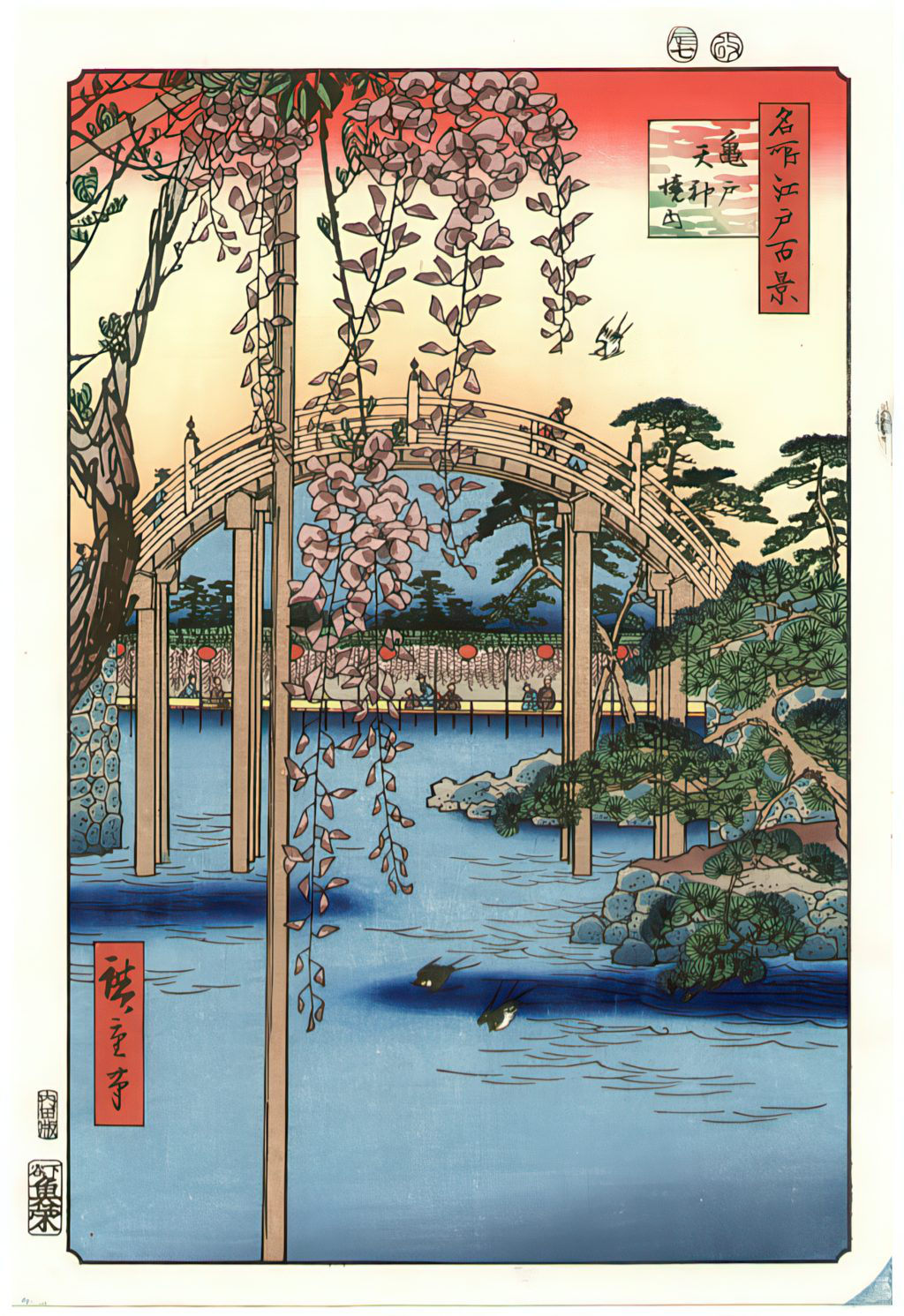
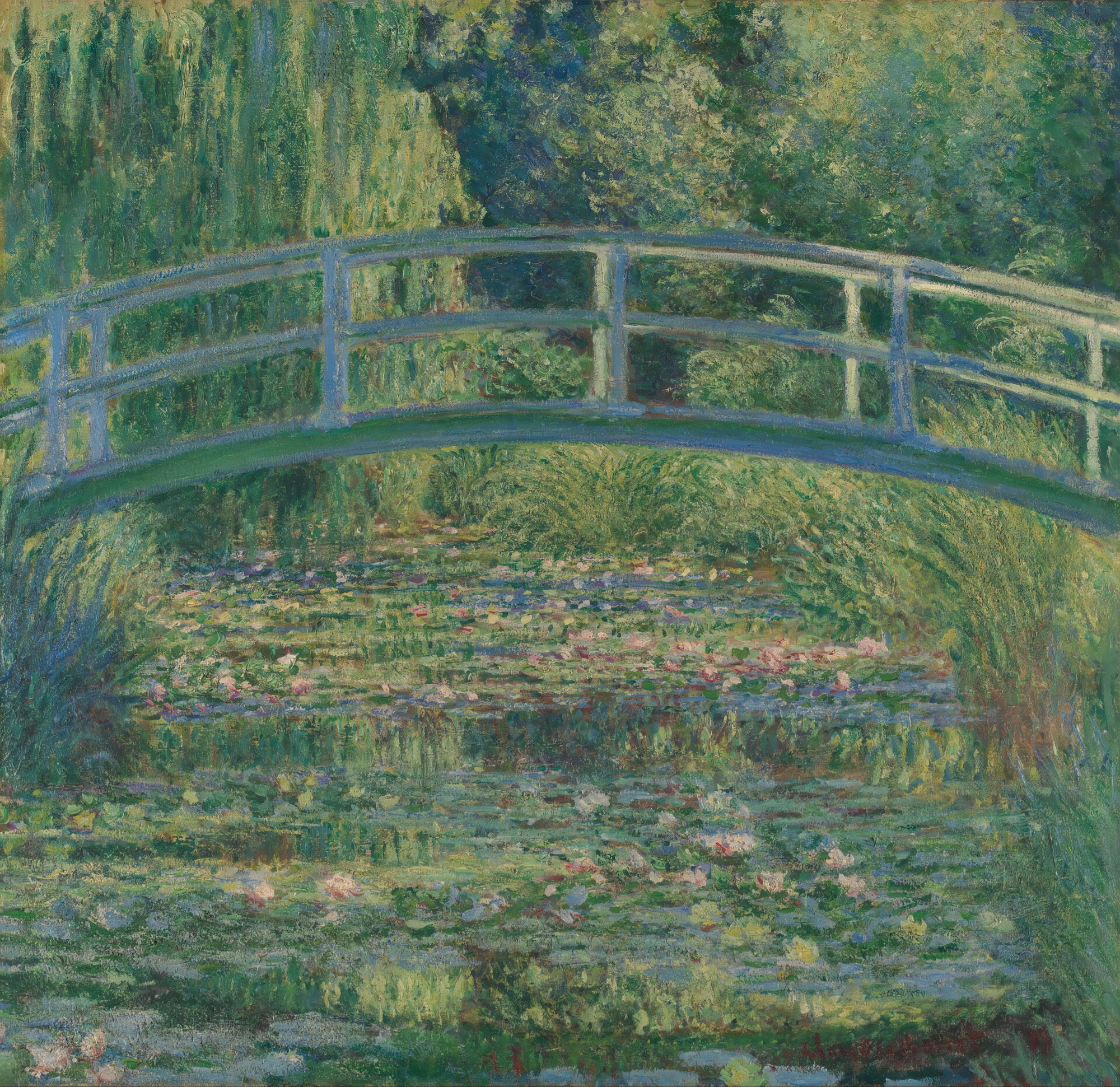
The National Gallery notes that Monet's bridge over the western end of the water-lily pond was inspired by bridges in ukiyo-e Japanese prints. It also states that Monet owned Hiroshige's Wisteria at Kameido Tenjin Shrine, a print featuring a curved bridge. [6] This gives the Hiroshige-Monet bridge connection unusually strong documentary support.
From Hiroshige's Edo bridge scenes to Monet's Giverny pond, the bridge becomes both a real structure and a decorative framework for seeing nature.
Edo and GIVERNY Bridges
Hiroshige's bridge prints helped establish a visual language of curved structures, asymmetry and framed landscape that Monet later transformed in his Giverny garden paintings.
Hiroshige: Wisteria at Kameido
Hiroshige's curved bridge and hanging wisteria create a layered, decorative composition in which foreground forms frame the view beyond.
Monet: The Water-Lily Pond
Monet's bridge at Giverny similarly becomes a decorative arc over water, flowers and reflections. It is both garden architecture and pictorial structure.
Snow, Silence and Seasonal Mood
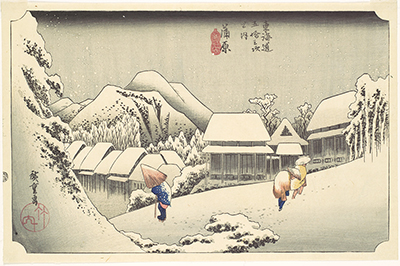
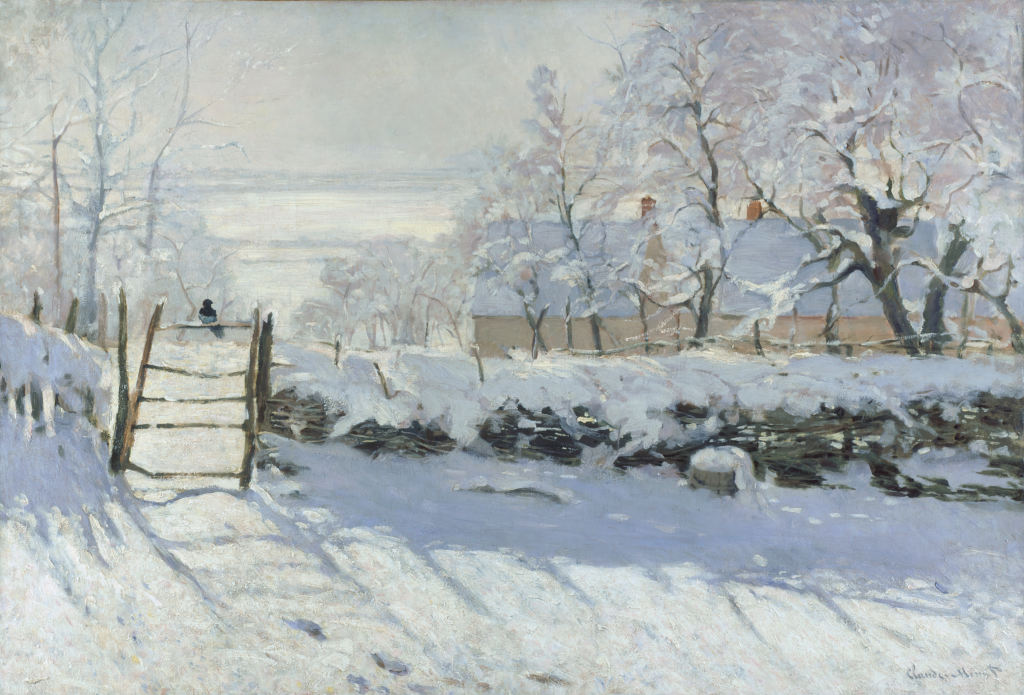
Hiroshige's landscapes often treat snow as a poetic atmosphere rather than a mere weather condition. Snow simplifies forms, softens edges and creates a mood of silence. This connects closely with Monet's winter paintings, particularly The Magpie, where snow is not just scenery but the organising substance of the whole image.
Monet's snow scenes are central to his development because they allowed him to study coloured shadows and subtle tonal variation. Hiroshige's snow prints offered a different but related lesson: a landscape could become more powerful when reduced, quietened and simplified by weather.
In both artists, snow simplifies the world and turns landscape into a study of stillness, tone and seasonal feeling.
Snow and SILENCE Compared
Hiroshige and Monet both understood that snow could flatten space, soften detail and create a deeply atmospheric image.
Hiroshige: Evening Snow at Kanbara
Hiroshige's snow scene reduces the landscape to quiet forms and muted contrasts. Weather becomes a poetic force that changes the emotional tone of the place.
Monet: The Magpie
Monet's The Magpie similarly makes snow the main subject. The image is built from delicate tonal shifts, coloured shadow and a quiet winter atmosphere.
Cropping, Asymmetry and Modern Space
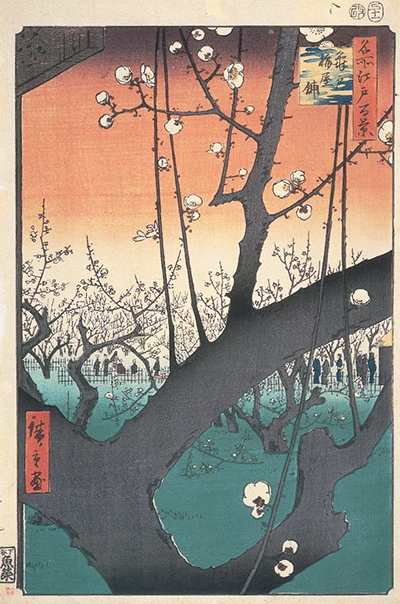
Hiroshige's compositions often feel strikingly modern because they refuse balanced, centred design. Foreground forms may cut abruptly across the view; bridges, trees or falling rain may dominate the picture; and important parts of the landscape can be pushed to the edges. This was one of the qualities that made ukiyo-e so important to European artists seeking alternatives to academic perspective.
Monet absorbed this lesson increasingly over time. His late works often abandon stable foreground, middle ground and background. Instead, the viewer is placed close to the motif, as if looking into a cropped fragment of a larger world. This is especially clear in the late Water Lilies, where pond surface, reflection, sky and plant forms merge into a single decorative field.
Cropping and ASYMMETRY Compared
Hiroshige helped normalise unusual framing, partial views and asymmetrical design, all of which became important to Monet's later visual language.
Hiroshige: Plum Estate, Kameido
Hiroshige's foreground tree dominates the design, cutting across the picture and turning the landscape into a bold, asymmetrical arrangement.
Monet: Cropped Water Lilies
Monet's late pond paintings often remove the horizon and crop the motif tightly, making the viewer feel surrounded by water, reflection and floating plants.

Hiroshige and the Late Water Lilies
The influence of Hiroshige becomes especially interesting when viewed through Monet's late work. By the time Monet was painting the Water Lilies, he was no longer simply borrowing Japanese motifs. He had absorbed Japanese ideas about surface, asymmetry, decorative rhythm and immersive space into his own pictorial language.
The late Water Lilies are often described as moving toward abstraction, but they can also be understood as the culmination of Monet's Japonisme. The pond becomes a shallow, all-over surface; forms are cropped; reflections replace conventional depth; and the viewer no longer stands outside the landscape but seems to enter it visually.
This connects closely with Hiroshige's own treatment of the world as a sequence of passing visual experiences. His prints often frame nature as something glimpsed through weather, architecture, water, trees or seasonal effects. Monet's late garden paintings transform that logic into oil painting on an unprecedented scale.
What Monet Learned from Hiroshige
-
1. Weather could become the subject
Hiroshige's rain, snow and mist scenes helped establish weather as a poetic and pictorial force. Monet similarly made fog, snow, smoke and changing light central to his art. -
2. Bridges could structure a landscape
Hiroshige's bridge prints use architecture as a compositional device. Monet later turned the Giverny bridge into one of the central forms of his Japanese-inspired garden paintings. -
3. Asymmetry could feel more modern than balance
Japanese print design showed Monet that a picture did not need to be centred or academically balanced to feel complete. -
4. A landscape could be decorative and atmospheric at the same time
Hiroshige combines flat colour, pattern and mood. Monet's late paintings achieve something similar through reflection, colour and surface rhythm. -
5. The passing moment mattered
Hiroshige's art often captures a temporary condition: rain beginning, snow falling, a bridge crossing, evening light. Monet's Impressionism was built on the same fascination with transient perception.
FAQs
References
- Daniel Wildenstein, Gilles Neret, Monet: Catalogue Raisonne, Cologne: Wildenstein Institute and Taschen, 1996.
- Daniel Wildenstein, Monet: The Triumph of Impressionism, Cologne: Taschen, 2015.
- Jackie Wullschlager, Monet - The Restless Vision, Milton Keynes: Allen Lane, 2023.
- Fondation Claude Monet, “Japanese Prints,” Maison et jardins de Claude Monet - Giverny, View source.
- The Metropolitan Museum of Art, “Utagawa Hiroshige: Sudden Shower over Shin-Ohashi Bridge and Atake,” The Met Collection, View source.
- The National Gallery, London, “Claude Monet: The Water-Lily Pond,” The National Gallery Collection, View source.
- National Gallery of Australia, “Monet & Japan,” National Gallery of Australia, View source.
- Cleveland Museum of Art, “Sudden Shower over Shin-Ohashi Bridge and Atake,” Cleveland Museum of Art Collection, View source.