


 by
Tom Gurney
Tom Gurney BSc (Hons) is an art history expert with over 20 years experience
Published on October 6, 2016 / Updated on October 23, 2026
Email:
tomgurney1@gmail.com
/ Phone:
+44 7429 011000
Claude Monet in Etretat
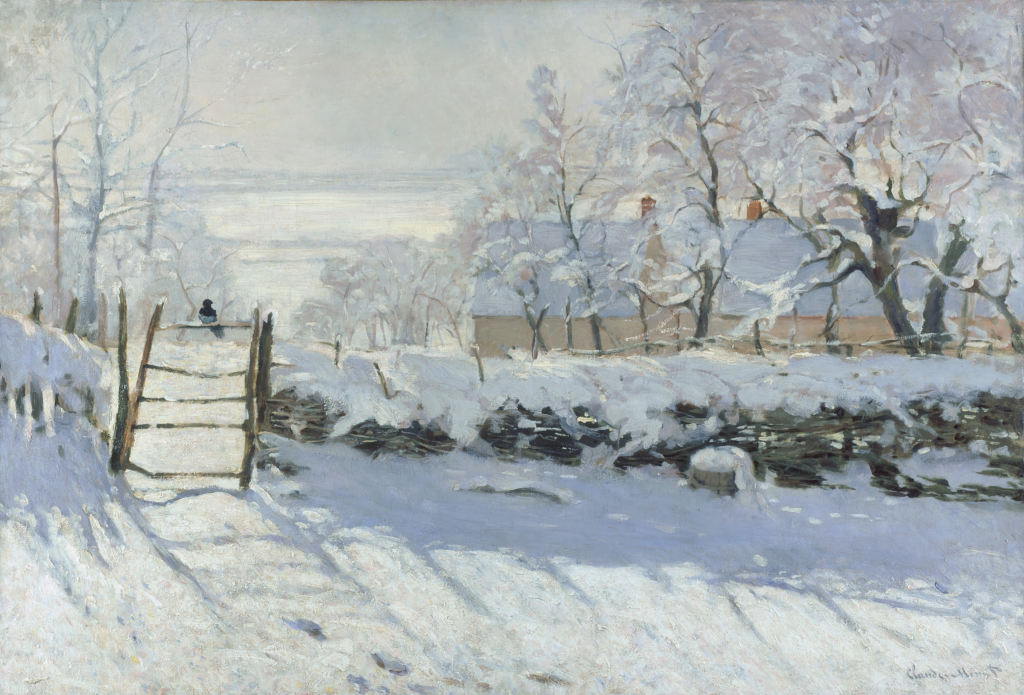
Etretat offered Claude Monet a coast in which recognisable rock formations could change dramatically with viewpoint, weather and light. He painted beaches, arches, fishing boats and rough water during repeated campaigns in the 1880s, but his association with the area reaches further back: The Magpie records the nearby snowy countryside in 1868-69. The variety matters. Etretat is not one cliff, one painting or one uninterrupted sequence of identical views. [1] [2] [3] [4]
At a Glance
- Location Etretat, on the Normandy coast
- Earlier example The Magpie, winter 1868-69, near Etretat [1]
- Principal coastal campaigns Repeated visits in 1883, 1885 and 1886 [3] [4]
- Distinct formations Porte d'Amont, Porte d'Aval and Manneporte [2] [3]
- Campaign count with a defined scope Chicago's catalogue identifies 51 canvases initiated in autumn 1885 [2]
- Working method Observation on the coast could be followed by studio refinement [2] [4]
A coast of distinct landmarks
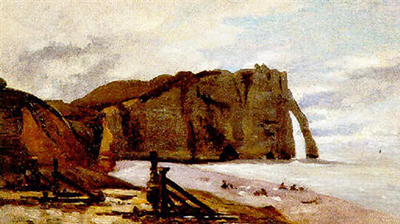
The names in Monet's Etretat titles are useful geographical clues, but they should not be treated as synonyms. The Falaise d'Amont lies to the northeast of the main bay; the Falaise d'Aval is to the southwest. The Manneporte is another great opening in the coastal rock. [2] [3]
Changing the point of view alters much more than the outline of an arch. A cliff can appear as a broad wall, a projecting mass or a frame around a distant view. A free-standing rock can seem attached to the land from one angle and isolated from another.
The same topography also offers different measures of distance. From above, the beach can become a sweeping band between cliff and sea. From lower down, the rock can tower beyond the field of vision.
A place overview is therefore best approached through comparisons rather than one supposedly definitive image. The rock provides continuity, but each painting constructs a different relation between the viewer, the coast and the water.
Etretat belongs within Monet's Normandy , while retaining a very particular combination of geology, maritime activity and established scenic viewpoints.
Before the famous cliffs: The Magpie
The Magpie was painted in the countryside near Etretat during the winter of 1868-69. The Orsay's record places it well before the celebrated coastal campaigns of the 1880s. [1]
The setting is not a dramatic arch. Snow-covered ground, a barrier and a small bird create a quieter landscape, organised through pale colour and the contrast between sun and shade.
This earlier work broadens the meaning of Monet in Etretat. An artist's relationship to a place need not be confined to its most recognisable tourist landmark. The surrounding countryside could offer another subject and another kind of light.
The Orsay records that the painting was rejected by the jury of the 1869 Salon. [1] Its later familiarity should not conceal how unusual its pale treatment could appear in its first context.
It also cautions against reducing Monet's snow to a colour formula. The interest lies in the relationships that make a white landscape legible: shaded and illuminated areas, solid boundaries and the small dark accent of the bird.
The 1883 Manneporte: rock seen through colour
The Met's The Manneporte (Etretat) dates from 1883. Monet spent much of February on the coast, painting beach views and rock formations. The museum emphasises how sunlight lets the great mass be interpreted through colour and luminosity. [3]
The cliff is both a substantial natural structure and a changing visible surface. Its shape remains recognisable, but the experience of that shape depends on the surrounding sea, the sky and the distribution of illuminated and shaded passages.
The Met also notes the two small figures beneath the arch. [3] Their scale makes the rock's size more apparent. A nearly empty scene is not necessarily without human presence; a tiny figure can become a powerful measure of the landscape.
The painting thus works on several levels. It records a known landmark, gives an impression of extraordinary scale and explores the way colour can soften the apparent solidity of stone.
Recognising the site is a starting point, not the end of looking. What matters next is how the image makes the site present under particular conditions.
Rough weather and the place left outside the frame
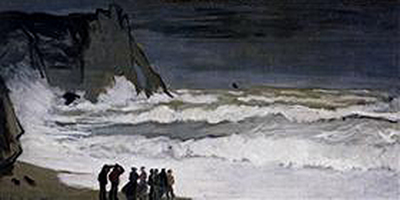
The National Gallery of Victoria's Rough weather at Etretat , dated 1883, directs attention towards sea and cliff rather than the busy resort nearby. The museum points out the small figures at the water's edge and the paths visible on the distant land. [5]
This is an important distinction between a painting and a complete description of a place. The town can be excluded while signs of human use remain. Selection changes the emphasis without making the setting imaginary.
The figures' smallness gives the waves and rock a different force. Their gestures are easy to read as human responses within an environment that is much larger than they are.
The movement of water also contrasts with the cliff's persistent outline. Broken light and irregular strokes can animate the foreground while the land supplies a firmer structure beyond it.
The result need not be explained as an abandonment of the subject into abstraction. It remains a particular stretch of coastline, made dramatic through framing, scale and the relationship between relatively stable land and moving water.
The intense campaign of autumn 1885
The Art Institute's scholarly catalogue identifies fifty-one canvases initiated between Monet's arrival in mid-September 1885 and departure in mid-December. It cautions that their exact sequence cannot be established. This is a count for a defined campaign, not a total of every Etretat work. [2]
The Chicago painting, Etretat: The Beach and the Falaise d'Amont , looks across the bay from the other side. Its account shows that Monet selected and altered a familiar scenic prospect rather than reproducing every topographical feature. [2]
Such a campaign required more than the recognition of a successful motif. Changing conditions could make one canvas relevant while another had to wait. A view might remain available while its appearance ceased to match what the painter was pursuing.
Repetition therefore created choices, not a simple timetable. Canvases could develop in parallel, with later decisions affecting the appearance of the earlier work.
The coast offered the consistency of a recognisable setting alongside the instability that made repeated looking necessary. That combination places Etretat within Monet's wider practice of related groups and series , without making every group identical.
The fishing boats keep the coast connected to work
Not all the paintings turn away from maritime activity. Dijon's Etretat, the Porte d'Aval: Fishing Boats Leaving the Harbour , dated 1885, depicts boats departing for the herring fishery. The museum connects it with Monet's enthusiasm for the collective departure described in an October letter. [6]
The boats were launched from the pebble beach. [6] Their presence gives the bay another rhythm, different from the nearly unpeopled view of a rock arch. Sails and hulls become moving forms within a working environment.
A fishing departure can also alter the role of the cliff. The formation remains recognisable, but it now provides a setting against which activity unfolds. The eye can pass between the more persistent coast and the momentary arrangement of vessels.
This prevents Etretat from becoming only a story of solitary contemplation. Monet could be interested in the changing ocean and in the practical movements that took place upon it.
Comparing boats with cliff views reveals the range of his attention within one location. The same bay could supply a monumental form, a weather effect or a sequence of departures.
A familiar motif can become an unfamiliar composition
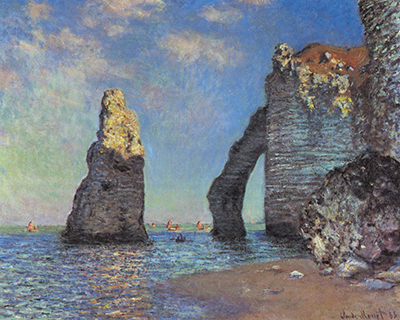
The Clark's Cliffs at Etretat (The Rock Needle and the Porte d'Aval) , dated 1885, brings two recognisable features into one carefully composed view. Its collection catalogue places the painting within Monet's engagement with a coast already familiar to tourists and other artists. [7]
A known prospect does not dictate one pictorial solution. The distance from the rock, the amount of sky and water, and the way the formation meets the edges all affect how it is experienced.
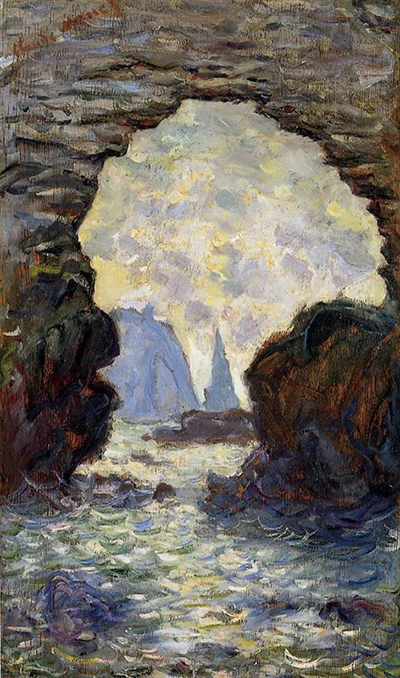
Philadelphia's Manne-Porte, Etretat , also dated 1885, offers another example. The museum stresses the vertical faces of the cliffs against a sea that seems to merge with the sky. [8]
The contrast is not only a matter of changing colour. It concerns the organisation of space: a relatively clear separation between land and sea in one view can become less secure in another.
This is why near-identical titles require care. Museum, date and the particular view identify the object more reliably than a generic phrase such as Monet's cliffs. Different canvases retain distinct compositions even when they represent the same formation.
Outdoor observation and later finishing
The Met's The Manneporte near Etretat , dated 1886, is a separate work from its 1883 canvas. Its account draws on Maupassant's description of Monet moving between several canvases as light and shadows changed, and notes later refinement in the studio. [4]
This working method joins responsiveness with revision. A canvas could begin in front of the motif without reaching its final form there. The finished image's apparent immediacy does not prove that it was untouched after one outdoor session.
Studio work also allowed Monet to consider a painting independently of the weather that first prompted it. The balance of colour, the strength of a shape or the relation between water and cliff could still demand adjustment.
Etretat therefore rewards attention to technique as well as scenery. The paintings are records of looking, but they are also made objects shaped over time.
The most productive comparison keeps both aspects visible. A familiar arch can organise a scene, while the accumulated choices of viewpoint, light, paint and revision make each canvas a different encounter.
Etretat Painting Pages
Frequently Asked Questions
Yes. The Magpie dates from the winter of 1868-69 and depicts the nearby countryside. [1]
No. The fifty-one canvases identified by Chicago's catalogue belong to that autumn campaign. [2]
No. The Met records studio refinement as well as work in changing coastal conditions. [4]
Discussion
Look again at the images and ideas explored in Claude Monet in Etretat. These editorial prompts invite your observations.
Reader Insights
Compare a cliff seen from above with one viewed near the water.
Notice which signs of the resort or fishing activity are included or excluded.
Separate a painting's original campaign from the later work needed to finish it.
Join the Conversation
Share a detail, comparison or question about Claude Monet in Etretat below.
References
- Musee d'Orsay , The Magpie, 1868-69, RF 1984 164; the countryside near Etretat and the 1869 Salon. View source .
- Art Institute of Chicago , Gloria Groom and Kimberley Muir, Monet scholarly catalogue, Cat. 21, Etretat: The Beach and the Falaise d'Amont, 1885; topography, campaign and working process. View source .
- The Metropolitan Museum of Art , The Manneporte (Etretat), 1883, accession 51.30.5; the February campaign, colour and scale. View source .
- The Metropolitan Museum of Art , The Manneporte near Etretat, 1886, accession 31.67.11; repeated views, eyewitness account and studio refinement. View source .
- National Gallery of Victoria , Rough weather at Etretat, 1883, accession 582-2; framing, figures and the omitted resort. View source .
- Musee des Beaux-Arts de Dijon , Etretat, the Porte d'Aval: Fishing Boats Leaving the Harbour, 1885, inventory 2961; the herring fishery and boat departures. View source .
- Clark Art Institute , collection catalogue, Cliffs at Etretat (The Rock Needle and the Porte d'Aval), 1885, accession 1955.528. View source .
- Philadelphia Museum of Art , Manne-Porte, Etretat, 1885; the relation between vertical cliffs, sea and sky. View source .







