


 by
Tom Gurney
Tom Gurney BSc (Hons) is an art history expert with over 20 years experience
Published on October 6, 2016 / Updated on October 23, 2026
Email:
tomgurney1@gmail.com
/ Phone:
+44 7429 011000
The Rock Needle Seen through the Porte d'Amont
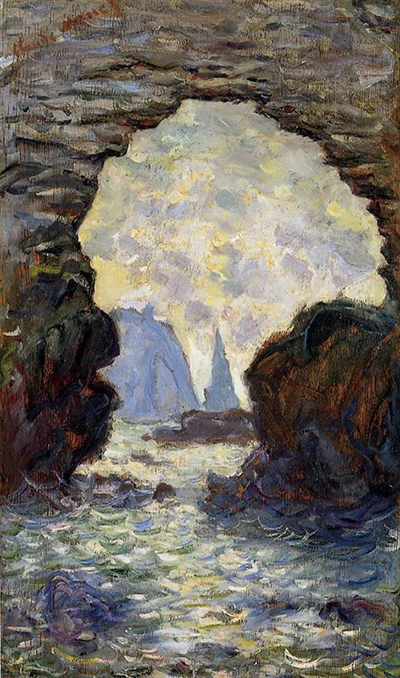
The Rock Needle Seen through the Porte d'Amont is an unusually narrow coastal painting by Claude Monet, catalogued as W1041. Christie's records the work as an oil painting on a cradled wooden panel, dated 1885-1886. The view places a dark, close rock opening around a luminous glimpse of sea and distant cliffs at Etretat. [1]
At a Glance
- Artist Claude Monet
- Date 1885-1886, in the cited sale record
- Support Wooden panel
- Dimensions 66 x 38 cm, as recorded by Christie's
- Catalogue Wildenstein 1041
- Signature Upper left: Claude Monet. [1]
A view enclosed by rock
The most striking feature is the amount of rock placed between the viewer and the open sea. Layered stone fills the upper edge and presses inward from both sides. Instead of looking at a cliff from a comfortable distance, we seem to look through it.
The opening is irregular rather than a smooth architectural arch. Its upper boundary forms a broad curve, but the sides break into projecting shapes and darker recesses. A heavy mass at the right narrows the passage near the water, while the left edge descends in a more sharply interrupted outline.
Within this enclosure, the distant rock formations appear cooler and lighter. The slender Needle rises near the lower centre of the opening, beside the broader cliff beyond. Their silhouettes are clear enough to identify, yet their colour separates them from the much nearer stone.
This contrast establishes a substantial depth within a compact format. Foreground rock, moving water and distant formations occupy successive spaces, but are held together by the opening's shape. The picture does not offer a general panorama of the coast. It concentrates on one framed encounter between solid rock and changing light.
Light through the opening
Pale yellow, grey and lavender passages animate the sky beyond the arch. They do not form a blank patch of brightness. Their shifting marks give the opening a painted texture of its own, answering the more heavily structured surface of the surrounding stone.
The water carries that light towards the foreground. Cream-coloured touches run between cooler blue and green strokes, suggesting broken reflections rather than one continuous beam. Darker patches interrupt the surface, while small curling marks give the nearer water a restless rhythm.
Monet uses different kinds of direction to hold these elements apart. The rock's layered marks often run across the upper field; the distant Needle supplies a sharp upright; the water moves in short, overlapping bands. The result combines a firm structural enclosure with a less stable surface below.
The contrast can feel dramatic without requiring an invented narrative. No figure is shown struggling against the sea, and no boat supplies an incident. The drama lies in the relation of scale, light and texture. Nor does a warm sky alone establish the exact time at which this panel was painted.
A wardrobe door, not a conventional canvas
The catalogue raisonne gives this work a distinctive material history. It identifies the support as a wardrobe door from the Aubourg inn, the Hostellerie des Vieux Plats at Gonneville-la-Mallet, south of Etretat. Monet is recorded as having stayed there on 7 December 1885. That association is not proof that every part of the painting was completed on that precise day. [2]
The catalogue also explains that the shaped upper and lower portions of the panel were removed. An older illustration preserves its curved, decorative outline, while the later rectangular form presents a more tightly cropped image. The change is important: the painting's present proportions do not preserve every boundary of the original door. [2]
Knowing this history changes the way the tall format is understood. It was not necessarily an arbitrary alternative to a standard landscape canvas. The available support offered a particular shape, and the view through the rock could be adapted to its vertical reach.
At the same time, the unusual support should not turn the work into a picturesque anecdote alone. Its composition remains carefully organised. The arch, the distant upright and the descending reflections make the narrow field visually coherent.
The Etretat campaigns
Monet returned repeatedly to Etretat in the 1880s. The Musee des Beaux-Arts de Lyon's study of the coast describes his renewed visits from 1883 to 1886, often outside the crowded summer season. It places his changing cliff views within a working process that could begin outdoors and continue in the studio. [3]
The subject was not an unknown wilderness discovered by Monet. The Stadel Museum's account traces a longer history of painters, writers, photographers and visitors attracted to the coast's arches and Needle. By Monet's time, the fishing village had also become a recognised tourist destination. [4]
Against that background, choosing a viewpoint became especially consequential. A familiar rock formation could still be made unfamiliar by approaching it from another direction, moving closer or allowing one mass to obscure another. This panel's enclosing arch offers a particularly concentrated example of that process.
The site provides recognisable forms, but Monet does not simply repeat a standard scenic view. The near rock almost overwhelms the landscape it frames, making the spectator conscious of how limited and particular this view is.
One motif, distinct works
The catalogue places W1041 beside another treatment of the same view, W1040, which has different dimensions and is painted on canvas. They should not be treated as interchangeable versions of one object. It also records another decorated wardrobe panel, W1043, with its own composition and later collection history. [2]
The many related cliff pictures can make short titles confusing. A work called The Rock Needle and Porte d'Aval may show the formations from outside rather than through the near opening. Date, support, dimensions and catalogue number are therefore more useful than a general coastal title when identifying this panel.
The Fitzwilliam Museum's account of a separate Etretat canvas quotes Maupassant's description of Monet following changing conditions with several paintings under way. That testimony helps explain the wider campaign's repeated motifs. It does not mean that every coastal picture was executed in a single uninterrupted session, or that the panel shares the Fitzwilliam painting's ownership. [5]
The recorded collection history
The cited auction record traces the panel to Paul Aubourg at Gonneville-la-Mallet and a sale at the inn on 5-6 September 1935. It records Galerie Bernheim-Jeune as acquiring it there. The lot is identified as either 126 or 127, a qualification that should not be silently converted into a definite number. [1]
Those records do not establish a current public museum location. They do, however, connect the surviving work with the inn described in the catalogue and preserve evidence of its unusual support. That history is more informative than assigning it to a museum that owns a different Needle painting.
What finally distinguishes the image is the tension between enclosure and distance. The stone seems immediate and weighty, while the light beyond remains open and mobile. A relatively small panel becomes an absorbing study of how much of a landscape can be revealed through a very restricted view.
Frequently Asked Questions
Christie's records 66 x 38 cm. [1]
The catalogue states that its shaped upper and lower portions were removed. [2]
Discussion
Look again at the images and ideas explored in The Rock Needle Seen through the Porte d'Amont. These editorial prompts invite your observations.
Reader Insights
How does the dark near rock affect your perception of the distant Needle?
What changes when you know the support was a shaped wardrobe door?
Which marks give the water movement without showing a specific incident?
Join the Conversation
Share a detail, comparison or question about The Rock Needle Seen through the Porte d'Amont below.
References
- Christie's , Claude Monet, L'aiguille vue a travers la porte d'Amont, W1041, lot record and essay. View source .
- Daniel Wildenstein , Monet: Catalogue raisonne, 1996, volume III, W1041, illustration p. 392 and commentary p. 394, Wildenstein Plattner Institute digital edition. Commentary spread. View source 1 . View source 2 .
- Musee des Beaux-Arts de Lyon , Etretat, par-dela les falaises, 2025-2026 exhibition press dossier, p. 10. View source .
- Stadel Museum , Monet's Coast: The Discovery of Etretat, 2026 digitorial. View source .
- Fitzwilliam Museum , The Rock Needle and Porte d'Aval, Etretat: the 1885-1886 campaign and Maupassant's account. View source .







