


 by
Tom Gurney
Tom Gurney BSc (Hons) is an art history expert with over 20 years experience
Published on October 6, 2016 / Updated on October 23, 2026
Email:
tomgurney1@gmail.com
/ Phone:
+44 7429 011000
The Cliffs at Etretat
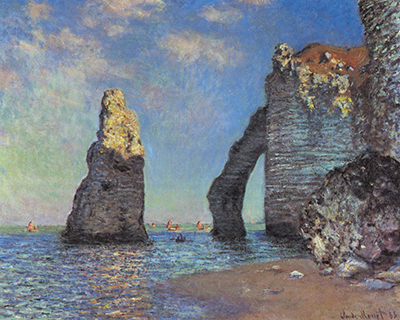
Claude Monet painted The Cliffs at Etretat in 1885. [1] Its great rock needle and arch dominate a small, intensely varied stretch of sea and shore.
At a Glance
- Artist Claude Monet
- Date 1885
- Medium Oil on canvas
- Dimensions 65.1 x 81.3 cm
- Collection Clark Art Institute, Williamstown
- Accession 1955.528
- Catalogue Wildenstein 1034. [1]
Rock, arch and open water
The needle stands to the left of the main cliff, separated from it by a narrow interval of sky and sea. It rises almost vertically, while the larger formation stretches across the right side of the picture. An opening beneath that mass allows a second glimpse of the water beyond.
These gaps are as important as the stone. The space beside the needle gives its height a clear edge; the arch interrupts the heavier cliff and makes its thickness easier to imagine. At the far right, a much nearer rock is cut by the frame, bringing the setting abruptly towards the spectator.
The beach is only a narrow wedge along the bottom. Monet gives far more room to the formations above it, so the shore does not become a comfortable platform from which to survey a distant view. The spectator seems close to the base of something considerably larger.
Small reddish sails appear against the blue-green water. Their minute scale makes the surrounding formations look still more substantial. Yet they do not become the main subject: the eye repeatedly returns to the needle, the dark arch and the irregular boundary where the cliff meets the sea.
A particular view of Etretat
Etretat's celebrated formations include the Porte d'Amont, Porte d'Aval and Manneporte. They are distinct landmarks, not interchangeable names for one arch. The Stadel Museum's coastal study places Monet within a long history of artists and travellers drawn to this shoreline. [4]
Here the Porte d'Aval and the detached needle make a powerful pair. It is worth following their outlines before considering their colour. The needle tapers unevenly; the larger cliff rises in steps and ledges; the arch opens beneath a sloping mass rather than forming a perfectly regular doorway.
The site was not an unknown wilderness discovered by Monet. Nineteenth-century visitors had already made Etretat a destination, while earlier painters helped establish its cliffs as recognisable subjects. [4] That history makes his selection of the view more interesting: a familiar place still offered new pictorial possibilities.
The village itself is absent from this composition. There are no streets, hotels or rows of spectators to compete with the rocks. This exclusion should not be mistaken for evidence that such things did not exist. It is a choice about what the painting makes visible, concentrating attention on the relation between stone, water and light.
Morning light rather than sunset
The Clark catalogue interprets the scene as early morning: the rising sun catches the needle's tip while much of the rock and beach remains shaded. It does not establish an exact painting date. [1]
That reading explains one of the picture's strongest contrasts. Gold-coloured light occupies a comparatively small area near the top, while cooler greys, mauves and greens spread below it. The bright tip is not simply decoration placed on a dark pillar. It makes the difference between exposed and sheltered surfaces immediately apparent.
The same structure appears across the cliff. Some ledges catch light while recessed areas remain subdued. Colour therefore helps describe a complicated surface without requiring every geological layer to be outlined separately.
The water responds differently. It is broken into short marks that seem to shift and overlap, particularly where pale touches interrupt darker blue and green passages. The rock suggests endurance; the sea suggests continuing movement. Light links them, but does not make them behave alike.
Sunshine, tides and the working day
A November 1885 letter presented by Seattle Art Museum describes Monet taking advantage of sunshine and a tide suitable for several motifs. He also watched changes in the moon and barometer. [2]
This is practical evidence about his work, rather than a romantic image of an artist painting whenever inspiration arrived. A coastal subject could depend on more than clear weather. The height of the water altered the visible shore, while changing light affected which parts of a formation stood out.
The letter's reference to several motifs is especially useful. It suggests a working day organised around more than one possible picture. Suitable conditions could return for one subject while becoming less useful for another. A canvas was therefore part of a larger activity of watching, returning and making choices.
The museum associates that letter with this painting in its interpretation, but the association does not prove that every brushstroke was applied on the letter's date. [2] The distinction leaves room for the picture's carefully organised appearance without turning it into a record of a single, precisely timed performance.
Courbet and an established coastal subject
Gustave Courbet had painted the Porte d'Aval in 1869. The Norton Simon Museum's account of its Courbet canvas connects Etretat's growing popularity with railway travel and notes the artist's extended stay there that autumn. It also describes his use of both brush and palette knife. [5]
This earlier painting offers a valuable comparison, not a formula for explaining Monet. Both artists could find weight and roughness in the cliffs, but a shared landmark does not make their choices of viewpoint, colour or handling identical. Nor does it establish that one particular Courbet canvas supplied Monet's entire composition.
The comparison also challenges the assumption that Impressionist coastal painting began with the sudden discovery of an untouched natural subject. The place already had an artistic history. Monet's achievement lay in making a distinctive painting within that history, not in being the first person to notice the arch. [4] [5]
In the Clark picture, the warm tip of the needle, the cool shaded rock and the restless water create contrasts that remain compelling even without a story about artistic rivalry. Looking closely at those differences is more rewarding than treating the work as an illustration of a simple succession from one famous painter to another.
A varied painted surface
The Clark's technical report identifies coarse linen, a pale grey ground and scumbled strokes applied wet into wet. Its findings distinguish physical evidence from guesses based only on a reproduction. [1]
Even at a reduced scale, the surface does not appear uniform. The sky is comparatively open and light; the rock is crowded with broken touches; the water is crossed by brighter interruptions. These differences allow the same paint medium to suggest air, solid mass and a moving surface.
The picture was included in Seattle Art Museum's 2021 Monet at Etretat exhibition, which considered his changing viewpoints and the pressures of coastal work. The exhibition also explained how poor weather could lead him to paint fishing boats from indoors. [3] The larger campaign thus contained different solutions, not one unvarying outdoor procedure.
This canvas rewards comparison with Monet's other Etretat paintings , but its particular balance should remain clear: a detached pillar, a massive arch, a close foreground rock and a narrow opening towards the horizon.
From private collection to the Clark
The painting passed from Monet to James F. Sutton at an unknown date. Robert Sterling Clark acquired it through Durand-Ruel in 1933; it entered the Institute in 1955. These are separate ownership events. [1]
Its appeal is not confined to the fame of the coastline. The picture makes a comparatively small area of the shore feel spatially complex: solid forms overlap, openings reveal further distances, and tiny boats interrupt the broad water. Light then changes the apparent character of those forms without dissolving their structure.
Within Monet's Normandy landscapes , it is a particularly concentrated meeting of monumental scale and fleeting appearance. The rocks give the view its enduring shape, while the touches of gold, blue and mauve make that shape belong to a specific, passing condition of light.
Frequently Asked Questions
The Porte d'Aval and the detached rock needle at Etretat. [4]
The Clark catalogue reads the light as early morning, not sunset. [1]
Clark Art Institute, accession 1955.528. [1]
Yes, in Monet at Etretat, held July-October 2021. [3]
Discussion
Look again at the images and ideas explored in The Cliffs at Etretat. These editorial prompts invite your observations.
Reader Insights
Which opening most strongly conveys the depth of the scene?
How does the small patch of sunlight change the needle's appearance?
What differences do you notice between the marks used for rock and water?
Join the Conversation
Share a detail, comparison or question about The Cliffs at Etretat below.
References
- Clark Art Institute , Cliffs at Etretat, 1955.528: Richard Kendall's entry and Sandra L. Webber's technical report in Nineteenth-Century European Paintings, 2012, pp. 529-533. View source .
- Lily Hansen , Monet's Letters: The Cliffs at Etretat, Seattle Art Museum, 2021. View source .
- Seattle Art Museum , Monet at Etretat, exhibition held July-October 2021. View source .
- Stadel Museum , Monet's Coast: The Discovery of Etretat, institutional Digitorial, 2026. View source .
- Norton Simon Museum , Gustave Courbet, Cliff at Etretat, the Porte d'Aval, 1869. View source .







