


 by
Tom Gurney
Tom Gurney BSc (Hons) is an art history expert with over 20 years experience
Published on October 6, 2016 / Updated on October 23, 2026
Email:
tomgurney1@gmail.com
/ Phone:
+44 7429 011000
Rough Sea at Etretat
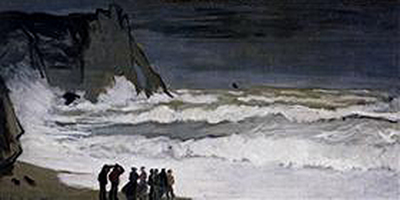
A small group stands at the edge of the beach while white water sweeps across almost the whole width of Claude Monet's Rough Sea at Etretat . The cliff rises on the left beneath a darkened sky, but it is the moving sea that dominates. Known in French as Grosse mer a Etretat , the painting dates from 1868-1869 and belongs to the Musee d'Orsay, Paris. Its broad canvas and foreground spectators distinguish it from Monet's later rough-sea views of the same coast. [1] [2]
At a Glance
The sea takes possession of the canvas
The painting is almost twice as wide as it is high. This allows the waves to extend in long, uneven bands from the foot of the cliff towards the right edge. Some break into bright foam, while others appear as darker ridges waiting behind them. They do not form a regular pattern. A swell rises, fragments and is overtaken by another, making the surface seem continuously unsettled.
The broad white area near the beach can initially look like one unbroken shape. Closer attention reveals changes of direction within it: curling crests, scattered strokes and darker hollows. The surf is both a mass and a succession of smaller events. That balance prevents the picture from becoming a diagram of separate waves.
Monet gives the sea much more room than the dry shore. The beach narrows beneath the spectators, while water occupies the middle and reaches towards the foreground. Even without knowing the place, the viewer can feel the pressure of an unstable expanse against a relatively small area of firm ground.
People watching from the shore
The foreground group supplies the picture's most concentrated human presence. Dark clothes distinguish the figures from the pale surf, and a red garment introduces a small but emphatic colour accent. One figure raises an arm towards the head. The gesture directs attention outwards while leaving its precise meaning open.
These people are not portraits identified by name. Their importance lies in the relationship they establish between ordinary human scale and the much larger movement of the sea. The French national collection record includes fishing people, women and observation among the painting's subjects, but the visible scene does not establish a particular rescue or named disaster. [5]
The group also gives the viewer a position. We seem to stand behind or beside people who are already looking, rather than arriving at an empty panorama. Their attention becomes part of the subject. The painting offers both the spectacle of rough water and the experience of pausing on shore to watch it.
Porte d'Aval in a different mood
Wildenstein identifies the background formation as the Porte d'Aval. Its profile gives the storm scene a recognisable setting, rather than leaving it as an anonymous study of waves. The cliff extends from the left and drops towards the water, its heavier, relatively stable form balancing the broken movement below. [2]
The sea is not simply laid in front of the rock. White water climbs against its base and spray interrupts the meeting of stone and surf. The cliff's vertical and sloping edges gather the strongest movements of the waves into one part of the canvas before the eye travels out across the open water.
Monet had already painted the Porte d'Aval in 1864 . That smaller work gives more space to the beach and its wooden equipment. Here the headland is pushed to the side, and the larger, wider format lets rough water become the dominant presence. The familiar landmark supports a different pictorial problem.
Colour without a bright seaside palette
The scene does not depend on the blue sky or sparkling sunshine often associated with Monet. Grey-green and brownish passages in the water sit beneath a darker sky, while the foam supplies the most insistent light. The cliff has enough warmth to separate it from the surrounding air without becoming a brilliantly coloured feature.
This restrained range makes differences of value especially important. The figures form a dark cluster against the surf; the crest of a wave catches the light before falling into a shadowed trough. Near the horizon, the divisions become less emphatic. Distance emerges through the strength and size of the marks as well as through the placement of forms.
The sky remains comparatively broad and subdued, with horizontal cloud passages that echo the sea's direction. Its stiller handling makes the lower movement feel more forceful. Water and air belong to the same weather, but they are not described with identical rhythms.
The winter of 1868-1869
The catalogue raisonne places the painting in the winter of 1868-1869. Lyon's institutional account of Monet's coastal work explains that he rented a house at Etretat with his family during that winter. His work there was not confined to seascapes: he also undertook the ambitious interior The Luncheon . [2] [3]
That context makes it misleading to imagine the visit as a fully organised series of storm paintings. Monet was pursuing different subjects and formats at a time when his career was still developing. The coast provided an environment for both family life and artistic experimentation, rather than one narrowly defined project.
The dating also places this canvas before the Impressionist group's first exhibition in 1874. Its place in Monet's biography is therefore an early one, even though its storm, broken water and interest in observation connect naturally with concerns that continued throughout his later work.
A related pastel, not an identical image
Wildenstein notes a pastel of the same site without the foreground figures. Artcurial's catalogue for La mer dechainee a Etretat , dated about 1868, identifies that work as pastel P20 and relates it specifically to Orsay's oil. Its measurements, 21 by 40 centimetres, make it much smaller than the canvas. [2] [4]
The auction catalogue proposes that the pastel preceded the painting. That is an interpretation of their relationship, not a securely dated account of every stage of production. What the comparison establishes more clearly is that Monet treated the motif in different media and altered the human presence. [4]
The addition of spectators changes more than the foreground's appearance. In the oil, a group responds to the scene and gives its scale a human measure. The water can be read through their act of watching. Removing the figures would shift attention towards the encounter of cliff, sea and air alone.
Not the Lyon rough-sea painting of 1883
Another Monet canvas commonly translated as Rough Sea at Etretat belongs to the Musee des Beaux-Arts in Lyon. That work dates from 1883, measures 81.4 by 100.4 centimetres and carries inventory number B 647. Lyon describes a view made from a hotel window, with two fishermen and three caloges, or repurposed boats used as shelters, on the beach. Those details belong to the later painting. [6]
The difference is useful because a repeated English title can hide a change of more than a decade. Orsay's long canvas, gathered spectators and cliff at the left are its own combination. Lyon's viewpoint and beach structures organise another encounter with similar weather. Neither work needs to be treated as a substitute for the other.
Together they show how Etretat remained a place of return. The continuity was geographical; the resulting paintings varied in scale, framing, human presence and treatment of the sea.
From private collections to Orsay
The documented ownership runs through the Marsigny collection, the dealer Durand-Ruel and Denys Cochin before Etienne Moreau-Nelaton acquired the painting in 1900. His donation to the French state in 1906 brought it into the national collections. Orsay records its later passage through the Musee des Arts decoratifs, the Louvre and the Jeu de Paume before its allocation to Orsay in 1986. [1] [2]
Moreau-Nelaton was himself an artist and art historian as well as a collector. Orsay's account of his donations places the Impressionist works within a broader interest in nineteenth-century painting, including Romantic and Barbizon artists. The storm canvas entered a collection shaped by that larger historical perspective, not simply a gathering of Monet's work. [7]
Today the painting's force remains in its compact opposition of watching people and restless water. The figures do not tame the scene, and the sea does not erase them. Monet keeps both in view, making a particular stretch of the Normandy coast the setting for an unusually direct encounter between human attention and natural movement.
Frequently Asked Questions
It belongs to the Musee d'Orsay, Paris, inventory RF 1678. [1]
No. Lyon holds a different rough-sea view from 1883, B 647. [6]
Discussion
Look again at the images and ideas explored in Rough Sea at Etretat. These editorial prompts invite your observations.
Reader Insights
How does the foreground group affect your sense of the sea's scale?
Follow the changing shapes within the large area of white surf.
Compare this wide composition with Monet's smaller 1864 Porte d'Aval.
Join the Conversation
Share a detail, comparison or question about Rough Sea at Etretat below.
References
- Musee d'Orsay , Grosse mer a Etretat, 1868-1869, RF 1678; exact object record, dimensions and collection history. View source .
- Daniel Wildenstein / Wildenstein Plattner Institute , Monet, volume II, 1996, entry 127; winter dating, Porte d'Aval identification, related pastel and provenance. View source .
- Musee des Beaux-Arts de Lyon , Claude Monet: The Pursuit of a Motif; winter 1868-1869 context and distinct later campaigns. View source .
- Artcurial , La mer dechainee a Etretat, circa 1868, lot 38; primary catalogue for the related pastel P20 and its proposed relationship to the oil. View source .
- French Ministry of Culture, POP/Joconde , Grosse mer a Etretat, notice 000PE003961; object and subject controls. View source .
- Musee des Beaux-Arts de Lyon , Etretat, mer agitee, 1883, B 647; a separate work with a different viewpoint and foreground. View source .
- Musee d'Orsay , From Corot to the Impressionists: A Homage to Etienne Moreau-Nelaton; institutional history of the collector and donations. View source .







