


 by
Tom Gurney
Tom Gurney BSc (Hons) is an art history expert with over 20 years experience
Published on October 6, 2016 / Updated on October 23, 2026
Email:
tomgurney1@gmail.com
/ Phone:
+44 7429 011000
Etretat: Porte d'Aval
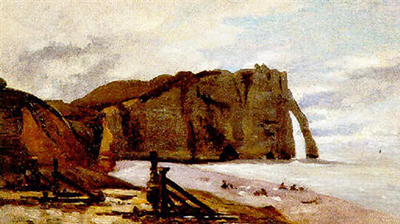
Claude Monet's Etretat: Porte d'Aval presents the famous rock arch as a dark, substantial mass above a pale sea. Wooden equipment interrupts the beach in the foreground, while the opening at the cliff's far end lets a narrow slice of light through the stone. Painted in 1864, this small oil belongs to Monet's early coastal work. The Stadel Museum identifies it with the collection of the Musee Mer Marine in Bordeaux; Wildenstein's catalogue records it as number 22b. [1] [2]
At a Glance
The cliff as a continuous wall
The rock occupies much of the middle of the painting. Its uneven upper edge crosses the sky in a succession of slopes and projections before dropping towards the sea on the right. Dark passages break up its surface, but its outline remains strongly legible. The arch is not isolated as a picturesque emblem. It belongs to a long wall whose weight is felt across the composition.
The opening is especially effective because it reverses the surrounding values. A pale, narrow shape appears within the dark rock, making absence as important as substance. It draws the eye towards the outer end of the formation without requiring a bright colour accent. The sea beyond seems continuous with the water in front, even though the stone briefly divides them.
At the left, the nearer slope and the cliff beyond overlap. Their similar dark tones can initially make them seem part of one compressed shape. Looking longer separates their directions and distances. Monet builds depth through these overlaps rather than providing a neatly receding sequence of equally distinct planes.
A working beach in the foreground
The beach enters diagonally from the lower edge and curves towards the foot of the cliff. Its warm, earthy tones set it apart from the cooler sea, although both remain subdued. The strip of breaking water follows the same curve, pulling the foreground into the middle distance and giving the scene a gentle but persistent movement.
The wooden structures nearest the viewer create a different rhythm. Uprights and sloping beams cut across the shore with abrupt, angular shapes. They make the beach feel used rather than untouched. Their exact mechanical details are less clear than their visual role: these are heavy objects between the spectator and the expanse of water, not decorative accessories placed at the horizon.
The foreground therefore changes how the landmark is encountered. Instead of looking at the cliff from an abstract, unobstructed vantage point, the viewer looks past the material signs of coastal work. The arch remains spectacular, but it shares the scene with a beach whose practical character has not been tidied away.
Muted colour and the small format
The Stadel describes the work as a study from Monet's first stay at Etretat in the summer of 1864. Its interpretation emphasises the muted palette and the clearly contoured areas used to describe the rock, in contrast to the more conspicuous colour contrasts and separate touches associated with his later Impressionist painting. [1]
That distinction is visible without treating the canvas as merely an unsuccessful version of a later style. Brown, grey and near-black passages allow the cliff to retain weight. The pale sky is varied rather than empty, while the surf provides a lighter boundary along the beach. A limited range can still establish several different surfaces and distances.
At only 28 by 49 centimetres, the painting brings an imposing subject into an intimate horizontal format. The broad width accommodates the cliff and shore together; the restricted height keeps the rock closely related to the bands of sky and water. Its scale encourages attention to the organisation of a compact scene rather than to an overwhelming painted spectacle. [1] [2]
Which Etretat arch is this?
Porte d'Aval is at the south-western end of Etretat's beach. Porte d'Amont lies at the other end, and the Manneporte is another distinct formation. Similar titles can obscure these differences, particularly when the same artist returned repeatedly to the coast. The Stadel's identification of the 1864 study and the Metropolitan Museum's account of the later coastal campaign keep the separate landmarks clear. [1] [4]
The distinction matters to the picture's composition. Here the arch is attached to the right-hand end of a broad, continuous cliff face. It is not the same view as the Met's The Manneporte , painted in 1883, where the great opening and its surrounding stone dominate a differently organised canvas. Shared geography does not make the paintings interchangeable. [4]
Nor should the title imply that this is Monet's only Porte d'Aval. The place supplied subjects across different visits, viewpoints and media. This particular canvas is identified by the combination of its 1864 date, small dimensions, composition and catalogue number, rather than the landmark's name alone. [1] [2]
A coast revisited over two decades
Monet had grown up in nearby Le Havre, and the Normandy coast was a familiar region rather than a distant discovery. The National Galleries of Scotland relates his knowledge of Etretat to that upbringing. Familiarity did not produce one unchanging pictorial solution, however. His later returns opened up different ways of making the same formations visible. [5]
The Stadel records at least six stays between 1864 and 1886. It distinguishes the early visits from the concentrated work of the 1880s, when Monet investigated changing weather and light through several canvases. That longer history gives the small 1864 picture a place within an extended engagement, but it does not turn it into part of a single, preplanned series lasting twenty years. [3]
A separate example from the next decade of his career is the Musee d'Orsay's Grosse mer a Etretat , dated 1868-1869. Its much wider canvas, 66.2 by 130.5 centimetres, addresses rough sea in another format. These differences of date, scale and subject help explain why the early Porte d'Aval deserves to be considered individually. [6]
From this oil to the later pastel
The National Galleries of Scotland holds Etretat, the Needle Rock and Porte d'Aval, the Cap d'Antifer , a pastel on paper dated about 1885. Its vertical format and high viewpoint differ markedly from the low, horizontal arrangement of the 1864 oil. The museum describes restrained blue, cream and brown tones in that later work. [5]
The comparison shows why development cannot be reduced to a simple movement from muted colour towards brightness. Restraint could serve Monet at different points in his career, but the arrangement of the landscape changed. In the early oil, the beach and its equipment establish the viewer's proximity to the shore. In the pastel, the elevated view reorganises the cliff and sea into another relationship.
Medium matters too. A pastel on paper and an oil on canvas are separate objects with different dimensions and histories, even when titles overlap. The later work is a useful comparison, not an alternative date or collection for this painting. [1] [5]
The catalogue record and collection history
Wildenstein's 1996 catalogue lists the painting under the French title Etretat, porte et falaise d'Aval . Entry 22b gives the 1864 date and dimensions of 28 by 49 centimetres. Its recorded ownership includes Baron Denys Cochin in Paris, a Belgian private collection in 1989, a Christie's sale in London in June 1994 and a Drouot sale in Paris in June 1995. [2]
These are documented points in the object's history, not a claim that every transfer is known. The later Stadel collection credit places the painting with the Musee Mer Marine in Bordeaux, whereas the older catalogue necessarily records an earlier stage of ownership. The records answer different historical questions rather than requiring one to be silently substituted for the other. [1] [2]
The canvas remains a distinctive early encounter with Etretat: a solid rock wall, an irregular working shore and a narrow opening of light. The broader Normandy paintings trace Monet's changing coastal subjects, while his Etretat works show how differently he could frame a familiar place. This small painting gives that later history an important early point of comparison.
Frequently Asked Questions
The Stadel Museum credits the collection of the Musee Mer Marine, Bordeaux. This does not establish whether it is currently on display. [1]
No. The Scottish work is a pastel on paper dated about 1885, not this 1864 oil. [5]
Discussion
Look again at the images and ideas explored in Etretat: Porte d'Aval. These editorial prompts invite your observations.
Reader Insights
Follow the pale opening of the arch against the darker cliff.
How do the wooden foreground structures change the view of the landmark?
Compare the horizontal shore-level composition with Monet's later elevated views.
Join the Conversation
Share a detail, comparison or question about Etretat: Porte d'Aval below.
References
- Stadel Museum , Monet on the Normandy Coast, digital story; exact 1864 Porte d'Aval, collection credit, dimensions and early-style interpretation. View source .
- Daniel Wildenstein / Wildenstein Plattner Institute , Monet, volume II, 1996, entry 22b, printed pages 16-17, viewer pages 20-21; identity and historical provenance. View source .
- Stadel Museum , Monet on the Normandy Coast, institutional exhibition research; visits and later coastal campaigns. View source .
- The Metropolitan Museum of Art , The Manneporte (Etretat), 1883, 51.30.5; a distinct arch and later canvas. View source .
- National Galleries of Scotland , Etretat, the Needle Rock and Porte d'Aval, the Cap d'Antifer, about 1885, D 5672; separate pastel comparison. View source .
- Musee d'Orsay , Grosse mer a Etretat, 1868-1869, RF 1678; separate early coastal painting. View source .







