


 by
Tom Gurney
Tom Gurney BSc (Hons) is an art history expert with over 20 years experience
Published on October 6, 2016 / Updated on October 23, 2026
Email:
tomgurney1@gmail.com
/ Phone:
+44 7429 011000
The Pink Skiff
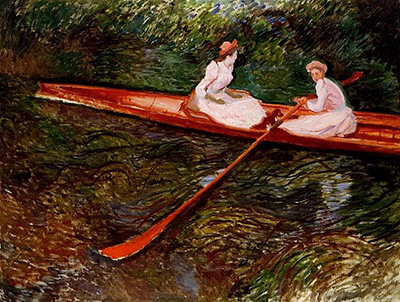
The Pink Skiff is Claude Monet's 1890 painting of two women in a narrow boat on the River Epte near Giverny. Now in the Pola Museum of Art, it contrasts pale clothing and warm-coloured wood with a dark, intricately moving field of water and submerged vegetation. The figures are prominent, but the river occupies much of the canvas and makes an equally demanding subject. [1]
At a Glance
A boat crossing the composition
The skiff runs across the upper part of the image, its long side forming a clear boundary between the figures and the water. Its warm reddish-pink and orange passages stand out against the surrounding greens and browns. The boat continues beyond the right edge, so it feels larger than the portion Monet has allowed us to see.
A long oar establishes a second, more forceful direction. It projects towards the lower left, with a broad blade that nearly reaches the edge of the canvas. This diagonal draws the foreground into the same action as the boat, preventing the large area of water from becoming an inactive setting.
The women's white dresses provide another contrast. Their pale folds form relatively compact, readable shapes amid the darker patterning. Hats and faces are indicated with small touches rather than elaborately finished portrait detail.
The composition therefore depends on several different kinds of mark and shape. The boat is long and comparatively firm; the clothing gathers into angular folds; the oar cuts diagonally through the scene; the water is woven from restless, irregular strokes. These elements share one space without losing their different visual characters.
Suzanne, Blanche and the family setting
The Pola Museum identifies the women as probably Suzanne and Blanche Hoschede, daughters of Alice Hoschede, who later married Monet. The catalogue raisonne also names the sisters and specifies Blanche as the figure holding the oars, drawing on a note by their brother Jean-Pierre. [1] [3]
This family connection gives the scene a more particular setting than an anonymous image of fashionable leisure. The women belonged to Monet's household circle and appeared in other paintings of the area. Yet the picture does not require a story about what they were discussing or how they felt.
The woman at the left turns across the boat, while the rower occupies the right. Their positions help establish the length of the vessel and the distance between its seats. They also create a pause between the strong line of the gunwale and the expansive diagonal of the oar.
Neither figure is isolated from the environment in the manner of a formal portrait sitter. Their light dresses are essential colour accents within a broader river composition. The interest lies partly in that balance: identifiable people are present, but the water refuses to remain a subordinate background.
Painting beneath the surface
The lower part of the painting is filled with long, interlacing strokes. Dark green and brown forms bend through the water, while lighter marks interrupt them. Some passages suggest submerged plants; others register light and movement at the surface.
These layers of seeing are difficult to separate. A reflection appears on the water, a plant grows below it, and an oar enters from above. Monet places all three in close contact, giving the river a depth that is not measured by a distant bank or a conventional horizon.
The catalogue connects this group of works with Monet's June 1890 letter to Gustave Geffroy about the difficulty of painting water together with the grass moving beneath it. The letter is useful evidence of the problem that absorbed him, although it should not be treated as a precise caption written only for this one canvas. [3] [4]
The dense marks can produce an unsettled effect, especially beside the pale figures. That response need not become an invented tale of danger. No emergency is shown. The tension is visual: the boat remains sharply intelligible, while the water below it is harder to organise into separate, stable forms.
A high viewpoint and Japanese comparisons
Monet looks down into the scene. Very little of the far bank is included, and there is no open sky to relieve the dark water. The boat is pushed towards an edge, while the extended oar seems to reach towards the spectator's space.
The Pola Museum relates the high viewpoint, cropped boat and exaggerated oar to Japanese ukiyo-e prints. This is a comparison of pictorial strategies, not proof that Monet copied one particular print. [1]
The distinction matters because the painting's structure can be understood directly. Cropping prevents the skiff from appearing as a complete object displayed at a distance. The elevated viewpoint exposes a large surface of water. The oar joins the near and farther parts of the canvas. Together, these choices make the viewer feel close to the action without supplying a conventional place to stand.
The pale figures and warm wood remain legible within this compressed space. Their clarity helps orient the eye while the river's interwoven marks complicate it. The result is neither an exact topographical survey nor an arbitrary arrangement of colour, but a carefully selected view with an unusually physical sense of proximity.
A study and a related canvas
Wildenstein's catalogue describes The Pink Skiff as a study for Boating on the River Epte, W1250, now in the Museu de Arte de Sao Paulo. It also records the vessel as a mahogany skiff, following Jean-Pierre Hoschede's account. [3]
The Sao Paulo work is a separate, more nearly square canvas. Its museum likewise emphasises Monet's attention to the water's depth and to the boat cut by the edge of the image. [4] The relationship provides a useful way to understand the Pola painting without confusing the two objects.
Calling it a study does not make it a tiny preliminary sketch. At more than a metre high and substantially wider, The Pink Skiff gives the figures, vessel and watery foreground considerable scale. Its broad format also changes the balance between the long boat and the space through which the oar projects.
The 2013 joint exhibition organised by the Pola Museum and the National Museum of Western Art compared these boating subjects with Monet's other late-1880s figure pictures. Its discussion stressed the integration of figures and setting, rather than treating the women as portraits placed in front of a landscape. [5]
The Epte and the later water garden
The setting belongs to Monet's boating pictures around Giverny , not to the mature water-lily pond familiar from his later paintings. His purchase of the land associated with the water garden came in 1893, after this canvas was painted. [6]
The connection with the later work is therefore an artistic question rather than an identity of place. Here, reflected light and submerged vegetation already complicate the water's surface. Later pond paintings would explore related difficulties while often removing the boat and its occupants altogether.
The catalogue's historical provenance traces The Pink Skiff through Rene Gimpel, subsequent private collections and dealers, and a 1994 auction. The current holding museum supplies its present collection identity. [1] [3] Those records distinguish it from the Sao Paulo canvas and from other similarly named boats.
What remains most memorable is the meeting of two visual rhythms. The long vessel and projecting oar offer clear directions, while the water flows in tangled, less predictable patterns. The women's light clothing sits between them, keeping the human scene present even as Monet makes the river itself the most absorbing problem in the picture.
Frequently Asked Questions
It belongs to the Pola Museum of Art in Hakone, accession 006-0487. [2]
They are identified as probably Suzanne and Blanche Hoschede. [1]
Discussion
Look again at the images and ideas explored in The Pink Skiff. These editorial prompts invite your observations.
Reader Insights
Does the projecting oar draw you into the image or keep you at a distance?
Which marks seem to represent the surface, and which suggest plants beneath it?
How does the wide format affect the relationship between figures and water?
Join the Conversation
Share a detail, comparison or question about The Pink Skiff below.
References
- Pola Museum of Art , The Pink Skiff, 1890. Japanese curatorial account. View source 1 . View source 2 .
- National Center for Art Research , Art Platform Japan, The Pink Skiff, museum-contributed record W34111. View source .
- Daniel Wildenstein , Monet: Catalogue raisonne, 1996, volume III, W1249-W1250, pp. 476-477, Wildenstein Plattner Institute digital edition. View source .
- Museu de Arte de Sao Paulo , A canoa sobre o Epte, circa 1890, MASP.00092. View source .
- Pola Museum of Art and National Museum of Western Art , Monet exhibition, 2013, section on the boating paintings. View source .
- The Metropolitan Museum of Art , Bridge over a Pond of Water Lilies: the creation of Monet's water garden. View source .







