


 by
Tom Gurney
Tom Gurney BSc (Hons) is an art history expert with over 20 years experience
Published on October 6, 2016 / Updated on October 23, 2026
Email:
tomgurney1@gmail.com
/ Phone:
+44 7429 011000
Sailboat
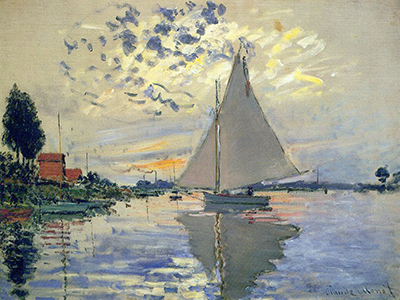
Claude Monet's Sailboat at Le Petit-Gennevilliers places a large pale sail against a bright, broken sky, with a low riverbank stretching away at the left. The painting dates to 1874 and is catalogued as Wildenstein 336. [1] Its subject is the Seine near Argenteuil, not an open-sea voyage. The boat provides a recognisable centre, but the changing relationships between sky, water and shore animate the whole view.
At a Glance
- Artist Claude Monet
- Full title Sailboat at Le Petit-Gennevilliers
- Date 1874
- Medium Oil on canvas
- Dimensions 56 x 74 cm
- Catalogue Wildenstein 336
- Collection record Lucille Ellis Simon, United States, in the 1996 catalogue; current ownership not established here. [1]
A river subject at Petit-Gennevilliers
Petit-Gennevilliers lay across the Seine from Argenteuil, where Monet lived from 1871 until 1878. [2] [4] These neighbouring banks offered different views of the same busy river. The location is important: a sailing boat here belongs to suburban life within reach of Paris, rather than to a remote coastal harbour.
The broad water at Argenteuil supported recreational sailing, boat hire and organised regattas. Christie's account of another Petit-Gennevilliers painting describes the local boating clubs and the contrast between the developed Argenteuil promenade and its quieter opposite bank. [2]
That setting helps explain why boats recur throughout Monet's Argenteuil paintings . A yacht could be a modern leisure subject, a structure of intersecting lines and a source of reflections at the same time. None of those roles requires an identifiable passenger or a dramatic event.
In this canvas, the main vessel has room around it. The nearest stretch of water remains largely open, while the low shore recedes behind the sail. The sense of spaciousness depends on that separation, not on a vast or uninhabited landscape.
The pale sail and its dark hull
The sail is the largest compact shape in the picture. Its triangular outline rises above the bank, and its right-hand edge runs down towards the small dark hull. A thin mast establishes a stronger vertical within the broad field of light.
Although the sail reads as pale fabric, it is not a blank white triangle. Grey and muted violet tones give it weight against the warmer sky. This makes its brightness relative: the sail appears luminous because of the colours placed around it, not because every part is equally light.
Below it, the hull is a narrow horizontal accent. Its dark edge stops the sail from dissolving into the reflections. Smaller marks along the boat suggest fittings or occupants, but the image does not offer a detailed portrait of a sailor.
The difference in scale is striking. A few dark strokes define the boat's practical structure, while the much larger sail becomes an almost architectural plane. It anchors the scene without closing off the view beyond it.
Reflections that do not copy exactly
Under the hull, the sail returns as an inverted, softened shape. The reflection is interrupted by horizontal strokes, so it never becomes a second solid sail hanging below the first. Its edges are more uncertain than those above the water.
The mast also continues downwards, but its reflected line is broken and displaced. This contrast lets the viewer recognise a vertical structure while also sensing the movement of the surface across it.
Towards the foreground, blue and violet patches mingle with pale yellow and cream. The water receives colours from several parts of the scene: open sky, cloud, sail and bank. Monet does not assign it one uniform blue and then add the objects on top.
At the left, the bank's dark vegetation makes a denser reflection. Nearer the middle, the intervals become brighter and more open. The differences establish the position of the shore even where no continuous contour separates land from water. This is one of the painting's clearest lessons in looking at the Seine : a reflection describes both an object and the surface that alters it.
A sky made from separate touches
Small blue-grey marks gather across the upper centre, surrounded by broad areas of pale yellow and white. Lower down, warmer streaks stretch towards the horizon. The sky has a loose pattern of its own, rather than serving simply as an empty background.
Those short marks contrast with the sail's comparatively continuous surface. Both occupy the upper half of the composition, but they invite different kinds of attention. The eye reads the sail as one object and the clouds as an accumulation of changing fragments.
The warm light can suggest a low sun, yet the image alone does not establish an exact hour or a named weather event. Its strongest evidence is visual: warmth near the horizon, cooler patches above, and a related mixture on the river below.
The tree and red-roofed building at the left supply another contrast. Their darker, more compact forms hold the edge of the scene while the sky and water remain relatively expansive. The small roof is especially effective because its warm colour has an answering note among the cooler reflections.
Related boats, different paintings
A short title such as Sailboat can obscure important distinctions. The National Gallery of Ireland owns Argenteuil Basin with a Single Sailboat, also dated 1874, but that is another composition: it measures 55 by 65 centimetres and has the inventory number NGI.852. [4]
Likewise, Les bords de la Seine au Petit-Gennevilliers, catalogued as Wildenstein 333, groups several vessels near the bank. Its documented ownership history must not be transferred to this single-sail composition. [2]
Monet's colleague Manet also painted Boating in 1874. The Met records his visits from Gennevilliers to Monet and Renoir at Argenteuil. [3] Manet's picture places two figures close to the viewer and crops the craft sharply; Monet's Sailboat keeps its principal vessel at a distance within a landscape.
The comparison reveals different choices within a shared setting. A boat can frame a social encounter, as in Manet's work, or organise a view of light and distance. The Monet and Manet relationship is more useful when those individual decisions remain visible than when every river subject is treated as the same experiment.
What the catalogue establishes
Wildenstein's catalogue identifies this composition as a downstream view of the Argenteuil basin and records Monet's signature at the lower right. It lists the painting in the 1889 Monet-Rodin exhibition at Georges Petit and in a 1914 Durand-Ruel exhibition in New York. [1]
The catalogue's early provenance begins with a possible sale to Pelgrin in January 1875, explicitly marked as uncertain. Its later entries include Durand-Ruel in 1912, the London dealer Arthur Tooth and, eventually, Lucille Ellis Simon. [1] A historical collection entry is not a promise of current public display.
The painting's interest does not depend on calling it a record of one effortless instant. Its apparent ease comes from relationships that remain carefully differentiated: the sail against the clouds, the hull against its reflection, and the dark bank against the open river.
Among Monet's boating subjects , this canvas is unusually concentrated on one upright sail. Yet the surrounding water and sky prevent that sail from becoming an isolated emblem. The boat belongs to the river's light, and the light becomes visible through the boat.
Frequently Asked Questions
Sailboat at Le Petit-Gennevilliers, or Voilier au Petit-Gennevilliers, Wildenstein 336. [1]
It is dated 1874. [1]
No. The National Gallery of Ireland's NGI.852 is a separate 1874 painting. [4]
That identification is not established for the vessel shown here. Monet's use of a floating studio is general context, not proof that this sailboat was his workplace. [4]
Discussion
Look again at the images and ideas explored in Sailboat. These editorial prompts invite your observations.
Reader Insights
How does the sail differ from its reflection?
Which patches of colour connect the sky with the foreground water?
Does the boat or the river feel like the principal subject?
Join the Conversation
Share a detail, comparison or question about Sailboat below.
References
- Daniel Wildenstein , Monet catalogue raisonne, volume II, 1996, W336, printed p. 140, Wildenstein Plattner Institute. View source .
- Christie's , Les bords de la Seine au Petit-Gennevilliers, 1874, W333, primary object record and contextual essay for a different composition. View source .
- The Metropolitan Museum of Art , Edouard Manet, Boating, 1874, 29.100.115, object record and curatorial audio. View source .
- National Gallery of Ireland , Argenteuil Basin with a Single Sailboat, 1874, NGI.852, a distinct painting and Argenteuil context. View source .







