


 by
Tom Gurney
Tom Gurney BSc (Hons) is an art history expert with over 20 years experience
Published on October 6, 2016 / Updated on October 23, 2026
Email:
tomgurney1@gmail.com
/ Phone:
+44 7429 011000
Sailing Boat in Argenteuil
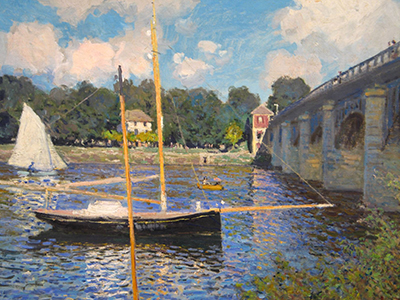
A dark-hulled sailboat sits near the foreground of Claude Monet's The Bridge at Argenteuil, painted in 1874. A second boat carries a bright white sail farther out, while the road bridge enters strongly from the right. The painting belongs to the National Gallery of Art, Washington, accession 1983.1.24. [1] Boats, architecture and reflections share the scene, making this more than an isolated study of a vessel.
At a Glance
- Artist Claude Monet
- Museum title The Bridge at Argenteuil
- Date 1874
- Medium Oil on canvas
- Dimensions 60 x 79.7 cm
- Collection National Gallery of Art, Washington; Collection of Mr. and Mrs. Paul Mellon
- Accession 1983.1.24; Wildenstein 312. [1]
Boating on the Seine at Argenteuil
Monet lived in Argenteuil from 1871 to 1878, repeatedly painting the Seine and its banks. The National Gallery of Ireland notes that he fitted out a boat as a floating studio during this period. [4] That is useful context for his interest in the river, but does not establish that every river scene was painted from aboard it.
The Washington painting brings leisure craft into the same view as an important crossing. Sailing, rowing, walking and transport belong to a shared environment. The National Gallery's educational account places Argenteuil within the changing Paris suburbs, where railway access, industry and recreation developed alongside one another. [3]
The subject is consequently modern without depending on a spectacular event. Ordinary boats and a familiar bridge provide the setting for an investigation of colour, light and the different speeds at which things seem to move.
The nearest sailboat is at rest
The dark hull near the centre-left provides a firm, low shape against the sparkling water. Its pale upper surfaces catch the light, while a tall warm-coloured mast rises towards the top of the canvas. The sails are not spread, making its quiet presence different from that of the boat under sail farther left.
Another narrow mast rises from the lower edge, but its boat is outside the frame. This is a small yet effective interruption: the scene seems to continue into the space immediately below our view. The canvas does not include every vessel in full simply to make the composition easier to read.
Together, the masts establish a series of verticals across the open water. They interrupt the long horizontal lines of the distant bank and the low shape of the foreground hull. The boats are subjects in their own right, but their lines also organise the landscape around them.
A diagonal bridge crossing a layered landscape
The bridge enters from the right at a steep diagonal, its shaded arches receding towards the opposite bank. This direction gives a sense of depth that differs from the broad horizontal expanse of river and sky.
Paul Hayes Tucker's catalogue entry identifies the viewpoint with the bank at Petit Gennevilliers, looking north towards Argenteuil. He stresses how carefully the bridge, tollhouse, masts and rigging are aligned within the composition. [2] The apparent ease of the river scene should not obscure that deliberate arrangement.
The bridge's near end is large and assertive, but it becomes narrower as it approaches the buildings. The small roof at its far end helps connect the architecture with the tree line. At the lower right, a patch of vegetation provides a softer counterweight to the crossing's geometry. The painting accommodates solid construction and irregular natural forms without making either disappear.
Reflections as broken colour
The Seine is built from numerous short touches. Blues dominate, but pale pink, yellow, green and white enter the surface as well. These interruptions prevent the river from reading as a flat area of blue paint.
The mast reflections are particularly important. Their warmer colour stretches downwards, yet the shapes break across the small horizontal marks of the water. We recognise a relation to the upright structures above without seeing a perfectly mirrored duplicate.
The bridge's shadow creates another kind of contrast. Beneath and beside the arches, cooler and darker passages gather against the brighter water farther left. The result suggests changing illumination across one connected surface.
This is central to Monet's painting of light . A reflection is not merely the colour of an object repeated below it. It is altered by the water's movement, the angle of view and the surrounding passages of paint. Those differences help make the river feel active even beside a stationary boat.
The scale of people and the scale of marks
Small figures are visible on the bridge, and a lightly suggested rowing boat occupies the water beyond the foreground vessel. They establish human activity without becoming detailed portraits. Faces and individual expressions are not necessary for the scene to convey a place used by people.
The handling varies with the subject. Fine lines serve the masts and rigging; shorter touches animate the water; fuller patches create the distant foliage. A broad cloud can remain relatively open while the river beneath it is densely broken.
The painting therefore does not use one identical brushstroke for everything. Its technique depends on variation. Looking closely reveals separate marks, while a more distant view brings them together as boats, trees and reflections. The two experiences reinforce one another: the scene remains recognisable without concealing all evidence of its construction in paint.
Two bridge paintings are not one object
The Musee d'Orsay holds a different Bridge at Argenteuil , also dated 1874, inventoryRF 193741. Its foreground includes a different grouping of moored boats. The museum distinguishes the road-bridge subject from Monet's separate views of the railway bridge upstream. [5]
The Washington canvas is Wildenstein 312, whereas the Orsay work is 311. Similar dimensions, date and titles make this distinction worth preserving. Their separate arrangements allow us to compare how Monet could reconsider the same crossing rather than assume that every reproduction shows the same painting.
Another useful comparison is the National Gallery of Ireland's Argenteuil Basin with a Single Sailboat, also from 1874. Its autumn setting and more extensive emphasis on sky and reflections belong to that separate work. [4] It shares a river culture with this scene, not an identical composition or collection history.
A painting of leisure and a built environment
The National Gallery's teaching account emphasises that the surrounding communities were being transformed by transport, recreation and industry. [3] The bridge in this painting is part of that inhabited landscape, not an accidental obstacle that Monet needed to hide to produce a pleasing view.
At the same time, the picture is not a comprehensive report on the town. Its trees, sunlit buildings and boating activity present a selected relationship between modern life and the river. We should not expect every feature of Argenteuil's economy to appear within one frame.
The museum records the canvas passing through the collections of Henri Vever and the vicomte de Curel before Paul Mellon acquired it in 1961; it entered the National Gallery as a gift in 1983. [1] Its enduring interest lies in the precision of the encounter it constructs: a quiet boat, a moving river and a bridge tying the near bank to the town beyond.
Frequently Asked Questions
The National Gallery of Art calls it The Bridge at Argenteuil, 1874, accession 1983.1.24. [1]
It depicts the road bridge, discussed as the highway bridge in Tucker's catalogue. [2]
Discussion
Look again at the images and ideas explored in Sailing Boat in Argenteuil. These editorial prompts invite your observations.
Reader Insights
How do the upright masts balance the diagonal bridge?
Which marks make the water look different from the trees?
Does the moored boat make the river seem more active or more tranquil?
Join the Conversation
Share a detail, comparison or question about Sailing Boat in Argenteuil below.
References
- National Gallery of Art , The Bridge at Argenteuil, 1874, 1983.1.24, object record and provenance. View source .
- Paul Hayes Tucker , The Impressionists at Argenteuil, National Gallery of Art, 2000, catalogue 28, printed page 114, The Highway Bridge and Boat Basin. View source .
- National Gallery of Art , Landscape Paintings, teaching packet, page 15, The Bridge at Argenteuil and suburban context. View source .
- National Gallery of Ireland , Argenteuil Basin with a Single Sailboat, 1874, NGI.852, separate painting and river context. View source .
- Musee d'Orsay , Le Pont d'Argenteuil, 1874,RF 193741, separate painting. View source .







