


 by
Tom Gurney
Tom Gurney BSc (Hons) is an art history expert with over 20 years experience
Published on October 6, 2016 / Updated on October 23, 2026
Email:
tomgurney1@gmail.com
/ Phone:
+44 7429 011000
The Bridge at Argenteuil
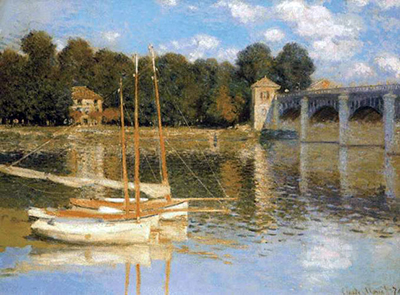
Claude Monet's The Bridge at Argenteuil brings pleasure boats, a road bridge and reflected light together in a compact view of the Seine. Painted in 1874, the canvas now belongs to the Musee d'Orsay. Its peaceful appearance does not place it outside modern life: the river was a space of recreation, transport and changing infrastructure. [1] [2]
At a Glance
Boats before the bridge
The foreground is occupied by a cluster of moored sailing boats. Their pale hulls sit low on the water, while slender, warm-coloured masts rise against the darker trees beyond. With the sails lowered, the rigging becomes particularly clear: vertical poles, short angled spars and fine lines establish a delicate framework above the broad hulls.
The bridge enters from the right and extends towards a small building on the far bank. It is not placed squarely across the whole picture. Its oblique direction leads the eye inward, while the boats hold attention nearer the front. Between these two groups, a generous expanse of water remains visible.
The arrangement is balanced without being symmetrical. The long bridge has visual weight, but the upward reach of the masts answers it. Trees form a darker band behind both, interrupted by light-coloured buildings whose roofs introduce warmer notes.
These relationships are what make the scene more than a record of separate objects. Boat, bridge, bank and reflection are fitted into one structure. The architecture gives direction and stability, while the water continually softens the divisions between them.
The river as a field of reflections
The lowest part of the river is relatively open and pale. Long reflections descend from the masts, carrying their ochre colour almost to the bottom edge. Around the boats, white and yellow touches suggest light catching the hulls and the surrounding water.
Farther back, the reflections become more densely broken. The bank's dark trees spread into green and brown patches, while the bridge supports continue downward as interrupted vertical bands. Small horizontal marks cross these reflected forms, making the surface appear mobile even where the larger colour shapes remain readable.
This is not a mirror image mechanically repeated beneath each object. Water changes the apparent shape and continuity of what it reflects. Monet gives enough information to connect the broken marks with the structures above, then allows them to take on a rhythm of their own.
The Orsay's curatorial account draws attention to the contrast between the firmer handling of solid objects and the different treatment of water and reflections. [1] The painting's coherence depends on that variation. If every part had equally hard outlines, the river would lose its fluid character; if every form dissolved, the bridge and boats would lose their distinct presence.
A modern crossing after the war
The subject is the road bridge, not the separate railway crossing that Monet also painted at Argenteuil. The catalogue identifies the viewpoint as the Petit-Gennevilliers bank, looking across towards the town. [7]
The bridge had a recent history of disruption. Paul Hayes Tucker's study of the area explains that spans of the road crossing were destroyed during the Franco-Prussian War. A temporary structure was built to maintain traffic and toll income while the main bridge was repaired; the permanent repairs were completed in 1872. [3]
By the time of this 1874 view, the crossing could again be shown as an orderly part of the riverside. Its regular arches and supports sit comfortably beside trees and boats, but the structure was a working connection between communities, not merely a picturesque feature.
Knowing that history changes the apparent timelessness of the scene. The calm river and settled boats coexist with recently rebuilt infrastructure. Monet need not include an explicit narrative of destruction or recovery for the painting to remain a view of a place shaped by contemporary events.
Argenteuil and the pleasures of the Seine
Monet lived at Argenteuil from 1871 to 1878. The National Gallery of Ireland's account of his work there describes his sustained attention to the Seine and its banks, including the use of a floating studio. That does not establish that this particular canvas was painted from the boat, but it indicates how closely the river entered his daily artistic activity. [4]
Leisure and practical activity were intertwined along these banks. A bridge carried people across the river; nearby boats offered another way of using the same water. In this composition, the vessels are at rest rather than competing in a race, allowing their shapes and reflections to assume more importance than an episode of human action.
The scene therefore avoids the crowded social narrative found in some other Impressionist boating pictures. No prominent sitter demands identification. The moorings, buildings and bridge still imply human use, but the people who built, owned or visited them remain secondary to the arrangement of light and form.
This is one way Monet makes a recognisable modern place seem quiet. He does not remove its structures. He selects a view in which their everyday purposes can coexist with the visual pleasure of their reflections.
Related views, different paintings
The name The Bridge at Argenteuil can refer to more than one Monet canvas. Washington's National Gallery of Art owns another 1874 treatment, catalogued as W312. Its composition includes a prominent raised sail at the left and a small rowing boat, rather than the close grouping of bare masts that distinguishes the Orsay view. [5]
The distinction is not a minor matter of wording. The canvases have separate collection histories and differ in how they distribute boats, bridge and open water. A similar title does not make one a duplicate photograph of the other.
The Orsay work also should not be confused with Monet's railway-bridge paintings, where iron trestles and trains can play a much more assertive role. Here, the low road crossing leaves the sky and foreground water comparatively open.
Comparing these views reveals the importance of position and selection. The same stretch of river offered different relationships between architecture and movement. Monet's repeated visits were an opportunity to reorganise those relationships, not simply to reproduce a finished formula.
Collection history and the surviving canvas
The Orsay record traces this painting through Jean-Baptiste Faure's collection to Durand-Ruel, who sold it to Antonin Personnaz in 1906. The French state accepted the Personnaz bequest in 1937, and the work was assigned to the Musee d'Orsay in 1986. It had appeared in the second Impressionist exhibition in 1876. [1]
Its later physical history includes damage from vandalism in 2007. The National Gallery of Ireland's conservation report records how information about the subsequent Orsay treatment helped conservators researching a different Monet canvas in Dublin. The report's detailed pigment and canvas findings concern that Irish painting and should not be transferred automatically to this one. [6]
The surviving work remains compelling because its apparent ease rests on precise relationships. Warm masts answer cool water; the bridge's steady intervals contrast with broken reflections; dark foliage sets off the light hulls and buildings. The river is calm, but its painted surface is never inert. It is the active element that links the entire composition.
Frequently Asked Questions
No. This is the road bridge seen from the Petit-Gennevilliers side. [7]
No. The National Gallery of Art owns a different 1874 version, W312. [5]
Discussion
Look again at the images and ideas explored in The Bridge at Argenteuil. These editorial prompts invite your observations.
Reader Insights
How do the bare masts balance the direction of the bridge?
Where are the reflections easiest to connect with the objects above them?
Does the bridge's recent rebuilding change your sense of the scene's calm?
Join the Conversation
Share a detail, comparison or question about The Bridge at Argenteuil below.
References
- Musee d'Orsay , Claude Monet, Le Pont d'Argenteuil, 1874, RF 1937 41. View source .
- French Ministry of Culture , POP/Joconde, Le Pont d'Argenteuil, notice 000PE003954. View source .
- Paul Hayes Tucker , The Impressionists at Argenteuil, National Gallery of Art and Wadsworth Atheneum, 2000, pp. 30-33 and catalogue 2, p. 46. View source .
- National Gallery of Ireland , Argenteuil Basin with a Single Sailboat: Monet's riverside context. View source .
- National Gallery of Art , Washington, The Bridge at Argenteuil, 1874, W312, accession 1983.1.24. View source .
- National Gallery of Ireland , Monet Conservation Project report, p. 6: consultation of Orsay conservation records. View source .
- Daniel Wildenstein , Monet: Catalogue raisonne, 1996, volume II, W311, pp. 131-132, Wildenstein Plattner Institute digital edition. View source .







