


 by
Tom Gurney
Tom Gurney BSc (Hons) is an art history expert with over 20 years experience
Published on October 6, 2016 / Updated on October 23, 2026
Email:
tomgurney1@gmail.com
/ Phone:
+44 7429 011000
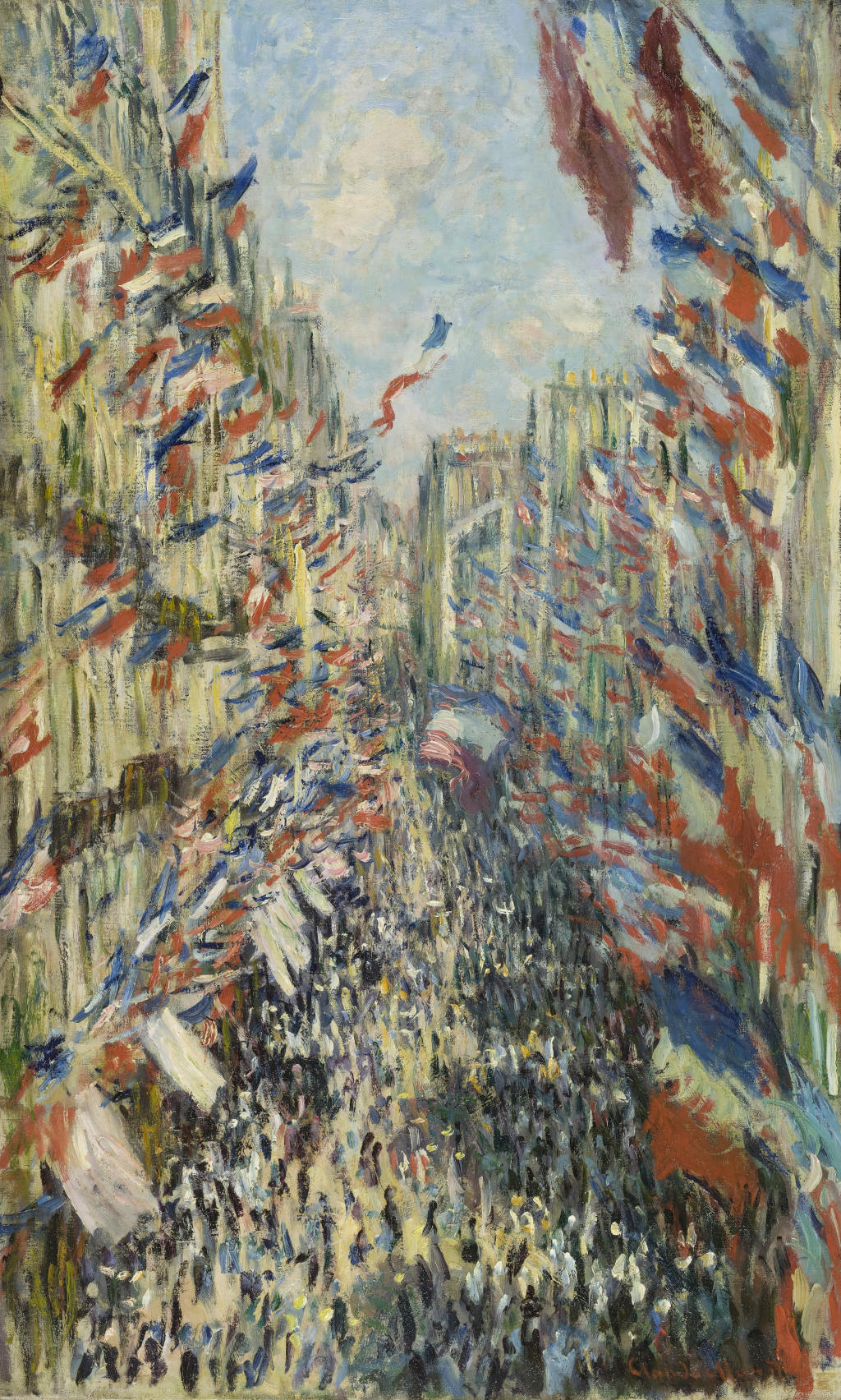
Rue Montorgueil in Paris, Festival of June 30, 1878
Rue Montorgueil in Paris, Festival of June 30, 1878 shows a narrow street transformed by red, white and blue flags and a dense crowd. Claude Monet looks down from above, allowing architecture, cloth and moving people to merge into an animated urban landscape. The painting belongs to the Musee d'Orsay, inventory RF1982 71. [1] Its date identifies a particular republican celebration, not a scene of Bastille Day.
At a Glance
- Artist Claude Monet
- Date 1878
- Event represented 30 June 1878
- Medium Oil on canvas
- Dimensions 81 x 50 cm
- Collection Musee d'Orsay, Paris
- Inventory RF1982 71. [1]
The celebration was on 30 June, not 14 July
The government designated 30 June 1878 as a celebration of peace and work during the third Paris Exposition universelle. The exhibition had already opened on 1 May; the flag-filled day was part of its festivities, not its inauguration or closing. [2]
The occasion carried political importance. Chantal Georgel's historical study places it after the defeat of 1870, the siege of Paris and the Commune, and within the effort to strengthen a republic that remained contested after the crisis of 1877. Public celebration could help present national recovery as something visible in the streets. [2]
The later annual national holiday can make the scene easy to misidentify. The 14 July date was established in 1880, two years after Monet's painting. [6]
Recognising the correct occasion does not reduce the picture to a political document. It makes the flags and crowd more specific. These are not decorations added to an otherwise timeless view of Paris: they are the reason the ordinary street has become an exceptional spectacle.
A view from above the crowd
The street narrows rapidly into the distance. Tall buildings press in at both sides, while an irregular opening of sky widens overhead. This vertical arrangement produces a strong sense of enclosure without shutting out the air above the roofs.
The foreground is crowded, but the viewer is not placed among the pedestrians. From the high viewpoint, the whole movement of the street can be seen at once. The people become a continuous pattern, and the flags project from the facades into the space between them.
In a later recollection recorded by Rene Gimpel, Monet described noticing a decorated street, finding a balcony and obtaining permission to paint. Philippe Piguet cites that account in his discussion of the two festival pictures. [3] It offers a remembered explanation of the vantage point, not a minute-by-minute record of the painting's execution.
The distance between painter and crowd is therefore both practical and pictorial. Monet can observe the gathering as an urban phenomenon while preserving the impression of excitement below.
Flags becoming the main subject
The nearest flags are large enough to interrupt the architecture behind them. Their shapes bend and overlap, making red, white and blue recur across both sides of the canvas. Some read clearly as cloth; others break into bands and streaks that are harder to separate from the surrounding marks.
Their unequal sizes help establish depth. Broad hanging forms appear near the edges, while smaller flashes continue towards the distant buildings. The repetition does not create a regular decorative pattern because each flag turns or folds differently.
The tricolour also changes how the buildings are seen. Pale walls and dark windows no longer provide the only rhythm of the facades. The flags cut across those stable divisions, temporarily giving the street a new visual order.
The Musee d'Orsay identifies the repeated colours with modern France. [1] Their political meaning is inseparable from their physical appearance here, but the painting also depends on ordinary properties of cloth: its capacity to fold, catch light, project into space and partially hide what lies behind it.
How small marks create a crowd
Individual people are suggested rather than described in detail. Dark upright touches can become bodies, light marks can become faces or hats, and gaps between them can become the remaining visible street. No single pedestrian dominates the scene.
Near the bottom, the marks are larger and more distinct. Farther away, they gather into a narrower, darker stream. This change allows the crowd to recede without requiring precise perspective drawing for every figure.
GrandPalaisRmn's analysis stresses the importance of viewing distance: small touches that appear separate at close range can combine into a coherent scene from farther away. [5] The picture offers both experiences rather than requiring us to choose between them.
The result is a convincing sensation of collective movement, but not an inventory of gestures. We cannot identify the people, count everyone present or reconstruct their conversations. Monet's technique conveys the density and energy of the gathering through the relation of marks, colours and compressed space.
Architecture as a framework for movement
The buildings do important work even when flags partly conceal them. Their vertical edges support the tall format, and their receding rooflines guide the eye towards the centre. Without that structure, the many red and blue touches could become an evenly scattered pattern.
The sky provides a contrasting interval. Its pale blue and cream passages are looser and more open than the dark crowd below. The visible wedge of air prevents the street from becoming a completely closed tunnel of decoration.
There is also a change of scale between the two halves. Large flags occupy the upper edges, while the numerous people are concentrated lower down. Human figures and national emblems meet within the same perspective, but they do not receive the same degree of visual emphasis.
This is a recognisable Paris street treated as a changing environment. Its architecture supplies continuity; the celebration supplies a temporary arrangement that could not remain in place indefinitely. The painting records that transformation without becoming a detailed architectural survey.
The separate Rue Saint-Denis painting
Monet also painted the nearby Rue Saint-Denis during the same celebration . That canvas is now in the Musee des Beaux-Arts in Rouen, inventory 909.1.34. [4] The shared date and flag-filled viewpoint make the two works natural companions, but they are not two titles for the same picture.
The Rouen museum discusses readable patriotic inscriptions within its canvas. Those details belong to Rue Saint-Denis and should not automatically be assigned to Rue Montorgueil. [4]
The comparison is useful because it shows how a single occasion could generate more than one visual solution. Different building lines, intervals of sky and arrangements of flags affect how the crowd is encountered. The subject remains a public celebration, yet the composition is particular to each street.
Both festival pictures were shown at the fourth Impressionist exhibition in 1879. [2] [3] Their connection is consequently historical as well as thematic, while their separate identities remain important for understanding each work.
Exhibition, reception and collection history
Piguet's account of the 1879 exhibition sets contrasting press reactions beside one another. One critic mocked the coloured flag marks; another praised the force with which Monet conveyed the crowd and the repeated national colours. [3] The same handling could appear inadequate or remarkably truthful, depending on what a viewer expected painting to do.
That disagreement belongs within Monet's reception , rather than a story of uninterrupted approval or universal rejection. The pictures asked audiences to recognise movement and public experience in marks that did not describe every object with equal precision.
The Orsay record states that Georges de Bellio acquired Rue Montorgueil from Monet on 11 July 1878. It later passed through other collections before entering French national ownership in 1982. [1]
Its place in Monet's exhibition history matters, but the painting remains more than evidence for an event. The meeting of fixed facades, fluttering flags and a moving crowd makes the excitement of a particular day visible through an unusually concentrated arrangement of colour.
Frequently Asked Questions
No. Rue Saint-Denis is a separate festival painting in Rouen. [4]
The Musee d'Orsay, Paris, inventory RF1982 71. [1]
Discussion
Look again at the images and ideas explored in Rue Montorgueil in Paris, Festival of June 30, 1878. These editorial prompts invite your observations.
Reader Insights
Do you notice the flags or the crowd first?
How does the high viewpoint affect your sense of involvement?
What changes when you look closely at the marks and then step back?
Join the Conversation
Share a detail, comparison or question about Rue Montorgueil in Paris, Festival of June 30, 1878 below.
References
- Musee d'Orsay , La Rue Montorgueil, a Paris. Fete du 30 juin 1878, RF1982 71. View source .
- Chantal Georgel,30 juin 1878 , une fete vraiment nationale, Histoire par l'image, GrandPalaisRmn,2016. View source .
- Philippe Piguet , Claude Monet, la fete du 30 juin 1878, Academie des beaux-arts, Gimpel account and 1879 reception. View source .
- Musee des Beaux-Arts , Rouen, Rue Saint-Denis, Celebration of 30 June 1878, separate painting. View source .
- GrandPalaisRmn , Panorama de l'art, La Rue Montorgueil, perspective and colour. View source .
- Presidency of the French Republic , La fete nationale du 14 juillet, historical adoption in 1880. View source .







