 by Tom Gurney
Tom Gurney BSc (Hons) is an art history expert with over 20 years experience
Published on May 13, 2026 / Updated on May 13, 2026
Email: tomgurney1@gmail.com / Phone: +44 7429 011000
Claude Monet Paris Trail - Walk Through the Paris That Shaped Impressionism
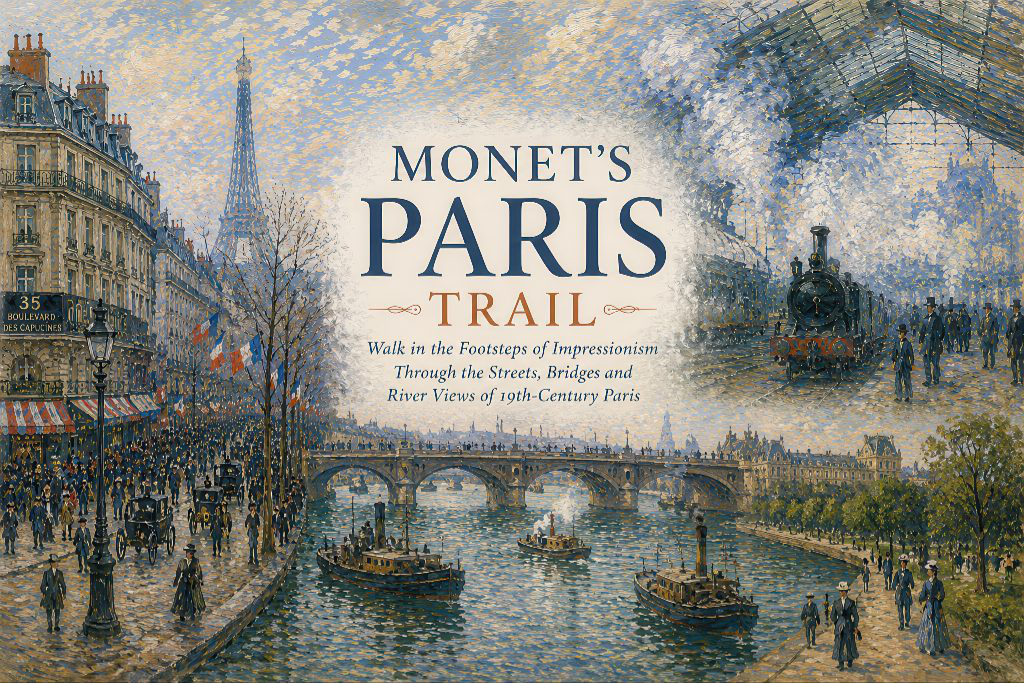
Claude Monet's Paris was a city of railway smoke, new boulevards, river reflections, crowded streets and modern spectacle. This self-guided Monet Paris trail follows the places most closely connected with his paintings, training and early Impressionist career.
Rather than treating Paris as a simple backdrop, Monet used the city as a laboratory for modern painting. He painted streets from elevated windows, studied steam inside railway stations, observed bridges over the Seine and transformed public festivals into vibrating fields of colour.
This trail connects the major Paris locations associated with Monet, including the Boulevard des Capucines, Gare Saint-Lazare, Pont de l'Europe, Rue Montorgueil, Rue Saint-Denis, the Tuileries and the Seine embankments. It is designed as both an art-history guide and a practical route for anyone who wants to experience Monet's Paris today.
- Trail type: Self-guided walking route
- Main area: Central Paris
- Best for: Monet, Impressionism, Paris history and museum visitors
- Key locations: Gare Saint-Lazare, Boulevard des Capucines, Rue Montorgueil, Seine
- Related guide: Claude Monet in Paris
Interactive Map of the Monet Paris Trail
Use the map below to follow Monet through the streets, bridges, railway stations and viewpoints that shaped his Paris paintings. The route can be adapted depending on how much time you have, but the full trail gives the clearest sense of how closely Monet's art was tied to the modern city around him.
View Fullscreen Interactive Map of Monet's Paris
Suggested Monet Paris Trail Route
This revised route follows a more natural west-to-east and then south-west walking flow through central Paris. It begins around the Boulevard des Capucines, moves through the railway district around Gare Saint-Lazare, continues to the festival streets of Rue Montorgueil and Rue Saint-Denis, then follows the Seine westward toward the Tuileries and Musée d'Orsay.
| Stop | Location | Monet connection | Suggested focus |
|---|---|---|---|
| 1 | Boulevard des Capucines | Monet painted elevated views of this modern boulevard. | Crowds, movement and Haussmann's Paris. |
| 2 | Nadar Studio, 35 Boulevard des Capucines | Site of the first Impressionist exhibition in 1874. | The birth of Impressionism outside the official Salon. |
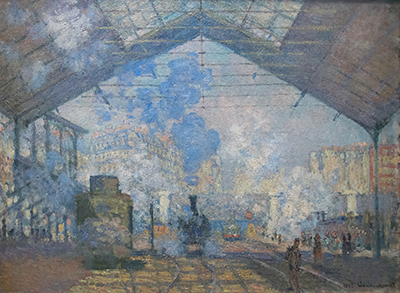
| 3 | Gare Saint-Lazare | Monet painted his famous railway station series here in 1877. | Steam, trains, iron, glass and modern atmosphere. |
| 4 | Pont de l'Europe | Monet painted the bridge and railway approaches near Saint-Lazare. | Industrial Paris and modern engineering. |
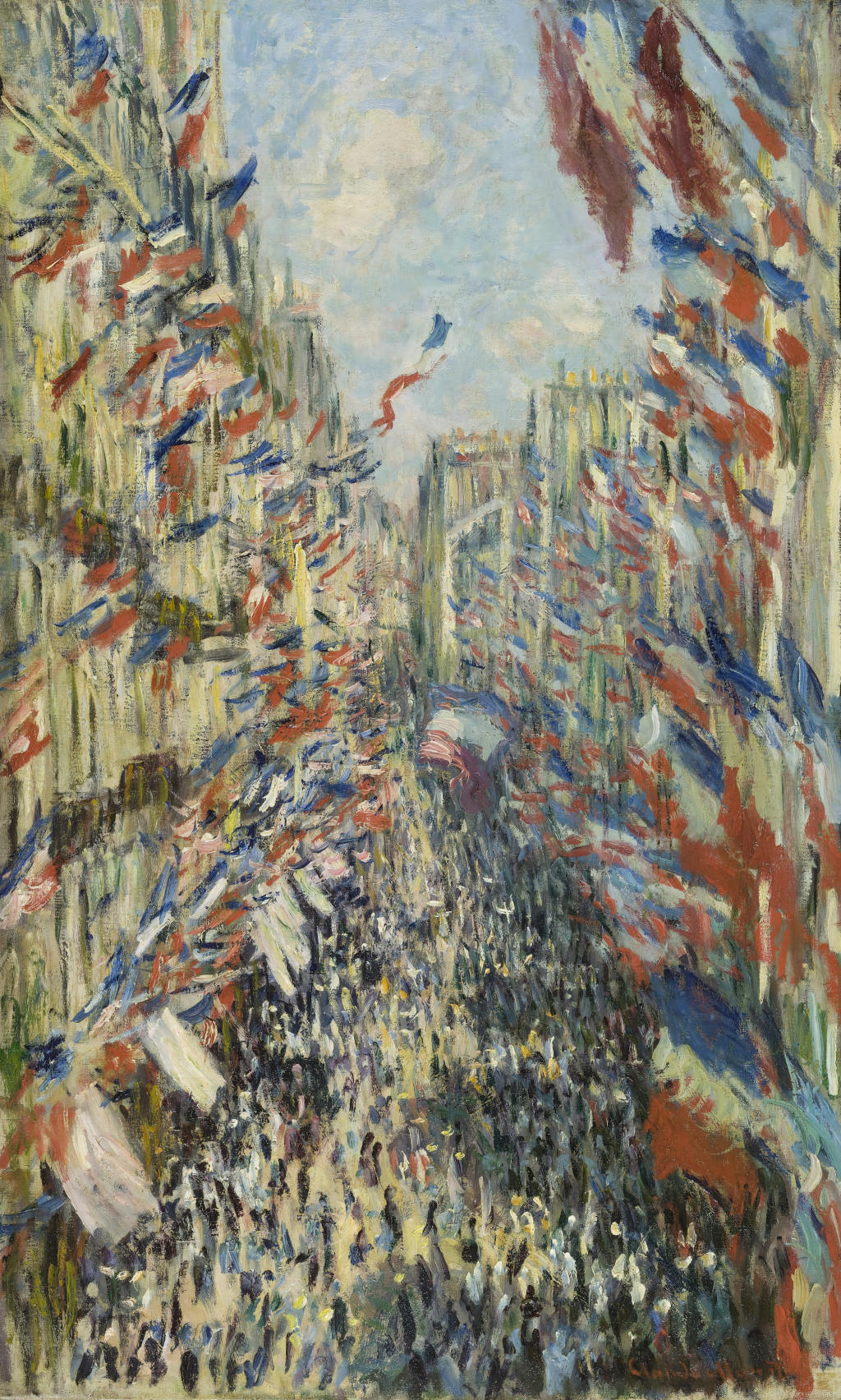
| 5 | Rue Montorgueil | Monet painted the street filled with flags on June 30, 1878. | Festival crowds, tricolour flags and urban spectacle. |
| 6 | Rue Saint-Denis | Monet painted a companion festival view here in 1878. | Repeated motifs, celebration and city movement. |
| 7 | Pont Neuf | Monet painted Paris bridges as part of his wider interest in rivers and viewpoints. | Bridges, water and urban perspective. |
| 8 | Quai du Louvre and Seine at the Louvre | Monet painted early Paris river views around the Louvre embankments. | Reflections, boats and Paris as a river city. |
| 9 | Tuileries Gardens | Monet painted early elevated views near the Tuileries in the 1860s. | Gardens, public leisure and open-air city views. |
| 10 | Musée d'Orsay | Now home to major Impressionist works, including Monet's Rue Montorgueil. | End the trail by seeing Monet's Paris in the museum. |
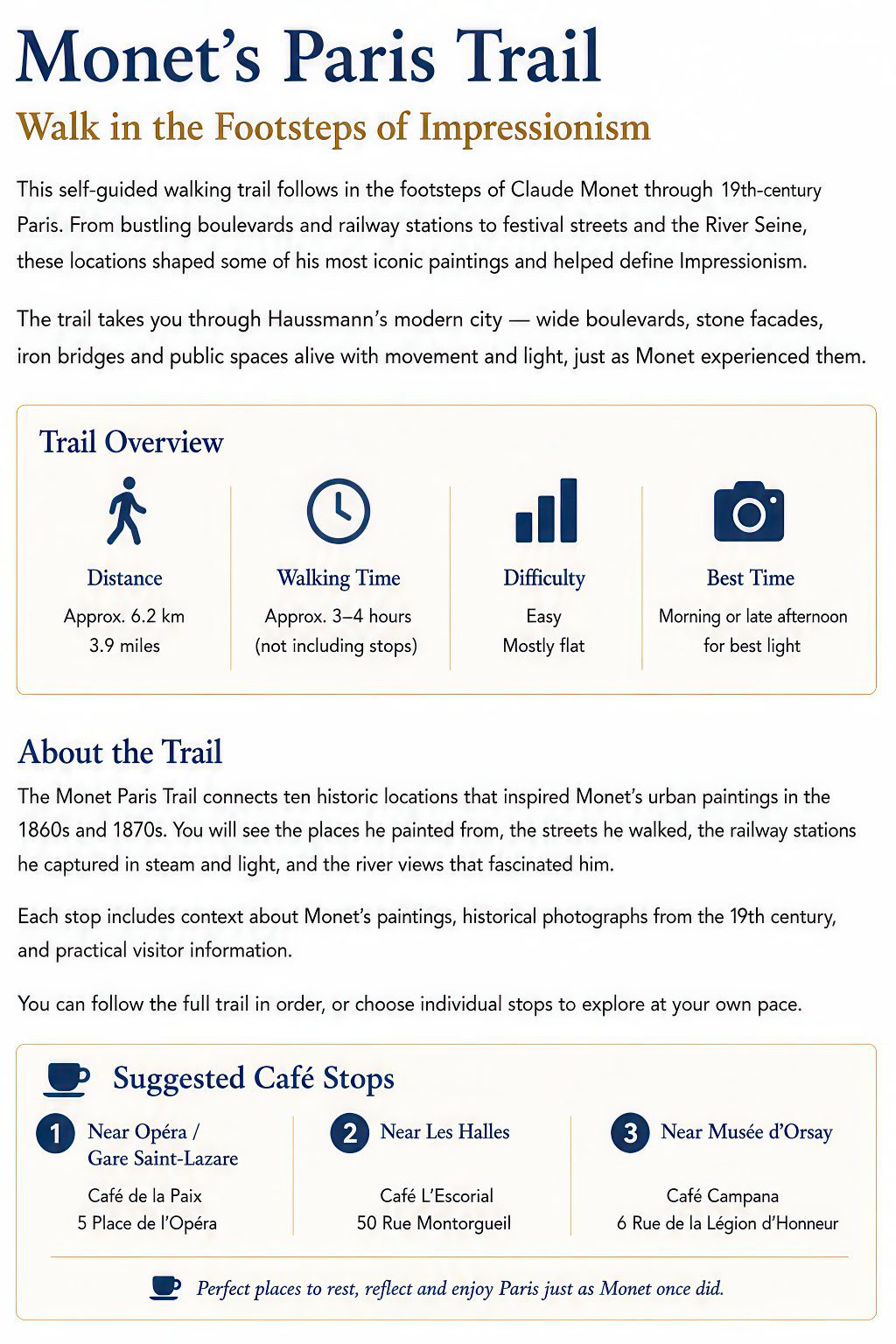
Monet's Paris Trail Overview — introductory guide to the self-guided walking route through the streets, bridges and railway stations connected to Claude Monet and the rise of Impressionism in Paris.
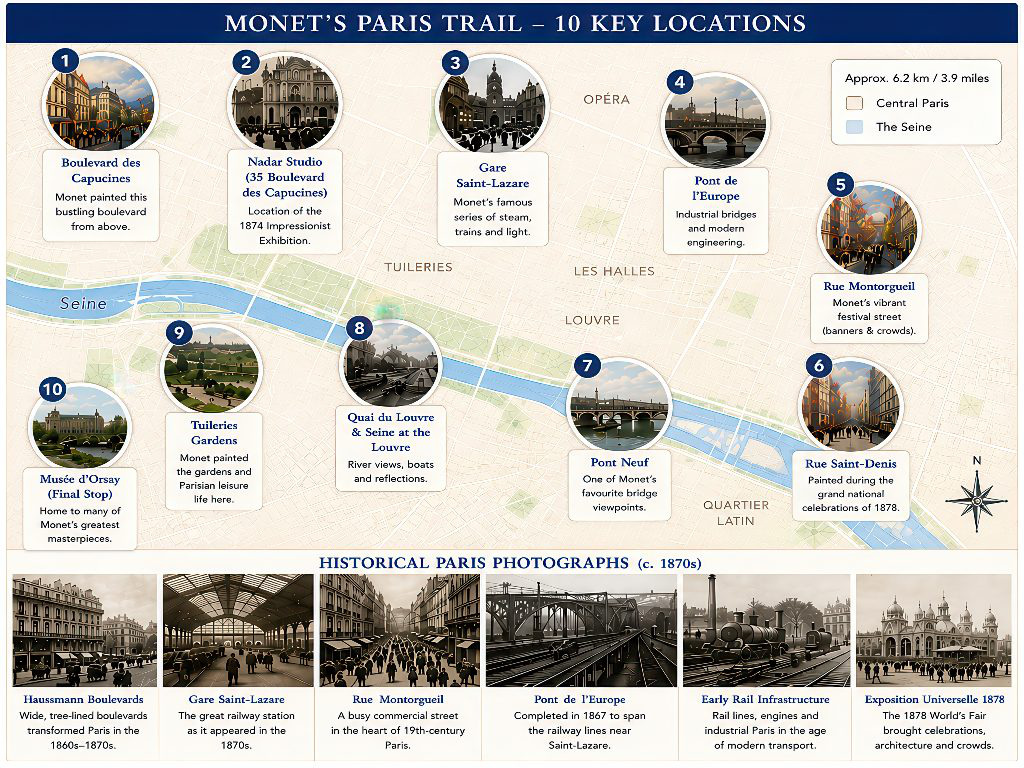
Monet's Paris Trail Map — interactive-style visual route connecting the major Paris locations that inspired Monet's urban paintings during the 1860s and 1870s.
Stop 1: Boulevard des Capucines
The Boulevard des Capucines is one of the essential starting points for a Monet Paris trail. Monet painted the boulevard from an elevated viewpoint, transforming pedestrians, carriages, trees and winter light into a moving pattern of brushstrokes.
This stop introduces the central theme of the trail: Monet's Paris was not a static city of monuments, but a modern environment of crowds, traffic, light and motion.
Stop 2: Nadar Studio, 35 Boulevard des Capucines
Just nearby was the former studio of the photographer Nadar at 35 Boulevard des Capucines, where the first Impressionist exhibition opened in April 1874. Monet, Renoir, Degas, Pissarro, Morisot and others showed their work independently from the official Salon.
This location makes the trail more than a walk through Monet's painted Paris. It also connects visitors to the moment when Impressionism first emerged publicly as a new artistic force.
Stop 3: Gare Saint-Lazare
Gare Saint-Lazare is one of the most important Monet locations in Paris. In 1877, Monet painted a series of views inside and around the station, capturing trains, steam, iron, glass and changing light.
The Gare Saint-Lazare paintings show Monet treating industrial modernity as a subject of beauty. Steam becomes atmosphere, the station roof filters light, and trains appear and disappear through clouds of vapour.
Stop 4: Pont de l'Europe
Pont de l'Europe crossed the railway approaches near Gare Saint-Lazare and symbolised the modern engineering of Haussmann-era Paris. Monet painted this area as part of his wider interest in railways, smoke and changing urban viewpoints.
The bridge gives the trail a strong industrial chapter, linking Monet's city paintings to the wider transformation of Paris through railway infrastructure.
Stop 5: Rue Montorgueil
Rue Montorgueil is one of the most visually exciting stops on the trail. Monet painted the street on June 30, 1878, when Paris was decorated with flags during celebrations connected with the Exposition Universelle.
In Rue Montorgueil, Paris, Festival of June 30, 1878, Monet turns the street into a vibrating display of tricolour flags, crowds and sunlight.
Stop 6: Rue Saint-Denis
Rue Saint-Denis forms a natural companion stop to Rue Montorgueil. Monet painted another festival view here during the same 1878 celebrations, again using flags and crowds to express the energy of modern Paris.
The two street paintings work especially well together because they show Monet repeating a related motif from different viewpoints — a habit that would later become central to his serial paintings.
Stop 7: Pont Neuf
After the festival streets, the route turns toward the Seine. Pont Neuf introduces the river section of the trail and links Monet's Paris paintings with his lifelong fascination with bridges, reflections and water.
Although Pont Neuf is one of the oldest bridges in Paris, Monet approached it through the fresh visual language of Impressionism: light, movement, atmosphere and viewpoint.
Stop 8: Quai du Louvre and the Seine at the Louvre
The Louvre embankments and nearby Seine views were important subjects for Monet during the 1860s. Here, Paris becomes a river city, with boats, bridges, architecture and reflections all contributing to the composition.
Paintings such as Quai du Louvre and The Seine at the Louvre anticipate Monet's later interest in river landscapes at Argenteuil, London and Venice.
Stop 9: Tuileries Gardens
The Tuileries Gardens connect Monet's Paris trail with his early interest in public gardens, leisure and elevated city views. From this area he explored how urban life, open space and sunlight could be brought together in modern painting.
This stop also creates a useful bridge to Monet's later garden subjects, especially the cultivated landscape he would eventually create at Giverny.
Stop 10: Musée d'Orsay
The trail ends naturally at the Musée d'Orsay, one of the best places in the world to understand Monet and Impressionism. After walking through the streets and river viewpoints connected with Monet's Paris, visitors can see major Impressionist works in person.
This final stop gives the route a satisfying conclusion: first you walk through the modern city that shaped Impressionism, then you enter the museum where many of its masterpieces now live.
How Long Does the Monet Paris Trail Take?
The full route can be adapted depending on your pace and whether you visit museums along the way. A shortened version focused on Boulevard des Capucines, Gare Saint-Lazare, Pont de l'Europe, Rue Montorgueil and Rue Saint-Denis can be completed in a few hours.
A fuller version including the Tuileries, Seine viewpoints, Pont Neuf and Musée d'Orsay works best as a half-day or full-day itinerary, especially if you want to stop for photographs, compare paintings and visit museum collections.
Best Monet Paris Trail for Limited Time
If you only have limited time in Paris, focus on these five essential stops:
- Boulevard des Capucines — modern crowds and the first Impressionist exhibition area.
- Gare Saint-Lazare — Monet's great railway station series.
- Pont de l'Europe — modern engineering and railway atmosphere.
- Rue Montorgueil — Monet's most famous festival street painting.
- Musée d'Orsay — to see major Impressionist works after walking the city.
Why Monet's Paris Still Matters
Monet's Paris paintings remain important because they show the birth of modern urban vision. He did not paint the city as a fixed architectural monument. He painted it as something unstable, crowded, smoky, luminous and constantly changing.
Paris taught Monet how to paint modern life as sensation. Crowds became brushstrokes. Steam became atmosphere. Flags became colour. Bridges became structures softened by light. Water turned stone into reflection.
This trail allows visitors to experience that transformation physically: walking through the same city that helped Monet invent Impressionism.