by Tom Gurney
Tom Gurney BSc (Hons) is an art history expert with over 20 years experience
Published on October 6, 2016 / Updated on March 22, 2026
Email: tomgurney1@gmail.com / Phone: +44 7429 011000
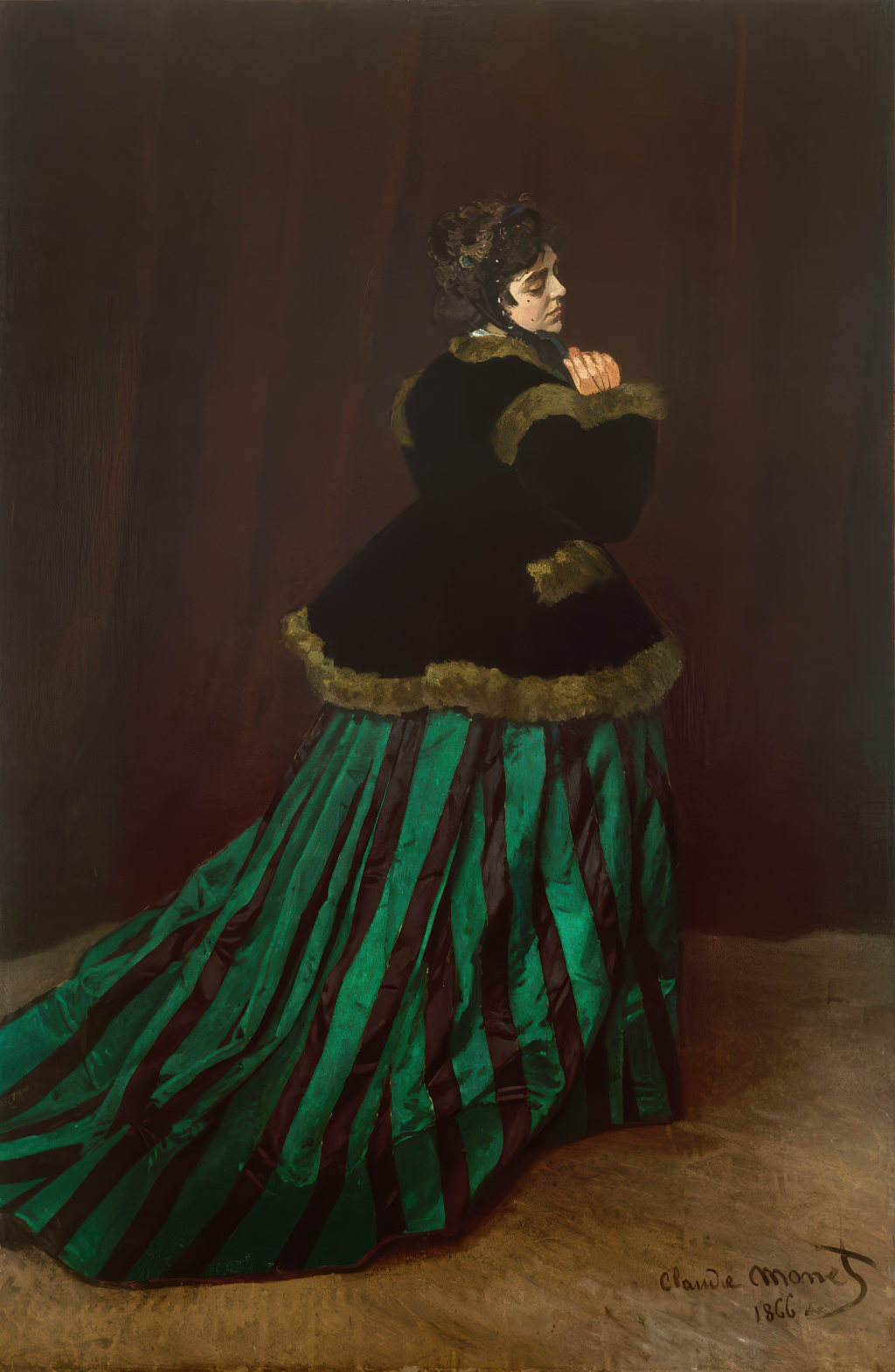
Camille, sometimes known as Woman in the Green Dress was created by Claude Monet in 1866.
This portrait painting, known in French as La Femme à la Robe Verte, is one of the defining works of his early career.
In 1865 Monet was working on a very large painting (Luncheon on the Grass). His plan was to show it at the Paris Saloon gallery. As Monet worked on it, he feared that he would not complete it in time for the exhibition. Because of this, he stopped work on the painting.
In its place, Monet decided to create a large-sized portrait of his model, Camille. The aim was to enter this picture in the Salon. The painting was accepted and appeared in the exhibition.
The subject of the painting, his favourite model Camille Doncieux, would later became his first wife and the mother of his two sons. Much of their relationship appeared in Monet's oeuvre, and she appears in many of his most significant paintings.
At first, this seems a conventional portrait - a young woman dressed in a stunning gown in the mid to late 19th century. In fact, this was a turning point for Monet, and ultimately the direction of modern art too. Camille Doncieux models in this painting, and she would soon become Monet's wife and one of the most important figures in his life.
This painting brought Monet his first major success at the Paris Salon, offering him recognition at a moment when his career was still uncertain. It stands at the intersection between tradition and innovation, revealing an artist on the verge of breaking away from academic conventions.
- Artist:Claude Monet
- Title:Woman in the Green Dress
- Original Title:La Femme à la Robe Verte
- Date:1866
- Medium:Oil on canvas
- Genre:Portrait
- Model:Camille Doncieux
- Location:Kunsthalle Bremen, Germany
- Significance:Monet's first major Salon success
Description
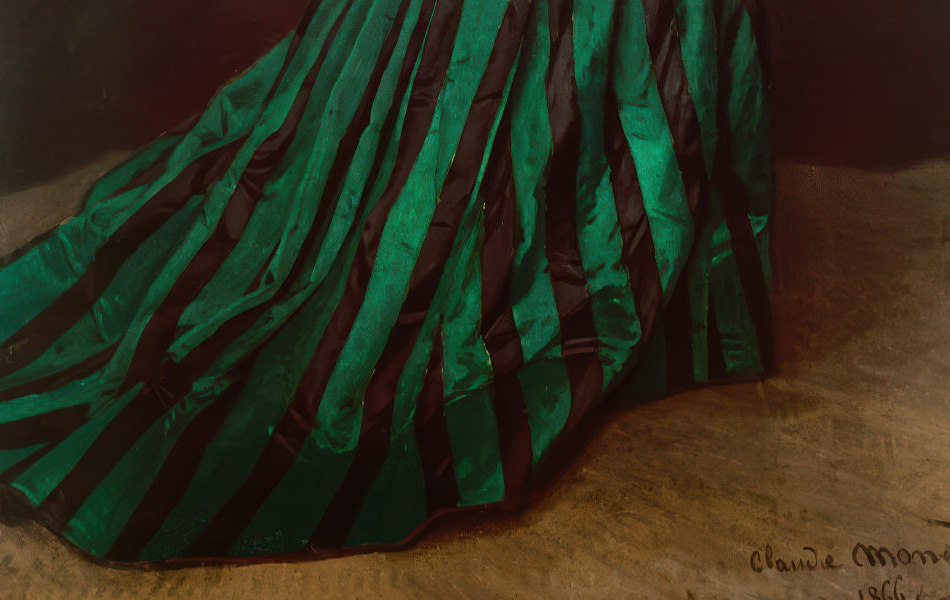
In the painting Camille is wearing a green and black striped dress with a train as well a fur-trimmed jacket. The hat is an Empire bonnet.
By opting for the undefined dark background, Monet makes us focus on the model and the detail of what she is wearing. Camille looks as if she is about to exit the door and go for a walk. The context of the scene and situation is unclear as she has her back to us.
Style
Despite being most associated with Impressionism, The Woman in the Green Dress did not follow the Impressionist style. The picture was something more associated with the style of Realism, or at least a photo-realistic look. Additionally, the portrait was unusual in that it was a life-sized portrait, where as most Monet paintings are much smaller.
Monet pays strong attention to the detail in the dress worn by the model, Camille. In his early years, many of the portraits that Monet's created were more refined in their detail, before he switched to the more abstract finish of Impressionism, where movement, light and expression took over.
Technique and Composition
Monet used fluid brushstrokes in constructing this portrait, and paid particular attention to Camille's facial features, as well as her dress. He is able to create a feeling of material and weight to the dress, one can almost reach out and touch it. Monet chooses a simplistic, darkened background which allows the focus to remain entirely on the subject.
Camille is also presented side-on, bringing her dress more into focus. Light and fabric then play off each other - it this regard, it is not a typical portrait. The green tones stand out beautifully against the darkened background, and the striped pattern helps balance the composition.
The angle of the dress, as it hangs out at the bottom, creates a triangular shape to Camille. There is also a sense of movement, as if Camille is wandering off to our right, and turns towards us just at the moment that Claude captures her image.
Who Was the Woman in the Green Dress?
The woman modelling for Claude Monet in this painting is Camille Doncieux, a young Parisian who met Monet in the mid-1860s. She quickly became his primary model and companion, appearing in some of his most important early works.
Their relationship would deepen in the years that followed. Camille appears repeatedly in Monet's paintings, from the ambitious Women in the Garden to intimate domestic scenes and, later, the deeply moving Camille on her Deathbed. Through these works, she becomes one of the most recognisable figures in early Impressionism, and was also portrayed by other artists too.
Camille as a Model for Monet
Camille played a central role in Monet's development during the 1860s. She appears in several key paintings that chart his transition from academic painter to Impressionist innovator.
Across these works, her presence evolves from elegance and vitality to quiet domestic intimacy and, ultimately, tragedy. This progression adds a deeply human dimension to Monet's early career, revealing the personal experiences behind his art. Indeed, we can track this part of her life through her husband's portraits.
Monet painted Woman in the Green Dress at a time of financial difficulty and artistic uncertainty. Determined to gain acceptance at the official Salon, he produced a work that would appeal to its jury while still retaining his own artistic sensibility.
The painting was completed relatively quickly, yet it demonstrates a high level of control and ambition. Monet focused on the dramatic impact of the dress, using its rich green tones to create a sense of movement and depth. The figure seems to emerge from the dark background, illuminated by subtle variations of light. The conventional approach of this piece would appeal to the Salon, whilst there was enough innovation to please the artist himself.
When the painting was exhibited at the Salon of 1866, it was met with praise. Critics admired its elegance and vitality and Monet enjoyed a rare moment of success within the established, traditional art world. This recognition provided him with both financial support and increased visibility, though he still wished to innovate within his future work.
Woman in the Green Dress represents a path Monet ultimately chose not to follow. He could have continued as a fashionable portrait painter, producing similar works for the Salon. Instead, he moved in a very different direction.
Within a few years, Monet would abandon the conventions of academic painting in favour of a more radical approach. He began to focus on light, atmosphere, and the fleeting effects of nature—hallmarks of what would become Impressionism.
Critical Acclaim
Art critics of the time were very positive of the painting. It gained him some well-received praise. The artwork was later sold for 800 Francs. For a somewhat new artist, this was a significant amount of money at the time.
Large, Detailed Images of Woman in the Green Dress, 1866

Woman in the Green Dress - Close Up of Camille
Woman in the Green Dress - Close Up of Green Dress
Woman in the Green Dress Claude Monet
Provenance
Acquisition by the Kunsthalle Bremen
The painting was acquired by Kunsthalle Bremen in 1906. This institution was seeking to build up a solid portfolio of contemporary French artists, such as Claude Monet, and they continue to benefit today from this forward-thinking approach.
The acquisition followed an international exhibition held at the museum, where Monet's work was presented alongside other leading figures of modern painting. With the support of the museum's patrons, the painting was secured for the collection, marking an important moment in its history.
Exhibitions
Information on where Woman in the Green Dress has been exhibited
- 1866 - Paris Salon, Paris
- 1906 - Acquired by the Kunsthalle Bremen following international exhibitions
- 2005-2006 - Monet and Camille: Women Portraits of Impressionism, Kunsthalle Bremen
- 2009 - Noble Guests: Impressionist Masterpieces from the Kunsthalle Bremen, Hamburger Kunsthalle
Location of this Painting
Claude Monet's Camille, Woman in the Green Dress, 1866 is now owned by the Kunsthalle Bremen in Germany. It remains accessible as part of their permanent collection.
Address of Kunsthalle Bremen
Kunsthalle Bremen,
Am Wall 207,
28195 Bremen,
Germany
Summary
Woman in the Green Dress captures a moment of transition — an artist balancing tradition and innovation, success and uncertainty. It also reminds us of the importance of Camille in Monet's life and work, and remains one of the most famous portraits of her.