


 by
Tom Gurney
Tom Gurney BSc (Hons) is an art history expert with over 20 years experience
Published on October 6, 2016 / Updated on October 23, 2026
Email:
tomgurney1@gmail.com
/ Phone:
+44 7429 011000
Women in the Garden, circa 1866
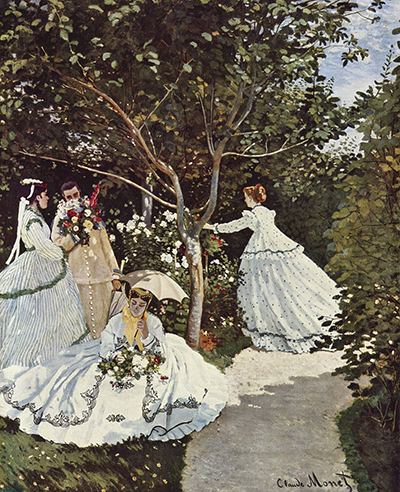
Women in the Garden brings four fashionably dressed figures into a sunlit clearing. Painted around 1866, this monumental oil on canvas belongs to the Musee d'Orsay, inventory RF 2773. It is a major early experiment in joining figure painting with the changing light of an outdoor setting. [1]
At a Glance
Four figures around a tree
A tree rises close to the centre of the picture, dividing the garden without splitting it into equal halves. A pale path curves around its base and opens towards the viewer. The figures occupy different points along this shallow space.
At the left, a standing woman wears a striped dress. Behind her, another figure's face is partly concealed by flowers. A seated woman spreads her white skirt across the foreground, with a parasol above her. On the right, a fourth woman reaches towards the flowering shrub.
Their positions form a loose circuit rather than a row of posed heads. Each body turns differently, and no single face supplies a dramatic focus.
The arrangement makes us move between people and surroundings. The skirt at the front leads towards the path; the reaching figure draws attention into the foliage; the tree gives the whole scene a vertical anchor.
The Monet portraits overview places this work alongside more individualised likenesses. Here, the relationship between figures and garden matters as much as anyone's expression.
A monumental painting of everyday leisure
The scale is striking. At more than two and a half metres high, the canvas gives an apparently ordinary garden gathering the physical presence of a major public statement.
That ambition belongs to a wider reconsideration of figure painting in the 1860s. The Metropolitan Museum's exhibition account connects Women in the Garden with Monet's earlier Luncheon on the Grass, Courbet's outdoor leisure scenes and Bazille's Family Reunion. These artists were exploring contemporary life through substantial compositions rather than reserving large canvases for distant history. [5]
In this picture, the challenge is not to identify a famous event. There is no commanding hero, decisive action or clearly narrated conversation. The women's clothes, gestures and changing patches of illumination supply the interest.
The setting remains recognisable, but its significance grows through the way it is painted. A shaded skirt can become as visually forceful as a face, while an opening in the foliage can redirect attention away from the figures.
This is a different kind of ambition from simply enlarging a small outdoor sketch.
Camille in three positions
Monet began the work in the garden at Ville-d'Avray in spring 1866. Camille Doncieux, his companion, modelled for the three figures on the left. The museum's restoration account makes that repeated modelling explicit. [2]
Knowing this changes the way the group is understood. It cannot be read as a straightforward record of four women assembled at one moment. Monet used separate poses to construct a convincing social space.
The left-hand figures differ through angle, clothing, height and activity. Repetition of the model does not produce repetition of the silhouette. The seated figure spreads widely, while the standing striped dress introduces a narrower vertical form.
Faces remain comparatively understated. Identity is important to the painting's history, but recognition of Camille is not required to follow its structure.
Nor does the evidence mean that every figure should automatically be called Camille. The documented identification concerns the three on the left. The biography follows her place in Monet's life beyond this carefully assembled garden scene.
White dresses divided by light
The white clothing creates the strongest contrasts. It is not treated as one continuous, equally bright material. Sunlit passages stand against broad shadows, and folds shift through cooler greys and subdued blues.
On the seated figure, the skirt becomes an expansive shape in its own right. Its outline is easy to follow, but the interior is broken by folds, patterned details and changing illumination.
The woman at the right is more sharply exposed against the greenery. Her reaching arm and extended skirt carry the eye sideways, countering the upright trunk.
The path also alternates between light and shade. This connects the figures with the ground: the same garden light crosses both clothing and earth.
Dark passages are therefore not merely empty areas behind the women. They make the brilliant fabric legible and bring the tree's shelter into the composition.
The Painting Light article considers this broader interest. Here, light does not simply illuminate an already complete arrangement; its divisions help organise the arrangement itself.
Fashion as a contemporary subject
The dresses belong to the painting's modern world. Stripes, dots and dark trimmings give the pale fabrics graphic variety, while the wide skirts establish substantial volumes against the plants.
Orsay's fashion exhibition describes a period in which dress silhouettes were changing, with the crinoline beginning to give way to arrangements that placed more emphasis on trains and fullness behind. Its account also discusses patterned light fabrics and carefully managed accessories in summer clothing. [4]
These details provide context, not a licence to name a particular dressmaker or identify every painted textile. A mark that looks like a dot is visible evidence; the exact fibre or shop of purchase requires a different kind of documentation.
The Met places such paintings within a culture of department stores, ready-made clothing and widely circulated fashion magazines. Contemporary dress helped artists give their subjects the recognisable appearance of their own time. [6]
Monet also makes dress pictorially useful. The striped skirt supplies a rhythm unlike the leaves, while the broad white forms separate bodies that might otherwise disappear into the green.
Working outdoors on an enormous canvas
To reach the upper parts while working outside, Monet had the canvas lowered into a trench. The Orsay account describes a pulley arrangement that allowed him to maintain his viewpoint. It also records that the picture was finished in the studio. [1]
The practical problem was considerable. A surface taller than its painter could not be approached like a small board held at arm's length. Moving the whole support made access possible without requiring him to keep climbing above the scene.
The outdoor setting nevertheless did not remove the need for design. The figures had to relate across the canvas, the white shapes had to balance and the path had to connect the foreground with the group.
The painting's immediacy should not be confused with an absence of preparation or revision. Its effects could be developed through several stages, with observation and construction working together.
The Technique guide follows this combination across different works. Women in the Garden is especially useful because its unusual scale makes the physical conditions of painting impossible to ignore.
What scientific imaging reveals
The museum's 2026 technical account provides unusually specific evidence of revision. X-rays show changes to the seated woman's position, with a doubled outline of her face and parasol. The striped figure at the far left was added last, rather than belonging to the initial design. [3]
Those findings make the finished scene more interesting, not less convincing. The apparent ease of the gathering emerged from decisions that could be reconsidered.
Moving a face or parasol alters more than a small detail. It changes how the seated figure relates to the standing women and to the space above her skirt. Adding the striped figure changes the weight of the entire left side.
The same technical account suggests that an old tear near the bottom may have resulted from handling the large canvas. That remains a possibility, not a demonstrated accident with a fully known sequence. [3]
Scientific images answer particular material questions. They do not turn the painting into a transparent record of every intention Monet had while working.
Restoration, refusal and later recognition
Orsay's restoration feature explains that yellowed varnish and deteriorated older repairs had dulled the picture. Treatment at the C2RMF recovered clearer contrasts between white clothing, blue-grey shadows and varied greens. [2]
That history matters when comparing reproductions. Differences in a photograph's brightness or colour may reflect lighting, reproduction or the painting's condition at the time. They should not automatically be interpreted as different versions of the composition.
The Salon jury refused the work in 1867. Bazille bought it that May; it later returned to Monet, and the French state purchased it from him in 1921. [1]
The Reception article places early resistance beside later recognition. This particular history cautions against treating one refusal as a complete verdict on a career.
What remains most persuasive is the painting's internal challenge: monumental figures whose faces are restrained, fashionable clothing that becomes a field of light, and a garden gathering that looks natural while revealing, under examination, how deliberately it was made.
Frequently Asked Questions
It belongs to the Musee d'Orsay, inventory RF 2773. [1]
No. The current museum record gives circa 1866 and notes uncertainty; work began in 1866. [1]
The documented identification is for the three figures on the left, not automatically all four. [2]
No. It was begun outdoors and finished in the studio. [1]
Discussion
Look again at the images and ideas explored in Women in the Garden, circa 1866. These editorial prompts invite your observations.
Reader Insights
Compare the striped dress with the broad white skirt in the foreground.
Follow the path and the tree's shadow through the group.
Consider how the X-ray evidence changes an impression of spontaneous outdoor painting.
Join the Conversation
Share a detail, comparison or question about Women in the Garden, circa 1866 below.
References
- Musee d'Orsay , Femmes au jardin, circa 1866, RF 2773; object record, working method and provenance. View source .
- Musee d'Orsay / C2RMF , Femmes au jardin: restauration d'un chef-d'oeuvre de Monet; Ville-d'Avray, Camille and the painting's treatment. View source .
- Anne Robbins / Musee d'Orsay , Monet: ce que l'on ne voit pas, 9 October 2026; published technical interview transcript, including revisions to Women in the Garden. View source .
- Musee d'Orsay , Impressionism and Fashion, 2012-2013; contemporary clothing and outdoor leisure. View source .
- Metropolitan Museum of Art , Impressionism, Fashion, and Modernity: Gallery Two, En Plein Air, 2013; monumental outdoor figure painting. View source .
- Metropolitan Museum of Art , Impressionism, Fashion, and Modernity, 2013; fashion and the representation of modern life. View source .







