


An umbrella can be shelter, silhouette and social signal at the same time. Open above a figure, its canopy creates a small zone of privacy. Repeated across a street or park, it gives a painter a ready-made rhythm of circles, diagonals and dark intervals. A parasol may tell us that the sun is bright even when no ray is painted; an umbrella can make rain legible through posture, wet pavement and the crowd gathering beneath it.
This guide follows ten paintings in chronological order, from Francisco de Goya’s The Parasol of 1777 to Childe Hassam’s The Avenue in the Rain of 1917. The selection is not an exhaustive history of the object. It asks a more useful visual question: what does the canopy allow each painter to do with a figure, a landscape or a crowd?
The Paintings hub organises subjects, genres and major works, while Famous Paintings provides a wider masterpiece directory. Broader classifications belong to Painting Genres: outdoor conversation may intersect with Genre Painting, and gardens or riverbanks may open toward Landscape Art. Here, however, umbrellas and parasols remain the connecting subject. The emphasis is on looking closely at ten individual paintings, not on clothing history, weather reports or painting instruction.
Shade, display and the outdoor figure
The first four paintings use parasols in outdoor scenes rather than rain. Goya treats the object as a bright courtly prop. Renoir first gives it the scale of a portrait attribute and then lets it almost disappear into a garden. Monet makes it an instrument for showing wind, sunlight and viewpoint. Across a century, the canopy shifts from a clearly outlined emblem of shade to a form embedded in rapidly changing atmosphere.
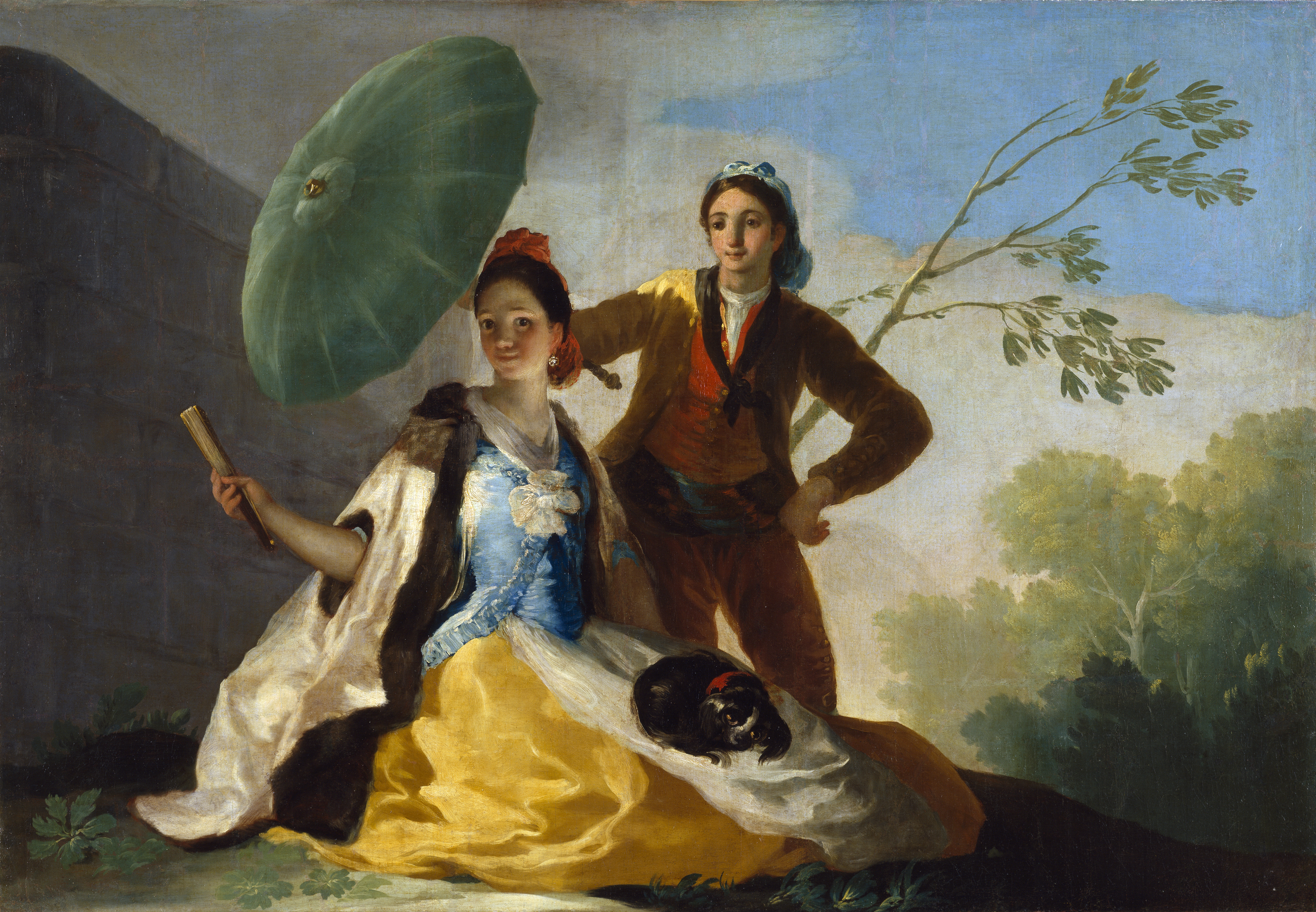
1. The Parasol — Francisco de Goya, 1777
In The Parasol, a seated young woman faces the viewer while a standing man holds a green parasol above her. The canopy tilts toward us, presenting its underside as a broad oval. That single shape blocks part of the darker wall at left and opens toward the blue sky at right, making the object both shelter and hinge between contrasting areas of the picture.
The Museo Nacional del Prado records the work as a 1777 oil on canvas measuring 104 by 152 centimetres, inventory P00773. It was designed as a tapestry cartoon—a painted model for woven decoration—destined for the royal couple’s dining space at El Pardo.[1] Its clear silhouettes, bright clothing and strongly directed light suit that decorative purpose, but the scene remains alert rather than merely ornamental.
Notice how the parasol completes a chain of gestures. The man’s raised arm leads to the handle; the handle leads to the canopy; the canopy returns attention to the woman’s face. Her fan establishes another diagonal below, while the small dog on her lap introduces a compact dark accent. The shade does not isolate her from the world. It frames her as the centre of a sociable outdoor encounter. More of the artist’s designs, portraits and darker late work can be found through Francisco de Goya.
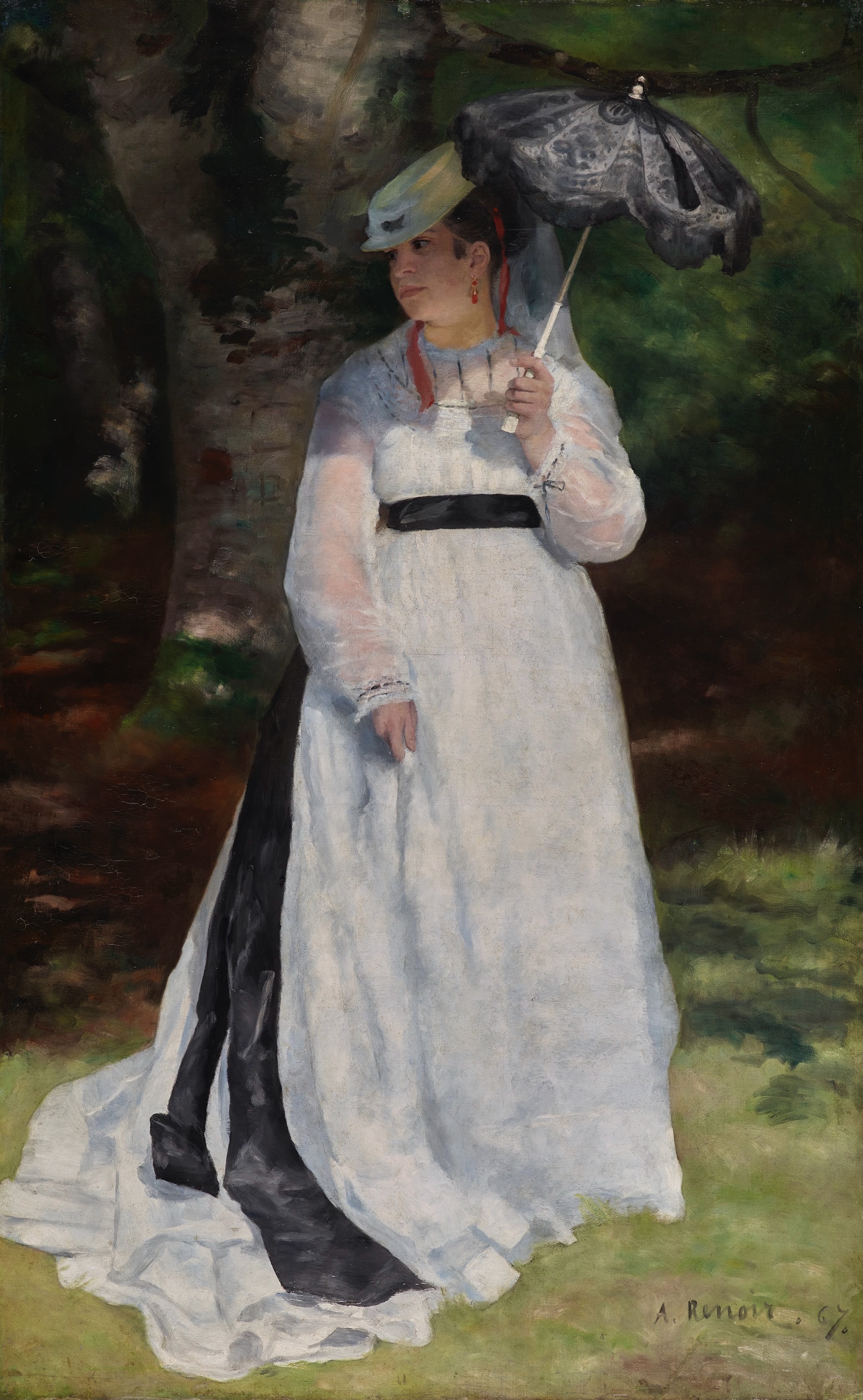
2. Lise with a Parasol — Pierre-Auguste Renoir, 1867
Lise with a Parasol changes the scale and mood. A woman in a long white dress stands almost the full height of the canvas. She holds a black lace parasol above her shoulder, and the wooded background encloses her in deep greens and browns. Instead of a crisp decorative oval, the canopy is irregular and porous, edged with lace that admits light while still casting shade.
Museum Folkwang identifies the 1867 oil on canvas as inventory G 144, measuring 184 by 115.5 centimetres.[2] The unusually large portrait format makes the figure physically commanding. Her pale dress spreads downward in a broad triangle, while the dark sash, trailing black panel and parasol interrupt it. The object above her head is therefore part of a balanced system of light and dark rather than an incidental accessory.
The sitter looks away from us, which makes the parasol’s small protected space feel private. Yet the painting also puts her clothing, posture and scale on public display. Those two effects—withdrawal and presentation—coexist. Renoir would later loosen the boundary between figure and setting, but here the contour remains firm enough to give Lise a monumental presence. The artist’s wider career can be followed through Pierre-Auguste Renoir.
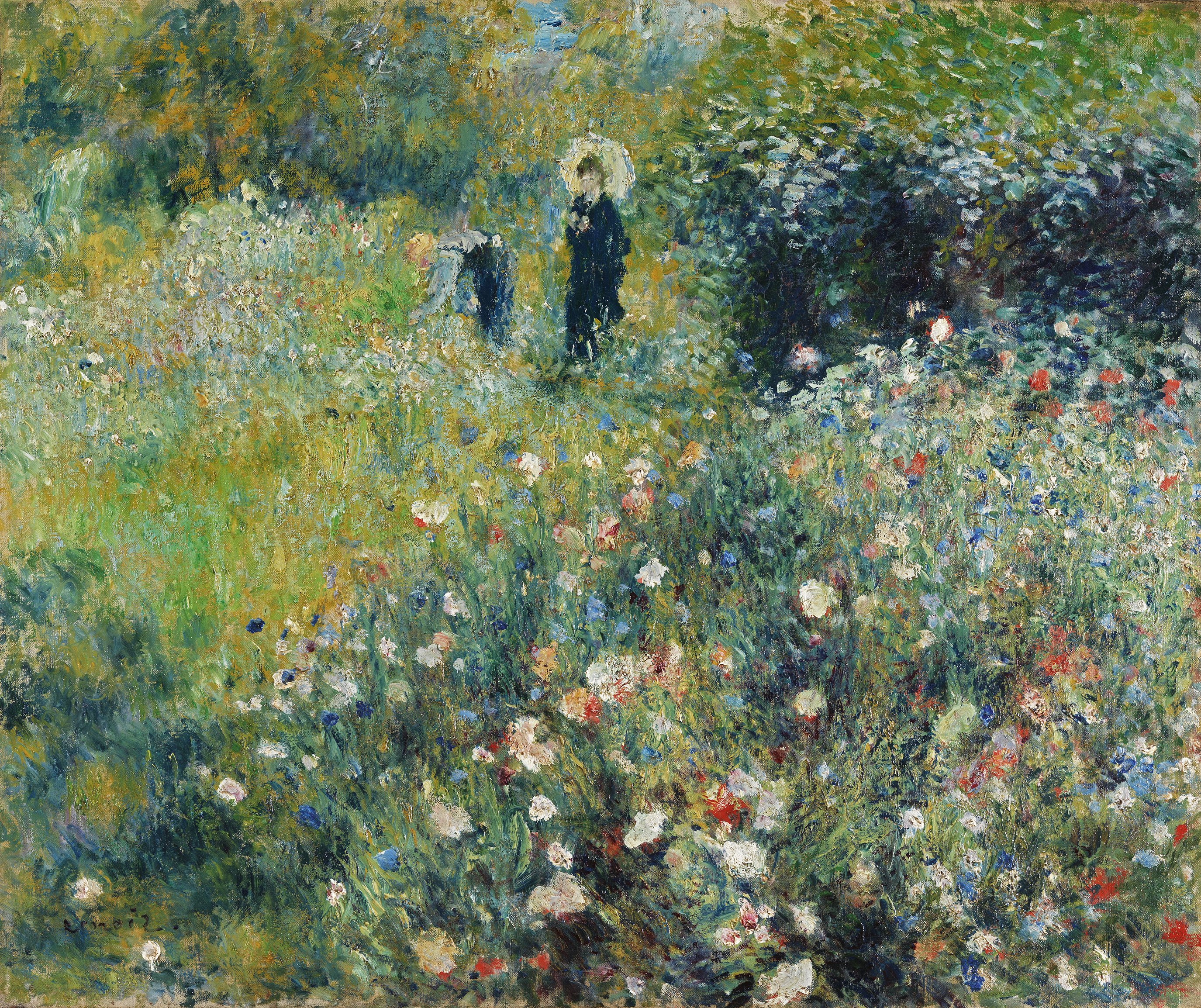
3. Woman with a Parasol in a Garden — Pierre-Auguste Renoir, 1875
In Woman with a Parasol in a Garden, the parasol is harder to find. Two figures stand among flowers and tall foliage, but the garden occupies most of the canvas. White, red and blue touches scatter across the lower half, and the figures are assembled from similarly broken strokes. The canopy near the centre belongs to the scene’s pattern instead of sitting cleanly above it.
The Museo Nacional Thyssen-Bornemisza displays the work as an 1875 oil on canvas, inventory 724 (1974.43), measuring 54.5 by 65 centimetres. Its catalogue also records earlier scholarly proposals of 1873 and 1874, so the date should be understood as the museum’s current designation rather than an uncontested certainty.[3]
That uncertainty does not prevent close looking. The parasol helps us locate a human presence amid the vegetation, but it does not dominate. Its pale surface catches some of the same light that flickers over blossoms and leaves. Compared with Lise, the figure is less a solid body posed against a setting than one element inside a field of colour. Shade remains the object’s practical role, while pictorially it becomes a bridge between person and garden.
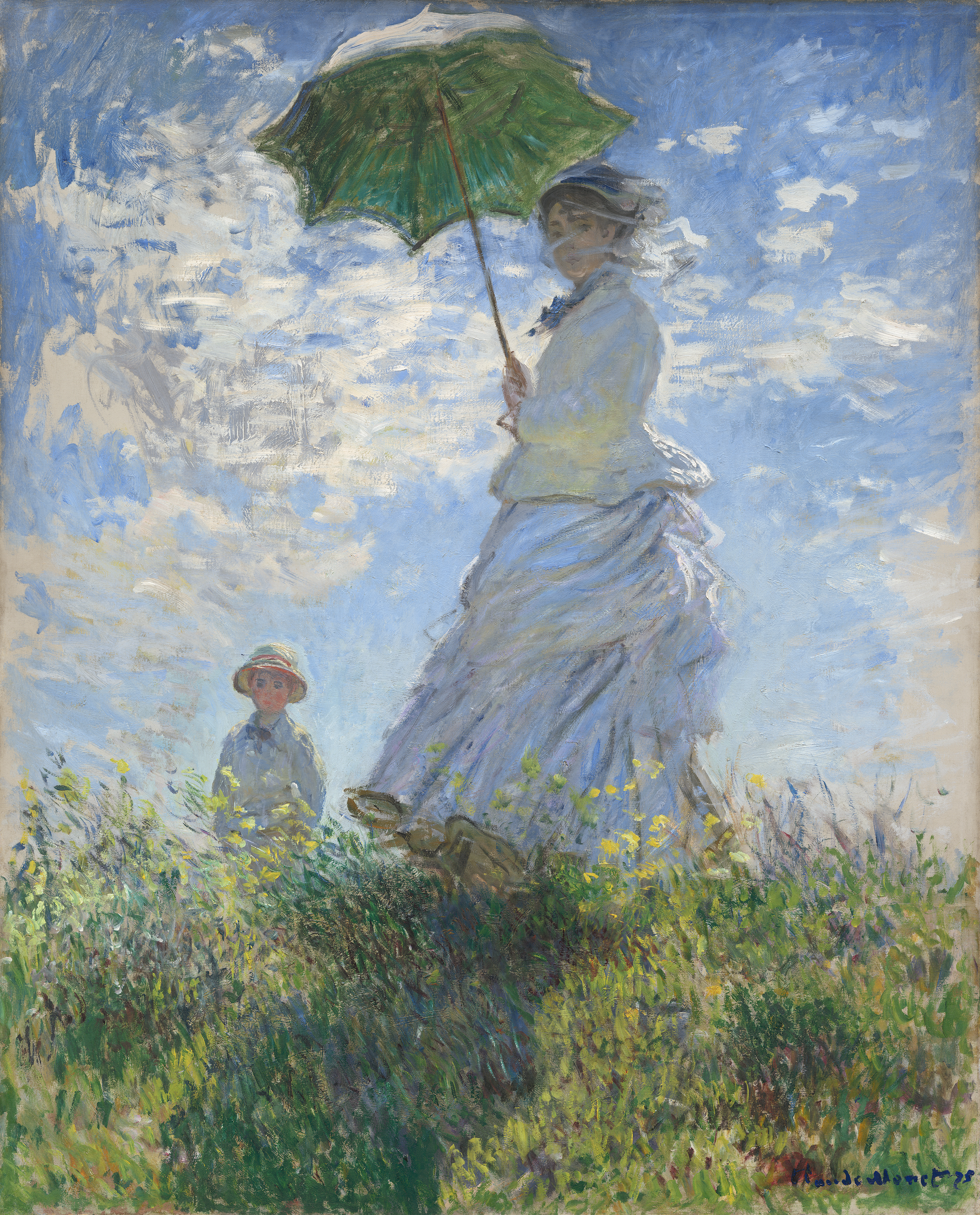
4. Woman with a Parasol—Madame Monet and Her Son — Claude Monet, 1875
Claude Monet’s Woman with a Parasol—Madame Monet and Her Son returns the canopy to prominence, but not to stillness. Camille Monet stands on a grassy rise seen from below. Her green parasol tilts against racing clouds, her veil streams sideways, and her dress seems caught by the same air. Their son appears lower on the slope, partly separated from her by the viewpoint.
The National Gallery of Art identifies the 1875 oil on canvas as accession 1983.1.29, measuring 100 by 81 centimetres.[4] The dimensions give the figure ample scale, yet the low horizon leaves most of the picture to sky. The parasol makes the weather visible because its angle implies resistance: it is held against the moving air rather than displayed frontally.
Monet also complicates the boundary between portrait and fleeting outdoor observation. Camille’s face is present but not minutely described. Her stance, the child’s position and the sweep of light are more decisive than facial detail. The viewer seems to have looked up at a passing moment before it changes. Explore Claude Monet and the wider history of the Impressionists to place this quickened treatment of atmosphere in context.
Streets, gardens and crowds
The next three works move between public rain and private sunlight. Caillebotte multiplies umbrellas across a rebuilt Paris intersection. Tissot places a single patterned parasol among rugs and figures in a garden. Renoir then fills almost an entire canvas with overlapping canopies. The object becomes a way to measure how closely people share space.
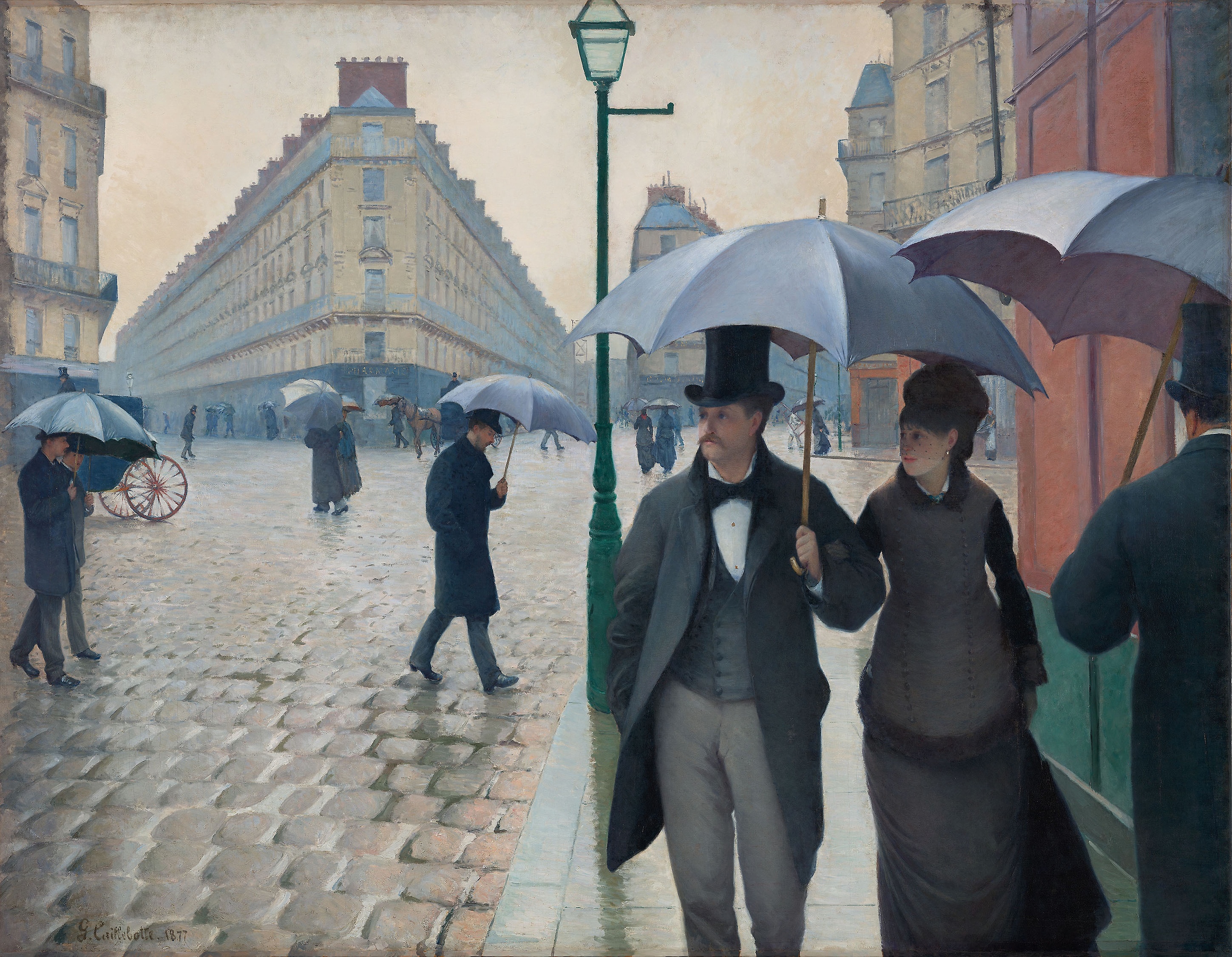
5. Paris Street; Rainy Day — Gustave Caillebotte, 1877
Paris Street; Rainy Day places a well-dressed couple under a large umbrella at the front right of a broad intersection. Other pedestrians, each with a canopy, recede across wet cobbles. A green lamppost near the centre divides the scene, while the sharp wedge of the distant building pulls the eye far into the boulevard.
The Art Institute of Chicago records the painting as an 1877 oil on canvas, accession 1964.336, measuring 212.2 by 276.2 centimetres.[5] Its monumental size matters: the foreground figures approach life scale, so the viewer meets them as fellow pedestrians rather than tiny staffage. Their umbrella extends beyond their bodies, claiming an area of the street and cropping the man at the extreme right.
Repetition creates order without community. The umbrellas rhyme across distance, but most people remain self-contained. Some move toward us, some cross laterally, and others dissolve into the pale air. The wet surface reflects light without turning the scene into a dramatic storm. Rain is registered through equipment, gait and pavement. Read more about Gustave Caillebotte to see how unusual viewpoints and modern Paris recur across his work.
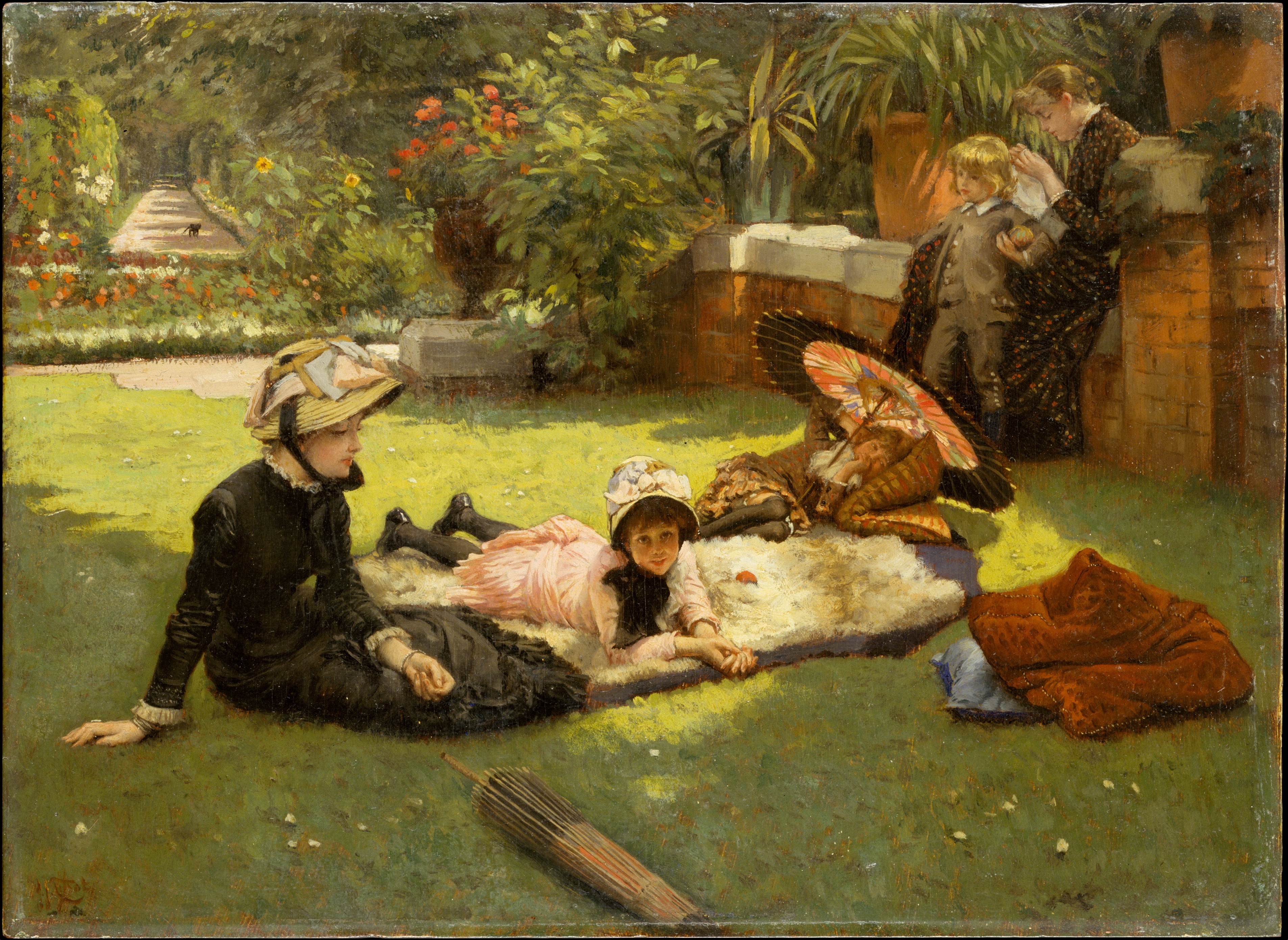
6. In Full Sunlight (En plein soleil) — James Tissot, c. 1881
James Tissot’s In Full Sunlight offers the opposite weather. Women and children rest on rugs in a bright garden. A patterned parasol shades a reclining figure near the right, while another closed parasol lies diagonally in the foreground. The repeated object appears in two states—open and folded—so protection from the sun becomes part of the picture’s geometry.
The Metropolitan Museum of Art dates the oil on wood to about 1881 and records it as accession 2006.278, measuring 24.8 by 35.2 centimetres.[6] The small panel contains a surprising variety of textures: grass, fur-like rugs, patterned fabric, brick, foliage and the ribbed canopies. Tissot’s precision keeps those surfaces distinct even in a scene saturated with light.
The open parasol creates a vivid island of colour around the reclining figure’s head. The closed one, placed where a viewer might almost step over it, points back into the group. Together they connect foreground emptiness to the clustered figures. This is not simply a catalogue of fashionable leisure. Shade determines where bodies settle and how attention moves through the garden. More of Tissot’s carefully observed social settings appears through James Tissot.
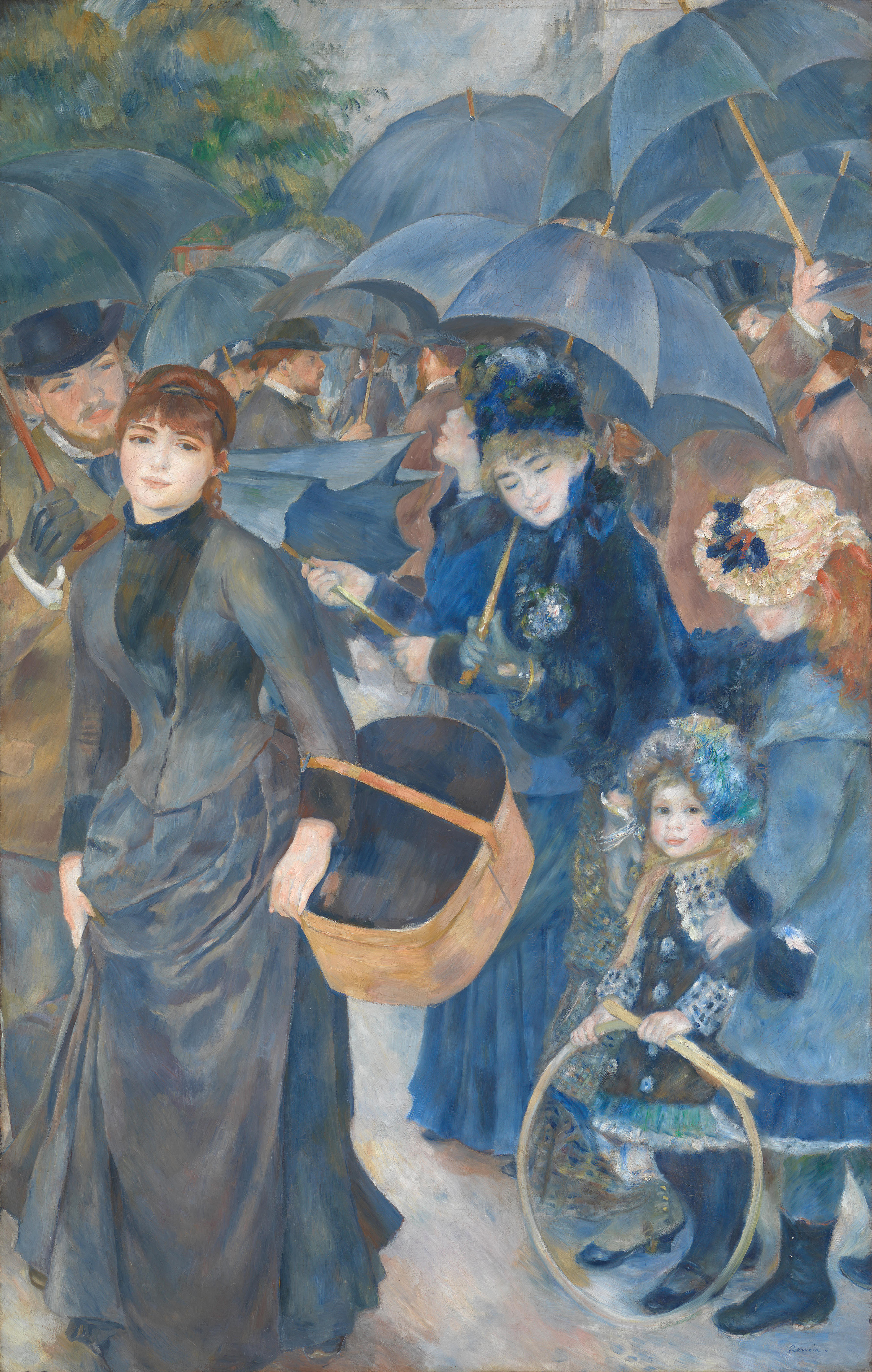
7. The Umbrellas — Pierre-Auguste Renoir, c. 1881–1886
Renoir’s The Umbrellas turns the canopy into a crowd. Blue-grey umbrellas overlap across the upper half of the canvas, hiding much of the sky and breaking the gathering into small pockets. At left, a woman carrying a basket meets the viewer’s gaze. At right, a mother and two girls form a brighter, more animated group.
The National Gallery records the oil on canvas as NG3268, measuring 180.3 by 114.9 centimetres, and dates its execution across about 1881–1886. Technical and stylistic evidence indicates that Renoir worked on it in two stages, with changes visible in handling, dress and figure construction.[7] That history helps explain why the composition holds different modes of painting together rather than representing one instantaneous performance.
The umbrellas unify those differences. Their repeated arcs form a cool, compressed ceiling above faces, hats and shoulders. Handles introduce diagonals that cross the bodies below. The canopies also regulate attention: they conceal the weather while proving that rain is present. Instead of looking outward to a boulevard, as in Caillebotte, we are placed within the press of pedestrians. The object becomes temporary architecture, creating separate personal zones that nevertheless collide.
Ordered leisure and the modern avenue
The final three works broaden the subject again. Seurat distributes parasols across a carefully ordered park. Monet isolates a single figure against sky and wind. Hassam brings multiple umbrellas back to the city, where flags and rain transform the avenue into a vertical field of colour. Together they show that the same object can stabilise a composition or intensify its movement.
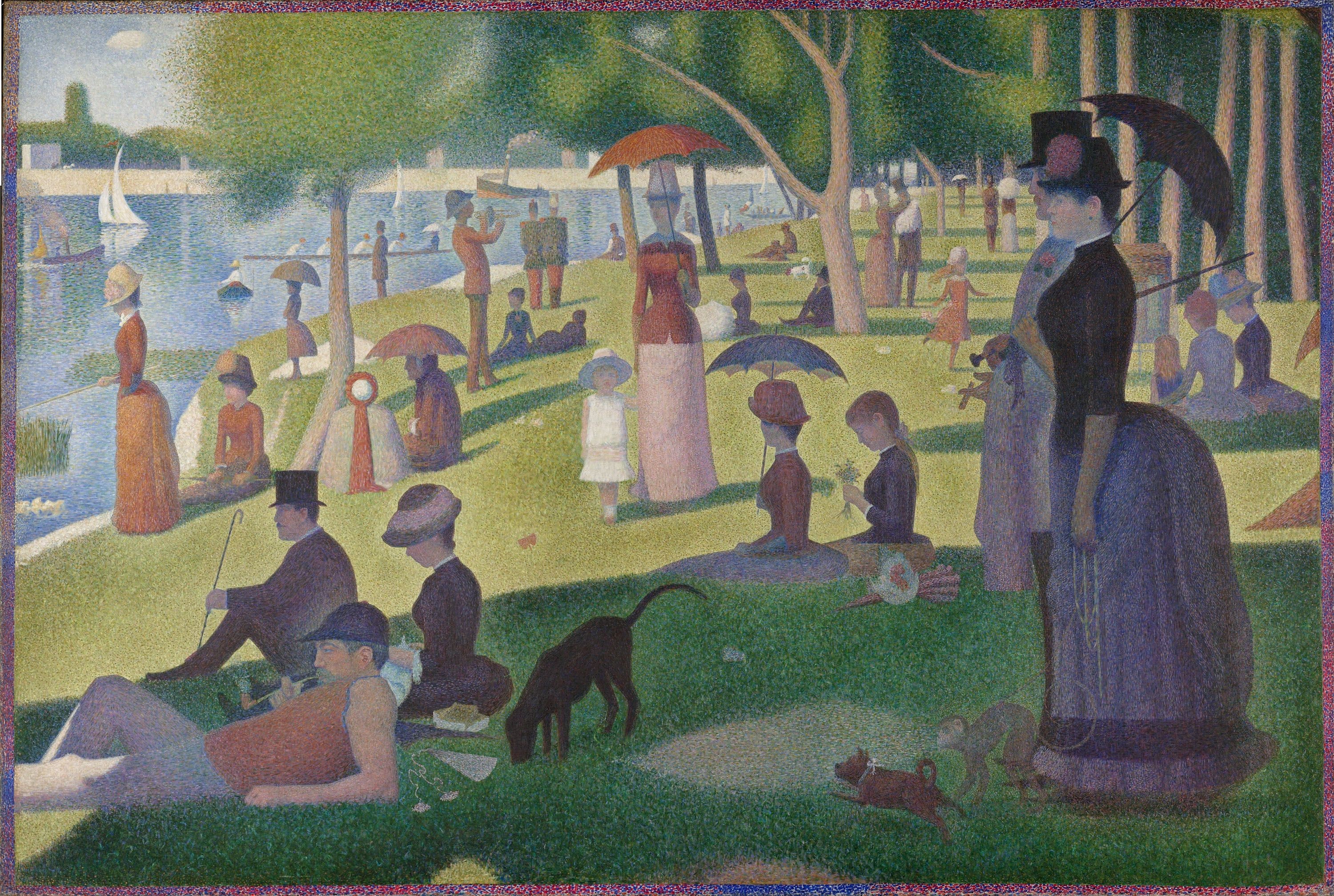
8. A Sunday on La Grande Jatte—1884 — Georges Seurat, 1884–1886
In A Sunday on La Grande Jatte—1884, parasols appear among scores of figures arranged beside the Seine. One large dark canopy anchors the fashionable pair at right; smaller red, orange and pale examples punctuate the distance. Their circular and conical shapes echo skirts, hats and the spreading foliage above.
The Art Institute of Chicago identifies the oil on canvas as accession 1926.224, measuring 207.5 by 308.1 centimetres. Seurat worked on it from 1884 to 1886 and added the painted border in 1888–1889.[8] The enormous surface and deliberate application produce a scene that feels less fleeting than its subject of Sunday recreation might suggest.
Parasols help articulate depth without naturalistic blur. A canopy can be read quickly at several scales, so it marks a figure’s place from foreground to distant riverbank. At the same time, each one reinforces the air of composure: people are not caught rushing for shelter but positioned within a measured social display. For the transition beyond Impressionism toward more constructed colour and form, see the Post-Impressionists and Georges Seurat.
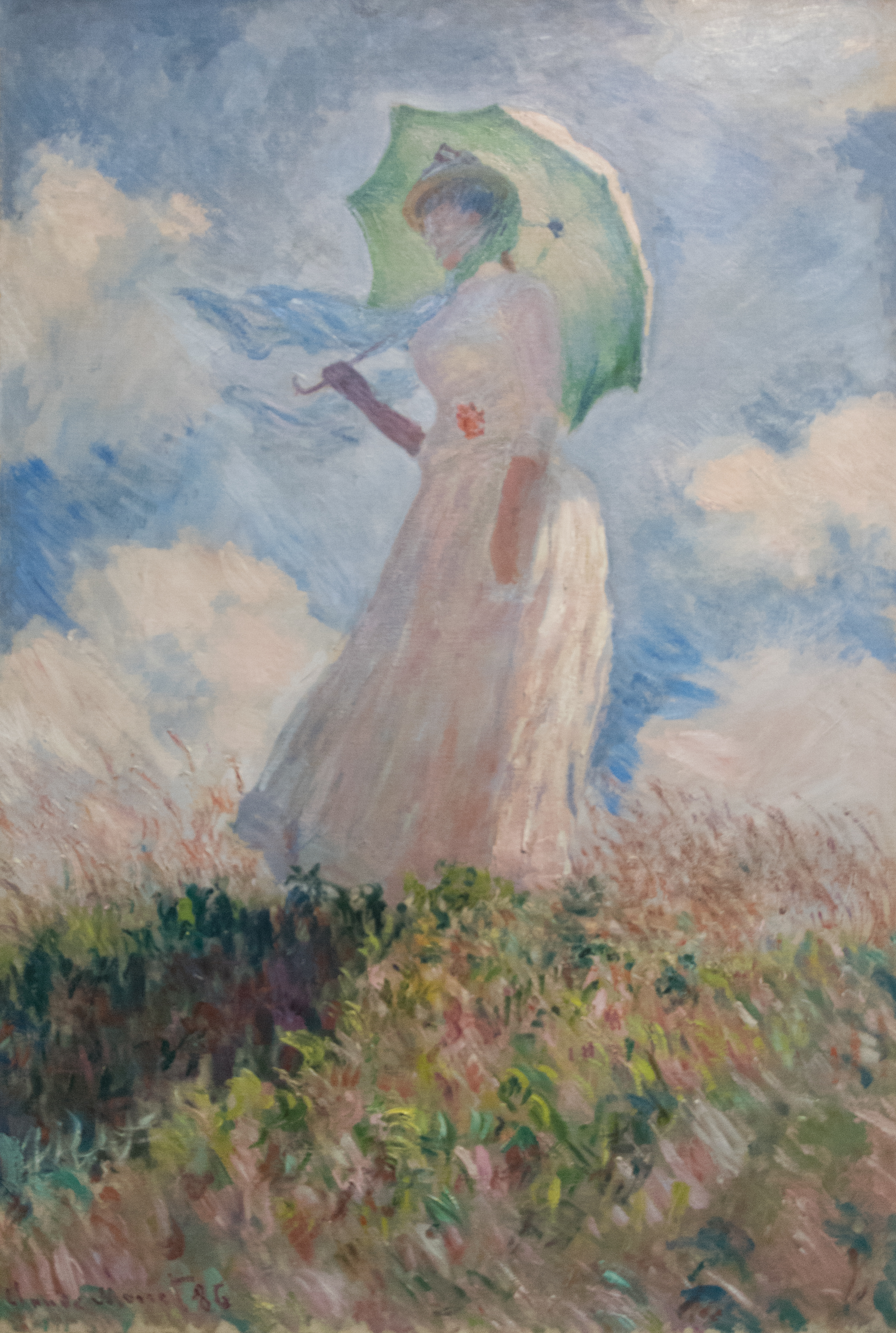
9. Study of a Figure Outdoors: Woman with a Parasol, Facing Left — Claude Monet, 1886
Monet’s Study of a Figure Outdoors: Woman with a Parasol, Facing Left enlarges the solitary figure until she towers against the sky. Seen from below, the woman turns left under a green parasol. Her pale dress, veil and surrounding grasses all appear unsettled by moving air, while clouds occupy nearly every open space around her.
The Musée d’Orsay records the French title Essai de figure en plein-air : Femme à l’ombrelle tournée vers la gauche, dates the oil on canvas to 1886, and identifies it as RF 2621, measuring 131 by 88.7 centimetres.[9] The title’s “study” is important: this is an experiment in placing a figure outdoors, where changing light and wind resist the stable clarity of a studio portrait.
Compared with the 1875 painting of Camille and her son, the later work removes narrative companionship and presses closer to the figure. Yet her face is even less individually descriptive. The parasol, profile and billowing clothing provide recognition through large shapes. We perceive a person through the atmosphere acting upon her. The object does not merely shield her from sunlight; its tilt supplies the strongest directional signal in the picture.
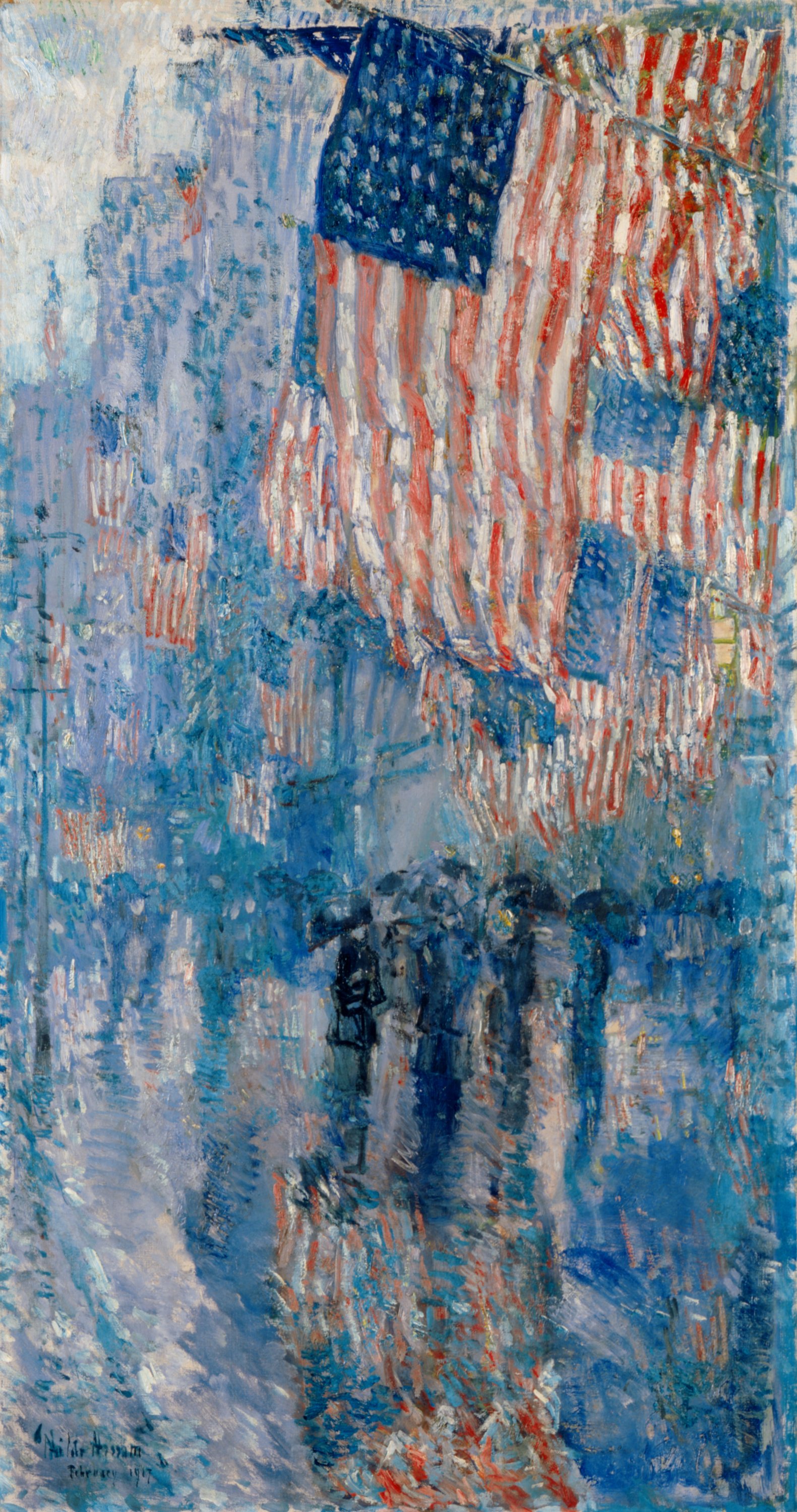
10. The Avenue in the Rain — Childe Hassam, 1917
Childe Hassam’s The Avenue in the Rain looks down a wet Fifth Avenue beneath an array of American flags. The flags project into the composition from unseen buildings, filling much of the upper surface with red, white and blue. Far below, pedestrians carrying dark umbrellas gather into a narrow band reflected on the street.
The White House Historical Association records the oil on canvas as White House Collection 963.422.1, signed and dated February 1917, measuring 106.7 by 56.5 centimetres.[10] The Smithsonian’s inventory corroborates Hassam’s authorship, the 1917 date and the work’s White House custody.[11] Those records fix the identity of a painting in which weather, urban space and national display are inseparable.
Umbrellas are small here, but they are crucial evidence of the rain named by the title. Their clustered dark forms establish the scale of the pedestrians and the depth of the avenue. Above them, the flags act almost like immense suspended canopies, breaking the view into overlapping planes. Hassam compresses the city vertically: people, reflections and architecture are subordinated to fabric moving overhead. Visit Childe Hassam for more American Impressionist city scenes and flag paintings.
How to compare umbrellas and parasols in paintings
Begin with the canopy’s orientation. Goya turns the underside toward us, making the parasol a bold oval. In Lise, lace softens the edge and lets the wooded darkness show through. Monet tilts green canopies against open sky, while Renoir and Caillebotte overlap many umbrellas until they become a system. A simple object can therefore behave as portrait frame, directional arrow, repeated pattern or temporary roof.
Next ask what kind of space the object creates. A single parasol establishes intimacy around Goya’s seated woman or Tissot’s reclining figure. In a street scene, each umbrella claims a moving pocket of room. In Renoir’s crowd those pockets collide; in Caillebotte they remain separated across the boulevard. Seurat distributes them as measured accents, and Hassam reduces them to a dark human scale beneath vast flags.
Weather and light should be inferred from the whole painting, not from the object alone. Closed parasols, wet reflections, streaming veils, bent grasses and the posture of a hand all matter. The same green canopy can signify composed shade in Goya and wind-borne instability in Monet. Looking for those supporting clues prevents “umbrella” from becoming a label pasted onto otherwise unrelated works.
The sequence also demonstrates a historical concentration rather than a universal story. Its strongest cluster belongs to French modern painting, where outdoor leisure, rebuilt streets and changing light became important subjects. That concentration can be explored through the artists and movements linked above. For a contrasting account of twentieth-century form that moves away from observed weather and social space, the Cubism guide provides a separate route; it is not the organising category for the paintings here.
Most importantly, compare relationships. Who holds the object, who shares its shelter, and who remains outside it? Does the canopy reveal a face, conceal the sky, divide a crowd or connect foreground to distance? Answering those questions turns a familiar accessory into a tool for reading composition. Across these ten works, umbrellas and parasols matter because they alter how bodies occupy painted space.
Frequently Asked Questions
Francisco de Goya's The Parasol, painted in 1777 as a tapestry cartoon for El Pardo, begins the sequence. [1]
A parasol primarily provides shade, while an umbrella protects against rain; painters use both canopies to frame figures and structure space. [1]
They suit outdoor leisure and modern street subjects while giving artists clear shapes through which to describe light, weather, movement and crowds. [5]
The clustered dark umbrellas establish the pedestrians' scale and make the rain legible beneath the much larger field of flags. [10]
Discussion
Use this work-led guide as a starting point for close looking rather than a universal history of umbrellas and parasols.
Share an observation about how a canopy changes the space around a figure, a crowd or the weather in one of these paintings.
Reader Insights
Which painter uses the canopy's tilt or edge most decisively to direct your eye?
How does a single parasol around one figure differ from repeated umbrellas across a crowd?
Where does shelter create privacy, and where does it instead make the holder more visible?
Join the Conversation
Add your reading below, keeping observations specific and evidence clear.
References
- Museo Nacional del Prado, “The Parasol”.
- Museum Folkwang, “Lise with a Parasol”.
- Museo Nacional Thyssen-Bornemisza, “Woman with a Parasol in a Garden”.
- National Gallery of Art, “Woman with a Parasol—Madame Monet and Her Son”.
- Art Institute of Chicago, “Paris Street; Rainy Day”.
- The Metropolitan Museum of Art, “In Full Sunlight (En plein soleil)”.
- National Gallery, “The Umbrellas”.
- Art Institute of Chicago, “A Sunday on La Grande Jatte—1884”.
- Musée d’Orsay, “Essai de figure en plein-air : Femme à l’ombrelle tournée vers la gauche”.
- White House Historical Association, “The Avenue in the Rain”.
- Smithsonian Institution, “The Avenue in the Rain”.