


 by
Tom Gurney
Tom Gurney BSc (Hons) is an art history expert with over 20 years experience
Published on October 6, 2016 / Updated on October 23, 2026
Email:
tomgurney1@gmail.com
/ Phone:
+44 7429 011000
Study of a Figure Outdoors: Woman with a Parasol
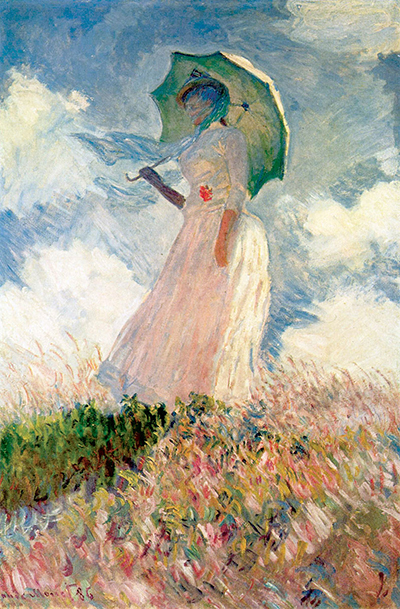
Study of a Figure Outdoors: Woman with a Parasol is Monet's 1886 painting of Suzanne Hoschede turned towards the left. It belongs to the Musee d'Orsay, where it is catalogued as RF 2621. [1] A green parasol frames her head, while pale fabric and clouds seem to move together in the wind.
At a Glance
Looking up at the figure
The spectator looks towards Suzanne from below the level on which she stands. The grass rises across the bottom of the canvas, leaving most of her figure against the sky. This low viewpoint gives her a substantial presence without placing her in a formal interior.
The tall format reinforces that effect. Her skirt extends down towards the foreground, while the parasol occupies the space above and behind her head. Very little architecture or distant landscape intervenes. Figure, grass and sky form the main elements of the painting.
The pose is not rigidly upright. The dress slopes gently towards the left at the bottom, and the scarf projects in the same direction above. Against these movements, the lowered arm forms a more vertical line. The balance makes the figure seem responsive to the conditions around her.
Her face is shaded and only lightly described. This does not erase her identity, which is documented by the museum, but it changes the painting's emphasis. The contours of clothing and parasol are more immediately legible than individual facial features.
Suzanne Hoschede as a model
Suzanne was the daughter of Alice Hoschede, whom Monet married in 1892. The Met's account of his later Stroller identifies Suzanne as a preferred model during the years after Camille Monet's death in 1879. [6]
That family connection distinguishes this picture from the more famous Woman with a Parasol of 1875. The National Gallery of Art identifies the earlier figures as Monet's wife Camille and their son Jean. [4] Suzanne is not simply another name for the woman in that painting.
In the 1886 study, her role is both personal and pictorial. She is a known member of Monet's household circle, but her figure also supplies the principal light shape around which the composition is arranged. Her pale dress gives the sky and grass something to act upon visually.
The small red accent near her waist is particularly effective. Set against the cream, pink and bluish fabric, it provides a compact point of stronger colour. It helps locate the body within a dress whose folds and outer edges otherwise remain deliberately mobile.
Wind across clothing and sky
The scarf stretches towards the left in long, pale strokes. Its loose ends seem to pull away from the head, while the parasol holds a much firmer outline. These two accessories make different responses to the same implied movement of air.
The sky is equally active. Broad white passages curve through blue and grey, with strokes that remain visible rather than disappearing into a smoothly blended surface. Some cloud forms gather around the figure; others open towards the edges.
The dress connects the upper and lower parts of the picture. Longer marks follow its length, while smaller changes of colour suggest folds and interruptions of light. Near the hem, the fabric meets grass painted in short, varied touches.
Together these marks produce a sense of animation without showing a dramatic event. Suzanne is not running or struggling through a storm. Much of the movement is carried by the materials around her: scarf, dress, parasol and clouds. Their different textures allow the scene to feel breezy while the central figure remains recognisable and composed.
White fabric as a field of colour
The dress is described as white, but its painted appearance contains far more than white pigment. Pink, cream, pale blue and violet-like shadows divide it into differently lit areas. The colour is most noticeable when compared with the darker green parasol and the dense foreground shadow.
Dominique Lobstein's Orsay-authorised account of the pair places Suzanne on the embankment of the Ile aux Orties near Giverny. It relates the strong light and coloured shadows to Monet's continuing investigation of the figure within landscape. [3]
This setting is not a seashore. The impression of fresh air does not require waves, salt water or a coastal breeze. A riverbank and open sky provide enough space for the figure to encounter light and movement.
The parasol also changes how we see her. Its green underside creates a darker zone around the head, while the rim catches light. The face remains comparatively indistinct beneath it, encouraging the eye to follow the larger colour relationships between the canopy, scarf and dress.
A pair, not a simple mirror image
The companion painting at Orsay turns the woman towards the right and carries a separate inventory number, RF 2620. [5] Its opposed orientation makes the two studies natural comparisons, but they are not one image mechanically reversed.
Direction changes the way the figure occupies the canvas. A parasol can open towards one side while the dress leads the eye towards another. The distribution of clouds and foreground colour then gives each canvas a different balance.
The earlier 1875 painting offers another comparison. It also uses a low viewpoint, a light dress, a parasol and a sky-filled background, but includes Jean behind Camille. [4] The later study concentrates the composition on one principal figure and gives the windblown scarf greater visual prominence.
These similarities do not require the pictures to be described as one formal series. They show Monet returning to a pictorial problem: how to place a light-clothed figure against an open sky without isolating that person from the surrounding atmosphere. The repeated subject becomes a means of varying the solution.
Repeated sittings behind a fleeting effect
The catalogue raisonne records Germaine Hoschede's recollection that Suzanne found the many sittings for this study exhausting. It also notes a drawing Monet made after the painting for an article by Octave Mirbeau in 1891. [2]
Those records complicate the impression of something caught in an instant. The loose marks and windblown fabric may suggest a passing moment, but the picture was not necessarily completed as quickly as its subject seems to move. Repeated posing and a fleeting visual effect can belong to the same work.
The later drawing is important for a different reason. It shows Monet returning to the painted composition in another medium, rather than proving that the oil was based on a preparatory drawing. The direction of that relationship matters.
The painting entered the French national collection through Michel Monet's gift in 1927. It was associated with the Louvre and the Jeu de Paume before its transfer to Orsay in 1986. [1] Today its distinctive strength lies in the integration of figure and setting: a familiar person becomes the centre of an entire arrangement of grass, fabric, cloud and light, without ceasing to be part of the outdoor world.
Frequently Asked Questions
No. That is a separate work in the National Gallery of Art. [4]
The catalogue records a family recollection of many sittings. [2]
Discussion
Look again at the images and ideas explored in Study of a Figure Outdoors: Woman with a Parasol. These editorial prompts invite your observations.
Reader Insights
Which part of the clothing gives the strongest impression of wind?
How does the green parasol affect the colours of the face and dress?
What changes when the figure is viewed from below?
Join the Conversation
Share a detail, comparison or question about Study of a Figure Outdoors: Woman with a Parasol below.
References
- Musee d'Orsay , Essai de figure en plein-air: Femme a l'ombrelle tournee vers la gauche, 1886, RF 2621. View source .
- Daniel Wildenstein , Monet: Catalogue raisonne, 1996, volume III, W1077, p. 408, Wildenstein Plattner Institute digital edition. View source .
- Dominique Lobstein , Orsay-authorised account of the 1886 parasol studies, reproduced for the 2007 Tokyo exhibition. View source .
- National Gallery of Art , Woman with a Parasol - Madame Monet and Her Son, 1875. View source .
- Musee d'Orsay , the right-facing companion study, 1886, RF 2620. View source .
- The Metropolitan Museum of Art , The Stroller, 1887: Suzanne Hoschede as Monet's model. View source .







