by Tom Gurney
Tom Gurney BSc (Hons) is an art history expert with over 20 years experience
Published on June 19, 2020 / Updated on October 2, 2026
Email: tomgurney1@gmail.com / Phone: +44 7429 011000
A woman in a white summer dress stands under a dark parasol near the edge of a wooded clearing. Sunlight reaches the fabric, while the trees behind her stay in deep shade. She is Lise Tréhot, a frequent model for Pierre-Auguste Renoir in the 1860s and early 1870s. He painted Lise with a Parasol, known to its holder as Lise – La femme à l’ombrelle, in 1867. The nearly life-size canvas belongs to Museum Folkwang in Essen, inventory G 144. Museum Folkwang object record. [1]
At 184 × 115.5 cm, the painting gives Lise the scale of a major Salon figure. Yet Renoir places that imposing figure in a leafy, changing light. The picture stands between formal portraiture and a scene of contemporary outdoor life. That tension helps explain why it mattered to Renoir's early public career: it was shown at the Paris Salon of 1868, before the first Impressionist exhibition existed. Museum Folkwang [1]; Barnes Foundation Renoir catalogue. [2]
At a glance
- ArtistPierre-Auguste Renoir
- Holder titleLise – La femme à l’ombrelle; English Lise with a Parasol
- Date1867
- MediumOil on canvas
- Dimensions184 × 115.5 cm
- SitterLise Tréhot
- CollectionMuseum Folkwang, Essen, G 144; acquired for its Hagen predecessor in 1901
This work in Renoir’s career
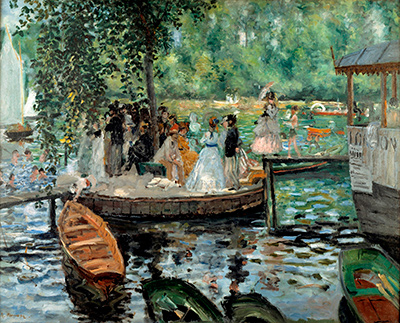
La Grenouillère
1869La Loge
1874The Umbrellas
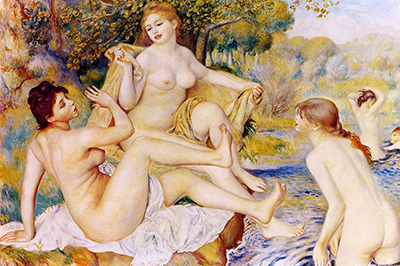
c. 1881–86The Great Bathers
1884–87The Bathers
1918–19Contents
- Annotated details of the painting
- A white dress in shifting light
- Why the outdoor setting matters
- Who was Lise Tréhot?
- The 1868 Salon
- Compare La Promenade : a later figure in the foliage
- From Hagen to Essen
- Looking again
Annotated Details from Lise with a Parasol
Lise Tréhot stands nearly life-size in a white summer dress beneath a black lace parasol.
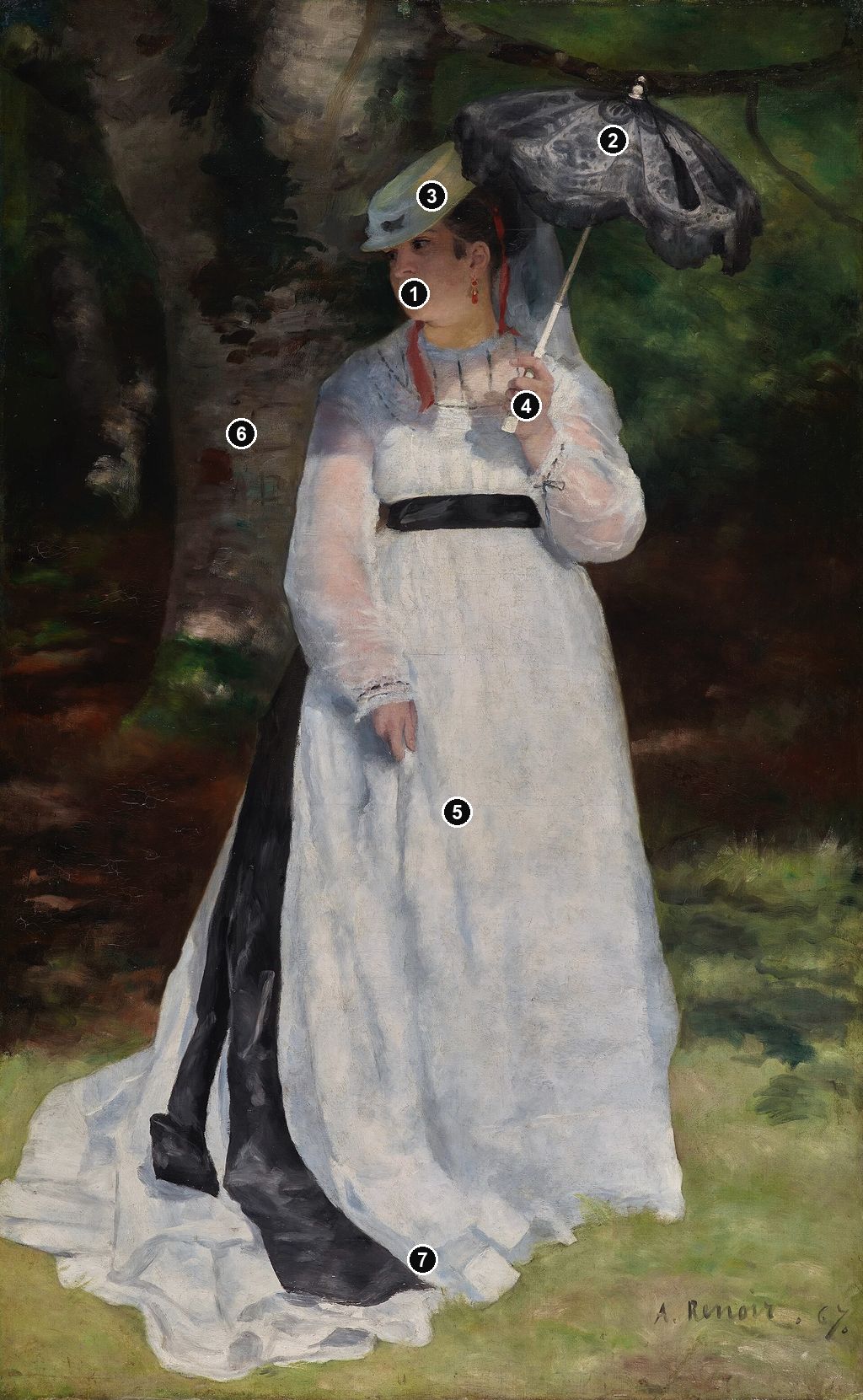
Details from LISE WITH A PARASOL
These details show Museum Folkwang G 144, painted in 1867 and exhibited at the 1868 Salon.
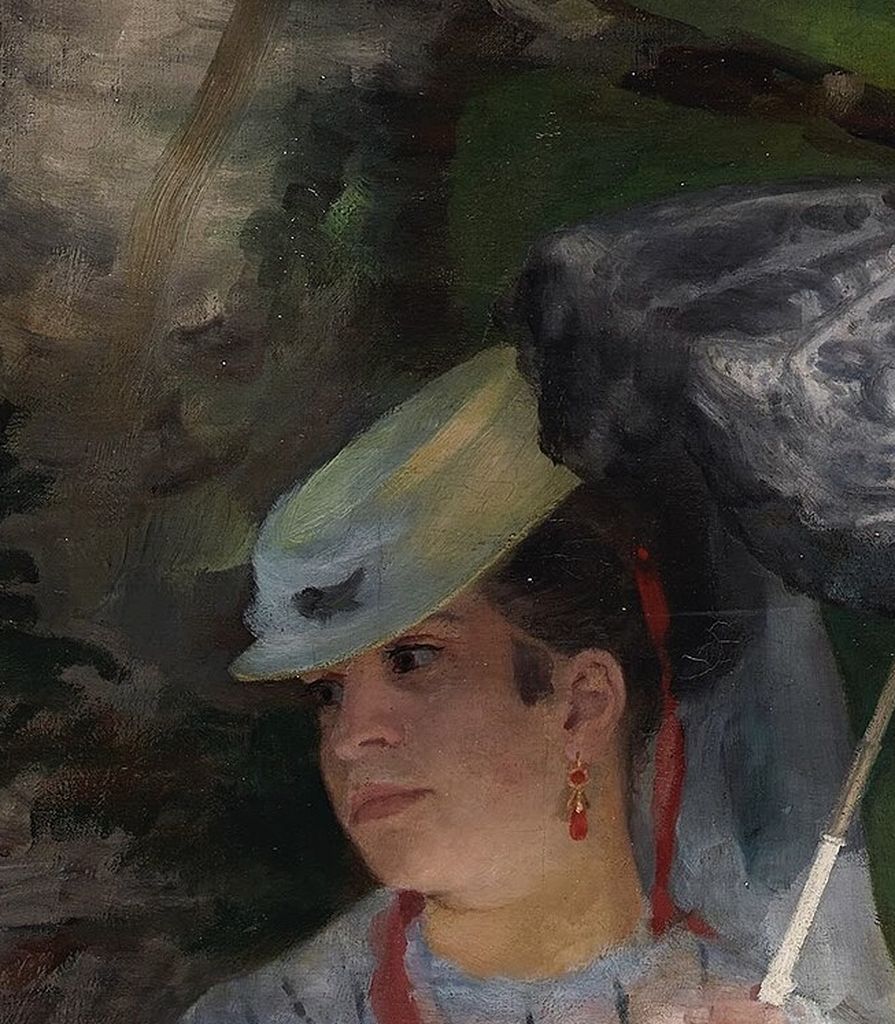
Lise’s face
Lise turns her face across the shaded clearing.
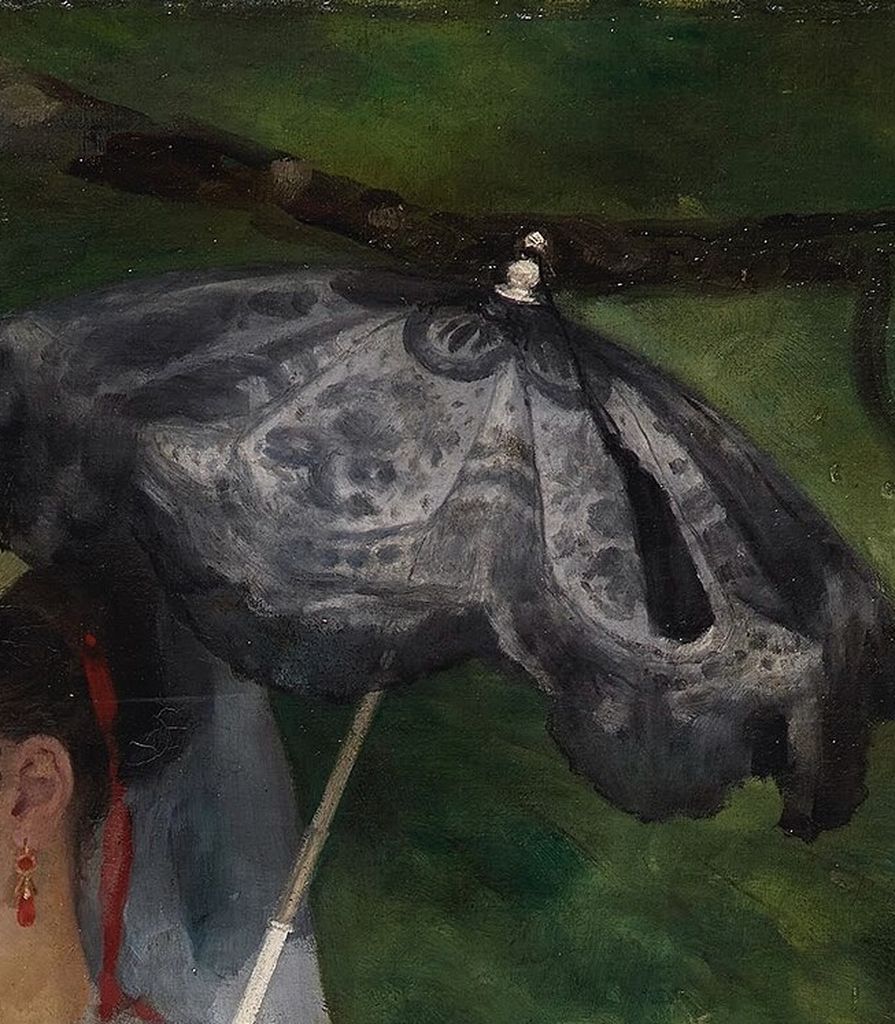
Parasol canopy
Black lace and white lining give the parasol changing tones.
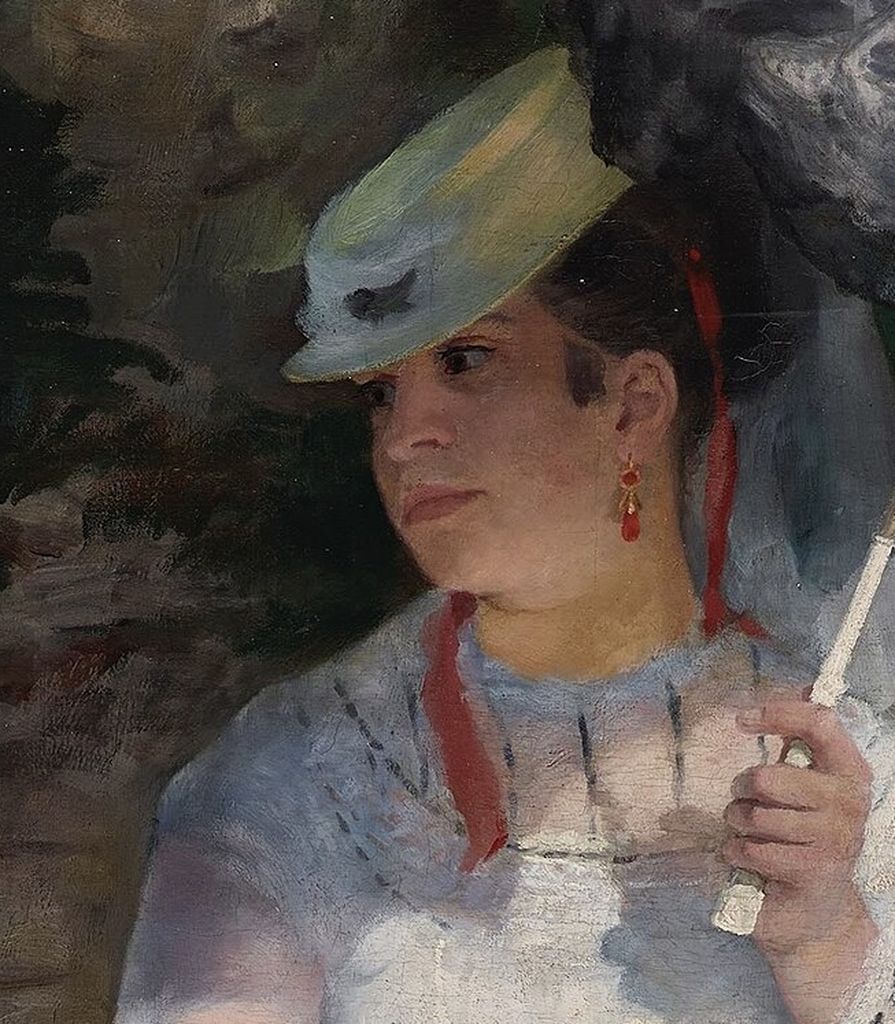
Hat and red accents
The hat’s ribbons and red earrings punctuate the pale clothes.
Hand on parasol
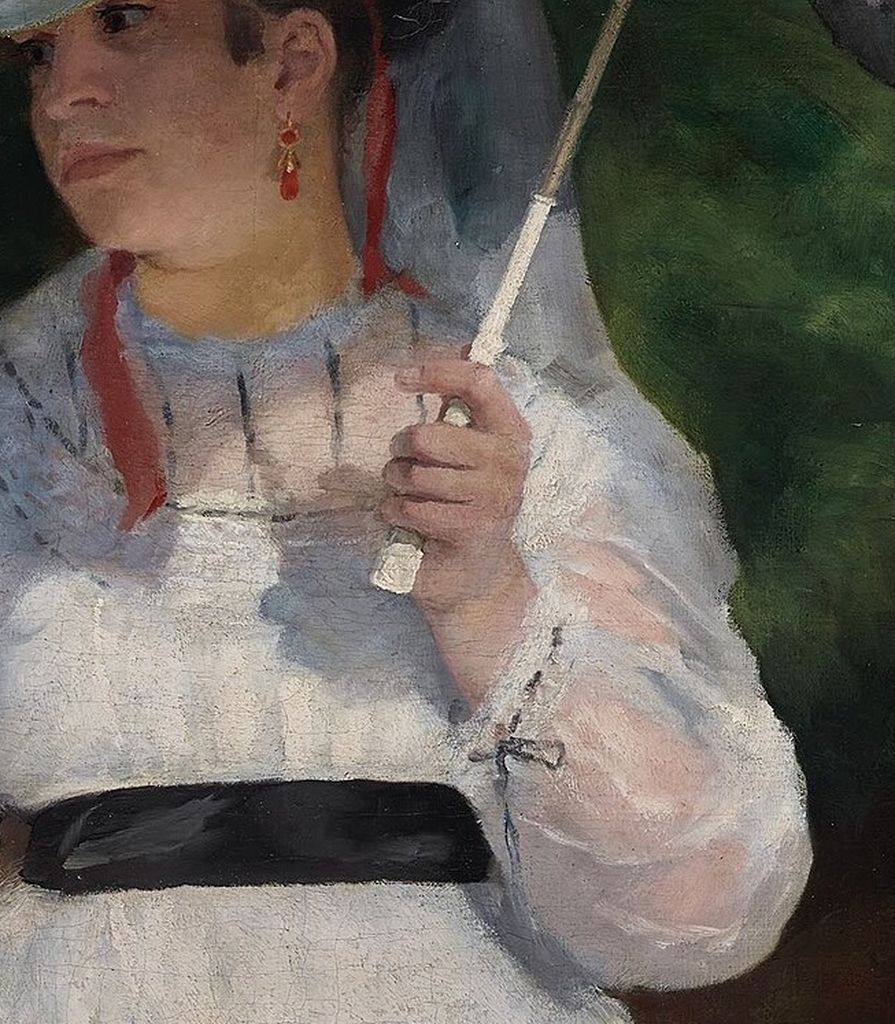
Her raised hand holds the parasol shaft close to her body.
White dress
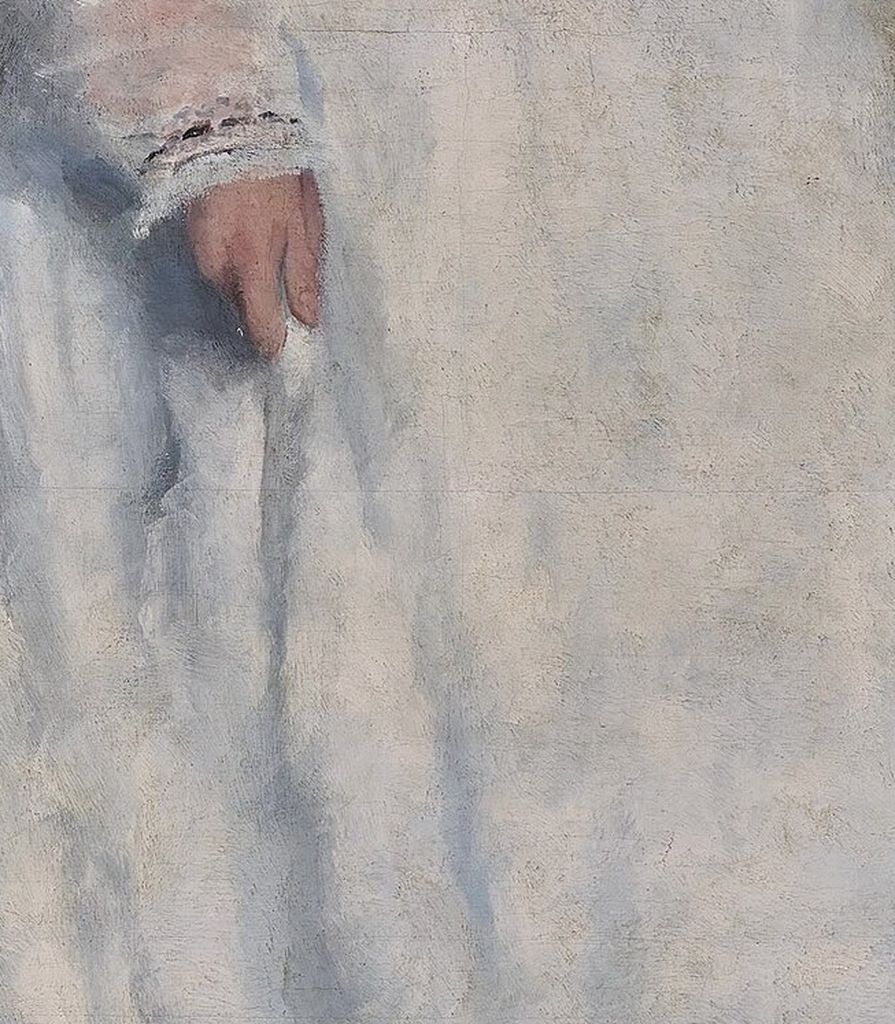
Cool and warm shadows make the white mousseline dress an active surface.
Tree and shade
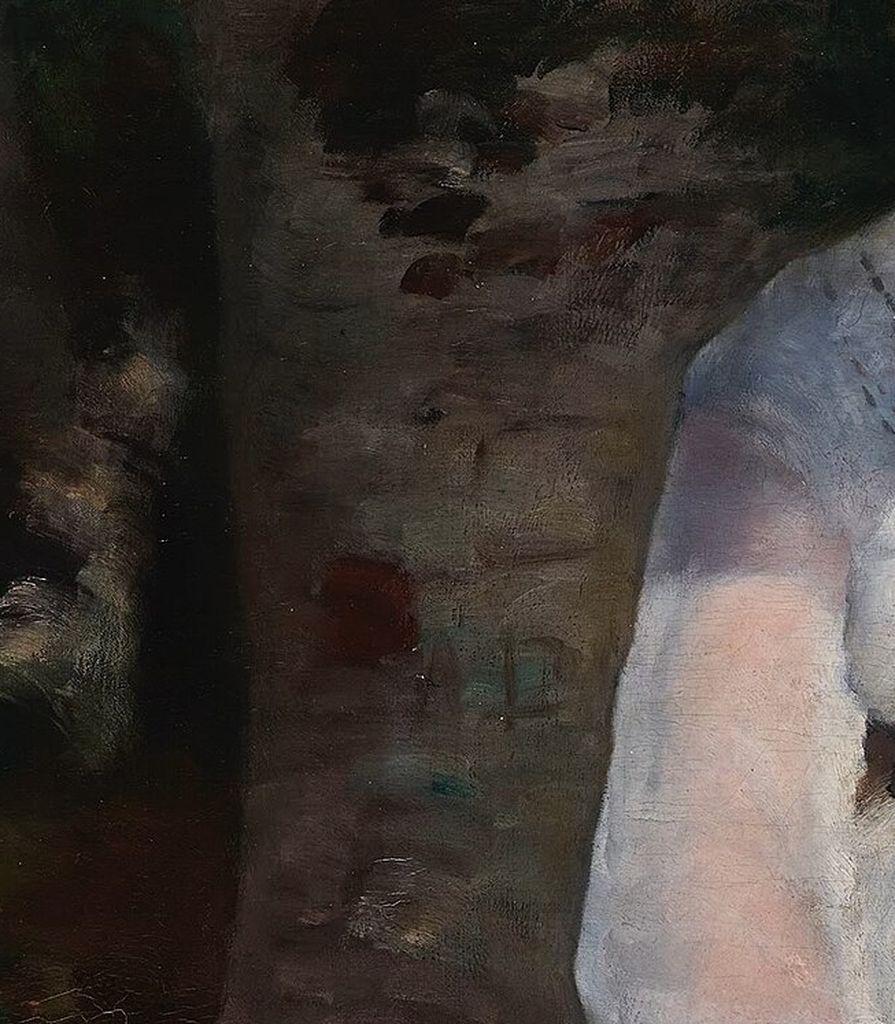
A dark tree trunk sets the bright figure against the wooded clearing.
Hem and grass
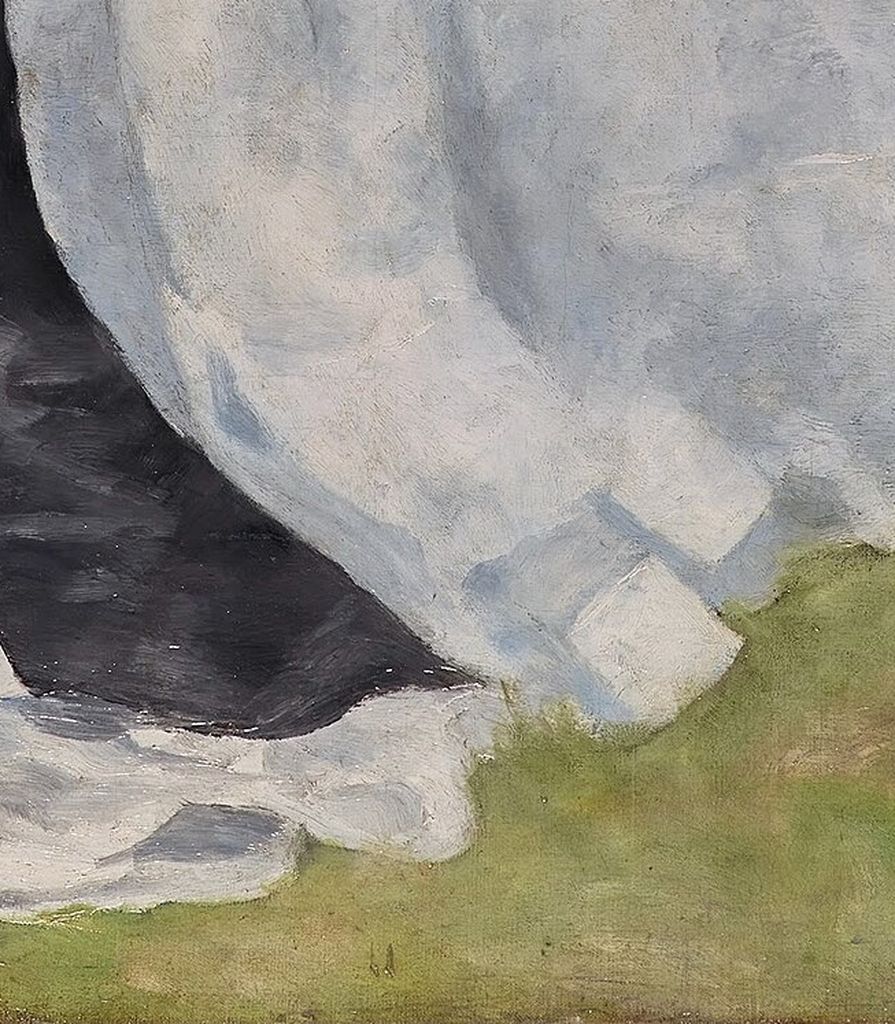
The sweeping hem meets sunlit grass at the bottom of the tall canvas.
Watch: Pierre-Auguste Renoir
Explore a Montmartre dance, a gathering beside the Seine and the drawings behind Renoir’s paintings.
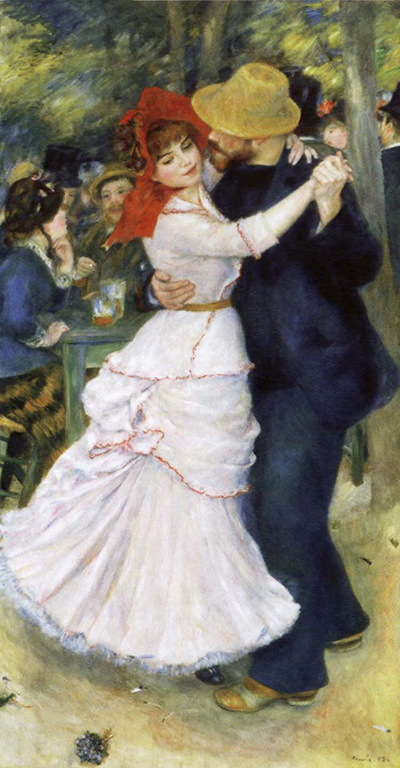
Renoir, Bal du moulin de la Galette
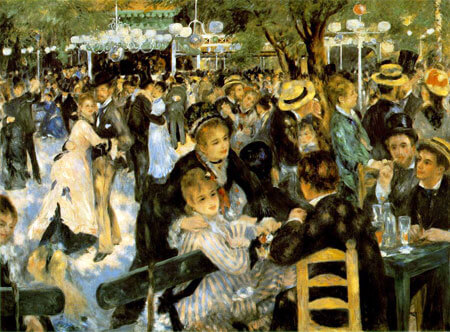
Dr. Beth Harris and Dr. Steven Zucker discuss Renoir’s 1876 Montmartre dance scene, its light and its crowds.
Watch on YouTubeRenoir artworks directory
A white dress in shifting light
Lise stands rather than walks. One hand holds the parasol; the other hangs beside the long skirt. The pose makes her easy to recognise from head to foot, but the dress refuses to be a flat white shape. Cool blues and greys mingle with pale warm strokes across its folds. The shaded ground and black trim set off the fabric's brightness. Renoir uses the contrast to join an individual figure with an impression of outdoor light. Museum Folkwang object and commentary. [1]
The Folkwang describes the dress as white mousseline, high at the neck and long in the arms. It interprets this as fashionable summer dress that protected from the sun and signalled propriety in its day. Small details give the sitter specificity: black ribbons at neck and sleeves; a straw hat with red ribbons; red drop earrings. The parasol combines ivory, black lace and white lining. These are not random colour accents. They carry the eye around the face, canopy and white clothing. Museum Folkwang commentary. [1]
Behind her, a large tree trunk divides the shadow. Renoir lets the wooded backdrop stay comparatively loose, so the carefully dressed figure has room to stand forward. Folkwang identifies the place as a clearing in the forest of Fontainebleau. It also says Renoir placed his initials on the tree as a sign of affection. That is the museum's interpretation of a small painted feature; the picture's main visible relationship remains between Lise, her clothing and the shaded setting. Museum Folkwang commentary. [1]
The parasol's size makes it more than a prop held by a sitter. Its black canopy creates a second dark shape above Lise's head, balancing the deep green and brown backdrop. The white lining catches light near her hand. From there, the light seems to continue into her bodice and across the dress. This is how a single object can help organise the whole picture: the canopy sets the darkest value, the dress the palest, and the face lies between them. The red notes of her ribbons and earrings are tiny by comparison, yet they stop the figure from dissolving into only black and white.
Lise does not gaze directly out at the viewer. Her turned face and still stance leave open whether she has stopped to pose or is pausing in a walk. The painting gives no companion and no narrated event. Instead, the full-length pose invites careful attention to the way fabric meets the weather and ground. The hem gathers and spreads in the grass; the darker underskirt and sash interrupt the column of white. The same movement of looking that begins at her face ends at the material weight of the dress.
Why the outdoor setting matters
The scale and upright pose could belong to a formal portrait, but Renoir surrounds Lise with a real-looking shaded clearing rather than a neutral interior. The tree occupies much of the left side; foliage and uneven ground continue around her. Museum Folkwang calls the combination of portrait and landscape the work's defining achievement. It also connects the scene to Fontainebleau, a landscape that was important to painters of Renoir's generation. Folkwang object commentary. [1]
The background does not describe every leaf or branch. Larger, darker passages make Lise's pale silhouette readable, while patches of light on the ground keep the setting from becoming a flat curtain. Her parasol promises shade, but the dress still gathers blue-grey and pink light. That mixture is a useful reminder that the canvas is not a simple demonstration of bright sunlight. Renoir sets a woman dressed for an outdoor day within a complex pattern of shelter, shade and reflected colour.
This outdoor setting also makes the fashionable clothing more striking. The museum reads Lise's covered arms and neckline as part of contemporary summer dress and its codes of propriety. The Metropolitan Museum of Art, in an exhibition on Impressionism and fashion, likewise singled out this painting when discussing how modern clothes could become a subject for outdoor painting. Met exhibition introduction. [3] These accounts describe historical dress and artistic choice; neither tells us what Lise herself thought of the outfit or the sitting.
Who was Lise Tréhot?
Lise Tréhot lived from 1848 to 1922. Museum Folkwang says Renoir met her through his friend Jules Le Coeur in 1865, and that she was his preferred model until 1872. She appears across Renoir's early work in different guises. Here the use of her first name for the Salon picture matters: the Barnes Foundation's Renoir catalogue notes that the original title simply Lise left the painting between portrait and genre scene. She is identifiable, but Renoir did not present it as a conventional commissioned family portrait with a full formal name. Museum Folkwang [1]; Barnes Foundation Renoir catalogue. [2]
The sitter's name prevents the picture from being reduced to a fashionable woman with an umbrella. At the same time, a named model does not make the painting a diary entry. Renoir built a public composition in which a recognisable person, contemporary dress and wooded landscape work together. Her individual presence and the pictorial experiment coexist.
Lise appears in other works from Renoir's early career, but the mere resemblance of a face is not enough to identify every woman he painted. The Art Institute of Chicago's scholarly catalogue identifies her in the smaller Lise Sewing of 1866/67, now in Dallas, and describes how Renoir could present her in different roles. In the Folkwang canvas, she is neither occupied with a domestic task nor transformed into a mythological figure. She stands, fully dressed, in a modern landscape. Art Institute of Chicago scholarly catalogue. [4]
The 1868 Salon
Renoir submitted Lise to the Salon of 1868, and it was accepted. The Frick Collection's Renoir chronology distinguishes this from the rejection of Diana the Huntress in 1867, another ambitious picture for which Lise modelled. The 1868 display placed Renoir's large canvas before the public at a time when admission to the Salon remained an important step for a young artist. Frick Collection chronology. [5]
Folkwang reports that Émile Zola and Zacharie Astruc, writing about the 1868 Salon, drew parallels with Manet's Olympia and Monet's Camille. Those are different paintings with different subjects; the comparisons locate Renoir's ambitious modern figure among works that had already prompted argument about contemporary women in art. They need not be collapsed into a single unanimous verdict, or treated as proof that Renoir imitated either canvas. The painting's public significance rests on its visible ambition and documented Salon appearance. Museum Folkwang commentary. [1]
The chronology also guards against calling Lise a product of the Impressionist exhibitions. The first of those group shows was still years away. Here Renoir tried to bring a modern subject and conspicuous outdoor effects into the established Salon. Its acceptance did not end debate about the style; it meant that a young painter's ambitious picture could be seen and discussed there. Folkwang describes it as an early landmark while also acknowledging its ties to realism and painting outdoors. Those overlapping descriptions suit a work made before Renoir's later Impressionist style had fully developed.
Compare La Promenade: a later figure in the foliage
Renoir returned to a woman in pale dress among trees in La Promenade of 1870, now at the J. Paul Getty Museum. The Getty canvas is much smaller, 81.3 × 64.8 cm, and introduces a second figure: a man guides a woman up a path through dense growth. Both the movement and the broken light differ from Lise's solitary, still presence in the Folkwang painting. The Getty explains how foliage and dappled light become active throughout the later scene. Getty collection and education record. [6]

The two pictures give different jobs to white fabric. In Lise, the dress makes a stable, almost uninterrupted form against the dark trees. In La Promenade, leaves, branches and flecks of light cross the dress as the figures move through the greenery. The comparison helps explain a change in pictorial emphasis over three years without turning one picture into a direct study for the other. It also shows why size matters: the monumental Folkwang canvas confronts a Salon viewer with one person, while the smaller Getty canvas brings the viewer close to an encounter in motion.
The identification of the Getty painting's woman requires care. A Getty publication describes Lise Tréhot as a possible model, and another Getty text notes that more than one name has been proposed. That is weaker evidence than Folkwang's identification of its own Lise canvas. The later painting can illuminate Renoir's treatment of outdoor figures even if the woman in it is left unnamed. Getty publication on La Promenade [7]; Getty collection catalogue. [8]
From Hagen to Essen
Museum founder Karl Ernst Osthaus acquired Lise in 1901 through the Berlin dealer Paul Cassirer for the original Museum Folkwang in Hagen. When the collection moved, the painting became part of Museum Folkwang in Essen from 1922. The acquisition helped establish the museum's early commitment to modern French painting. This is one continuous institutional story with a change of city, not two different original paintings. Museum Folkwang object record [1]; Museum Folkwang exhibition history. [9]
The museum returned to that collecting history in its 2022 exhibition Renoir, Monet, Gauguin: Images of a Floating World. It placed Osthaus's Lise in dialogue with works from Kōjirō Matsukata's collection at the National Museum of Western Art in Tokyo. The exhibition did not imply that the Japanese collector had owned this painting: Folkwang explicitly identified Lise with Osthaus. That comparison helps explain how an early Renoir acquired in Germany could be studied within a wider history of collectors who made French modern painting accessible through museums. Museum Folkwang, 2022 exhibition. [9]
Looking again
Look first at the black canopy and Lise's face. Trace the small red notes of ribbon and earrings, then follow the white dress downward into the grass. Finally let the tree and shaded clearing re-enter the view. Renoir makes a full-length figure command the canvas while giving the landscape its own active light.
Questions about Lise with a Parasol
She is Lise Tréhot, a recurring model for Renoir from the mid-1860s to the early 1870s, according to Museum Folkwang.
Renoir painted it in 1867. It was accepted for and shown at the Paris Salon of 1868.
At Museum Folkwang, Essen, inventory G 144. It was acquired in 1901 for the museum's predecessor in Hagen.
Discussion
Look closely at Lise with a Parasol and use the questions below to compare what you see with the documented history.
Reader Insights
How does the parasol organise Lise’s figure and the path?
Folkwang identifies the large canvas shown at the 1868 Salon.
What does this early work share with or resist in later Impressionist pictures?
Join the Conversation
Share a close observation or a source-backed question about Lise with a Parasol. The prompts above are starting points for discussion.
References
- Museum Folkwang, Lise – La femme à l’ombrelle, G 144, object, commentary and acquisition View source.
- Barnes Foundation Renoir catalogue, analysis of Lise as portrait and genre image View source.
- Metropolitan Museum of Art, Impressionism, Fashion, and Modernity, exhibition discussion of outdoor fashion View source.
- Art Institute of Chicago, scholarly catalogue on Renoir's Young Woman Sewing, discussion of the distinct Lise Sewing and her roles in early paintings View source.
- Frick Collection Renoir chronology, 1867–68 Salon context View source.
- J. Paul Getty Museum, J. Paul Getty Museum, The Promenade View source.
- J. Paul Getty Museum, Getty publication View source.
- Getty collection catalogue View source.
- Museum Folkwang, Renoir, Monet, Gauguin: Images of a Floating World, 2022 exhibition of the Osthaus and Matsukata collections, including Osthaus's Lise View source.
- Whole-work reproduction: Commons Lise with a Parasol file, Public Domain Mark faithful reproduction, with a 2022 colour correction noted in its file history View source.