by Tom Gurney
Tom Gurney BSc (Hons) is an art history expert with over 20 years experience
Published on June 19, 2020 / Updated on October 2, 2026
Email: tomgurney1@gmail.com / Phone: +44 7429 011000
Two people sit shoulder to shoulder in a red theatre box. The woman looks down towards a pale folded paper in her hands; the bearded man beside her looks away to the left. Pierre-Auguste Renoir's The Theater Box, also called The Small Theater Box, La petite loge or Die kleine Loge, belongs to Museum Langmatt in Baden, Switzerland. Its owner dates it circa 1873–74. This is the small painting behind this site's older title, The Little Theatre Box. It is a different canvas from Renoir's more famous La Loge at the Courtauld Gallery. Museum Langmatt's object entry [1]; Courtauld Gallery, La Loge. [2]
At a glance
- ArtistPierre-Auguste Renoir
- Owner titleThe Theater Box; also The Small Theater Box and French La petite loge
- DateCirca 1873–74, Museum Langmatt
- Medium and sizeOil on canvas, 27 × 20.7 cm in the owner record
- CollectionMuseum Langmatt, Baden, inventory 179
- SubjectTwo spectators seated in a theatre box
Watch: Pierre-Auguste Renoir
Explore a Montmartre dance, a gathering beside the Seine and the drawings behind Renoir’s paintings.
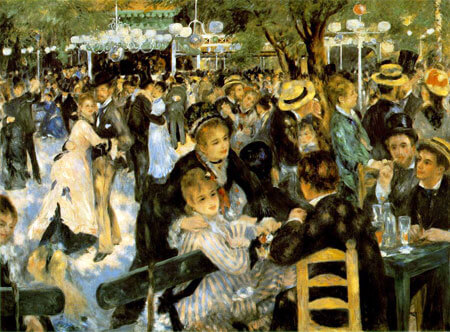
Renoir, Bal du moulin de la Galette
Dr. Beth Harris and Dr. Steven Zucker discuss Renoir’s 1876 Montmartre dance scene, its light and its crowds.
Watch on YouTubeThe measurements matter here. At only about 27 cm high, this picture presents a closely cropped pair rather than a broad account of an auditorium. The Courtauld's La Loge is 80 × 63.5 cm, nearly three times as high, and shows a differently dressed couple seen more frontally. The similar English titles can obscure two distinct objects. Museum Langmatt [1]; Courtauld collection record. [2]
What we can see
The high viewpoint brings us close to the sitters. Their heads nearly fill the upper half of the picture, while the curved red interior of the box encloses their bodies. The woman occupies the foreground and right side. She wears a pale dress with a dark band at the neck, an earring and a small ornament in her hair. Her companion's dark jacket and beard recede behind her shoulder. Neither looks at us. Instead, the two faces turn slightly apart, and both gazes lead down or out of the frame.
The pale form near the woman's hands is described as a theatre programme in the collection catalogue quoted by Museum Langmatt. The museum essay also proposes a handkerchief as a possible reading. In the reproduction it reads as pale folded material, but its precise purpose is not settled by sight alone. A programme is the catalogue identification, not a cue to invent a specific performance or a conversation between the pair. Even their expressions remain open: a downcast glance might suggest concentration, fatigue or a passing pause. The painting does not confirm any one of those stories. Museum Langmatt, object interpretation. [1]
Renoir gives us no view of a stage. The sharply cropped theatre setting is conveyed by the red lining, seated posture and the pairing of spectators. This omission directs attention to the people who are watching, or perhaps waiting, rather than to the entertainment they came to see. It also makes the viewer's position ambiguous. We seem to look down into their private space from nearby, yet the figures do not acknowledge our presence.
A narrow space made with colour
Red surrounds the pair along the back and right edge. Renoir uses that warm enclosure to hold together two otherwise differently lit figures: the woman's face and bodice are pale, while the man's coat creates a dark wedge at the left. Her head is set against reddish brown; his profile meets a lighter patch at the upper left. These changes of value keep their overlapping silhouettes legible within a small format.
The brushwork is especially visible in the woman's dress. Short, varied strokes in cream, grey, pink and faint yellow suggest fabric without closing every contour. Darker marks at her neck and waist stop the pale dress from dissolving into the paper in her lap. Her earring and hair ornament are small points of light against deeper paint. This is a close reading of the image, not a claim about a documented sequence of Renoir's working sessions.
The red box has another effect. It places the two people physically together while their attention remains separate. The man faces left; the woman leans forward and down. The picture gives us the tension between proximity and private thought without giving us the words or relationship that might explain it. That restraint is part of what makes the tiny scene worth looking at slowly.
The theatre box as an early Renoir subject
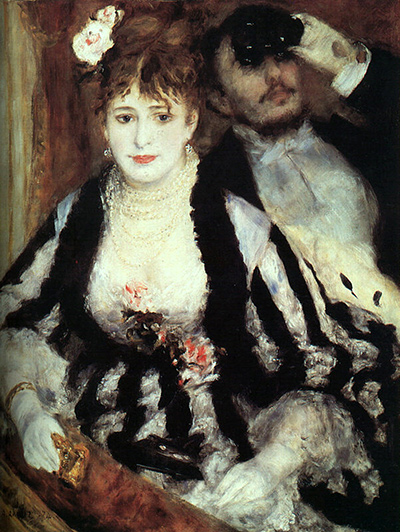
Renoir returned to theatre spectators in the 1870s. The Courtauld Gallery's La Loge is dated 1874 and was shown in the first Impressionist exhibition that year. In that larger painting, a woman faces us while a man behind her looks through opera glasses towards the audience. The Courtauld identifies the models there as Nini Lopez and Renoir's brother Edmond. Those names belong to the Courtauld work's documentation. Museum Langmatt's small canvas has different figures and gives us no secure identification for either person. The older article on this site incorrectly carried those sitter names across to the small painting. Courtauld Gallery object record [2]; Museum Langmatt. [1]
Another separate picture, At the Theatre (La Première Sortie) in the National Gallery, London, is dated 1876–77 and shows two young women looking towards the audience below. Together, the works show Renoir revisiting a social setting where people watch and are visible to others. They do not form a documented sequence of preparatory studies. We can compare viewpoints and the direction of each gaze without claiming that one picture was made directly for another. National Gallery, At the Theatre. [3]
The old local copy also claimed Renoir sketched this scene in a theatre and finished it in his studio. That specific account is unsupported for the Langmatt canvas in the available owner record. Studio staging is documented for the Courtauld La Loge, but evidence for one object cannot automatically establish how the other was painted. The small picture's lively surface allows us to describe what Renoir achieved, not to reconstruct an undocumented workday. Courtauld Gallery on La Loge. [2]
Title, date and collection
The Little Theatre Box, The Small Theater Box, La petite loge and Die kleine Loge are labels encountered for this same small Museum Langmatt painting. The owner museum's circa 1873–74 date conveys an approximate range, rather than a signed year proved by the image. Some short catalogue listings reduce it to 1873; here the owner record takes precedence. The inventory number 179 anchors the identification more firmly than a translated title alone. Museum Langmatt [1]; Wikimedia Commons object and file record. [4]
Museum Langmatt preserves the painting as part of the collection associated with Sidney and Jenny Brown. Its object entry establishes the present collection and dimensions; it does not provide a secure acquisition date for this canvas. A detailed path from Renoir's studio to the Browns should therefore wait for documented provenance. The museum's online title is The Theater Box; the inventory number and pictured object help distinguish it from similarly titled paintings. Museum Langmatt collection [5]; Commons record citing Langmatt, inventory 179. [4]
Looking again
Start with the woman's bright sleeve and follow the curve of the box around her hair. Then look left to the man's profile. They are close enough to overlap, yet the image does not tell us whether they are responding to the same thing. Return to the pale object in her hand: even its identity remains open between the catalogue’s programme and the museum essay’s suggested handkerchief. This small painting works by holding our attention on the act of looking and on what remains outside the frame.
Renoir artworks directory
Questions about The Small Theater Box
No. Museum Langmatt's picture is a 27 × 20.7 cm canvas dated circa 1873–74. The Courtauld's 1874 La Loge is 80 × 63.5 cm and shows a different couple.
Those are the models identified for the Courtauld La Loge. There is no secure identification for the two people in this Langmatt painting in the museum's available record.
The collection catalogue calls it a theatre programme. Museum Langmatt’s essay suggests it might instead be a handkerchief. The reproduction cannot settle the question, and the painting does not identify a performance.
Museum Langmatt dates it circa 1873–74. That is an approximate date, distinct from the Courtauld picture's firm 1874 record and signed date.
Discussion
What do you notice when you return to Little Theatre Box?
How does the high viewpoint bring the two spectators together inside the narrow box?
Reader Insights
How does the high viewpoint bring the two spectators together inside the narrow box?
Museum Langmatt records this small canvas around 1873–74; the Courtauld La Loge is a separate 1874 painting.
What can the woman’s paper and the figures’ downward glances suggest without settling a story?
Join the Conversation
Share a close observation or a source-backed question about Renoir’s little theatre box.
References
- Museum Langmatt, The Theater Box: owner identification, approximate date, medium, dimensions and interpretation. The current object page includes Markus Stegmann’s 2020 essay, which deliberately offers more than one reading of the figures View source.
- Courtauld Gallery, Courtauld Gallery, La Loge , P.1948.SC.338 View source.
- Courtauld Gallery, National Gallery, At the Theatre , NG3859 View source.
- Whole-work image: Wikimedia Commons, Renoir - Die kleine Loge, Um 1873-74.jpg, 824 × 1098 pixels, attributed there to the Museum Langmatt source and labelled Public Domain Mark under its PD-Art rationale. The displayed image is a reduced copy of the linked reproduction View source.
- Museum Langmatt collection View source.