Pierre-Auguste Renoir.jpg)
 by Tom Gurney
Tom Gurney BSc (Hons) is an art history expert with over 20 years experience
Published on June 19, 2020 / Updated on October 2, 2026
Email: tomgurney1@gmail.com / Phone: +44 7429 011000
Two women rest close to the viewer while three others gather around a stream at the right. The figures seem to belong to an endless warm afternoon. Pierre-Auguste Renoir painted this version of The Bathers (Les Baigneuses) between 1918 and 1919. It belongs to the Musée d'Orsay, accession RF 2795, and measures 110 × 160 cm. The museum describes it as one of Renoir's last major experiments with nude figures in a landscape. Musée d'Orsay object record. [1]
This is a specific late canvas, not a generic title for every Renoir bather scene. In particular, it is different from the Philadelphia Museum of Art's Great/Large Bathers, made in 1884–87. The Philadelphia painting is more sharply outlined and stages a playful splash among three large figures. The Orsay work gives two reclining women nearly the whole foreground and folds the other three into a softer, more spacious setting. Musée d'Orsay [1]; Philadelphia Museum of Art. [2]
At a glance
- ArtistPierre-Auguste Renoir
- Holder titleLes Baigneuses; English The Bathers
- Date1918–1919
- MediumOil on canvas
- Dimensions110 × 160 cm
- CollectionMusée d'Orsay, Paris, RF 2795; gift from Renoir's sons in 1923
This work in Renoir’s career
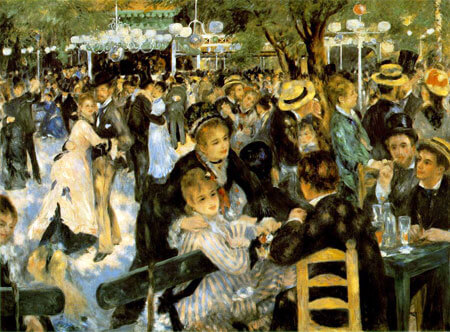
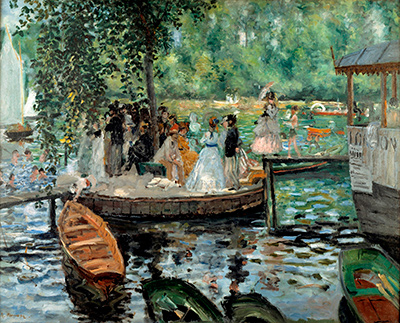
La Grenouillère
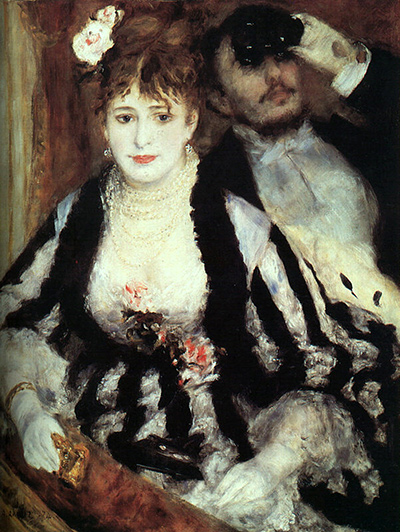
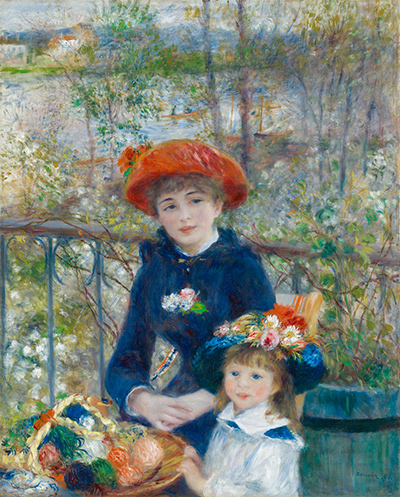
1869La Loge
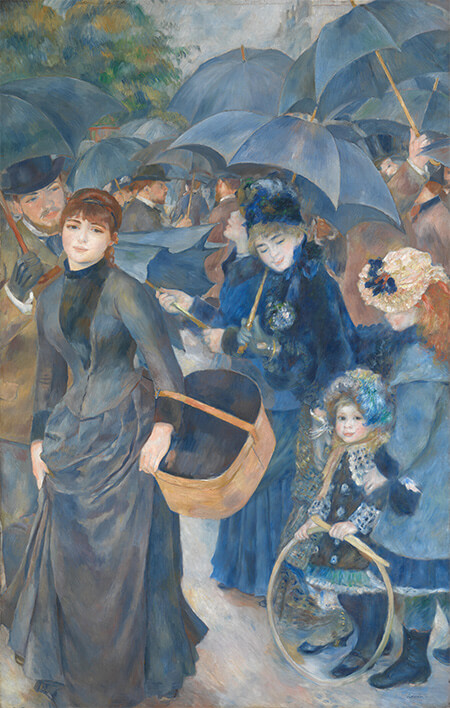
1874The Umbrellas
c. 1881–86The Great Bathers
1884–87The Bathers
1918–19Contents
- Annotated details of the painting
- Two figures hold the foreground
- Colour, cloth and the route through the picture
- A late return to bathers
- Compare Philadelphia's earlier Great Bathers
- From Renoir's family to the Musée d'Orsay
- Looking again
Annotated Details from The Bathers (1918–1919)
Two reclining foreground bathers and three figures near a stream fill Renoir’s late Orsay canvas.
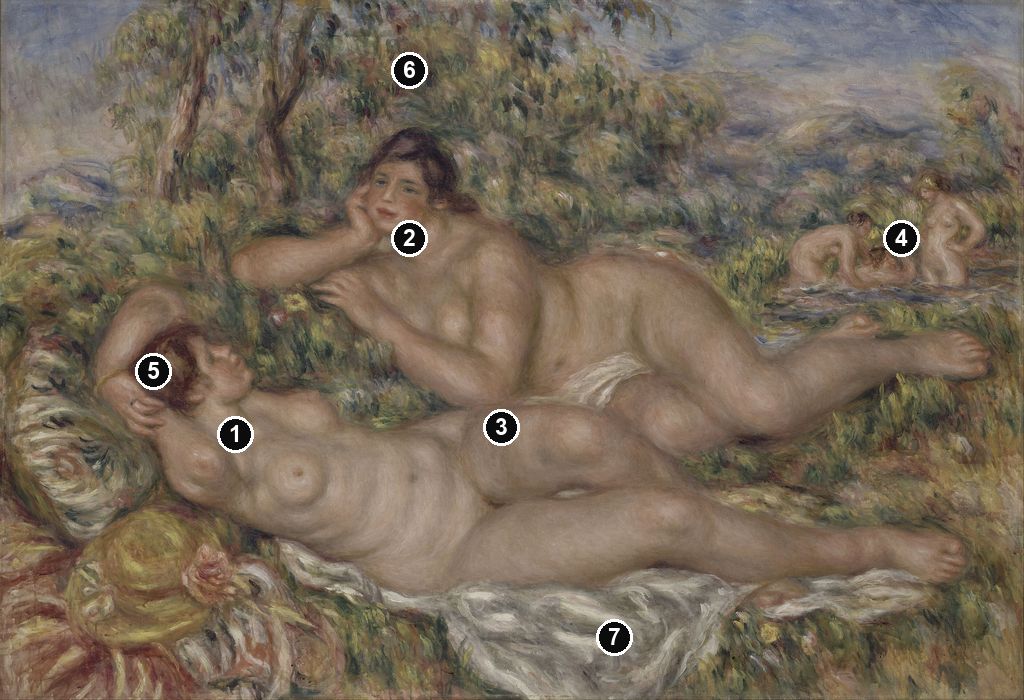
Details from THE BATHERS (1918–1919)
All details show Orsay RF 2795; they are not details of the earlier Philadelphia Bathers.
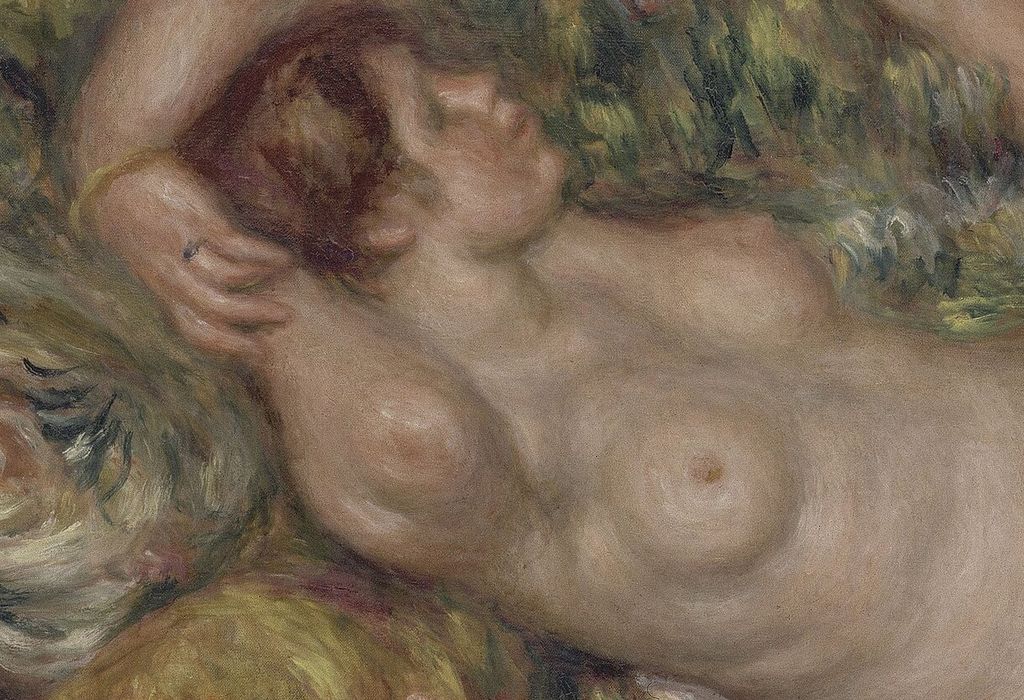
Reclining figure
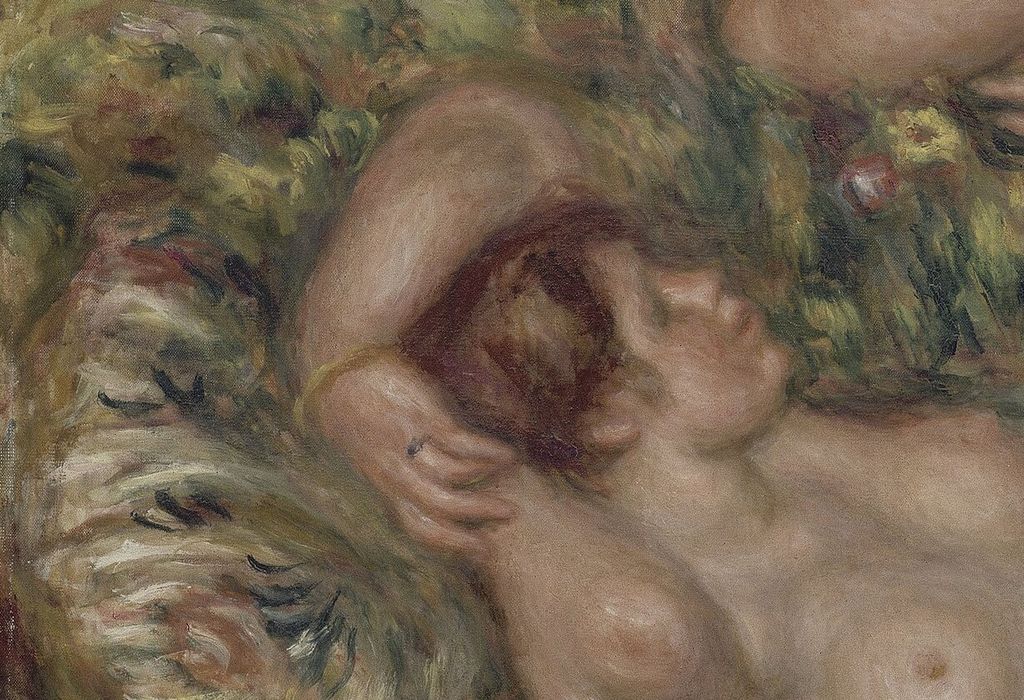
The lower figure curves an arm behind her head and extends across the foreground.
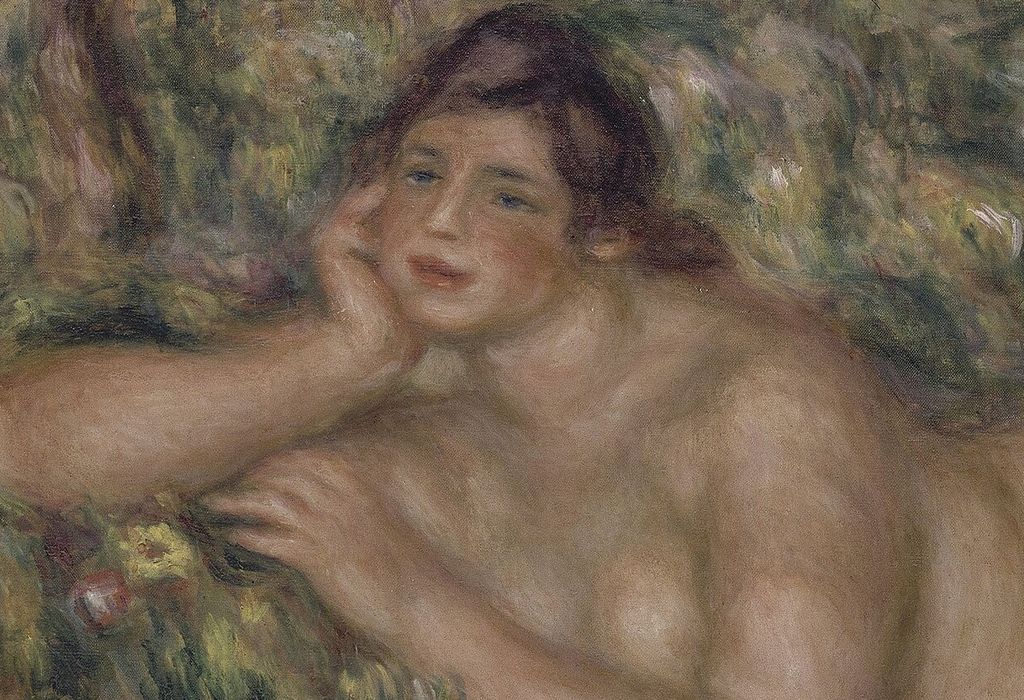
Upper figure
The second large figure rests on an elbow and turns toward the viewer.
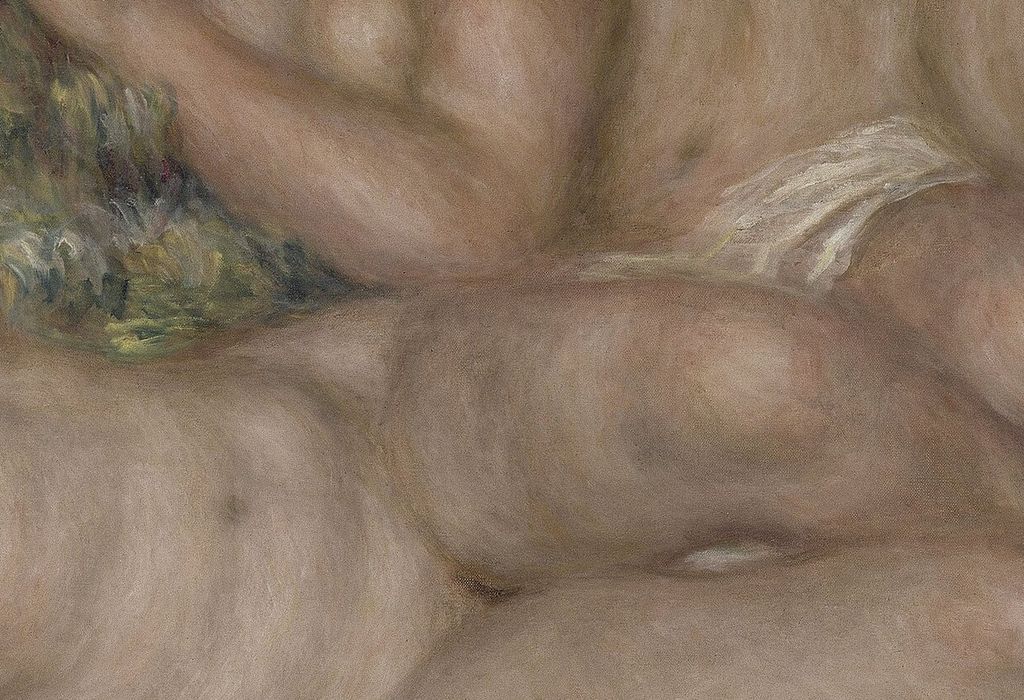
Linked foreground forms
Overlapping bodies and pale cloth give the broad foreground its rhythm.
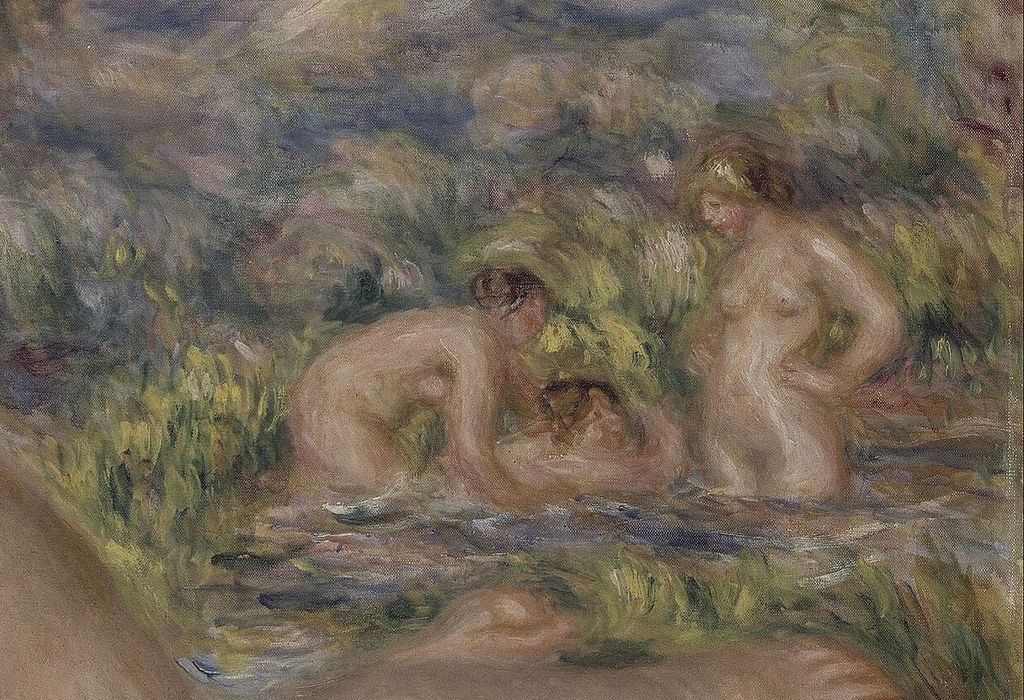
Three distant bathers
Three smaller figures gather around the stream at the right.
Curving arm
The near bather’s raised arm forms a strong curve within the relaxed pose.
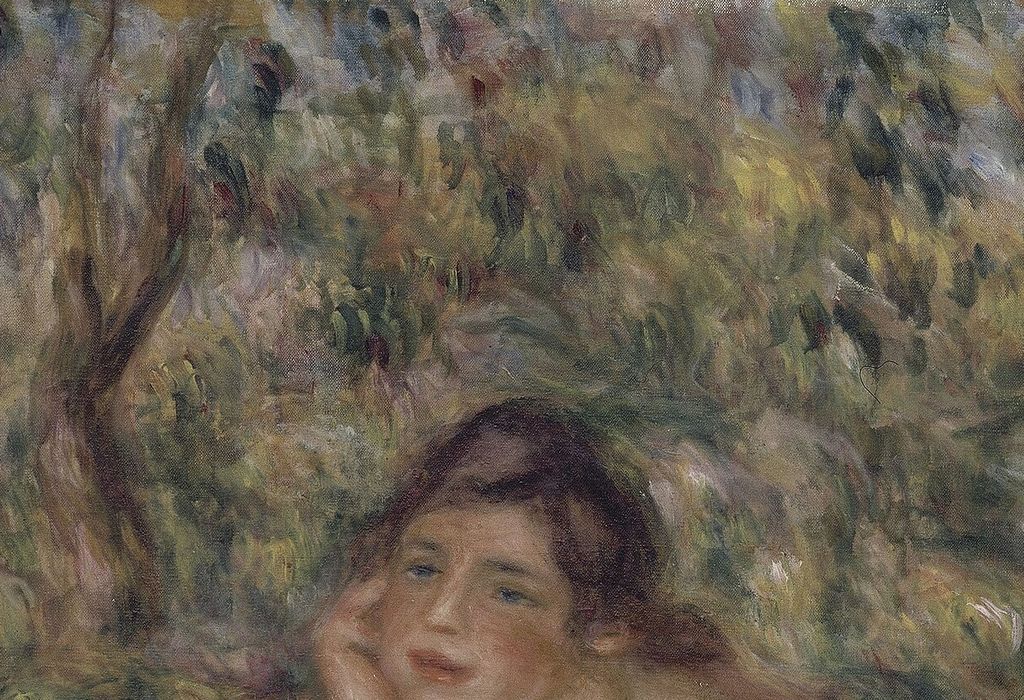
Olive trees
Loose foliage suggests a lush setting without mapping a precise site.
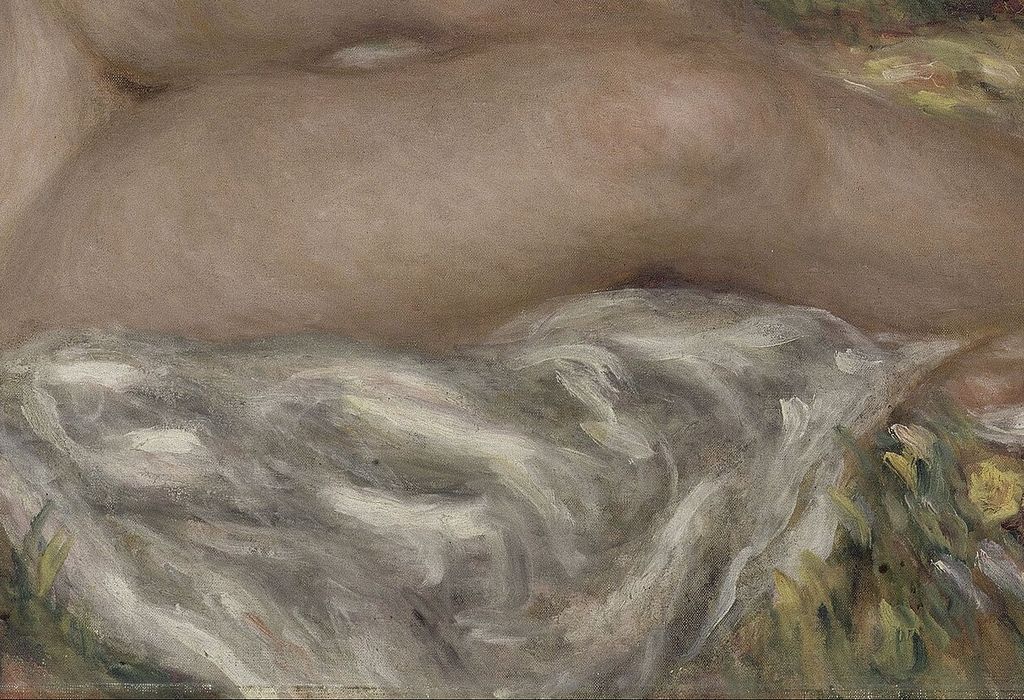
Cloth and grass
Pale drapery and grassy strokes meet at the bottom edge of the canvas.
Watch: Pierre-Auguste Renoir
Explore a Montmartre dance, a gathering beside the Seine and the drawings behind Renoir’s paintings.
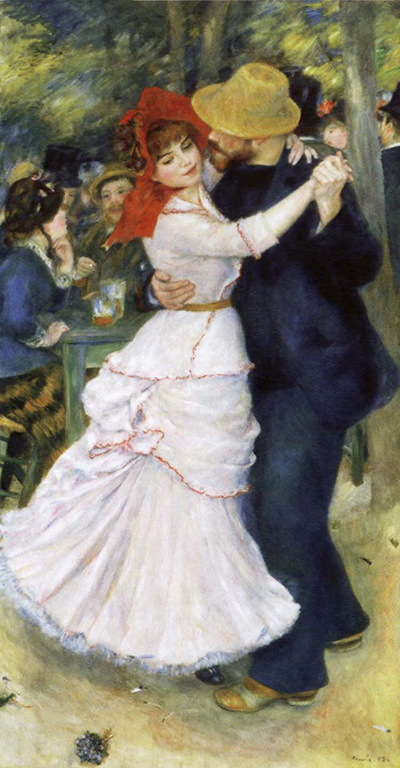
Renoir, Bal du moulin de la Galette
Dr. Beth Harris and Dr. Steven Zucker discuss Renoir’s 1876 Montmartre dance scene, its light and its crowds.
Watch on YouTubeRenoir artworks directory
Two figures hold the foreground
The lower woman reclines across the width of the painting, one arm curved behind her head. Above her, a second woman props herself up and looks outward. Their limbs and nearby cloth make broad curves that carry the eye from left to right. The scene has the loose intimacy of a pause after bathing, but Renoir arranged it on a large canvas. The bodies are carefully related in shape even where their edges seem to dissolve into grass and light. Musée d'Orsay image and essay. [1]
Farther back, three women appear at the stream. They are small beside the reclining pair, and their activity keeps the composition from becoming a simple double portrait. Notice how the right edge of the foreground woman's outstretched leg points towards them. A shift in scale, rather than a wall or path, separates near from far. The museum counts two foreground models and three bathers in the background; the painting should not be described as a scene of only two women. Musée d'Orsay object essay. [1]
The land appears lush but lacks signs of a particular modern resort or outing. Orsay says that the models posed in the large olive garden at Les Collettes, Renoir's property at Cagnes-sur-Mer in southern France. That is evidence about where they posed, not proof that this is a literal view of the property. Renoir used a real setting and living models to make an ideal landscape. Musée d'Orsay object essay. [1]
The foreground is almost filled by skin, pale drapery and close vegetation. The lower woman's body travels across the canvas, while the upper woman's bent arm and leg form another set of curves behind it. Their heads are near one another, but they look in different directions. The pair is linked by position and scale rather than by a visible conversation. Renoir gives the viewer a resting group whose forms can be followed slowly, not a single dramatic gesture to decode.
On the right, the stream creates a second, much smaller scene. One distant figure bends towards the water, while the others are absorbed into the bank and foliage. Their scale makes the foreground women feel close, but it also keeps the landscape active beyond them. Without those three figures, the picture might read mainly as two nudes posed before scenery. With them, the same motif repeats at a distance and carries the eye deeper into the painted world.
Colour, cloth and the route through the picture
The broad white cloth beneath the reclining woman is a useful starting point. It catches light beside her skin and then breaks into cooler grey and blue folds. Nearby foliage supplies greens, yellows and reddish notes. Those colours return in the distant bank and trees, helping near and far parts of the canvas feel connected even though the figures change greatly in size.
Renoir does not build every contour with a hard line. Some edges of the bodies remain clear enough to describe a shoulder or knee; elsewhere warm skin tones blend towards the plants and fabric. The tree and stream are similarly made from many colours rather than a uniform green or blue. The result is not simply softness for its own sake. Linked tones make the group and landscape share an atmosphere, while the larger curves of arms and legs keep the composition legible.
Look from the lower woman's raised arm to the upper woman's bent arm, then along the upper figure's extended leg towards the stream. This path moves across the picture without relying on a road or architectural perspective. The figures themselves establish the route. The white cloth and the small bright areas of water complete it, so the viewer can return from the background to the foreground. That circulation gives the large, horizontal canvas its slow pace.
A late return to bathers
Renoir returned to outdoor nudes repeatedly after 1910. The Orsay essay calls this canvas emblematic of that late experimentation. Earlier in his career, a bather could be tied to a specific episode or to a sharply observed landscape. Here the place is more timeless. The foreground women settle into the earth and cloth, while the stream and trees carry their warm tones away into the distance. Musée d'Orsay object essay. [1]
The museum compares the full forms to nudes by Titian and Rubens, artists Renoir admired. This is a comparison of approach, not an identification of one figure as a copy of a particular Old Master image. In the Orsay painting, colour and the linked curves of bodies do much of the organising work. The Philadelphia Great Bathers, by contrast, had pursued clearer sculptural edges in the 1880s. Both works show Renoir treating the bather as a serious figure-painting problem, though their answers differ. Musée d'Orsay [1]; Philadelphia Museum of Art. [2]
Sylvie Patry's Orsay lecture also reads the late groups through their curving, interlocking shapes and through the position offered to a viewer looking at women together. She compares Renoir's treatment with Ingres's Turkish Bath and contrasts it with the contemporary bathers painted by Suzanne Valadon. This is an art historian's comparison of approaches, not evidence that a particular Orsay figure copies an Ingres figure or that the five models can be named. It makes the picture's ideal world open to questions about viewpoint as well as colour and form. Musée d'Orsay lecture. [3]
The classical reference also helps explain what is absent. There are no contemporary clothes, bathhouses or holiday crowds. The women inhabit a space assembled from trees, stream and drapery rather than a named public beach. Orsay describes the late paintings as attempts at a timeless view of nature. Its mention of Titian and Rubens places The Bathers within a long history of ideal figure painting, while the actual posing at Les Collettes keeps the canvas tied to Renoir's late working life. Both kinds of information are needed; neither turns the view into a photograph of Cagnes. Musée d'Orsay object essay. [1]
One of the people in that late working life was Andrée Heuschling, a model who became Jean Renoir's first wife. Orsay's account of the Renoir father and son says she probably met the painter in 1915 and inspired late works including The Bathers. That account does not identify her as any particular woman in this five-figure composition. It gives useful context for the living models behind the imagined scene without turning a painted figure into a certain portrait. Musée d'Orsay, Renoir Father and Son. [4]
The dates 1918–19 also place the picture at the end of the First World War and in its immediate aftermath. In a 2026 Musée d’Orsay lecture, Sylvie Patry points out that two of Renoir’s sons had gone to the front and returned wounded. She reads the late bathers’ imagined abundance and health as one way the painter moved beyond the violence around him. This is a historian’s interpretation of the late series, not evidence that Renoir described this individual canvas as a direct response to the war. It gives the work’s apparently timeless world a historical setting without turning the figures into wartime allegories. Musée d’Orsay, Les Grandes Baigneuses de A à Z. [3]
Patry also describes Renoir’s late garden studio at Cagnes, built with large windows on several sides to bring shifting southern light indoors. The Orsay object account says the models for The Bathers posed in the olive garden, but neither source proves that every passage of this particular canvas was painted outside or inside that studio. Together they explain how observed models, a real property and an invented landscape could coexist in Renoir’s late practice. Musée d’Orsay lecture [3]; Orsay object account. [1]
Compare Philadelphia's earlier Great Bathers
The Philadelphia Museum of Art owns a distinct canvas, The Great Bathers, made in 1884–87. Its larger figures gather around a waterside encounter: one woman raises a cloth, another turns towards her, and a third approaches from the right. The forms are more firmly bounded than the reclining bodies in the Orsay painting, and the relationships between the principal figures have a more active rhythm. The earlier work is a useful comparison because it shows Renoir returning to the same broad subject with a different arrangement and treatment. Philadelphia object record. [2]
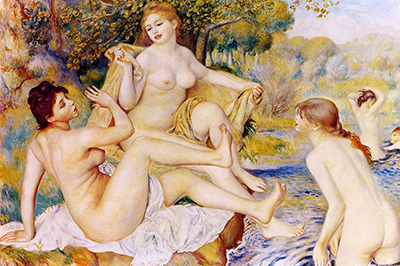
The Philadelphia picture brings its main figures close to an exchange of gestures across water. The Orsay picture instead places two large women at rest and sets the other three well back in the stream. Its action is quieter and its space more continuous. Comparing them side by side makes the change clear without reducing Renoir's decades of bather painting to one linear story of improvement or decline.
The titles make confusion especially easy. Great Bathers, Large Bathers, Bathers and Les Baigneuses appear in English and French discussions of different works. Use the museum, date and accession with the title: Philadelphia 1963-116-13, 1884–87 for the earlier canvas; Orsay RF 2795, 1918–19 for this late one. A detail cropped from either painting is not a third complete version.
Orsay suggests that The Bathers may be read as Renoir's pictorial testament, since he died in December 1919. That is the museum's interpretation of a late, ambitious canvas, not a recorded statement that Renoir declared it his final message. The picture rewards looking beyond the biography: the foreground figures, stream and trees show how he could still remake a familiar subject at the end of his career. Musée d'Orsay object essay. [1]
A Philadelphia Museum of Art publication offers another way to frame the same late canvas. Its description reports that Renoir considered the 1918–19 painting a starting point for further work. Read alongside Orsay's retrospective description, this keeps the date in perspective: the painting became one of his last major statements because of when his life ended, while the subject still gave him room to experiment. These are museum accounts of the work's place in his career, rather than a reason to treat every passage of colour as a farewell. Philadelphia Museum of Art, Renoir in the 20th Century. [5]
The museum also notes that illness did not end Renoir's interest in making paintings. That observation belongs in the context of the work rather than as an explanation for every brushstroke. The five figures, large format and related colour across the canvas show deliberate choices that can be examined on their own terms. A late date tells us when the picture was made; it does not by itself explain why the forms look as they do.
From Renoir's family to the Musée d'Orsay
The Orsay provenance records the canvas with Renoir's son Pierre until 1923. That year the artist's sons gave it to the French state for the Musée du Luxembourg. It later passed into the Louvre's care and was displayed at the Jeu de Paume before being assigned to the Musée d'Orsay in 1986. The 1923 transfer was a family gift, not a later purchase by Orsay. Musée d'Orsay provenance. [1]
The gift offers another reason the picture acquired a retrospective place in Renoir's story: his sons chose it as a work for a public collection soon after his death. Yet its lasting interest comes from what can be seen. A garden in the south becomes an imagined place; five models become a rhythm of near and far; a familiar bather subject becomes a wide, late composition.
The Orsay provenance dates the state’s acceptance process more precisely: a committee considered the sons’ gift on 5 March 1923, a council followed on 12 April, and the formal order was issued on 8 August. The canvas was assigned to the Musée du Luxembourg before its later Louvre and Jeu de Paume history. These are stages of one family donation, not three separate acquisitions. They show how quickly the work entered a public collection after Renoir’s death without telling us which son chose it or what each hoped viewers would see in it. Musée d’Orsay provenance. [1]
Looking again
Begin with the lower woman's curved arm. Follow the line of her body towards the right, then look back to the second woman's face and across to the three figures in the stream. The painting asks the viewer to move between a close, almost domestic rest and a landscape that seems to extend beyond them. Its softness is structured, not accidental.
Questions about The Bathers
Five: two large reclining women in the foreground and three smaller bathers near the stream, as the Musée d'Orsay describes them.
No. The Philadelphia work was made in 1884–87 and belongs to a different phase of Renoir's figure painting. The work here is Orsay's RF 2795, dated 1918–19.
Orsay says the models posed in the garden at Renoir's Les Collettes property in Cagnes-sur-Mer. It does not mean the completed background is an exact survey of that garden.
It belongs to the Musée d'Orsay, Paris. Check its current object page for display status.
Discussion
Look closely at The Bathers (1918-1919) and use the questions below to compare what you see with the documented history.
Reader Insights
How does the group of bathers fill the late Orsay canvas?
This 1918–19 work is separate from the Philadelphia Great Bathers.
What does the late picture retain from Renoir’s earlier study of bodies outdoors?
Join the Conversation
Share a close observation or a source-backed question about The Bathers (1918-1919). The prompts above are starting points for discussion.
References
- Musée d'Orsay, Les Baigneuses, RF 2795, object essay, measurements and provenance View source.
- Philadelphia Museum of Art, The Great Bathers, 1963-116-13, distinct earlier painting used for comparison View source.
- Musée d’Orsay, Les Grandes Baigneuses de A à Z, Sylvie Patry lecture, 2026, historical reading of the late bathers and Cagnes studio View source.
- Musée d'Orsay, Renoir Father and Son: Painting and Cinema, context for Andrée Heuschling and Renoir's late models View source.
- Philadelphia Museum of Art, Renoir in the 20th Century, catalogue description of the late Bathers View source.
- Whole-work reproduction: Commons Google Art Project file, Public Domain Mark faithful reproduction, distinct from Orsay/RMN website photographs View source.