by Tom Gurney
Tom Gurney BSc (Hons) is an art history expert with over 20 years experience
Published on June 19, 2020 / Updated on October 2, 2026
Email: tomgurney1@gmail.com / Phone: +44 7429 011000
A young woman stands on a swing, holding its ropes while a man seen from behind speaks to her. A child watches, and another man leans against a tree. Renoir offers no caption for the conversation. Instead he places the group in shifting patches of sunlight, so that people, clothes and ground are joined by the same light. The Swing (La Balançoire) is an 1876 oil painting in the Musée d'Orsay, Paris, accession RF 2738. Orsay object record. [1]
The painting was made in the same summer as Bal du moulin de la Galette. Its scale is smaller and the social situation more concentrated. Both works test how sunlight filtered through trees can break across people in a modern leisure scene. Orsay essay. [1]
At a glance
- ArtistPierre-Auguste Renoir
- Holder titleLa Balançoire; English The Swing
- Date1876
- MediumOil on canvas
- Dimensions92 × 73 cm
- CollectionMusée d'Orsay, Paris, RF 2738; Gustave Caillebotte bequest
This work in Renoir’s career
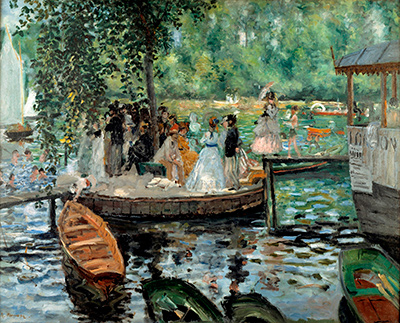
La Grenouillère
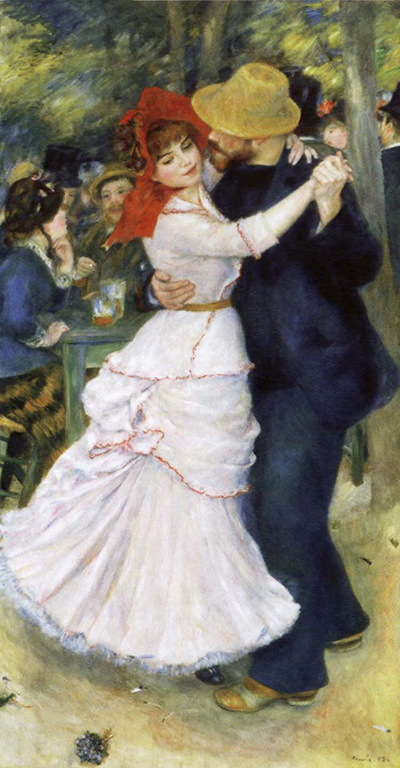
1869La Loge
1874The Swing
1876The Umbrellas
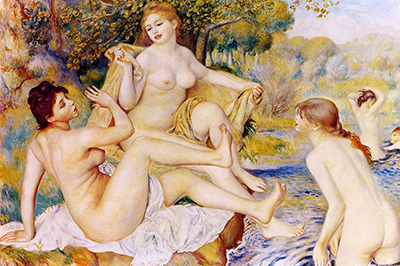
c. 1881–86The Great Bathers
1884–87The Bathers
1918–19Contents
- Annotated details of the painting
- Who is looking at whom?
- A white dress crossed by light
- Light as the subject
- The Montmartre circle
- Beside Bal du moulin de la Galette
- From Lise to the blue bows
- The 1877 exhibition and Caillebotte
- Looking again
Annotated Details from The Swing
Four figures in the foreground share an uncertain conversation under broken sunlight.
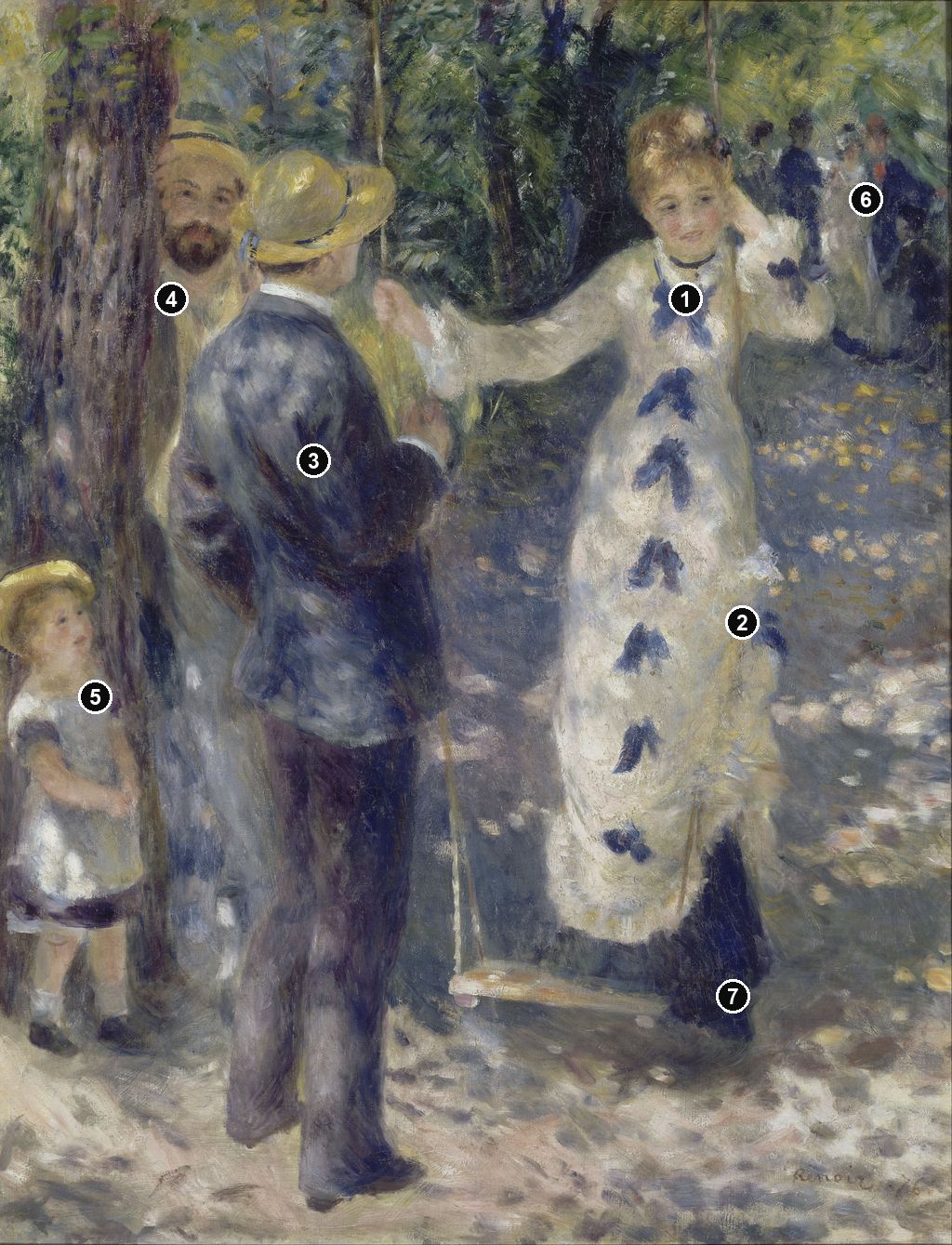
Details from THE SWING
Follow the ropes, glances and scattered light; the museum identifies several models but does not record their conversation.
Woman on the swing
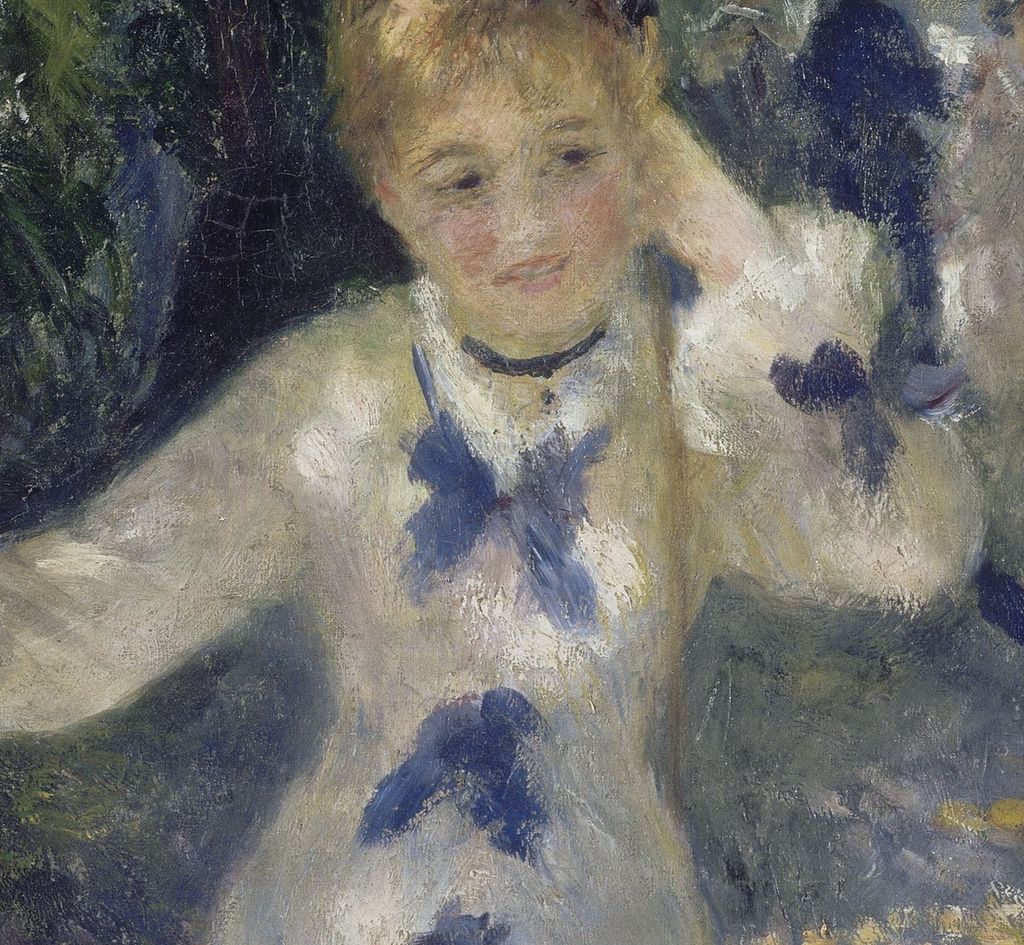
She holds the ropes and turns toward the man whose back faces us.
Swing ropes
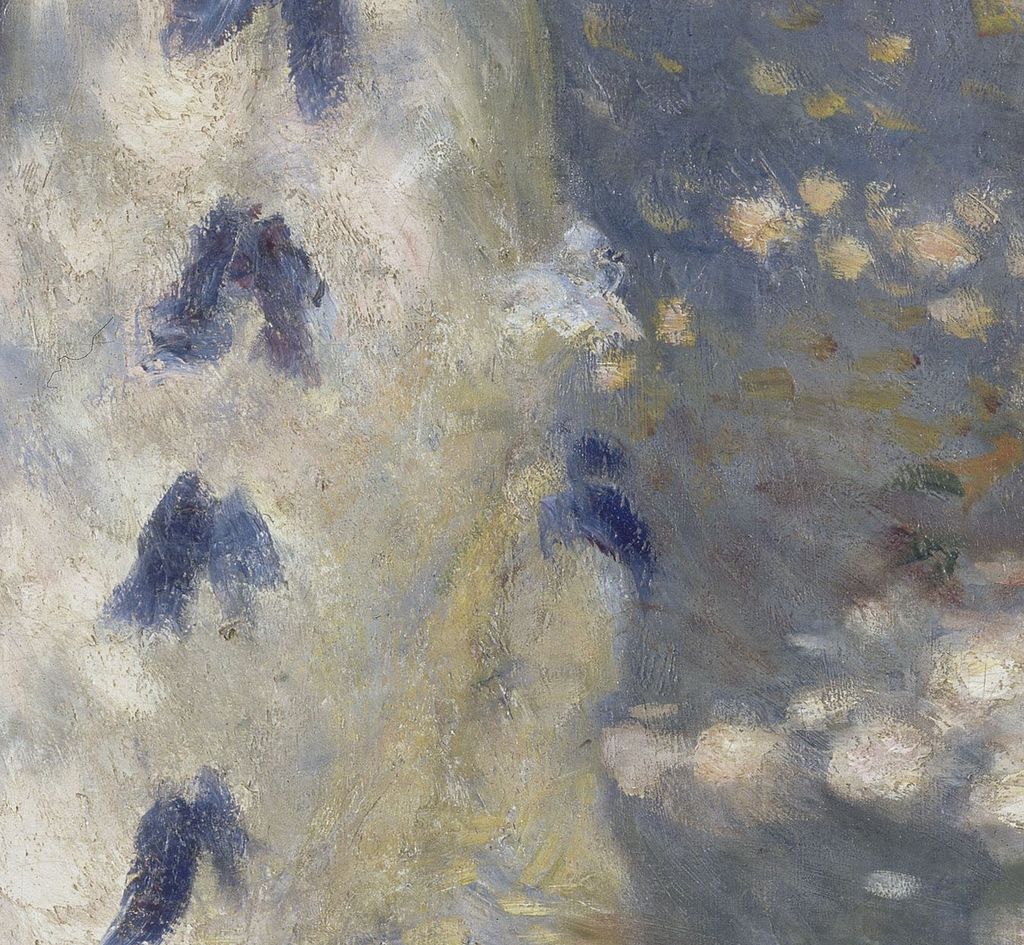
Long ropes give firm verticals among the broken foliage.
Man facing away
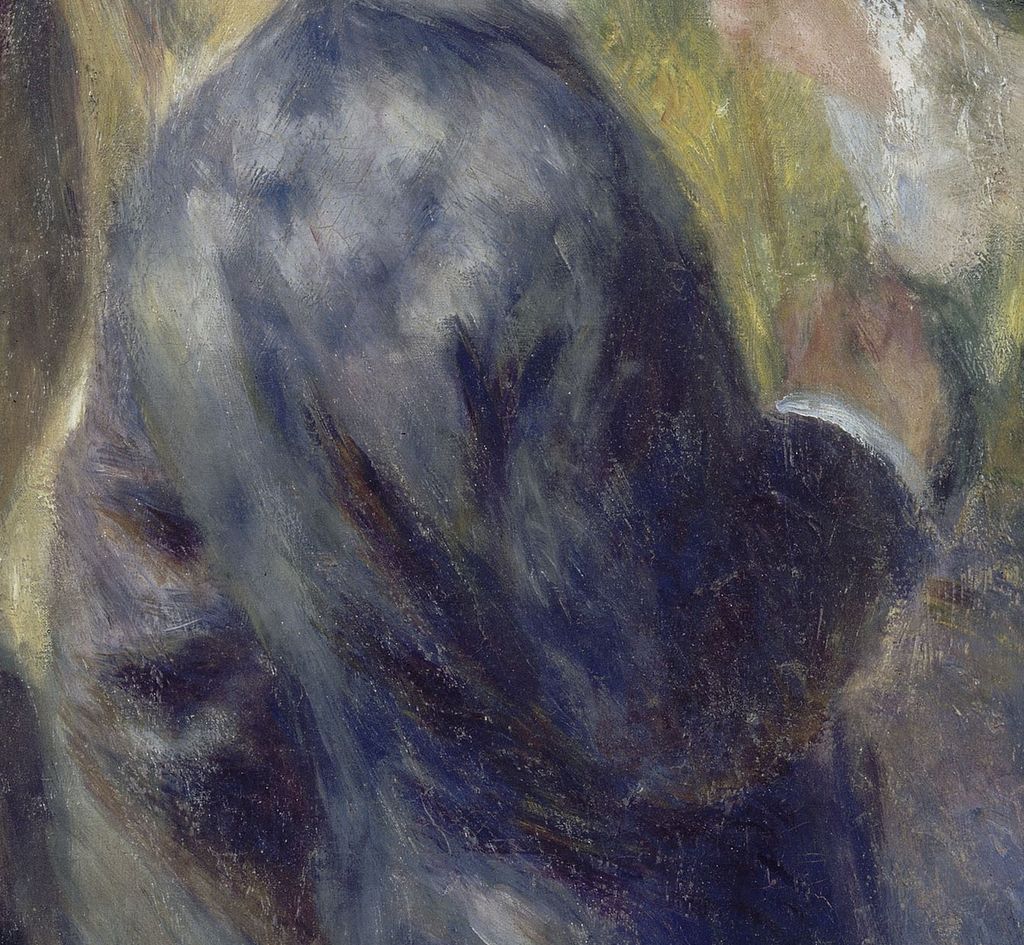
His turned back lets us enter the conversation without hearing it.
Watcher at the tree
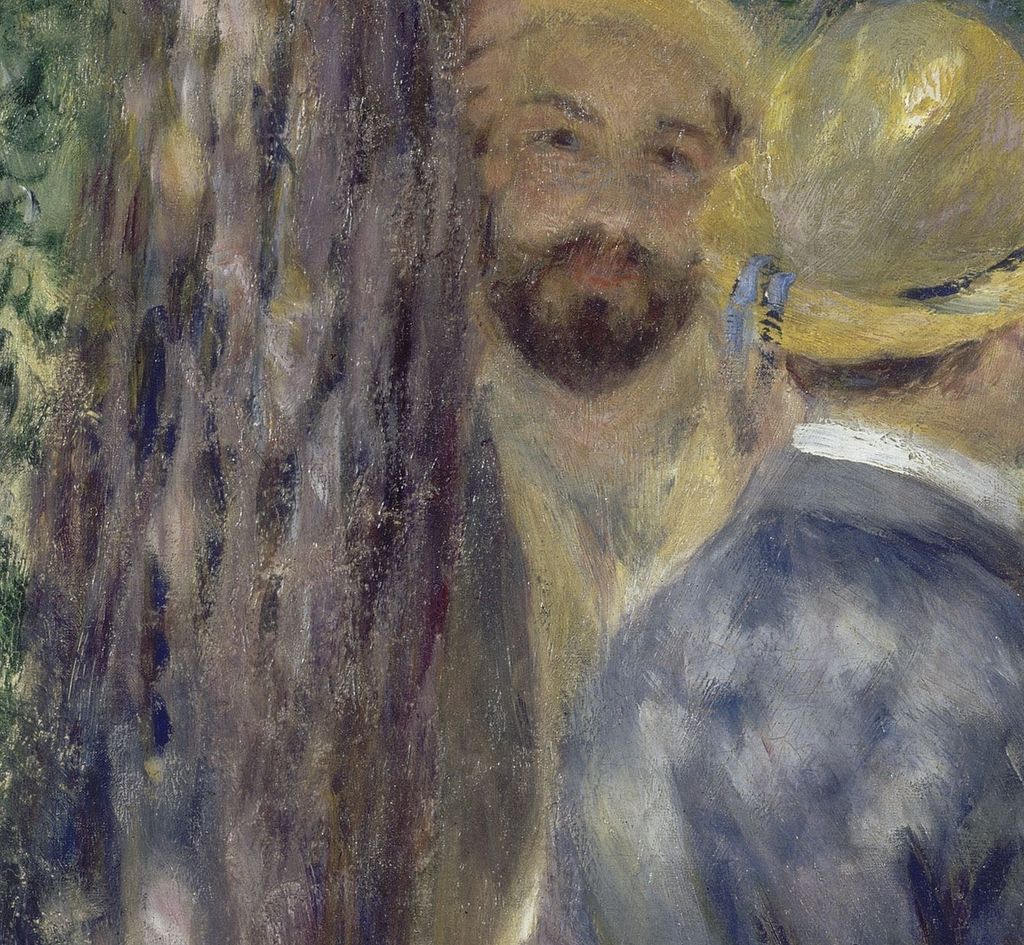
A man leans beside the trunk and looks toward the group.
Child
The child observes the encounter from the lower left.
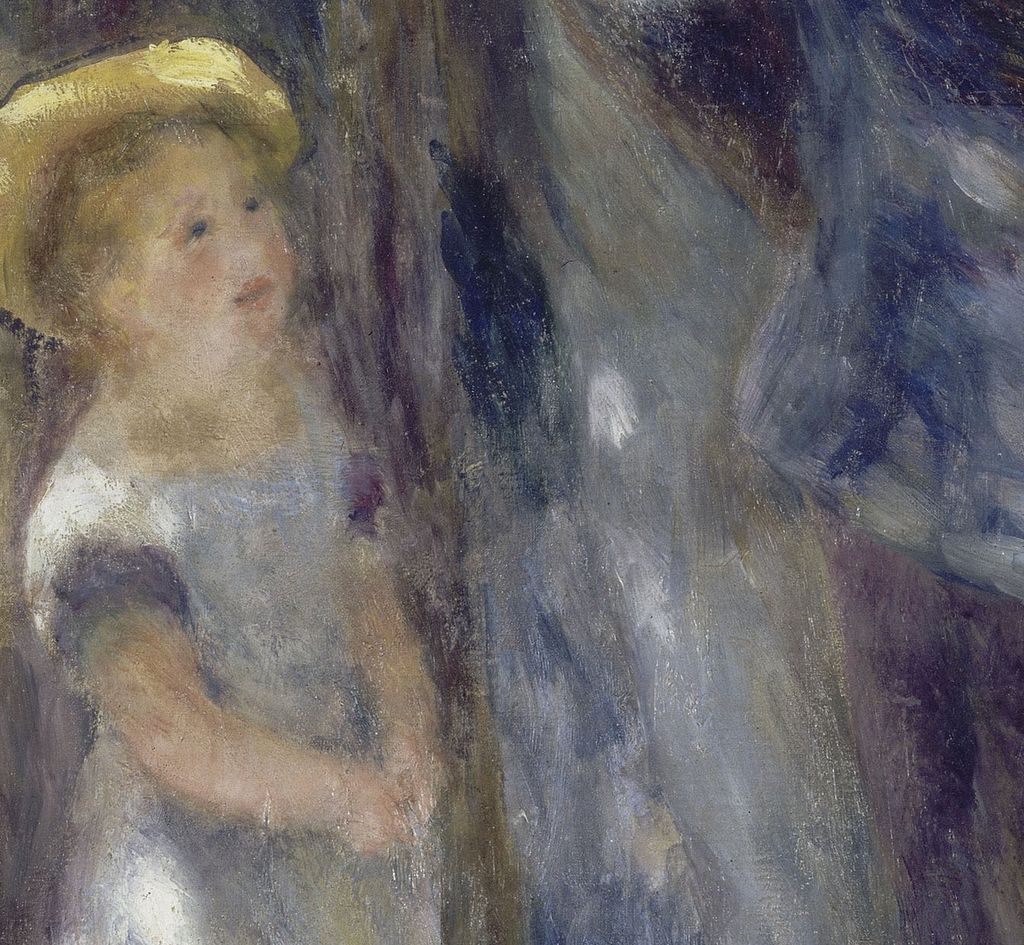
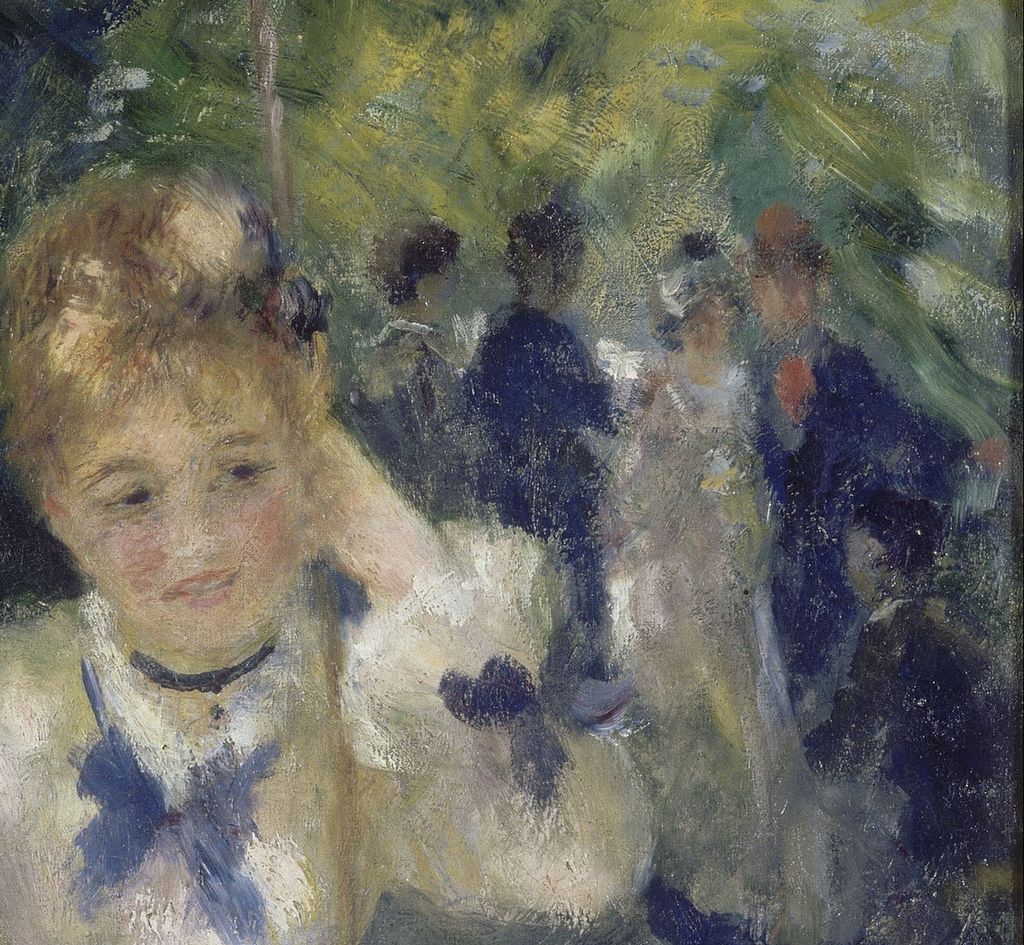
Distant gathering
Rapidly painted people extend the social scene beyond the foreground four.
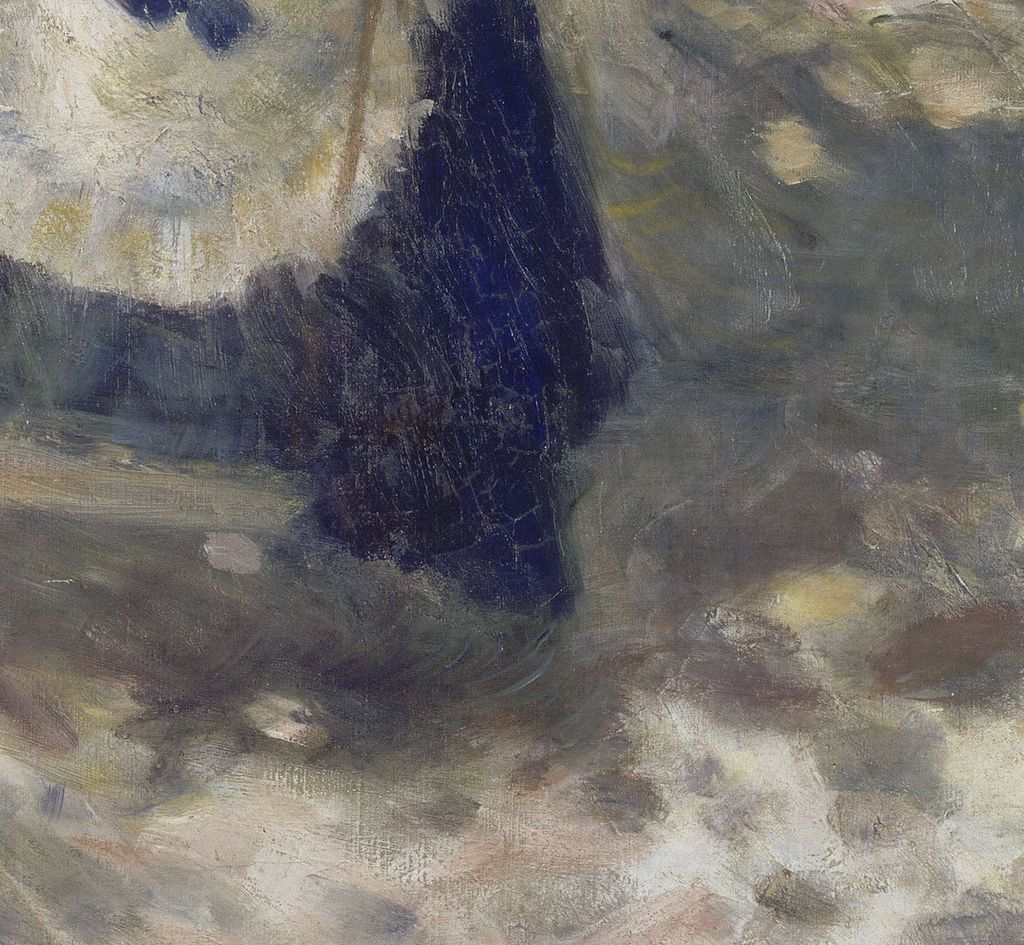
Dappled ground
Pale patches on the ground repeat the light on clothes, joining people and place.
Watch: Pierre-Auguste Renoir
Explore a Montmartre dance, a gathering beside the Seine and the drawings behind Renoir’s paintings.
Renoir, Bal du moulin de la Galette
Dr. Beth Harris and Dr. Steven Zucker discuss Renoir’s 1876 Montmartre dance scene, its light and its crowds.
Watch on YouTubeRenoir artworks directory
Who is looking at whom?
The swing is present but scarcely swings. The woman stands on its seat and holds the ropes, her body briefly paused. The man closest to us faces her, leaving his expression invisible. The child at the right looks into the exchange, while the man by the tree completes a loose circle around it. Orsay notes how their gazes make a conversation seem to be unfolding. The picture suggests an incident without telling us its words or outcome. Orsay object essay. [1]
It is tempting to describe the woman as embarrassed or the man as flirting. Orsay itself reads her averted look as possible embarrassment, but the visible evidence is modest: she turns her face and seems not to meet the near man's gaze. The viewer's own position behind that man makes us part of the uncertainty. We have arrived in the middle of a social situation, with no privileged access to it. That ambiguity is one reason the picture remains lively.
Renoir places five more people in the background, according to the museum's close description. They are rapidly sketched rather than developed as a second narrative. Their presence opens the garden beyond the four foreground figures. The main exchange is therefore intimate but not isolated; leisure continues around it. Orsay object essay. [1]
The left side of the canvas works almost like a screen. A broad tree trunk separates the little girl from the man leaning beside it, yet both look towards the conversation. The man seen from behind occupies much of the centre foreground. His straw hat and dark jacket block parts of the woman on the swing, so that we see her through a gap made by bodies and ropes. The picture's social uncertainty comes from that viewpoint as well as from the poses: Renoir lets us witness the moment without putting us in front of every face.
The woman does not ride the swing. Its seat is visible below the hem of her dress, and the ropes rise beyond the top of the frame. She holds one rope while bringing the other hand near her head. Those gestures anchor her in the scene but do not explain whether the conversation has interrupted play or whether she was simply standing there. The painting turns a piece of leisure equipment into a frame around a paused encounter. It does not need the swing's motion to make the scene feel momentary.
A white dress crossed by light
The pale dress is one of the largest continuous shapes in the picture, but it never stays one colour. Blue bows interrupt it, and the fabric catches yellow, grey and blue-green touches from the surrounding garden. Similar pale flecks fall on the man's jacket and the path. The light seems to move across unrelated surfaces, joining them in a single outdoor atmosphere. At the same time, the blue ribbons help the woman's figure remain distinct from the patterned ground.
This is an occasion to look beyond a shorthand description of “dappled light.” Trace one chain of marks from the woman's shoulder to her skirt, then across to the man's back and down to the ground. The touches vary in size and position; they do not form a neat repeating pattern. Renoir uses irregularity to suggest sunlight passing through leaves. Orsay identifies these pale patches as a central concern of the painting, and records how they irritated some critics at its 1877 exhibition. Orsay object essay. [1]
The effect is especially striking because dress and garden remain recognizable. We can identify a modern outfit, four nearby people, a swing and a path. Yet patches of colour sometimes weaken the border between fabric and surrounding space. The picture asks a viewer to keep both experiences at once: the clarity of a social scene and the instability of light as it falls over it.
Light as the subject
The tree canopy does not produce a smooth, even shade. Pale marks touch faces, dresses, jackets and ground in separate patches. The effect ties bodies to their environment without giving each outline equal firmness. Orsay says Renoir was particularly concerned with sunlight filtered through leaves in The Swing and the larger Moulin picture. The light is not a decorative layer placed over a finished story. It shapes the way we see the whole gathering. Orsay essay. [1]
This treatment was contentious. Orsay reports that critics particularly disliked the coloured light patches when the work was shown in 1877. We should not turn that statement into an invented quotation from a named critic. The material point is that marks now often admired as a vivid impression of daylight challenged some contemporary expectations about finished figure painting. Orsay essay and exhibition record. [1]
The swing ropes also organise the surface. They make long vertical lines among the more broken foliage and clothing. The woman stands between them, literally held in place while the brushwork around her shifts. The design allows two kinds of time at once: a brief pause in a conversation and the fleeting pattern of sun through leaves.
The scale reinforces that concentration. At 92 × 73 cm, The Swing is a modestly sized vertical canvas beside the broad 131.5 × 176.5 cm Bal du moulin de la Galette. Renoir has less room for a crowd and uses it to heighten the relation between the near figures. The standing woman, the back-view man and the tree build a compact foreground triangle. People behind them give depth, but the scene does not spread sideways into a panorama.
The Montmartre circle
Orsay identifies three models used in the work: Edmond Renoir, the artist's brother; fellow painter Norbert Goeneutte; and Jeanne, a young woman from Montmartre. Its essay says these people also appear among the dancers in Bal du moulin de la Galette. The museum does not provide a secure full name for Jeanne here; it is best to retain the limited identification rather than attach another biography to the figure. Orsay object essay. [1]
This overlap of models does not mean The Swing is a detail cut out of the Moulin painting or a direct record of one afternoon. Renoir was using people he knew or could pose in two separate compositions. The larger canvas spreads social activity across a crowded venue; the smaller one gathers it into a question of glances. The shared summer of 1876 gives readers a productive comparison of his scale and attention, not a reason to collapse two works into one. Orsay essay. [1]
Beside Bal du moulin de la Galette
The larger Bal du moulin de la Galette was also shown in the 1877 Impressionist exhibition and entered Caillebotte's collection. Orsay describes its movement across a dance garden on the Butte Montmartre, with crowds and changing natural and artificial light. In The Swing, a little group occupies a wooded space and the strongest light effect is sunlight filtered through foliage. Both are scenes of modern leisure, but their different formats and numbers of people make the viewer's experience markedly different. Orsay Bal du moulin de la Galette record. [2]
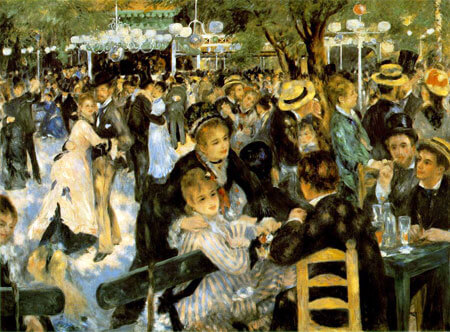
Compare the role of figures near the front of each picture. At the Moulin, people sit at tables, turn in groups and merge into the activity farther back. The eye can choose among many exchanges. In The Swing, the view is narrowed by the tree and the man's back, steering attention to one woman and the people who watch her. The same painter's interest in outdoor social life produces a crowded panorama in one work and an unfinished encounter in the other.
The comparison is strongest when it stays visual. Orsay says the models overlap and the paintings were made in parallel, but that does not identify a single occasion represented in both canvases. Nor does it prove that the figures in The Swing are standing at the Moulin venue. What can be seen is Renoir working with related people, light and leisure scenes at two different scales.
From Lise to the blue bows
An earlier full-length woman in a white dress appears in Renoir's Lise with a Parasol of 1867, now in Museum Folkwang, Essen. Orsay's Impressionism and Fashion exhibition explicitly compares Lise's white muslin dress with the slimmer silhouette and blue bows of the woman in The Swing. The comparison is about dress and painting, not an assertion that the women are the same sitter. Orsay exhibition on fashion [3]; Museum Folkwang object record. [4]

In Lise, the dark parasol and woods set off a broad, comparatively stable column of white. In The Swing, sunlight falls across the pale fabric in many small, irregular touches, while blue bows punctuate the dress from neck to hem. The figures are posed differently, too: Lise stands alone and nearly life-size; the woman on the swing belongs to a four-person exchange. The change is not a simple march from one style to another. It shows two specific solutions to placing a fashionable white dress outdoors, nine years apart.
The 1877 exhibition and Caillebotte
Orsay lists La Balançoire as no. 185 at the third Impressionist exhibition in April 1877. Its light effects drew objections, but the painting already had a buyer: Gustave Caillebotte, himself an Impressionist painter and an important supporter of the group. The museum's provenance says he had acquired it before April 1877. He also bought Bal du moulin de la Galette. His purchase should not be presented as a response to the exhibition's criticism. Orsay exhibition and provenance. [1]
The critical record was not all one-sided. The French Ministry of Culture's reconstruction of the 1877 exhibition notes that Georges Rivière, a friend of Renoir, issued four numbers of L'Impressionniste that April. A sketch of La Balançoire appeared in the journal, which Rivière used to answer attacks on the group. That contemporary reproduction shows the painting circulating in print as well as on the gallery wall. His defence was the position of a friend and advocate; it does not make the hostile reactions recorded by Orsay disappear or establish what most visitors thought. French Ministry of Culture, third Impressionist exhibition. [5]
Caillebotte died in 1894. Orsay dates the acceptance of his bequest for French national collections to 1896. Those dates refer to different events. The painting's path from a contested exhibition picture to a public collection is part of the history of Impressionism's reception. It also reminds us that the museum image we see today entered a collection through a fellow artist's decision to preserve it. Orsay provenance. [1]
The collection did not move straight from Caillebotte's home to the present Orsay building. The museum records assignments to the Musée du Luxembourg, then the Louvre, followed by the Jeu de Paume galleries before the work was assigned to Orsay in 1986. These later transfers help explain why the painting is now documented under an Orsay accession even though its first public collection home was elsewhere. Orsay provenance. [1]
Looking again
Look first at the woman held between the ropes. Trace the near man's back up to his head, then cross to the child and tree-side man. Follow the light spots from clothing to the ground and then to the quickly painted group behind. The apparent snapshot contains a careful network of gaze and light. Renoir leaves the conversation unfinished so that the act of looking becomes the centre of the scene.
Questions about The Swing
1876, during the summer Renoir also worked on Bal du moulin de la Galette. The oil canvas measures 92 × 73 cm.
Orsay identifies Edmond Renoir, Norbert Goeneutte and a young Montmartre woman named Jeanne among the models. The museum's brief account does not establish a fuller identity for Jeanne or tell us what the figures are saying.
Yes. Orsay lists it as no. 185 in the third Impressionist exhibition of 1877.
The Musée d'Orsay, Paris, accession RF 2738. Check the museum's current record for display status before visiting.
Discussion
Look closely at The Swing and use the questions below to compare what you see with the documented history.
Reader Insights
How do the surrounding figures direct attention to the woman on the swing?
The Orsay picture belongs to Renoir’s 1870s Montmartre work.
What is visible about the gathering, and what remains outside the frame?
Join the Conversation
Share a close observation or a source-backed question about The Swing. The prompts above are starting points for discussion.
References
- Musée d'Orsay, La Balançoire, RF 2738, object essay, exhibition history and provenance View source.
- Musée d'Orsay, Bal du moulin de la Galette, RF 2739, separate 1876 canvas for comparison View source.
- Musée d'Orsay, Impressionism and Fashion View source.
- Musée d'Orsay, Museum Folkwang, Lise View source.
- French Ministry of Culture, third Impressionist exhibition of 1877, Rivière's journal and its sketch of La Balançoire View source.
Whole-work reproduction: Commons Google Art Project file, Public Domain Mark; not the Orsay/RMN website image.
View source.