by Tom Gurney
Tom Gurney BSc (Hons) is an art history expert with over 20 years experience
Published on June 19, 2020 / Updated on October 2, 2026
Email: tomgurney1@gmail.com / Phone: +44 7429 011000
A young girl sits in profile, her face turned towards something beyond the left edge. A blue ribbon holds back a fall of reddish hair; her hands rest in her lap. Pierre-Auguste Renoir painted Portrait of Mademoiselle Irène Cahen d’Anvers, also called La Petite Irène, in 1880. The sitter was Irène Cahen d’Anvers (1872–1963). The painting is now in the Emil Bührle Collection, on long-term loan to the Kunsthaus Zürich, inventory BU 0090. Kunsthaus Zürich object and provenance record. [1]
The portrait is small, 65 × 54 cm, but its history is unusually extensive. It began as a commission within a Parisian family, entered Renoir's early exhibition history, was seized by a Nazi looting organisation in 1941, and was returned to the adult sitter after the war. Looking at the child and tracing the object's movements are both needed to understand it. Kunsthaus Zürich provenance [1]; Kunsthaus Jewish Collectors interpretation. [2]
At a glance
- ArtistPierre-Auguste Renoir
- Holder titleIrène Cahen d’Anvers (La Petite Irène)
- Date1880; signed and dated in the upper right
- MediumOil on canvas
- Dimensions65 × 54 cm
- SitterIrène Cahen d’Anvers, born 1872
- CollectionEmil Bührle Collection, BU 0090, on long-term loan to Kunsthaus Zürich
This work in Renoir’s career
La Grenouillère
1869La Loge
1874The Umbrellas
c. 1881–86The Great Bathers
1884–87The Bathers
1918–19Contents
- Annotated details of the painting
- A child given room to look away
- The family commission and Salon
- Seized in 1941, restituted in 1946
- From restitution to the Zürich loan
- An owner and a display venue
- Looking again
Annotated Details from Portrait of Mademoiselle Irène Cahen d’Anvers
Irène sits in profile, blue ribbon in her long hair and hands resting in her lap.
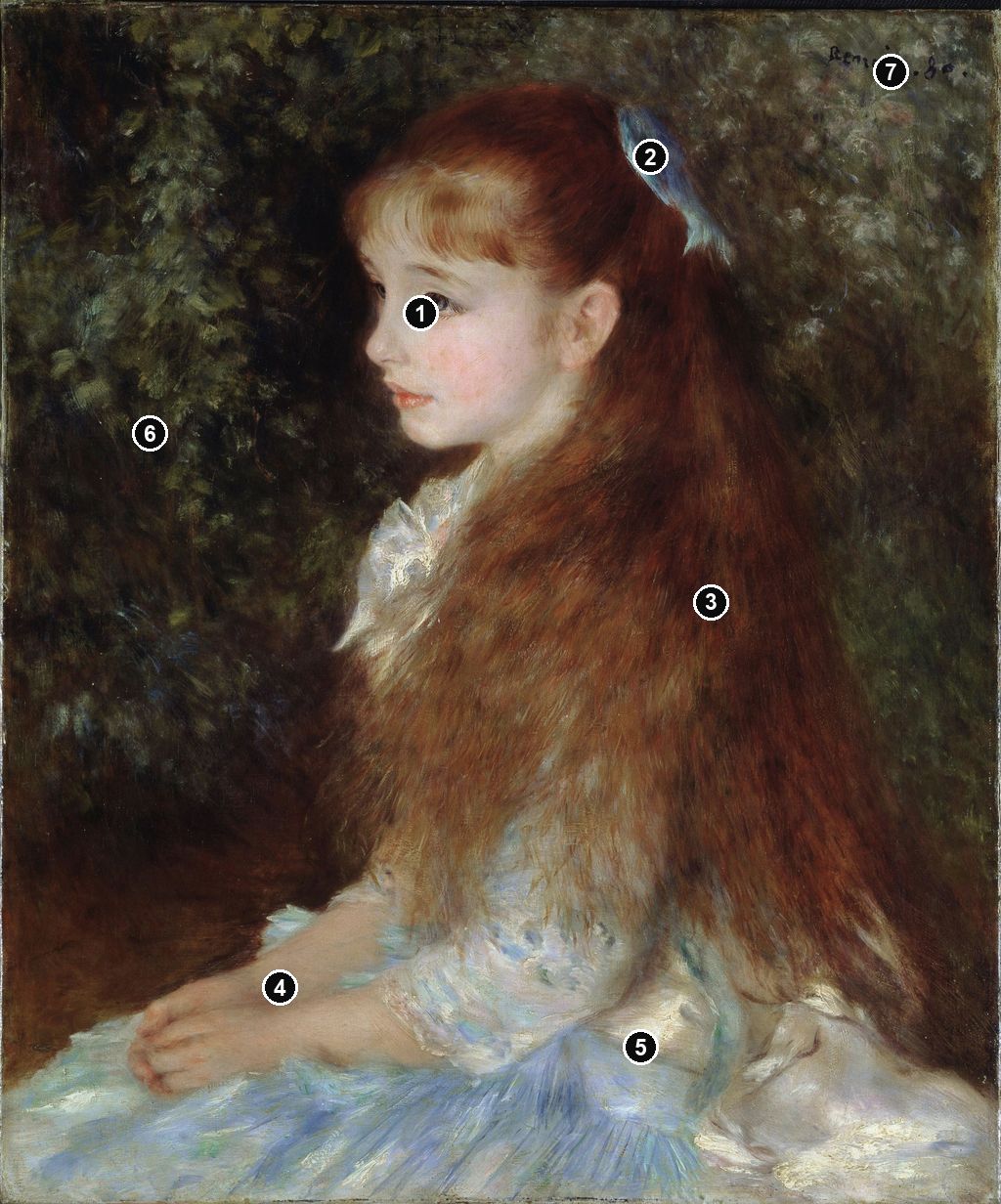
Details from PORTRAIT OF MADEMOISELLE IRÈNE CAHEN D’ANVERS
These seven details show Bührle Collection BU 0090, on long-term loan at Kunsthaus Zürich.
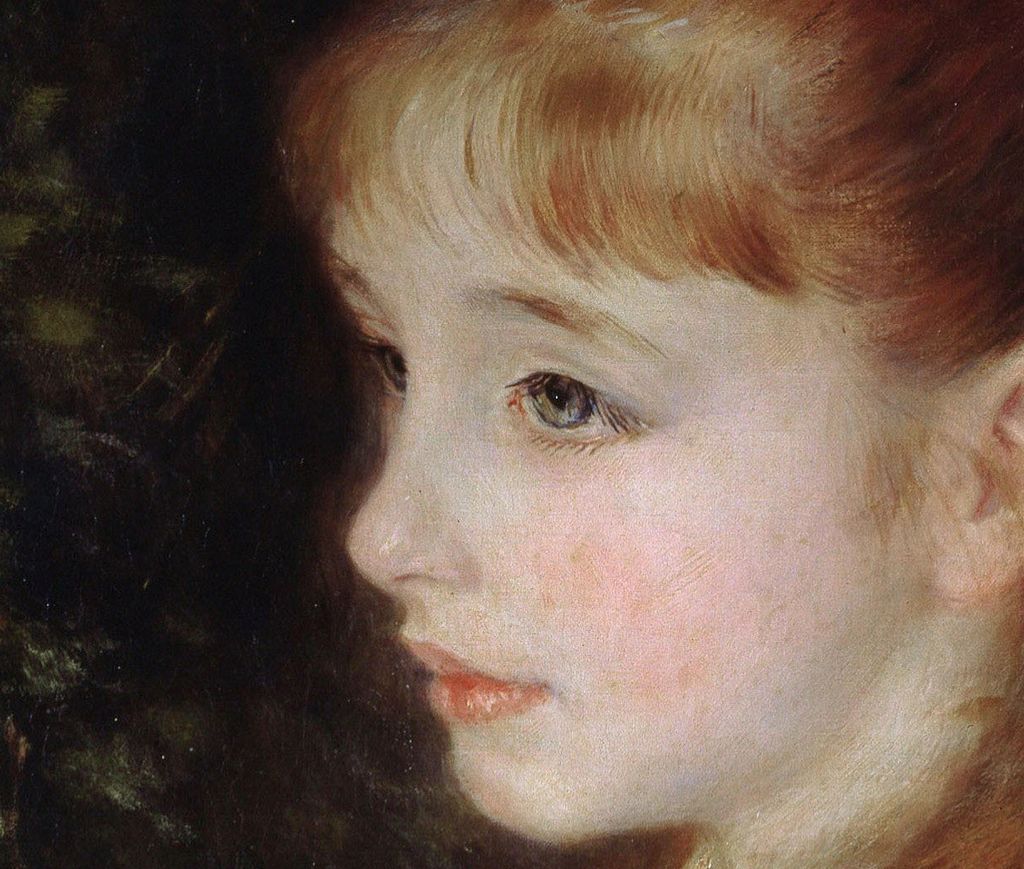
Face in profile
Irène looks beyond the left edge rather than directly at the viewer.
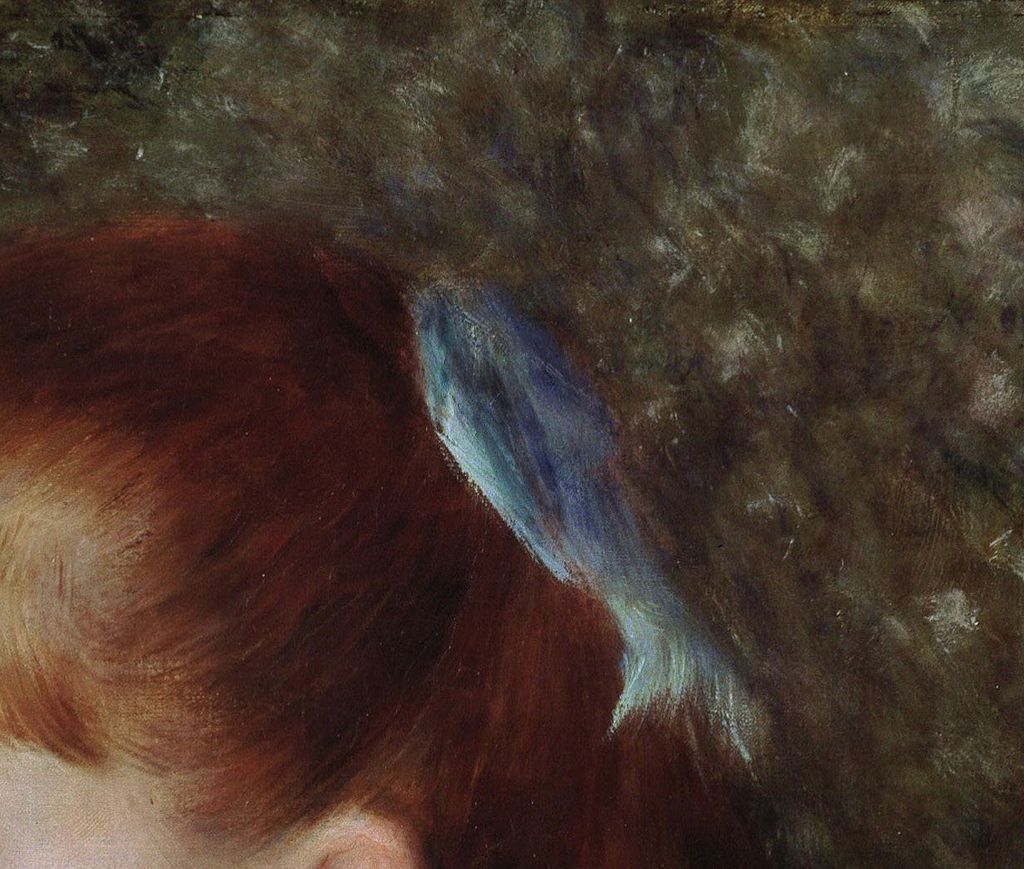
Blue hair ribbon
A cool blue ribbon draws attention to the top of her long hair.
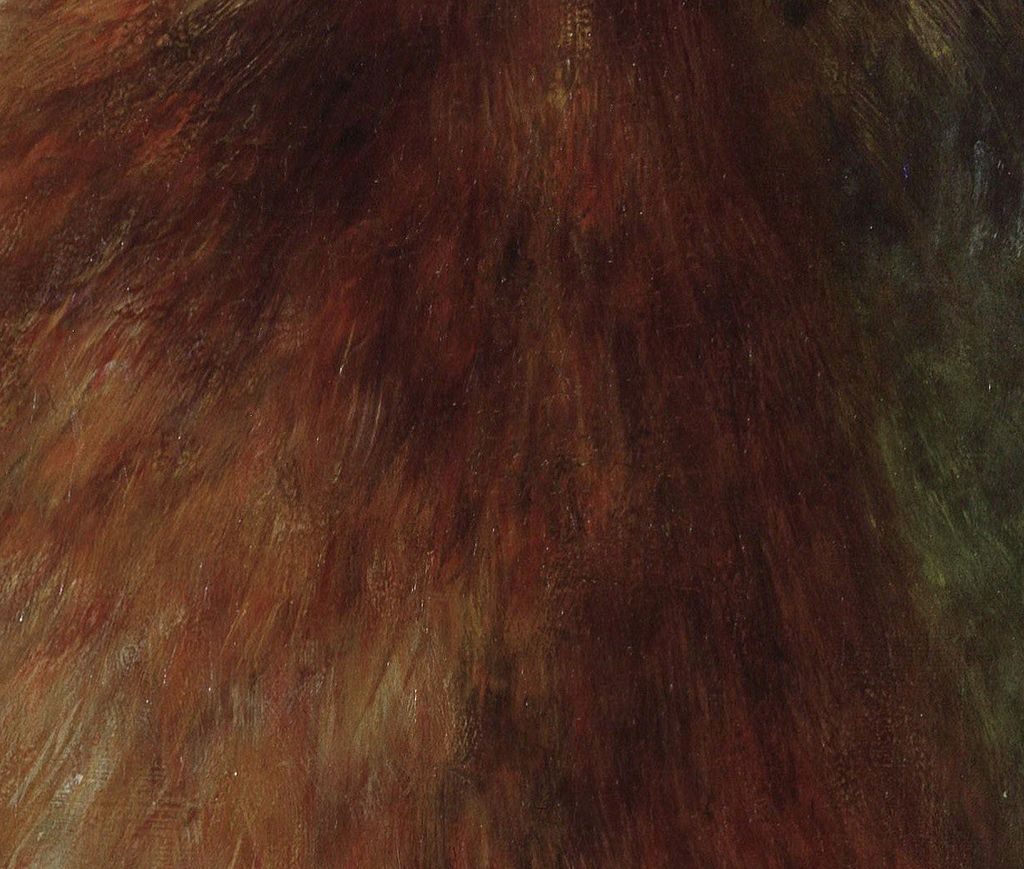
Long hair
Warm, loose strokes let the long hair merge softly into the background.
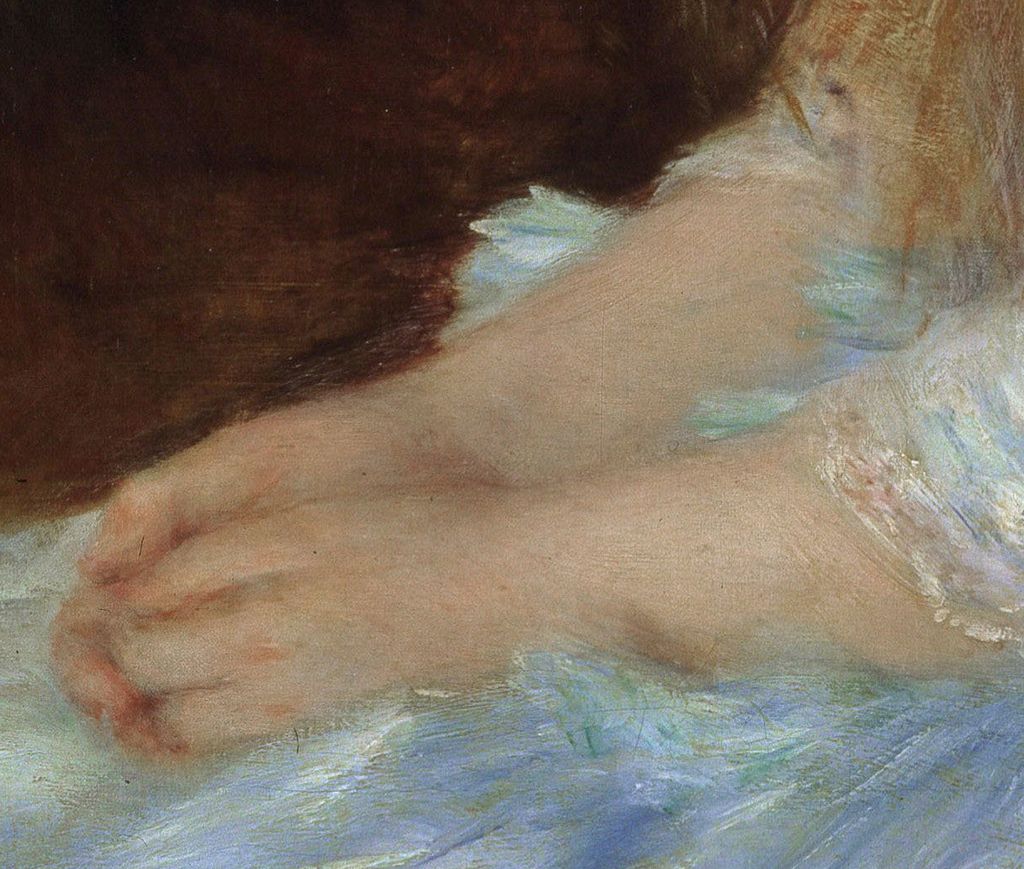
Resting hands
Her hands rest together over the pale dress.
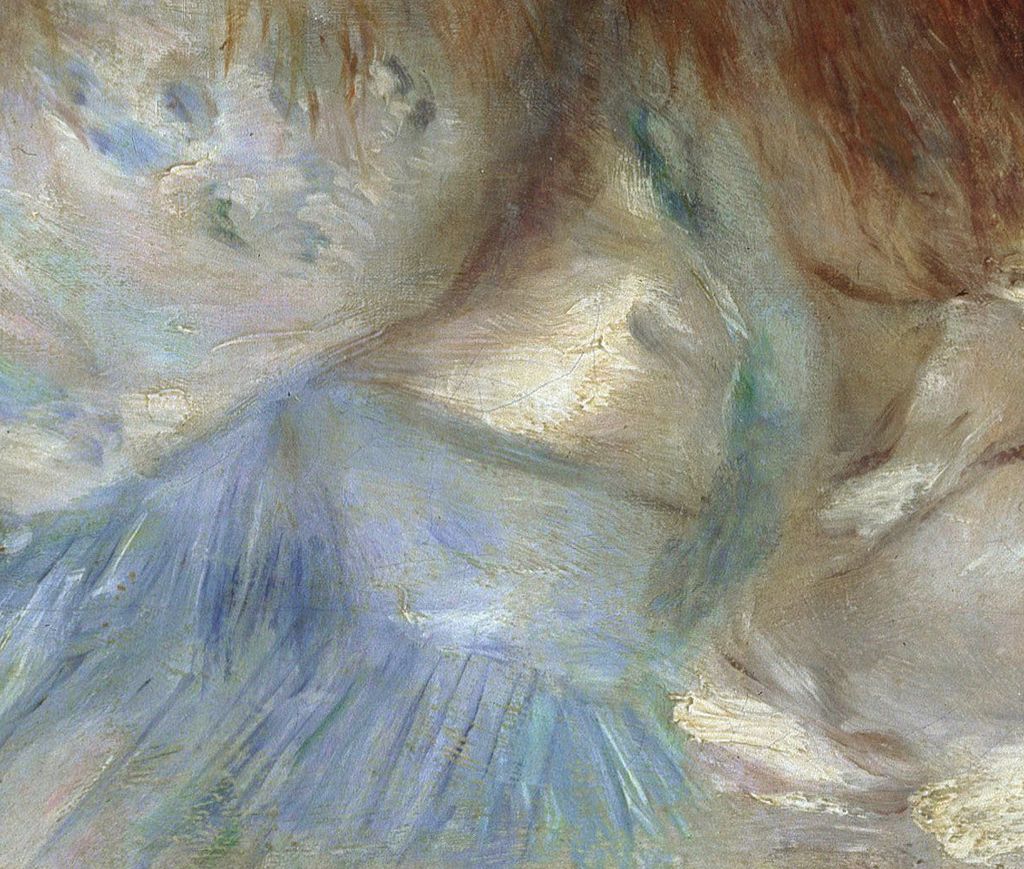
Pale dress
Blue and white marks brighten the dress at the bottom of the picture.
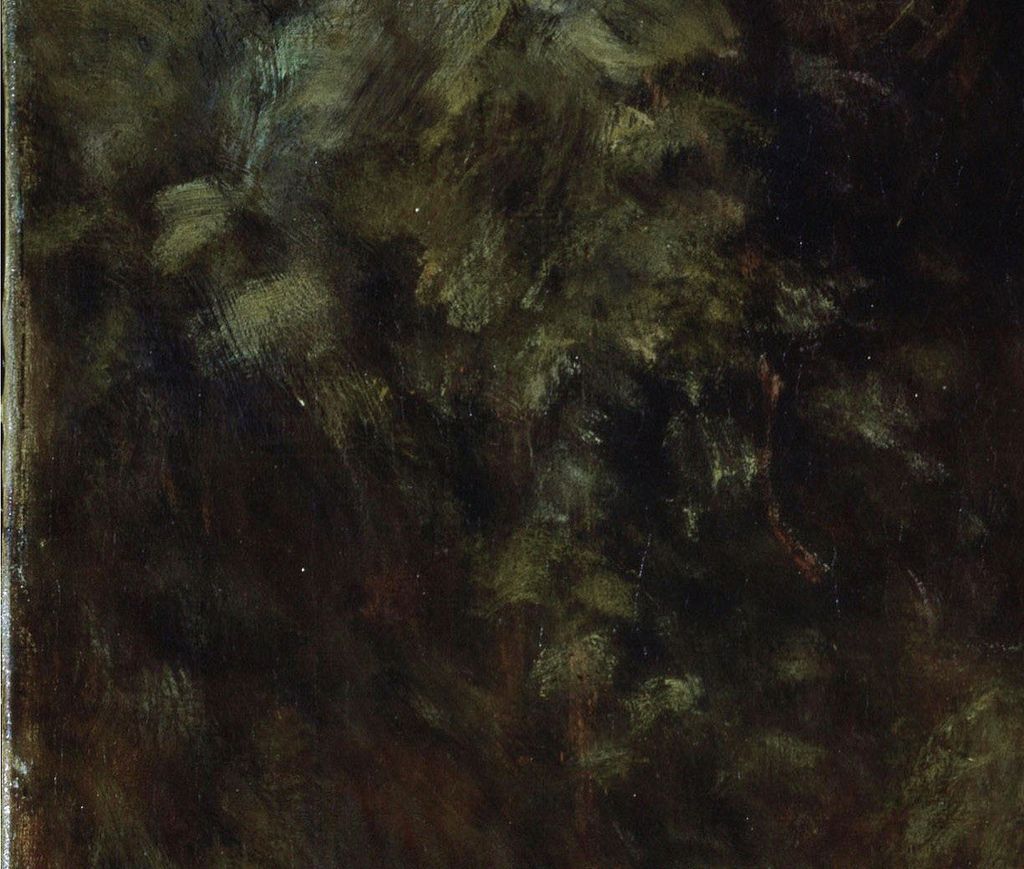
Dark background
Dark foliage-like strokes make the face and dress appear more luminous.
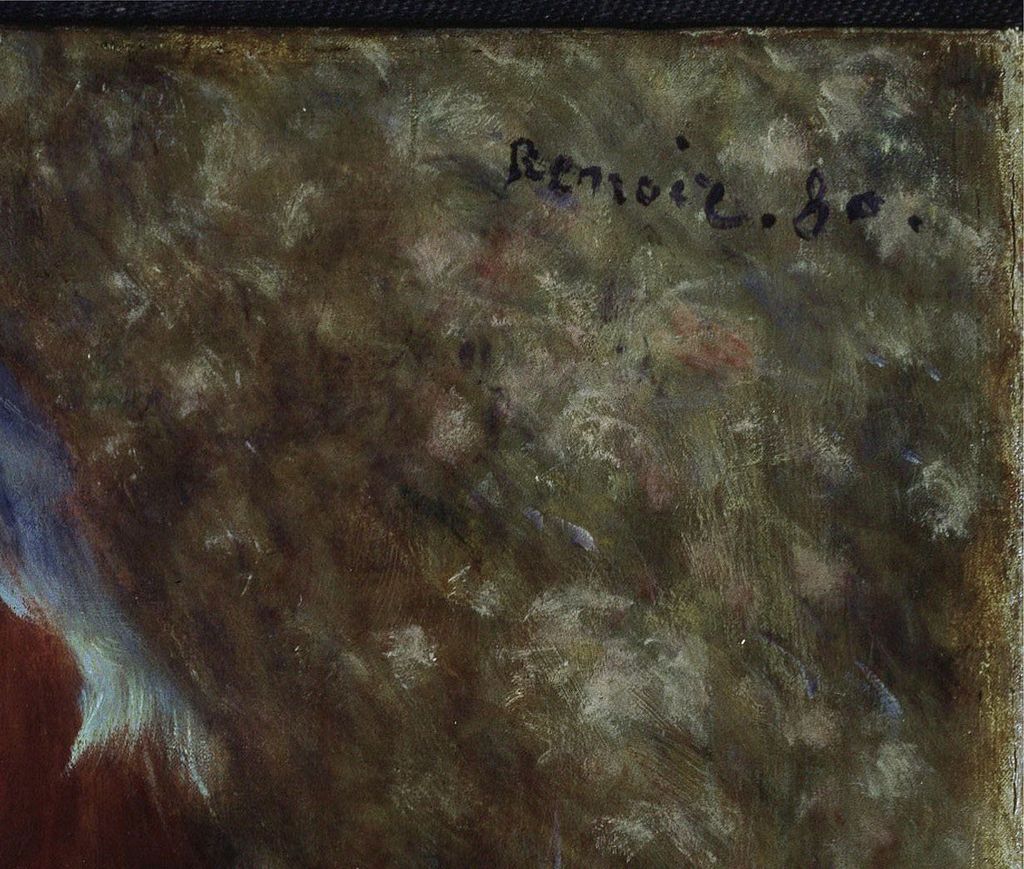
Signature and date
The upper-right inscription includes Renoir’s name and the date 1880.
Watch: Pierre-Auguste Renoir
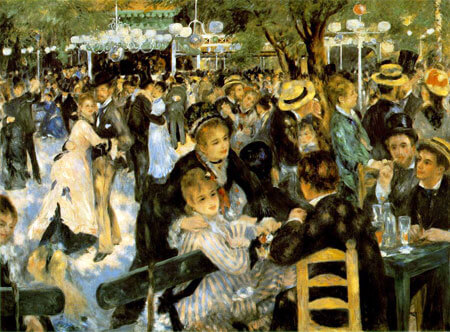
Explore a Montmartre dance, a gathering beside the Seine and the drawings behind Renoir’s paintings.
Renoir, Bal du moulin de la Galette
Dr. Beth Harris and Dr. Steven Zucker discuss Renoir’s 1876 Montmartre dance scene, its light and its crowds.
Watch on YouTubeRenoir artworks directory
A child given room to look away
Irène is not looking at the viewer. Her head turns left while her body and folded hands remain still. That difference gives the portrait a sense of life beyond the sitting. The blue hair ribbon repeats in cooler marks across the pale dress, while her reddish hair spreads over most of the lower right half. A dark, loosely painted background makes her face and clothing luminous. These are visible choices in the painting; they do not tell us what she was thinking. Kunsthaus Zürich collection image and object data. [3]
The hair deserves a slow look. Rather than arranging it into a hard outline, Renoir lets strands merge with surrounding brown and green. He gives the face more exact attention: the bridge of the nose, cheek and small mouth are more defined. The contrast carries the eye back from the wide sweep of hair to Irène's expression. Her hands make a quiet second focus below. The work can feel spontaneous even though its pose and colour are carefully coordinated.
The signed date sits high at the right, in the dark background. It is a small but useful point of object control: Renoir's own 1880 marking supports the holder's date for this individual portrait. The pale collar and dress are made from cooler white and blue marks, while the long hair provides the painting's largest warm area. The ribbon joins those colour zones, holding back the hair while echoing the dress. None of these visible features licenses a claim about the child's private feelings; the sitter's gaze is directed beyond what the canvas shows.
The nickname La Petite Irène means “Little Irène,” but the sitter had an adult life. She was the eldest of three Cahen d’Anvers daughters Renoir painted for the family. Her younger sisters Alice and Elisabeth appear together in the separate 1881 portrait now called Pink and Blue at MASP. Irène does not appear in that two-girl canvas. MASP, Pink and Blue [4]; Kunsthaus Zürich interpretation. [2]
The family commission and Salon
The portrait came from the Cahen d’Anvers family commission in 1880. Kunsthaus's public interpretation says Irène's mother Louise commissioned it. Its detailed provenance record notes that a catalogue assigned the commission to her father Louis and that a 1900 exhibition listed Mme L. Cahen d’Anvers as lender. The safest account is that Renoir painted it for the family, without claiming to resolve which parent formally arranged every part of the transaction. Kunsthaus Zürich object and provenance record [1]; Kunsthaus interpretation. [2]
Kathleen Adler's study in the J. Paul Getty Museum Journal traces how Renoir reached the family through the financier and publisher Charles Ephrussi, who introduced him to Louise Cahen d'Anvers. Adler reports that Irène, then eight, sat twice in the summer of 1880 in a family garden in Paris. Her account names rue Bassano, but MASP's later catalogue places the family's move to the rue Bassano house in 1883–84. The address therefore needs further archival checking; the painted foliage does not identify a street. Kathleen Adler, “Renoir's Portrait of Albert Cahen d'Anvers,” J. Paul Getty Museum Journal 23 (1995), pp. 33–34 [5]; MASP catalogue history. [4]
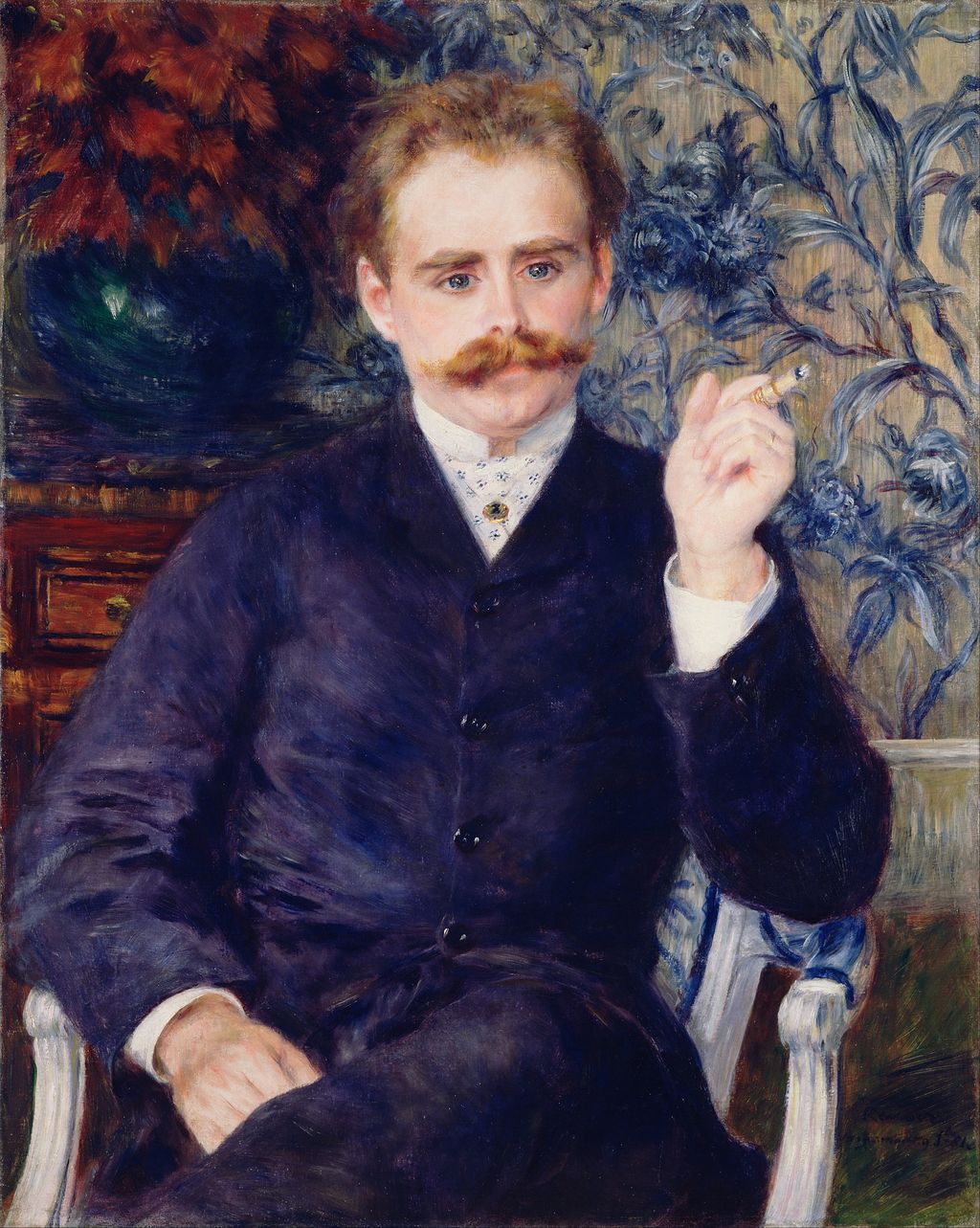
Renoir also painted Albert Cahen d’Anvers, Louis's younger brother and thus Irène's uncle, in 1881. Albert was a composer. His Getty portrait places an adult sitter in a patterned interior at the Bérards' Wargemont home, a cigarette raised in one hand. The armchair, decorative wall and direct gaze give him a social setting and a pose unlike Irène's profile against foliage. Comparing the two portraits shows Renoir adapting a family commission to each sitter and setting; it does not make Albert the father of the Cahen daughters. Getty, Masterpieces of Painting, on 88.PA.133 [6]; Adler, pp. 31–34. [5]
The family setting also produced a second, very different commission. In 1881, Renoir painted Irène's younger sisters Alice and Elisabeth together in a full-length double portrait, now at the Museu de Arte de São Paulo. Its 119 × 75.5 cm format and paired frontal figures make the children's clothing and their relationship to each other central. Irène's smaller portrait turns one sitter away from the viewer and lets hair and foliage absorb much of the frame. The two pictures therefore give different answers to the same family's request for likenesses. MASP object record [4]; Adler, pp. 33–35. [5]

Which portrait was exhibited, and when?
Kunsthaus says Irène's portrait was praised at the 1881 Paris Salon. MASP's history states that two portraits of the Cahen daughters were included there, while Renoir's surviving letter to Théodore Duret names the “portrait of the little Cahens” he had just finished—language the Louvre identifies with the double portrait. The Getty study identifies Irène's painting in Renoir's 1883 one-person exhibition at Durand-Ruel. These records should not be compressed into a single undifferentiated “Cahen portrait”: the 1880 individual painting and the 1881 double portrait have different dates, formats and later owners. The current owner records the Salon claim for Irène, while the Louvre letter provides direct evidence for Renoir's work on her younger sisters. Kunsthaus provenance [1]; MASP history [4]; Louvre letter record [7]; Adler, p. 39 n. 11. [5]
The family response needs similar care. Kunsthaus's interpretation says Louise disliked Irène's portrait and placed it in servants' quarters. Adler's Getty account and MASP's history instead attach the servants'-floor story to the double portrait of Alice and Elisabeth. Both refer to the Cahen family commissions, but the available summaries conflict about which canvas the anecdote concerns. The painting itself cannot settle that question; the safe conclusion is that private family reception is less securely documented than the identity, date and later provenance of Irène's portrait. Kunsthaus interpretation [2]; Adler, p. 34 and n. 17 [5]; MASP history. [4]
Seized in 1941, restituted in 1946
The painting's twentieth-century history needs precision. The Kunsthaus provenance research records that it was confiscated on 7 July 1941 by the Nazi Einsatzstab Reichsleiter Rosenberg (ERR) at Chambord. It passed to Hermann Göring and was traded onward. Allied recovery led to its return to Irène Sampieri-Camondo, the adult Irène in Renoir's picture, on 27 March 1946. In 1949, she sold the restituted portrait through Werner Feuz to Emil Bührle. A restitution followed by a later sale is different from Bührle acquiring the painting directly from its wartime captors. Kunsthaus Zürich detailed provenance [1]; Kunsthaus Jewish Collectors account. [2]
The archive does not agree on every earlier transfer within Irène's family. One postwar account says the painting belonged to Irène and was placed with her daughter Béatrice Reinach; a 1941 letter by Béatrice's husband says his wife had received it from her grandmother. Kunsthaus records both. Those sources support family custody and the documented Nazi seizure, but do not justify a simple, certain ownership chain through every family member before 1941. Kunsthaus Zürich provenance, pp. 2–3. [1]
The museum's record establishes several physical movements even while that ownership question remains unresolved. It lists the work with the Cahen parents from 1880 and notes Mme L. Cahen d'Anvers as its lender to a 1900 Bernheim-Jeune exhibition, catalogue no. 14. A 1933 Orangerie exhibition listed the work under no. 57, with a loan associated with the Reinachs. Léon Reinach later reported that the painting was deposited with the Musées Nationaux in October 1939. The ERR seized it at Chambord on 7 July 1941. Göring exchanged it with dealer Gustav Rochlitz for a Florentine tondo on 10 March 1942. The exhibition and custody records locate the canvas; they do not settle which family member held legal title at every moment. Nor were its wartime movements ordinary sales by the family. Kunsthaus detailed provenance, pp. 2–3. [1]
American Monuments officers recovered the portrait at Rochlitz's residence in Hohenschwangau on 31 July 1945. It entered the Munich Central Collecting Point on 4 September, under number 8035, before its documented return to Irène on 27 March 1946. Those dates give the restoration of custody a clear sequence. They do not remove the family's losses or resolve the earlier question of which relative held legal title before seizure. Kunsthaus detailed provenance, pp. 3–4. [1]
This was also a family catastrophe. Kunsthaus recounts that Béatrice, her husband Léon and their children Fanny and Bertrand were murdered at Auschwitz. Irène survived and received the portrait back. These events belong to the real history of the sitter and object; they are not hidden meanings Renoir painted into an 1880 image. Kunsthaus Jewish Collectors interpretation. [2]
From restitution to the Zürich loan
The postwar transaction has its own evidence. Kunsthaus lists Irène as the recipient of restitution and records that the artist and intermediary Werner Feuz negotiated a sale to Emil Bührle in 1949. A signed declaration and receipt dated 21 October 1949 give the purchase amount as CHF 240,000. The record also notes a collection card with an earlier August date, so the documentation distinguishes negotiation, sale paperwork and internal recording rather than reducing them to one unexamined day. Kunsthaus detailed provenance, p. 4. [1]
Emil Bührle held the painting until his death in 1956. His heirs transferred it to the Foundation E.G. Bührle Collection in 1960, and it has been on long-term loan to Kunsthaus Zürich since 2021. The present setting is thus a museum display of a foundation-owned work whose wartime seizure and restitution are explicit in the museum's provenance category. That history belongs beside the portrait's aesthetic account, without implying that a later purchase erases the confiscation. Kunsthaus detailed provenance, pp. 4–5. [1]
An owner and a display venue
The painting is part of the Emil Bührle Collection and is on long-term loan at Kunsthaus Zürich. Those are different roles. The museum's object record gives the inventory as BU 0090 and the collection relationship explicitly. Current display conditions can change, so consult the holder's live page before a visit. Kunsthaus Zürich object record. [1]
Its more than sixty years between Salon display and restitution make the simple image of a child hard to detach from an adult life's losses. Still, the painting deserves to be read on its own terms too: a turned face, a blue ribbon, a pale dress and a dark setting form a portrait of unusual quiet attention.
Looking again
Follow Irène's glance beyond the left edge, then return along the blue ribbon and the long line of hair. Look down to the folded hands. Renoir makes the sitter present without making her meet the viewer's gaze. Knowing the name and later provenance gives that presence a fuller human context.
Questions about Irène's portrait
No. Pink and Blue depicts her younger sisters Alice and Elisabeth. This 1880 painting is Irène's individual portrait.
Yes. Kunsthaus records confiscation by the Nazi ERR on 7 July 1941. The work was recovered and restituted to Irène in 1946. She later sold it to Emil Bührle in 1949.
It belongs to the Emil Bührle Collection and is on long-term loan at Kunsthaus Zürich. Check current museum information for display status.
Discussion
Look closely at Portrait of Mademoiselle Irene Cahen d'Anvers and use the questions below to compare what you see with the documented history.
Reader Insights
How do Irène’s face and hair stand against the cool background?
The Bührle/Kunsthaus records trace seizure, restitution and the 1949 sale.
How should uncertain prewar ownership be expressed alongside documented restitution?
Join the Conversation
Share a close observation or a source-backed question about Portrait of Mademoiselle Irene Cahen d'Anvers. The prompts above are starting points for discussion.
References
- Kunsthaus Zürich, Irène Cahen d’Anvers (La Petite Irène), BU 0090, detailed object and provenance record View source.
- Kunsthaus Zürich, Jewish Collectors interpretation, family, looting, restitution and acquisition account View source.
- Kunsthaus Zürich collection image and object data View source.
- MASP, Pink and Blue, separate portrait of her sisters View source.
- Kathleen Adler, “Renoir's Portrait of Albert Cahen d'Anvers,” J. Paul Getty Museum Journal 23 (1995), pp. 31–40 and notes; family commission, 1883 exhibition and discussion of the disputed servants'-floor account View source.
- Companion reproduction, Getty object discussion View source.
- Musée du Louvre, Renoir's Easter Monday 1881 letter to Théodore Duret, describing the “portrait of the little Cahens” sent to the Salon View source.
- Whole-work reproduction: Commons Public Domain Mark file, faithful 2D reproduction View source.
- Companion reproduction: Daderot's independently photographed Pink and Blue on Wikimedia Commons, CC0 View source.
- Companion reproduction, Google Art Project image of Albert Cahen d'Anvers on Wikimedia Commons View source.