by Tom Gurney
Tom Gurney BSc (Hons) is an art history expert with over 20 years experience
Published on June 19, 2020 / Updated on October 2, 2026
Email: tomgurney1@gmail.com / Phone: +44 7429 011000
Tall, loose shrubs almost close over the foreground. Beyond them, a strip of water, a pale boat and a small house come into view. The inherited image matches Gallerix’s On the Seine, near Argenteuil [1] and WikiArt’s reproduction [2]; both associate the picture with about 1874. Those illustrated secondary listings identify the composition but do not provide a direct original-object catalogue, dimensions or present owner. The date remains attributed to them.
Renoir gives the river less space than the vegetation on this particular canvas. The viewer must look through near leaves and branches to discover the boat and house. That makes the river a glimpse rather than an open panorama. The arrangement differs from Renoir's broad boating views, even though Argenteuil was a frequent subject for painters working along the Seine.
Contents
- The work at a glance
- A bank that nearly hides the river
- Boat, water and house
- Argenteuil as subject and setting
- Which Seine view is it?
- Paint and depth
- Looking again
Watch: Pierre-Auguste Renoir
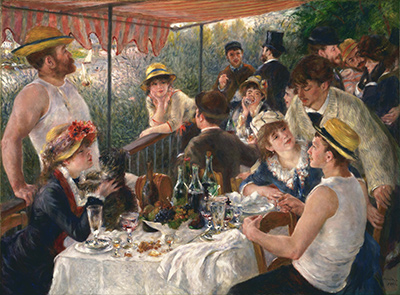
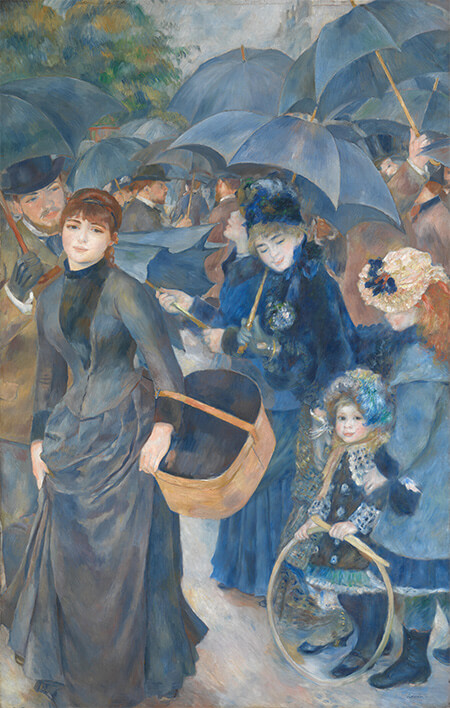
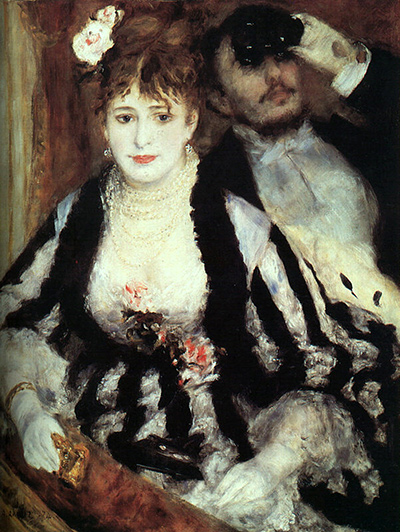
Explore a Montmartre dance, a gathering beside the Seine and the drawings behind Renoir’s paintings.
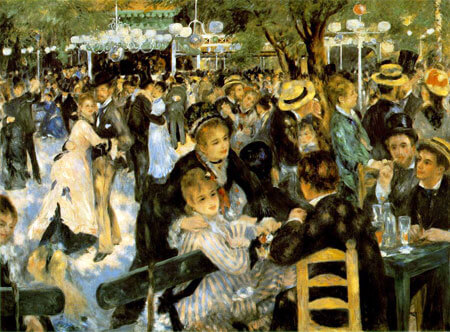
Renoir, Bal du moulin de la Galette
Dr. Beth Harris and Dr. Steven Zucker discuss Renoir’s 1876 Montmartre dance scene, its light and its crowds.
Watch on YouTubeAt a glance
- ArtistPierre-Auguste Renoir (1841–1919)
- Inherited titleOn the Seine near Argenteuil
- Matching circulated titleOn the Seine, near Argenteuil
- Date in illustrated secondary listingsCirca 1874; exact-object verification needed
- Medium, dimensions and present ownerNot independently established for the pictured canvas
- Local imageInherited small landscape-format reproduction
The Gallerix [1] and WikiArt [2] images share the distinctive foreground tangle, white boat and distant house. Their agreement is an image trail, not two independent museum records. No current owner should be inferred from a search result for another Argenteuil painting.
A bank that nearly hides the river
The near bank takes most of the lower half. Olive, ochre and rust-coloured marks overlap in uneven clusters. At left, a tall yellow-green bush rises above the waterline. At right, thinner dark stems curve inward. They create a frame with no straight edge. The viewer feels positioned among plants rather than standing on a clear towpath.
This foreground can seem chaotic until its structure appears. The bush at left and dark growth at right leave a narrow gap near the centre. Through it we see water, a low white boat and the house across the river. The focal point is therefore small. Renoir delays its discovery by making the nearer vegetation lively and bright.
Branches cross in front of the water. Their many short strokes suggest leaves in light, but the inherited file does not show every species or stem clearly. The painting gains depth from overlap: near leaves interrupt a middle band of water, which in turn lies before the far building and sky.
The foreground is not simply a border. Its colour and movement occupy the viewer's attention as fully as the boat. Renoir's subject is the experience of finding a river view through growth on its bank. A cleaner, more open vantage would have produced a different painting.
Boat, water and house
A pale boat sits near the middle of the picture. It has a warm orange-brown edge and a white form above it that could be a person, sailcloth or a bright reflection. The reduced image does not justify a precise count of occupants. What matters compositionally is the small, light horizontal shape against darker water and foliage.
The river is visible in a narrow band. Grey-green and blue notes interrupt its muted surface. It does not stretch to the foreground as a broad blue plane. The boat therefore appears through a slot in the vegetation, linked visually to the house behind it.
Across the water, the house has pale walls and a dark pitched roof. Its small scale makes it a point of distance. A few horizontal strokes beneath it suggest bank, landing or low buildings, but their exact identity is uncertain. The house gives the eye a place to rest after the active foreground.
The sky is light grey and cream, not a sharply drawn blue backdrop. Bare or thin branches rise into it at the right. A brighter patch over the central house helps the roof become legible. Renoir arranges light in layers: pale sky, pale building, pale boat, with dark plants separating them.
Argenteuil as subject and setting
Argenteuil, west of Paris, became important to Impressionist painting in the 1870s. The National Gallery, London's account of Monet's Petit Bras of the Seine at Argenteuil [3] explains that Monet settled there in 1871 and that the area combined boating with signs of industry. The Courtauld's catalogue of Manet's Banks of the Seine at Argenteuil [4] notes that Renoir and other painters visited the area. These sources establish the wider artistic setting, but they do not document this particular Renoir canvas.
The inherited title locates the view “near Argenteuil,” which is broader than a precise point on the river. The image has a house and boat but no identifiable bridge or church that would fix a viewpoint. It would be unsafe to name the distant building or assert that the boat belonged to Monet, Renoir or another painter without an original-object source.
The landscape also looks less like a picture of leisure than some familiar Argenteuil scenes. A boat is present, but the shrubs occupy the foreground and make a human story difficult to read. The emphasis falls on foliage, layers of light and the act of looking across water. That is a distinctive choice within the river subject.
If the circulated circa-1874 date is confirmed, the picture would belong to the years when Renoir and Monet were experimenting with small, broken strokes and outdoor light. It remains important to keep that phrasing conditional. The image listings may repeat a date from an untraced catalogue, but the present audit has not located the illustrated original record.
Which Seine view is it?
Renoir painted multiple Argenteuil works. The Portland Art Museum’s 1874 The Seine at Argenteuil [5] is known through published scholarly comparisons as a wide view with boats and sails on open water. The Barnes Foundation’s The Seine at Argenteuil of 1888 [5] has its own boating arrangement and documented catalogue history. Neither description matches the close, plant-screened glimpse on this route; their dates and ownership cannot be borrowed.
The route /seine-at-argenteuil/ in this same local cluster is also a different image. Its broad blue-grey water at left and warm trees at right lack this page's central distant house and framed small boat. Similar English titles should not collapse separate paintings into one record.
Monet and Manet also made works on these banks. Manet's Courtauld painting [4] places a woman and child beside an open river with sailboats. Its social scene is different from Renoir's thicket-framed glimpse. A place name shared across painters is valuable context, never evidence that their canvases depict the same exact spot.
The small house is a tempting clue, but many riverside buildings had pale walls and pitched roofs. A secure identification would need a historical map or a catalogue note that actually links this arrangement to a named building. Until then, the page uses the visual description rather than guessing a landmark.
Paint and depth
Renoir uses the most active strokes in the near plants. Yellow, olive and brown marks change direction rapidly, making the bank feel rough and sunlit. The water and distant architecture are flatter and quieter. This change of handling makes space: the near world presses forward while the far house recedes.
The image also depends on colour echoes. Cream light in the sky reappears on the house and boat. Orange on the boat's edge returns in leaves and earth. Green and grey connect shrubs with water. These repeated tones prevent the bright centre from becoming detached from its frame.
The branches at right reach upward and inward, while the larger left bush leans toward the centre. Their opposing directions lead the eye to the gap. The painting can appear almost abstract at first because the foreground has no simple path or platform. Once the distant objects are recognised, the dense marks become a deliberate viewing device.
The inherited 400-pixel file may simplify or distort individual brushstrokes. A higher-resolution photograph could clarify boat, figures and shoreline. It could also reveal a signature or changes at the canvas edge. None of those possible details should be invented from the current crop.
Looking again
Begin at the yellow bush on the left. Move down through the darker leaves, then across the small open space to the boat and house. Return through the wiry stems at right. This short circuit reproduces the painting's main experience: seeing a distant river scene through a vivid near bank.
The circulated circa-1874 attribution has not been verified by an illustrated original-object catalogue; the medium, dimensions and present owner are also unconfirmed. The composition can still be distinguished from other Argenteuil views while leaving those factual gaps visible.
Renoir artworks directory
Questions about On the Seine, near Argenteuil
Dense shrubs frame a narrow view of the Seine, a pale boat and a small house across the water.
Illustrated secondary listings give about 1874. A direct catalogue record for this exact image is still needed.
No accessible source identifies the building. Its appearance alone is not enough to name it.
No. The Barnes work is a documented 1888 boating view with a different composition.
Its present owner has not been independently verified in the sources available for this route.
Discussion
Where do the shrubs first reveal the river?
How do the trees frame the light around the garden?
Reader Insights
How do the trees frame the light around the garden?
Matching secondary listings give circa 1874; the exact object record remains open.
How does the distant house give the scene depth?
Join the Conversation
Share a close observation or a source-backed question about this Seine view.
References
- Gallerix, On the Seine, near Argenteuil: matching secondary reproduction and 1874 date View source.
- WikiArt, On the Seine, near Argenteuil: matching secondary image and circa-1874 attribution View source.
- National Gallery, London, Monet’s Petit Bras of the Seine at Argenteuil: historical context, different painting View source.
- Courtauld collection catalogue, Manet’s Banks of the Seine at Argenteuil: artistic context, different painting View source.
- Barnes Foundation, The Seine at Argenteuil: different 1888 Renoir canvas View source.