by Tom Gurney
Tom Gurney BSc (Hons) is an art history expert with over 20 years experience
Published on June 19, 2020 / Updated on October 2, 2026
Email: tomgurney1@gmail.com / Phone: +44 7429 011000
Renoir's paintings are often described through light and colour. Those qualities matter, but they do not explain by themselves how he made a picture. A canvas could begin with a prepared ground, develop through thin washes and thicker strokes, and change after figures or a background had already taken shape. At another point in his career he might make many large drawings before committing to the oil painting. His methods changed over time, and more than one method could appear in the same year.
Technical studies give the firmest evidence. Museum conservators examine the surface, the edges of a canvas and small samples of paint. Infrared imaging and X-radiography can reveal shapes obscured by later paint, while close inspection shows where a brush left a ridge or where one layer dried over another. Such tools do not read an artist's mind. They help distinguish what the physical object shows from an interpretation based only on its finished appearance.
Contents
- Learning a trade and learning to look
- What a visible brushstroke can do
- Does “painted outdoors” mean “painted without changes”?
- A seascape that looks immediate but has layers
- The Umbrellas : a painting made in two periods
- Drawing as preparation and as a work of art
- The changing 1880s were not a single turn
- Firm fruit against loose colour in Italy
- A figure and a landscape on the same canvas
- What colour analysis can and cannot prove
- Why a preparatory study is not a miniature final painting
- A practical way to compare Renoir’s surfaces
- Late colour, line and collaboration
Watch: Pierre-Auguste Renoir
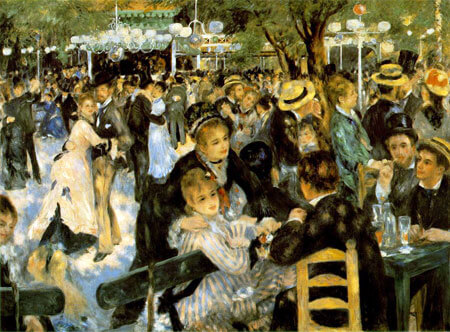
Explore a Montmartre dance, a gathering beside the Seine and the drawings behind Renoir’s paintings.
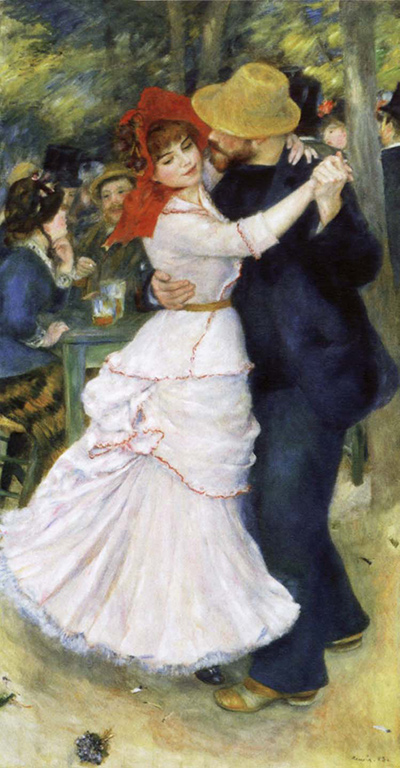
Renoir, Bal du moulin de la Galette
Dr. Beth Harris and Dr. Steven Zucker discuss Renoir’s 1876 Montmartre dance scene, its light and its crowds.
Watch on YouTubeLearning a trade and learning to look
Renoir was apprenticed to a porcelain-painting workshop in the 1850s, then copied at the Louvre and studied in Charles Gleyre's studio. The training exposed him to commercial decoration, drawing from older art and academic figure work. It would be too simple to say that porcelain painting directly produced every bright colour in his later oils. The connection is a question to test on objects, not a fixed formula for the career. Metropolitan Museum of Art, “Auguste Renoir” [1]; Musée d'Orsay, Renoir dessinateur. [2]
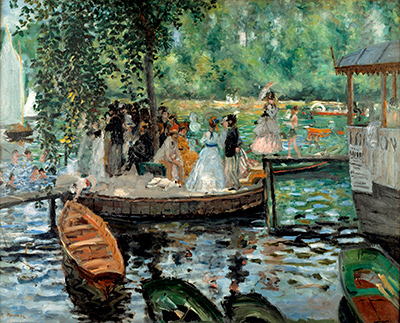
His friendships with Monet, Sisley and Bazille created opportunities to paint outdoors. At La Grenouillère in 1869, Renoir and Monet faced a moving riverside scene and developed different ways to organise its water, figures and reflections. Visible brushstrokes could suggest a quick change of light, but a mark that looks swift does not prove the entire picture was finished in one sitting.
What a visible brushstroke can do
The Art Institute of Chicago's study of Near the Lake, dated 1879/80, is a useful close case. Renoir varied the application of paint even within its relatively small canvas. The museum describes thin early washes, saturated strokes mixed on the surface, thicker highlights on a girl's hat and dry brushing that caught the raised threads of the canvas. Some parts look fluid, others textured. Art Institute of Chicago, Near the Lake. [3]
The support beneath those marks matters. The canvas had a commercially applied preparation with several layers, and the museum detected an additional layer that may have been applied by the artist. A light ground can affect how thin colour appears to the eye. The picture's luminosity therefore cannot be explained as a list of bright pigments alone. Renoir worked with the surface already there, sometimes allowing its texture or pale preparation to contribute to the result.
In the nineteenth century a visible touch of the brush could itself be controversial. The Art Institute's curatorial study discusses la tache, a term used for a visible mark or patch, and records how a sketch-like surface was judged by some viewers unsuitable for a finished painting. Renoir's strokes in Near the Lake are neither random nor uniform. A broad brush can put down a leaf shape in one motion; a smaller tip can make a feather or face. Seen at a distance, the different marks join into a scene; seen close, they declare that the picture was painted.
The same Art Institute study [3] connects Renoir’s varied touch to his later thinking about irregularity. In a May 1884 letter to Paul Durand-Ruel, Renoir argued that the slight differences among faces, leaves and flower petals were part of their beauty. Around that time he drafted notes for a proposed “Society of Irregularists” that would bring together painters and decorative artists who valued such variation. The museum presents these ideas as a way to read the handmade differences in Near the Lake, not as proof that each brushstroke was planned to illustrate a theory formulated years later. Nor does a proposed society establish that such a group ever held an exhibition. The useful connection is between a painter’s expressed interest in natural variation and the visible range of marks on his canvases.
Does “painted outdoors” mean “painted without changes”?
No. The Art Institute found alterations in Near the Lake visible both at the surface and in imaging. Renoir raised the horizon, changed elements of the figures and added small boats and walkers late in the process. Some earlier marks now lie beneath foliage. These are object-specific findings, but they make a broader point: an apparently immediate outdoor picture may have been revised and composed over time.
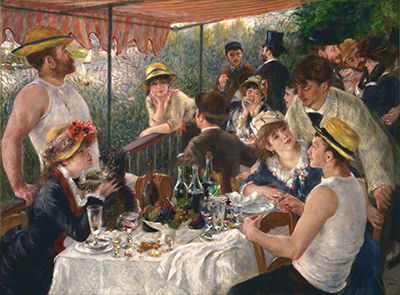
The Phillips Collection's study of Luncheon of the Boating Party gives another example. No preparatory drawings are known for the work, and infrared examination shows little underdrawing. Renoir seems to have developed the complex group directly on the canvas. X-radiography, infrared examination and raking light reveal changed figures and buried strokes; drying cracks also show that he reworked paint before earlier passages had fully dried. One cannot equate “no known drawing” with “no preparation” or “unchanged at the easel.” Phillips Collection technical study. [4]
The choice of subject may itself demand revision. Luncheon gathers multiple friends at a restaurant terrace, with overlapping heads, bodies and table objects. A person's arrival, absence or changed pose could disturb the balance of the whole. The Phillips quotes a letter in which Renoir describes difficulty finishing the picture as models came and went. The final image appears socially effortless because the composition holds those people together, not because the painter had no difficulty making it.
A seascape that looks immediate but has layers
The Art Institute's Seascape of 1879 [5] is useful precisely because it has no figure or elaborate social setting to explain the changes. From a distance it can look like a single experience of surf rolling toward a beach. Close and technical study reveal several different operations. Renoir laid broad cobalt-blue washes over a white ground in the sky, used diagonals to suggest rain, built the wave forms with opaque pale colours, then put heavy white paint onto the breaking foam.
Thin paint in the background lets the prepared support contribute to the light. The foreground has thicker, more tactile layers. The Art Institute reports that some early paint was allowed to dry before later work went on, suggesting a limited number of separate painting campaigns. It proposes that Renoir may have established wash-like passages on site and developed the complex waves later, perhaps with help from a smaller study. That remains a reasoned possibility, not a witnessed account of a studio session.
The sequence matters more than a rule about where Impressionists were supposed to work. A painting can record an outdoor observation and still be shaped indoors. A quick-looking brushstroke can belong to a considered later layer, while a thin first wash may survive in a picture that took longer to complete. In Seascape, the same white ground supports translucent sky and thick surf in different ways. The canvas does not ask us to choose between observation and construction; both are present in the technical record.
The Umbrellas: a painting made in two periods
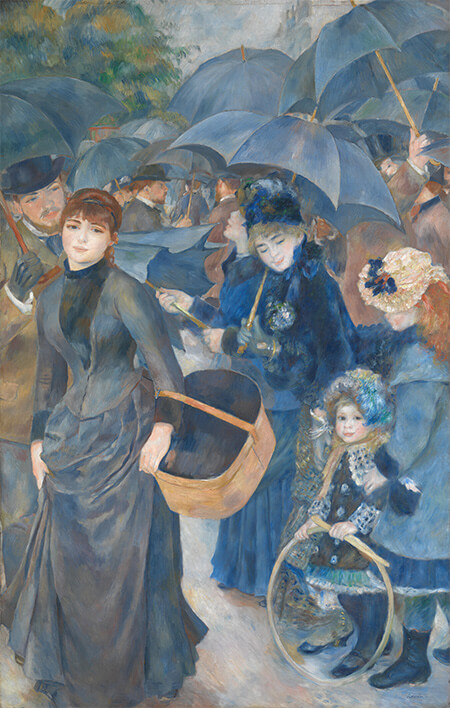
The Umbrellas is one of the clearest cases where material examination changed an art-historical account. National Gallery researchers distinguish two substantial phases: an earlier stage around 1881 and a later one from about 1885. The evidence includes paint cross-sections and X-rays, not just the contrast a viewer sees between some softer figures and firmer drawing. National Gallery Technical Bulletin, “Renoir's Umbrellas Unfurled Again”. [6]
The researchers found a change in materials between phases. Cobalt blue and zinc yellow occur in the earlier work, while French ultramarine and Naples yellow help identify later passages. New infrared images and digitally improved X-rays allowed the authors to refine which parts were altered. A pigment is not a timestamp on its own, but a pattern of materials, layers and forms across the canvas can establish a persuasive sequence.
This is why a date range on a museum label can be more honest than a single year. It also complicates a neat story in which Renoir first painted one “Impressionist” work, then suddenly made a wholly different “classical” one. In The Umbrellas, stages of his changing practice occupy one physical surface. The painting can be read as a history of decisions made years apart.
Drawing as preparation and as a work of art
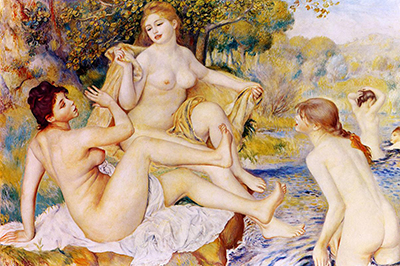
The Musée d'Orsay notes that relatively few early Renoir drawings survive. During much of the 1870s he often painted directly on canvas. In the early 1880s he began to make more extensive paper studies for large pictures, including Dance in the Country and The Great Bathers. This is a change in emphasis, not proof that he had been unable to draw before.
The Art Institute's large Splashing Figure, a study for The Great Bathers, shows how much can happen on one sheet. Renoir used white, red and black chalk, Conté crayon, blending and erasure to form the body. The white layer beneath darker marks and the exposed tan paper contribute to its light. Several related studies tested different poses and groupings before the oil painting was completed. Art Institute, Splashing Figure. [7]
Drawing could also be an independent portrait, an illustration, a pastel or a watercolour landscape. The drawings page follows those distinctions. A paper study helps explain a painting's making when the link is documented, but paper works should not be valued only as steps toward oil.
The changing 1880s were not a single turn
Renoir travelled in Italy from 1881 and thought deeply about older figure painting. Stronger contour and more sculptural bodies became important in The Great Bathers. Its preparation lasted years, and its reception in 1887 was divided. Yet landscapes, watercolours and freer colour remained in his practice. The Art Institute's Grove of Trees, dated 1888/90, is one example of a later paper work interested in outdoor colour and marks. Art Institute, Grove of Trees. [8]
The best question is not which single year Renoir “stopped being an Impressionist.” It is what a specific object required of him. A portrait client, a crowd of friends, a bather group and a grove of trees posed different problems. Technical evidence can show how he solved some of them; others remain matters of careful looking and qualified interpretation.
Firm fruit against loose colour in Italy
The Art Institute of Chicago's Fruits of the Midi gives a particularly clear example of methods overlapping in 1881, before the large bather project. Painted during Renoir's Italian journey, its peppers, tomatoes, aubergine, citron and pomegranate have distinct edges and weight. The tablecloth and background are more freely brushed. A viewer need not assign the canvas to one side of an “Impressionist versus classical” divide: the tension between carefully modelled objects and loosened surroundings is already visible within it. Art Institute, Fruits of the Midi. [9]
Technical examination refines that observation. The museum reports radiotransparent outlines around the still-life forms in X-radiography, and it identifies a change to the background from blue, lavender and mauve toward lighter greens and yellows. Some earlier colours remain visible at the edges. Renoir did not simply apply a new manner to an unchanging arrangement; he adjusted the colour field behind the objects as the picture developed. The outlines are evidence of how he established shapes, while the revised background shows continued judgement about how those shapes should sit in light. The Art Institute’s technical report is more specific: Renoir first traced the major contours in fluid, thin red paint, then brought the still-life forms close to completion before adding the background. Here the physical sequence supports the visual impression that firm fruit and looser surroundings were deliberately brought into relation, rather than painted in a single uniform manner.
The catalogue links this canvas with Onions, another Naples still life of 1881. Both were among a group of works bought by Durand-Ruel in May 1882. They share controlled modelling, yet their objects and formats differ. Looking at them together makes an important methodological point: a development in Renoir's handling can be traced through several related works, but each surface still has to be examined. A remembered remark about a “crisis” of Impressionism cannot replace the material record of particular paintings. Art Institute, Fruits of the Midi. [9]
A figure and a landscape on the same canvas
The Art Institute's technical catalogue for Two Sisters (On the Terrace) [10] shows why “Renoir's brushwork” is too broad a description even for one painting. The two figures are modeled with substantial paint and comparatively controlled marks. Behind them, the trees and riverside activity are made with thinner, lighter strokes. These different surfaces have different jobs: one establishes the women's presence near the front of the canvas; the other lets air and water seem to move through the background.
The canvas was commercially prepared with a smooth white ground. A bright background is therefore partly a matter of support as well as colour chosen from a palette. In some foliage, Renoir used thinned paint and a dry brush so that delicate marks lie lightly over the white surface. In the faces and garments he layered paint more heavily. The catalogue identifies both round and flat brushes, a cloth used for wiping, and a palette knife used for scraping. The finished image may look effortless, but its materials record several ways of putting paint on and taking it off.
Renoir initially planned fuller decoration between the balcony rails; infrared imaging reveals curving forms beneath the present surface. Suppressing them allowed the thin foliage beyond to show more clearly. He altered the woman's head, hat and arm, and wiped paint from areas of the child's face before adding thinner layers. None of this means the painting is an accidental survival of indecision. The final grouping is a choice made through revision. A viewer can look from the solid figures into the feathered background and understand why reducing the railing helped open that passage of space.
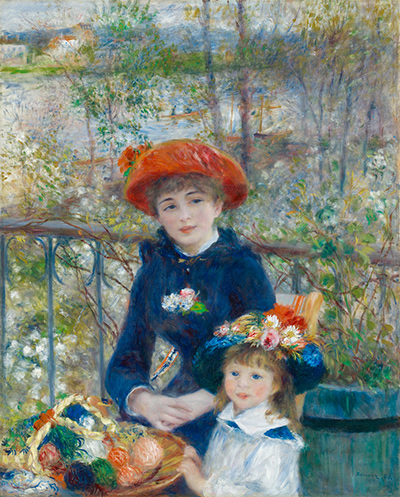
This is also a case where an image made with a scientific instrument has limits. The Art Institute reports no clear underdrawing in infrared reflectography. Outlines in transmitted light and transmitted infrared may have been made at an early stage, but some could have been worked into still-wet upper paint. We should not transform “no underdrawing observed” into “Renoir began with no plan.” Negative imaging evidence is narrower than a complete account of the artist's intentions.
What colour analysis can and cannot prove
The Art Institute identifies lead white, cobalt and ultramarine blues, several greens, vermilion, red lake, and several yellows in Two Sisters. That list tells us what its analysts found in samples and with examination; it does not assign a simple emotional meaning to each pigment. Red lake appears in the flesh tones, hat, flowers, yarn and parts of the background. It ties visually distant areas together, but the exact proportion and layering change from place to place. A single colour name is not a recipe for the look of the whole painting.
The same caution applies to The Umbrellas. There, comparing materials across layers helps distinguish working phases because the National Gallery's team also has X-rays, infrared images and the clothing chronology. If we removed those other kinds of evidence, the observation that one blue differs from another would be weaker. A technical account is strongest when colour, stratigraphy and visible form agree.
Paintings also change after leaving the studio. Varnishes may be applied, removed or replaced; a lined canvas can obscure the original reverse. The Art Institute records a synthetic varnish on Two Sisters from a 1972 treatment and says that the earlier natural-resin varnish could not securely be identified as Renoir's. What we see today is the work as preserved and conserved. The original painting remains central, but a present-day surface should not automatically be treated as an untouched 1881 surface.
Why a preparatory study is not a miniature final painting
The large Art Institute sheet Splashing Figure, made about 1884/85, documents the work of testing a pose for Renoir's bather project. He combined red, white and black chalk with Conté crayon, blending and erasure on tan paper. Those are not merely substitutes for colours that would later appear in oil. White chalk can bring a body forward from the paper tone; dark marks can test weight and overlap; erased areas can reconsider a contour. The sheet is a fully worked encounter with form in its own medium. Art Institute technical report. [7]
 Pierre-Auguste Renoir.jpg)
The Art Institute cautions that aspects of this study are closer to an earlier arrangement of The Great Bathers than to the final Philadelphia canvas. If a figure's arm or position differs from the finished painting, the difference is evidence of development rather than a defect in the drawing. Placing the study beside the oil can reveal alternatives Renoir explored. It cannot prove the precise order of every sheet and painted change unless the surviving records or physical evidence support that order.
This distinction helps explain why a period label can mislead. The preparatory drawing belongs to the years when Renoir sought firmer figure structure; it also depends on vigorous rubbing, chalk texture and revised lines. Greater attention to drawing did not remove experiment or touch. Meanwhile, the Art Institute's later Grove of Trees shows the continuing appeal of loose landscape marks. A painter could work toward constructed bathers and still make exploratory, colour-rich landscapes.
A practical way to compare Renoir’s surfaces
Choose a single painting and look at it in three passes. First, identify its large arrangement: where the bodies, foreground objects and background zones sit. Second, compare how the edges are made. Does a face end in a sustained contour, or does it merge with neighbouring colour? Are leaves individually described, or built from marks that become foliage only at a distance? Third, ask which apparent effects depend on the support, on layered colour, or on changes visible through technical imaging. These are different questions and may have different answers within the same canvas.
The selected objects here make a short sequence rather than a universal timetable. Near the Lake demonstrates washes, dry brush and thick touches around 1879/80. Two Sisters gives substantial figures against thin foliage in 1881. The Umbrellas retains phases from different years on one canvas. Splashing Figure records the 1880s turn to sustained figure study on paper. The Bathers of 1918–19 belongs to another late moment again. Their dates help a reader orient themselves, while their physical evidence shows why style is not one line of progress.
The most useful result of technical research is often a better question to take back to the visible painting. When an X-ray reveals an altered hat, look at how the present head sits in the composition. When a report identifies wiped paint on a face, ask whether the current thin layer affects its softness. When a study shows a different arm, look at the final grouping before deciding why a revision helped. Conservation evidence and visual attention work together; neither needs to stand in for the other.
Late colour, line and collaboration
Renoir continued to paint figures, still lifes and landscapes at Cagnes even as arthritis limited his mobility. The Musée d'Orsay's account of late drawings describes large red-chalk figures and motifs that moved among drawing, painting and sculpture. Sculpture had a collaborative material process: Richard Guino physically modelled works under Renoir's direction and is recognised as co-author. Those objects cannot be described as Renoir's solitary handiwork in clay. Orsay, Renoir dessinateur [2]; Orsay, Richard Guino. [11]
The late oil Bathers of 1918–19 at the Musée d'Orsay is a different object from Philadelphia's large Bathers of the 1880s. Both ask how figures occupy an outdoor setting, but their dates, scale and making histories should not be merged. A technique page can help readers compare them only after first identifying each work. The paintings directory and individual artwork pages give that object-level context.
Renoir artworks directory
Discussion
Look closely at Style and Technique and use the questions below to compare what you see with the documented history.
Reader Insights
Where do broken colour and a firmer drawn contour coexist?
Compare technical evidence for the 1870s with the preparations for the 1880s bathers.
Which work resists a neat division into Impressionist and later styles?
Join the Conversation
Share a close observation or a source-backed question about Style and Technique. The prompts above are starting points for discussion.
References
- The Metropolitan Museum of Art, “Auguste Renoir (1841–1919)” View source.
- Musée d'Orsay, Renoir dessinateur View source.
- Art Institute of Chicago, Near the Lake View source.
- The Phillips Collection, Luncheon of the Boating Party technical study View source.
- Art Institute of Chicago, Seascape, catalogue essay and technical report View source.
- National Gallery, London, “Renoir's Umbrellas Unfurled Again” View source.
- Art Institute of Chicago, Splashing Figure View source.
- Art Institute of Chicago, Grove of Trees View source.
- Art Institute of Chicago, Fruits of the Midi, technical study and catalogue essay on Renoir's Naples still lifes View source.
- Art Institute of Chicago, Two Sisters (On the Terrace) View source.
- Musée d'Orsay, Richard Guino directory View source.
- Art Institute of Chicago, Art Institute open-access object image View source.
- Art Institute of Chicago, Splashing Figure open-access object image View source.