by Tom Gurney
Tom Gurney BSc (Hons) is an art history expert with over 20 years experience
Published on June 19, 2020 / Updated on October 14, 2026
Email: tomgurney1@gmail.com / Phone: +44 7429 011000
More than one meaning of “by Rubens”
Peter Paul Rubens directed a productive Antwerp workshop, but an artwork associated with him need not fit a simple choice between “painted by Rubens” and “painted by someone else.” He could design a composition, paint it throughout, let a pupil bring a design forward before retouching it himself, or work with an established specialist. A later copy made after one of his designs raises a different question again. These are distinctions about the making of a particular object. They cannot be assigned to every Rubens painting from a general claim that his workshop was large.
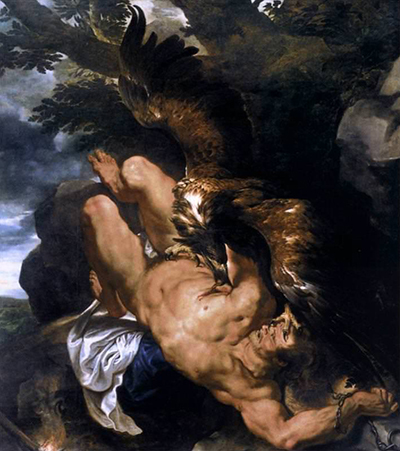
The clearest starting point is Rubens's own 1618 list of pictures offered to the English diplomat Sir Dudley Carleton. In this commercial document he explained levels of his participation and named Frans Snyders for the eagle in Prometheus Bound. The letter tells us how Rubens described a selection of works to a buyer at that moment. It is evidence of categories he found useful, not a complete inventory of his studio or a guarantee that every modern attribution can be settled by repeating them. Today's museum labels also draw on technical examination, comparison and later provenance.
This guide follows several named works to show how those judgments operate. Philadelphia's Prometheus documents a collaboration between two recognised painters. A Norton Simon portrait currently carries a “Workshop of Peter Paul Rubens” credit. A British Museum cattle drawing is catalogued to his office or studio, with doubt that his own hand drew it. Each case requires its own record. The paintings guide and drawings guide lead to individual objects; this page explains the working relationships those records may describe.
At a Glance
- Key documentRubens's Carleton picture list, 1618 [1][2]
- Named collaborationRubens and Frans Snyders, Prometheus Bound [3][4]
- Qualified painting creditWorkshop of Rubens, Anne of Austria [6]
- Qualified drawing creditOffice or studio of Rubens, Cows [7]
What the 1618 Carleton list actually shows
Rubens and Carleton discussed an exchange of pictures for antiquities in 1618. Rubens's list identified subjects, sizes and conditions of execution to help Carleton judge what was offered. He distinguished works wholly by his hand from pictures in which pupils had advanced the painting from his design and he then intervened. He also specified the separate contribution to Prometheus Bound. These differences had practical force: a buyer could care how much of a picture was actually painted by the celebrated master.
The list should be read as a seller's contemporary description of the works on offer, not as a modern certificate for every object now carrying a familiar title. Historic titles can recur, and works may have been altered or lost. A large Leda mentioned in the correspondence, for example, must not automatically be equated with the separate small Leda and the Swan panel on this site. The quotations guide uses short fragments from the two Carleton letters and keeps the business setting visible.
Rubens's own distinctions also warn against calling every assistant's passage a counterfeit. If a pupil made a picture from a design under the master's direction and Rubens retouched it, the resulting work could be sold in a category described openly to the client. Yet neither “design” nor “retouching” tells us exactly which visible strokes are his. The amount and significance of an intervention must be argued from evidence for a named object. A phrase from the 1618 list cannot be pasted onto an unrelated altarpiece merely because its figures look uneven.
A documented specialist: Prometheus Bound
The Philadelphia Museum of Art dates Prometheus Bound as begun about 1611–12 and completed by 1618. Its accession number is W1950-3-1. The large oil canvas depicts the Titan chained to a rock while an eagle attacks him, a scene from the Greek story of his punishment for bringing fire to humanity. The figure's twisting body and the bird's grip form a single violent composition. Philadelphia identifies the eagle as the work of Frans Snyders, the Antwerp painter known for animals and still lifes, alongside Rubens's principal painting of Prometheus.
The museum's object study makes the division visible in technique: it describes Rubens's broad, loose handling of the lit flesh and Snyders's minute strokes in the dark bird. Those observations help a viewer look at the canvas, but stylistic contrast alone would be weaker evidence than the combination of object study and Rubens's own 1618 identification of Snyders. The bird is essential to the story, not a dispensable embellishment added after the “real” picture was complete. The Prometheus Bound object page follows the composition and its history in more detail.
Snyders was an established painter contributing a specialised part, not simply a student learning to imitate Rubens's manner. The collaboration does not prove that Snyders painted every animal in every Rubens picture. Names of possible contributors need work-specific evidence, especially where a painting's history is complicated by restoration, copies or changes in attribution. Philadelphia's record gives a strong named example because contemporary and institutional evidence align. That is why it can support an explanation of collaboration without being made into a universal formula.
Collaboration among established painters
The Museo del Prado names Jan Brueghel the Elder among Rubens's collaborators. Brueghel, like Snyders, had his own career and reputation. Joint work by established painters could bring different strengths into one object: one artist might handle figures while another developed a landscape, flowers or other detailed passages. The general pattern is useful, but it does not identify the hands in an unnamed painting. For a specific Rubens–Brueghel picture, the holder's catalogue must supply the date, attribution and proposed division of work.
“Collaborator,” “assistant” and “pupil” therefore describe different relationships. A collaborator has a recognised practice beyond the Rubens shop; a pupil might be learning there; an assistant could execute work under direction without the same role as a contracting master. In real production the boundaries might overlap. A painter could learn in a workshop and later work independently. These labels are best treated as descriptions of the documented relationship for a particular task, not permanent ranks assigned to a person for life.
The surviving documents and paintings also remind us that authorship need not be distributed by the physical size of a passage. A small animal or flower can carry meaning in a scene, while a large background may be subordinate to a composition devised by someone else. Conversely, the fact that Rubens planned an image does not mean he held the brush for every visible square inch. The modern label tries to express the museum's best judgment about this balance, but a short credit line may compress a complex history.
A present-day “workshop of” label: Anne of Austria
The Norton Simon Museum currently catalogues its Portrait of Anne of Austria, Queen of France as “Rubens, Workshop of Peter Paul.” It dates the oil-on-canvas portrait to about 1622 and gives accession F.1965.1.059.P, measuring 119.7 × 96.8 cm. Anne wears an elaborate lace collar, jewelled crown, embroidered satin and an ermine-lined mantle. Those details present a queen through court dress and rank. The museum associates the portrait with Rubens's work around the Luxembourg Gallery project in Paris.
“Workshop of” is a qualified attribution. It places the painting within Rubens's studio practice or immediate circle of production while stopping short of certifying that Rubens himself painted this canvas throughout. The label does not mean the museum has identified a particular pupil. It also does not tell us, on its own, whether Rubens supplied a model, made a sketch, supervised a stage or touched the final surface. Such claims need separate evidence. The Norton Simon catalogue records the present status without converting association with the master into autograph authorship.
A separate Norton Simon online exhibition has credited the portrait directly to Rubens with a slightly later date range. That institutional inconsistency is worth retaining as a source note, not disguising as a resolved scholarly debate. For the public label here, the live object catalogue is the more specific current record. Should that record change, this guide and the object page should be checked together. The point of a cautious credit is to tell the reader what level of certainty the collection presently expresses.
A drawing catalogued to the office or studio
The British Museum's Cows, Study for a Painting provides a different test. Its current object record assigns it to the office or studio of Peter Paul Rubens, while a curator's comment compares a stronger Van Dyck sheet at Chatsworth and doubts that the British Museum drawing is in Rubens's own hand. The museum sheet is a study in pen and brown ink with grey wash, about 34 × 52.6 cm. The cattle-study page preserves both the office attribution and the curator's comparative judgment.
A drawing may have served a painting process even when its hand is uncertain. Studio drawings could preserve poses, motifs and arrangements for use by more than one painter. The label “office” does not make this British Museum sheet an anonymous mechanical tracing, nor does a link to a Rubens composition settle its author. A similar motif could be drawn by another artist working near him. The comparison with Van Dyck is a reason to examine how the lines behave and how the sheet relates to other drawings, not a licence to reattribute it without a catalogue argument.
The British Museum record was intermittently inaccessible during this research check, so its exact current date fields should be reopened before release. Conflicting fields in a cached version make a precise year unsafe here. The material, dimensions and qualified attribution are retained from the object packet; the public copy avoids a false single date. This is a useful example of why “Rubens drawing” in a legacy page title can be more certain than the current evidence permits.
Reading attribution terms carefully
“By Peter Paul Rubens” normally states the cataloguer's judgment that the object is substantially autograph. It does not assert that no one ever prepared a ground, panel or canvas, or that conservation has left every passage untouched. “Workshop of Peter Paul Rubens” identifies production in his orbit without identifying his hand to the same level. “Office or studio of” is a related qualification used by some drawing catalogues. Institutions choose terms differently, so their accompanying notes matter more than forcing all collections into one fixed dictionary.
“After Rubens” generally means that an artist followed a Rubens composition in a separate work. A print after a painting can distribute its design widely without being a painted object by Rubens. The prints guide explains how a design, engraving and later impression each have their own makers and dates. “Retouched by Rubens” claims that he altered a work begun by another hand; it is narrower than saying he originated or painted it all. A technical report may identify those retouchings more precisely than an old sale title.
A copy is also an object with its own date, support and history. Some copies were made in Rubens's period, some later. A copy can be valuable evidence of a lost composition while remaining a distinct work. The site's Scipio and Hannibal drawing illustrates how a sheet catalogued as anonymous after Giulio Romano, possibly retouched by Rubens, requires more than one clause in its credit. The words “after” and “possibly” each change the claim; dropping either makes the public label less accurate.
Design, execution and the buyer's expectations
In a busy workshop, making an image could include invention, preparatory drawings, a painted model, enlargement, execution, correction and finishing. The same person did not necessarily perform every step. Rubens's business letters show that he cared how much his own participation was represented to a client. This was especially significant when works varied in size and price. It would be misleading to treat the name at the top of a workshop as a promise of every stroke, but it would be equally misleading to assume the master's role was merely signing finished work.
The material evidence can sometimes sharpen a written claim. Underpainting, changes of mind, revisions, differences in touch and the fit between a sketch and a final canvas may help a conservator or catalogue author distinguish stages. However, a photograph usually cannot settle these questions. Even a high-resolution screen image may flatten a brushstroke, hide restoration or make two materials look alike. Readers should use a museum's technical findings where available and keep interpretation separate from observation.
Some Rubens commissions involved many related objects: drawings, oil sketches, full-scale canvases, variants and prints. Their connections matter, but an oil sketch is not automatically “all Rubens” and a large finished work “all assistants.” Each needs its own examination. The oil sketches and technique guide follows that sequence of making, while individual object pages state what the present holder attributes to each surviving work.
How to use the site’s Rubens pages
Begin with the exact object: current collection, accession number, material, dimensions, date range and image match. Then read the full attribution, including qualifiers such as “workshop,” “after,” “possibly” or “with.” Finally look for the evidence behind the label. Rubens's 1618 letter is unusually direct for Prometheus; most works do not have such a convenient contemporary statement. A curator's comparison, a conservation study or a documented provenance may carry the argument instead.
Do not transfer an attribution from a work with the same title. Rubens and his circle made repetitions and variants, and later artists copied popular compositions. “Portrait of Anne of Austria” can identify more than one object; only F.1965.1.059.P identifies the Norton Simon canvas discussed here. Likewise, the Philadelphia Prometheus is W1950-3-1. A page title and image are an entry point, not a substitute for the record.
The workshop was a means of making ambitious work across many commissions, and it also created evidence that resists a one-name answer. The most faithful account is sometimes a clear sentence with a qualification. A documented collaboration can be named with confidence; a studio attribution can be left qualified; a possible retouching can remain possible. Those are useful distinctions for looking, not obstacles to enjoying the picture.
When a design became a room or a tapestry
The Banqueting House ceiling reveals the size of a workshop task unusually well. The Royal Collection's detailed account[1] says Rubens developed painted models, submitted a final programme for Charles I's approval in 1632, and oversaw the production of nine large canvases in Antwerp by 1634. Assistants carried out significant painting under his direction, while he reviewed, retouched and supplied final passages. The canvases then crossed the sea and were fitted into an existing ceiling in London. Because measurements did not align perfectly, adjustments were made in situ after delivery. The work's authorship thus includes design and direction as well as brushwork, while its final physical form also depended on installation.
This example does not erase the people who built the architectural setting. Inigo Jones designed the Banqueting House, and Rubens's paintings were made for its compartments and views from below. The ceiling was not a series of portable easel pictures later hung in a convenient room. At the same time, the Royal Collection does not name every assistant responsible for each passage. An honest account can describe the documented division of labour without inventing individual identities. The ceiling's continuing place at Whitehall lets a viewer understand a kind of making that a single framed reproduction cannot convey.
Tapestry design brought still more hands into the chain. The Metropolitan Museum's Constantine series account[2] separates Rubens's oil-on-panel modelli from cartoons made by pupils in distemper on paper and from the Paris weavings. Patrons inspected the intermediate cartoons before all the textiles were made. A label that says “designed by Rubens” for a tapestry makes a different claim from “painted by Rubens” for an oil modello. It assigns invention while leaving the cartoon maker and weaver's material work visible. This distinction is particularly important where the woven scale and architectural purpose differ greatly from the small painted proposal.
Technical differences within a joint painting
The Getty's Rubens and Brueghel: A Working Friendship[11] examines paintings produced through an association of two established artists. The technical study describes Brueghel's relatively opaque, precise handling and Rubens's tendency in those works toward translucent glazes and scumbles. It also follows Rubens laying in and altering contours with warm brown paint. These observations help explain how an expert might distinguish a collaborator's passage, but they are not a simple visual test for every animal, figure or flower in every painting. Pigments and binders could be similar, and later varnish or restoration can make a surface less legible. Technical and documentary evidence should be read together.
The same Getty study explains that Rubens's fast bozzetto could be followed by a more finished modello for a patron and assistants. That sequence helps make sense of a workshop in which the lead painter's design could be communicated through multiple objects. It should not be imposed on every commission. Some projects have a surviving drawing but no known painted model; others preserve a model and a finished painting with differences between them. The distinction matters because a studio's creative work was not limited to enlarging a small picture mechanically. Revision could continue at the stage of figure studies, canvas or installation.
Frequently Asked Questions
His 1618 Carleton list distinguishes works entirely by his hand from pictures begun by pupils to his design and then retouched. A modern museum attribution must still be checked for each surviving object; the letter is not a blanket label for the whole output.
Frans Snyders painted the eagle in the Philadelphia Museum of Art's canvas W1950-3-1. Rubens named Snyders in his 1618 offer, and the museum's object study discusses their different handling of bird and human figure.
It attributes a work to production within Rubens's studio or immediate working practice without giving the same certainty of his own execution as an autograph credit. It does not, by itself, identify a named pupil or the exact passage Rubens painted.
The museum's current object catalogue credits its F.1965.1.059.P to “Rubens, Workshop of Peter Paul.” Another museum exhibition page uses a direct Rubens credit, so the live object record is followed with the discrepancy disclosed.
The museum assigns Cows, Study for a Painting to Rubens's office or studio and records curatorial doubt that he drew this particular sheet. A related motif or a workshop use does not establish his hand.
Discussion
Which catalogue label most needs an explanation?
Share a collection record if a credit has changed.
Reader Insights
How does the 1618 Carleton list change your reading of a picture?
What does the Prometheus collaboration show about specialist work?
Where should a possible retouching be described more carefully?
Join the Conversation
Add a specific observation or source below.
References
- Royal Collection Trust, The Apotheosis of James I , design, workshop and installation. View source
- Metropolitan Museum of Art, Constantine tapestry models, cartoons and weavings. View source
- Max Rooses, Correspondance de Rubens , vol. 2, digitised Carleton correspondence. View source
- Kunsthistorisches Museum, analysis of Rubens's 1618 Carleton list. View source
- Philadelphia Museum of Art, Prometheus Bound , W1950-3-1. View source
- Philadelphia Museum of Art, Prometheus Bound object study. View source
- Philadelphia Museum of Art, Prometheus Bound collection highlight. View source
- Norton Simon Museum, Portrait of Anne of Austria , F.1965.1.059.P. View source
- British Museum, Cows, Study for a Painting , 1895,0915.1046. View source
- Museo del Prado, Rubens artist record. View source
- Getty Research Institute, Rubens and Brueghel: A Working Friendship. View source