by Tom Gurney
Tom Gurney BSc (Hons) is an art history expert with over 20 years experience
Published on June 19, 2020 / Updated on October 14, 2026
Email: tomgurney1@gmail.com / Phone: +44 7429 011000
A small painting can do several jobs
An oil sketch by Peter Paul Rubens is a painted object, often on a wood panel, that could help develop or communicate a design for another work. It may set out a composition for a patron, guide an assistant making a larger painting, or demonstrate how an object in another material should look. Some sketches are swift and exploratory; others are carefully resolved. Size and freedom of handling alone do not tell us what commission a sketch served. The named object and its documentary setting do.
Rubens's process was varied. The Metropolitan Museum describes a recurring relationship among compositional drawings, painted modelli and more focused studies of figures. Its account says small oil sketches increasingly performed some planning tasks that earlier compositional drawings had served. This is a pattern, not a rule requiring every surviving sketch to occupy the same stage. A drawing could also be a private study, a copy after earlier art or a design for a print. A painted model might already be persuasive enough to present to a patron.
Three examples make the range concrete. The Snijders&Rockox House holds a sketch for a Ghent altarpiece later executed by Anthony van Dyck. The National Gallery's Aurora abducting Cephalus supplied a design from which assistants could make a full-size painting for a Spanish hunting lodge. The Gallery's Birth of Venus helped design a silver basin, not a conventional finished canvas. Their different destinations matter as much as their shared use of oil paint. The workshop guide explains how design and execution could be divided among artists.
At a Glance
- Planning patternDrawings, painted modelli and figure studies [1]
- Ghent modelloChrist on the Cross, 1628 [3]
- Royal decoration modelAurora abducting Cephalus, about 1636–37 [4]
- Silver-basin designThe Birth of Venus, about 1632–33 [5][6]
Drawing, modello and finished work
A drawing uses dry or liquid graphic media such as chalk, pen, ink or wash on a support usually identified as paper. An oil sketch uses oil paint, often on wood, and can quickly test colour, light and the arrangement of figures. A modello is a model or proposal for a projected work; it may be a painted sketch, but the term describes its function rather than a fixed size or degree of finish. The projected work may be a large painting, a decorative scheme or an object in another material.
The terminology is useful only when we keep the actual object in view. A small painting can be the final object offered to a collector. A drawing can be highly finished, and a painted modello can show many settled decisions. The drawings guide follows paper studies and copies after earlier masters. Here the focus is what painted designs did and what material examination can establish. Neither category should be made into a universal first step for every Rubens commission.
Planning also happened in relationships. A patron might need to see a proposed arrangement before consenting to a full-size altarpiece. A collaborator or assistant might need a reliable model while the master worked elsewhere. A silversmith needed a visual design that could be translated into metal. Those are distinct practical problems. The survival of a sketch gives us an unusually close view of one proposed solution, but it does not guarantee that the final work followed it without revision.
A Ghent altarpiece model completed by Van Dyck
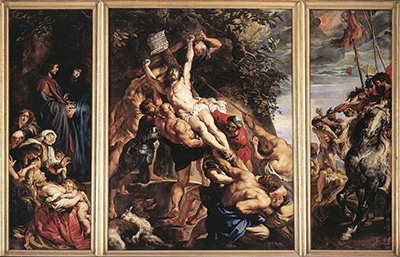
The Snijders&Rockox House describes its Christ on the Cross, inventory 77.124, as a Rubens modello for a high altarpiece for St Michael's Church, Ghent. It dates the painted panel to 1628. The finished altarpiece was executed by Van Dyck. That distinction makes this work particularly clear as a design with a later life beyond Rubens's own brush. The sketch records his proposed image; it is not a reduced photograph of a full-size Rubens canvas.
A model for a church painting had to make the central action and devotional focus intelligible. In the sketch, the crucified Christ dominates the vertical composition. The scale of the surviving panel is different from the scale of an altar, so the artist had to think across a change in size and viewing distance. The Christ on the Cross page identifies this particular model and its relationship to the Ghent commission. It also keeps the sketch separate from other Rubens crucifixion paintings, which have different patrons and supports.
An older source gives a date around 1627, while the house's visitor guide says 1628. A one-year difference is smaller than the central identity of the work but still relevant for a chronology of Rubens and Van Dyck. This page uses the house's date for its object and notes the older variation rather than averaging them into an invented exact month. The important methodological point is that a Rubens design could be realised by another painter. “Rubens modello” does not imply “Rubens finished altarpiece.”
Aurora abducting Cephalus : a working model for assistants
The National Gallery, London, holds Aurora abducting Cephalus, NG2598, an oil sketch dated about 1636–37. It measures 30.8 × 48.5 cm and is painted on wood, probably oak. The small panel was a design for one of the mythological hunting scenes commissioned by Philip IV of Spain for the Torre de la Parada outside Madrid. The Gallery says Rubens's assistants could use such sketches as models from which to complete large pictures.
Aurora, goddess of dawn, moves toward the reclining huntsman Cephalus. His dog and spear help identify him; the white horses and chariot mark her arrival. In the sketch, the bodies, animals and surrounding landscape are organised so that the mythological action remains readable. A viewer can see how a compact painted design might carry the main decisions for another painter, even though it cannot specify every stroke of a future large canvas. The work's small size does not make its compositional role minor.
The Gallery identifies a different Prado oil sketch for a later part of the Cephalus story. It also names a related finished painting by Peeter Symons, an assistant, and says Rubens himself never painted a definitive version of that later scene. The London sketch, Madrid sketch and Symons painting are therefore separate objects and separate stages. Transferring the London panel's date, dimensions or action to the other two would confuse a design sequence with a single picture. Nor does the Gallery's “probably oak” become a firm wood-species identification just because a summary needs a short material label.
This example helps explain the scale of Rubens's later commissions. He could provide inventive designs for a coordinated group of works destined for a royal lodge without personally executing every large painting. What survives in London is itself a valued painting, however. Calling it “preliminary” describes its relationship to another project; it does not reduce it to a disposable note.
The Birth of Venus : painted design for silver
The National Gallery's Birth of Venus, NG1195, shows a different function. Dated about 1632–33, it is black chalk and oil on wood, probably oak, 61 × 78 cm. Rubens designed a silver basin for Charles I of England. At the centre Venus rises from the sea; figures and sea creatures fill the surrounding border. The motif had a physical point for a vessel: as water drained, the goddess would emerge more clearly. This is design thinking for an object held and used, not simply a small version of a painting to hang on a wall.
The basin was cast by the Antwerp silversmith Theodore Rogiers. An accompanying ewer carried a Judgement of Paris design. The silver objects no longer survive, but the Gallery notes their record in a 1660 print by Jacob Neeffs. That chain contains multiple makers and media: Rubens's chalk-and-oil design, Rogiers's metalwork and a later print. One cannot describe the surviving Gallery panel as “the silver basin,” or attribute the silversmith's craftsmanship to Rubens merely because he invented its imagery.
The Gallery's conservation account also makes this panel an unusually good case for studying technique. It describes deliberately streaky priming and a striking variety of effects achieved with three or four pigments, scumbling and glazing. These are findings about NG1195, not a recipe for all Rubens oil sketches. The report explains that discoloured varnish applied in 1885 had distorted the look of the limited palette. Conservation removed that varnish and revealed more of the painted surface. A viewer encountering a pre-treatment photograph and a current one might draw different conclusions about Rubens's colour if the treatment history were ignored.
Scientific examination found warm brown paint around the perimeter covering gold leaf. The Gallery considers that paint probably not original, yet consistent with older materials rather than a modern intervention, and left it in place. This is a useful limit on easy stories of “the artist's original intention.” A historic alteration can be early without being Rubens's own. A material investigation can identify a layer and propose its chronology, but it cannot supply an undocumented name for the person who added it.
What a support and paint surface can tell us
A catalogue's “oil on panel” gives a broad description, not a complete technical history. The support may be composed of several boards. A conservator may find changes in ground, priming, underdrawing, paint handling or later restorations. The technical details matter when they help answer a specific question: was a format enlarged, was a part revised, what surface did the artist work over, or what can we still see of the painted design? A medium label alone cannot answer all of these questions.
The National Gallery's treatment of A View of Het Steen in the Early Morning offers a comparison from a finished landscape, not an oil sketch. Its conservators documented board joins, open splits, complex construction and evidence of enlargement. The panel required a specially shaped support after repairs. These findings concern that one large landscape and its later physical history. They show how close examination can reveal construction that a reproduction conceals; they do not prove that small modelli were assembled or enlarged in the same way. The Het Steen page follows the painting itself under its legacy route.
The Gallery's technical bulletin on Minerva protects Pax from Mars, often called *Peace and War, is another object-level study of a finished painting*. It addresses the material and conservation history of that work rather than setting out a universal sequence for Rubens's sketches. Its findings should be read next to the Gallery's catalogue for the painting and not converted into a blanket claim about all panels. A painted allegory given to Charles I in 1630 had a different function from a small working model.
These comparisons also set a limit on looking at screens. A photograph can show subject and composition very well, but not necessarily a thin glaze, an altered varnish, a join on the back of a panel or the order of paint layers. A statement about technique should identify whether it comes from a catalogue description, a conservation report or direct looking. If the source says “probably oak,” retain the qualification. If it documents a later addition, call that layer later rather than presenting all visible colour as Rubens's first paint.
The same material, different destinations
The Ghent, Torre de la Parada and silver-basin examples all involve small painted designs, but their audiences differed. The Ghent modello proposed a religious image later realised by Van Dyck. The Aurora sketch helped transmit a mythological scene to assistants making royal decoration. The Birth of Venus helped another craftsperson make a silver object. A generic phrase such as “Rubens sketched in oils before making a large painting” works only for some of them. The actual destinations give the panels their meaning.
There are also boundaries of attribution. A Rubens design does not make every later work after it autograph. The prints guide describes how engravers used and interpreted designs, while the workshop guide distinguishes pupils from independent collaborators. The later object must retain its own artist, date and material. In the same way, a modern high-quality reproduction of a sketch is not a substitute for its conservation record. Surface and support are part of the evidence, not merely decorative details.
The practical way to read an oil sketch is to ask four questions: What is this particular object? What was it for? Who executed the later work, if one exists? What has technical examination actually shown? The answers may differ from panel to panel. Rubens's ingenuity is visible across these varied tasks, but the strongest account does not force them into one studio recipe.
Designing a room through painted models
The Getty's account of the Triumph of the Eucharist[9] shows a larger challenge than the single later painting in the Aurora example. Rubens devised 20 tapestry compositions for the church of the Descalzas Reales in Madrid. He worked in Antwerp from descriptions of the church, rather than measuring the space in person. The painted designs thus had to carry an architectural plan as well as stories and figures. The Getty's discussion of differing viewpoints and a sketch for the choir wall suggests that the finished hangings were intended on two levels. The arrangement is a scholarly reconstruction of the programme, not something visible from one surviving oil sketch alone.
The Getty also distinguishes the lively brushwork of Rubens's oil sketches from the monumental woven results. In a tapestry, a painted line had to become a pattern of coloured threads at a radically different size. There would be decisions by cartoon makers and weavers between the panel in Rubens's studio and the installation in Madrid. The two media even behave differently under light and across time. A close study of a modeller's paint can explain invention, but the original spectator confronted a church decoration assembled from multiple hangings. To interpret either stage fully, one must identify where it sits in that process.
Another sequence survives for the Story of Constantine. The Metropolitan Museum's account[10] distinguishes Rubens's oil-on-panel modelli, cartoons produced by his pupils in distemper on paper, and tapestries woven in Paris. The first cartoons were delivered late in 1622 and January 1623. Advisors to Louis XIII examined them, praising some aspects while criticizing the proportions of the figures. That report is unusually direct evidence that a patron's circle could evaluate the intermediate stage, not simply the master's first sketch and the final hanging. Louis XIII later ordered multiple weavings. Calling the oil model, cartoon and tapestry three “versions” without naming their media would hide the different labour and decisions documented here.
What close material study adds
The Getty's technical study of Rubens and Jan Brueghel[11] describes a range of Rubens's painted preparations. Swift bozzetti could work through a composition directly on a prepared surface, often with changes. A more resolved modello might then help secure patron approval and guide assistants. The study observes warm brown painted contours, adjusted as the image developed, and areas in which the ground remained visible under flesh shadows. These observations make the surface itself a record of choices. They also show why a sketch's apparent speed does not mean it had no preparation: a prepared panel and a carefully chosen initial ground were already part of the work.
The same publication compares Rubens and Brueghel on technical grounds. In the works it examines, Brueghel's denser, more opaque detail and Rubens's more translucent glazes and scumbles produce different effects even when their pigments and binding materials are broadly similar. That contrast is useful for a joint painting, but it should be applied carefully. An isolated photograph does not reveal the full paint stratigraphy, and a named collaboration should be grounded in the collection's own record and examination. The publication also notes Rubens's selective use of walnut oil for pale passages rich in lead white because of its lesser tendency to yellow than linseed oil. This is an observed choice within studied works, not a claim that every light Rubens passage used the same binder.
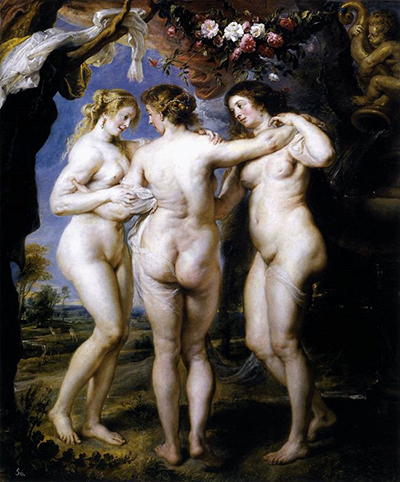
Conservation evidence can distinguish the artist's revision from later change. In the National Gallery's Birth of Venus, the altered varnish affected how viewers perceived a deliberately limited palette, while perimeter paint over gold leaf may have been old without being Rubens's. In the Prado's Three Graces, the artist enlarged the oak support as the composition developed; centuries later, conservators addressed movement and damage in that support. These are different moments in an object's history. Technical information becomes most valuable when it answers which layer or join belongs to which moment, rather than when it provides impressive-sounding materials without a connection to the work being discussed.
Frequently Asked Questions
It is a small painted work, often on wood, that can test or communicate a design. Some served as proposals for patrons or models for assistants, while others designed works in different materials. The specific commission determines its function.
No. Modello describes a model or proposal for another work. It can be carefully resolved and valuable in its own right, even when the eventual altarpiece or decorative object differs from it.
The Snijders&Rockox House calls its 77.124 panel a Rubens modello for St Michael's Church, Ghent. The finished altarpiece was executed by Van Dyck, so design and final painting have different makers.
National Gallery NG1195 was a design for a silver basin for Charles I, made in metal by Theodore Rogiers. The chalk-and-oil panel survives; the silver basin does not.
No. The National Gallery's findings about three or four pigments, streaky priming and later perimeter paint apply to its Birth of Venus. Other sketches require their own material examination.
Discussion
Which sketch function is clearest in its surviving object?
Share a collection or conservation record that clarifies a claim.
Reader Insights
What changes when the final maker differs from the designer?
How does the silver-basin destination affect how you read the panel?
Which technical finding needs a stronger object-specific source?
Join the Conversation
Add a specific observation or source below.
References
- Metropolitan Museum of Art, Peter Paul Rubens (1577–1640): The Drawings. View source
- Metropolitan Museum of Art, Rubens and Van Dyck works on paper. View source
- Snijders&Rockox House, visitor guide with Christ on the Cross , 77.124. View source
- National Gallery, Aurora abducting Cephalus , NG2598. View source
- National Gallery, The Birth of Venus , NG1195. View source
- National Gallery, annual review 2015–16, conservation of The Birth of Venus. View source
- National Gallery, conservation of Het Steen. View source
- National Gallery, technical bulletin on Peace and War. View source
- Getty Museum, The Triumph of the Eucharist designs and installation. View source
- Metropolitan Museum of Art, Constantine tapestry designs, cartoons and weavings. View source
- Getty Research Institute, Rubens and Brueghel: A Working Friendship , technical study. View source