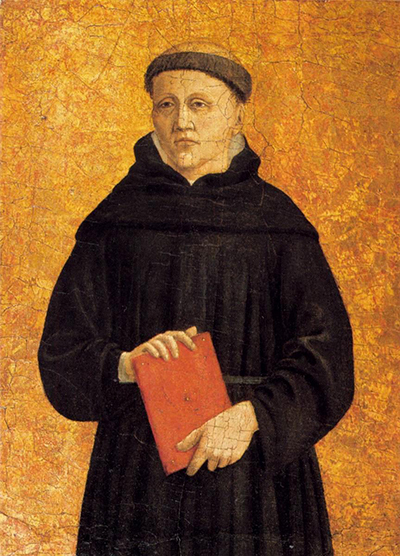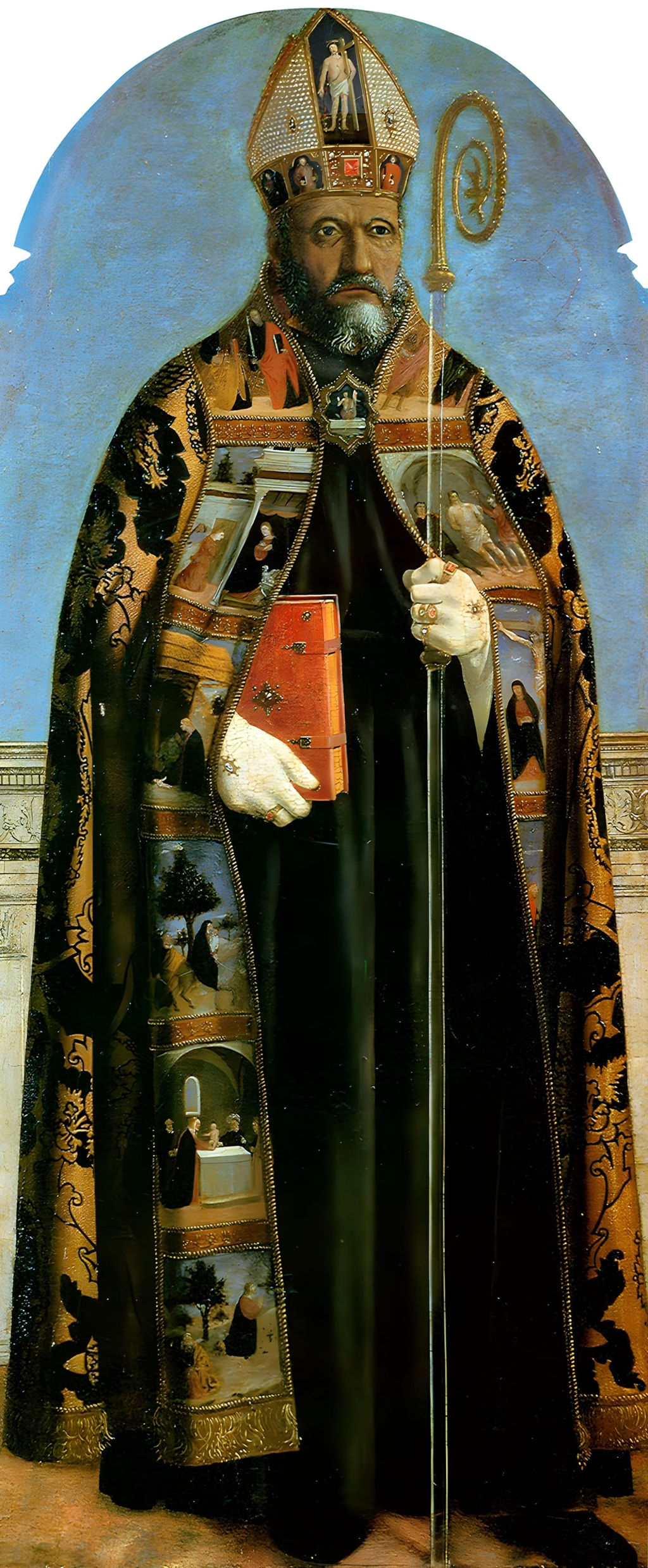
Piero della Francesca, Saint Augustine, surviving panel from the Augustinian Polyptych, Lisbon. Image source. Public domain. Resized only; native appearance preserved.
 by Tom Gurney
Tom Gurney BSc (Hons) is an art history expert with over 20 years experience
Email: tomgurney1@gmail.com / Phone: +44 7429 011000
Piero della Francesca’s Augustinian Polyptych: Introduction
In 2024 four saints painted by Piero della Francesca stood together in Milan for the first time in centuries. Between Saint Michael and Saint John the Evangelist was a broad gap. It marked the position of the missing centre of the altarpiece that Piero made for the high altar of Sant’Agostino in his home town of Borgo San Sepolcro, now Sansepolcro. The exhibition brought together all eight known survivors from five museums. It also brought two painted edges back into relation with one another. Traces of wings, steps and expensive cloth on those edges gave the curators grounds to propose that the missing picture showed the Coronation of the Virgin. [1] [2]
The saints belonged to a structure known as a polyptych, an altarpiece made of several panels. The four tall figures occupied the principal tier. Three smaller individual saints probably belonged to the frame at its sides. The remaining survivor, a Crucifixion, came from the predella, the low horizontal tier at the base. The scale of the parts and what survives on their edges tell us how differently they worked within the whole. Among the large saints, Piero used a continuous painted setting that crossed physical divisions. The three small saints were made as separate units whose wood and fixings link them to the surrounding carpentry. [2] [3] [4] [5]
At a Glance
- ArtistPiero della Francesca. [6] [7]
- DateCommissioned on 4 October 1454 and apparently substantially complete by November 1469. Financial records continue to 1473. [6] [8] [9] [10]
- Original settingThe high altar of the Augustinian church of Sant’Agostino in Borgo San Sepolcro, now Sansepolcro. [6] [11]
- MaterialsPainted wooden panels with work in oil, tempera or both according to the individual object records, and gilding on the smaller survivors. [3] [7] [12] [13] [14]
- Surviving panelsFour standing saints, three small independent saints and one narrative predella scene, held in Lisbon, London, Milan, New York and Washington, DC. [1] [12] [4] [5]
- Lost centreA Coronation of the Virgin is the leading proposal from the 2024 study of adjoining panel edges. [2]
- ReunionAll eight survivors were shown at the Museo Poldi Pezzoli from 20 March to 24 June 2024. [1]
This work across Piero della Francesca’s career
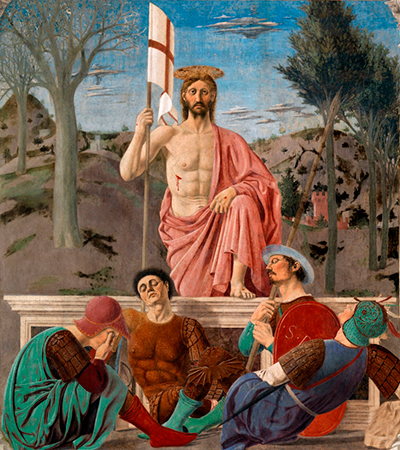
The Baptism of Christ
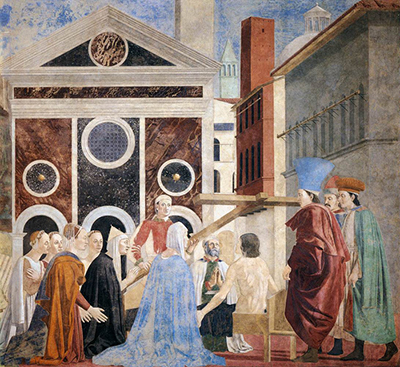
Probably about 1437–45The History of the True Cross
Mid-fifteenth centuryAugustinian Polyptych (current article)
Commissioned 1454, substantially complete in 1469The Resurrection
About 1458–68 (Opificio)The Flagellation of Christ
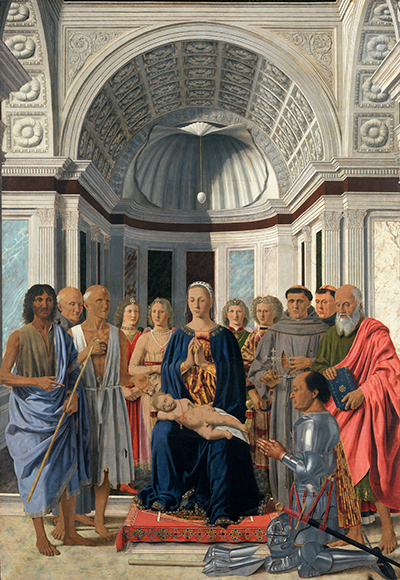
1459–60 (GNDM)The Montefeltro Altarpiece
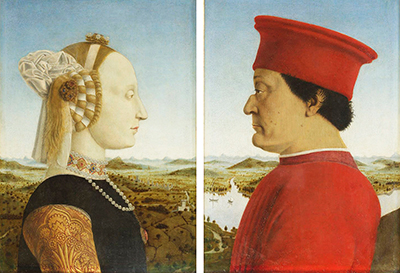
About 1472–74 (Brera)The Duke and Duchess of Urbino
About 1473–75 (Uffizi)The Nativity
Early 1480s (National Gallery)Contents
- A commission, a land transfer and three receipts
- An old structure and a new painted space
- The four saints around the centre
- Four smaller panels, two different purposes
- What the painted edges reveal
- Dismantling and rediscovery
- What Milan could show together
- Annotated details
A commission, a land transfer and three receipts
On 4 October 1454 the Augustinian friars convened in the sacristy at Sant’Agostino. The prior and members of the convent joined with two officers responsible for the church’s works and a lay patron, Angelo di Giovanni di Simone, to commission Piero. Angelo acted out of devotion and to fulfil the wishes of his late brother Simone and Simone’s wife Giovanna. This was the church’s principal altar, although Angelo also had a separate family connection with its chapel of Saint Peter, where his will specified that he should be buried. The commission joined the religious community’s needs with an obligation that extended across a local family. [6] [11] [15]
The contract set a price of 320 florins for Piero’s work and allowed eight years for completion. The wooden structure was already made and in the sacristy. Piero was hired to paint, adorn and gild its front, using fine colours, gold and silver. The contract refers to a separate written specification naming the figures and ornaments. That reference establishes that their choice had been discussed and agreed. The contract itself gives no list that could settle the subject of the lost centre. The instruction to paint the front alone is more explicit and rules out treating this commission as evidence for a painted reverse. [6] [11]
The fee was divided between the lay patron and the convent. Angelo undertook to provide 100 florins and a piece of arable land, to be valued by agreement, with another 50 florins due after completion. The friars and church officers undertook to cover the balance of the full price. Angelo’s will of 1459 is a separate record of what he said he had already provided. It puts the land at about 39 florins, acknowledges payment of the 100 florins to Piero and records 21 florins spent on the wooden work. The last figure concerns the support and should be kept separate from Piero’s painting fee. The will can confirm that the transaction was under way in 1459, without dating a single brushstroke. [6] [11] [15]
A receipt of 14 November 1469 calls the altar panel painted and names Piero as its painter. It acknowledges an instalment from the church side, paid in several currencies and partly assembled through loans from individual friars. Piero reserved his right to the balance, secured on a vineyard. On 21 May 1470 his brother Antonio, acting for him, gave Angelo’s heirs a discharge for their share. A further receipt dated 2 October 1473, issued by another brother, Marco, on Piero’s behalf as well as his own, accounts for the full 320 florins by including earlier payments and 20 florins remitted as a gift to the church works. The conventional date range of 1454–69 describes the commission and the date by which the work appears to have been essentially complete. The later records have a different purpose. They show how long it took to settle the account. [8] [9] [10] [12]
An old structure and a new painted space
The wooden structure had a history before the Augustinians acquired it. Archival work by James R. Banker connects it with an earlier commission for San Francesco in the same town. A carpenter had been engaged in 1426, and the painter Antonio d’Anghiari contracted in 1430 to paint the front. Piero worked with Antonio in his early career and, according to the documentary reconstruction, helped prepare these panels. The Franciscans eventually commissioned Sassetta to make their altarpiece in a new structure. The older carpentry was sold to Angelo in 1451 and passed to the Augustinians. An abandoned commission thus supplied the framework for a major work by a painter who had already encountered it as a young collaborator. [16]
Several aspects of that history can be tested against the objects. The 2024 team reported that on the small elements Piero laid a new preparation over an earlier one. In the principal tier the curators found evidence consistent with scraping back an older ground and removing dividing mouldings before planning the image. Earlier studies by Roberto Bellucci, Marco Ciatti and Cecilia Frosinini identified traces consistent with the arches being carried on small brackets instead of a full upright between every painted compartment. The surviving material supports significant changes to the inherited structure, while leaving the precise appearance of all its missing carved parts open. [2] [3]
Piero laid out major architectural lines by incision. The investigations also detected pouncing, a transfer technique that uses powdered pigment passed through tiny holes in a design, particularly in elements meant to repeat. It helped lay out the parapet ornament and details in the bishop’s cope. Surviving incised lines on the two inner saints can be prolonged across the missing space. In the Opificio delle Pietre Dure team’s reconstruction they converge on a point in the centre of the altarpiece, at the base of the parapet frieze, and support an estimate that the central compartment was about half as wide again as one side panel. That proportion depends on reconstructing the architectural modules and accounting for altered edges. It is an estimate derived from the painted geometry. [3]
Piero’s documented work with Antonio establishes a workshop connection early in his career. The 1454 contract establishes mature responsibility for the Augustinian commission. Its span overlaps with other work, including the frescoes at Arezzo and the years in which the Perugia altarpiece was made. The evidence leaves room for a shorter, later period of concentrated painting within that long interval. There is no secure timetable assigning particular saints to particular years or particular members of an Augustinian altarpiece workshop. On the finished surfaces one can see something more definite. Piero used repeated architectural forms to give common measure to figures whose clothing, gestures and habits of attention differ sharply. [6] [16] [3] [7] [17]
Annotated Details from Piero della Francesca’s Augustinian Polyptych
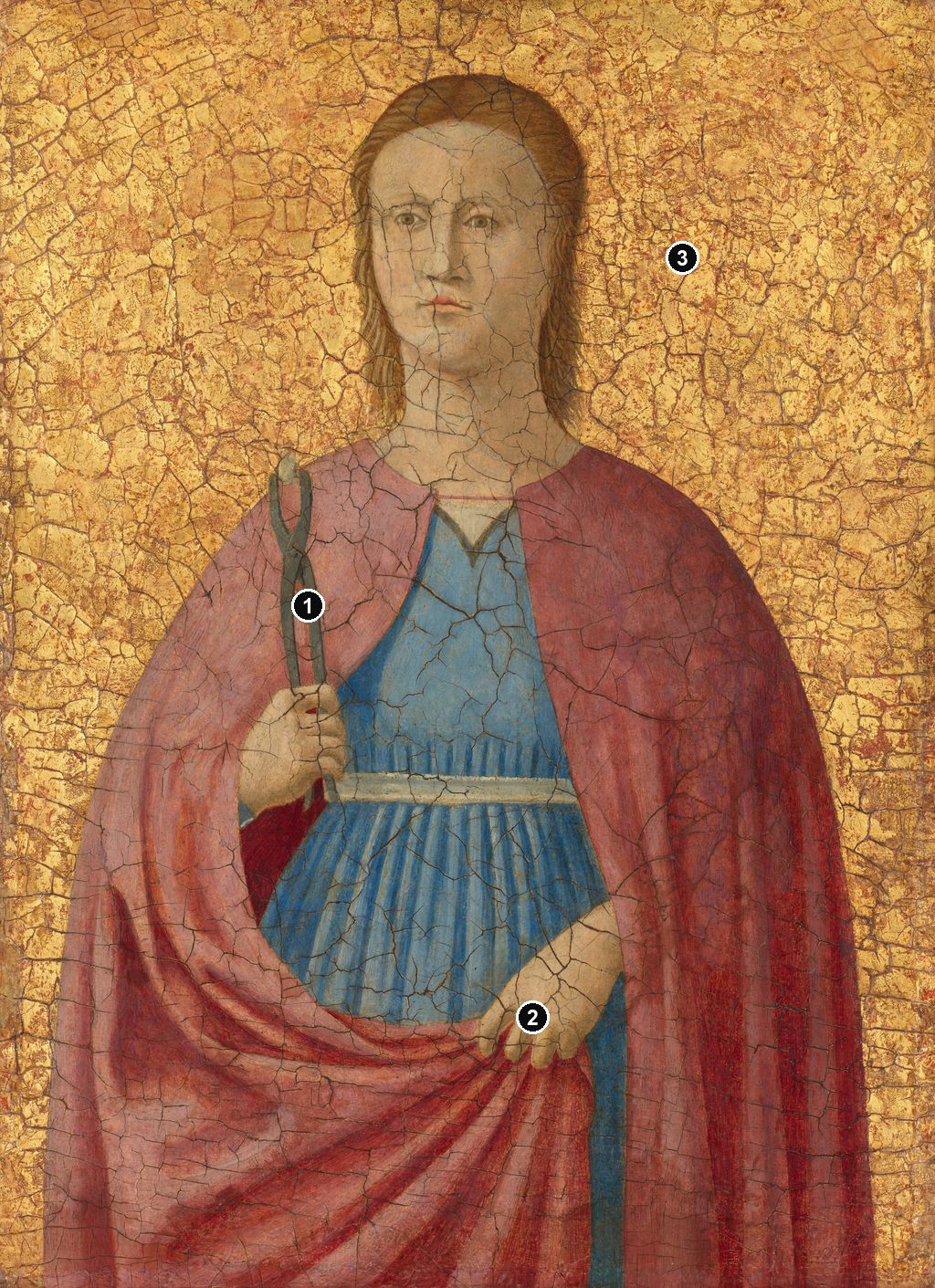
The numbered points identify visible features discussed in this article. Return from each detail to the numbered overview. Piero della Francesca, Saint Apollonia, National Gallery of Art, Washington. Image source. Public domain.
Details from PIERO DELLA FRANCESCA’S AUGUSTINIAN POLYPTYCH
Compare the cropped details with the source images above. Notice how their colours, shapes and positions contribute to the larger compositions.
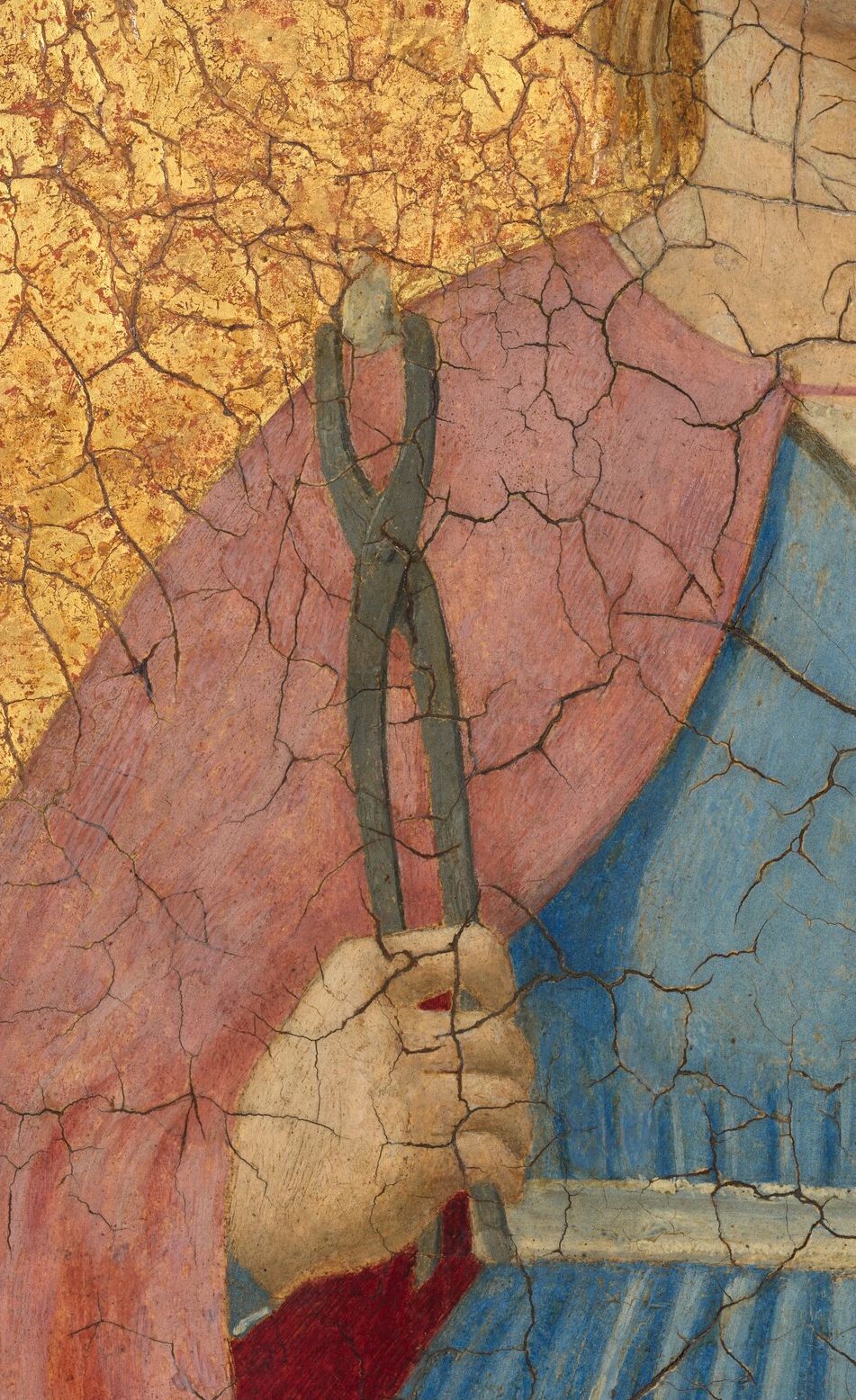
Tongs
The saint holds the elongated handles of a small pair of tongs. They identify her amid the relatively simple patterns of her dress and mantle.
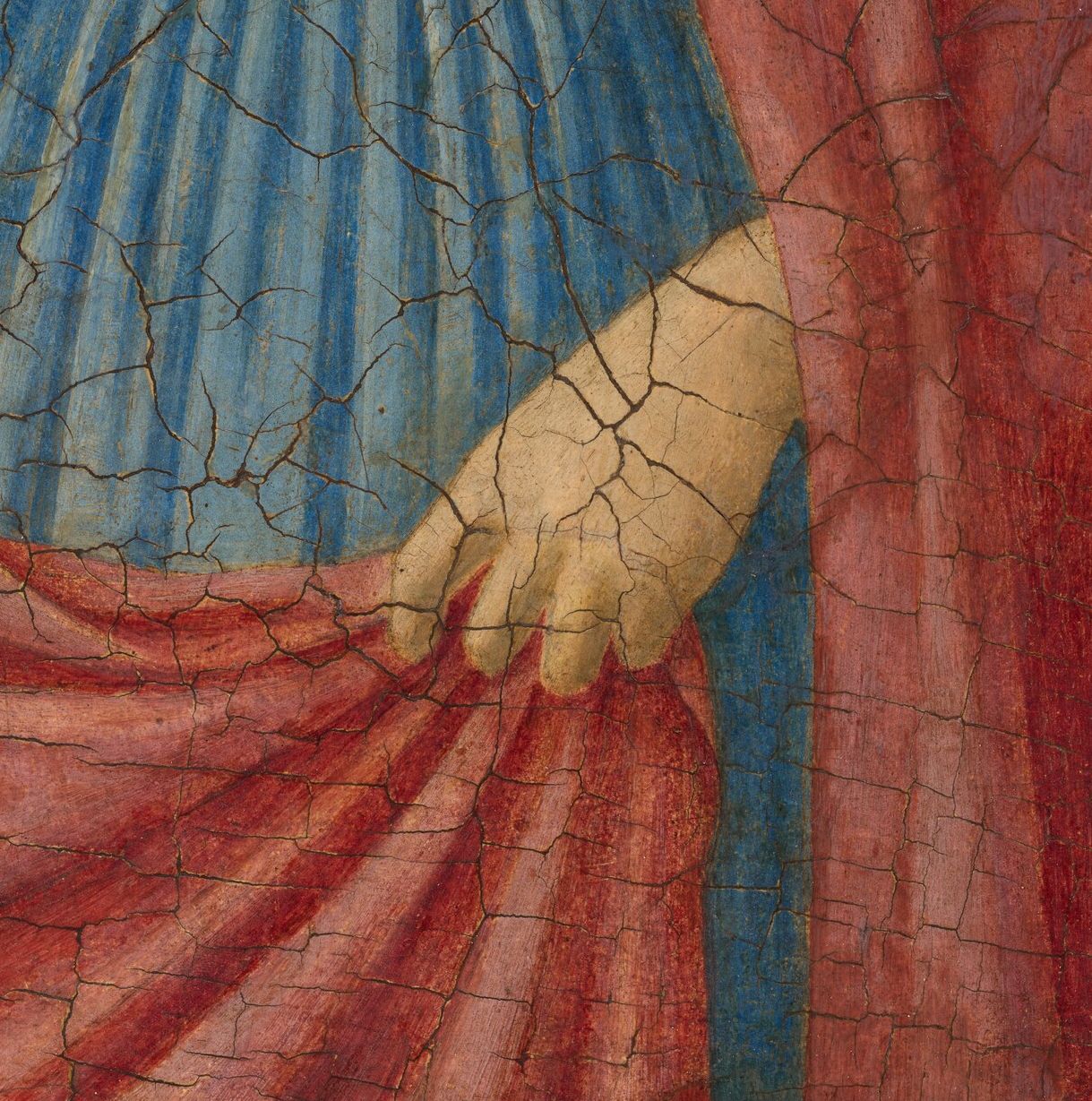
Gathered cloth
Apollonia gathers the mantle where it meets the close vertical folds of the blue dress. The movement of the hand turns the mantle into a series of diagonal folds.
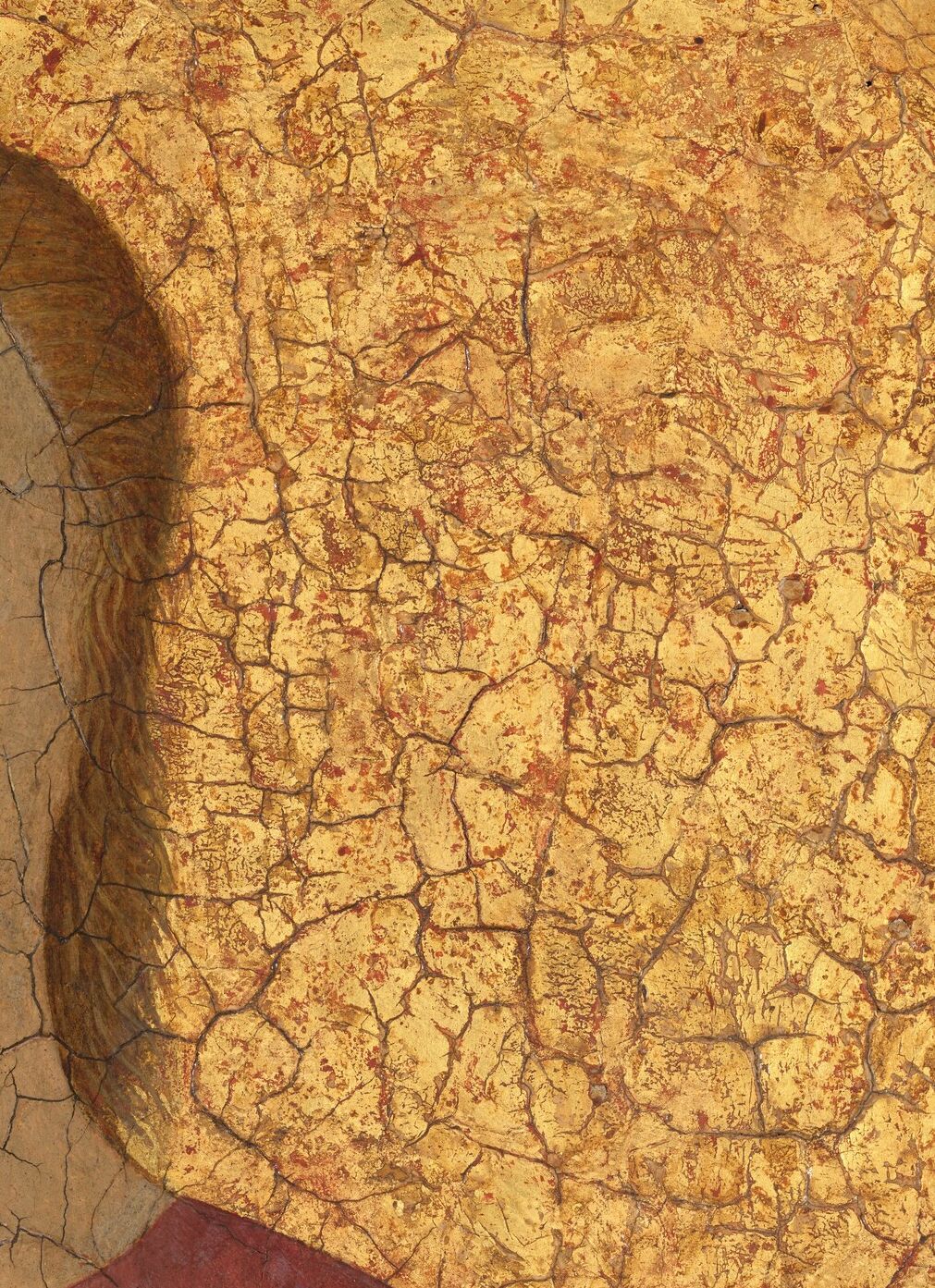
The patterned gold
The gold surface includes an incised pattern and an extensive network of age cracks. Its texture contrasts with the modelling of the face.
The four saints around the centre
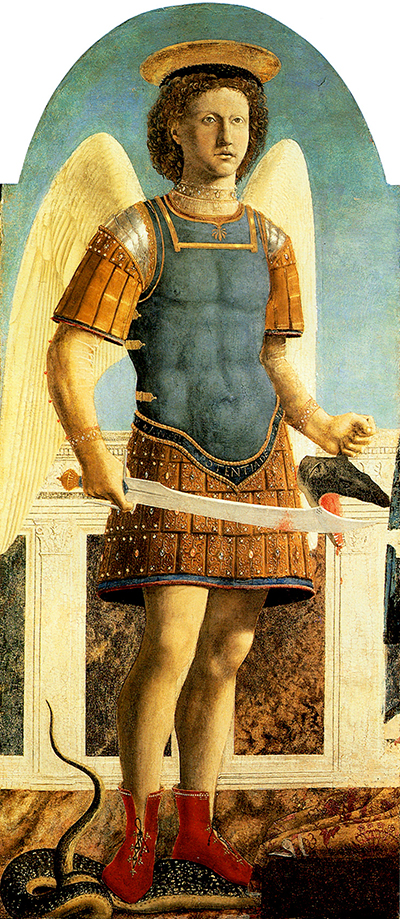
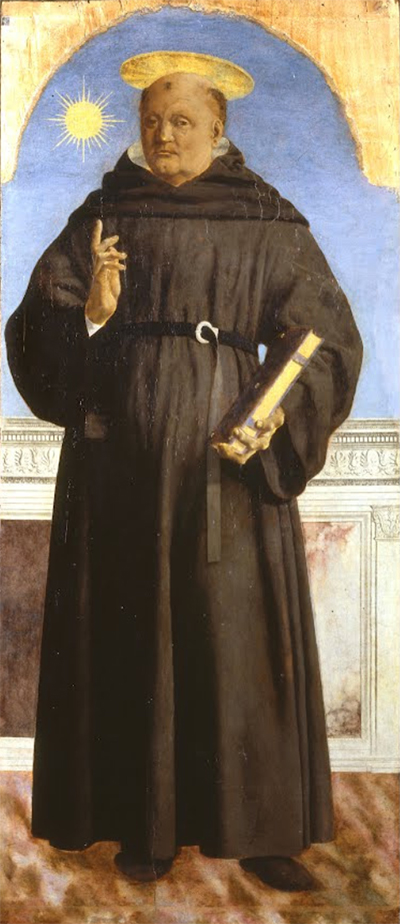
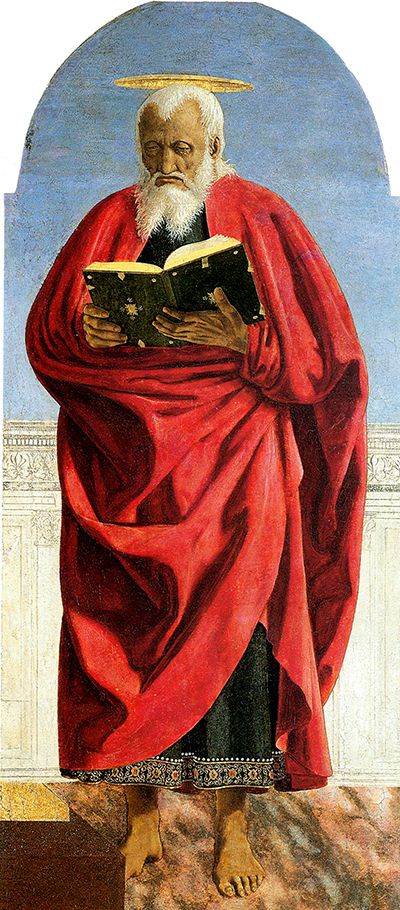
Read from left to right, the main tier runs from Saint Augustine and Saint Michael to the missing centre, then Saint John the Evangelist and Saint Nicholas of Tolentino. Their painted parapet and blue sky tie the panels together. The two outer figures make the Augustinian character of the commission explicit. Inside them, the archangel and Evangelist face a sacred event whose main actors are now absent. [1] [2] [7]
Saint Augustine, now in the Museu Nacional de Arte Antiga in Lisbon, is dressed as a bishop. His cope carries tiny episodes from scripture, set one above another in bands. These include the Annunciation, which recalls Piero’s work on the same subject at Arezzo. The minute scenes make the garment do two things at once. Seen at a distance it is an emphatic patch of brilliant colour and patterned fabric. At close range it contains a sequence of recognisable events. His elaborate crozier adds a different kind of precision, with its shaft made to resemble rock crystal. Across the altarpiece, Nicholas wears the black habit and buckled belt of the Augustinian Hermits, clothing that the friars celebrating at the altar would have recognised as their own. [2] [18] [19] [20]
Michael stands over the dragon’s body in armour, holding its severed head. In the London panel the hard brightness of metal and the sweep of fabric give physical weight to a heavenly figure. John, now at the Frick Collection in New York, appears as an old man absorbed in his book. Their different forms of attention matter to the composition. Michael’s action is legible in an instant. John’s reading invites a slower look. On the outer right, Nicholas’s raised finger draws attention to the star that helps identify him. The original arrangement brought these different gestures into the same measured setting without making the saints behave like matched ornaments. [7] [19] [21]
The surviving panels give an idea of scale. The National Gallery’s Michael measures 133 × 59.5 cm and the Poldi Pezzoli’s Nicholas 139.4 × 59.2 cm. The near agreement in width and discrepancy in height are a reminder to compare object measurements with the physical history of each board. The two outer saints’ upper contours were modified, and the support of Saint Augustine was widened with an added strip. The two inner panels also underwent alterations. The London panel was thinned and backed with canvas, and John’s thinned board acquired a cradle, a grid applied to its reverse. A modern display can line up the painted architecture, which supplies a better point of comparison than the edges of later frames. [3] [7] [19] [13]
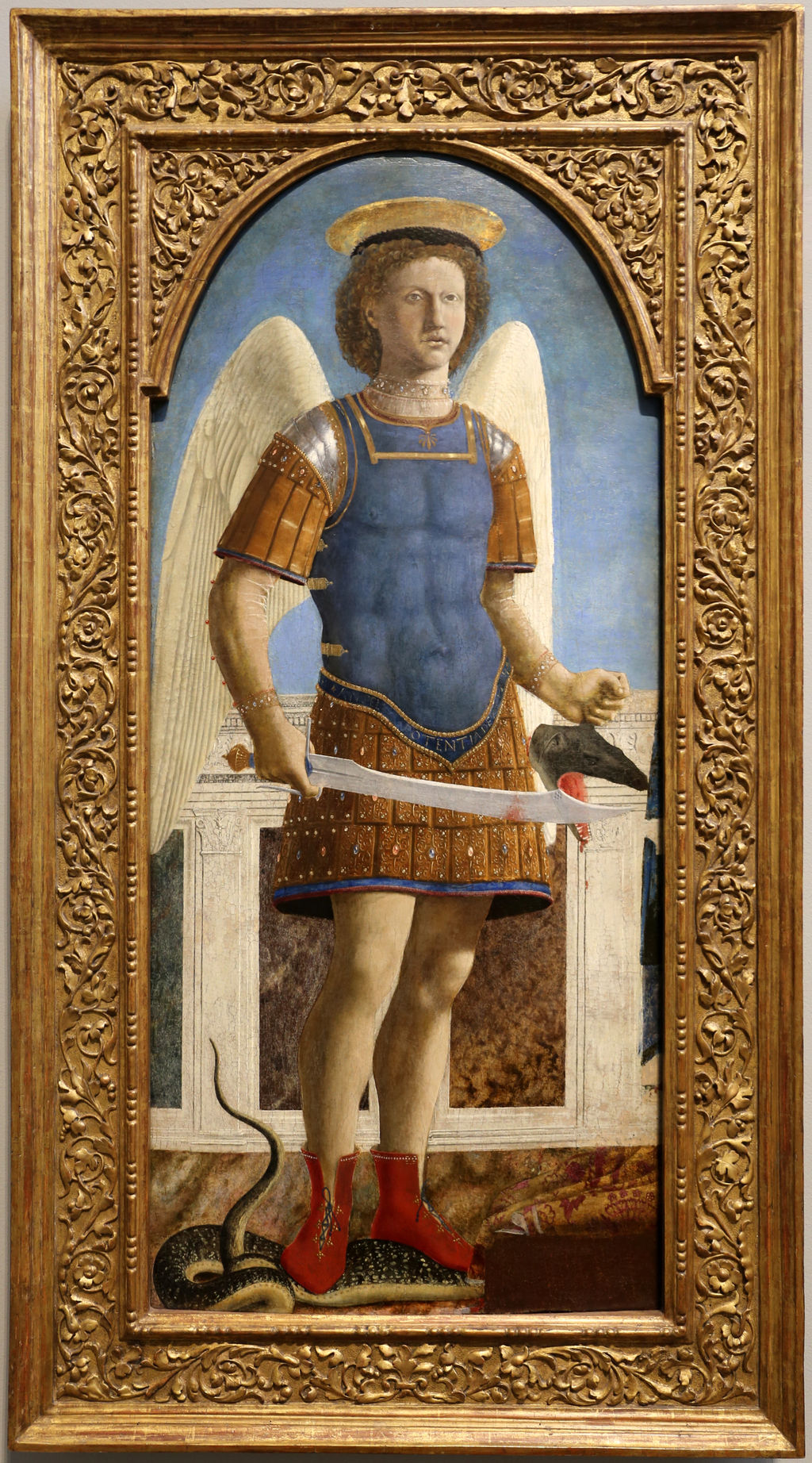
Piero della Francesca, Saint Michael, National Gallery, London. Sailko. Image source. CC BY 3.0. Resized from the source. This reproduction uses CC BY 3.0.
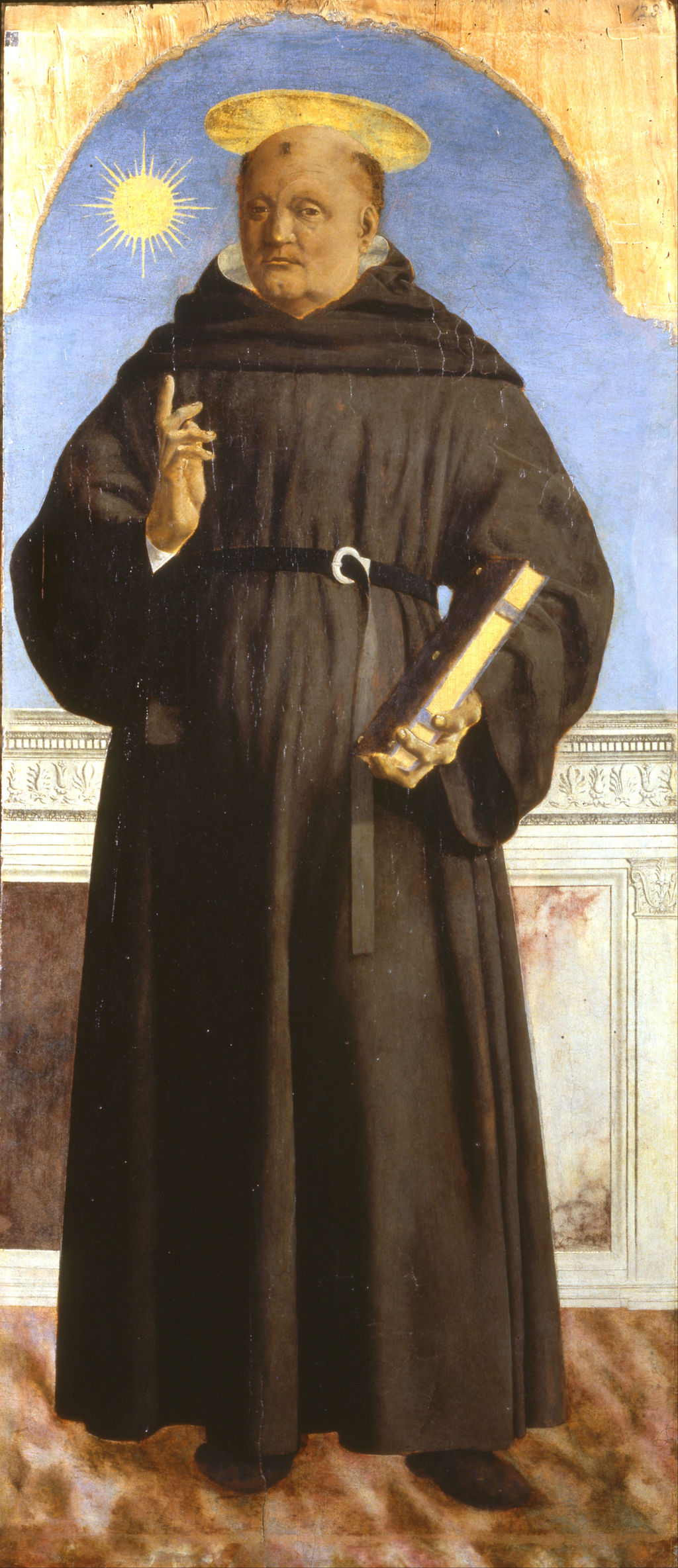
Piero della Francesca, Saint Nicholas of Tolentino, Museo Poldi Pezzoli, Milan. Image source. Public domain. Resized only; native appearance preserved.
Four smaller panels, two different purposes
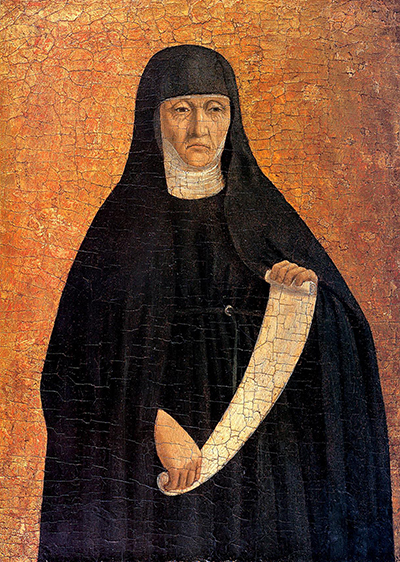
The small saints are An Augustinian Nun, identified as Saint Monica, An Augustinian Friar, possibly Saint Leonard, and Saint Apollonia. Monica and the friar are at the Frick. Apollonia is at the National Gallery of Art in Washington, DC. Monica, Augustine’s mother, wears the habit and holds a scroll. The Frick notes the requirement for an image of Monica in Augustinian churches at the time. The male saint’s habit makes his affiliation intelligible, but his personal identification as Leonard remains tentative. Apollonia’s tongs and the tooth they hold identify her through the story of her martyrdom. Her pink cloak and blue dress give the Washington panel a colour accent quite different from the two dark habits. [12] [4] [5] [22]
At roughly 39 × 28 cm, the three small saints are almost matched in size. That resemblance gains weight from the boards themselves. Bellucci, Ciatti and Frosinini found upright grain, traces of original gesso along the sides, strips of fabric and matching patterns of perimeter nails or their traces. X-rays revealed diagonal nails under the original preparation, evidence that the boards were fastened to carpentry before painting. Traces of the ground at the horizontal edges suggest it once continued across the frame. This combination explains why modern reconstructions put these saints in independent frame compartments such as the side piers. A conventional painted predella used a continuous plank with horizontal grain. The evidence identifies a type of mounting, while the exact assignment of every small saint to a particular side or surface remains partly reconstructive. In the Frick’s 2013 reconstruction, Apollonia was placed on a side face outside the front view. [3] [12] [13]
The Frick’s Crucifixion, measuring 37.2 × 40.3 cm in its present state, differs from those upright portraits. Its landscape, set beneath a gold sky, makes room for a dense group around the cross. On the left Mary swoons. On the right John approaches in grief. Below Christ, three soldiers gamble for his clothing. The board was cut at both sides, so the episode once continued beyond its current edges. It is the sole surviving narrative panel securely assigned to the predella. A seventeenth-century description cited by the National Gallery of Art mentions a Crucifixion alongside episodes of the Flagellation, Deposition and Resurrection. The record suggests a more extensive sequence, but the other scenes in that account survive as names, and their exact arrangement in the altar remains uncertain. [12] [14]
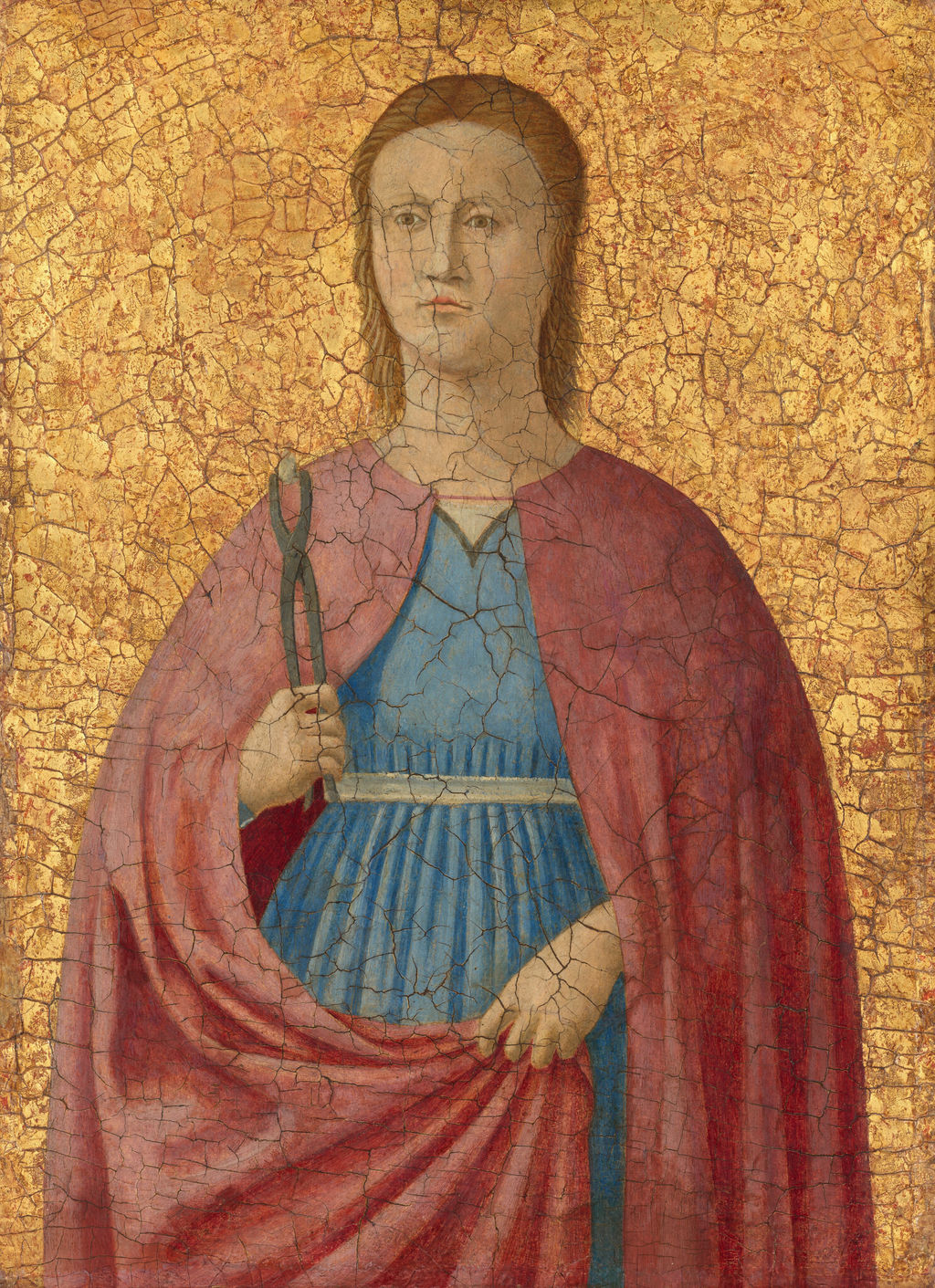
Piero della Francesca, Saint Apollonia, National Gallery of Art, Washington. Image source. Public domain. Resized only; native appearance preserved.
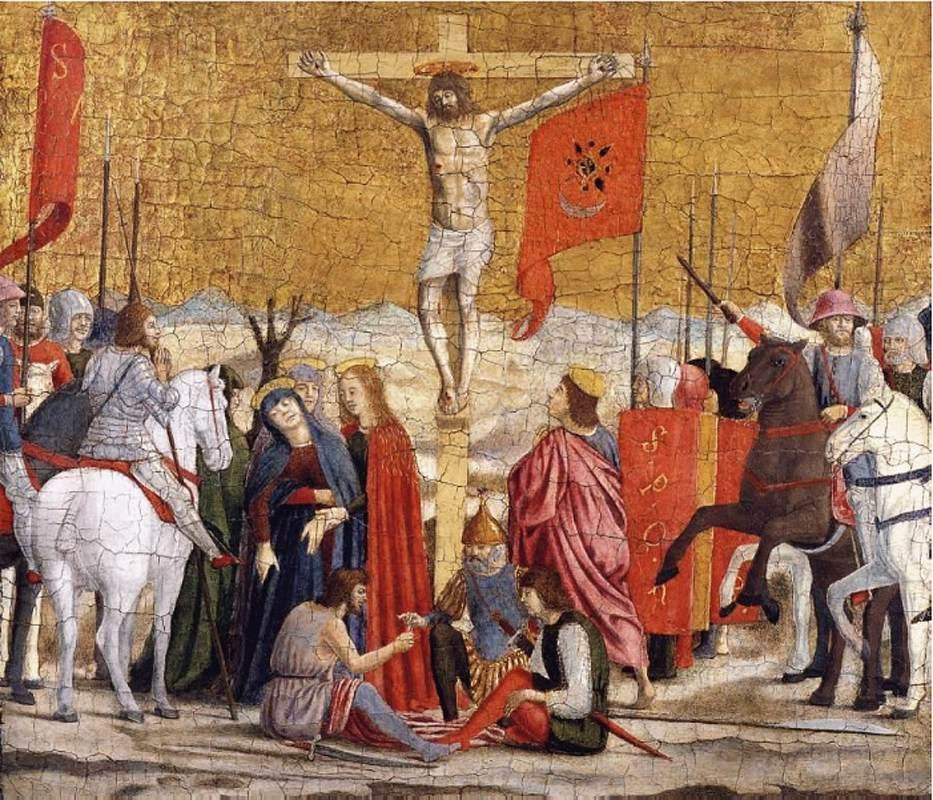
The Crucifixion, a surviving panel of Piero’s Augustinian Polyptych, The Frick Collection. Image source. Public domain. Resized only; native appearance preserved.
What the painted edges reveal
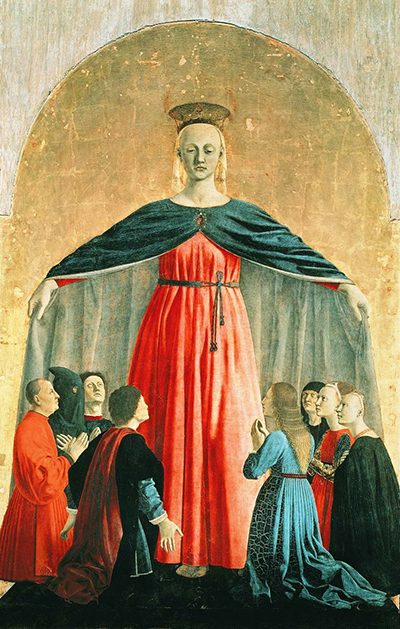
A Virgin and Child enthroned long made sense as a proposal for the middle. It is the subject Piero used for the centre of the Polyptych of Perugia, another religious commission of broadly comparable date. In Perugia, the saints belong to the Franciscan community’s devotional programme, and the compartments include two predellas and an Annunciation above. In Sansepolcro, the Polyptych of the Misericordia offers a second comparison, with the Virgin of Mercy sheltering a local confraternity under her outspread mantle. A central Virgin could serve quite different purposes in Piero’s altarpieces. Analogy alone leaves the action at Sant’Agostino unresolved. [17] [23] [24]
The 2024 team examined the inner edges of Michael and John with scientific imaging and magnification. A foot and the remains of crimson brocade appear at the bottom of the Michael panel, close to where it met the centre. [2] [25] Traces on the two inner panels are consistent with a stepped platform linked across the missing section. Magnification also revealed minute remains of wings, one pink and one blue, extending from the centre onto the neighbouring boards. The curators interpreted the wings as traces of angels whose bodies once belonged to the middle scene. Their partial erasure makes sense in the context of dismantling, when a wing projecting from beyond the edge would have been difficult to make intelligible on an independent saint panel. [2] [3]
Machtelt Brüggen Israëls and Nathaniel Silver interpreted the expensive ermine-lined textile, the porphyry steps and the foot as remnants of a royal ceremony in which Mary knelt to receive a crown from Christ. The exhibition research points to Filippo Lippi’s Coronations as a comparison for the disposition of the figures and proposes a connection with Giovanni Bellini’s later altarpiece for Pesaro. The former comparison helps explain the pose. The latter suggests how an invention of this kind could have travelled. The painted traces make a Coronation the strongest current proposal. The wings establish that figures extended across the boundaries and the steps establish a continuous architectural setting. The identification of Mary’s pose and the act of crowning are interpretations of those surviving parts, since the board that would show the central figures and crown is still missing. [1] [2] [3]
Dismantling and rediscovery
Giorgio Vasari knew the altarpiece as a work for the high altar of the Augustinians before 1550. In 1555 the friars moved to the Pieve di Santa Maria and took movable artworks with them. That transfer and the eventual dismantling are separate events. The Frick’s 2013 account gives a dismantling date around 1555, and the Poldi Pezzoli’s exhibition introduction places dismantling and dispersal by the end of the sixteenth century. The Washington provenance instead places the work at the high altar of the friars’ new church and raises the possibility of dismantling around or after a wall collapse in 1652. A seventeenth-century notice of detached panels in the Ducci household helps explain how the four large saints can be traced in Sansepolcro. The surviving evidence establishes the move and the later separation more securely than a precise year for the sawing and dispersal. [1] [12] [4]
The panels became independent objects in the market and in scholarship. The Portuguese state bought Saint Augustine at the Burnay sale in 1936. A Saint Barbara of similar size was associated with it at the sale, and both were attributed to Cima da Conegliano. Kenneth Clark identified the bishop as Piero’s Augustine in 1946, following Millard Meiss’s 1941 study, which had linked three recognised large survivors to the Sansepolcro commission and anticipated a missing Augustine. The grouping also clarified the identity of Nicholas. Tancred Borenius had recognised the Augustinian in the Milan panel in place of the earlier name Thomas Aquinas. The Lisbon case shows why dimensions are strongest when combined with other kinds of evidence. Similar size had helped produce a mistaken pairing, while the painted parapet, the saint’s identity, his format and the archival context linked him to the correct ensemble. [23] [26]
Apollonia’s history illustrates another difficulty. The Washington catalogue traces her to the Franceschi Marini family in Sansepolcro, probably by the nineteenth century. A mid-century description records small pictures of similar height, but the attributions and names attached to the group varied. Cavalcaselle saw small panels displayed together in what was already a later collecting arrangement. Apollonia subsequently passed to Philip Lehman in 1914 and entered the National Gallery of Art with the Samuel H. Kress Collection in 1952. The early descriptions connect the small pictures to local collections and to each other. Their nineteenth-century framing tells us how they were marketed or displayed after dispersal, while the diagonally driven nails and original gesso give earlier evidence of how Piero worked with them. [3] [12]
What Milan could show together
The Frick displayed six of the eight known survivors in 2013. It also showed the Clark Art Institute’s Virgin and Child Enthroned with Four Angels, an independent Piero painting in the same exhibition. The Clark work explains why seven works appeared in the exhibition when only six belonged to Sant’Agostino. Milan in 2024 secured loans of the London Michael, the Lisbon Augustine, all four Frick panels and Washington’s Apollonia to join the Poldi Pezzoli’s Nicholas. The preparations built on earlier partial reunions and reconstructions, including Milan’s 1996 and the Hermitage’s 2018 initiatives. Brüggen Israëls and Silver’s 2024 catalogue brought the exhibition’s historical and technical research together in Italian and English editions. [1] [4] [27] [28]
The full reunion allowed visitors to compare the breadth of the four large figures, the changing treatment of reflective surfaces, and the grain, scale and framing evidence that distinguish the smaller boards. The large space left between Michael and John made it possible to appreciate the painting that lies beyond their present boundaries while keeping the absence visible. Since the temporary exhibition closed on 24 June 2024, the museums’ collection records and the guide to where to see Piero della Francesca provide the starting points for finding the works separately. Read together, the records offer a view from the outside of the altarpiece inwards, from the smaller saints and towering figures to the painted steps and scraps of wings that survive at the edge of the lost scene. [1] [2] [3]
Browse the artworks
Compare Piero’s frescoes, panels and manuscript figures. The list includes ensembles and separately identifiable panels or scenes. Dates are approximate where the sources differ.
| Name | Date | Medium and source |
|---|---|---|
| The Baptism of Christ | Probably c. 1437–45 | Panel painting Catalogue. |
| The Flagellation of Christ | 1459–60 (GNDM) | Panel painting Catalogue. |
| The History of the True Cross | Mid-fifteenth century | Wall painting Catalogue. |
| Dream of Constantine | Mid-fifteenth century | Wall painting Catalogue. |
| The Duke and Duchess of Urbino | About 1473–75 (Uffizi) | Panel painting Catalogue. |
| The Resurrection | About 1458–68 (Opificio) | Wall painting Catalogue. |
| Brera Madonna | About 1472–74 | Panel painting Catalogue. |
| Annunciation at Arezzo | Mid-fifteenth century | Wall painting Catalogue. |
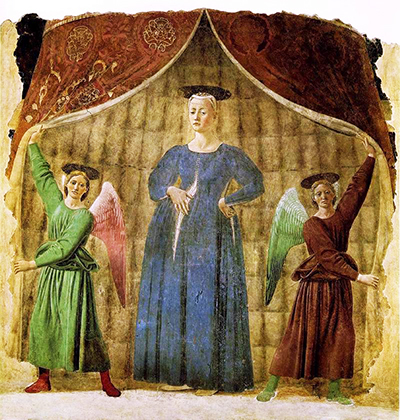
| Madonna del Parto | About 1450–65 (Monterchi) | Wall painting Catalogue. |
| Polyptych of the Misericordia | Commissioned 1445 | Panel painting Catalogue. |
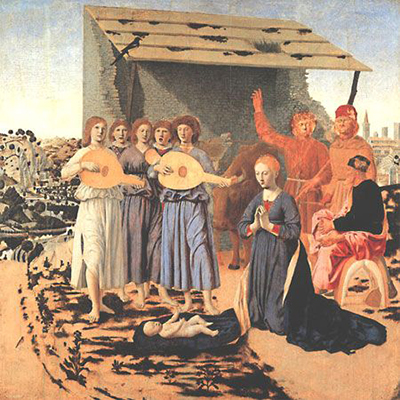
| The Nativity | Early 1480s (National Gallery) | Panel painting Catalogue. |
| Madonna di Senigallia | About 1474–75 (GNDM) | Panel painting Catalogue. |
| Death of Adam | Mid-fifteenth century | Wall painting Catalogue. |
| Queen of Sheba | Mid-fifteenth century | Wall painting Catalogue. |
| Victory of Constantine | Mid-fifteenth century | Wall painting Catalogue. |
| Battle between Heraclius and Chosroes | Mid-fifteenth century | Wall painting Catalogue. |
| Saint Mary Magdalen | Wall painting Catalogue. | |
| The Augustinian Polyptych | 1454–69 | Panel painting Catalogue. |
| Polyptych of Perugia | About 1467–69 (GNU) | Panel painting Catalogue. |
| Perugia Annunciation | About 1468–70 (national catalogue) | Panel painting Catalogue. |
| St Francis and St Elizabeth | About 1467–69 (GNU) | Panel painting Catalogue. |
| Stigmatisation of St Francis | About 1468–70 (national catalogue) | Panel painting Catalogue. |
| An Augustinian Nun (Saint Monica) | 1454–69 | Panel painting Catalogue. |
| Augustinian Saint | 1454–69 | Panel painting Catalogue. |
| Saint Michael | 1454–69 | Panel painting Catalogue. |
| Saint Nicholas of Tolentino | 1454–69 | Panel painting Catalogue. |
| Saint John the Evangelist | 1454–69 | Panel painting Catalogue. |
| Virgin and Child Enthroned with Four Angels | About 1460–70 (Clark) | Panel painting Catalogue. |
| Portrait of Sigismondo Pandolfo Malatesta | About 1450–51, often proposed. Louvre catalogue range 1450–75. | Panel painting Catalogue. |
| Sigismondo before St Sigismund | 1451 | Wall painting Catalogue. |
| St Jerome and a Donor | 1460s (Accademia); about 1450 also proposed | Panel painting Catalogue. |
| St Jerome in Penitence | 1450, dated on the panel | Panel painting Catalogue. |
| Saint Julian | About 1455–60, often proposed | Wall painting Catalogue. |
| Saint Augustine | 1454–69 | Panel painting Catalogue. |
| Saint Apollonia | 1454–69 | Panel painting Catalogue. |
| Crucifixion from the Augustinian Polyptych | 1454–69 | Panel painting Catalogue. |
| Saint Louis of Toulouse | Wall painting Catalogue. | |
| Burial of the Wood | Mid-fifteenth century | Wall painting Catalogue. |
| Discovery and Proof of the True Cross | Mid-fifteenth century | Wall painting Catalogue. |
| Exaltation of the Cross | Mid-fifteenth century | Wall painting Catalogue. |
| Saint Anthony Raises a Child | About 1467–69 (GNU) | Panel painting Catalogue. |
| Saint Elizabeth Revives a Child | About 1467–69 (GNU) | Panel painting Catalogue. |
| Hercules | About 1470 | Wall painting Catalogue. |
| Portrait of a Boy (possibly Guidobaldo da Montefeltro) | Panel painting Catalogue. | |
| De prospectiva pingendi, Reggio Emilia witness (figures) | Manuscript diagrams Catalogue. | |
| The Interrogation of Judas | Mid-fifteenth century | Wall painting Catalogue. |
| Two prophets, Bacci Chapel | Mid-fifteenth century | Wall painting Catalogue. |
| Saint Clare of Assisi, upper predella | About 1467–69 (GNU) | Panel painting Catalogue. |
| Saint Agatha, upper predella | About 1467–69 (GNU) | Panel painting Catalogue. |
| Lost centre of the Augustinian Polyptych | 1454–69 | Lost panel or panels Catalogue. |
Frequently Asked Questions
The Museu Nacional de Arte Antiga in Lisbon has Saint Augustine. The National Gallery in London has Saint Michael. The Museo Poldi Pezzoli in Milan has Saint Nicholas of Tolentino. The Frick Collection has Saint John the Evangelist, An Augustinian Nun (Saint Monica), An Augustinian Friar (Saint Leonard?) and The Crucifixion. The National Gallery of Art in Washington, DC, has Saint Apollonia. [1] [12] [4]
The dated contract belongs to October 1454, and the November 1469 receipt refers to the high-altarpiece painting as executed. Antonio’s discharge of May 1470 concerns a patron’s heirs, and Marco’s 1473 receipt settles the overall accounting. These are different documentary milestones. [6] [8] [9] [10] [12]
Discussion
Look again at the images and ideas explored in Piero della Francesca’s Augustinian Polyptych. These editorial prompts invite your observations.
Reader Insights
Compare what the 2024 curators inferred from the foot and wings with what the earlier conservation team inferred from the nail traces. Which clues speak to the subject of the painting, and which tell us how its boards were fitted together? [2] [10]
Join the Conversation
Share a detail, comparison or question about Piero della Francesca’s Augustinian Polyptych below.
References
- Museo Poldi Pezzoli, Piero della Francesca. The Augustinian Polyptych Reunited, 2024 exhibition record. View source.
- Museo Poldi Pezzoli, Il polittico agostiniano riunito, 2024 press dossier, especially the five discoveries presented by Machtelt Brüggen Israëls and Nathaniel Silver. View source.
- Roberto Bellucci, “Caro Marco, ancora Piero”, with Roberto Bellucci, Marco Ciatti and Cecilia Frosinini, “Il polittico agostiniano di Piero della Francesca. Analisi tecniche”, in Con passione e leggerezza. View source.
- The Frick Collection, Piero della Francesca in America, 2013 exhibition record. View source.
- The Frick Collection, Piero della Francesca in America, 2013 exhibition announcement and list of survivors. View source.
- Archivio di Stato, Firenze, Sant’Agostino commission, 4 October 1454, fol. 116r, transcribed by Matteo Mazzalupi, Italian Renaissance Document Site. View source.
- National Gallery, London, Saint Michael, NG769. View source.
- Archivio di Stato, Firenze, receipt to the representatives of Sant’Agostino, 14 November 1469, transcribed by James R. Banker and revised by Matteo Mazzalupi, Italian Renaissance Document Site. View source.
- Archivio di Stato, Firenze, discharge issued by Antonio della Francesca for the heirs of Angelo di Giovanni, 21 May 1470, transcribed by James R. Banker and revised by Matteo Mazzalupi, Italian Renaissance Document Site. View source.
- Archivio di Stato, Firenze, final accounting recorded by Marco della Francesca, 2 October 1473, transcribed by James R. Banker and revised by Matteo Mazzalupi, Italian Renaissance Document Site. View source.
- Archivio di Stato, Firenze, Sant’Agostino commission, 4 October 1454, fol. 116v, transcribed by Matteo Mazzalupi, Italian Renaissance Document Site. View source.
- National Gallery of Art, Washington, Saint Apollonia, 1952.5.19, including the provenance and documentary notes. View source.
- The Frick Collection, Piero della Francesca in America, 2013 exhibition image list, especially item 9 on the hypothetical reconstruction. View source.
- The Frick Collection, The Crucifixion, 2013 exhibition entry. View source.
- Archivio storico comunale, Sansepolcro, will of Angelo di Giovanni di Simone, 3 August 1459, transcribed by James R. Banker, Italian Renaissance Document Site. View source.
- Dillian Gordon and Susanna Avery-Quash, San Sepolcro Altarpiece, National Gallery catalogue, 2003, especially the history of the early commission and the note on the 1451 sale of the wooden structure. View source.
- Galleria Nazionale dell’Umbria, Polittico di Sant’Antonio, Perugia. View source.
- Museu Nacional de Arte Antiga, Santo Agostinho, collection entry in Portuguese. View source.
- Museo Poldi Pezzoli, Saint Nicholas of Tolentino, inventory 0445. View source.
- Treccani, Piero della Francesca, catalogue commentary on the Augustinian altarpiece and the cope of Saint Augustine. View source.
- The Frick Collection, Saint John the Evangelist, 2013 exhibition entry. View source.
- The Frick Collection, Saint Monica, 2013 exhibition entry. View source.
- Kenneth Clark, “O painel de Santo Agostinho de Piero della Francesca”, Boletim do Museu Nacional de Arte Antiga, pp. 214–218. View source.
- Sansepolcro Misericordia confraternity’s commission to Piero, transcribed by Matteo Mazzalupi, Italian Renaissance Document Site. View source.
- Colleen Barry, interview with the 2024 exhibition curators on the reunion and new findings, Associated Press, 19 March 2024. View source.
- Millard Meiss, “A Documented Altarpiece by Piero Della Francesca”, The Art Bulletin, 1941. View source.
- Fondazione Bracco, research partnership for the 2024 Augustinian Polyptych exhibition. View source.
- Machtelt Brüggen Israëls and Nathaniel Silver, eds., Piero della Francesca. The Augustinian Polyptych Reunited, 2024, University of Amsterdam research catalogue record. View source.