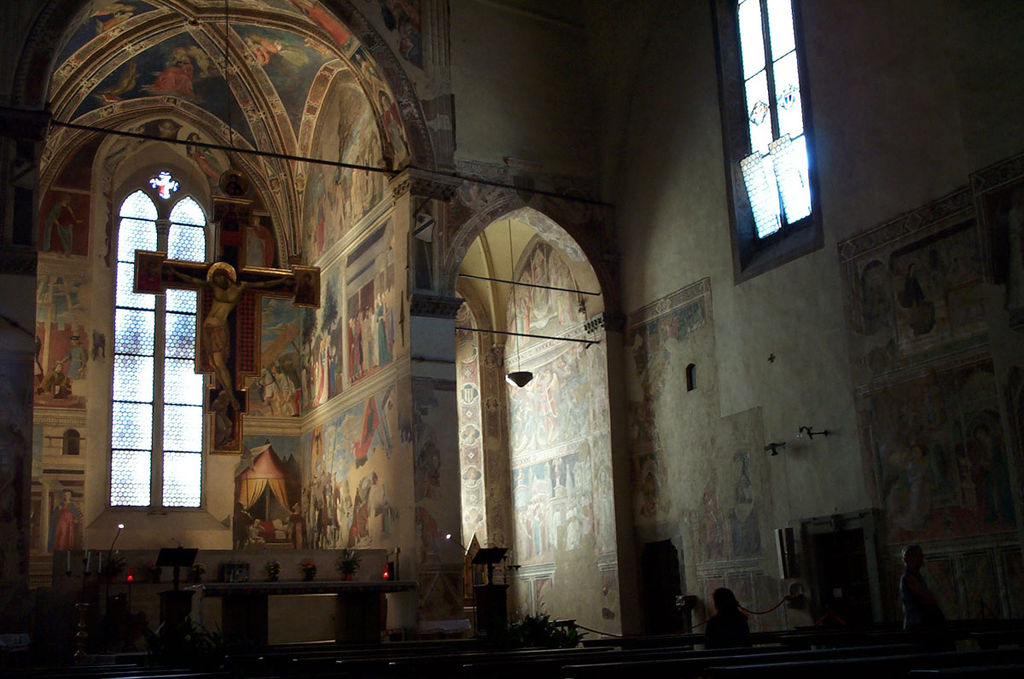
An oblique view of the Bacci Chapel with its window, suspended crucifix and right wall. louis-garden. Image source. CC BY-SA 2.5. Resized from the source. This reproduction uses CC BY-SA 2.5.
 by Tom Gurney
Tom Gurney BSc (Hons) is an art history expert with over 20 years experience
Email: tomgurney1@gmail.com / Phone: +44 7429 011000
Where to See Piero della Francesca: Introduction
Start in eastern Tuscany. In Arezzo, Piero della Francesca’s cycle of the True Cross still covers the walls of the Bacci Chapel, and a second fresco survives uphill in the cathedral. In Monterchi, a small museum houses his image of the pregnant Virgin. In Sansepolcro, the town where Piero was born, the civic museum grew around the hall that contains his Resurrection. Together these three stops show how differently a fifteenth-century painter could address a chapel, a place of local devotion and a room associated with civic government. [1] [2] [3] [4] [5]
Other works take you farther afield. Urbino has the Flagellation and the Madonna di Senigallia, Florence has the Urbino portraits, and a single altarpiece made for Sansepolcro has surviving panels in five museums on both sides of the Atlantic. This route gives the works’ usual locations. For travel centred on a particular panel, open the collection record and the museum’s visitor notices close to your date, especially if a major exhibition has announced a loan. Browse Piero della Francesca’s paintings for works to pair with the places below. [6] [7] [8] [9]
At a Glance
- Best first stopThe Bacci Chapel in Arezzo, with a timed reservation through the official visitor page. [2]
- Core Tuscan routeArezzo for two church interiors, Monterchi for the detached Madonna del Parto, and Sansepolcro for the civic museum. [1]
- Urbino portraitsFederico da Montefeltro and Battista Sforza are held at the Uffizi in Florence. [8]
- Augustinian panelsEight known survivors are held in Milan, London, Lisbon, New York and Washington. [9]
- Announced London exhibitionThe National Gallery lists loans from Florence and Perugia for its 2027–28 Piero exhibition. [10]
Contents
- Arezzo, Monterchi and Sansepolcro
- Urbino, Florence, Rimini and Perugia
- Milan and the dispersed Augustinian Polyptych
- London, Williamstown and two smaller panels
Arezzo, Monterchi and Sansepolcro
Arezzo’s Bacci Chapel and cathedral
Reserve the Bacci Chapel first and arrange the rest of your day around that slot. It is inside the Basilica di San Francesco on Piazza San Francesco. The state museum authority requires reservations for timed visits to the chapel and provides a link to the official ticket service. Use its visitor page to verify the entry arrangements for your date, including any interruption for a religious service. [2]
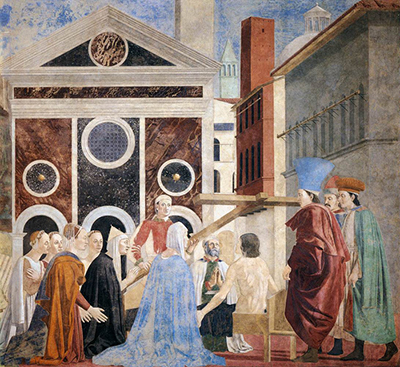
In The History of the True Cross, the wood of Christ’s Cross has a history stretching from Adam to the age of emperors. A photograph of a single scene can make the cycle seem like a row of separate pictures. In the chapel, the walls ask you to turn and compare. Pick out a ceremonial meeting and a battle, then look across to the opposite wall for another gathering or another clash. The figures and architecture are legible in groups before the details of the story come into focus. It helps to look at the sequence before you go, since the story moves across and between the tiers. [2]
From the basilica, walk uphill to Piazza del Duomo for Saint Mary Magdalen. The cathedral is dedicated to Saints Peter and Donatus. The fresco is in the left aisle near the sacristy door, inside the church. Allow for worship and local access arrangements. Coming from the crowded narratives of San Francesco, you can give this one upright figure time. Look for the jar and the painted architectural surround, then see how the outer folds of the mantle give the saint a presence at the edge of a real passage through the cathedral. [3]
Monterchi and the Madonna del Parto
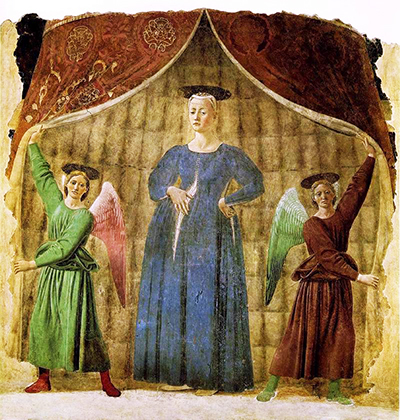
In Monterchi, go to the Musei Civici Madonna del Parto on Via della Reglia. The museum occupies a former school, and its principal work is Madonna del Parto. Piero painted it for the church at Momentana, near the cemetery. The original setting and the current display are therefore two destinations. Follow the museum’s information for the fresco itself and confirm its location before travelling if your route was drawn up from an older guide. [4] [11]
The painting rewards a close look at fabric. Two angels lift the sides of a patterned tent, and Mary stands with one hand at the opening of her dress. The opening in the canopy and the opening under her hand help draw the eye inward. Remembering the fresco’s church setting gives that gesture a different weight. The image once met visitors at an altar, where the Virgin’s pregnancy was a subject for devotion. In the museum you can concentrate on the detached painted surface and the deliberate symmetry of the attendants. [4] [11]
Sansepolcro’s Museo Civico
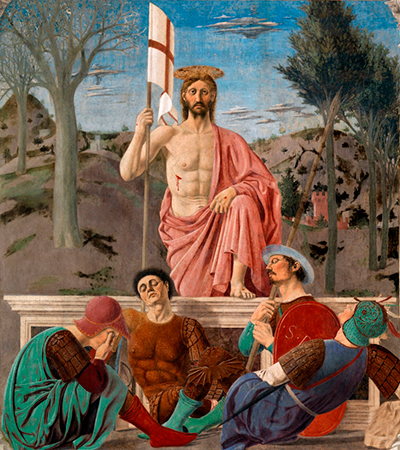
The Museo Civico on Via Niccolò Aggiunti is the place to see Piero’s works together in his home town. Its building incorporates the former Palazzo della Residenza and the Sala dei Conservatori, the civic room associated with The Resurrection. Give the fresco and the room time together. Christ rises frontally above the tomb, with the soldiers crowded below. The effect of that division is easiest to judge at the scale of the wall, where the height of the figure above the guards can be felt before the individual poses are studied. [5] [12]
Make time for the Polyptych of the Misericordia on the same visit. A confraternity commissioned it in 1445. At the centre the Virgin opens her mantle over kneeling worshippers, and the gold ground links the component panels. Compare her function with that of the Virgin at Monterchi. One canopy belongs to the setting within the fresco, while the other is formed by Mary’s own garment. The museum also identifies two smaller frescoes among its Piero holdings, the detached fragment of Saint Julian and Saint Louis of Toulouse. Their surviving scale and condition give a different sense of what can happen to mural painting after its first setting changes. [5] [12]
How to split the Tuscan route
With two days, give the first to Arezzo’s two church interiors and put Monterchi and Sansepolcro together on the second. If you have one day and want to travel between towns, choose your most important work before planning the connections. Arezzo offers a fresco cycle and a single figure within walking distance of one another. Sansepolcro offers both a civic fresco and a confraternity altarpiece in one building. The regional route takes in all three towns and can be followed in either direction. [1] [2] [3] [4] [5]
For a bus itinerary, check the individual journeys and the return before reserving anything at the other end. Autolinee Toscane’s SI381 has route variants between Arezzo and Sansepolcro, and its published options include journeys serving Monterchi. Look at the actual stops on your run and the walk to the hill-town museum. If the onward service leaves little time for the fresco, give Monterchi a separate visit or keep the day to the two venues that fit your available transport. [4] [13]
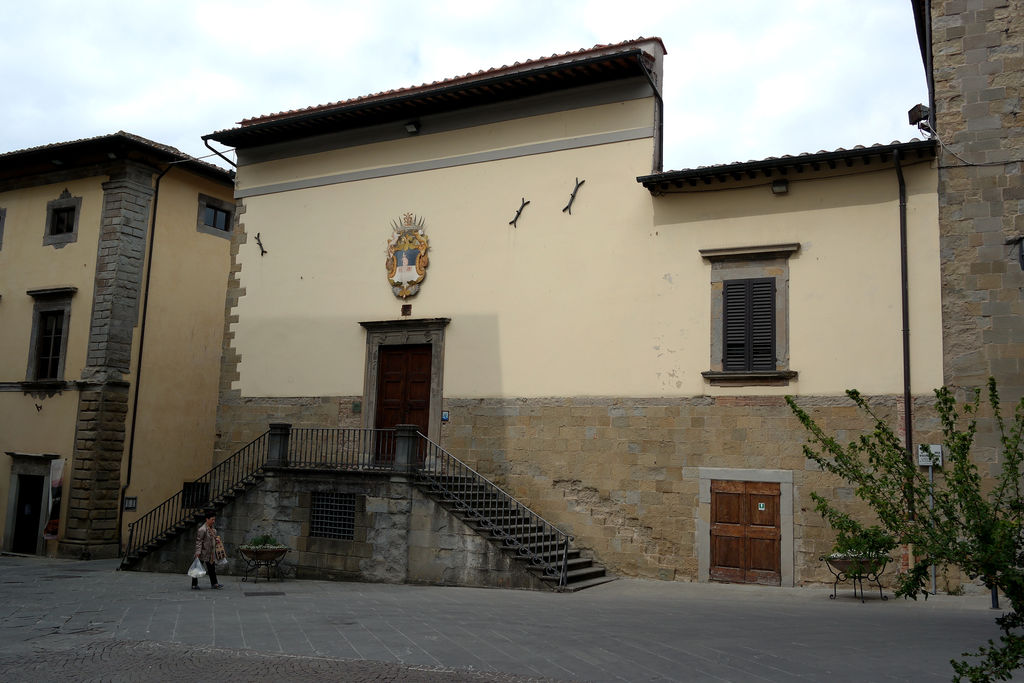
The façade and exterior staircase of the Museo Civico, Sansepolcro. Luca Aless. Image source. CC BY-SA 4.0. Resized from the source. This reproduction uses CC BY-SA 4.0.
Urbino, Florence, Rimini and Perugia
Urbino and Florence
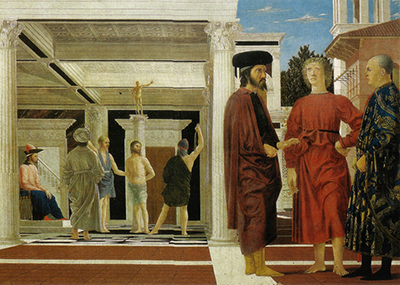
In Urbino, go to the Palazzo Ducale for the Galleria Nazionale delle Marche. Piero’s signed Flagellation of Christ draws you into a colonnaded space while three men stand in the open at right. The gallery records that the panel came from the cathedral sacristy and entered the collection in 1915. Its early purpose and the identities of the three men remain subjects of debate. In the same collection, seek the Madonna di Senigallia, where daylight enters through a window in a much smaller painted room. Seeing the two works together gives you two ways to judge depth in Piero’s panels, through the pavement and columns of one and the opening and light of the other. The gallery’s visit page gives ticket and access information for the palace. [6] [7] [14]
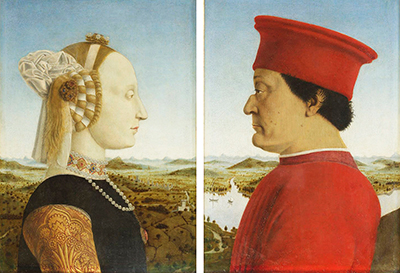
For the Duke and Duchess of Urbino, use the Uffizi’s collection and visitor pages in Florence. Federico da Montefeltro and Battista Sforza face each other across a landscape that seems to continue from one panel to the other. Give the reverses time as well if the display permits. They turn the sitters’ profiles into two allegorical triumphs accompanied by inscriptions. Urbino gives you the palace built for the couple’s court, while Florence gives you the painted object through which many visitors first meet them. [8] [15]
Rimini and Paris
The Tempio Malatestiano is Rimini’s cathedral. Its municipal listing identifies Piero’s fresco of Sigismondo Pandolfo Malatesta before Saint Sigismund among its works. Verify local church access and service times. The kneeling ruler is part of a larger programme inside a building that he commissioned to be remodelled. Give yourself time to see the painted ruler in relation to the other forms of commemoration around him. [16]
Compare the fresco with the Portrait of Sigismondo Pandolfo Malatesta in Paris. The Louvre catalogue lists the small profile panel on display in the Denon wing when checked for this guide. It proposes a connection between the panel and the fresco. In Rimini the ruler’s profile is part of an act of prayer before his patron saint. In Paris the dark field isolates the same commanding outline, leaving the face, hair and patterned clothing to carry the image. Check the Louvre’s object record for the current room. [16] [17]
Perugia
At the Palazzo dei Priori in Perugia, the Galleria Nazionale dell’Umbria holds the Sant’Antonio Polyptych, made for a community of Poor Clares. Begin with the enthroned Virgin and saints, then look down at the smaller scenes across the base and up to the Annunciation above. The receding columns in that upper scene create a space quite unlike the gold field below. The chance to see the changes of scale and setting within one object makes Perugia a useful companion to Sansepolcro’s Misericordia. Use the gallery’s visitor page and check for planned loans before committing to the trip. [18] [19] [10]
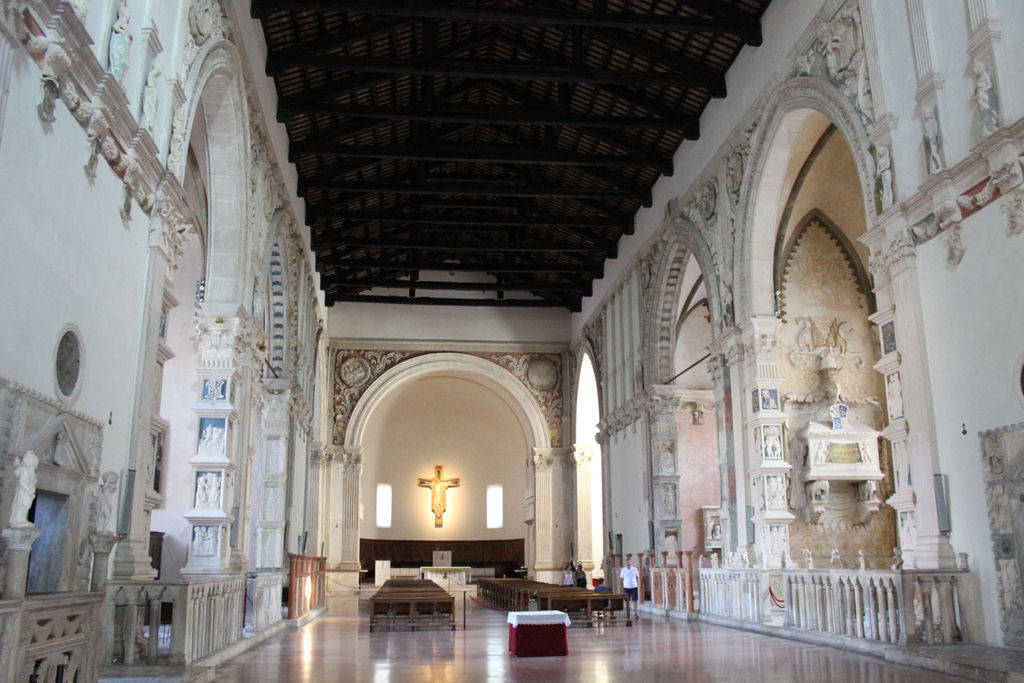
The nave of the Tempio Malatestiano, looking towards the altar, Rimini. Tulumnes. Image source. CC BY-SA 4.0. Resized from the source. This reproduction uses CC BY-SA 4.0.
Milan and the dispersed Augustinian Polyptych
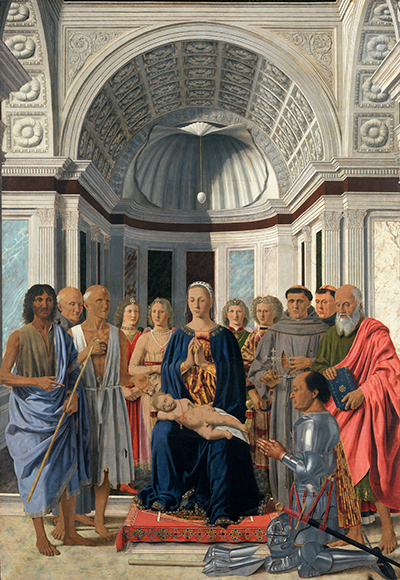
Milan has two Piero destinations. At the Pinacoteca di Brera, the Brera Madonna is catalogued as the San Bernardino Altarpiece and also called the Montefeltro Altarpiece. Federico da Montefeltro kneels in armour below the saints and angels. The work reached Brera from San Bernardino in Urbino. After seeing the Uffizi portraits, compare the duke’s profile there with the way his kneeling body enters an architectural space at Brera. This is an altarpiece with the donor placed within the gathering, a different role from the one he occupies in the double portrait. Brera gives the current location in the object record and visit guide. [8] [20]
At the Museo Poldi Pezzoli, Saint Nicholas of Tolentino is a tall panel from the Augustinian Polyptych, made for the high altar of the Augustinian church in Piero’s native Sansepolcro. The museum exhibited all eight known surviving panels together in 2024. That reunion was temporary, and the central panel remains missing. Looking at the single saint in Milan, notice the height of the figure and the ledge beyond him. Those features help you imagine how a companion saint at a comparable scale would have stood across the ensemble. [9] [21]
London’s National Gallery holds the armoured Saint Michael, and Lisbon’s Museu Nacional de Arte Antiga holds the bishop Saint Augustine. The Frick Collection in New York holds the tall Saint John the Evangelist and three smaller panels, The Crucifixion, Saint Monica and an Augustinian saint often identified as Saint Leonard. In Washington, the National Gallery of Art lists Saint Apollonia, who holds a tooth in pincers, on view in its West Building at the time of checking. Verify individual display status at each institution. Lisbon’s museum reopened in part in November 2026 while its European Painting Gallery remained under renovation. Confirm whether Saint Augustine is accessible before travelling for it. [9] [22] [23] [24] [25]
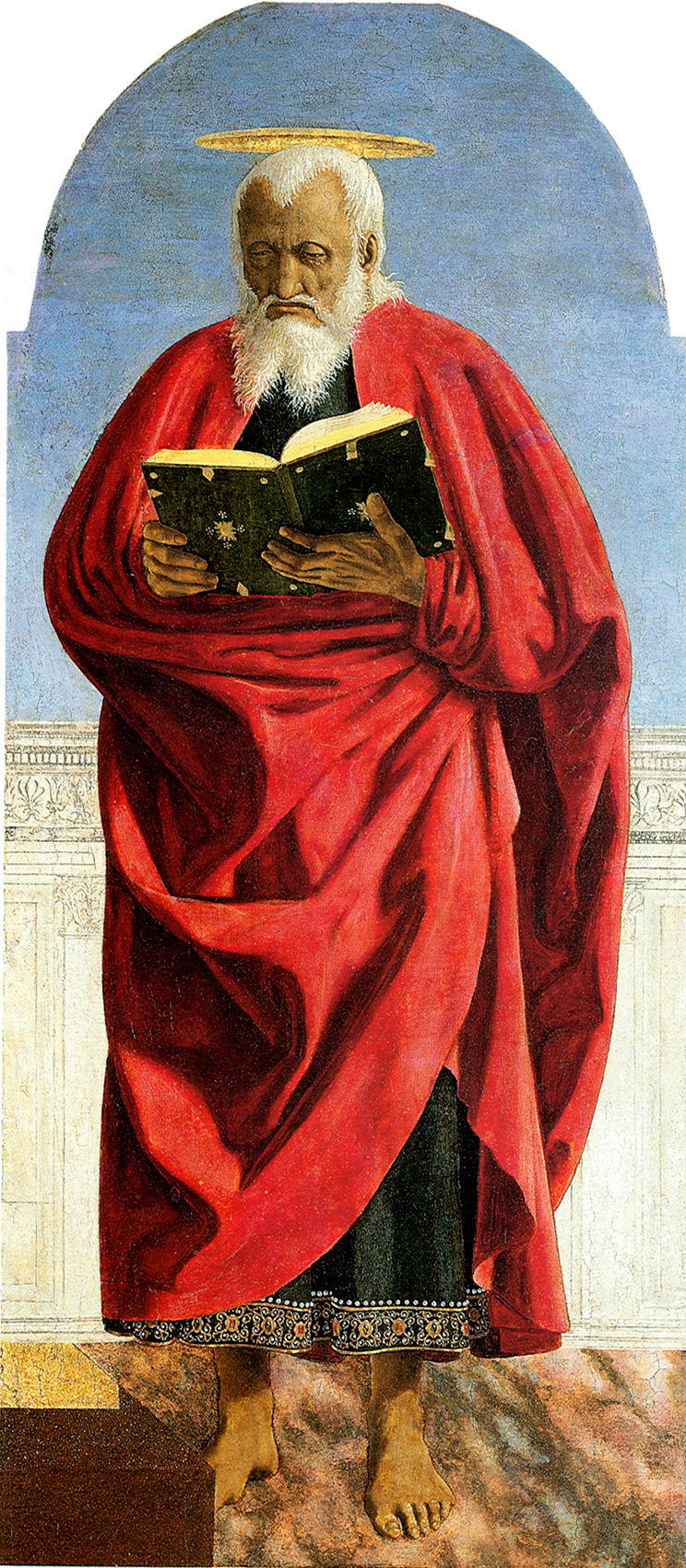
Piero della Francesca, Saint John the Evangelist, The Frick Collection, New York. Image source. Public domain. Resized only; native appearance preserved.
London, Williamstown and two smaller panels
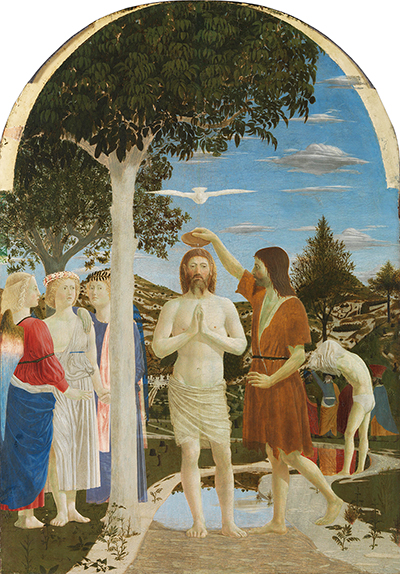
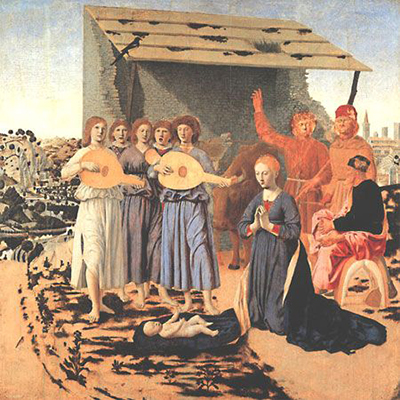
In London, start with the National Gallery’s Baptism of Christ and Nativity, alongside Saint Michael. The Baptism was painted for a church in Piero’s home town and was subsequently fitted into an ensemble with gilded elements by Matteo di Giovanni. Seen by itself, the pale tree, Christ and descending dove set the scale of the landscape around the Jordan. The Nativity is a different kind of encounter, with musical angels and a child lying low on the ground. At the time of checking, the gallery’s floor plan listed all three in Room 66. Consult the individual records for any change. [22] [26] [27] [28]
The National Gallery has announced a Piero exhibition for 2 October 2027 to 30 January 2028. It lists the Uffizi diptych and the Sant’Antonio Polyptych from Perugia alongside its own three paintings. That makes the exhibition listing relevant to both a London visit and an Italian itinerary around those dates. Confirm the latest loan list and booking information with the host gallery, and allow for movement before and after the public dates when planning to see the panels at home. [10]
At the Clark Art Institute in Williamstown, Massachusetts, the Virgin and Child Enthroned with Four Angels offers another scale of encounter. The Christ Child reaches for a rose in a scene in which the angels stand close around the throne. Compare the intimacy of that arrangement with the monumental Saint John in New York and the small gold-ground Saint Apollonia in Washington. The Frick’s record of the Clark painting belongs to a past exhibition, and the Clark is its home institution. Check the Clark’s visitor information and confirm display if it is the reason for your trip. [23] [25] [29] [30]
Two small treatments of Saint Jerome provide another pairing. The Gallerie dell’Accademia in Venice holds St Jerome and a Donor. The Gemäldegalerie in Berlin holds St Jerome in Penitence. Both were lent to the Metropolitan Museum of Art for a focused presentation in 2014, an example of how old exhibition pages can place a painting temporarily in a city far from its home collection. For either panel, confirm current public display with the home museum. [31] [32]
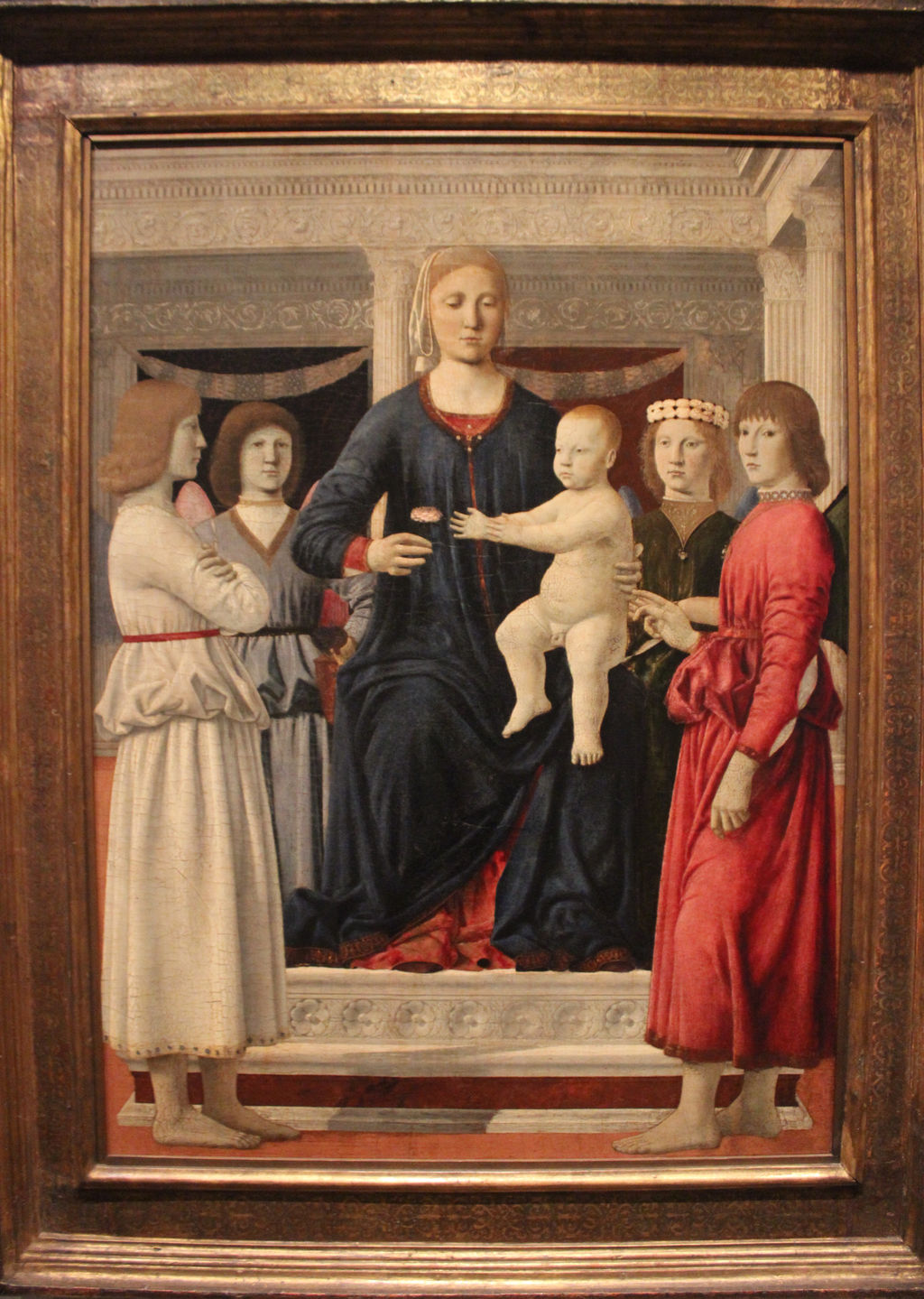
Piero della Francesca, Virgin and Child Enthroned with Four Angels, Clark Art Institute. Miguel Hermoso Cuesta. Image source. CC BY-SA 4.0. Resized from the source. This reproduction uses CC BY-SA 4.0.
Browse the artworks
Compare Piero’s frescoes, panels and manuscript figures. The list includes ensembles and separately identifiable panels or scenes. Dates are approximate where the sources differ.
| Name | Date | Medium and source |
|---|---|---|
| The Baptism of Christ | Probably c. 1437–45 | Panel painting Catalogue. |
| The Flagellation of Christ | 1459–60 (GNDM) | Panel painting Catalogue. |
| The History of the True Cross | Mid-fifteenth century | Wall painting Catalogue. |
| Dream of Constantine | Mid-fifteenth century | Wall painting Catalogue. |
| The Duke and Duchess of Urbino | About 1473–75 (Uffizi) | Panel painting Catalogue. |
| The Resurrection | About 1458–68 (Opificio) | Wall painting Catalogue. |
| Brera Madonna | About 1472–74 | Panel painting Catalogue. |
| Annunciation at Arezzo | Mid-fifteenth century | Wall painting Catalogue. |
| Madonna del Parto | About 1450–65 (Monterchi) | Wall painting Catalogue. |
| Polyptych of the Misericordia | Commissioned 1445 | Panel painting Catalogue. |
| The Nativity | Early 1480s (National Gallery) | Panel painting Catalogue. |
| Madonna di Senigallia | About 1474–75 (GNDM) | Panel painting Catalogue. |
| Death of Adam | Mid-fifteenth century | Wall painting Catalogue. |
| Queen of Sheba | Mid-fifteenth century | Wall painting Catalogue. |
| Victory of Constantine | Mid-fifteenth century | Wall painting Catalogue. |
| Battle between Heraclius and Chosroes | Mid-fifteenth century | Wall painting Catalogue. |
| Saint Mary Magdalen | Wall painting Catalogue. | |
| The Augustinian Polyptych | 1454–69 | Panel painting Catalogue. |
| Polyptych of Perugia | About 1467–69 (GNU) | Panel painting Catalogue. |
| Perugia Annunciation | About 1468–70 (national catalogue) | Panel painting Catalogue. |
| St Francis and St Elizabeth | About 1467–69 (GNU) | Panel painting Catalogue. |
| Stigmatisation of St Francis | About 1468–70 (national catalogue) | Panel painting Catalogue. |
| An Augustinian Nun (Saint Monica) | 1454–69 | Panel painting Catalogue. |
| Augustinian Saint | 1454–69 | Panel painting Catalogue. |
| Saint Michael | 1454–69 | Panel painting Catalogue. |
| Saint Nicholas of Tolentino | 1454–69 | Panel painting Catalogue. |
| Saint John the Evangelist | 1454–69 | Panel painting Catalogue. |
| Virgin and Child Enthroned with Four Angels | About 1460–70 (Clark) | Panel painting Catalogue. |
| Portrait of Sigismondo Pandolfo Malatesta | About 1450–51, often proposed. Louvre catalogue range 1450–75. | Panel painting Catalogue. |
| Sigismondo before St Sigismund | 1451 | Wall painting Catalogue. |
| St Jerome and a Donor | 1460s (Accademia); about 1450 also proposed | Panel painting Catalogue. |
| St Jerome in Penitence | 1450, dated on the panel | Panel painting Catalogue. |
| Saint Julian | About 1455–60, often proposed | Wall painting Catalogue. |
| Saint Augustine | 1454–69 | Panel painting Catalogue. |
| Saint Apollonia | 1454–69 | Panel painting Catalogue. |
| Crucifixion from the Augustinian Polyptych | 1454–69 | Panel painting Catalogue. |
| Saint Louis of Toulouse | Wall painting Catalogue. | |
| Burial of the Wood | Mid-fifteenth century | Wall painting Catalogue. |
| Discovery and Proof of the True Cross | Mid-fifteenth century | Wall painting Catalogue. |
| Exaltation of the Cross | Mid-fifteenth century | Wall painting Catalogue. |
| Saint Anthony Raises a Child | About 1467–69 (GNU) | Panel painting Catalogue. |
| Saint Elizabeth Revives a Child | About 1467–69 (GNU) | Panel painting Catalogue. |
| Hercules | About 1470 | Wall painting Catalogue. |
| Portrait of a Boy (possibly Guidobaldo da Montefeltro) | Panel painting Catalogue. | |
| De prospectiva pingendi, Reggio Emilia witness (figures) | Manuscript diagrams Catalogue. | |
| The Interrogation of Judas | Mid-fifteenth century | Wall painting Catalogue. |
| Two prophets, Bacci Chapel | Mid-fifteenth century | Wall painting Catalogue. |
| Saint Clare of Assisi, upper predella | About 1467–69 (GNU) | Panel painting Catalogue. |
| Saint Agatha, upper predella | About 1467–69 (GNU) | Panel painting Catalogue. |
| Lost centre of the Augustinian Polyptych | 1454–69 | Lost panel or panels Catalogue. |
Frequently Asked Questions
The central panel and other parts remain unlocated. The Museo Poldi Pezzoli showed all eight known surviving panels in a temporary exhibition in 2024. Its reconstruction provides a way to compare panels whose home collections are now in five cities. [9]
Discussion
Look again at the images and ideas explored in Where to See Piero della Francesca. These editorial prompts invite your observations.
Reader Insights
What does the chapel add to the story? Choose two scenes in Arezzo that face one another. Where does your eye go first, and what relationship becomes apparent when you turn from one wall to the other? [2]
Join the Conversation
Share a detail, comparison or question about Where to See Piero della Francesca below.
References
- Visit Tuscany, Sulle orme di Piero della Francesca View source.
- Direzione regionale Musei nazionali Toscana, Basilica di San Francesco View source.
- Musei di Arezzo, Piero della Francesca and Giorgio Vasari View source.
- Comune di Monterchi, Musei Civici Madonna del Parto View source.
- Museo Civico di Sansepolcro, museum and collection View source.
- Galleria Nazionale delle Marche, Flagellazione View source.
- Galleria Nazionale delle Marche, Madonna of Senigallia View source.
- Uffizi Galleries, The Duke and Duchess of Urbino View source.
- Museo Poldi Pezzoli, Il polittico agostiniano riunito View source.
- National Gallery, announced Piero della Francesca exhibition View source.
- Ministero della Cultura, Chiesa di Momentana View source.
- Discover Arezzo, Museo Civico di Sansepolcro and its Piero paintings View source.
- Autolinee Toscane, Arezzo–Sansepolcro route SI381 View source.
- Galleria Nazionale delle Marche, visitor information View source.
- Uffizi Galleries, visitor information for the Uffizi View source.
- Comune di Rimini, Tempio Malatestiano View source.
- Musée du Louvre, Portrait de Sigismond Malatesta View source.
- Galleria Nazionale dell’Umbria, Polittico di Sant’Antonio View source.
- Galleria Nazionale dell’Umbria, visitor information View source.
- Pinacoteca di Brera, San Bernardino Altarpiece View source.
- Museo Poldi Pezzoli, San Nicola da Tolentino View source.
- National Gallery, Saint Michael View source.
- The Frick Collection, Saint John the Evangelist View source.
- Câmara Municipal de Lisboa, Museu Nacional de Arte Antiga reopening View source.
- National Gallery of Art, Saint Apollonia View source.
- National Gallery, The Baptism of Christ View source.
- National Gallery, The Nativity View source.
- National Gallery, Room 66 floor plan View source.
- The Frick Collection, Virgin and Child Enthroned with Four Angels, from the Clark Art Institute View source.
- Clark Art Institute, Journal of the Clark, vol. 20 View source.
- Metropolitan Museum of Art, Piero della Francesca, 2014 exhibition and lending collections View source.
- Staatliche Museen zu Berlin, Der heilige Hieronymus View source.