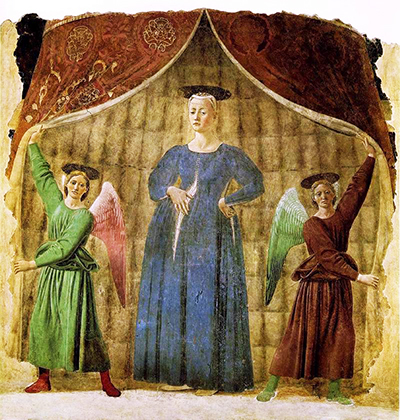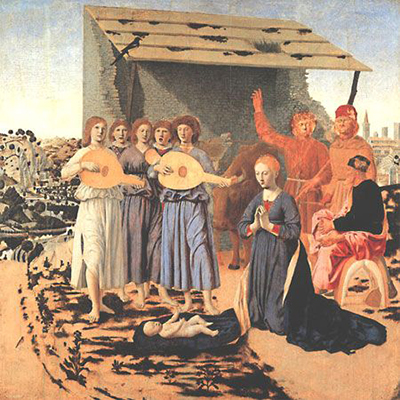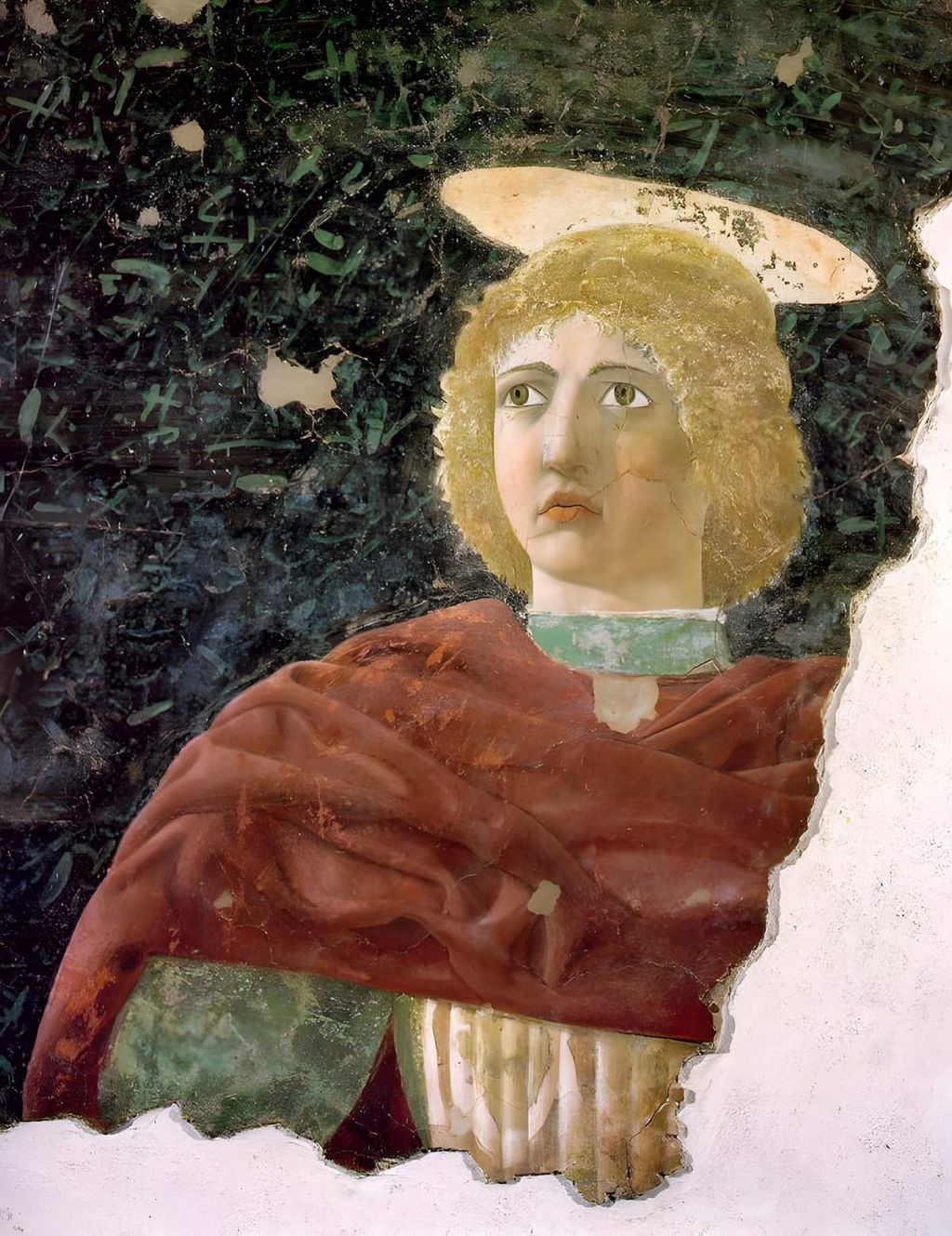
Piero della Francesca, Saint Julian, detached fresco in the Museo Civico, Sansepolcro. Image source. Public domain. Resized only; native appearance preserved.
 by Tom Gurney
Tom Gurney BSc (Hons) is an art history expert with over 20 years experience
Email: tomgurney1@gmail.com / Phone: +44 7429 011000
Saint Julian: Introduction
In the Museo Civico in Sansepolcro, a young man with light hair and a red mantle looks steadily past the viewer. The head and part of the upper body are all that survive of Piero della Francesca’s Saint Julian. The painting came to light under whitewash in December 1954, on a wall of the former Augustinian church by then known as Santa Chiara. Its discovery restored a work to Piero’s catalogue. Finding the saint’s name took much longer. [1] [2]
At a Glance
- ArtistPiero della Francesca [3]
- SubjectSaint Julian the Hospitaller, traditionally invoked by travellers and pilgrims [4]
- DateMid-fifteenth century, with published estimates around 1455–60 [4]
- TechniqueDetached fresco fragment [4]
- Dimensions130 × 105 cm in the Piccoli Grandi Musei catalogue [4]
- Original locationSant’Agostino, later Santa Chiara, Sansepolcro [2]
- Rediscovery1954, with transfer to the civic collection in 1957 [1]
- CollectionMuseo Civico di Sansepolcro, Tuscany [3]
This work across Piero della Francesca’s career
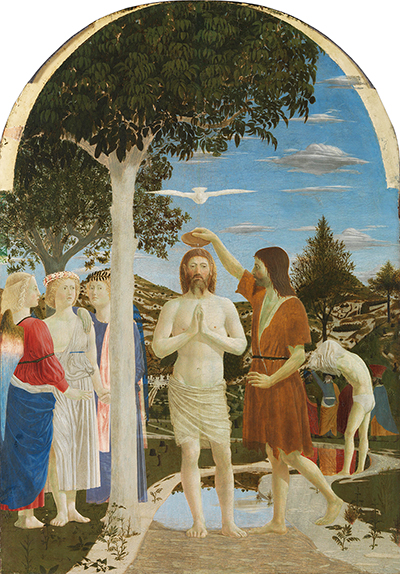
The Baptism of Christ
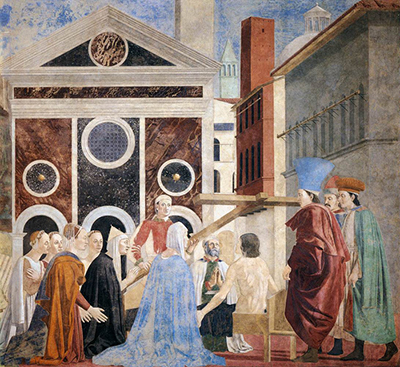
Probably about 1437–45The History of the True Cross
Mid-fifteenth centurySaint Julian (current article)
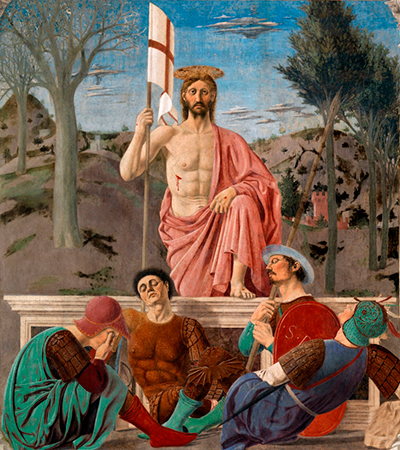
About 1455–60, often proposedThe Resurrection
About 1458–68 (Opificio)The Flagellation of Christ
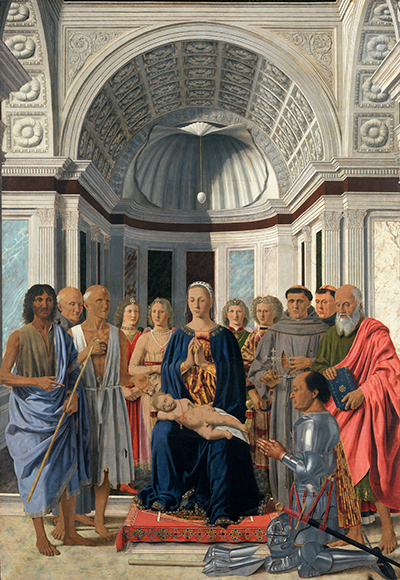
1459–60 (GNDM)The Montefeltro Altarpiece
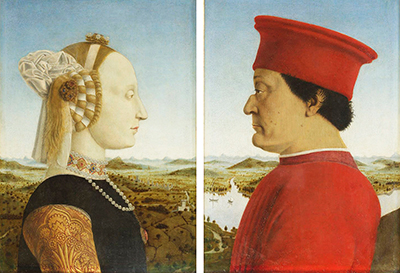
About 1472–74 (Brera)The Duke and Duchess of Urbino
About 1473–75 (Uffizi)The Nativity
Early 1480s (National Gallery)Contents
- The young man in the fragment
- Sant’Agostino before Santa Chiara
- How the fresco was found and named
- Date, dimensions and technique
- Seeing Saint Julian in Sansepolcro
- Annotated details
The young man in the fragment
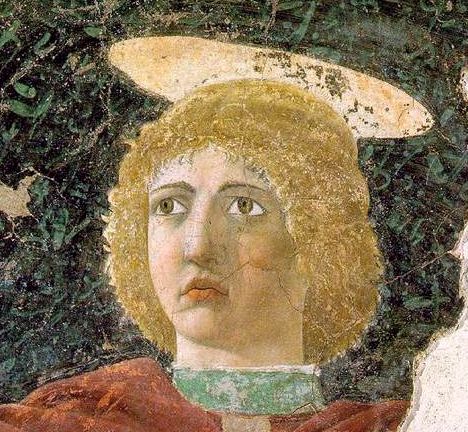
The fragment directs the eye towards the head. Pale curls pick up the light around the forehead and temples. The bridge of the nose curves prominently, and the large eyes look beyond the edge of the painting. There is a slight turn to the head, enough to make the nearer cheek broad and the far side of the face narrow. The mouth is closed. Beneath it, the pale cloth at the throat gives way to the much larger area of red. The damaged patches interrupt the background and costume, but the modelling of the cheek and the line of the jaw still give the face weight. [1] [5]
The curved nose and attentive gaze give Julian the presence of a portrait. They tell us little about whether Piero used a particular sitter. The surviving clothes give a more secure historical clue. A young saint could appear in the costly dress of a Renaissance layman, and David Franklin notes that the red and green of Piero’s figure are consistent with images of Julian. In Andrea del Castagno’s altarpiece in Berlin, the same saint stands holding a sword across his body. A panel in the Courtauld also shows him richly dressed and armed. Piero’s figure has lost the hands and much of the body, precisely the parts that could have shown such a sign. A sword is possible here. Its appearance and position are unknown. [1] [6] [7]
The sword in comparable images recalls the legend of Julian the Hospitaller. He killed his own parents in error and, in penance, devoted himself to helping travellers. The cult honoured him as a protector of pilgrims and people who provided lodging. A figure of Julian near a doorway would have had a particular resonance for people who regularly crossed that threshold, although no specific practice of devotion can be recovered from the surviving paint. The mural, as preserved, gives us the quiet presence of a saint whose legend turned on a violent act and the long labour of making amends. [2] [6] [4]
The art historian A. G. Vinogradova has compared the solid, almost sculptural head with Piero’s investigations of the human head in his treatise De prospectiva pingendi. Piero devoted a proposition in the third book to constructing a head at different angles from measured points. In the fresco there is a similar concern with keeping the features aligned as the face turns. The far eye sits close to the strong line of the nose and the nearer cheek carries the turn towards the light. Vinogradova’s comparison offers a way to examine the painting closely, even though the fragment alone cannot show how Piero transferred his design to the wall. [8]
Sant’Agostino before Santa Chiara
When Piero worked in the building, it belonged to the Augustinian friars. Giacomo Guazzini and Elena Squillantini reconstruct a rectangular church with a five-sided apse facing south, lit by narrow windows. They place the mural on the right-hand wall near a side door that has since been blocked, drawing on a document from 1503, observations recorded at the discovery and a physical trace of the removed painting. They also cite a recollection from works supervisor Giuseppe Nomi, who put the saint’s head about three and a half to four metres above the original floor. The estimate changes how one imagines the image. Someone looking up would have first seen the clear outline and strong colours from below, where the refined transitions in the flesh would have been harder to distinguish than they are today. [2]
The church housed another work by Piero with a securely documented starting point. In 1454 he contracted to paint what is now called the Augustinian Polyptych, completed by about 1469. Its painted wooden panels stood at the high altar and survive in several collections. Julian was painted on the church wall. The contract dates the commission of the altarpiece, while the mural belongs to the wider history of decoration in the same building. Earlier frescoes there depicted Augustinian saints and episodes from their lives. In the fifteenth century a worshipper would have encountered Piero’s work among images installed at different times, each in a place shaped by altars, chapels, doorways and the needs of the friars. [2] [9]
In 1555 the Augustinians moved out and the Poor Clares took over. Alberto Alberti’s subsequent remodelling divided the building into upper and lower levels, provided new space for the nuns’ choir and dormitory, and altered the windows of the apse. The former Sant’Agostino became known as Santa Chiara. These changes account for the different church names in catalogues and help explain how a mural once high above the floor could be rediscovered in a small room built into the upper part of the church. The old building is now the Auditorium Santa Chiara. The painting is kept elsewhere in town, at the Museo Civico. [2] [10] [3]
Annotated Details from Saint Julian
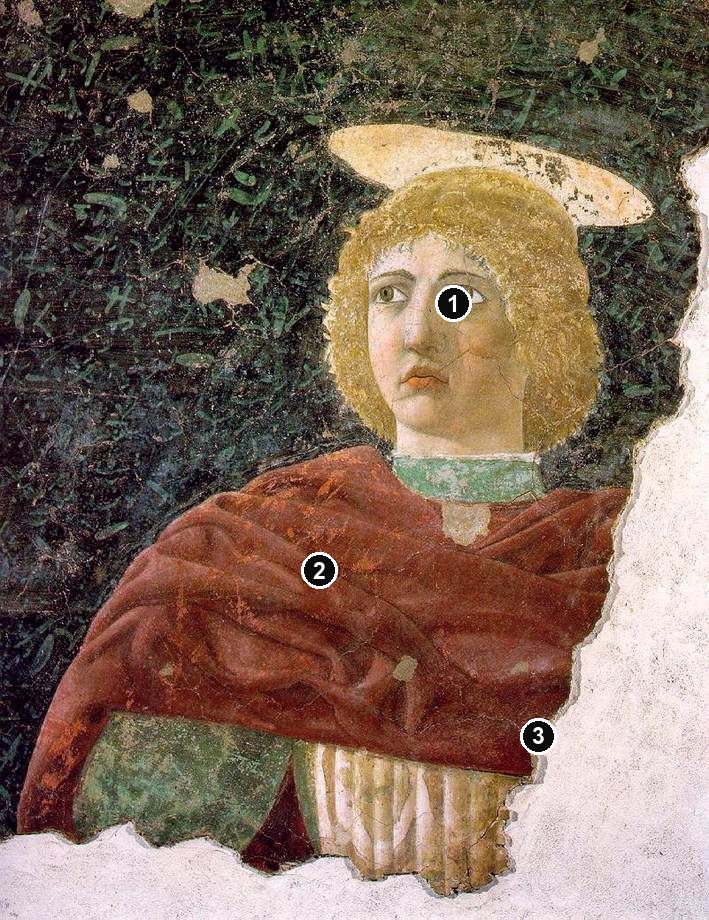
The numbered points identify visible features discussed in this article. Return from each detail to the numbered overview. Piero della Francesca, Saint Julian, detail of the surviving detached fresco, Museo Civico, Sansepolcro. Image source. Public domain.
Details from SAINT JULIAN
Compare the cropped details with the source images above. Notice how their colours, shapes and positions contribute to the larger compositions.
The face and painted halo
Julian’s eyes turn to his right under a pale halo seen in perspective. The dark foliage makes the outline of the light hair easier to follow.
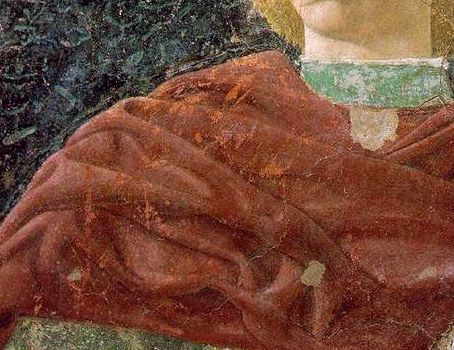
The red cloak and green collar
The green collar cuts a narrow line across the top of the red cloak. Broad folds interrupt the red surface.
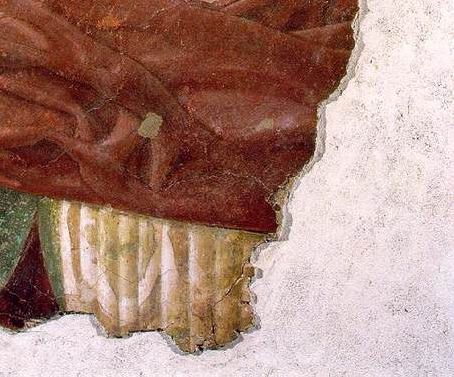
The irregular edge of the painted field
The surviving painted surface ends unevenly across the right side and the bottom. The light area makes the surviving boundary easy to see.
How the fresco was found and named
December 1954 brought the first glimpse of the painting during building work. In a recollection published decades later, Fausto Braganti describes returning from school and being shown the face by the mason Lino Mercati, who had been working in the former church. Braganti remembered the colour looking particularly vivid on the damp wall. His account captures something of the first encounter, when a patch of paint emerged unexpectedly during work on the building. Mario Salmi published the fresco in the Bollettino d’Arte in 1955, while it was still on the wall. He recognised Piero’s hand and proposed that the figure was Julian. Eugenio Battisti later doubted whether the identity could be settled from what remained. [1] [11] [12]
The fresco was detached and transferred to the civic collection in 1957. The conservation historian Giuseppe A. Centauro credits Leonetto Tintori with the difficult extraction and records that the fragment was featured in the 1967 exhibition of detached frescoes in Milan. The ragged lower edge is much older than its museum display. Guazzini and Squillantini cite superintendent Filippo Rossi’s observation that an opening cut into the wall had already destroyed the bottom of the image. That report gives a physical explanation for a major loss that can otherwise look like the consequence of taking the painting down. [1] [2] [13]
In 1999 Franklin published the document that supplied the decisive evidence for identifying the saint. It dates from 1503 and indirectly mentions Julian near a side door. The location fits the find and the trace of the mural in the building. The same record also helps situate the Cresci family’s chapel, which Franklin associated with a separate altarpiece painted by Gerino da Pistoia in 1510 and now at the Courtauld. Guazzini and Squillantini proposed a link between Piero’s fresco and the Cresci family, who had patronage of a chapel dedicated to Saint John in the church. That is a plausible explanation for the fresco’s setting, whereas who paid Piero and exactly when he painted it remain open. The 1503 evidence concerns a painting already in the church. [2] [14] [15]
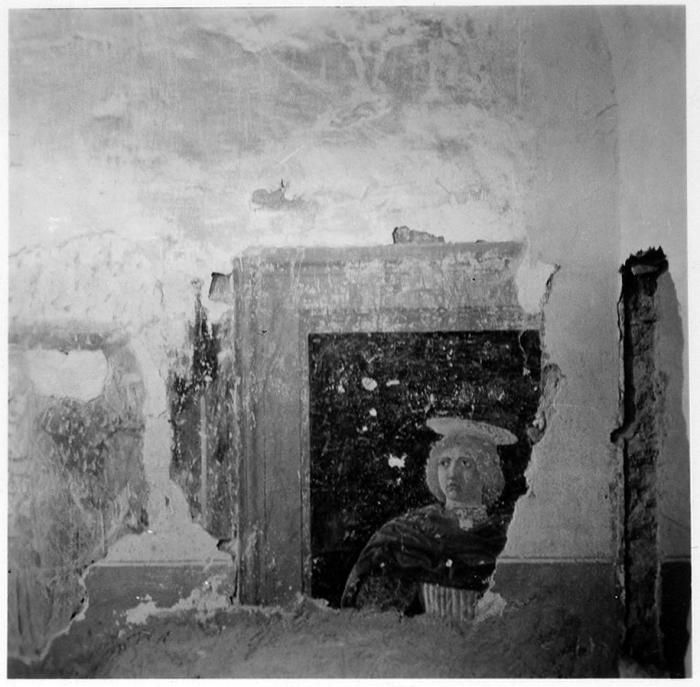
Historical photograph of the Saint Julian fresco fragment at its original site in Sansepolcro. Image source. Public domain. Resized only; native appearance preserved.
Date, dimensions and technique
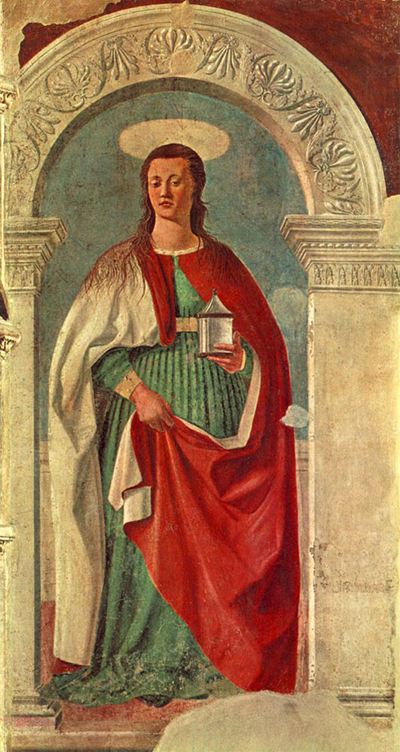
The civic exhibition Nel segno di Roberto Longhi dated Saint Julian to about 1455, while the Piccoli Grandi Musei catalogue proposes about 1460. Both place it around the middle of the fifteenth century. The softness of the face and the measured fall of the light invite comparison with Piero’s Saint Mary Magdalen in Arezzo Cathedral. In Arezzo the saint remains part of the cathedral wall and her pose can be read with the painted architectural surround. In Sansepolcro the surviving fragment concentrates attention on the face, and the reconstructed church helps us recover something of its former scale and position. Such comparisons can suggest a period of work. The precise year remains unknown. [2] [4] [16] [17]
Published dimensions vary for the detached work. Piccoli Grandi Musei gives 130 × 105 cm, the church reconstruction gives 135 × 105 cm, and the Longhi exhibition listing gives 130 × 80 cm. These are published sizes of the surviving object. The descriptions do not establish a common measurement boundary for the irregular fragment and its mounting, so the original height and width of the painted design cannot be recovered from these figures. A separate Lombardy archive record gives 180 × 240 mm for a black-and-white photographic print of a detail. Those dimensions describe the photographic paper. [2] [5] [4] [16]
The regional catalogue classifies the work as affresco staccato, a fresco removed from its wall. Fresco is a form of painting on plaster, and the word staccato describes what later happened to the work. Guazzini and Squillantini describe a trace of the removal using the term strappo, which refers to lifting the painted surface. Centauro’s account establishes Tintori’s involvement, while the exact build of the present mount and the materials in Piero’s paint layers would need a work-specific conservation record. The catalogue designation is sufficient to identify the work as transferred mural painting. [2] [4] [13]
Seeing Saint Julian in Sansepolcro
The Museo Civico brings together three murals with very different histories. The young bishop in Saint Louis of Toulouse came from the Palazzo Pretorio and is recognisable by his ecclesiastical dress. The regional catalogue relates that work to the Florentine official Lodovico Acciaioli and dates it to 1460. Julian came from the Augustinian church and has the dress of a layman. The Resurrection is a civic commission still incorporated into a wall of the Palazzo della Residenza, now the museum. Research by the Opificio delle Pietre Dure established that the wall painting had been moved with its masonry from an earlier position. Seen together, the paintings show how much the experience of a fresco depends on the wall, building and audience for which it was made. The guide to seeing Piero’s work gives the locations of the surviving paintings. [4] [3] [18] [19]
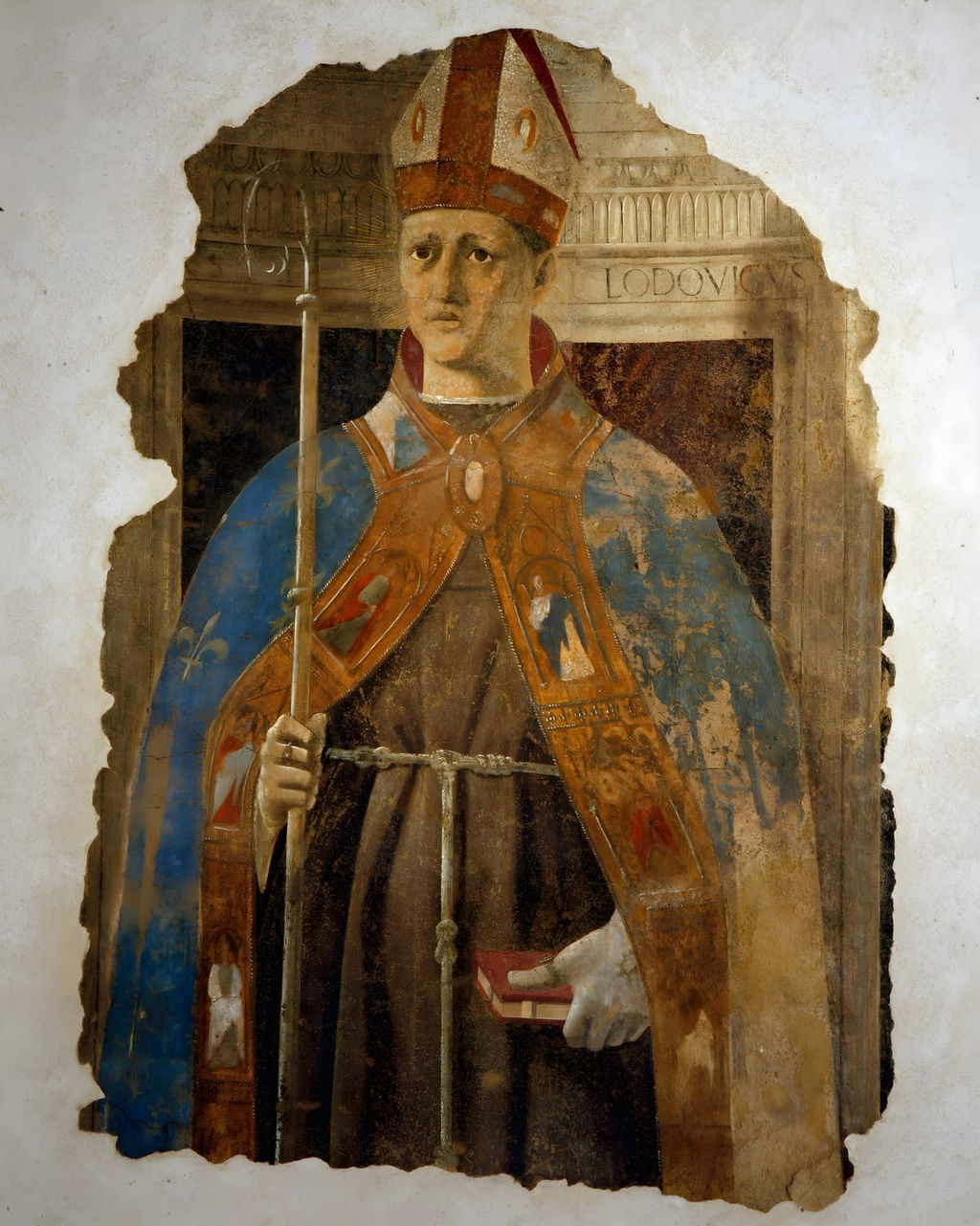
Piero della Francesca, Saint Louis of Toulouse, detached fresco, Museo Civico, Sansepolcro. Image source. Public domain. Resized only; native appearance preserved.
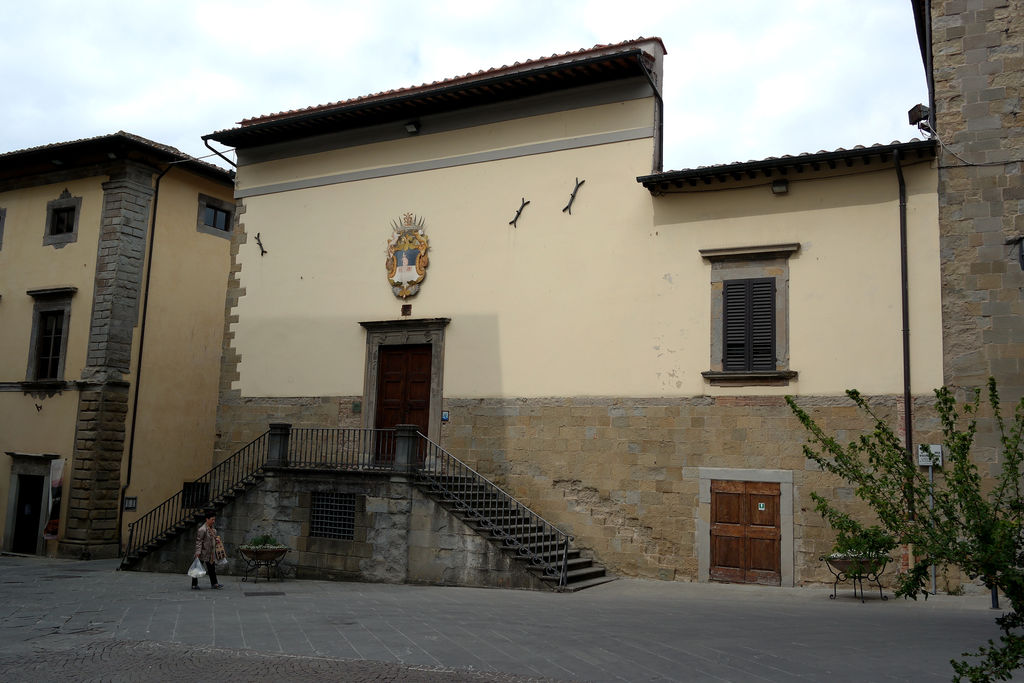
The façade and exterior staircase of the Museo Civico, Sansepolcro. Luca Aless. Image source. CC BY-SA 4.0. Resized from the source. This reproduction uses CC BY-SA 4.0.
Browse the artworks
Compare Piero’s frescoes, panels and manuscript figures. The list includes ensembles and separately identifiable panels or scenes. Dates are approximate where the sources differ.
| Name | Date | Medium and source |
|---|---|---|
| The Baptism of Christ | Probably c. 1437–45 | Panel painting Catalogue. |
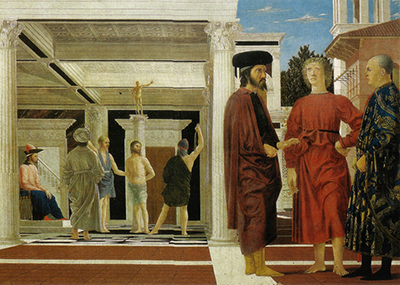
| The Flagellation of Christ | 1459–60 (GNDM) | Panel painting Catalogue. |
| The History of the True Cross | Mid-fifteenth century | Wall painting Catalogue. |
| Dream of Constantine | Mid-fifteenth century | Wall painting Catalogue. |
| The Duke and Duchess of Urbino | About 1473–75 (Uffizi) | Panel painting Catalogue. |
| The Resurrection | About 1458–68 (Opificio) | Wall painting Catalogue. |
| Brera Madonna | About 1472–74 | Panel painting Catalogue. |
| Annunciation at Arezzo | Mid-fifteenth century | Wall painting Catalogue. |
| Madonna del Parto | About 1450–65 (Monterchi) | Wall painting Catalogue. |
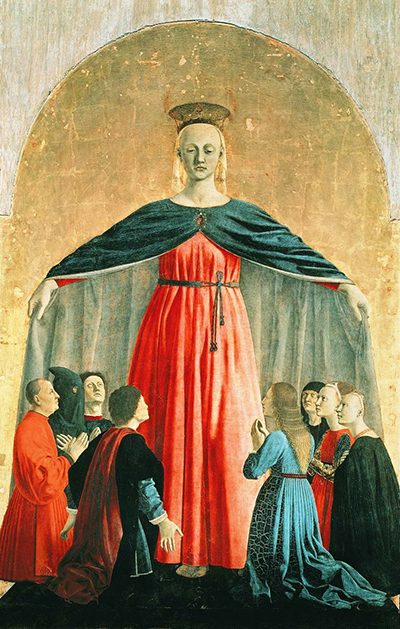
| Polyptych of the Misericordia | Commissioned 1445 | Panel painting Catalogue. |
| The Nativity | Early 1480s (National Gallery) | Panel painting Catalogue. |
| Madonna di Senigallia | About 1474–75 (GNDM) | Panel painting Catalogue. |
| Death of Adam | Mid-fifteenth century | Wall painting Catalogue. |
| Queen of Sheba | Mid-fifteenth century | Wall painting Catalogue. |
| Victory of Constantine | Mid-fifteenth century | Wall painting Catalogue. |
| Battle between Heraclius and Chosroes | Mid-fifteenth century | Wall painting Catalogue. |
| Saint Mary Magdalen | Wall painting Catalogue. | |
| The Augustinian Polyptych | 1454–69 | Panel painting Catalogue. |
| Polyptych of Perugia | About 1467–69 (GNU) | Panel painting Catalogue. |
| Perugia Annunciation | About 1468–70 (national catalogue) | Panel painting Catalogue. |
| St Francis and St Elizabeth | About 1467–69 (GNU) | Panel painting Catalogue. |
| Stigmatisation of St Francis | About 1468–70 (national catalogue) | Panel painting Catalogue. |
| An Augustinian Nun (Saint Monica) | 1454–69 | Panel painting Catalogue. |
| Augustinian Saint | 1454–69 | Panel painting Catalogue. |
| Saint Michael | 1454–69 | Panel painting Catalogue. |
| Saint Nicholas of Tolentino | 1454–69 | Panel painting Catalogue. |
| Saint John the Evangelist | 1454–69 | Panel painting Catalogue. |
| Virgin and Child Enthroned with Four Angels | About 1460–70 (Clark) | Panel painting Catalogue. |
| Portrait of Sigismondo Pandolfo Malatesta | About 1450–51, often proposed. Louvre catalogue range 1450–75. | Panel painting Catalogue. |
| Sigismondo before St Sigismund | 1451 | Wall painting Catalogue. |
| St Jerome and a Donor | 1460s (Accademia); about 1450 also proposed | Panel painting Catalogue. |
| St Jerome in Penitence | 1450, dated on the panel | Panel painting Catalogue. |
| Saint Julian | About 1455–60, often proposed | Wall painting Catalogue. |
| Saint Augustine | 1454–69 | Panel painting Catalogue. |
| Saint Apollonia | 1454–69 | Panel painting Catalogue. |
| Crucifixion from the Augustinian Polyptych | 1454–69 | Panel painting Catalogue. |
| Saint Louis of Toulouse | Wall painting Catalogue. | |
| Burial of the Wood | Mid-fifteenth century | Wall painting Catalogue. |
| Discovery and Proof of the True Cross | Mid-fifteenth century | Wall painting Catalogue. |
| Exaltation of the Cross | Mid-fifteenth century | Wall painting Catalogue. |
| Saint Anthony Raises a Child | About 1467–69 (GNU) | Panel painting Catalogue. |
| Saint Elizabeth Revives a Child | About 1467–69 (GNU) | Panel painting Catalogue. |
| Hercules | About 1470 | Wall painting Catalogue. |
| Portrait of a Boy (possibly Guidobaldo da Montefeltro) | Panel painting Catalogue. | |
| De prospectiva pingendi, Reggio Emilia witness (figures) | Manuscript diagrams Catalogue. | |
| The Interrogation of Judas | Mid-fifteenth century | Wall painting Catalogue. |
| Two prophets, Bacci Chapel | Mid-fifteenth century | Wall painting Catalogue. |
| Saint Clare of Assisi, upper predella | About 1467–69 (GNU) | Panel painting Catalogue. |
| Saint Agatha, upper predella | About 1467–69 (GNU) | Panel painting Catalogue. |
| Lost centre of the Augustinian Polyptych | 1454–69 | Lost panel or panels Catalogue. |
Frequently Asked Questions
Discussion
Look again at the images and ideas explored in Saint Julian. These editorial prompts invite your observations.
Reader Insights
A face seen from below. Imagine meeting Julian’s gaze with his head several metres above the floor. Which details of the fragment would you register first?
Recognising a saint. Compare Julian’s clothing with the bishop’s dress in Saint Louis of Toulouse. What clues could a viewer have used before reading either label?
Two traces of a vanished setting. The archive records a side door and the building preserves a trace of the mural. What would each piece of evidence tell you on its own?
Join the Conversation
Share a detail, comparison or question about Saint Julian below.
References
- David Franklin, ‘Piero della Francesca’s “St Julian” at Sansepolcro’, The Burlington Magazine 141 (1999), pp. 473–475, publisher’s preview View source.
- Giacomo Guazzini and Elena Squillantini, ‘A Visual Context for Piero’, Piero della Francesca in America (The Frick Collection, 2013), pp. 129–133 View source.
- Museo Civico di Sansepolcro, Carta dei servizi, collection history View source.
- Piccoli Grandi Musei, Museo Civico di Sansepolcro, San Giuliano and San Ludovico catalogue entries View source.
- Lombardia Beni Culturali, Foto Saporetti photograph of San Giuliano, SIRBeC record IMM-3a140-0000102 View source.
- Staatliche Museen zu Berlin, Andrea del Castagno, The Assumption of the Virgin with Saints Julian and Minias View source.
- The Courtauld Gallery, Saint Julian, virtual gallery interpretation View source.
- A. G. Vinogradova, ‘Piero della Francesca’s Treatise in Relation to His Art’, in From Classical Antiquity to Modernism (State Institute for Art Studies, Moscow, 2018), pp. 106–125, especially pp. 115–118, in Russian View source.
- The National Gallery, Piero della Francesca, Saint Michael, including catalogue documentation for the Augustinian altarpiece View source.
- Comune di Sansepolcro, Auditorium Santa Chiara View source.
- Fausto Braganti, ‘M’Arcordo… quando il San Giuliano era ancora un angelo’, eyewitness recollection (2015) View source.
- Mario Salmi, ‘L’affresco di Sansepolcro’, Bollettino d’Arte 40 (1955), pp. 230–236, Ministry of Culture issue record View source.
- Giuseppe A. Centauro, ‘L’arte di restaurare l’arte’, pp. 33–34 View source.
- OpenBibArt, Getty Bibliography of the History of Art abstract of Franklin’s documentary study View source.
- The Courtauld Institute of Art, Gerino da Pistoia’s 1510 altarpiece in ‘The Painted Surface and Interface’ View source.
- Nel segno di Roberto Longhi. Piero della Francesca e Caravaggio a Sansepolcro, Comune di Sansepolcro exhibition checklist reproduced by Arti e Lettere View source.
- Diocesi di Arezzo-Cortona-Sansepolcro, Arca di Luce, Piero’s Maddalena in Arezzo Cathedral View source.
- Museo Civico di Sansepolcro, museum notice identifying San Giuliano and San Ludovico as two detached frescoes in the Resurrection room View source.
- Opificio delle Pietre Dure, La Resurrezione, research and conservation report View source.