


 by Tom Gurney
Tom Gurney BSc (Hons) is an art history expert with over 20 years experience. Updated September 24, 2026.
Introduction
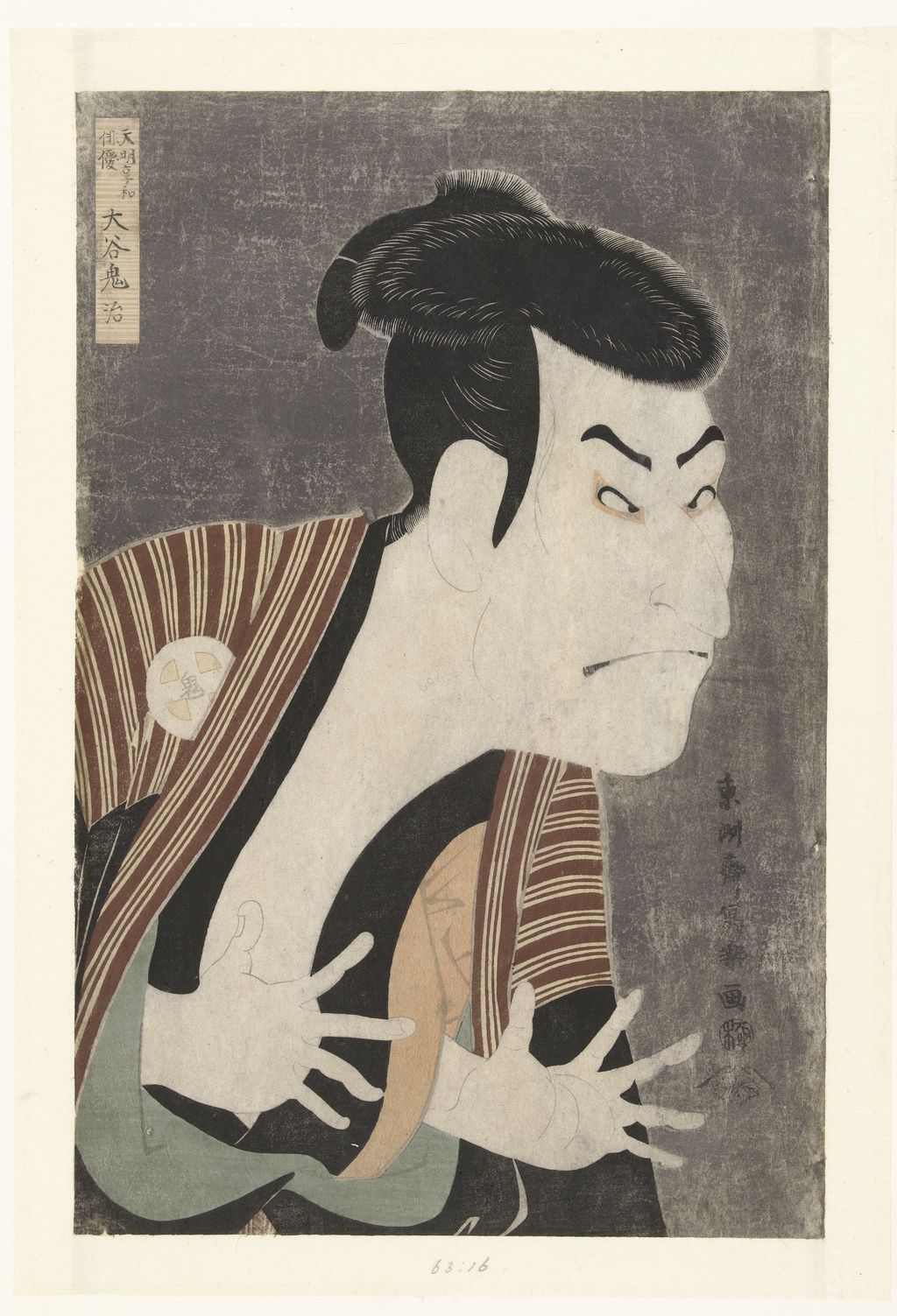
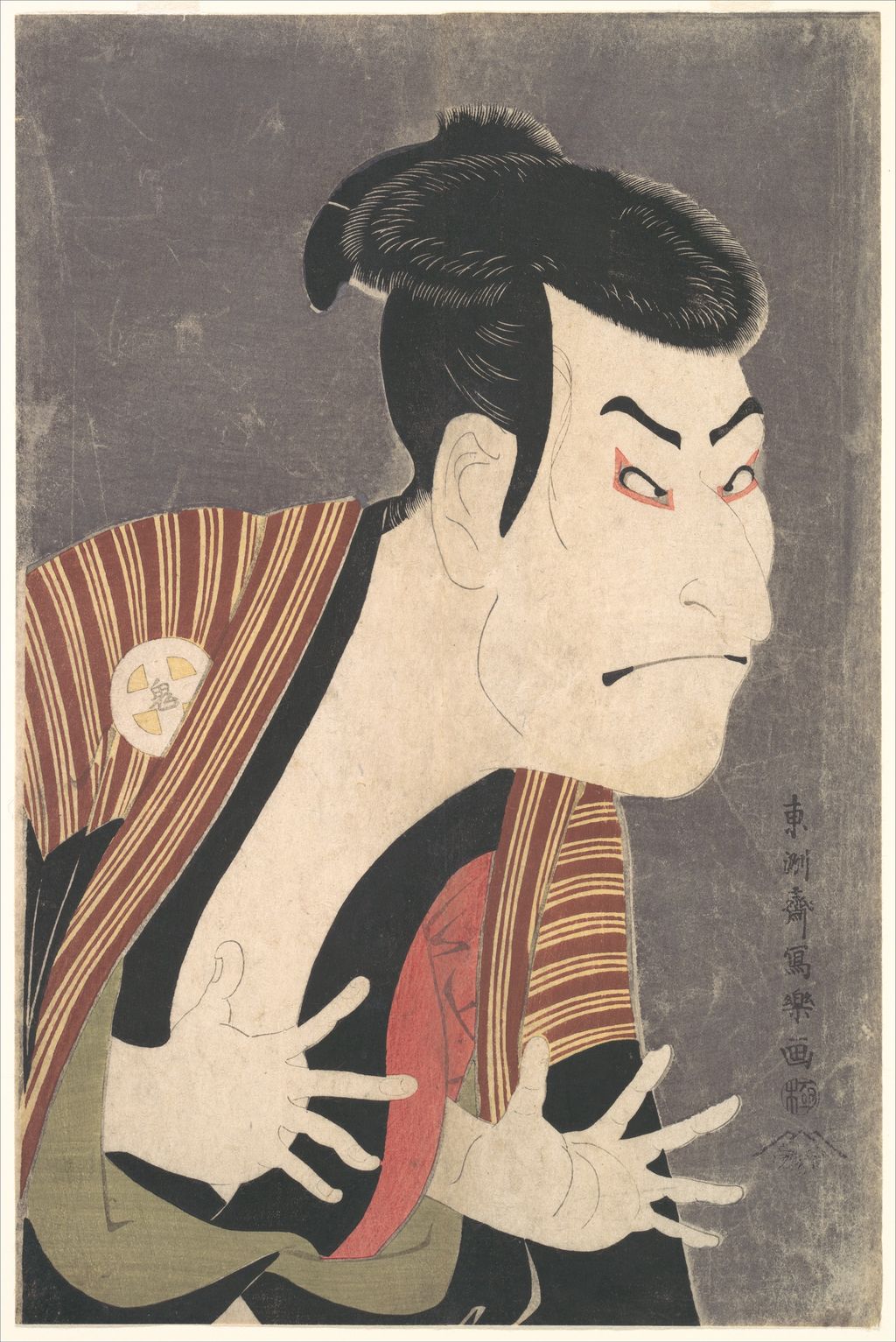
The figure leans towards us with narrowed eyes and both hands held out. His hair bristles against a dark, shimmering ground. This is not simply a picture of a man called Ōtani Oniji III. He was an actor playing the servant Edobei in a named kabuki play, and the print asked an audience that knew the theatre to recognise both a performer and the character he had become. The Metropolitan Museum of Art's impression [6] calls the role Yakko Edobei and identifies the play as Koi nyōbō somewake tazuna. The Rijksmuseum's separate impression [6] supplies a second physical object through which we can look at the same design. Beginning with those distinctions makes Tōshūsai Sharaku (東洲斎写楽) easier to understand. His subject was not an abstract expression called “drama,” but a specific performer, role, production and viewing public.
Sharaku's known print activity is exceptionally concentrated. In the fifth lunar month of 1794, his publisher Tsutaya Jūzaburō brought out a group of twenty-eight large actor portraits with mica grounds. By the first lunar month of 1795, publication under the Sharaku name had stopped. The Tokyo National Museum's 2011 exhibition [1] describes more than 140 prints in the intervening ten lunar months; the British Museum's artist record [3] counts 144 known designs and divides them conventionally into four phases. These are design counts, not a tally of surviving individual sheets. Multiple impressions of a design can survive in different collections. The reason for the end of the project, and the identity of the person who used the Sharaku name, remain unresolved.
Contents
- Introduction
- A print made for the theatre
- First phase: twenty-eight faces
- The publisher behind the name
- From face to figure: the second phase
- Eleventh month: a broader repertoire
- Last publications in the first month of 1795
- Reading the print rather than a reproduction of a design
- Who was “Sharaku”?
- Looking across Sharaku's contemporaries
- Afterlives: an artist recovered through objects
- How to use this cluster
This page is a guide to the pictures before it is a search for their maker. Sharaku's great mica-ground heads are only the first phase. The next publications include tall, narrow full-length actor prints, later smaller bust images, memorial and sumo subjects, and paired sheets. The change in format changes what we can see. A close portrait lets a face and two hands stand for a role; a whole body can show stance, costume and a relation between performers. The Japan Search Sharaku gallery [4], drawing on Japanese collection records, offers a particularly useful four-phase map. It also reveals why a single famous Edobei image should lead into a wider body of work rather than stand in for the whole of it.
Sharaku at a glance
- When did Sharaku work?From the fifth lunar month of 1794 to the first lunar month of 1795, according to the Tokyo National Museum [1] and British Museum [3]. 1794 included an intercalary eleventh month, so the roughly ten-month project should not be flattened into ordinary Gregorian month names.
- What did he make?Primarily actor prints, with some memorial and sumo images. A 2011 Tokyo exhibition displayed 142 Sharaku woodblock prints; that is an exhibition count and should not be confused with every institution's known-design total. See the National Research Institute for Cultural Properties' account [5].
- Who published the designs?Tsutaya Jūzaburō, identified for all known designs by the British Museum [3]. The publisher commissioned and sold prints; a designer's signature does not name every person who cut blocks or printed sheets.
- Which image should I see first?Compare Rijksmuseum RP-P-1963-16 [6] and Met JP2822 [6], two impressions of Ōtani Oniji III as Edobei. Then look at Met JP3128a,b [8], a later two-sheet actor design.
- Do we know who Sharaku was?A Noh actor named Saitō Jūrōbei is a significant proposal. The Tokyo National Museum [9] treats it as persuasive, while the British Museum [3] says no identification commands general agreement. His birth and death details should not be invented to fill the gap.
A print made for the theatre
An actor print could serve several overlapping purposes. It recorded a performer and advertised the pleasures of seeing that performer in a particular role. It could place a favourite star in a buyer's hands after the event, and it could turn theatrical gesture into a composition fit for close, repeated looking. The Tokyo National Museum's Sharaku exhibition [1] traced the actor and play behind individual sheets; Tobunken's account of that exhibition [5] says its researchers compared prints with surviving theatre programmes. That research matters because the same actor could play different roles, while a role could be represented by several artists. A portrait becomes more precise when it has an actor, a role, a play, a theatre and a lunar performance month rather than just a modern nickname.
The Edobei design is a useful test. “Ōtani Oniji III” names a stage performer and the generation of a stage name. “Yakko Edobei” names the servant he performed. The play Koi nyōbō somewake tazuna names the dramatic context. “Kawarazaki-za,” recorded by the Rijksmuseum [6], is a theatrical venue. “RP-P-1963-16” is the Rijksmuseum's accession for one physical print. “JP2822” is the Met's different impression [6]. None of these labels can simply replace another. The Met describes Edobei as a ruthless henchman and points to the leering face, untidy hair and extended hands. The visual force comes from such particular decisions: the hands reach out almost as separate figures against the ground, while the close view gives the viewer little surrounding scene in which to escape the encounter.
Another 1794 portrait, the Met's Ichikawa Omezō I as Yakko Ippei (JP196) [7], belongs to the same named play. Place it beside Edobei and two visual approaches to a servant role emerge. The museum records justify comparison by play and performer, but the surviving Met and Rijks sheets are different objects. Similar subject matter does not prove that the two impressions were originally displayed or purchased together. The comparison should ask what posture, hands, clothing and expression do in each picture, not supply an imagined account of the original buyer's wall.
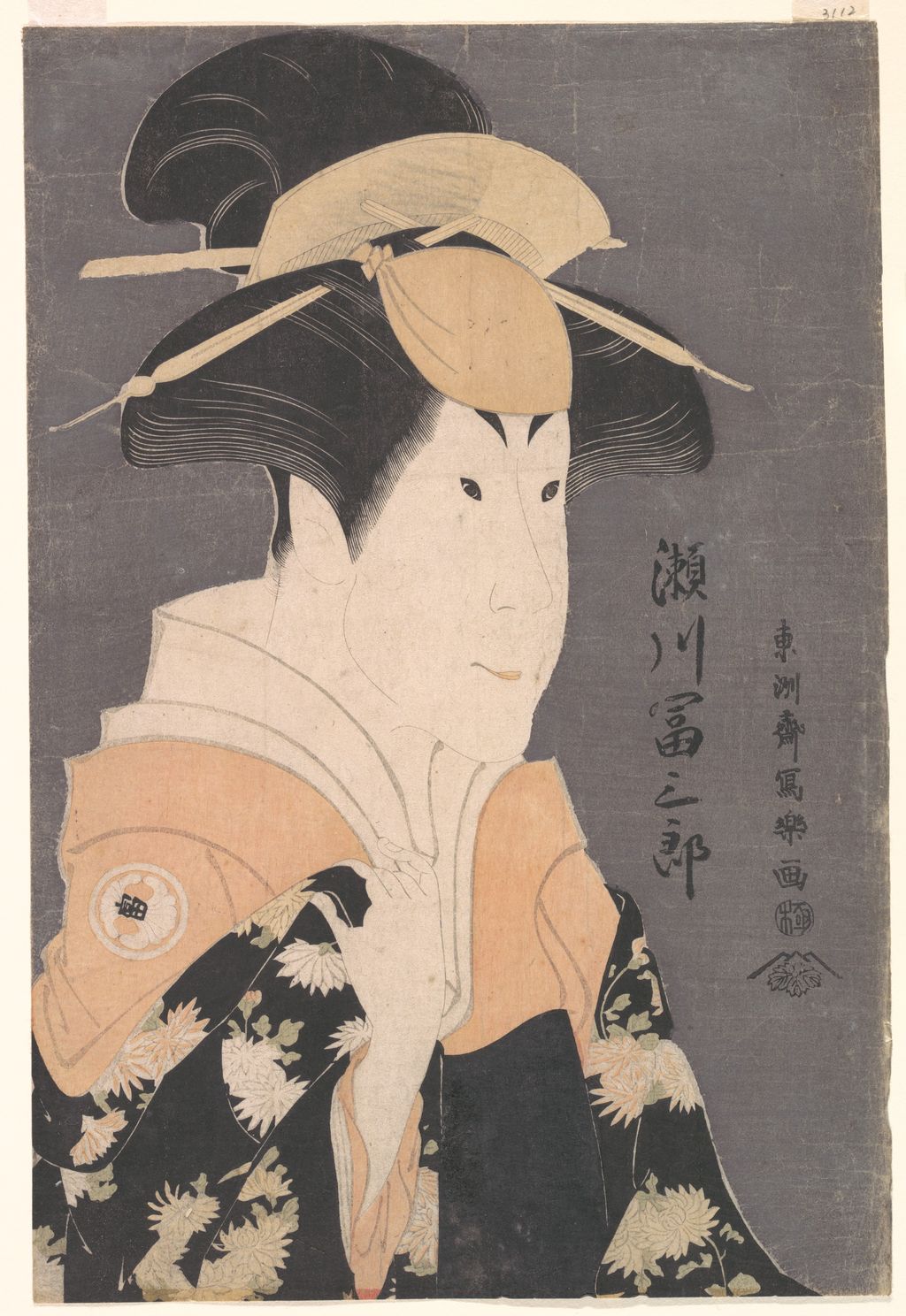
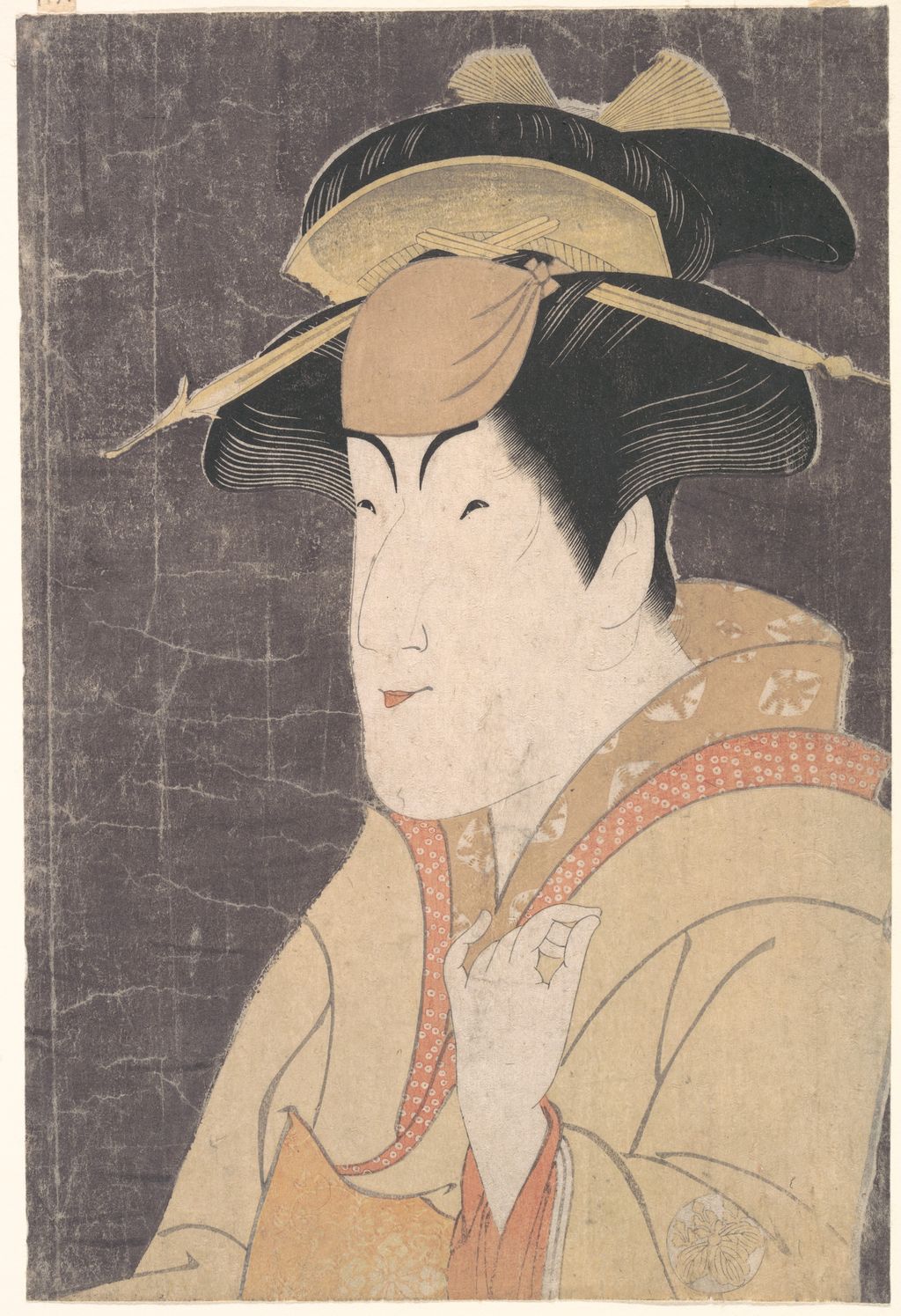
The stage world also complicates a modern assumption about portraiture. An actor's appearance in a sheet is not a neutral documentary likeness taken outside performance. Costume, performed gender, role type, gesture and the expectations of spectators shape what is shown. The Met's Segawa Tomisaburō II as Yadorigi (JP3112) [7] gives an early portrait associated with Hana Ayame Bunroku Soga, while its Nakayama Tomisaburō as Miyagino (JP1737) [7] relates to Katakiuchi Noriyaibanashi. The identity of the actor and the identity of the character are distinct in both records. If we call a portrait “Yadorigi” without the actor, or “Tomisaburō” without the role, we lose half of its theatrical point.
First phase: twenty-eight faces
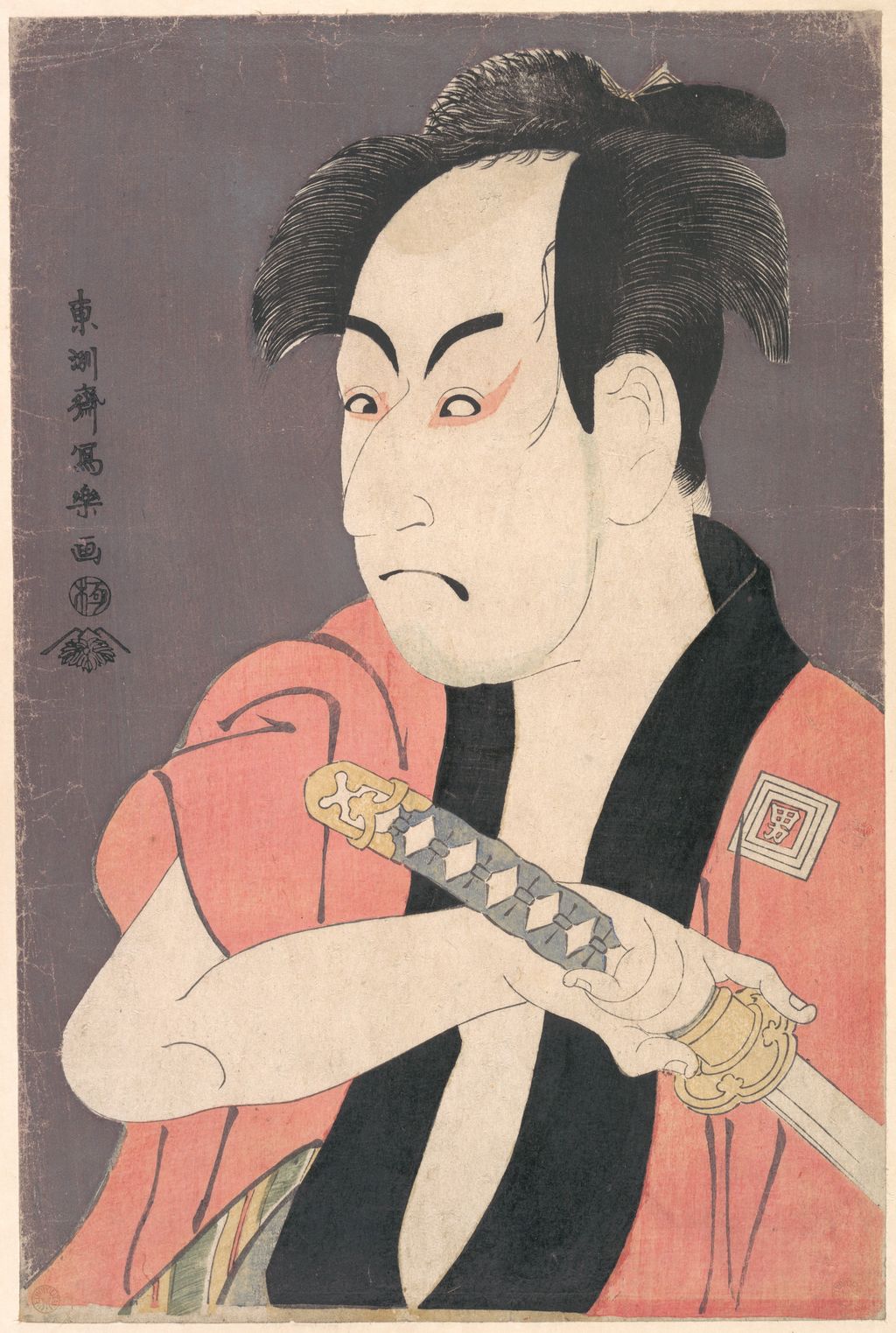
The opening group of twenty-eight is one of the best defined events in Sharaku's working record. The British Museum [3] describes large-format bust portraits of performers in plays at Edo's three kabuki theatres in the fifth lunar month of 1794. The Tokyo National Museum [1] emphasises their costly mica-ground appearance. Mica is a mineral added to the ground to create a sparkling surface. Its effect changes with actual light and angle; a digital file can show tone and some texture, but cannot duplicate the way a sheet catches light in a room. A dark ground also removes much of the stage setting. Face, hair, collar and hands bear the burden of identifying a moment in the performance.
The phrase ōkubi-e is often translated “large-head picture.” It describes the tight framing rather than a literal drawing of only the head. Edobei has a broad upper body and two extraordinary hands. In the Rijksmuseum impression [6], the grey ground creates room around them, so that the empty surface becomes an active part of the drama. The printed actor-name cartouche and artist's signature remain part of the composition: Sharaku does not rely only on a face to make a commercially legible actor print. The details reward close looking, but they remain parts of one physical sheet. Its full composition is needed to understand how face, gesture, lettering and ground work together.
The first group was not a uniform collection of angry faces. Compare Segawa Tomisaburō II as Yadorigi [7], Nakayama Tomisaburō as Miyagino [7], Ichikawa Omezō I as Ippei [7] and Ōtani Oniji III as Edobei [6]. The roles, costumes and gestures differ. What links the designs is a format that invites close inspection of a performer carrying a character. The artist can exaggerate features and abbreviate setting without detaching a figure from a specific play. The British Museum's description [3] judges the images unusually perceptive as portraits of both actors and roles. That is a critical reading, not proof that we can know the actor's private personality from the print.
These pictures also mark a risk taken by a publisher. A series of twenty-eight large-format mica-ground prints demanded materials, coordination and a buyer's interest in theatre. The Tokyo National Museum's exhibition research [2] describes the first issue as an unusually lavish debut. We can reasonably infer an ambitious commercial undertaking from the number and finish of the designs; we cannot infer Tsutaya's exact costs, edition sizes, sales or profits from the images alone. An edition's surviving impressions do not equal the original print run. Treat “a bold launch” as a conclusion drawn from the production evidence, not as a claim to have found an account book.
The publisher behind the name
Tsutaya Jūzaburō is not a footnote to Sharaku's story. The British Museum's artist record [3] attributes the publication of all known Sharaku designs to him. The artist supplied designs, but a print reached customers through publishing and workshop labour. The editions required cutting separate blocks, registering colours, applying mica to some grounds, preparing paper and selling the result. The number of people and precise methods could differ by sheet, so the signed name “Sharaku” cannot safely be turned into a statement that one man made every material component. The Tokyo National Museum's 2025 Tsutaya exhibition list [15] situates Sharaku among the publisher's other ventures, but it does not reveal the terms of their personal relationship.
Thinking about the publisher also guards against a romantic story in which an inexplicable genius appears for ten months and walks away. What we can date is a publication project under a particular name. Its pace and presentation changed. A commercial project can stop for many reasons, including reasons entirely invisible in the surviving prints. Neither a theory about audience distaste nor a theory about the artist's private life should be written as the answer. The Japan Search account [4] discusses a later comment that an overly candid likeness failed to please viewers. That is a historically interesting judgement; it is not a sales record. The separate biography can place that comment among the later sources without allowing it to dictate the whole story.
From face to figure: the second phase
The next group demonstrates how much of Sharaku's art disappears when a selection reproduces only his famous heads. Japan Search [4] assigns thirty-eight designs to the seventh and eighth lunar months of 1794. Most are narrow, full-length images of actors, while a smaller group keeps larger mica-ground formats. The British Museum [3] likewise identifies thirty-eight full-length actor designs as the defining work of its second period. The difference in how those summaries describe the group is a reminder to use a full catalogue for exact format counts. The change is still unmistakable: many bodies now stand or move within a long vertical space rather than emerging at close range from a broad ground.
Why does that matter to a viewer? A hand seen beside a face can make an intense, almost self-contained sign, as in Edobei. A full-length actor must be read from feet to head. The bend of a knee, the angle of a sleeve, the spread of a costume and the empty area around a body can all locate a character within an imagined action. A narrow sheet also requires the designer to control how far the eye moves up and down. The Japan Search gallery [4] identifies, for example, a full-length Ōtani Oniji III as Kawashima Jibugorō from an eighth-month performance at Kawarazaki-za. That object shows the same actor name in a different role from Edobei. A viewer who searches only “Sharaku Oniji” and treats the two as the same scene would miss the change of play, character and format.
Other second-phase examples also include more than one person. Japan Search's Sawamura Sōjūrō III as Nagoya Sanza with Segawa Kikunojō as Katsuragi [4] relates to a Miyako-za performance. Here a print can express a relationship between performers within the space of one design. A two-person scene and a single full-figure actor are different solutions to the same challenge: how does a print remind the buyer of a moment in a production? The gallery helps identify the designs, while the individual holding museums supply the object records needed to distinguish one surviving impression from another.
The second phase also warns against a simple rise-and-fall story. One institution may prefer the visual force of the opening mica portraits; another may value a subtler relationship between costume and stance in a narrow sheet. The British Museum's appraisal [3] says many second-period designs have high artistic merit, while the Japan Search synthesis [4] notes a reduction in facial exaggeration. Those are not incompatible observations. The artist and publisher altered the visual problem. To judge the result, a reader must look at a well-identified impression rather than measure every later sheet against the particular theatrical shock of Edobei.
Eleventh month: a broader repertoire
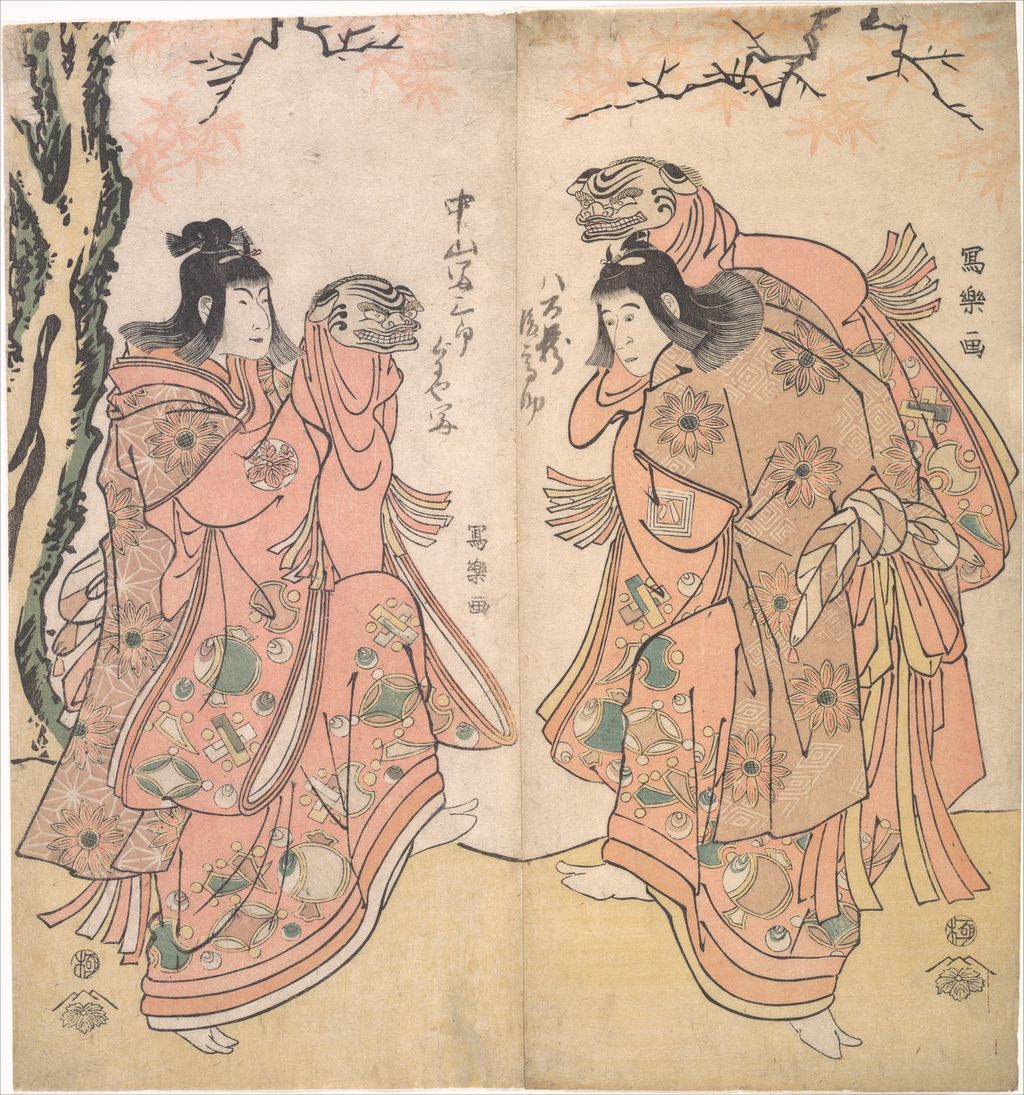
In Japan Search's arrangement, the third phase spans the eleventh lunar month and the intercalary eleventh month of 1794. It counts sixty-four designs: forty-seven narrow full-length actor pictures, eleven medium-sized bust portraits, two memorial images, one medium sumo image and three large sumo images. The counts are given by Japan Search [4]; the British Museum [3] uses a different total for Sharaku's complete known corpus. This is why the homepage can say “more than 140” in prose and leave exact subtotals visibly attributed. “Third phase” is a catalogue tool for organising output, not a label that ancient buyers would necessarily have recognised.
The Met's two-sheet print of Ichikawa Yaozō III and Nakayama Tomisaburō I as kamuro, JP3128a,b [8], provides a securely dated object for the eleventh month. Its description connects the figures to a lion-dance performance of Shinobu Koi Suzume no Irodoki at the Kiri theatre in Edo. The performers' names and roles were written by hand on the sheets, a detail that belongs to this particular object. Those handwritten marks should not be represented as something every impression of the design necessarily carried. Nor should the image be folded into Sharaku's original twenty-eight bust portraits: the Met catalogues a diptych of narrow hosoban sheets, with a different composition and month.
The diptych is especially useful beside a single actor portrait because it lets the eye cross a join. Two narrow sheets can establish an exchange between bodies, giving each performer a vertical field while allowing a performance relationship to appear across the boundary. The modern digital composite is convenient, yet the accession “JP3128a,b” reminds us that the museum holds two physical sheets. If a site shows the pair as one picture, its caption should still identify both parts and not count the left and right images as two unrelated designs. The Met's object record [8] is the authority for the exact accession and description of these sheets.
The third-phase inclusion of memorial and sumo subjects also widens the question of what “an actor artist” means. Sharaku is famous for faces on the kabuki stage; the catalogued output was not exclusively those faces. A memorial image responds to the death of a performer or figure, while sumo prints address another arena of popular spectatorship. The Japan Search phase account [4] identifies these categories. They show that the production widened beyond kabuki actors, even though each individual memorial or sumo print needs its own object record before its imagery can be interpreted closely.
Last publications in the first month of 1795
The fourth phase takes us to the first lunar month of 1795. Japan Search [4] counts twelve designs in this group: ten narrow full-length actor pictures and two medium-sized sumo subjects. It calls these the final published works known under the Sharaku name. The British Museum [3] also places the end of recorded activity after the first month of 1795. “Final known publication” is a narrower and safer statement than “the artist died,” “retired” or “left Edo.” There is no evidence here that proves any of those life events.
The ending is often told backwards from the great opening portraits. In that version, smaller and less dramatic sheets are presented as evidence of declining popularity, then the project stops because buyers rejected candour. The sources support less certainty. The prints demonstrate changed formats and fewer designs in this last group. A later textual judgement about lifelike actor faces survives and has influenced interpretation. It does not tell us print runs, shop income, contract decisions, illness or the artist's next occupation. The Japan Search essay [4] discusses the historical judgement, while TNM's 2011 exhibition introduction [1] describes the abrupt end of the known output. A responsible page can make that gap part of the story instead of filling it with a persuasive but unproved cause.
The twelve final known designs belong in the chronology even though the celebrated 1794 portraits tend to dominate reproductions. Their recorded formats and subjects establish a distinct closing phase. A print dated only 1794 cannot illustrate that 1795 group without further evidence.
Reading the print rather than a reproduction of a design
Sharaku's best-known compositions circulate in many photographs, printed books, souvenirs and modern versions. The underlying design may be recognisable while the physical evidence differs. A museum holds an impression: a sheet printed at a particular moment, with its own colours, paper, wear, trimming, inscriptions and later collecting history. Its accession number identifies that object. A photograph of it is another layer, with light and colour decisions made during imaging. An image downloaded from a museum's Open Access service is a file with its own rights statement. These distinctions are not pedantry. They determine which caption is honest and which details can be enlarged and examined.
Our Edobei selection illustrates the point. Rijksmuseum RP-P-1963-16 [6] and Met JP2822 [6] show the same design, but they are not interchangeable records. The Rijksmuseum file is large enough to support details cut from its original image at useful resolution; the Met file gives an additional public-domain impression for comparison. If the pictures differ in tone, boundary or mark, first check the source photography and object record before declaring a historical “state” or different edition. A state is a change to printing blocks, and an edition is a publication question; neither can be diagnosed responsibly from two thumbnails alone.
Sharaku's backgrounds especially invite a material reading. The Met [6] identifies ink, colour and white mica on its Edobei sheet, while Rijksmuseum [6] describes a dark grey mica ground on its impression. The difference belongs to the descriptions of two different museum objects. A web image compresses the surface into coloured pixels and fixes one lighting condition. In a gallery, mica responds to a changing viewpoint. The larger original file can reveal the boundary between figure and ground and the form of the inscription, but it cannot make the site visitor experience actual mineral sparkle. Magnification clarifies a line or printed texture, but cannot restore the changing light of the physical print.
Text can also change the meaning of a sheet. The name cartouche on Edobei makes the represented performer legible to an informed buyer; the hand-written names on the Met's kamuro diptych [8] reveal a different kind of object-specific information. A digital gallery that strips both to an English nickname would erase much of what links these prints to theatre. Each caption should therefore supply Japanese title or inscription where an institution records it, romanised actor name, generation, role, play, month and accession. When one field is uncertain, say so. The reader then sees not only an attractive image but also the pieces of evidence from which an art-historical claim is built.
Who was “Sharaku”?
The signature names a designer but does not securely disclose a civil identity. The Tokyo National Museum's 2006 account [9] presents Saitō Jūrōbei, a Noh actor associated with the Awa domain, as a leading identification. The British Museum [3] explicitly says no theory of Sharaku's identity has won general acceptance. Japan Search's Japanese essay [4] traces later annotations in writings about ukiyo-e that connect Sharaku with the name Saitō Jūrōbei and a residence in Hatchōbori. The distance between a later written attribution and a contemporary signature matters. The proposal, its documentary path and the continuing disagreement all belong in a careful account of the artist.
We therefore cannot supply a conventional biography of birth, childhood, apprenticeship, marriage and death. A separate Sharaku biography can still be substantial. It can give a source-confidence chronology of the ten-month publication window; describe Tsutaya's documented publishing role; examine the changes in actor subject, format and inscription; identify theatres and plays where records permit; and trace how later writers and museums debated his name. That is a history of a documented artistic activity, not a fictional life made plausible by period detail. A later view of a place in Edo, if added, can illustrate the history of a locality but cannot show that Sharaku occupied a particular street or saw a particular bridge.
The identity question may attract readers, yet it should not be the only reason to examine the prints. The Tokyo National Museum's 2011 exhibition [1] argues that the pictures' visual invention cannot be reduced to the mystery. Its researchers grouped works by performance and compared them with contemporaneous actor images. This approach lets a viewer ask sharper questions. How is a role expressed with hands as well as face? How does a theatrical moment change when the figure becomes full-length? What does a diptych add to a single sheet? Such questions survive even if no new document ever resolves the name behind the signature.
Looking across Sharaku's contemporaries
Kabuki prints were not invented by Sharaku, and other artists were active during the same seasons. The Tokyo National Museum's 2011 exhibition [10] included works by predecessors and rivals to reveal what Sharaku changed. A comparison is most persuasive when it uses the same actor, role or play, since the viewer can then see different choices made around a shared theatrical subject. The Met's Utagawa Toyokuni I portrait of Sawamura Sōjūrō III as Shimada Jūzaburō [11] dates to about 1795, is public domain, and its museum text contrasts Toyokuni's relaxed whole-body stance with Sharaku's compressed poses. That is a museum's interpretation of particular examples, not a rule that every Toyokuni actor stands calmly or every Sharaku actor grimaces.
The Museum of Fine Arts, Boston [12] holds an unusually large Japanese print collection whose catalogues can support comparison between impressions and between designers. Its published collections guide identifies Sharaku's double portrait of Sawamura Yodogorō II and Bandō Zenji, accession 11.14676 [12], in a fifth-month 1794 theatrical context. The guide's description of opposing characters shows why two-actor designs should be read as scenes and relations, not merely as extra faces. The Boston work is a research lead here; its image should not be imported into production until the exact record and reuse terms are checked.
Placing Sharaku among other printmakers also reminds us that theatre had its own cycles of repertory and stardom. The viewer who knew an actor's previous roles might enjoy a contrast that a modern browser misses. The scholar can often reconstruct a play through programmes and actor records, but that reconstruction is more secure when tied to the specific sheet. Documented performance details give these images more meaning than a generic claim that a face depicts “the emotion of Edo.” An unknown theatre or role should remain an open question until an object record or programme resolves it.
Afterlives: an artist recovered through objects
Sharaku's later fame was not a continuous, easily documented line of public admiration from 1794 to the present. Japan Search's historical summary [4] points to the 1910 study by the German researcher Julius Kurth as an important moment in international reappraisal. The National Art Center's record of the 2011 TNM exhibition [13] likewise recalls that book and the later debate over identity. These histories of reception are valuable, but they do not show how every eighteenth-century customer responded. Modern fame and original sales are separate questions.
The 2011 Tokyo National Museum exhibition offered another kind of afterlife: it assembled a large corpus, placed Sharaku among other actor-print designers, and used theatre evidence to order the prints. Tobunken [5] records 142 Sharaku woodblock prints displayed, in an exhibition with sections on earlier actor pictures, Tsutaya Jūzaburō, Sharaku's oeuvre, rivals and later influence. This institutional project is a strong model for the structure of the present cluster. The home introduces a visual story; the separate biography weighs the documentary questions; the chronology shows the changing print groups; the Edobei page slows down over a named design and its surviving impressions.
Printed scholarship can deepen that work. The National Diet Library's bibliographic record [14] confirms the 2002 large-format volume 東洲斎写楽 : 原寸大全作品, with authors Asano Hideyoshi, Suwa Haruo and Yamaguchi Keizaburō. The 2011 TNM exhibition catalogue [14] is another verified publication. Their records justify recommending or seeking these books; they do not justify claiming to have read analyses on pages that have not yet been consulted. The accessible museum object records, Japanese exhibition material and British Museum catalogue currently carry this page's factual claims.
How to use this cluster
Start with the two Edobei impressions and ask what the same design retains or changes across physical objects. Open the dedicated Edobei study for an annotated look at the face, hands, inscription and mica ground. Move to the actor-print chronology to see the opening bust portraits alongside later full-figure and paired designs, with actor, role, play and theatre labels kept separate. The Sharaku biography follows documented activity and grades the evidence for competing identities. The Japanese versions provide the same routes through /ja/sharaku/, with Japanese titles and terminology where the original records support them.
This order guards against two misleading shortcuts. The first treats one superb design as Sharaku's entire output. The second treats an unresolved identity as the only interesting fact about the pictures. The larger story is a short, ambitious and changing publication project tied to Edo's theatres. Its works survive as particular sheets in particular collections. A reader can meet the theatrical moment in a face, then learn how design, publisher, performance and object history produce the image now on a screen. That is a more durable explanation than a tale of a mystery artist whose prints somehow explain themselves.
Reader insights and discussion
Choose one actor print, then share what its performer, role, gesture and text reveal.
Reader Insights
What do Edobei’s hands add to the expression in his face?
Where do you see differences between the two museum impressions of Edobei?
How does your eye move differently across a bust portrait and the kamuro diptych?
Join the Conversation
Share the print and museum accession that prompted your observation.
References
- Tokyo National Museum, Sharaku, 2011 exhibition introduction. Opening 28, 1794–95 activity, exhibition framework.
- Tokyo National Museum, 2011 Japanese exhibition press dossier. Four periods, intercalary month and print context.
- British Museum, Tōshūsai Sharaku artist record. 144-design count, opening issue, format shift, Tsutaya and unresolved identity.
- Japan Search, Tōshūsai Sharaku gallery; Japanese version. Four-phase counts, work examples and historiography. Item images require source-institution rights verification.
- National Research Institute for Cultural Properties, Tokyo, account of the 2011 exhibition. Exhibition's 142 prints and performance-based research method.
- Metropolitan Museum of Art, Ōtani Oniji III as Yakko Edobei, JP2822; Rijksmuseum, Edobei, RP-P-1963-16. Separate 1794 impressions and object records.
- Metropolitan Museum of Art, Ichikawa Omezō I as Yakko Ippei, JP196; Segawa Tomisaburō II as Yadorigi, JP3112; Nakayama Tomisaburō as Miyagino, JP1737. Early actor portraits with exact collection records.
- Metropolitan Museum of Art, Ichikawa Yaozō III and Nakayama Tomisaburō I as two kamuro, JP3128a,b. Later eleventh-month diptych and impression-specific handwriting.
- Tokyo National Museum, 2006 Sharaku exhibition note. Leading Saitō Jūrōbei identity proposal.
- Tokyo National Museum, 2011 Sharaku exhibition checklist. Works by Sharaku and contemporaries.
- Metropolitan Museum of Art, Utagawa Toyokuni I, Sawamura Sōjūrō III as Shimada Jūzaburō, JP2720. Comparative museum interpretation.
- MFA Boston, Japanese Prints collection; published collections guide preview. Boston collection context and Sharaku double-portrait lead.
- National Art Center, Tokyo, record of the 2011 Sharaku exhibition. Reception and Julius Kurth research reference.
- National Diet Library, 東洲斎写楽 : 原寸大全作品 bibliographic record; WorldCat, 2011 TNM Sharaku catalogue record. Publication details only; contents not fully consulted.
- Tokyo National Museum, 2025 Tsutaya Jūzaburō exhibition list. Publisher context.
