


 by Tom Gurney
Tom Gurney BSc (Hons) is an art history expert with over 20 years experience. Updated September 24, 2026.
Introduction
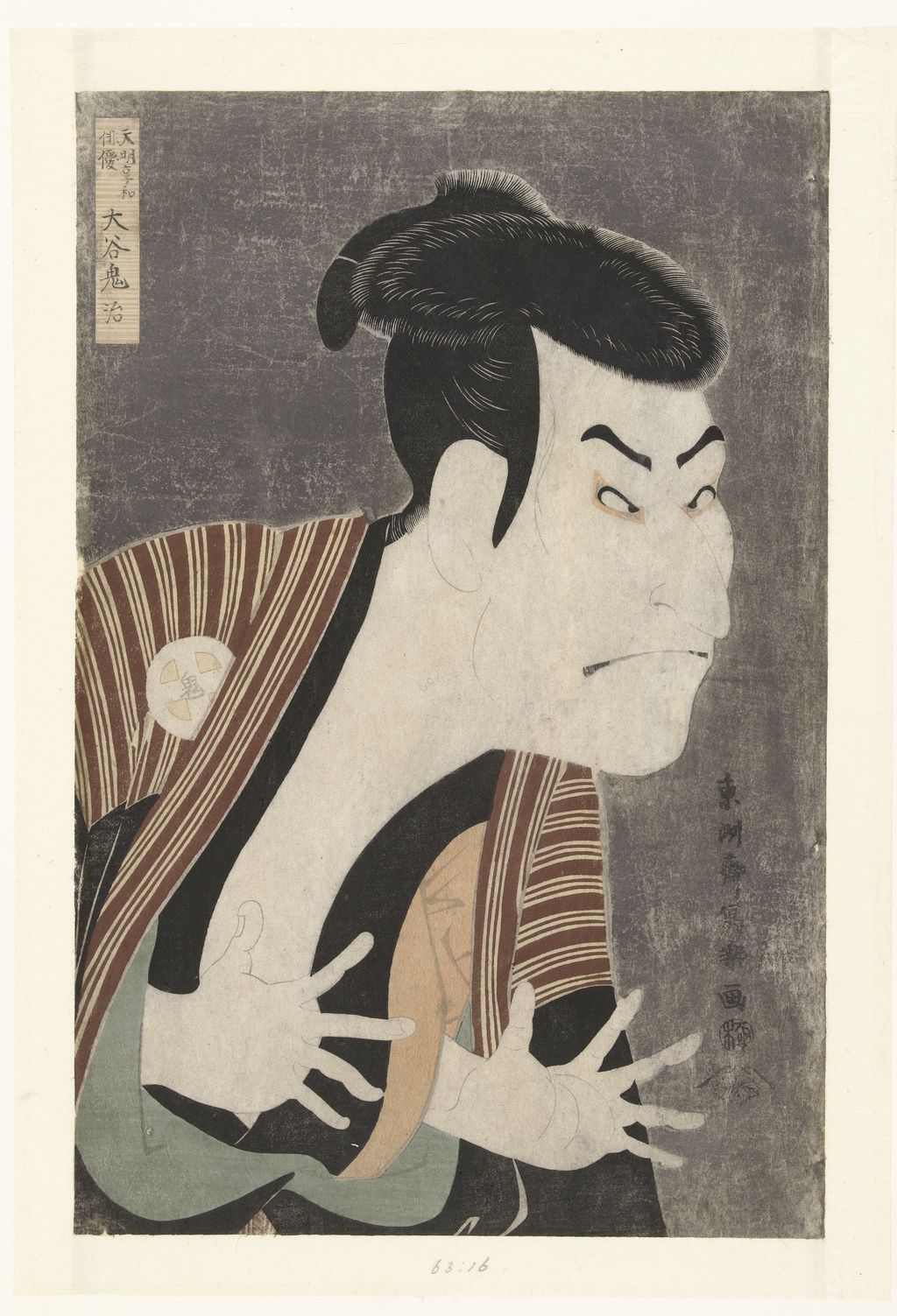
Two pale hands reach out below a face turned sharply to the right. Their open fingers make the narrow space at the bottom of the print feel charged with movement. The figure is the kabuki actor Ōtani Oniji III playing Yakko Edobei, a servant in Koi nyōbō somewake tazuna (恋女房染分手綱). Tōshūsai Sharaku designed the image for publication by Tsutaya Jūzaburō in the fifth lunar month of 1794, in the first group of twenty-eight actor portraits. The Rijksmuseum's impression, RP-P-1963-16 [1], identifies the actor, role, play, publisher and Kawarazaki-za theatre. The Metropolitan Museum of Art's separate impression, JP2822 [2], describes ink, colour and white mica on paper. These are records of two physical sheets made from the same design, not interchangeable pictures of one object.
Edobei is often reproduced as an isolated emblem of “dramatic expression.” The play gives his expression a sharper setting. The Tokyo National Museum's account of its own Edobei print [3] says the character attempts to rob the servant Ippei of money at Shijōgawara. The museum's Japanese description situates that episode within the wider Koi nyōbō somewake tazuna story of the Yurugi household, forbidden relations, stolen funds and family separation. That account is explanatory research tied to a Tokyo National Museum object, not a licence to reuse e-Museum photography. It gives a basis for relating Edobei to Ippei without inventing dialogue or claiming that this exact pose reproduces a documented second of a performance.
Contents
- Introduction
- A moment from a larger play
- Face, hair and the force of a close view
- The two hands and an unstable space
- The dark mica ground is material, not a blank screen
- The actor cartouche, signature and publisher
- A stage pose translated into a print
- Tsutaya's publishing project and its limits as evidence
- What changes between three impressions?
- Edobei beside Ippei and Sadanoshin
- Read five annotated details
- Questions the image can answer—and those it cannot
This page asks five things of the print: what the face and hair do, why the hands pull the eye downward, how the mica ground changes the figure's space, what the actor-name cartouche tells us, and how the signature and publisher mark identify a commercial print. It then compares the Rijksmuseum sheet with the Met's JP2822 [2] and the Art Institute of Chicago's 18765 [6]. Those three impressions show how a design survives through individual objects. Two images of other roles in the same play show how Sharaku pictured more than the threatening servant. The actor-print chronology places the design within his rapidly changing 1794–95 output.
What this print records
| Field | Source-led identification |
|---|---|
| Designer | Tōshūsai Sharaku (東洲斎写楽), the name on the print; the Rijksmuseum [1] lists the printmaker and publisher separately. |
| Actor | Ōtani Oniji III (三代目大谷鬼次). “III” is a stage-name generation, not the date of the picture. |
| Role | Yakko Edobei (奴江戸兵衛), a servant associated with the play's antagonists; the Tokyo National Museum's text [3] describes his attempted robbery of Ippei. |
| Play and theatre | Koi nyōbō somewake tazuna / 恋女房染分手綱; Kawarazaki-za, Edo. Rijksmuseum object record [1]. |
| Time | Fifth lunar month of 1794 as part of Sharaku's first group. Tokyo National Museum [4]; the individual Rijks record gives 1794. |
| Publisher | Tsutaya Jūzaburō (蔦屋重三郎), identified as publisher on the Rijksmuseum record [1]. A designer's signature is not the name of every cutter and printer who made a sheet. |
| Main object | Rijksmuseum RP-P-1963-16; sheet 381 × 249 mm, colour woodblock print with a dark grey mica ground and public-domain status. Rijksmuseum full record [1]. |
| Other impressions | Met JP2822, 38.1 × 25.1 cm; Art Institute of Chicago 18765, 37.9 × 25 cm. The dimensions and accessions describe the holdings, not a single uniform sheet. Met [2]; AIC [6]. |
A moment from a larger play
The print's compressed drama can obscure that a buyer in Edo was seeing a known performer in a known theatrical role. The Rijksmuseum [1] identifies Edobei as the servant of one of the play's villains. Tokyo National Museum [3] specifies his attempted attack on Ippei and the money at Shijōgawara. This is stronger context than calling Edobei simply “a wicked man.” It places a role within an event, while leaving the print's exact relation to a sequence of stage gestures open. The hands suggest an action; the museum text identifies a plot episode. We can set them beside one another without claiming to have a surviving stage direction that says exactly how Oniji held each finger.
The play was not only a story about Edobei. The Tokyo National Museum's Japanese synopsis follows the Yurugi household, the retainer Date no Yosaku, the attendant Shigenoi, her father Takemura Sadanoshin and the child who grows up as a horse-boy. Its characters become entangled in a stolen sum and a prohibited relationship. The same theatrical production provided several portrait subjects in Sharaku's first issue. That matters because a collector could recognise a web of roles rather than one inexplicable face. It does not mean that every surviving portrait was printed, sold or displayed as a numbered set with Edobei.
The Met's Ichikawa Omezō I as Yakko Ippei, JP196 [7], brings the targeted servant into the visual comparison. Sharaku again isolates an actor as a role. The face, arms and direction of attention differ from Edobei's outstretched hands. Even if the plot links the characters, two single-sheet portraits cannot tell us the precise blocking of their encounter on stage. The useful comparison is between choices the designer actually made in two objects associated with the play: how much of a body appears, where hands lead the gaze, and how the dark ground gives a performer room or pressure.
Another related image is Cleveland Museum of Art 1930.205 [8], Ichikawa Ebizō IV as Takemura Sadanoshin. Cleveland supplies both the English and Japanese title and explains that the character is allowed to perform opposite his daughter before her banishment. Its text points out the actor's crest of three nested boxes on his clothing. The portrait's hands are held close, and the large robe makes a different shape against the ground from Edobei's grasping silhouette. This is a comparison within Koi nyōbō somewake tazuna, not proof that the two characters appear in the same scene. The Cleveland object record [8] explicitly allows copying and modification of its open-access image.
Face, hair and the force of a close view
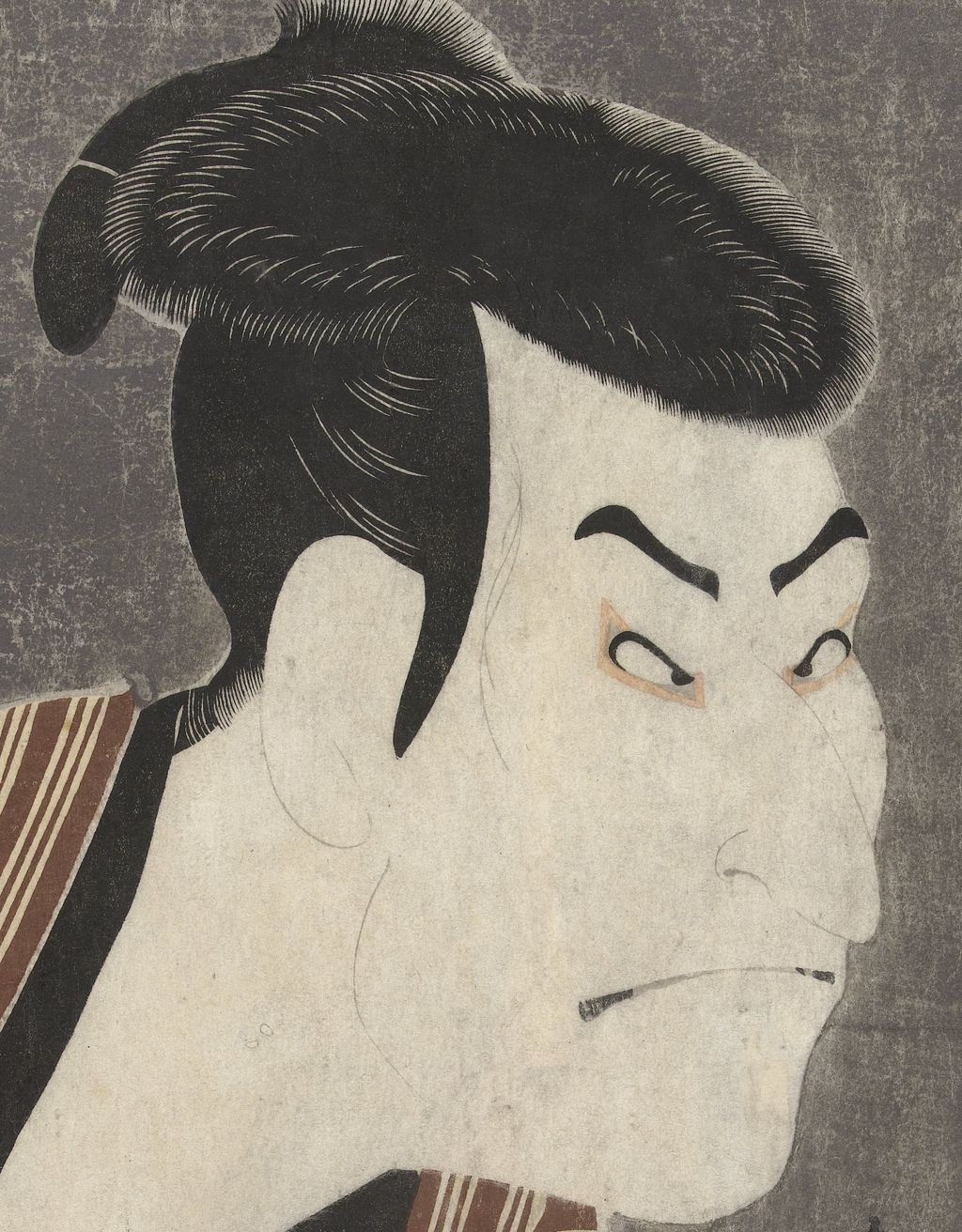
Sharaku cuts the stage away. In the Rijksmuseum sheet [1], the face occupies a broad central area, with the hair mass pressing against dark ground. The head turns right, while the eyes pull sideways. Strong eyebrows, thin eyes, the hard line of the mouth and sharply defined nose create a particular expression. The Met's description [2] calls attention to the leering face, bristling hair and reaching hands as means of presenting Edobei as a threatening henchman. That is an institutional interpretation of the design and its character. It is not a photograph of Ōtani Oniji III's private face or evidence about the actor's personal temperament.
The cropped hair detail makes a small technical decision easier to see. Short pale lines separate the black shapes of the hair. The topknot does not dissolve into the background even though both appear dark. Changes in line direction guide the eye around its volume, then toward the eyebrow and cheek. The forehead and lower face are left comparatively open. The dark hair can therefore frame a wide pale face without the artist drawing a detailed theatrical setting. These are visual observations from the high-resolution Rijksmuseum source for RP-P-1963-16 [1]; another impression may show surface and colour differently.
The portrait is often called an ōkubi-e, a close head-and-shoulders image. That does not mean the hands are secondary. Edobei's upper body extends almost the full height of the sheet, and his fingers spread across the lower edge. A crop of the face alone would turn the print into an expression study and lose the gesture that gives it momentum. The whole image is needed first; magnification should take the visitor back to it, not replace it. The British Museum's object record for another Edobei print [5] likewise describes Oniji in mid-pose on a powdered mica ground, keeping role and action together.
The two hands and an unstable space
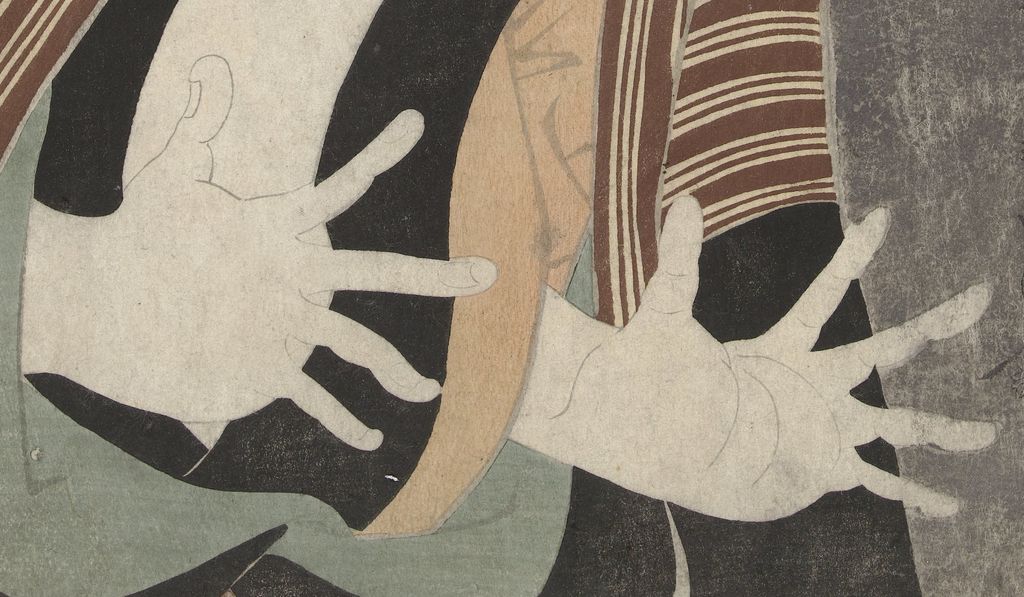
The hands do different visual jobs. On the viewer's left, fingers arc around a dark opening in the costume. On the right, the palm faces outward and fingers move toward the edge of the sheet. Between them, a pale arm, patterned garment and dark negative spaces produce alternating shapes. In the high-resolution Rijks crop, fine contours of thumb and knuckles are visible without an enclosing stage backdrop. The print suggests a reach while leaving the exact object of that reach outside the picture. Knowing the robbery episode from Tokyo National Museum [3] helps a viewer understand the character's threat; it does not establish that this print illustrates the instant a specific purse was seized.
The position of the hands also changes how large the body feels. Oniji's head turns right, but the arms extend in two directions beneath it. The figure seems to advance into the viewer's space even though the image remains a flat printed sheet. The contrast between widely splayed fingers and the composed stripes of the robe makes the gesture more conspicuous. This is a visual reading, not a claim about Sharaku's written intentions. We have the design and surviving sheets, but not the artist's own explanation of why he chose this angle.
Compare Ippei's Met impression [7] after looking at the hands. The role link is historically documented, yet Sharaku's physical arrangement for each performer differs. An actor print could distil a character into a memorable configuration of face, hand and fabric rather than describe an entire scene. The pairing invites a reader to reconstruct the play from reliable sources, not to treat two static images as consecutive frames from a film.
The dark mica ground is material, not a blank screen
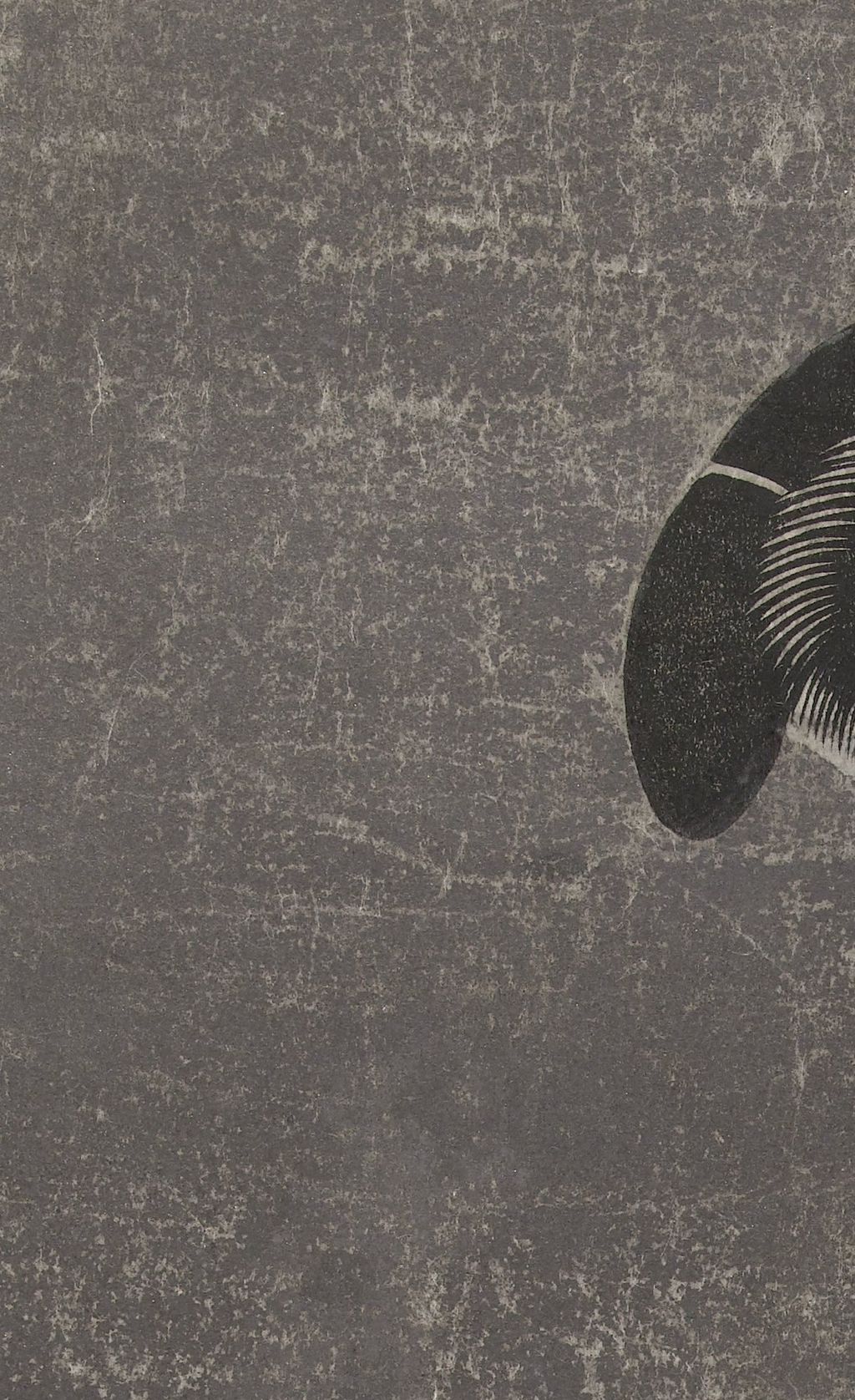
The Rijksmuseum describes a dark grey mica ground on RP-P-1963-16 [1], and the Met lists white mica among the materials of JP2822 [2]. These wording choices refer to two distinct impressions and their catalogues; they should not be flattened into a claim that every Edobei sheet has an identical colour or mineral appearance. Mica is a reflective mineral used in the ground. A digital file fixes its surface under one camera and lighting arrangement. In person, its response to changing light is part of the work.
The background performs compositional work even in a fixed image. Around the face it makes the pale skin and dark hair stand apart; between the hands it becomes a field the fingers interrupt. In the cropped Rijks detail, the ground has visible texture and wear. Some marks may belong to the material's state, printing history, later handling or photography; the web image alone cannot assign a cause to each. That is why a magnified image should invite close looking rather than make a conservation diagnosis. The contrast with the small actor-name cartouche at upper left also shows that the ground was never simply empty.
The Tokyo National Museum's 2011 account [4] places Edobei within Sharaku's first twenty-eight luxurious actor portraits. Their mica grounds were a distinctive production choice. We can infer ambition from the scale and finish of the issue, but no surviving image tells us its exact sale price, edition size or profits. The glittering ground should be explained as both a material surface and a visual device, without converting it into a ledger for Tsutaya's business.
The actor cartouche, signature and publisher
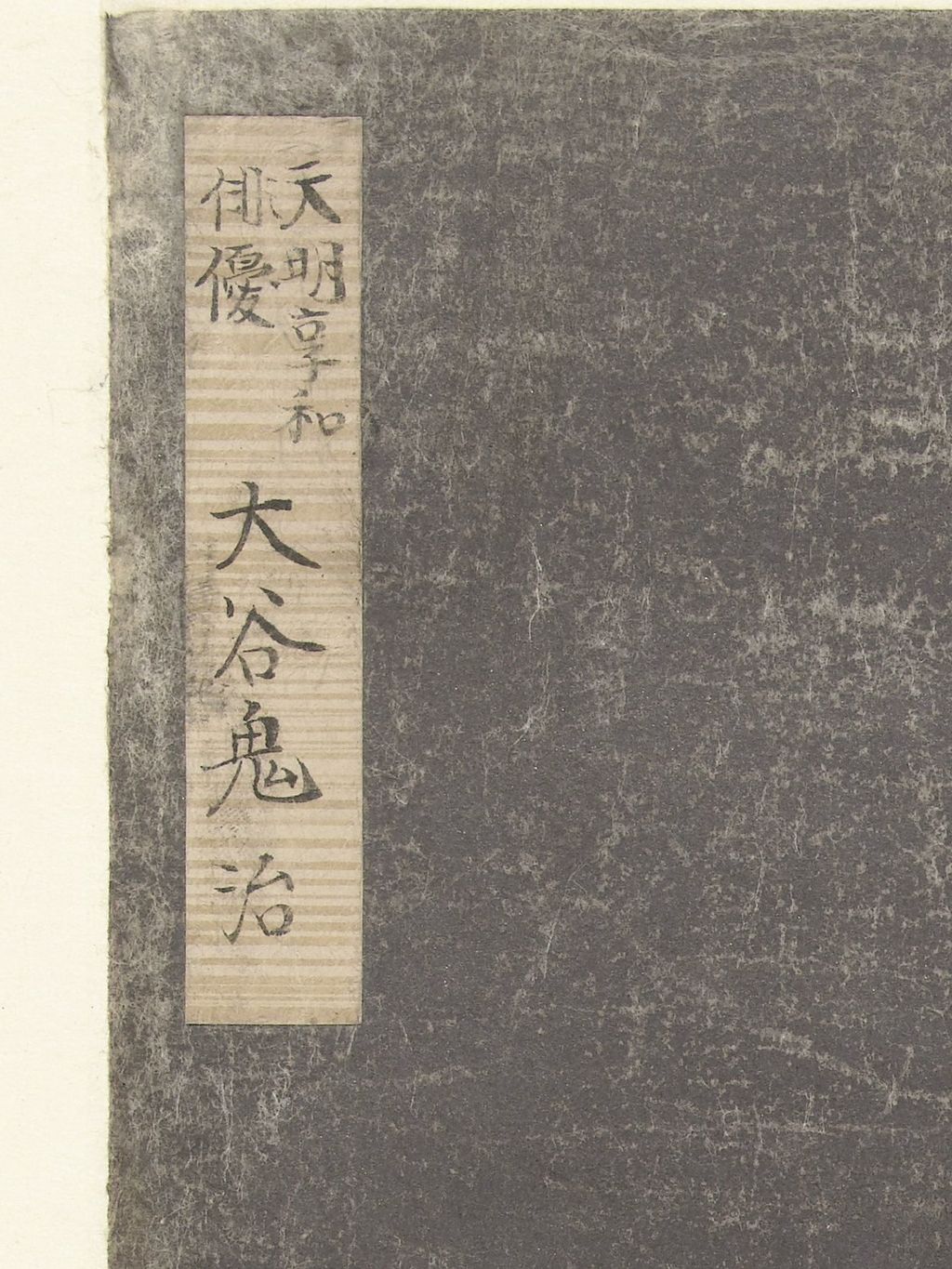
The rectangle at the upper left of the Rijks print is a printed actor and role label. The inspected crop makes the characters legible enough to compare with the Met's Japanese title transcription, 東洲斎写楽画 三代目大谷鬼次の奴江戸兵衛 [2]. The words distinguish the third-generation actor's name from the servant role. They do not supply a birth name or a biography of Ōtani Oniji III. The cartouche gives the print a way to be recognised by a theatre-aware buyer while its visual arrangement supplies the performed presence.
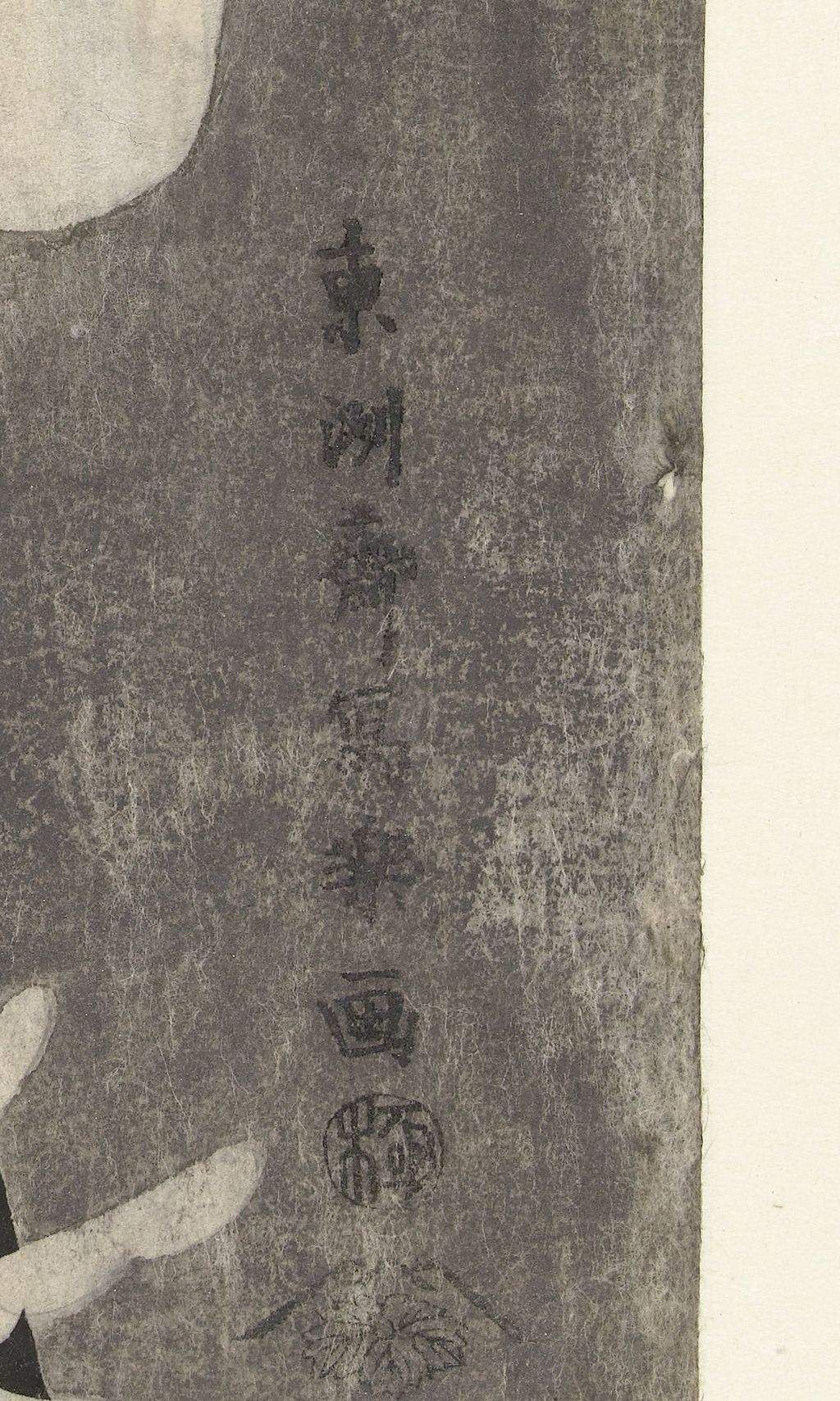
At lower right, the Rijks crop shows Sharaku's vertical signature and a publisher mark. The Rijksmuseum object record [1] lists Toshusai Sharaku as printmaker and Tsutaya Jūzaburō (Kōshodō) as publisher, both mentioned on the object. The mark is not a declaration that the designer carved blocks or pulled the sheet. A colour woodblock print required a chain of work, though the names and shares of particular cutters and printers are not supplied by these object records. The inscription is evidence for attribution and publication, not a transcript of every person in the workshop.
The details can be read in either direction. Begin with the whole sheet, follow the eye toward Edobei's face, then down to the hands. Return to the cartouche and signature to ask who and what the image presents. The five annotated views below use crops from the same 4542 × 6666-pixel Rijksmuseum source. They are separate views of RP-P-1963-16, not five different prints. The original sheet is 381 mm tall according to the Rijksmuseum [1]; at that size the retained file supplies well over 300 pixels per physical inch. Display derivatives are 1024 pixels wide, saved at JPEG quality 80 and 144 dpi, with crop rectangles and master checksum in the rights ledger.
A stage pose translated into a print
The British Museum's separate Edobei impression, 1909,0618,0.41 [5], adds a useful theatrical interpretation. Its curator's label describes the open fingers and strained, cross-eyed expression as the tension of a mie, a held kabuki pose. The record identifies the print as a colour woodblock sheet with powdered mica ground, signed, sealed and marked. It is a different physical object, measuring 36.2 × 24.4 cm, smaller than the sheet dimensions recorded for the Rijksmuseum example. The label helps connect what we see to a performance convention, while its own wording remains an interpretation of the print, not a surviving notation of Oniji's exact actions during a named evening at the theatre.
A mie can concentrate attention by interrupting movement. Sharaku makes a similar interruption possible in a stationary medium: the fingers reach but never close, the mouth holds its line, and the eyes remain fixed. The sheet cannot reproduce music, speech, stage movement or the shifting response of spectators. It can, however, turn a performed role into a repeatable visual form that people could carry away from the theatre. That is a more precise account of the work's dramatic quality than saying that the artist merely “captured a moment.” The relationship between stage and paper involves choices about what to omit, enlarge and fix. The British Museum's object interpretation [5] and the Tokyo National Museum's plot account [3] offer two different kinds of evidence for that reading: one names a performance convention, the other describes the character's conflict.
The print also shows how a theatre image can be intelligible without a stage set. The actor's name is printed, the role is named, and the apparent aggression of hands and face carries emotional information. A buyer who knew the play would bring memories that are no longer fully recoverable; a modern visitor needs object records to reconstruct even the basic identification. We should therefore distinguish contemporary recognition, which we can reasonably infer from the image's naming and publication, from documented individual responses, which these records do not provide. No museum catalogue quoted here gives a diary entry from an original purchaser of this particular sheet.
Tsutaya's publishing project and its limits as evidence
The name Tsutaya Jūzaburō on the object is more than a footer in a modern catalogue. A publisher made a design available as a printed commodity. The Tokyo National Museum's 2025 exhibition on Tsutaya [11] describes his connections with the pleasure quarters, kabuki theatre, comic verse, poets and fiction writers. That broader network helps place Sharaku's actor prints inside Edo's urban publishing culture. It does not prove a particular conversation between Tsutaya and Oniji, or why one design was chosen over an unprinted alternative. The Edobei sheet provides an object-level anchor for the publisher's name; the exhibition supplies a broader institutional account of the world in which he worked.
The Tokyo National Museum's Sharaku exhibition account [12] calls the first issue a lavish series of twenty-eight mica-ground portraits launched in May 1794, and says that more than 140 prints followed before the artist's work ceased the next January. The numbers describe the scope of known designs in a publishing programme, not how many copies of Edobei were pulled from the blocks. A famous design now appears in at least the Rijksmuseum, Met, AIC and British Museum collections. Four museum records are evidence for four surviving physical examples, not an edition size of four. Many more sheets may have existed, and survival is shaped by later collecting as well as original production.
This distinction matters when discussing cost or risk. Mica, a large sheet and a group of twenty-eight designs support the description “lavish”; they do not yield a sale price, the number of impressions printed or Tsutaya's profit. Likewise, the brief documented publication window does not by itself tell us whether sales failed, the artist became ill or the publisher changed strategy. A close reading can confidently join printed evidence to dated institutional context and still leave the business outcome open. Doing so makes the person behind the publishing decision visible without turning a scarce historical record into a speculative story.
What changes between three impressions?
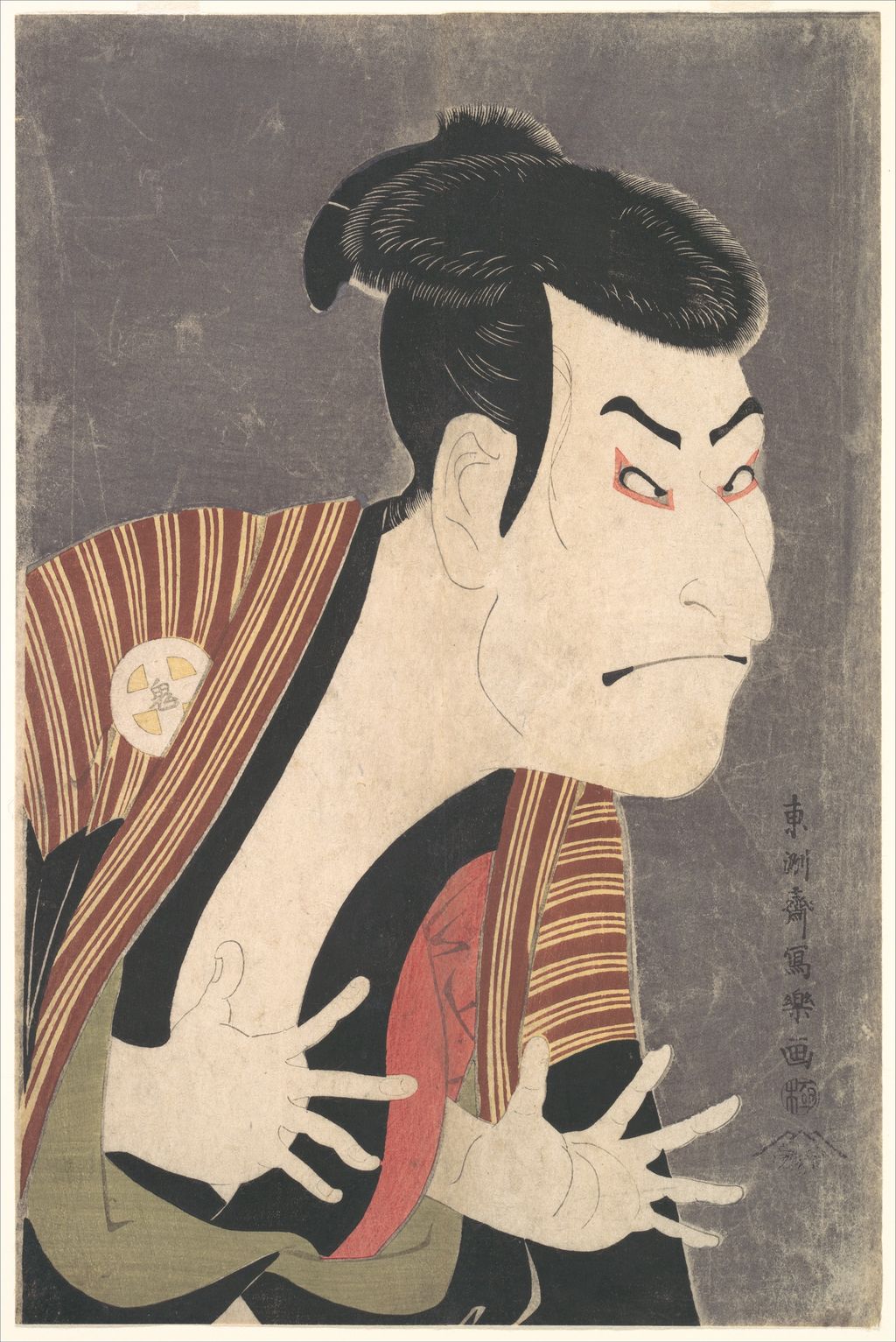
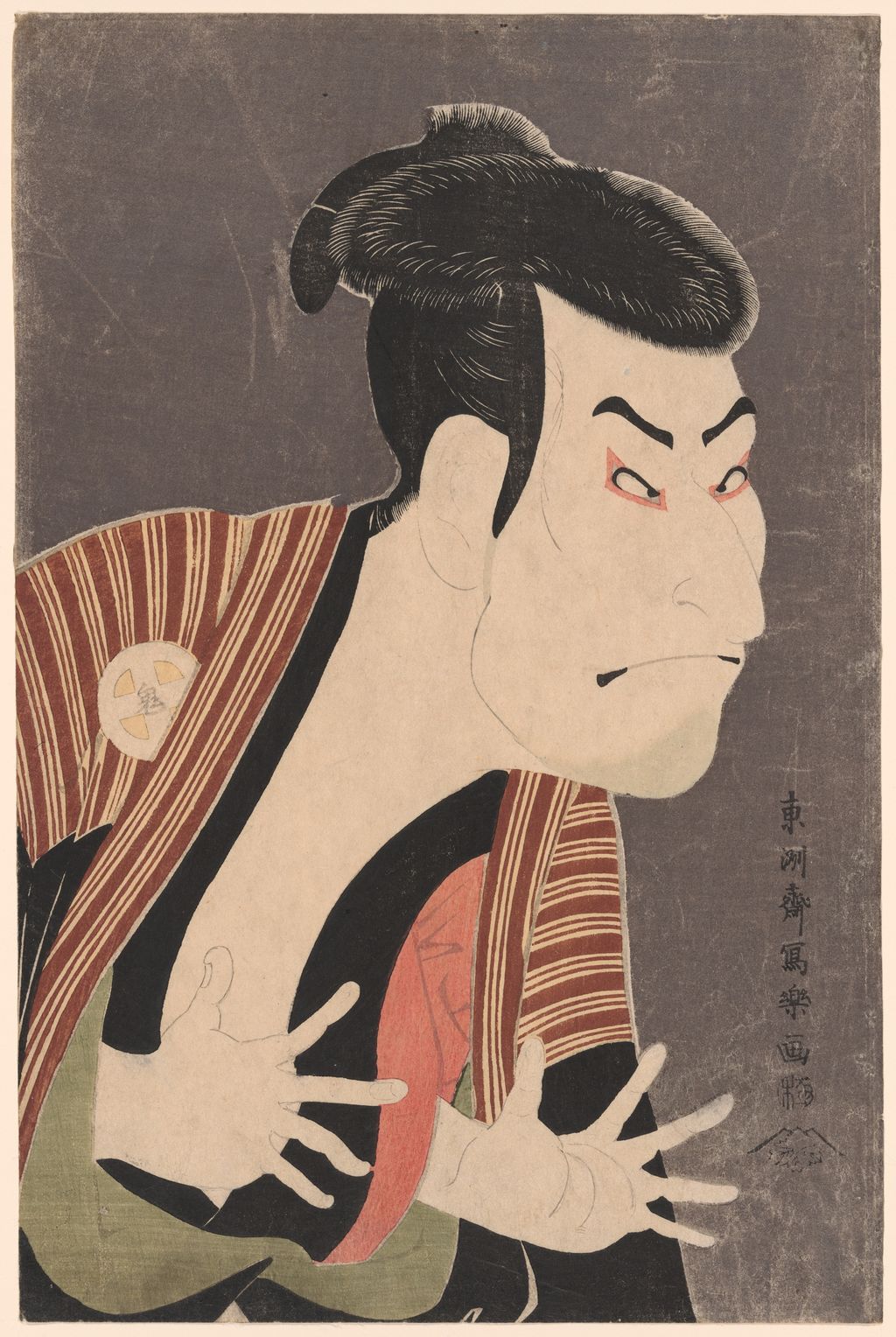
The Rijksmuseum RP-P-1963-16 [1], Met JP2822 [2] and Art Institute of Chicago 18765 [6] have different collection histories, dimensions and photographic files. Their common face, gesture, clothing and inscription arrangement show a shared design. Looking closely at reproductions also reveals differences in colour balance, margins and the visibility of surface texture. The AIC file, for example, gives a stronger red impression in parts of the garment than the current Rijks file, while the Rijks image shows a large area of mottled dark ground. The visible AIC reproduction lacks the upper-left actor cartouche seen in the Rijks image. Those are observations about these files and sheets; this page does not have enough evidence to diagnose why each difference arose.
A different photographic light can change the appearance of mica. Pigment may have aged or faded differently, a sheet may have been trimmed, or separate printings may vary. To call two impressions different “states” would require evidence that the blocks themselves changed; to call them different “editions” would require a publication argument. Comparing three JPEGs does not by itself settle either matter. The prints should be captioned with the institution and accession of the file actually shown, so a reader can return to the underlying object record. A side-by-side comparison is valuable precisely because it makes the material life of a printed design visible without forcing an unsupported conclusion.
The three objects also guard against a common reuse mistake. The Rijksmuseum marks its own object public domain; the Met calls JP2822 public domain under Open Access; AIC's API marks 18765 public domain. Each right attaches to the file and record used. The British Museum's Edobei object [5] is a useful research comparison but is not substituted as a production image without a separate image-use check. An exact-object ledger is essential when a famous design survives in many collections.
Edobei beside Ippei and Sadanoshin
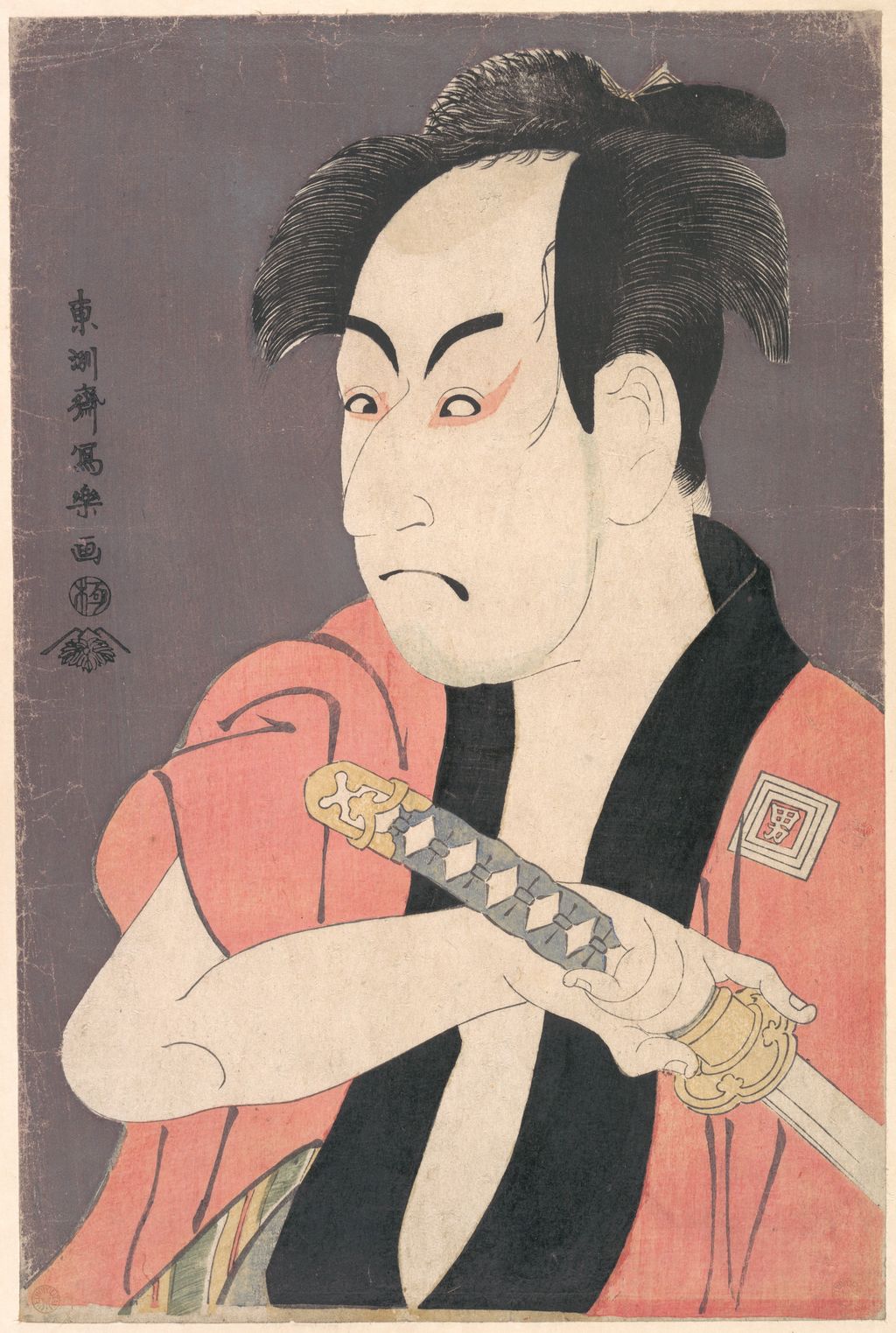
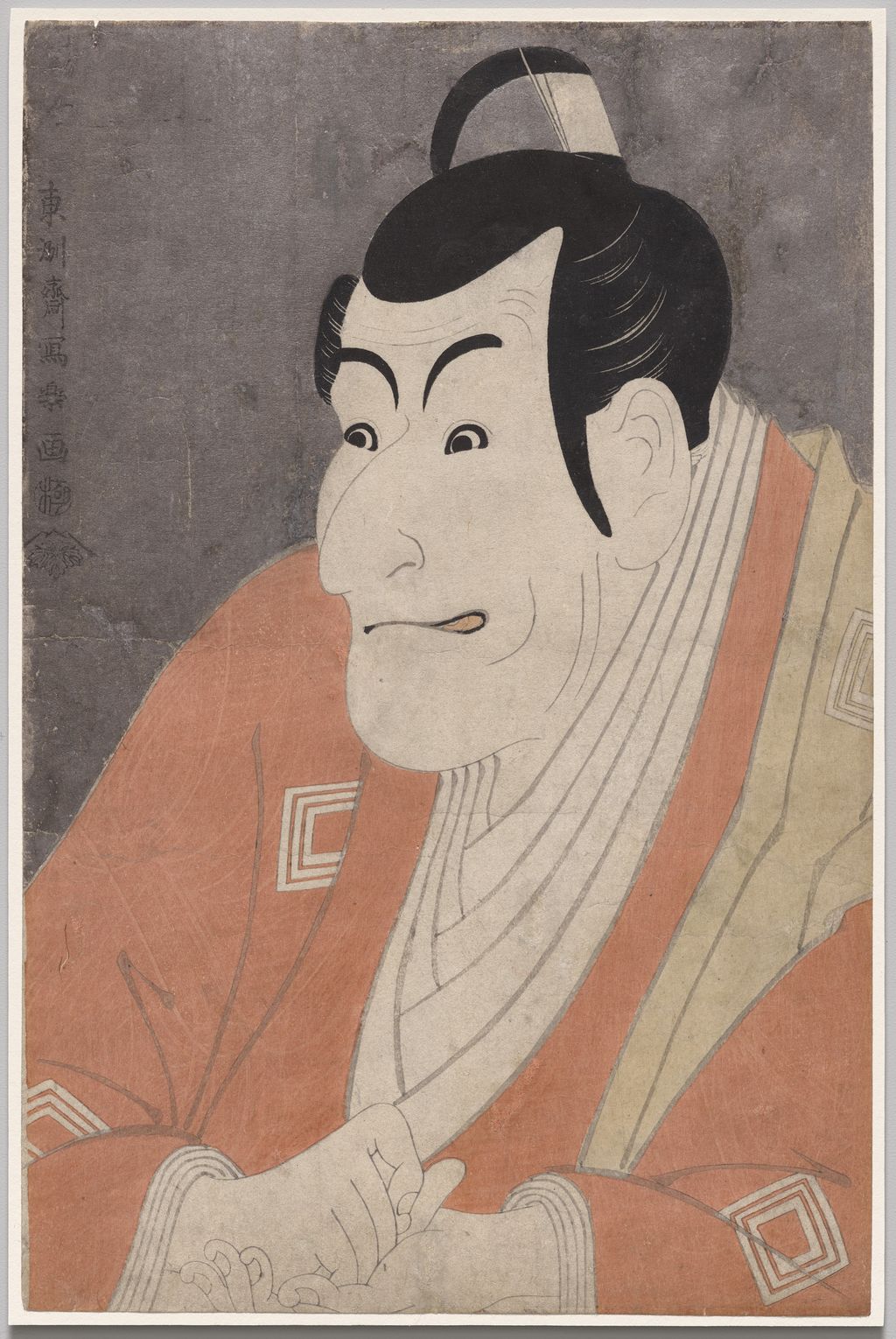
The related first-phase actor portraits prevent the work from becoming a single-face curiosity. In the Met's Ippei [7], another servant from the play carries a different visual weight. Oniji as Edobei seems to grasp at the space beyond his sheet; Omezō as Ippei is framed through his own posture and costume. The Tokyo National Museum plot description [3] links the characters through the attempted robbery. It does not tell us that their prints were issued as an intended pair, or that either image illustrates a particular line of dialogue. The comparison is therefore anchored in named roles and visible design choices.
Cleveland's Takemura Sadanoshin [8] opens the story beyond the two servants. The museum describes the father's last opportunity to see and hear his daughter before her banishment, a different emotional situation from Edobei's threat. The nested-square crest and the closeness of the hands are concrete visual features on its own 1930.205 sheet. The Japanese title provided by Cleveland, 四代目市川鰕蔵「五代目団十郎」の竹村定之進 恋女房染分手綱, gives another source-led path into the play's names. It does not turn the Cleveland impression into a print by a different actor or a physical companion to RP-P-1963-16. These works are associated through the same theatrical production and Sharaku's first-phase publishing project.
The wider cluster places this image in context. The Sharaku biography weighs the later attempts to identify the designer behind the signature; it does not supply an invented account of his childhood. The actor-print chronology shows how rapidly his formats changed after the opening mica portraits. Edobei remains one of the most forceful works to begin with, but the other actors, the material print, the publisher and the surviving impressions are what make a close reading historically grounded.
Read five annotated details
Choose a number for its explanation, then open the detail image to enlarge it. All five crops come from the same high-resolution Rijksmuseum RP-P-1963-16 master.
Annotated image details
Face and hair
Pale cuts articulate the dark hair around the turned face. The sideways eyes and compressed features present Edobei as a role, not the actor’s private character.
The reaching hands
The fingers spread in two different directions below the sleeves. Their open spaces carry the action beyond the sheet, although the print does not show Ippei.
Dark mica ground
The Rijksmuseum records a dark grey mica ground on this impression. A photograph can show its texture, but cannot reproduce every change in reflected light.
Actor and role cartouche
The upper-left label helps identify Ōtani Oniji III as the performer and Edobei as his role. It is evidence of theatrical identification, not an actor biography.
Signature and publisher mark
Sharaku’s signature and the printed mark connect the design to its publication. The Rijksmuseum catalogues Sharaku and Tsutaya Jūzaburō separately.
Questions the image can answer—and those it cannot
What is most secure? The named actor and role, the play, the 1794 first-phase setting, the publisher named in museum records, the format and material of a particular surviving sheet. We can point to printed letters, hands, hair, clothing and mica ground. The Rijksmuseum [1], Met [2], Tokyo National Museum [3] and Cleveland Museum of Art [8] let us connect an image to actors, theatre, material and part of the plot.
What remains an interpretation? Exactly which instant of a kabuki performance Sharaku selected; what Oniji intended to express privately; why Tsutaya chose mica for this issue; the print run and the original buyer's response; the cause of visible differences between museum impressions. None of these is solved by a high-resolution crop alone. A detail can reveal a line, a colour boundary or a printed mark; its meaning requires context and sometimes remains undecidable. The best use of a digital close-up is to return the eye to the whole image with a more precise question.
Sharaku gave a servant in a particular play an unforgettable arrangement of face, hands, text and ground. That arrangement is now known through individual surviving impressions, each with its own dimensions and surface. A careful object study keeps both sides in view: the shared design that an Edo theatre audience could recognise, and the specific print in front of us today. The result is more than an icon of “expression.” It is a legible, material piece of theatre and publishing history.
Reader insights and discussion
Choose one actor print, then share what its performer, role, gesture and text reveal.
Reader Insights
What do Edobei’s hands add to the expression in his face?
Where do you see differences between the two museum impressions of Edobei?
How do gesture and costume change across Edobei, Ippei and Sadanoshin?
Join the Conversation
Share the print and museum accession that prompted your observation.
References
- Rijksmuseum, Ōtani Oniji III as Edobei, RP-P-1963-16; full catalogue record. Actor, role, publisher, theatre, material, dimensions and public-domain mark.
- Metropolitan Museum of Art, Kabuki Actor Ōtani Oniji III as Yakko Edobei, JP2822. Separate impression, Japanese title, material and curatorial interpretation.
- Tokyo National Museum, Edobei object explanation; Japanese text. Plot context and performance identification. Research text only; e-Museum image reproduction is restricted.
- Tokyo National Museum, 2011 Sharaku exhibition. Opening twenty-eight portraits and chronology.
- British Museum, another Edobei impression, 1909,0618,0.41. Research comparison, not production-image source.
- Art Institute of Chicago, Edobei, 18765. Third impression and public-domain metadata.
- Metropolitan Museum of Art, Ichikawa Omezō I as Yakko Ippei, JP196. Related role from the play.
- Cleveland Museum of Art, Ichikawa Ebizō IV as Takemura Sadanoshin, 1930.205; Cleveland Open Access API. Related role, Japanese title, museum description and CC0 image.
- British Museum, Tōshūsai Sharaku artist record. Publisher and first-phase context.
- Japan Search, Sharaku gallery. Japanese phase framework and object links.
- Tokyo National Museum, Tsutaya Jūzaburō: Creative Visionary of Edo. Publisher's wider connections to theatre, writing and verse.
- Tokyo National Museum, 2011 Sharaku exhibition schedule. The 28 mica-ground opening designs and later output, not an impression count.
