


 by Tom Gurney
Tom Gurney BSc (Hons) is an art history expert with over 20 years experience. Updated September 24, 2026.
Introduction
Sharaku's famous close portraits were the beginning of a print project, not its whole story. From the fifth lunar month of 1794 through the first lunar month of 1795, designs signed Tōshūsai Sharaku moved between large mica-ground busts, narrow full-length actors, paired figures, medium portraits and a handful of subjects beyond kabuki. Japan Search's Japanese-language gallery [1] divides the output into four phases and gives their months and formats. The British Museum [2] identifies Tsutaya Jūzaburō as publisher of all known designs. The actor-print chronology below treats the works as a sequence of theatrical images, while keeping individual museum impressions distinct from the larger number of designs.
The change of scale matters to the viewer. A large bust against a shimmering ground concentrates attention on an actor's face, hands and clothing. A tall, narrow print makes the weight of the body and the reach of a sleeve central to the role. A design with two actors lets them face, avoid or confront one another across the paper. Even in a smaller sheet, details of fabric, stage name, role and publisher can carry the link to a particular performance. These are observable differences; they do not by themselves reveal how buyers responded, why Tsutaya changed formats, or why signed publication stopped.
Contents
- Introduction
- Reading an actor-print record
- Phase I: a close view of a performed character
- Phase II: bodies, pairs and the stage between them
- Phase III: an expanded repertoire and a doubled month
- Phase IV: the last known actor sheets
- What changes on the printed sheet
- Why phase boundaries need both dates and objects
- What the gallery makes possible
The chronology is built to answer precise questions. Who was the actor, including the generation number in a repeated stage name? Which role is represented? What play, theatre and lunar performance month can be verified? What is the sheet's format, and which particular museum object supplies the image and the catalogue facts? If an object record does not identify a play or theatre, the card states “unconfirmed.” That is more informative than a confident but untraceable caption. The Tokyo National Museum's 2011 exhibition research [4] compared prints with theatre programmes precisely because a face alone cannot settle every performance identification.
Four phases at a glance
- ICalendar and catalogue count: Fifth lunar month 1794; 28 designs in Japan Search [1]
Dominant forms: Large actor busts, mostly mica grounds
Key caution: A portrait records a performer in a role; it is not a private psychological photograph. - IICalendar and catalogue count: Seventh–eighth lunar months 1794; 38 designs
Dominant forms: Thirty narrow full figures alongside eight larger mica-ground sheets
Key caution: Do not call every second-phase work narrow or infer the precise month of an undated object from its format alone. - IIICalendar and catalogue count: Eleventh and intercalary eleventh lunar months 1794; 64 designs
Dominant forms: Narrow full figures, medium busts, memorial and sumo prints, paired images
Key caution: A museum's performance month and a print's exact printing day are different questions. - IVCalendar and catalogue count: First lunar month 1795; 12 designs
Dominant forms: Ten narrow actor prints and two medium sumo images
Key caution: The end of known publication is not proof of the artist's death or a sales collapse.
These subtotals follow Japan Search's own scheme [1]. The British Museum's count of 144 known designs [2] and the 142 physical Sharaku prints displayed at Tokyo National Museum in 2011, reported by Tobunken [4], measure different things. A design is a composition prepared for printing; an impression is a surviving physical sheet. A diptych can consist of two sheets, while an exhibition count refers to objects actually displayed. None of these numbers should be silently substituted for another.
Reading an actor-print record
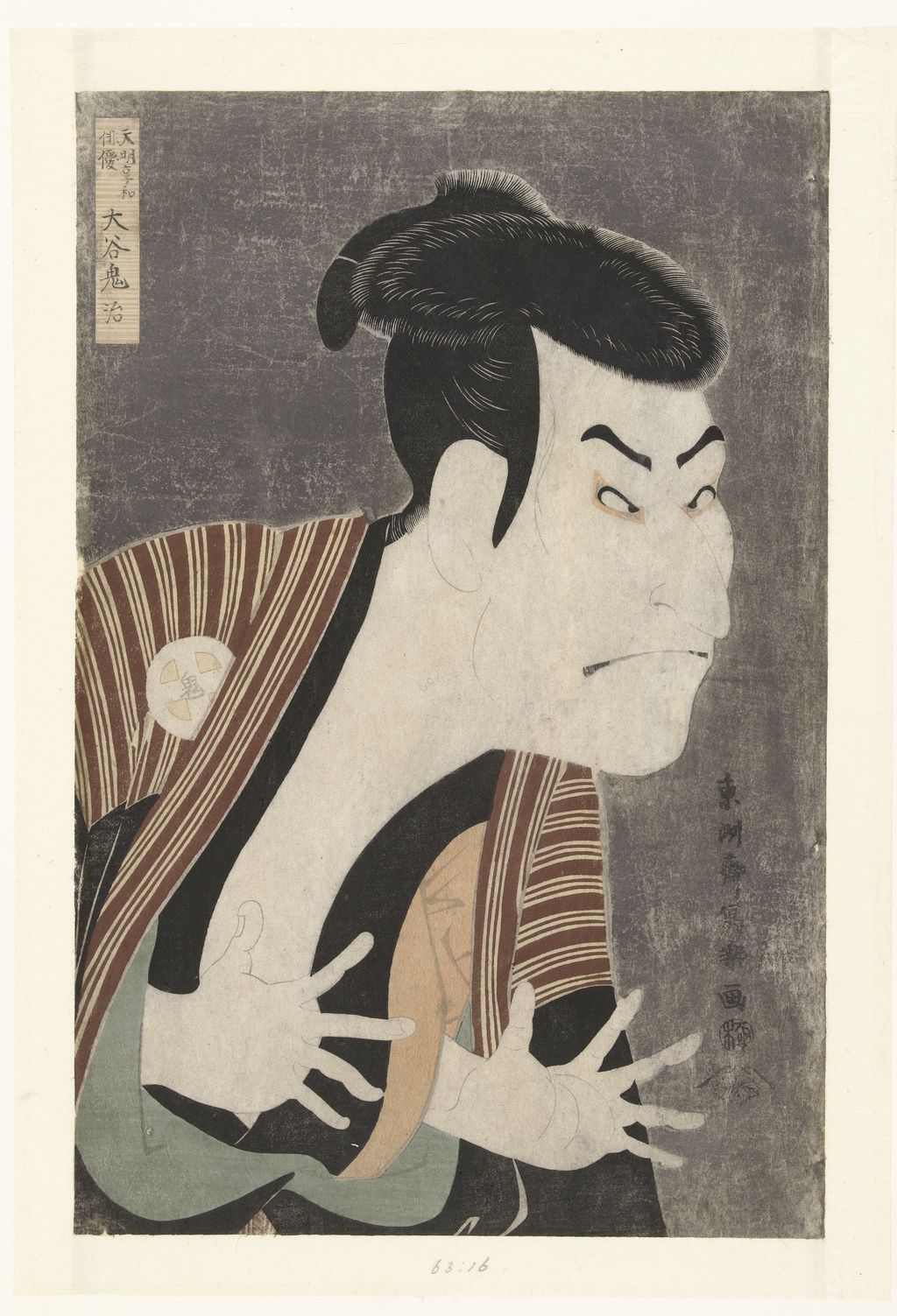
Consider the Rijksmuseum's Ōtani Oniji III as Edobei, RP-P-1963-16 [5]. The artist is the designer named by the signature, Tōshūsai Sharaku. The actor is Ōtani Oniji III, where “III” distinguishes a stage-name generation. Yakko Edobei is the role; Koi nyōbō somewake tazuna is the play. The Kawarazaki-za is the Edo theatre associated with that performance, and the fifth lunar month of 1794 is the performance group. Tsutaya Jūzaburō is the publisher. RP-P-1963-16 identifies the Rijksmuseum's physical impression. The Met's JP2822 [5] and the Art Institute of Chicago's 18765 [5] are other impressions of the design, with their own histories and photography.
That sequence of labels protects several distinctions. An actor may appear under different stage names at different points in a career, and one actor can portray many roles. A role may be represented by multiple artists or impressions. A play title can have romanisation variants, so the Japanese wording is useful where a source gives it. A publisher's imprint is not a synonym for the person who carved the blocks. The museum accession belongs to one owned item, not to every sheet originally sold. A web gallery should make those fields legible without implying that every item is equally fully documented.
Where a record gives only an actor and role, that is still useful. It should be possible to filter the cards by phase and see at a glance which plays and theatres remain unconfirmed. Some cross-references in Japan Search [1] identify performance contexts for designs also held abroad. The source of that match should appear in the card, because the holding museum's metadata may be less specific. Readers can then distinguish a museum's direct object description from a well-supported cross-institutional identification.
Phase I: a close view of a performed character
The twenty-eight first-phase sheets belonged to an ambitious opening issue. Tokyo National Museum [3] emphasises their large scale and mica-ground finish. Mica reflects light; a file records one photographic lighting condition and cannot reproduce the shifting mineral surface in a gallery. The dark field removes much surrounding scenery and sharpens the visual part played by features and hands. The printed name cartouche, clothing and coiffure remain part of the theatrical message. Calling the pictures “portraits” is useful, provided we remember that the person is costumed as a character in an identifiable play.
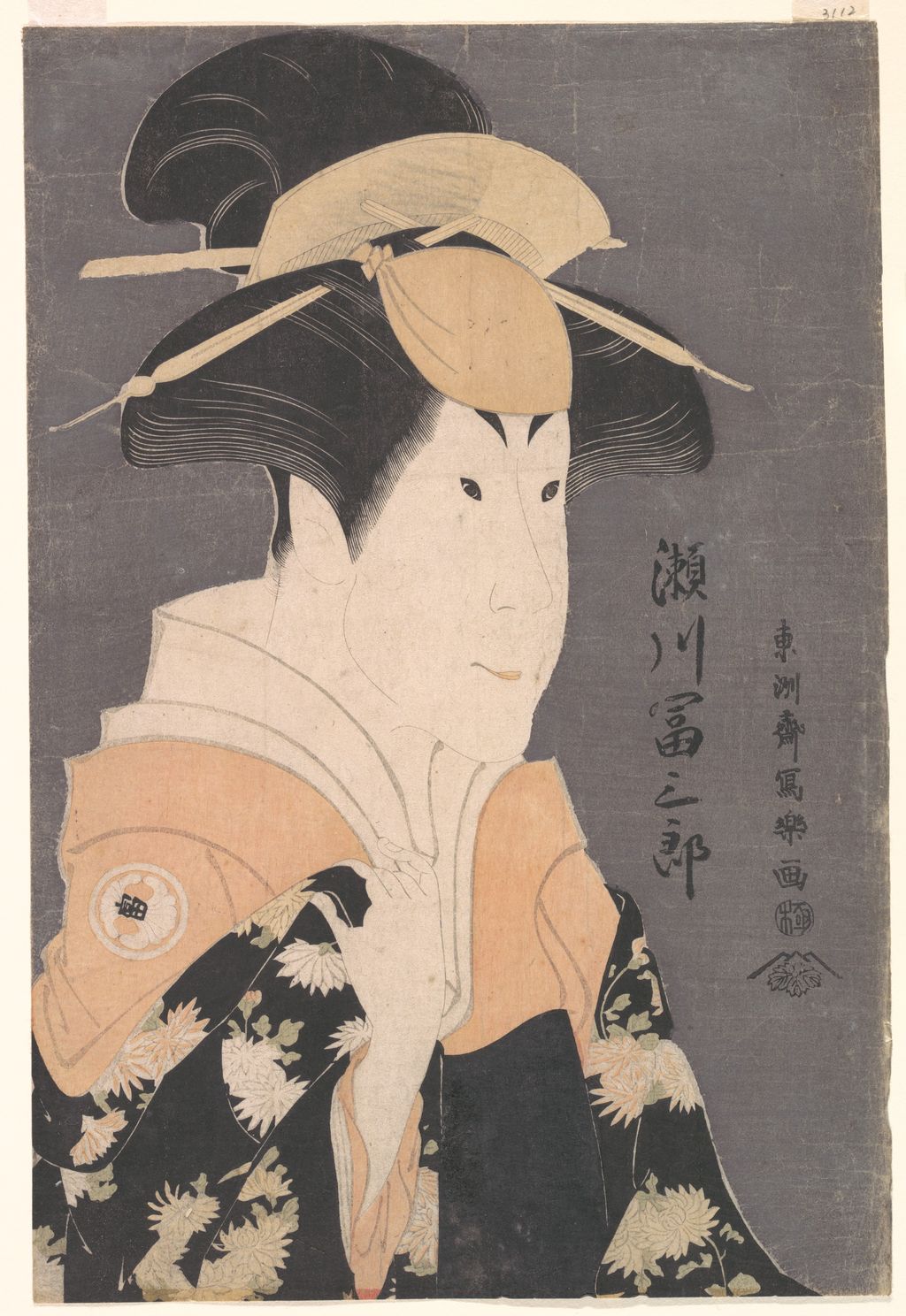
Edobei is the obvious first card, but it should be read beside another role. The Met's Segawa Tomisaburō II as Yadorigi, JP3112 [6], relates to Hana Ayame Bunroku Soga. The Japan Search entry following a Tokyo National Museum object [1] places that role at the Miyako-za in the fifth lunar month. Yadorigi is Ōgishi Kurando's wife in the play, performed by an actor. The pose, garment and direction of attention produce a different kind of presence from Edobei's reaching hands. It would be a mistake to translate that difference into a claim about the actors' private temperaments.
The Met's Ichikawa Omezō I as Yakko Ippei, JP196 [6] belongs to the same play as Edobei. Looking across the two servant roles illustrates how Sharaku could build different expressions from faces, arms and costume inside a shared production. The museum impression, however, does not prove the two designs were hung together in a shop or bought by the same spectator. This page shows Ippei as a record card even if its full image is reserved for the artist home; no gallery should inflate its visual selection into a complete surviving corpus.
Several first-phase actor identifications depend on both the collection record and the performance sources. Japan Search's descriptions [1] of the Tokyo National Museum holdings identify the roles, plays and theatres behind early designs, including Hana Ayame Bunroku Soga and Koi nyōbō somewake tazuna. This research prevents a common gallery error: putting the name of a character in the actor field or treating a stage-name generation as a date. It also shows that the first twenty-eight were linked to multiple theatres and stories, not a single episode with twenty-eight faces.
Phase II: bodies, pairs and the stage between them
The second phase is often described as a retreat from large heads to narrow, full-length figures. That description catches an important shift, but Japan Search [1] counts eight larger mica-ground sheets alongside thirty hosoban designs in its thirty-eight. Format must be checked object by object. A paired sheet can ask the viewer to read relations between bodies rather than simply scrutinise one face. Neither a narrow format nor a change of ground establishes that Tsutaya was cutting costs or that the public rejected the debut.
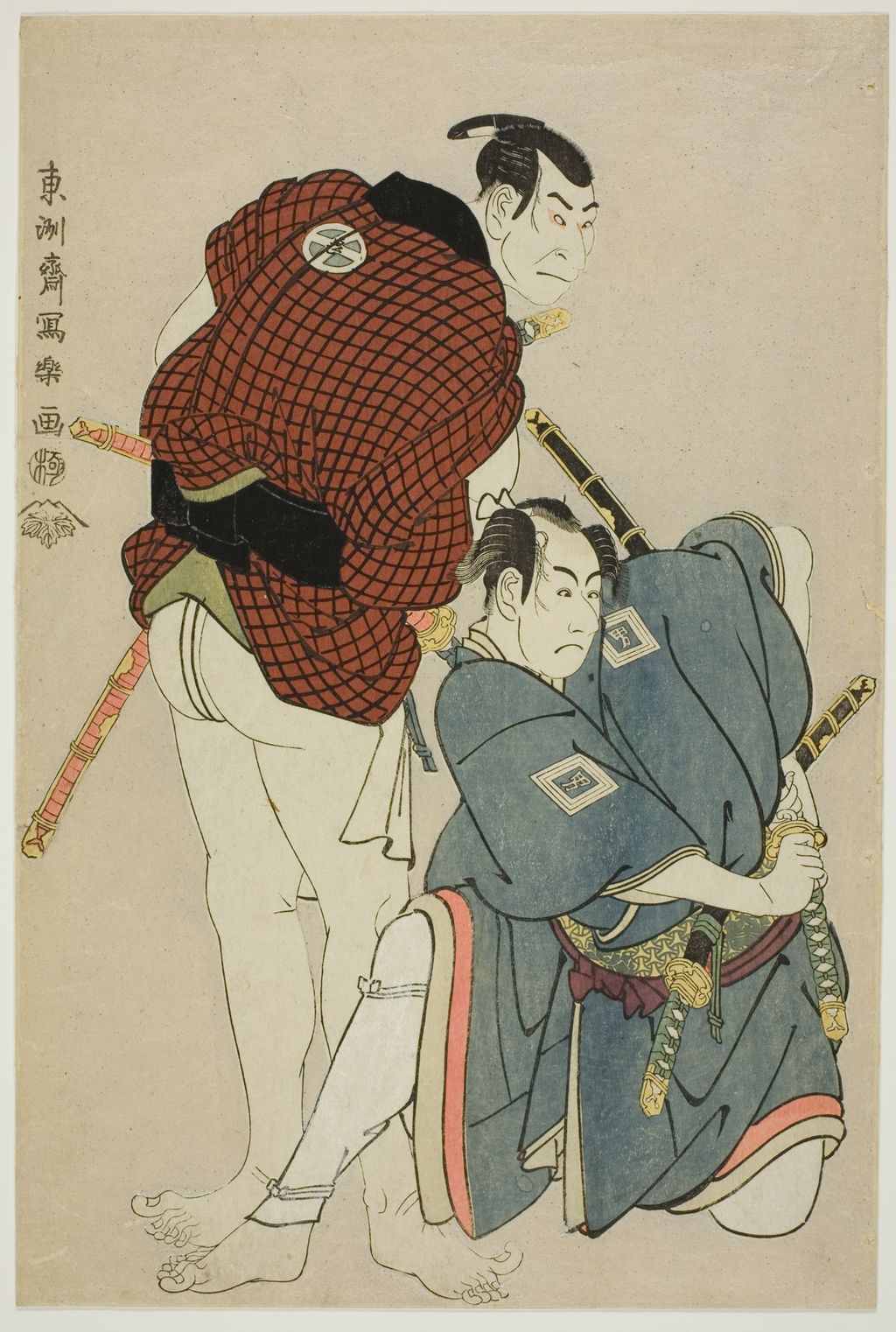
The Art Institute of Chicago's 18897 [7] names two actors: Ichikawa Omezō I as Tomita Hyōtarō and Ōtani Oniji III as Kawashima Jibugorō. Its object metadata describes a large-format colour print, not a narrow hosoban. Japan Search's account of the Oniji design [1] links Jibugorō to the eighth-month Kawarazaki-za production 二本松陸奥生長 (Nihonmatsu michinoku sodachi). The Chicago title distinguishes left and right performers. Their positions, raised arms and directed glances give the viewer a stage relation to follow. The performance link should be attributed to Japan Search; the Art Institute's basic record by itself gives the actors and roles but not all of those theatrical fields.
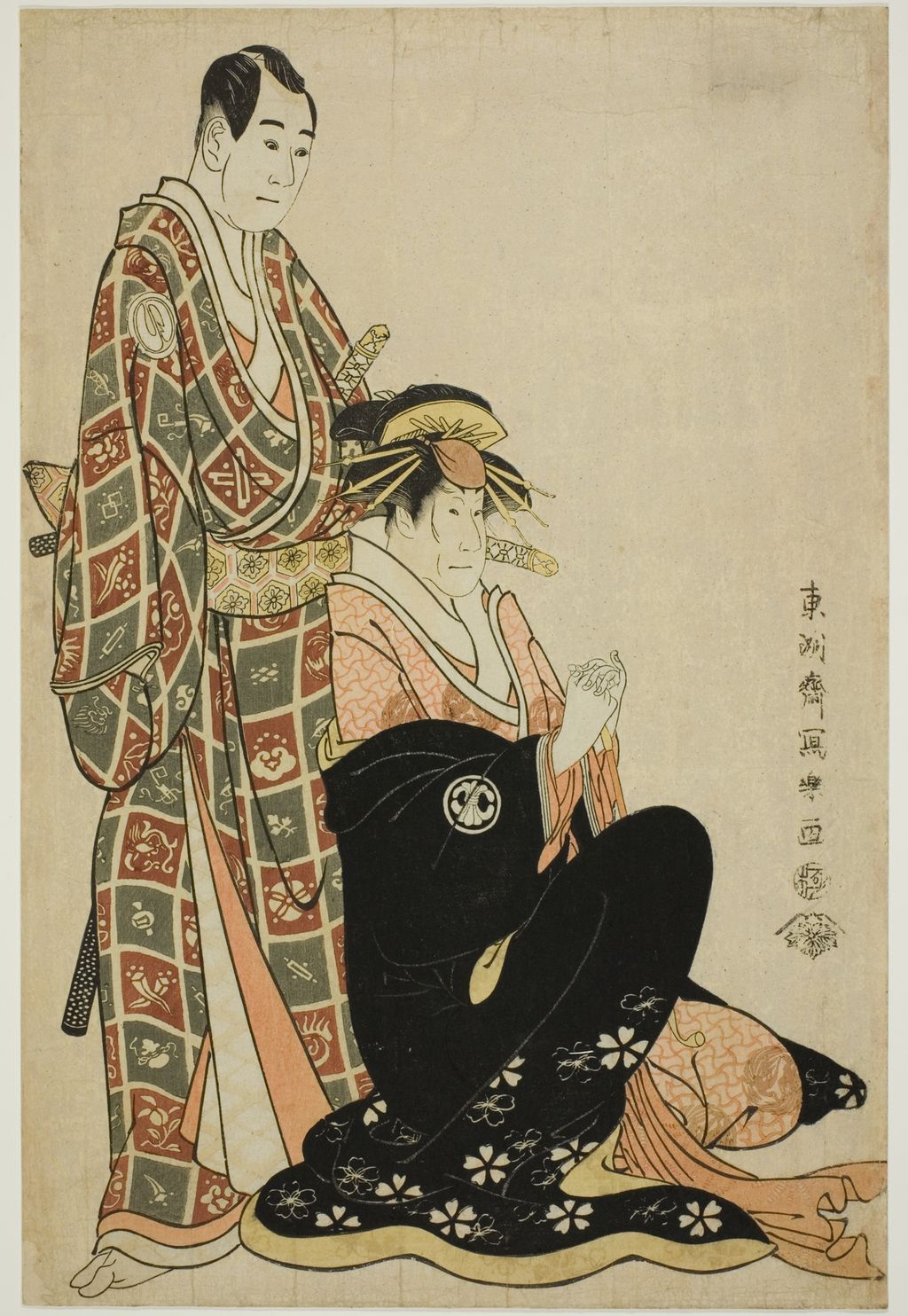
The Art Institute's 86923 [7] gives another pair: Segawa Kikunojō III as the courtesan Katsuragi and Sawamura Sōjūrō III as Nagoya Sanza Motoharu. Japan Search [1] puts the design in the second phase and relates the encounter to けいせい三本傘 (Keisei sanbon karakasa) at the Miyako-za. The phase spans seventh and eighth lunar months, but the specific month of this AIC impression is not identified in the material used here. The card therefore gives the phase span and marks the individual month unconfirmed. This is a small example of why an interactive gallery needs an explicit confidence field, rather than a date copied from the section heading into every object.
The second-phase works also include Sakata Hangorō III as Kosodate Kannonbō at AIC, 8955 [7], listed in Japan Search's phase-II group [1]. It supplies another actor and role, but play and theatre have not been verified for this page. An honest text-only card is better than a false theatrical identification. The work is also a reminder that the same generation number can appear across different designs; the stage name, character and accession should stay attached to the exact print being discussed.
Phase III: an expanded repertoire and a doubled month
The calendar becomes especially important in the third phase. Japan Search [1] places it in the eleventh and intercalary eleventh lunar months of 1794, with sixty-four designs across several forms. An intercalary month is an extra month inserted into the lunar year; it should not be silently converted to a second Gregorian “November.” The two eleventh months provide a longer and more complex sequence than a modern month label suggests. Some collection records specify the first eleventh month, while others date a print only to the year or phase. The card should reproduce the precision of its source.
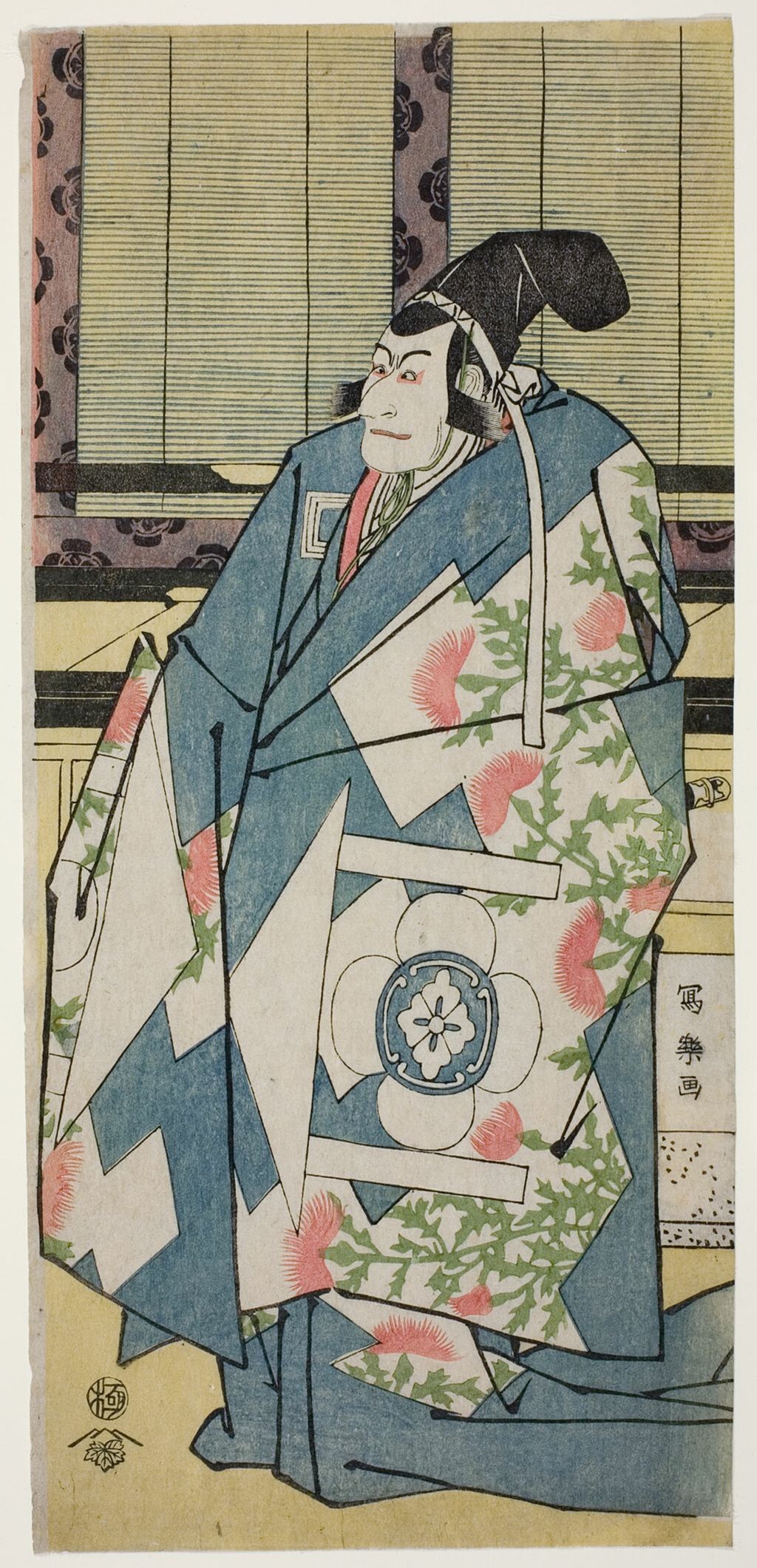
The Art Institute's 39433 [8] is unusually informative. Its title names Nakamura Nakazō II as Prince Koretaka disguised as the farmer Tsuchizō, gives the play Uruo toshi meika no homare, names the Miyako-za and dates the performance to the eleventh month of 1794. The disguise is an important part of the role, not a second actor. The large sheet's composition can be studied beside the medium busts of this phase: the actor's posture and costume communicate a character with layered identities, while the object record ties it to a named event. These detailed fields make it a strong chronological anchor, though they do not establish the exact date its blocks were cut.
The Art Institute's 18811 [8] calls itself Naritaya Sanshō and identifies Ichikawa Danjūrō VI as Arakawa Tarō Takesada. The museum calls the sheet aiban, a medium format. Japan Search [1] lists it among third-phase works and relates it to the Kiri-za. A precise play title or one of the two eleventh months has not been confirmed in the sources used for this page; those fields should remain open. The card still has value: it lets a reader compare how a medium actor image rearranges space after the much larger opening busts and narrower whole-body sheets.
The Met's two-sheet image of Ichikawa Yaozō III and Nakayama Tomisaburō I as two kamuro, JP3128a,b [9] shows another third-phase possibility. The Met dates the pair to the eleventh month and notes handwritten names on its particular impression. A diptych is neither a single isolated portrait nor two unrelated pictures. It asks the viewer to cross the join between sheets. The handwritten information belongs to this surviving object; it is not evidence that every impression carried the same marks or that Sharaku wrote them. Here object history and theatrical identification meet, but they should not be collapsed.
Phase IV: the last known actor sheets
The fourth phase runs into the first lunar month of 1795. Japan Search [1] groups twelve designs, ten narrow actor prints and two medium sumo images. The actor portraits therefore remained part of the project until its last known publication. The narrower format is not inherently less inventive: a figure can be set against a screen, textile or relatively empty background in different ways. Critical judgements about the artistic quality of the late sheets should be attributed to the critic making them, rather than treated as a property proved by date and size.
The Art Institute's 89854 [10] identifies Ichikawa Danjūrō VI as Soga no Gorō Tokimune and dates its narrow colour print to 1795. Japan Search [1] places the named design in the fourth phase. The AIC record does not itself supply the play and theatre, so the gallery leaves them unconfirmed. On the sheet, large areas of patterned costume share the work of identifying the performed figure with the face. The collector's physical print has its own colour and margins; a derivative image is an aid to looking at that object, not a generic illustration of all later Sharaku prints.
The Art Institute's 18833 [10] names Ichikawa Ebizō as Kudō Saemon Suketsune and likewise dates a narrow actor sheet to 1795. The exact lunar performance month, play and theatre do not appear in the consulted AIC record. The first-month phase heading supplies the broad production context, not an individually documented performance date. This distinction also matters for the actor name: it is catalogued as “Ichikawa Ebizō,” while 89854 uses “Ichikawa Danjūrō VI.” Stage-name succession may connect these names historically, but the object cards should reproduce their own museum labels until a dated actor source documents the relationship for these performances.
The end of signed output invites a story about failure. A later comment in the Ukiyo-e ruikō tradition criticises excessive likeness; Japan Search [1] includes it in the historiography. That comment is not a contemporary balance sheet. We do not know the print run, shop receipts or contractual decisions behind the last issue. The biography traces the later identity sources; the chronology's more modest conclusion is that the visible sequence of forms stops after the early-1795 group.
What changes on the printed sheet
The phases are more than a list of months. Japan Search [1] notes that the early works generally carry a longer “Tōshūsai Sharaku ga” signature, while the later phases usually use the shorter “Sharaku ga.” A signature is part of a printed design and can help catalogue a sheet. It is not, by itself, evidence that a different person took over. A change in wording, size or location can reflect a choice in design or publishing practice. It needs to be weighed beside paper size, actor subject, publisher and performance date rather than turned into a free-standing identity theory.
The ground also changes how a viewer meets a character. The opening mica portraits isolate a bust against a field that responds to light. The second-phase AIC 18897 [7] sets two costumed figures together, giving them a relation in space. The third-phase AIC 39433 [8] uses a large sheet for a single actor in a disguise, whereas AIC 18811 [8] compresses a different actor into medium format. The 1795 AIC 89854 [10] gives patterned clothing and a screen or architectural backdrop much of the visual weight. These are specific compositional observations from specific museum files. They do not prove that all prints in a phase share one background, or that a smaller sheet is a cheaper copy of an earlier image.
Differences between physical impressions complicate a simple sequence further. The Rijksmuseum's Edobei [5] and Met's Edobei [5] differ as surviving objects and photographic files. Colour balance, trimming, fading or a change in condition can make two images look like different designs when they represent the same blocks. A real “state” would require an identified alteration to the printing blocks. Conversely, two actor pictures that look visually related are not necessarily the same design. The site's captions should make the design/impression distinction explicit, and annotations on the dedicated Edobei page must begin from the high-resolution source for the particular accession being labelled.
The images for this page use files whose rights have been checked at the object level. The Art Institute's API [11] marks the selected Chicago objects public domain. Its IIIF service permits a 2000-pixel source for several sheets, but supplies only a 1024-pixel file for two 1795 examples in the acquisition pass. Those later images are suitable for full-sheet viewing at the site's standard display width; they should not be used for claims about microscopic line structure or for annotated crops advertised as 300-dpi details. A rights mark permits reuse, but it does not turn a web reproduction into a conservation photograph.
Why phase boundaries need both dates and objects
The four-phase scheme is a strong guide, particularly because it connects output to the calendar of Edo theatre. It remains a modern catalogue arrangement. “Second phase” is not a title Sharaku printed on a series cover, and a work's shape does not function as a date stamp. Japan Search's phase-II count [1] includes thirty narrow figures and eight larger mica-ground sheets. The AIC 18897 [7], a large paired work linked through the Japanese source to the eighth-month play, makes that exception concrete. If a viewer filtered only for hosoban, the phase would appear more uniform than it was.
The third phase likewise resists a single thumbnail. Japan Search [1] counts narrow actor figures, medium heads, memorial and sumo designs across the two eleventh months. The Met's kamuro pair [9] involves two physical sheets, while the AIC's Nakamura Nakazō II [8] is a single large sheet with an unusually detailed theatrical attribution. A comparison between them asks how a figure or pair fills a page and how metadata reconstructs the performance. It should not assume that one object replaced another in a clean line of stylistic “progress.” Several formats coexisted within a phase.
The final phase offers a useful check on hindsight. Because publication stops after it, it is easy to read every late narrow print as a symptom of exhaustion. The two Chicago 1795 objects [10] have distinct actors and roles; one is catalogued with a different stage-name form from the other. Their designs deserve the same exact identification and visual attention as the celebrated first-phase faces. Whether their original buyers favoured them, or how Tsutaya evaluated them, would require commercial records that the object entries do not provide. Chronology lets us describe change; it does not automatically explain its cause.
Explore the objects by phase
Each card describes one museum object. An unconfirmed play, theatre or individual month remains visibly unconfirmed.
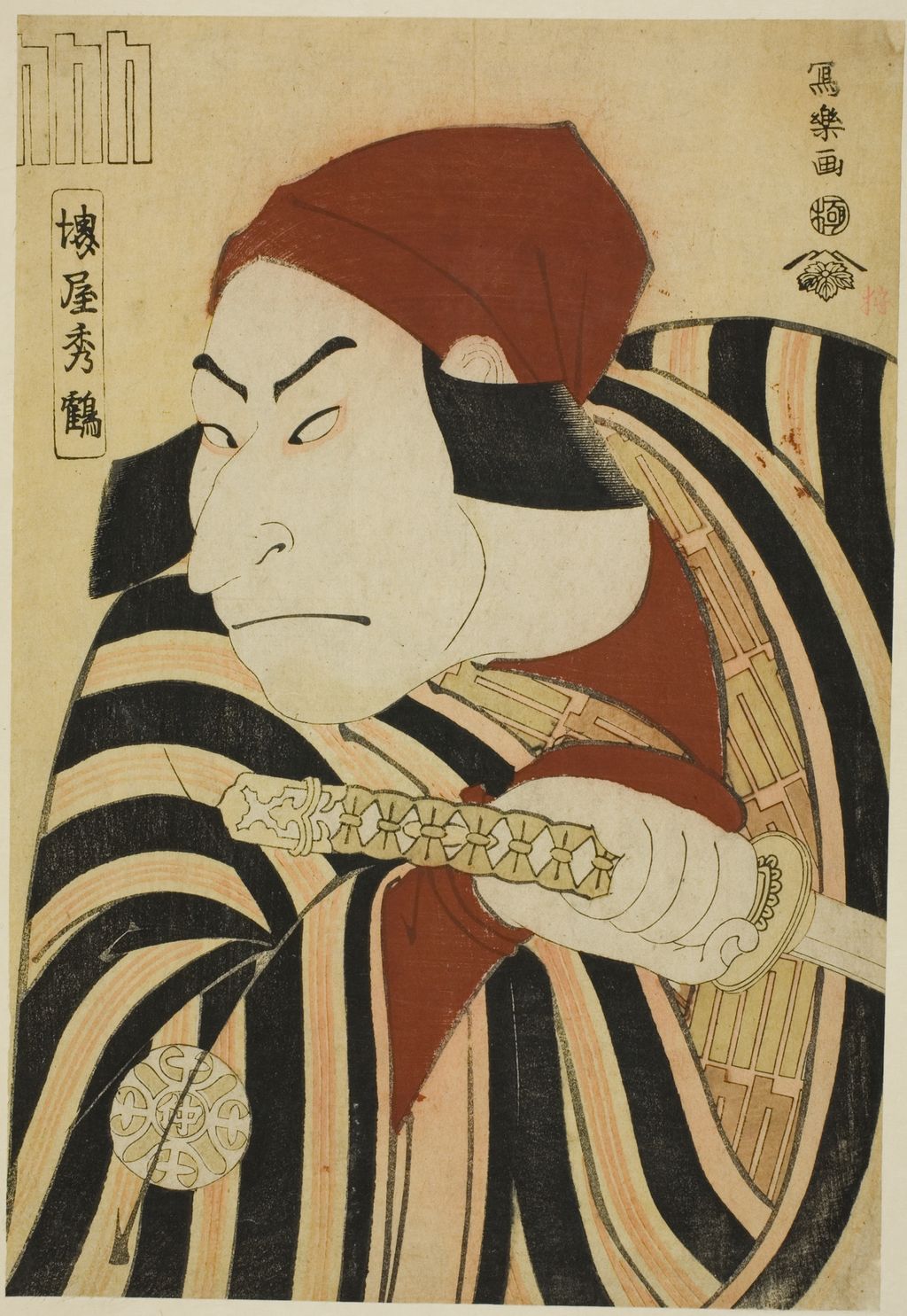
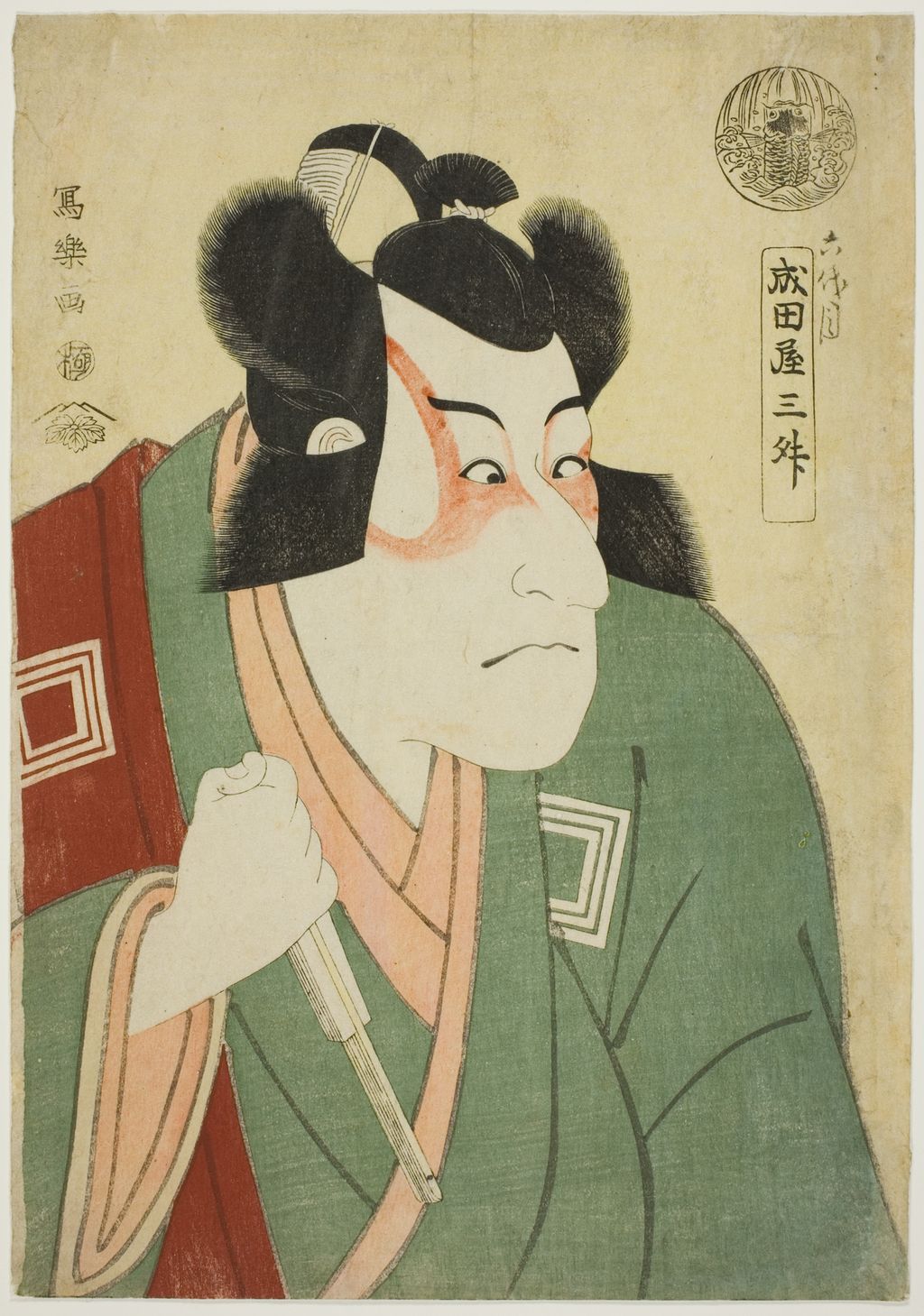
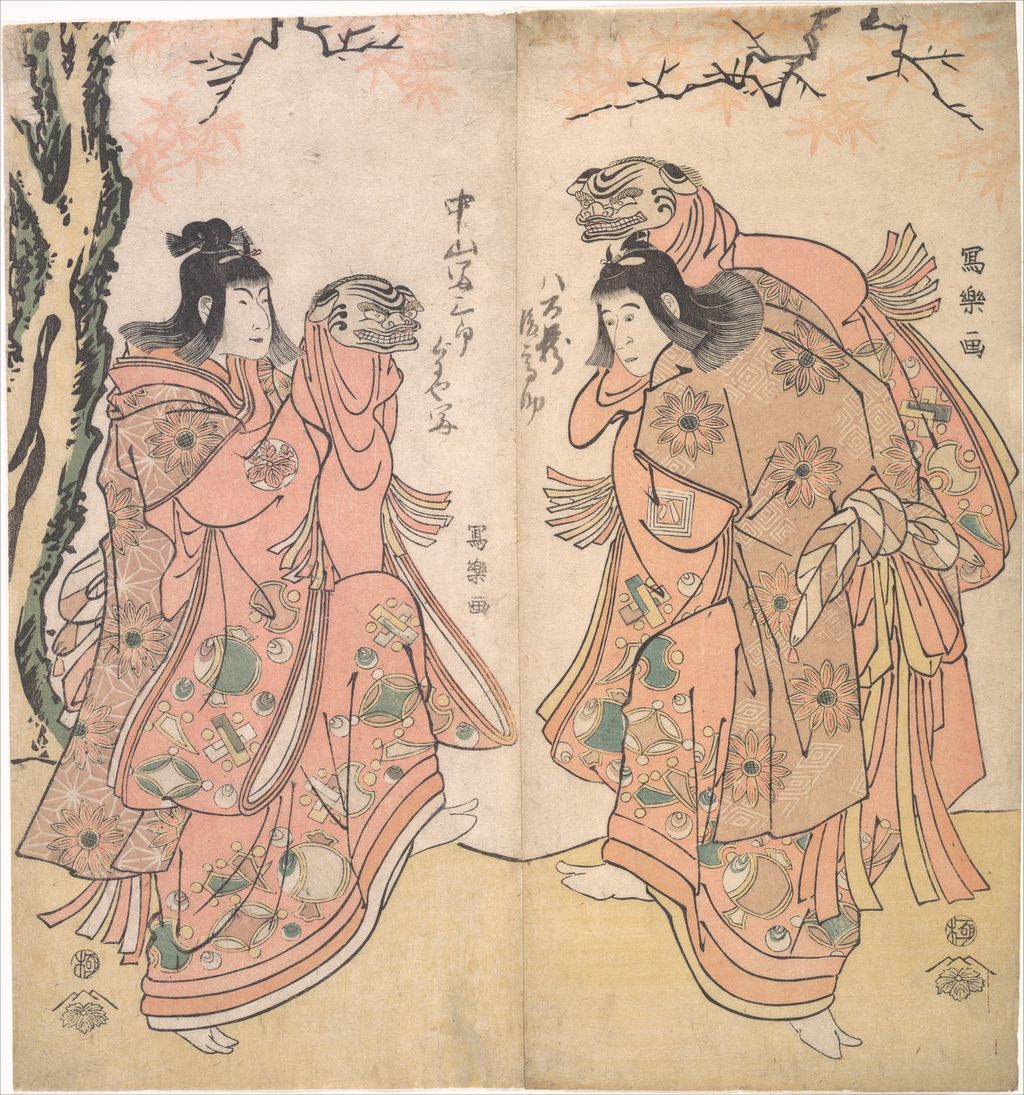
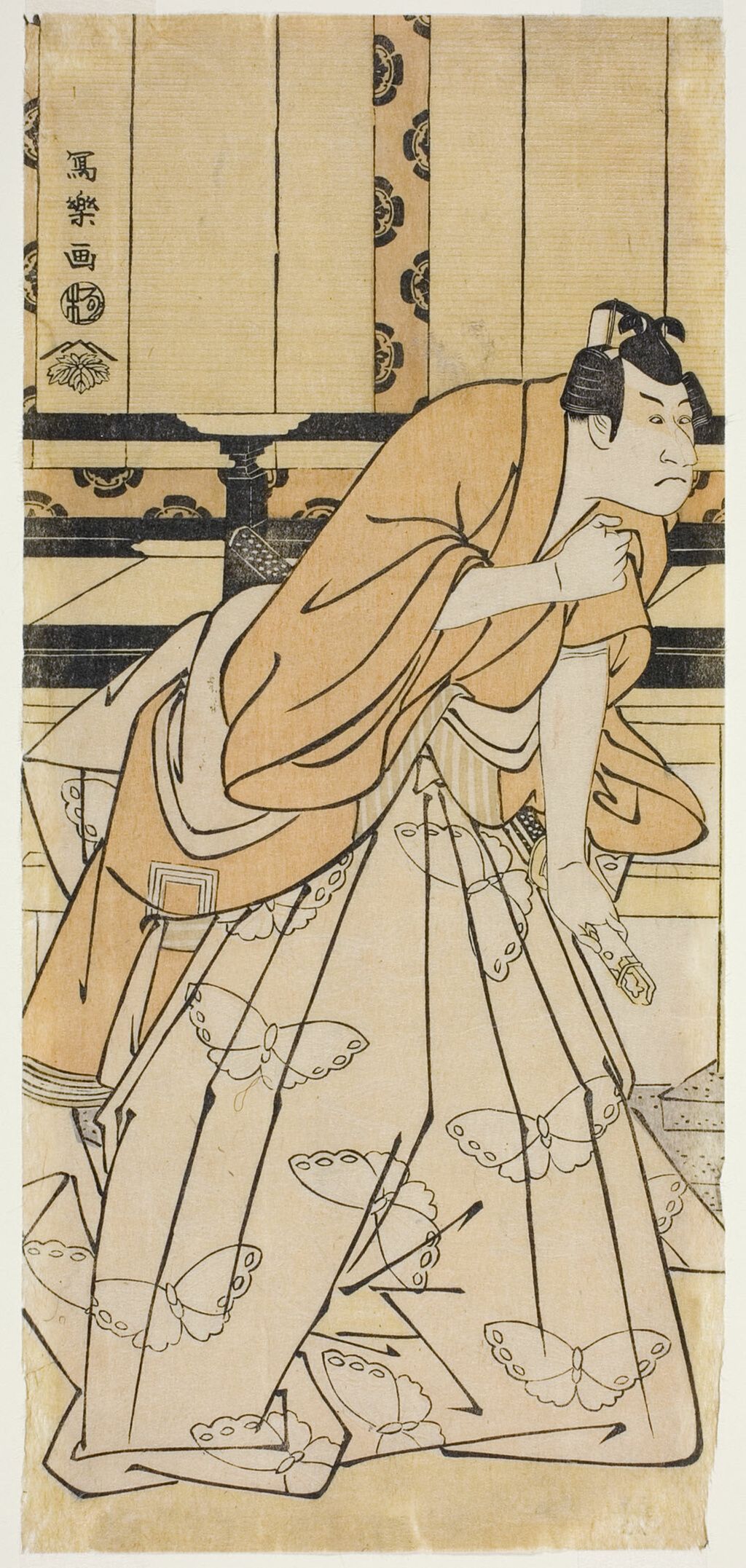
What the gallery makes possible
Switching between the four phases lets a viewer see both continuity and difference. Actor, role and publisher remain core fields. The framing, body scale, number of figures and use of ground change. A paired second-phase sheet is not merely a smaller version of an opening bust, and a third-phase diptych is not merely two busts placed together. The gallery's image selection is deliberately documented rather than exhaustive: it draws on separately catalogued Rijksmuseum, Metropolitan Museum and Art Institute objects, each with an accession and image-rights record. The Art Institute's exact object record [7] for a given Chicago sheet and the museum links in each card remain available for a reader who wants to inspect a full file.
The page also reveals gaps. Some plays and theatres are known through Japanese research even when an English object record omits them; others remain unconfirmed here. A date such as “1795” is less precise than a named lunar month. A format describes the physical sheet, while a phase is a modern way of organising a publication sequence. These differences can be expressed visually with a filter and an “unconfirmed” tag, but they should also remain in prose and captions so the page works without interaction.
Start with the opening Edobei study to inspect one design and separate impressions closely. Then return to the chronology and compare its paired figure, medium bust and 1795 narrow actor sheets. The prints gain meaning when their theatrical labels are as carefully handled as their colour and composition. Sharaku's short publication window remains striking, but a record-based view makes the achievement more precise: an artist and publisher produced varied ways to turn particular stage performances into printed images that still reward detailed looking.
Reader insights and discussion
Choose one actor print, then share what its performer, role, gesture and text reveal.
Reader Insights
What do Edobei’s hands add to the expression in his face?
Where do you see differences between the two museum impressions of Edobei?
How does your eye move differently across a bust portrait and the kamuro diptych?
Join the Conversation
Share the print and museum accession that prompted your observation.
References
- Japan Search, “東洲斎写楽” gallery. Four-phase counts, performance identifications and Japanese-language object leads.
- British Museum, Tōshūsai Sharaku artist record. Known-design count, publication period and Tsutaya.
- Tokyo National Museum, 2011 Sharaku exhibition. Opening issue and chronology.
- National Research Institute for Cultural Properties, Tokyo, exhibition report. Theatre-programme research and number of displayed physical prints.
- Rijksmuseum, Ōtani Oniji III as Edobei, RP-P-1963-16; Metropolitan Museum of Art, separate Edobei impression, JP2822; Art Institute of Chicago, another Edobei impression, 18765. Distinct objects.
- Metropolitan Museum of Art, Segawa Tomisaburō II as Yadorigi, JP3112; Ichikawa Omezō I as Ippei, JP196. First-phase records.
- Art Institute of Chicago, two actors, 18897; Segawa Kikunojō III and Sawamura Sōjūrō III, 86923; Sakata Hangorō III, 8955. Second-phase objects, with phase context from Japan Search.
- Art Institute of Chicago, Nakamura Nakazō II, 39433; Ichikawa Danjūrō VI as Arakawa Tarō, 18811. Third-phase objects.
- Metropolitan Museum of Art, two kamuro, JP3128a,b. Two-sheet object and impression-specific handwriting.
- Art Institute of Chicago, Ichikawa Danjūrō VI as Soga no Gorō, 89854; Ichikawa Ebizō as Kudō Saemon, 18833. 1795 actor objects.
- Art Institute of Chicago API documentation. Object metadata, public-domain field and IIIF access. Image rights recorded separately for each selected object.
