


 by Tom Gurney
Tom Gurney BSc (Hons) is an art history expert with over 20 years experience. Updated September 24, 2026.
Introduction
Tōshūsai Sharaku (東洲斎写楽) left an unusually vivid record of work and an unusually thin record of life. In the fifth lunar month of 1794, twenty-eight large actor portraits appeared under his name. Prints continued through the first lunar month of 1795, changing size, format and subject along the way. The British Museum [1] catalogues 144 known designs and identifies Tsutaya Jūzaburō as their publisher. It also cautions that no proposed civil identity has won general acceptance. A biography can therefore be detailed about the pictures, their theatrical circumstances and the later documentary trail, while remaining honest about the person behind the signature.
The most famous candidate is Saitō Jūrōbei, said in a later source to have been a Noh performer in the service of the Awa domain. The Tokyo National Museum [8] has treated this as a leading identification; the British Museum [1] and a Japanese Embassy exhibition leaflet [9] preserve the absence of decisive proof. Those positions are not interchangeable, and none supplies a secure birth year, family history, teacher or death date. The name on a print belongs to a documented publishing project. Whether it also names a particular person known from later writing remains an open historical question.
Contents
- Introduction
- The life we cannot yet document
- The first appearance: twenty-eight actor portraits
- Changing the frame in 1794
- Tsutaya, theatre and the limits of a professional biography
- What the later writings actually say
- Disappearance from the print record
- How objects become biographical evidence
- Testing the Saitō Jūrōbei proposal
- Reputation and modern research
- A biography that remains open
This biography follows two clocks. The first counts the months in which dated prints appeared and asks what each phase reveals. The second follows writings about Sharaku from 1796 to the nineteenth and early twentieth centuries. A later writer may transmit valuable memory, but cannot automatically be promoted to a witness of what happened in the studio in 1794. Keeping those clocks apart gives the artist a richer, more credible history than an attractive story about a genius who suddenly vanished.
Chronology and source confidence
The life we cannot yet document
A conventional artist biography begins with family, birthplace, education and entry into a workshop. Those chapters cannot currently be written as facts for Sharaku. The British Museum's artist record [1] begins with the period of known activity and ends by declining to settle the identity question. The Tokyo National Museum's group description [10] notes the absence of a known master–apprentice relationship. That is a statement about surviving attribution, not proof that the printmaker learned without teachers. The e-Museum text is useful research evidence; its images have separate reproduction restrictions and are not the source for the pictures on this page.
The tempting solution is to fill the gap with general Edo history. A printer in Edo could learn by copying designs, visiting theatres and working with a publisher. None of those possibilities identifies where Sharaku trained, whether he was born in Edo, or how he met Tsutaya. The dated works demonstrate command of actor imagery, composition and the conventions of colour printing. They do not tell us when that skill was acquired. Even the apparent confidence of the first twenty-eight pictures cannot date a private apprenticeship. The biography must begin where its evidence begins: the publication of prints.
Sharaku's signature also needs to be read in its proper setting. An artist's name on a woodblock print names the designer in a commercial object assembled by multiple workers. Publishers planned and financed issues; block cutters and printers translated designs into saleable sheets. The British Museum [1] attributes all known Sharaku designs to Tsutaya Jūzaburō as publisher. That is a substantial relationship in the documented history, even if its private terms are missing. Neither the number of prints nor the elaborate mica grounds reveal what Tsutaya paid the designer, what an edition cost, or whether a contract ended in dispute.
The first appearance: twenty-eight actor portraits
The fifth lunar month of 1794 is the clearest starting point. The Tokyo National Museum's 2011 exhibition [2] described twenty-eight large-format actor pictures as a remarkable opening issue. The faces and upper bodies press forward from shimmering mica grounds. Because the background gives little stage scenery, a spectator must read costume, gesture, expression, actor label and remembered performance together. The prints were tied to productions at Edo's three kabuki theatres; they were not an abstract portrait gallery assembled centuries later.
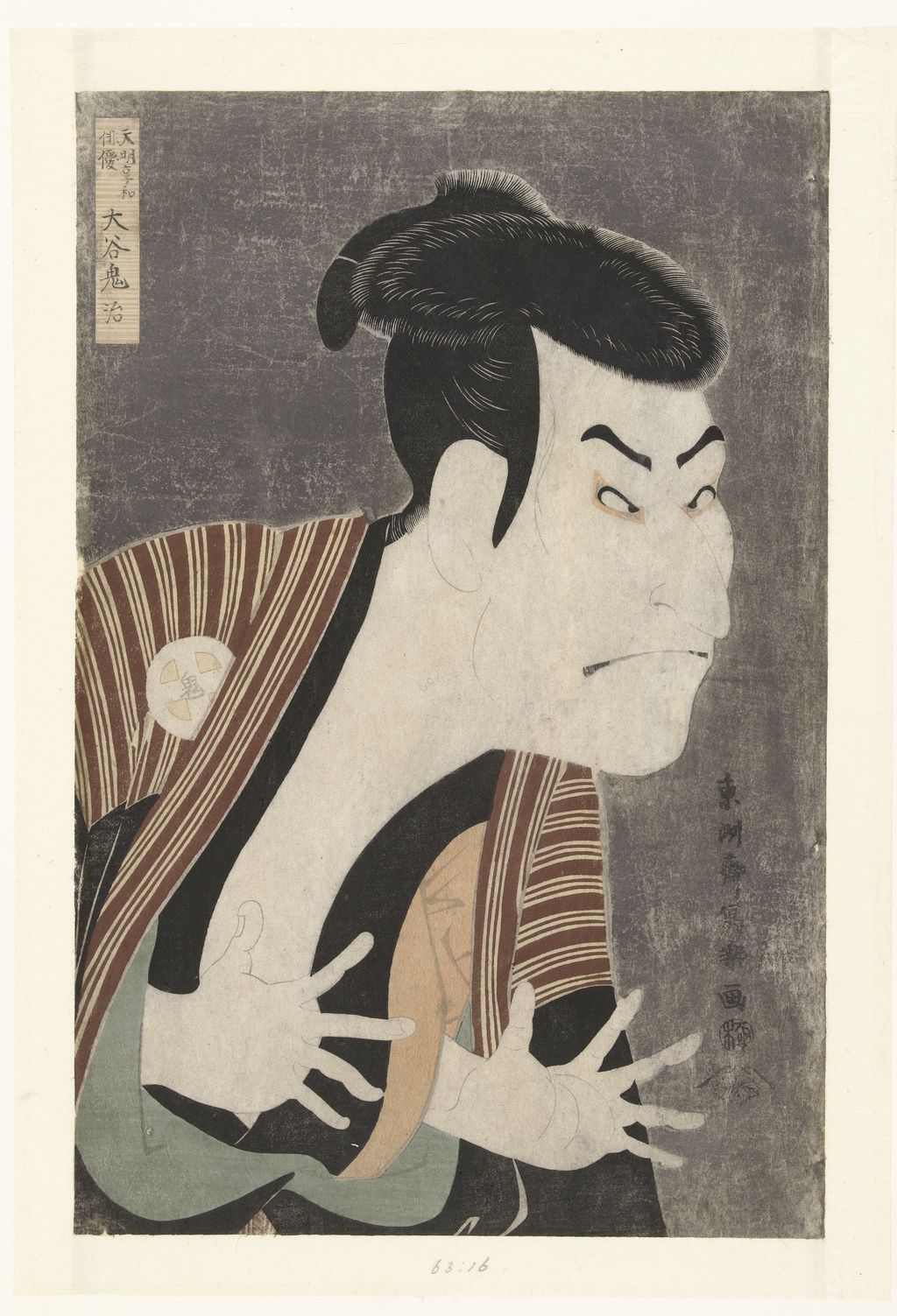
The actor Ōtani Oniji III appears as the servant Edobei in Koi nyōbō somewake tazuna. This is a biography of an artist's documented activity, so the object must be named with precision: the Metropolitan Museum's JP2822 [5] and the Rijksmuseum's RP-P-1963-16 [5] are different surviving impressions of a design. The actor's name is not the character's name, and neither is an accession number. The spread hands, bristling hair and narrowing eyes show the designer compressing a performance into a close view. The similar design in two collections permits a comparison of physical impressions, but it does not reveal which shop sold either one or how many customers bought the issue.
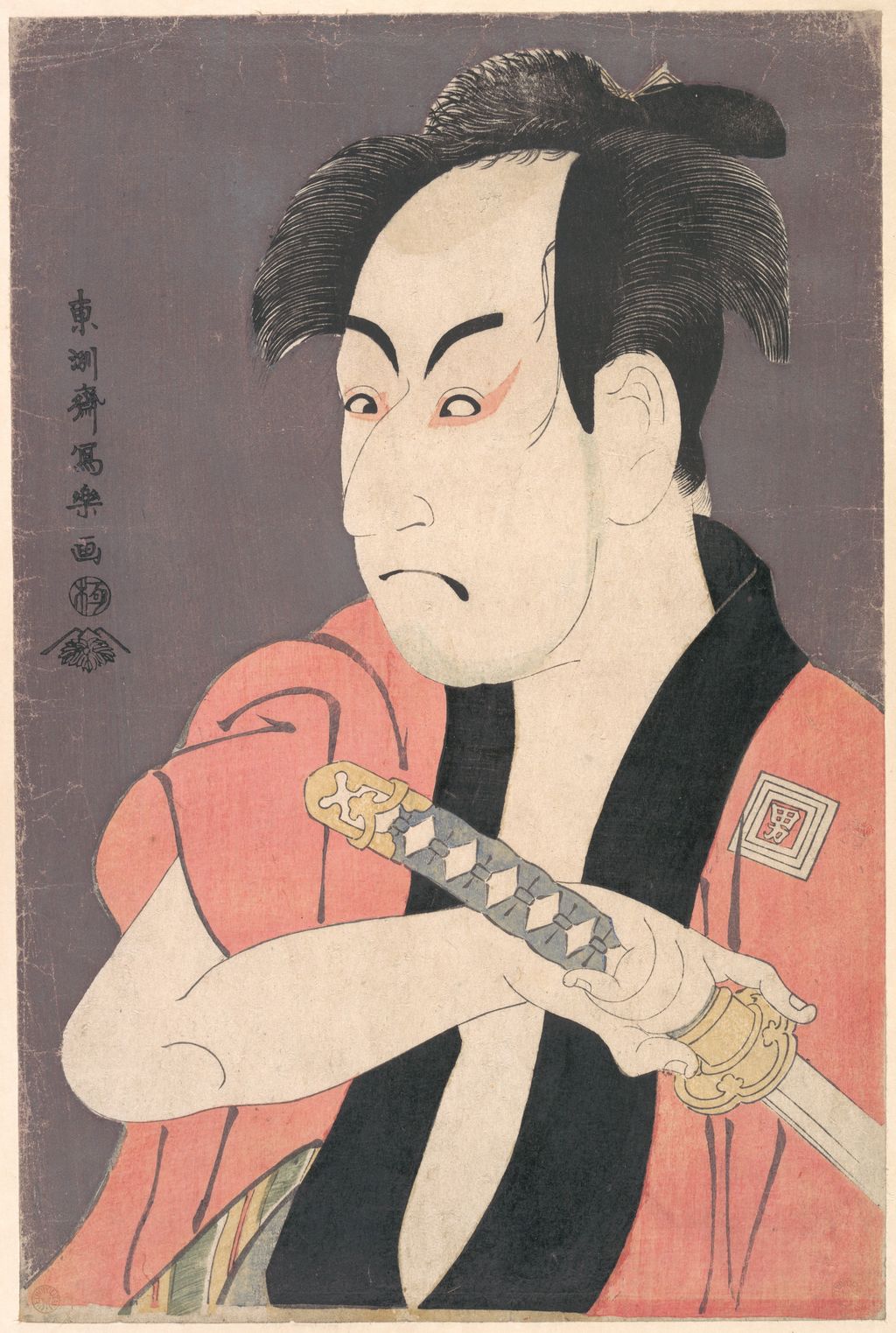
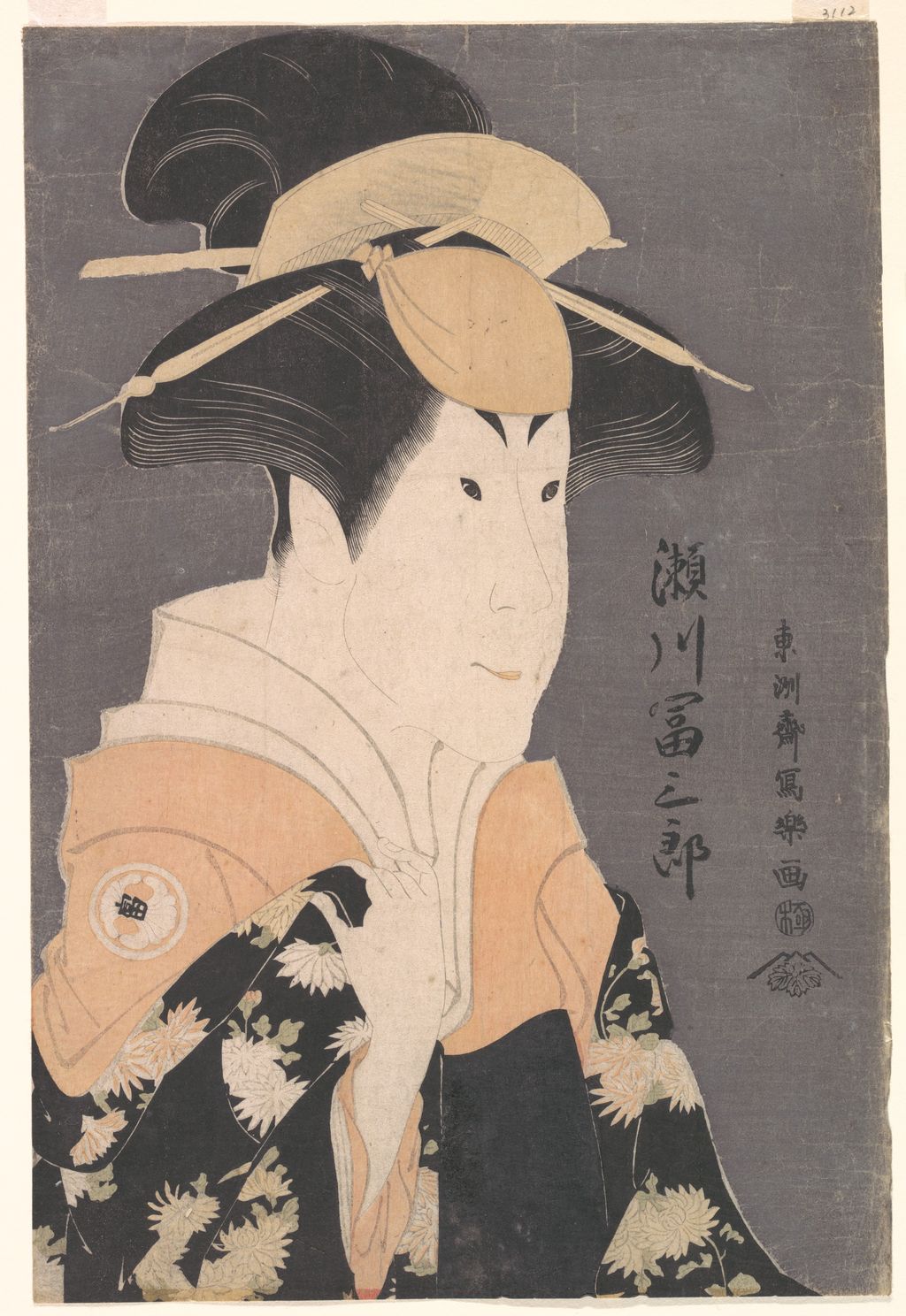
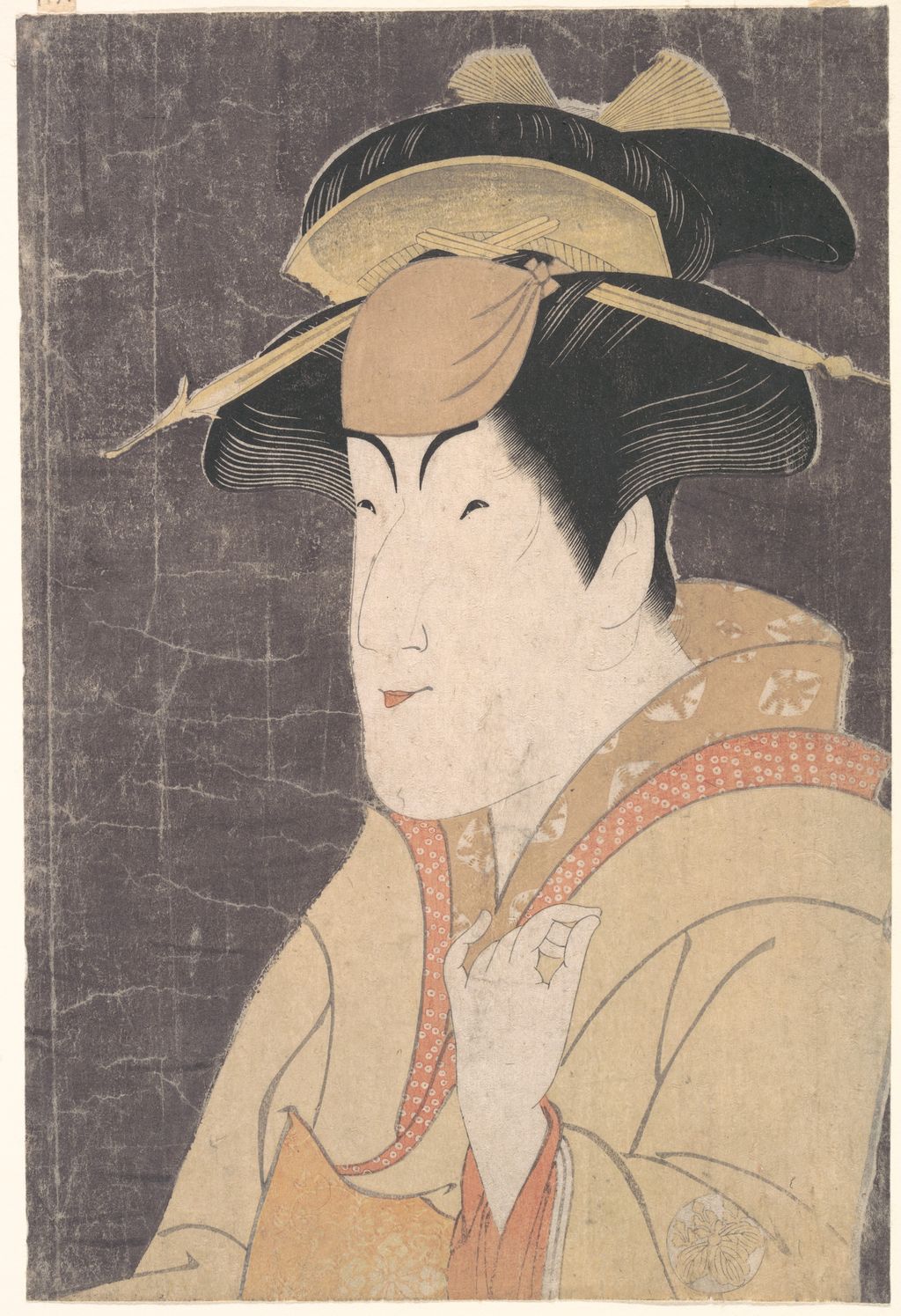
Other first-phase portraits show that Sharaku's project was not simply a run of fierce male faces. The Met's Ichikawa Omezō I as Yakko Ippei [6] belongs to the same named play as Edobei, yet the role and gesture differ. Segawa Tomisaburō II as Yadorigi [6] and Nakayama Tomisaburō as Miyagino [6] show still other performers and roles. A performer could play a gendered role distinct from everyday identity; the print records theatrical transformation, not a neutral likeness of a private person. These museum records place the designer among actors, plays and publishers that can be named, even where the designer's household cannot.
The costly appearance of twenty-eight large mica-ground pictures supports an inference of an ambitious launch. It does not support a precise claim about sales. The later line, associated with the Ukiyo-e ruikō tradition, that Sharaku rendered actors too accurately for the public's taste is a judgement made after the fact. Japan Search [3] presents it in a history of writing about the artist. An opinion about likeness is valuable for reception history; without an account book, price list or contemporary customer survey, it cannot by itself explain why the project ended.
Changing the frame in 1794
The next prints resist an easy explanation of decline or improvement. Japan Search [3] gives thirty-eight second-phase designs for the seventh and eighth lunar months, many tall and narrow full-figure actor portraits. A close head had made the face and hands unusually dominant. The taller format offered room for the actor's stance, sleeves, costume and the direction of a body in performance. A change in what the picture can show is observable; a claim that the artist lost confidence, or that a publisher forced an economy, requires evidence we do not have.
The third phase is broader again. The Japan Search chronology [3] groups full figures with smaller busts, memorial and sumo subjects during the eleventh and intercalary eleventh months. The intercalary month matters: the Japanese lunar calendar inserted an extra eleventh month in this cycle, so “ten months” of activity is not a smooth January-to-October run in the Gregorian calendar. Editorial shorthand can obscure the timing of plays and prints. Each work should therefore carry its recorded performance month where an institution supplies one.
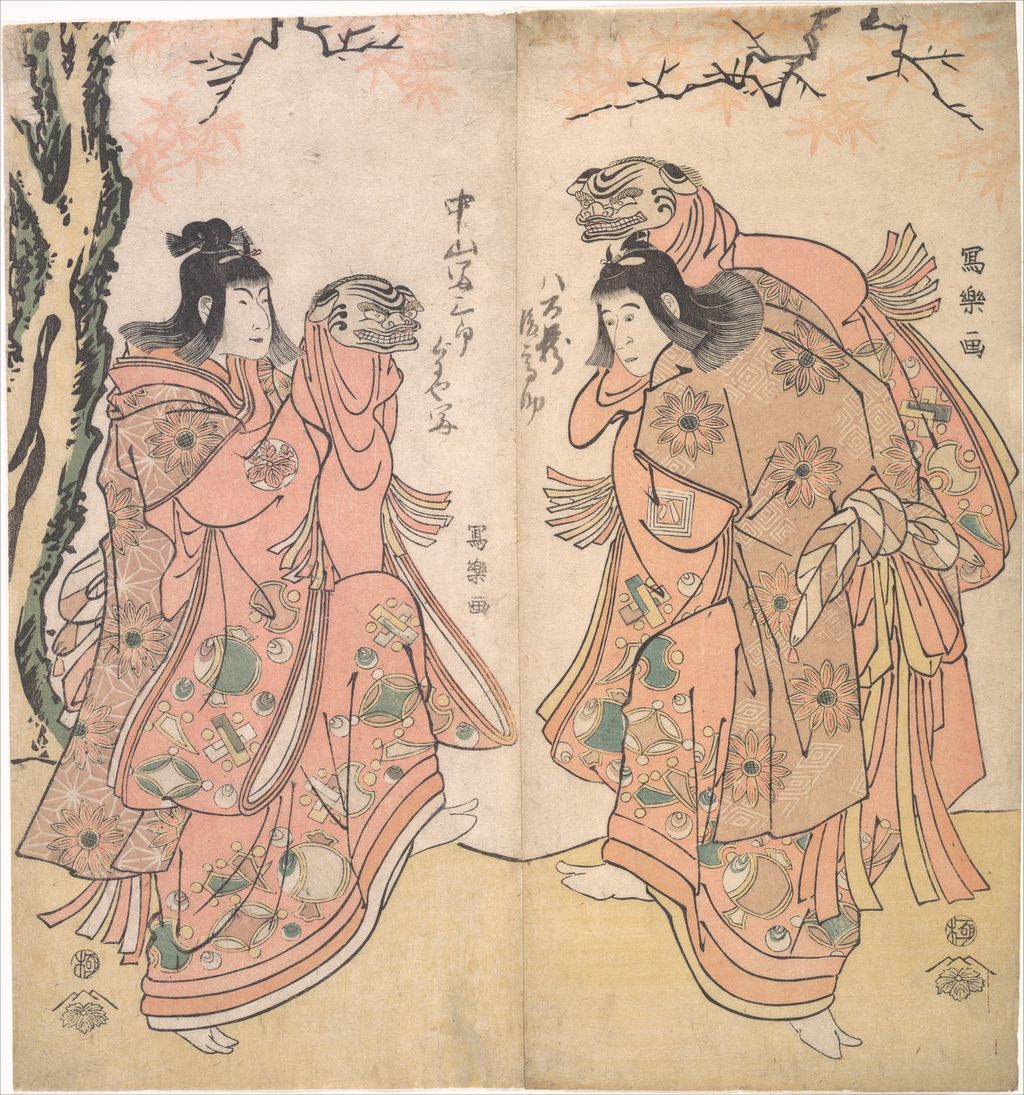
The Met's two-sheet kamuro design, JP3128a,b [7], is a useful later anchor. It depicts Ichikawa Yaozō III and Nakayama Tomisaburō I as two young attendants, and the museum dates it to the eleventh lunar month. On its particular impression, names and roles are handwritten. Those marks belong to that object: they should not be quietly described as printed on every copy of the design. In a biographical chronology, the diptych proves that the project explored relations between figures and a different physical format. It cannot tell us who wrote on this pair or what conversation prompted a change of format.
The first lunar month of 1795 supplies the final known group. Japan Search [3] lists twelve designs for its fourth phase, while the British Museum [1] places the end of documented activity in early 1795. Totals differ by catalogue convention: the British Museum's 144 known designs, Japan Search's grouped counts and the 142 physical prints shown in the 2011 Tokyo exhibition are not three measurements of exactly the same thing. An individual design may survive in more than one impression; an exhibition may show selected objects. The honest biographical claim is narrower: after the early-1795 group, no further accepted run of prints is known under the Sharaku name.
Tsutaya, theatre and the limits of a professional biography
For a person whose private record is elusive, the publisher is a reliable professional connection. Tsutaya Jūzaburō's imprint links the known designs to a particular commercial enterprise. The Tokyo National Museum's Sharaku exhibition [2] placed the first issue within the history of that publisher and Edo's actor-print market. To say Tsutaya published the prints is secure; to describe the two men as friends, enemies or collaborators in a specific creative discussion would require letters or other documents not provided by this corpus. The print's signature tells us a design was attributed to Sharaku, while the finished sheet demonstrates the work of an entire production chain.
Theatres give firmer coordinates than a speculative home address. The opening actor portraits relate to plays performed at Edo's three major kabuki theatres. Researchers at the 2011 Tokyo National Museum exhibition [4] compared surviving theatre programmes with the pictures to identify actors and roles. That work can recover a performance context after more than two centuries, though it does not put Sharaku personally in a particular seat at a particular show. The artist had access to theatrical information and made designs intelligible to theatre-aware buyers; the route by which he acquired each detail remains unknown.
Noh and kabuki must also be kept distinct. The proposal that Saitō Jūrōbei was an Awa-domain Noh performer is an identity hypothesis about the person behind Sharaku. The prints themselves are principally images of kabuki actors and performances. One cannot infer a Noh profession merely from a kabuki print, nor dismiss the proposal because the genres differ. What is needed is a trustworthy bridge between the named individual and the signed designs. The later texts supply a possible bridge, but the British Museum [1] still finds the identification unresolved.
What the later writings actually say
In 1796, after the last known signed issue, Jippensha Ikku's 初登山手習方帖 included a kite image marked with Sharaku's name, as Japan Search [3] notes. It indicates that the name or design was still culturally legible. It does not establish that a living Sharaku produced a new dated print in 1796. The distinction matters because biographies often turn every later appearance of a name into another year of active practice.
An early strand of Ukiyo-e ruikō, associated with Ōta Nanpo around 1802, introduced a concise appraisal of the artist's brief career. A later Shikitei Sanba annotation in this textual tradition mentions Hatchōbori. Japan Search's account [3] traces these layers rather than presenting them as a single eyewitness statement. Hatchōbori is therefore a historically meaningful lead, but it is not a securely proved birthplace or an address reconstructed from a tax register. A photograph of a later Tokyo bridge, even one correctly located, could show how the district changed; it could not photograph Sharaku's street in 1794.
A separate record from about 1817–18, Segawa Tomisaburō III's Shoka jinmei Edo hōgakubun, lists a deceased print artist called “Sharaku-sai” around Hatchōbori/Jizōbashi while leaving the given name blank. The Japan Search discussion [3] makes it an important clue. Yet a similar artist name in a later directory is not an independently authenticated match to the 1794–95 designer, and the entry does not fix a death year. The document deserves space in a biography because it shows the shape and limit of the evidence at once.
Keisai Eisen's 1833 Mumeiō zuihitsu adds information to the written tradition of Sharaku and his actor subjects. In 1844, Saitō Gesshin's expanded Ukiyo-e ruikō supplies the consequential identification with Saitō Jūrōbei, a Noh performer connected to the Awa domain. Both are decades later than the portraits. The Tokyo National Museum [8] has considered the identification persuasive; the Japanese Embassy's Sharaku leaflet [9] says decisive proof is lacking, and the British Museum [1] says no theory has general agreement. A responsible caption can say “possibly Saitō Jūrōbei”; a bare biographical fact box that says “born Saitō Jūrōbei” would turn a later proposal into a document it is not.
Disappearance from the print record
Sharaku did not disappear from history in a literal sense. His prints survived, his name appeared in later writings, and collectors eventually studied his work in detail. What stops is a known sequence of signed print publications after the first lunar month of 1795. The reason has not been established. A sales failure, Tsutaya's change of plan, a return to Noh, a prohibition, a death and the use of a different name have all been offered as explanations in some retellings. None follows automatically from the dated print sequence or the later critical comment about candid likenesses. The evidence should be allowed to end without forcing a dramatic last scene.
If the Saitō Jūrōbei identification were eventually proved, it could reshape the account of earlier training and later work. It would still need its own dated records to answer those questions. A proposed identity cannot retroactively produce a childhood, a family tree and a death certificate. The artistic record is rich enough to sustain this biography without such additions: it shows a publisher, a market, specific actors and plays, technical and compositional change, and the many later attempts to identify the designer.
How objects become biographical evidence
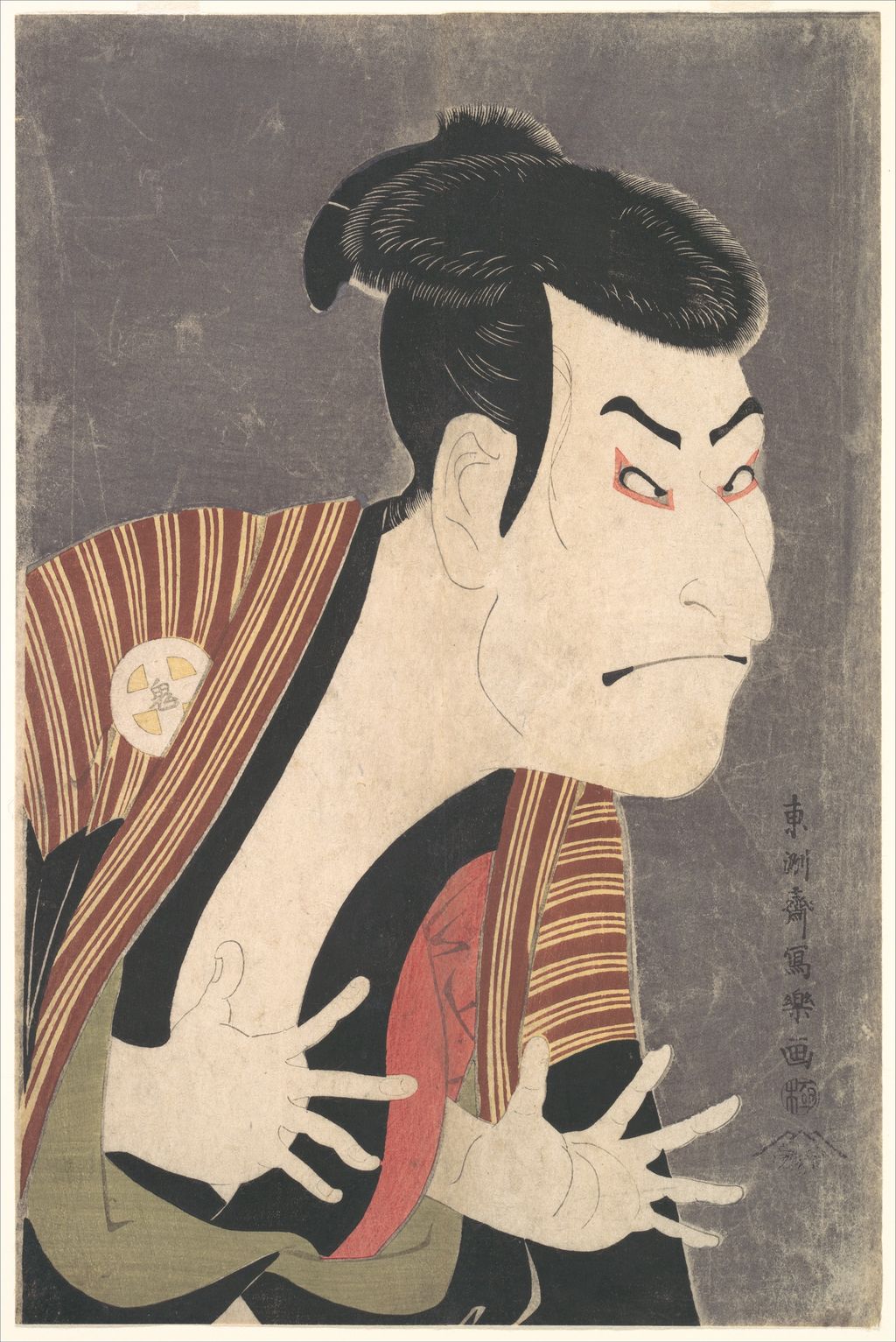
A physical impression is a better witness to a design than an unlabelled thumbnail, but it still needs interpretation. The Met's Edobei [5] records ink, colour and white mica on paper; the Rijksmuseum's Edobei [5] is a separately catalogued sheet. We can inspect each institution's file for cropping, colour balance and the visibility of inscription, and compare what survives in the printed image. We cannot infer from a web JPEG that two sheets were pulled on the same day, held by the same buyer or printed in the same sequence. A catalogue's accession describes the collection object, not the eighteenth-century edition number.
The same caution applies to the kamuro pair. The Met [7] catalogues two physical sheets and notes writing on that impression. A modern article that quotes those names as if they had been printed across the entire edition would erase a crucial distinction. Handwriting could be evidence for an object's later use or ownership; it is not automatically Sharaku's writing. A design can also be known through multiple impressions in different conditions. Damage, trimming, fading and photography may change the appearance of an individual sheet without requiring an altered original design. The identity of the artist is a separate question from the state or history of any one impression.
Performance evidence has a different strength. The theatre programmes studied for the Tokyo National Museum exhibition [4] can link an actor, role, play and performance period. This lets us correct a caption that confuses a stage name with a character. It cannot, alone, prove where the print designer sat, whom he spoke to or whether he attended the first night. Naming a play is a substantial gain even without such anecdotes. A print that once circulated among spectators can be read again as a response to a particular theatrical event rather than a timeless study of emotion.
These layers explain why counts need care. A design is a composition made for printing. An impression is one surviving pull from blocks. A diptych can contain two sheets but be treated as one composition; a museum exhibition counts the objects that it physically displays. Thus 142 prints shown in 2011, 144 known designs in the British Museum [1] and another institution's grouped phase total can all be meaningful without being directly interchangeable. The biography uses the opening twenty-eight and the early-1795 endpoint as chronological anchors, then gives the object and source type behind each more detailed claim.
Testing the Saitō Jūrōbei proposal
The Saitō identification has endured partly because it gives a plausible connection between a person recorded in later Edo writing and the otherwise unidentified print signature. It is possible to take the proposal seriously without treating it as settled. The strongest question is not whether a Noh performer could have understood kabuki's expressive possibilities. It is whether an independently dated document securely joins Saitō Jūrōbei to the name Tōshūsai Sharaku, to Tsutaya's publishing enterprise, or to the signed designs. The British Museum's caution [1] signals that this documentary bridge has not won general acceptance.
The source chain is longer than many short biographies suggest. A signed print in 1794 is contemporary evidence for the publishing name. An early nineteenth-century commentary is evidence that people discussed the designer after the prints appeared. The c.1817–18 “Sharaku-sai” directory entry is a lead about a person and a district; it omits a given name. The 1844 expanded Ukiyo-e ruikō gives the Saitō Jūrōbei identification about fifty years after the opening portraits. Japan Search [3] allows these steps to be read separately. Joining them into one unbroken eyewitness account would disguise the gaps that researchers still need to test.
The Noh hypothesis also raises specific, testable questions. Could a record of Awa-domain performers identify the same Saitō in a place and period compatible with the print publication? Is there a contemporary link to Tsutaya, a theatre, a block-cutter or an identifiable drawing? Does a later annotation copy an earlier lost source, or does it reflect an inference made by its own writer? A name resemblance and a plausible cultural setting are not enough for certainty. Conversely, the absence of such a surviving link does not disprove the hypothesis. It establishes the present level of confidence: possible and historically important, but not a foundation for unqualified birth, occupation or death fields.
The alternative is not to advertise every speculative identity with equal weight. Museum catalogues and Japanese historiography can indicate which proposals have been taken seriously and why. The Tokyo National Museum [8] has argued strongly for the Noh-performer view; the Embassy leaflet [9] expressly notes the missing decisive proof. Presenting that disagreement gives a reader a route into the research. It is more informative than repeating “nobody knows” without identifying the sources, and more faithful than writing “Sharaku was Saitō Jūrōbei” as a settled sentence.
Reputation and modern research
Sharaku's modern standing developed over time. Japan Search [3] identifies an 1893 collector reference and Julius Kurth's 1910 study as milestones in the later story. The National Art Center's record [11] likewise places Kurth in the history of international appreciation. Modern enthusiasm cannot be read backward as proof of the first issue's commercial success, just as a later remark about unflattering portraits cannot prove failure. Reception history follows its own clock.
The 2011 Tokyo National Museum exhibition approached the prints as historically located theatre images. The National Research Institute for Cultural Properties, Tokyo [4] reports that it displayed 142 Sharaku woodblock prints and used theatre programmes to examine actors, roles and plays. That physical-print count should not be swapped for the British Museum's count of known designs. The exhibition also placed the work beside other actor prints and the publisher's activity. Its research model is useful for any future attribution: begin with an identifiable sheet, compare records and distinguish what is actually observed from what a later interpreter concludes.
Books have helped build this record. The National Diet Library [12] verifies the 2002 large-format 東洲斎写楽 : 原寸大全作品 by Asano Hideyoshi, Suwa Haruo and Yamaguchi Keizaburō; the 2011 exhibition catalogue [12] has its own bibliographic record. These are appropriate routes for deeper study. Their existence should not be cited as support for a specific interpretation without consulting the relevant pages. The object records and accessible institutional research cited here carry the manuscript's specific claims.
A biography that remains open
The most secure story of Sharaku is neither a full private life nor a one-line mystery. It is a tightly dated episode of graphic invention within Edo theatre culture, followed by a long and layered debate about the designer's name. The actor-print chronology can take readers through each phase, and the Edobei study can slow down over one design and two surviving impressions. This biography's work is to show why the phases can be dated, why the later texts matter, and where the chain of proof stops.
It is possible that a newly identified theatre record, publisher document or securely linked manuscript will make the Saitō proposal stronger or point elsewhere. Until then, the twenty-eight first portraits, the shifting format of 1794, and the last known issue of 1795 are stronger anchors than any confident claim about where Sharaku was born or why he ceased publishing. The gaps should be visible. They are part of the history of how we know an artist whose pictures can feel startlingly immediate while his life remains beyond the evidence.
Reader insights and discussion
Choose one actor print, then share what its performer, role, gesture and text reveal.
Reader Insights
What do Edobei’s hands add to the expression in his face?
Where do you see differences between the two museum impressions of Edobei?
How does your eye move differently across a bust portrait and the kamuro diptych?
Join the Conversation
Share the print and museum accession that prompted your observation.
References
- British Museum, Tōshūsai Sharaku artist record. Corpus, publisher and identity caution.
- Tokyo National Museum, Sharaku, 2011 exhibition introduction. First issue and exhibition framework.
- Japan Search, Sharaku gallery and historiography. Four phases and successive later texts.
- National Research Institute for Cultural Properties, Tokyo, 2011 exhibition report. Theatre programmes and displayed print count.
- Metropolitan Museum of Art, Ōtani Oniji III as Edobei, JP2822; Rijksmuseum, Edobei, RP-P-1963-16. Distinct impressions.
- Metropolitan Museum of Art, Ichikawa Omezō I as Ippei, JP196; Segawa Tomisaburō II as Yadorigi, JP3112; Nakayama Tomisaburō as Miyagino, JP1737. Early portraits.
- Metropolitan Museum of Art, two kamuro, JP3128a,b. Eleventh-month diptych and impression-specific handwriting.
- Tokyo National Museum, 2006 Sharaku note. Saitō Jūrōbei proposal.
- Japanese Embassy exhibition leaflet, Sharaku. No decisive identity proof and later reception.
- Tokyo National Museum, first-phase object group description. Research text only; e-Museum image terms are not production rights.
- National Art Center, Tokyo, Sharaku exhibition record. International reception.
- National Diet Library, 東洲斎写楽 : 原寸大全作品 record; WorldCat, 2011 Sharaku catalogue. Bibliographic records, not consulted textual claims.
