



 by Tom Gurney
Tom Gurney BSc (Hons) is an art history expert with over 20 years experience
Email: tomgurney1@gmail.com / Phone: +44 7429 011000
Study of a Man (Académie d’homme): Introduction
A man stands with his feet far apart, one hand resting on a tall block and the other hanging beside his thigh. Light picks out his chest, shoulder and abdomen against a dark interior. Théodore Géricault’s Study of a Man makes this exposed body the whole subject: there is no surrounding action to explain the pose. The French national collections catalogue identifies the painting as Académie d’homme, dates it broadly to 1808–1812 and records it at the Musée des Beaux-Arts in Rouen. It is an oil painting on canvas, 81 cm high by 65 cm wide, inventory 1876.7.1. [1]
At a Glance
- Catalogue titleAcadémie d’homme [1]
- Date1808–1812 [1]
- Medium and dimensionsOil on canvas; 81 cm high × 65 cm wide [1]
- CollectionMusée des Beaux-Arts de Rouen, 1876.7.1 [1]
This work across Théodore Géricault’s career
The Severed Heads
1810s [2]Charging Chasseur
1812 [3]Horse Frightened by Lightning
c.1813–14 [4]The Raft of the Medusa
1818–19 [6]Portrait of a Kleptomaniac
c.1820–24 [8]The Epsom Derby
1821 [9]Contents
- An academic figure with an individual presence
- A stance built from unequal movements
- What the block contributes
- Light describes a connected body
- The head changes the encounter
- Learning in the studio
An academic figure with an individual presence
The French title identifies a study of the male figure. Yet the painting does more than display an assortment of muscles. The head bends towards the supporting hand, the shoulders sit at different angles and the light changes as it travels across the torso. These relationships give the man a particular physical presence. His pose is arranged for inspection, but the arrangement still depends on a body holding its balance.
The catalogue names the model as Cadamour. That is a useful identification to retain as a catalogue statement; it does not supply a personal history or explain what he thought about posing. The record also mentions copies by Géricault’s neighbouring studio pupils, held in Morlaix and a private collection in Paris. It thereby places this composition within a shared studio setting, without establishing that every version was painted at the same moment or from the same position. [1]
A stance built from unequal movements
Start with the feet. They occupy opposite sides of the bottom edge, giving the figure a broad foundation. The leg on the viewer’s left opens sideways, its knee bending as the thigh projects away from the pelvis. The other leg descends more directly towards the foot on the right. Neither forms a straight, diagrammatic column. Changes in direction at the hips, knees and ankles make the stance look held rather than mechanically fixed.
The torso complicates this wide base. Its central line does not simply bisect the gap between the feet. The abdomen, rib cage and shoulders create successive shifts, while the head introduces another turn. Follow the body upwards and the apparent symmetry of two separated legs gives way to a series of unequal adjustments. The pose becomes a useful way of seeing how one part of a figure affects another.
There is also a difference between the two outer contours. On the left, the extended arm leads across to the block before the eye descends through the bent leg. On the right, the shoulder, hanging arm and leg create a longer downward movement. The body is therefore open towards the support on one side and more enclosed on the other. Those contrasting rhythms animate a figure that is standing still.
What the block contributes
The block is conspicuous because it gives the hand something definite to touch. Its vertical face, narrow illuminated side and horizontal top describe a solid object beside the softer forms of the body. The fingers bend over its upper edge. At this point, flesh and geometry meet: the irregular shapes of knuckles and fingertips are set against a comparatively straight boundary.
A lower support beneath the block adds another horizontal level. Together these objects divide the left-hand darkness into readable surfaces. They also provide a measure for the figure. The height of the hand, the angle of the forearm and the space beneath the upper arm can be understood against the block’s fixed edges. It is a simple studio arrangement with substantial pictorial consequences.
The opposite hand offers a quieter comparison. Hanging close to the thigh, it receives little light and is harder to distinguish from its surroundings. One hand is spread against an object; the other gathers into a darker, narrower shape. Géricault gives the viewer two different problems of recognition within the same figure. Touch is explicit on one side, while the contour has to do more work on the other.
Watch: Géricault and The Raft of the Medusa
Three perspectives on Géricault’s best-known painting, its making and its historical setting.
Gericault, Raft of the Medusa
Smarthistory examines the composition and historical setting of The Raft of the Medusa.
Watch on YouTubeLight describes a connected body
The strongest illumination falls across the upper chest and the shoulder on the viewer’s right. From there, the eye moves through alternating light and shadow around the ribs, waist and abdomen. These are not isolated bright patches pasted onto a silhouette. Their edges turn gradually in some places and sharply in others, suggesting changes in the direction of the flesh.
The abdomen provides a particularly useful passage to examine. Small darker accents around the navel and along the central division sit within a broader, warmer field. To either side, the flanks darken unevenly. The result is a torso that appears to turn in space, rather than a flat frontal surface. A narrow shadow can carry as much descriptive weight as a large highlight.
The knees and shins continue the same process at a different scale. Bright ridges interrupt the darker lower legs, while the feet remain close to the bottom of the composition. Light joins distant parts of the figure without making every part equally clear. The pale chest attracts attention first, but the lower limbs are necessary to explain how that illuminated mass is supported.
These effects remain legible across the available reproductions, although their overall brightness differs. Fine claims about the original paint surface or exact flesh colour would require examination beyond a photograph. The important visible relationship is stable: the figure emerges from darkness through selected areas of illumination, and some contours remain difficult to follow.
The head changes the encounter
The downward turn of the face prevents the nude from confronting the viewer directly. Its profile is compressed between the forehead, projecting nose and chin, with a dark eye socket interrupting the lit side. The hair forms a relatively compact mass above it. Compared with the broad treatment of the chest, the face concentrates attention into a much smaller area.
Its direction also brings the gaze back towards the extended arm. The head does not float independently above the torso; its inclination joins the shoulder and hand in a descending sequence. It is tempting to describe the expression as weary or melancholy, but the visible evidence is more specific and less conclusive: a lowered head, averted eyes and a closed mouth. These features create reserve without proving a psychological state.
Learning in the studio
The painting’s broad date range overlaps Géricault’s early artistic education. The Musée des Beaux-Arts de Lyon’s exhibition biography places his move from Carle Vernet’s teaching to Pierre Guérin’s studio in late 1810 or early 1811. It also describes his sustained study at the Louvre. These were connected forms of training, bringing direct observation into contact with the example of other painters. The chronology provides a context for the Rouen nude, rather than a precise date or documented place of execution. [10]
The studio connection helps explain why this apparently simple arrangement can sustain such close attention. A single pose offers questions of balance, proportion, foreshortening, touch and illumination. Here those questions remain visible together. The block makes the extended arm comprehensible; the legs establish the body’s support; the turned head and differently angled shoulders prevent the torso from becoming a rigid frontal pattern.
A comparison with Nude Warrior with a Spear brings the arrangement into focus. There, the seated body folds around a long diagonal weapon. Here, the standing figure opens between separated feet and a fixed vertical block. The different supports change how arms, torso and legs form a connected structure.
Seen this way, Study of a Man rewards looking without needing an invented story. Nothing in the image requires the man to be identified as a hero, a combatant or a survivor. Its strength lies in the coordination of an ordinary studio support with an unusually demanding pose. The body is exposed to light and to scrutiny, yet the bowed face preserves a sense of distance. Géricault makes a figure study compelling through that combination of physical clarity and withheld encounter.
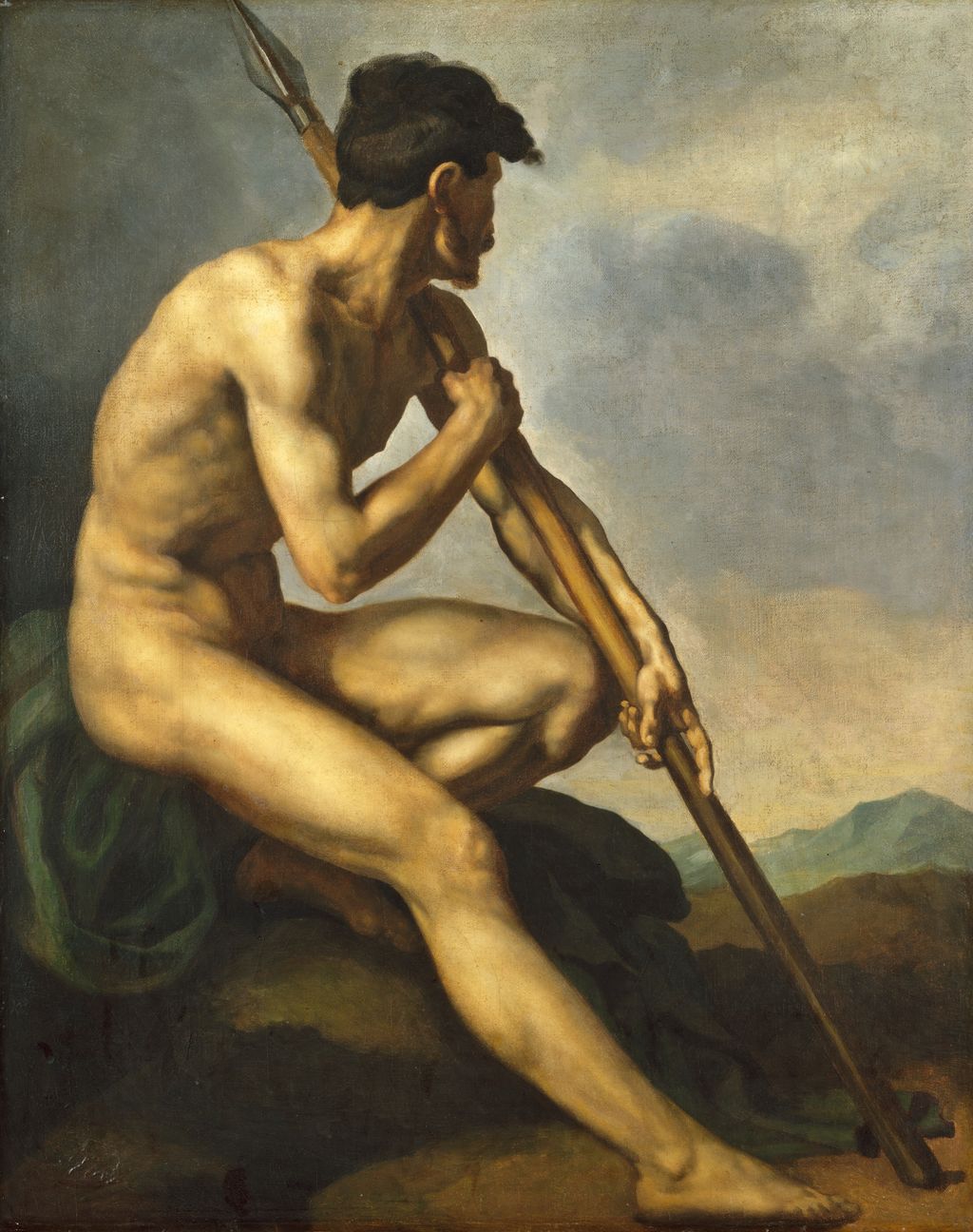
Nude Warrior with a Spear Image source. Public domain.
Géricault collection records
Seventy collection records include paintings, drawings and individual print impressions. Different impressions remain separate records; this selection is not a complete catalogue raisonné.
Frequently Asked Questions
The French national collections catalogue identifies the model as Cadamour. This is a catalogue identification; the consulted record does not provide a personal biography. [1]
The catalogue dates the painting to 1808–1812. Its present location in Rouen does not establish where it was painted, and the consulted record does not name a place of execution. [1]
The oil painting on canvas measures 81 cm high by 65 cm wide. It is held at the Musée des Beaux-Arts de Rouen as inventory 1876.7.1. [1]
Discussion
Look again at the images and ideas explored in Study of a Man (Académie d’homme). These editorial prompts invite your observations.
Reader Insights
How does the supporting block change your understanding of the man’s balance?
Where does the light explain the body most clearly, and where do contours disappear?
How would the encounter change if the model looked directly at the viewer?
Join the Conversation
Share a detail, comparison or question about Study of a Man (Académie d’homme) below.
References
- French Ministry of Culture / Musée des Beaux-Arts de Rouen, Académie d’homme, inventory 1876.7.1, Joconde notice 07290021830, updated 23 February 2026 (French). View source.
- Nationalmuseum, The Severed Heads, NM 2113; collection metadata and museum interpretation (Swedish). View source.
- Louvre, Charging Chasseur, INV 4885; collection metadata and museum interpretation (French/English interface). View source.
- National Gallery, Horse frightened by Lightning; collection metadata and museum interpretation (English). View source.
- Louvre, Wounded Cuirassier, INV 4886; collection metadata and museum interpretation (French). View source.
- Louvre, The Raft of the Medusa, INV 4884; collection metadata and museum interpretation (French). View source.
- Gary Tinterow / The Metropolitan Museum of Art, Géricault’s Heroic Landscapes: The Times of Day, Met Bulletin 48/3, Winter 1990–91; consulted main essay and relevant object entries (English). View source.
- Vlaamse Kunstcollectie, Portrait of a Kleptomaniac; collection metadata and museum interpretation (Dutch). View source.
- Louvre, Epsom, MI 708; collection metadata and museum interpretation (French/English interface). View source.
- Musée des Beaux-Arts de Lyon, Géricault, la folie d’un monde, exhibition press dossier, 2006, biography, p. 15 (French). View source. (in French).


