 by Tom Gurney
Tom Gurney BSc (Hons) is an art history expert with over 20 years experience
Published on June 19, 2020 / Updated on October 14, 2023
Email: tomgurney1@gmail.com / Phone: +44 7429 011000
Ascending by Wassily Kandinsky: Introduction
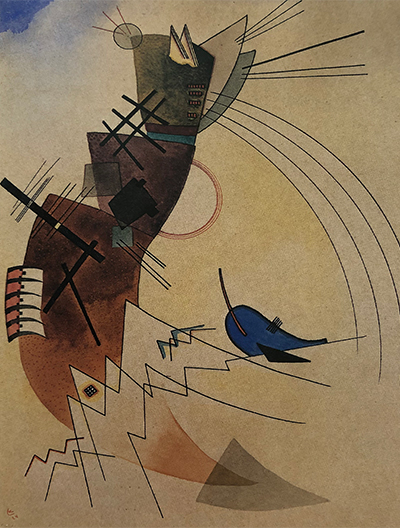
Ascending is the English title used here for Wassily Kandinsky's Aufstieg, a watercolour and pen-and-ink composition made in April 1924. A russet and violet upright form rises through a web of black lines. To its right, a compact blue shape sits inside long, sweeping arcs; below, a jagged path cuts across a pale ground. The image on this page matches the work reproduced in Sotheby's 2023 catalogue, where the artist's dated monogram and the title and number on the reverse establish a firmer identity than the page previously supplied. [1].
This matters because Kandinsky made several works with titles meaning ascent. A separate 1929 watercolour called Aufstieg appears in a Bührle holdings catalogue, and the 1923 lithograph Fröhlicher Aufstieg is usually translated Joyous Ascent. Neither is this picture. The visible match to Sotheby's image, together with the 1924 object's documented medium, dimensions and catalogue history, allows this page to discuss the correct work without carrying over its inherited 1929 date. [1]; [3]; [4].
Watch: Wassily Kandinsky
Five museum videos about Kandinsky’s art, sources of inspiration and the relationship between colour and music.
Vasily Kandinsky: Around the Circle
Curator Megan Fontanella introduces Kandinsky and the Guggenheim collection.
Watch on YouTubeAt a Glance
- Artist and date:Wassily Kandinsky, April 1924.
- Original title:Aufstieg; English Ascent or Ascending.
- Medium:Watercolour and pen and ink on paper mounted on artist's board.
- Sheet:31.7 × 22.8 cm in the Canadian review decision; Sotheby's rounds to 32 × 23 cm.
- Inscription:Monogram and “24” lower left; title, 1924 and No. 132 on the reverse of the mount.
- Identification:Sotheby's 2023 lot 409; Barnett watercolour catalogue no. 689.
- Image:Inherited site reproduction retained; no newly licensed auction photograph added.
Where this work sits in Kandinsky’s career
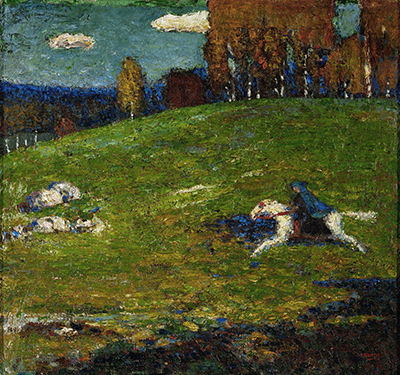
The Blue Rider
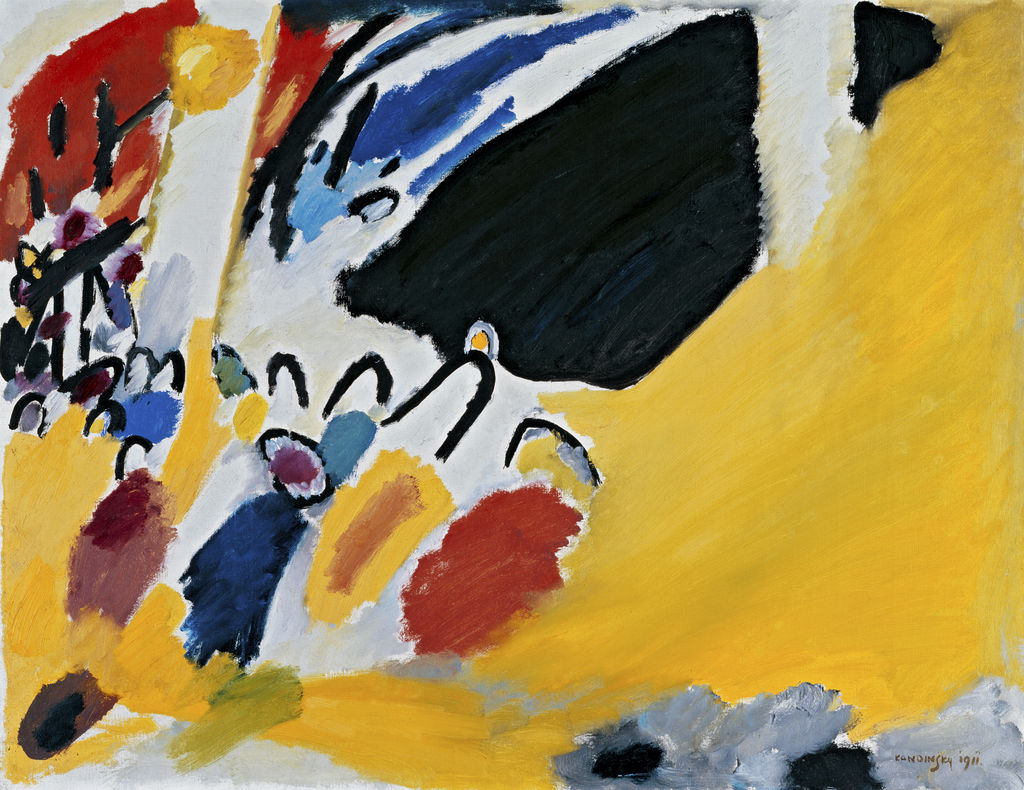
1903Composition VII
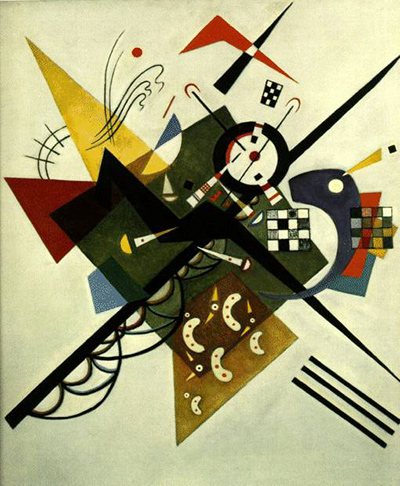
1913Composition VIII
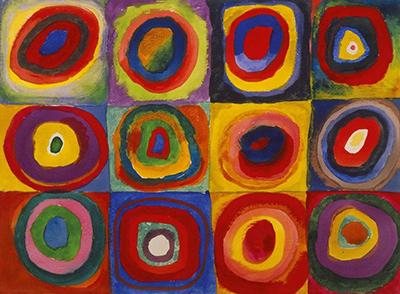
1923Several Circles
1926Sky Blue
1940Contents
- A shape that seems to rise
- Watercolour, ink and the scale of the sheet
- A Bauhaus work with its own identity
- Three similarly named works
- Frequently asked questions
- References
A shape that seems to rise
The strongest mass begins near the lower left in warm brown and red. It narrows as it climbs into a violet and olive form near the top edge. A pair of sharply pointed projections crowns that upper shape. Lines cross the broad lower section and then radiate from the upper one, so the colour mass never remains a sealed silhouette. Its implied upward travel makes the German title Aufstieg persuasive as a way to begin looking. The title does not, however, identify a depicted person, animal or event. [1].
The surface feels active even where little colour is applied. A small pale circle near the upper left seems suspended beside the pointed crown. On the right, parallel arcs open an expanse of unpainted paper; darker straight lines run across and beyond them. At the bottom, a thin, irregular line zigzags beneath the larger form. These different routes let the eye move upward, outward and back down. The composition makes ascent a visual action rather than a literal staircase. That is a description of its arrangement, not evidence for Kandinsky's private symbolic key. [1].
The blue element at lower right interrupts the warm vertical. Its rounded body and tapered end can suggest a small bird or fish; the pointed tips at the top of the central form can suggest ears. The inherited article turned these associations into a cat hunting a bird. Neither the auction catalogue nor the Canadian object decision identifies that story as Kandinsky's subject. The shapes reward imaginative comparison, but the gap between “looks like” and “represents” should stay visible. The blue form also works simply as a cool, low counterweight to the warm, rising mass. [1]; [2].
Watercolour, ink and the scale of the sheet
The sheet measures 31.7 × 22.8 cm in the Canadian review record. Sotheby's gives the same sheet approximately as 32 × 23 cm and separately lists the larger mount. These figures describe different levels of precision rather than two versions of the composition. They also establish an intimate work on paper, not a large oil painting. The coloured areas are watercolour; pen and ink supply the strong crossings, arcs and fine angular lines. [2]; [1].
Some washes have broad, soft transitions while the black marks remain abrupt. The contrast makes the central mass appear to shift or rotate within a more exact linear framework. A watercolour also leaves the pale paper active: the right half is not an empty backdrop waiting to be filled, but an open field that gives the arcs room to register. The existing web image cannot reveal the support's texture or every layer of pigment. This close reading describes what can be seen in the reproduction and does not claim a laboratory account of the sequence in which Kandinsky applied each mark. [1].
In 2023 the Canadian Cultural Property Export Review Board reported slight discolouration, minor foxing and some fading as issues raised in the export review; the Board considered the colour largely fresh. That discussion concerns the object's condition as evaluated then. It does not authorise correcting the original palette from a screen image, nor does it prove the inherited digital reproduction has accurate colour. It is a useful reminder that a work on paper has a material life beyond its online file. [2].
A Bauhaus work with its own identity
Kandinsky was teaching at the Bauhaus when he made Aufstieg in 1924. The tension between free watercolour washes and emphatic line fits a period in which geometric relationships were central to his practice. His later book Point and Line to Plane was first published in German in 1926. That chronology makes the book useful context for his continued attention to elements of form, but it would be anachronistic to present the 1924 sheet as an illustration of a passage published two years later without direct evidence. [1]; [6].
The artist's monogram and “24” appear at lower left. Sotheby's records the title, year and No. 132 on the reverse of the mount and cites Vivian Endicott Barnett's watercolour catalogue raisonné as no. 689. Those are more useful anchors for identity than a broad stylistic resemblance to another Bauhaus picture. The auction listing also traces the sheet from Erich Scheyer by December 1924, through the Scheyer family and later dealers to the private collection that offered it in 2023. A listing of provenance does not establish a current owner or a permanent place to view the work. [1].
The 2023 Canadian review concerned whether an export permit should be issued for this specific 1924 sheet. The Board found the work significant for its aesthetic qualities and value in studying art, while its majority concluded that the legal threshold of national importance was not met and directed issue of a permit. That outcome concerns Canadian export law and the evidence before the Board at the time. It does not rank Aufstieg within Kandinsky's art by universal artistic merit, and it does not tell us where the object is now. [2].
Three similarly named works
The Bührle catalogue lists a 1929 Kandinsky Ascent, also Aufstieg, as watercolour and India ink on paper, 48 × 28.5 cm, catalogue B.936. The year, dimensions and catalogue number differ from the 1924 sheet discussed here. The previous source match for this page had linked that 1929 record without proving a visual match. Comparing the inherited picture with Sotheby's 1924 reproduction resolves the page's image identity and makes the 1929 entry a cautionary comparison, not the source for this article's facts. [3]; [1].
There is also Fröhlicher Aufstieg (Joyous Ascent), a colour lithograph of 1923 from the Bauhaus Masters' Portfolio. MoMA and the Lenbachhaus catalogue examples of that print. Its extra word, different medium and portfolio setting identify another work again. Reading any of these titles as a generic invitation to look upward may be productive; transferring their dates, dimensions or images between them is not. [4]; [5].
The inherited page image remains in place because it already depicts the 1924 sheet. Sotheby's reproduction helped verify it, but the auction page does not offer a clear new licence for copying its photograph into the site or the planned PDF. The guide entry can use the documented object facts and a text description without adding that new image. The strongest reading of Ascending starts with the actual sheet: a small, dated work whose warm upward form, cool blue interruption and competing ink directions keep movement unsettled. [1].
Kandinsky artworks directory
Frequently Asked Questions
The work shown here is Aufstieg, executed in April 1924. Its lower-left monogram is dated “24”; the reverse of the mount records 1924 and No. 132. [1].
No. It is watercolour and pen and ink on paper mounted on artist's board. The sheet is 31.7 × 22.8 cm in the Canadian review record. [2].
There is another Kandinsky Aufstieg dated 1929 in the Bührle holdings catalogue. Its 48 × 28.5 cm sheet and Barnett B.936 number are distinct from the 1924 work pictured on this page. [3]; [1].
Some shapes can evoke ears and a blue bird-like form, but the cited object sources do not identify a cat-and-bird narrative. Those are possible visual associations, not confirmed subjects. [1].
No. Joyous Ascent (Fröhlicher Aufstieg) is a separate 1923 lithograph from the Bauhaus Masters' Portfolio. Ascending here is a 1924 watercolour and ink sheet. [4]; [1].
Discussion
What do you notice first in Ascending? Share a close observation or a question about the evidence for this work.
Comments are for comparing what we see and what the cited sources establish.
Reader Insights
Which line most strongly sends your eye upward through the warm form?
How does the small blue shape change the balance of the open right side?
What evidence distinguishes this 1924 sheet from the other works called Ascent?
Join the Conversation
Add your observation below and tell us which part of the artwork led you to it.
References
- Sotheby's, Aufstieg (Ascent), Modern Day Auction lot 409, 2023. View source.
- Canadian Cultural Property Export Review Board, decision on Aufstieg, 23 March 2023. View source.
- The Emil Bührle holdings catalogue, English extract, item 473. View source.
- MoMA, Joyous Ascent (Fröhlicher Aufstieg), 1923. View source.
- Lenbachhaus, Fröhlicher Aufstieg, 1923. View source.
- Guggenheim, Point and Line to Plane publication record. View source.