by Tom Gurney
Tom Gurney BSc (Hons) is an art history expert with over 20 years experience
Published on June 19, 2020 / Updated on October 14, 2023
Email: tomgurney1@gmail.com / Phone: +44 7429 011000
Impression V (Park) by Wassily Kandinsky: Introduction
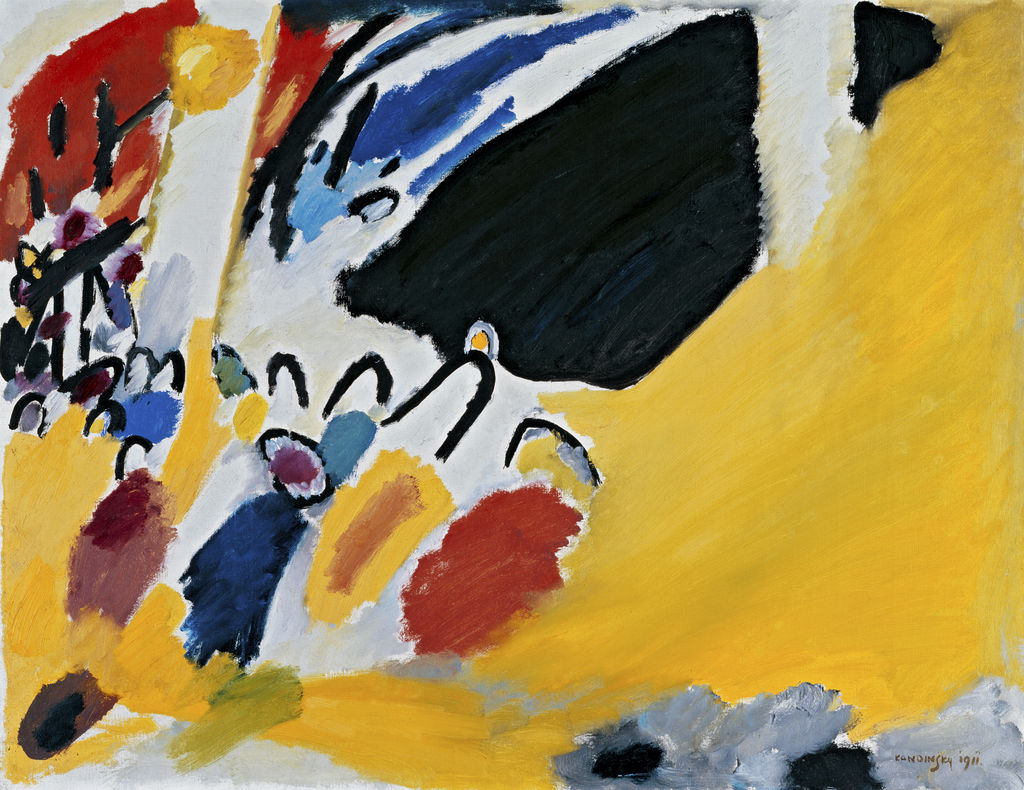
A broad red triangle rises from a field of loosely brushed green, blue, yellow and white. Long black lines travel over the colour rather than enclosing each area neatly. Look longer and a scene begins to emerge: mounted riders, two seated figures, perhaps a path through a park. Yet none of these figures holds the picture still. The Centre Pompidou identifies the painting as Impression V (Parc), made on 12 March 1911, in oil on canvas, 106 × 157.5 cm. It is now in the French national modern art collection, inventory AM 1976-851. The English title Impression V (Park) translates the museum's French subtitle while preserving the familiar number. [1].
The picture sits at an especially revealing point in Kandinsky's move toward abstraction. The museum still finds two riders and their horses among the black marks. A longer educational account also finds two figures seated on a bench. But the curves and colour patches have a visual life apart from those recognisable forms. Kandinsky's word “Impression” did not mean an Impressionist exercise in recording sunlight. In his 1911 scheme, it described a painting that began with an impression of the external world, as distinct from an Improvisation prompted more directly by inner experience. [1]; [2].
Watch: Wassily Kandinsky
Five museum videos about Kandinsky’s art, sources of inspiration and the relationship between colour and music.
Vasily Kandinsky: Around the Circle
Curator Megan Fontanella introduces Kandinsky and the Guggenheim collection.
Watch on YouTubeAt a Glance
- Artist and title:Wassily Kandinsky, Impression V (Parc) in the owner's catalogue; Impression V (Park) in English.
- Date:12 March 1911, as recorded by the Centre Pompidou. The canvas is also signed and dated 1911 at the lower right.
- Medium and size:Oil on canvas, 106 × 157.5 cm.
- Collection:Musée national d'art moderne, Centre Pompidou, Paris, inventory AM 1976-851; donated by Nina Kandinsky in 1976.
- Early exhibition:Shown at the Paris Salon des Indépendants in 1911, according to the owner.
- Subject and form:Two mounted riders are identified by the owner; its educational dossier also describes two seated figures. A red triangle and roaming black lines dominate the arrangement.
- Image:Existing site reproduction retained. The museum credits a separate photographer for its reproduction, so no replacement image was taken.
Where this work sits in Kandinsky’s career
The Blue Rider
1903Composition VII
1913Composition VIII
1923Several Circles
1926Sky Blue
1940Contents
- Finding the figures among the lines
- What Kandinsky meant by an Impression
- A painting made in March 1911
- The object in Paris's collection
- Frequently asked questions
- References
Finding the figures among the lines
The centre of the painting is a red, almost triangular mass, tipped upward. Its edges are not mechanically ruled, and its colour is not perfectly even. To the left a dark green area stretches toward the canvas edge; to the right a stronger blue area settles low. These two cooler fields give the red a place to press against. Yellow reaches across much of the upper middle, while the pale ground shows through between patches. The result is spacious but restless: areas that could make a landscape never quite join into a conventional view. [1].
Black marks give the eye routes through the surface. One long stroke begins near the left side, bends, and runs toward the central red. Another rises sharply on the right. There are shorter hooks and loops near the figures. From a distance these may first seem like independent gestures; with the museum's account in mind, some lines also become horses and riders. This dual reading matters. A viewer can find a scene without reducing every black mark to an outline with only one job. [1]; [2].
The longer museum dossier describes one rider near the centre with something blue that could be a cloak or veil, and another beige-toned rider at the far right. It also identifies two people seated on a bench. Its hesitation over the blue form is helpful: the figures are suggested, not crisply illustrated. The current owner record mentions two riders and their mounts, reduced to black lines against the great red triangle, without requiring every possible figure to be certain. These are observations from the museum, not a complete key to hidden symbols. [2]; [1].
The title's park may help the eye organise the picture as an outdoor encounter. Green at left can suggest vegetation; blue low at right can suggest another stretch of ground, water or shadow. But those possibilities need not be fixed into a map. The Centre Pompidou warns in its educational account that the subtitle does not point directly to a specific external reality. There is no documented park address to attach to the painting. The central question is how a remembered or felt encounter turns into relations between red, blue, green, yellow and black. [2].
What Kandinsky meant by an Impression
Kandinsky used three related terms in his theory of painting around 1911: Impressions, Improvisations and Compositions. The Centre Pompidou's account describes the first as starting from external reality. The latter two drew on images arising from inner life, with a Composition more deliberately worked out as a formal whole. The categories describe starting points and processes, not a simple scale on which one picture is better or more abstract than another. Nor do they make this Impression a late nineteenth-century Impressionist painting. [2]; [1].
The title therefore holds a useful tension. The word Park keeps an external prompt in view, and riders still survive inside the painting. At the same time, the black strokes do more than describe anatomy or perspective. The owner says forms and colours have begun to leave their descriptive function and translate rhythms and tempos. That formulation suits the way a line can carry the eye across several coloured areas before it settles into a leg, a rein or no figure at all. The work does not need to have abandoned subject matter completely to be a decisive experiment in abstraction. [1].
The museum's older dossier quotes a letter in which Kandinsky explains that subtitles are not there to define a painting's content; the viewer's experience of colours and forms matters. That is a more precise claim than saying every viewer may assign absolutely any story. The picture offers actual forms, marks and a recorded title. It also resists a single literal translation of each coloured patch. A careful reading can move back and forth between what is visible, what the owner identifies and what remains an individual's response. [2].
This distinction also corrects a misleading account on the former page. It described the Impressions as products of the subconscious and compared the method to later Surrealism. The Centre Pompidou places external nature at their starting point. Unconscious or inward images belong more directly to its account of the Improvisations and Compositions. The categories may overlap in the experience of looking, but reversing their stated sources makes this particular title harder to understand. [2].
A painting made in March 1911
The object's catalogue date is unusually exact: 12 March 1911. The detailed museum record also notes Kandinsky's signature and the year 1911 at the lower right. A dated catalogue entry and a visible year inscription are different kinds of evidence. The page can use the owner's exact creation date while saying only that the inscription itself gives the year, not the day and month. That care avoids turning a catalogue fact into a claim about the wording on the canvas. [1].
The Centre Pompidou says Kandinsky exhibited the work at the Paris Salon des Indépendants in the same year. This matters because Impression V was seen publicly during the very period in which he was working out the relationship between observed motifs and freer colour and line. It was not a private experiment discovered decades after his death. The museum's bibliography lists the later catalogue raisonné and exhibition catalogues for readers who want to trace the work's subsequent documentation. [1].
The painting belongs to the years in which Kandinsky and Franz Marc developed the Blue Rider project. The museum places Impression V in its account of the passage “from the Blue Rider to abstraction,” 1908–14. The shared rider motif has resonance in that setting, yet this is an individually catalogued canvas rather than an illustration of a group manifesto. Its two riders remain small and elusive when set against the commanding red triangle and the broad reaches of colour. [2].
Compare Impression V with Impression III (Concert), another 1911 painting. A concert could supply an external experience just as a park could, while Kandinsky reorganised what he had encountered through colour and form. The comparison does not mean one canvas can be decoded by the other. It shows why the series name marks a mode of response rather than a fixed subject. Looking at the two pages together also makes the variety within his early 1910s work clearer than a single claim that he became abstract at one precise moment. [1]; [2].
The object in Paris's collection
Nina Kandinsky donated the canvas to the Centre Pompidou's Musée national d'art moderne in 1976. Its inventory number, AM 1976-851, separates this specific object from other numbered Impressions and from similarly titled works. The museum records oil on canvas and the relatively large dimensions of 106 × 157.5 cm. Those measurements help explain why the red centre and long black lines could register strongly when encountered in person, far beyond the small reproduction on this page. [1].
A collection entry can show a temporary loan or display location that changes. The stable home of the work is the museum's collection record, which should be checked for its current location before planning a visit. The site keeps its existing image because it is sufficient for reading the overall arrangement. The owner lists a photographer and picture agency for its own reproduction; the artwork's public-domain status does not alone clear a new museum photograph for reuse here or in a downloadable guide. No replacement image was acquired. [1].
Impression V (Park) rewards both kinds of attention it seems to ask for. Find the riders, seated figures and possible path, then let those identifications loosen again. Follow a black line over a red edge or watch the green and blue fields hold the triangle between them. The painting's precise date, early Paris exhibition and owner record give it a firm historical identity. Its marks still leave room for an active encounter with colour and form. [1]; [2].
Kandinsky artworks directory
Frequently Asked Questions
The Centre Pompidou dates it to 12 March 1911. Its detailed record separately notes a lower-right inscription with Kandinsky's name and the year 1911. [1].
The owner identifies two riders and their horses amid colour patches and black lines. Its educational dossier also describes two seated figures on a bench. These figures are deliberately hard to separate from the painting's larger pattern of shapes and marks. [1]; [2].
The museum's educational account says the subtitle does not directly indicate a particular external location. It can guide a reading of the subject without proving that Kandinsky depicted a named park. [2].
It is oil on canvas, 106 × 157.5 cm, according to the Centre Pompidou. [1].
In the museum's account of his 1911 theory, an Impression begins with external reality. He distinguished this starting point from the more inward sources of Improvisations and the more formally developed Compositions. [2].
It belongs to the Musée national d'art moderne, Centre Pompidou, inventory AM 1976-851. Nina Kandinsky donated it in 1976. Check the museum's live record for its current display or loan location. [1].
Discussion
What do you notice first in Impression V (Park)? Share a close observation or a question about the evidence for this work.
Comments are for comparing what we see and what the cited sources establish.
Reader Insights
Where do the black lines suggest riders, and where do they act simply as lines?
How does the red triangle change the balance between the green and blue areas?
What does the subtitle Park offer without locating a particular real park?
Join the Conversation
Add your observation below and tell us which part of the artwork led you to it.
References
- Centre Pompidou, Impression V (Parc), AM 1976-851: object record, dimensions, provenance, exhibition and image credit. View source.
- Centre Pompidou, Kandinsky educational dossier: analysis of Impression V (Parc) and the Impressions, Improvisations and Compositions. View source.