 by Tom Gurney
Tom Gurney BSc (Hons) is an art history expert with over 20 years experience
Published on June 19, 2020 / Updated on October 14, 2023
Email: tomgurney1@gmail.com / Phone: +44 7429 011000
Railroad at Murnau (Eisenbahn bei Murnau) by Wassily Kandinsky: Introduction
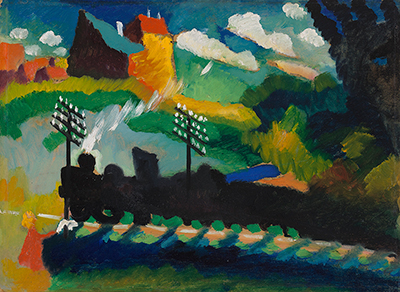
A little black locomotive pulls a dark train across a brightly coloured landscape in Wassily Kandinsky's Railroad at Murnau. Two slender telegraph poles lean over the track, white smoke rises from the engine, and a tiny pale shape at the left suggests someone waving. Orange, yellow, blue and green passages fill the hills behind. The scene is lively and recognisable, but the dark train seems almost like a single cut-out form sliding across those broad fields of colour. The Lenbachhaus in Munich identifies the work as Eisenbahn bei Murnau, painted in 1909, oil on cardboard, 36.1 × 49.2 cm. [1].
The painting belongs to the period when Kandinsky and Gabriele Münter spent important stretches of time in Murnau. The museum's account gives a specific local reason for the motif: the Munich–Garmisch railway ran close below the house Münter bought in late summer 1909, and a passing train could be seen frequently. That connection makes the picture more concrete than a generic “modern technology” subject. It does not require us to identify a precise locomotive class, service or day. [1].
Watch: Wassily Kandinsky
Five museum videos about Kandinsky’s art, sources of inspiration and the relationship between colour and music.
Vasily Kandinsky: Around the Circle
Curator Megan Fontanella introduces Kandinsky and the Guggenheim collection.
Watch on YouTubeAt a Glance
- Artist and title:Wassily Kandinsky, Eisenbahn bei Murnau (Railroad at Murnau).
- Date:1909, according to the Lenbachhaus collection entry.
- Medium and size:Oil on cardboard, 36.1 × 49.2 × 0.4 cm.
- Collection:Städtische Galerie im Lenbachhaus und Kunstbau München, inventory GMS 49.
- Recorded marks:The museum lists the work as unsigned.
- Documented provenance:Gabriele Münter held it from 1926 to 1957; she gave it to the Lenbachhaus in 1957.
- Distinct painting:Kandinsky's similar Landscape near Murnau with Locomotive is a separate work in the Guggenheim Museum collection.
Where this work sits in Kandinsky’s career
The Blue Rider
1903Composition VII
1913Composition VIII
1923Several Circles
1926Sky Blue
1940Contents
- A train cutting through colour
- The Murnau setting
- One of two railway paintings
- A documented collection history
- Frequently asked questions
- References
A train cutting through colour
The dark train crosses the lower half of the small board with almost no break in its black silhouette. Its engine is compact, and the long following mass resembles a moving shadow as much as a set of individually described carriages. That simplification is important. A viewer recognises a railway at once, yet the train also acts as a broad horizontal shape against the fractured greens and blues behind it. The Lenbachhaus likens it to a giant black snake headed by a toy-like locomotive, a description that brings out both scale and playfulness. [1].
The track beneath does not read as a careful engineering drawing. Short, repeated dark and coloured marks make it pulse along the lower edge. Kandinsky sets the train's near-continuous body against this broken rhythm, giving a sense that one thing is sweeping across many others. Little red-orange passages under the wheels add a flash of warmth. The museum describes them as flickering sunlight. Looking at the painted surface, they also serve as small accents that keep the black mass from becoming inert. [1].
Above the engine, white smoke rises into the colour of the landscape. Its light diagonal points up and back, making movement visible even if the train itself is painted as a thick, dark band. The two telegraph poles tilt at different angles and seem caught in the same energy. The museum notes both the smoke and poles as parts of the picture's dynamism. Those observed features are more reliable than trying to invent a train speed or exact direction of travel from the image. [1].
The rest of the landscape refuses to be passive scenery. A bright orange tower-like form stands near the upper centre; a dark pointed shape rises to its left; a heavy near-black cluster closes the right side. Blue and green areas meet in unusually sharp blocks. White clouds and yellow ridges appear in a strip across the top. Some features may be buildings, hills or trees, but they are arranged to make colour contrasts as emphatic as the train. [1].
At the far left, a small white mark seems to wave near the track. The museum's essay describes a girl's fluttering cloth there. The figure is so slight that a small reproduction can make it easy to miss. Once found, it changes the scale of the whole scene: the train is suddenly related to a human observer, and the painting's playful quality becomes easier to see. Yet the figure remains a minor detail rather than the work's central subject. [1].
The Murnau setting
The Lenbachhaus ties the motif to the house Münter acquired in late summer 1909. A railway line ran close below the property, connecting Munich and Garmisch, so the passing train was a familiar sight. Kandinsky did not have to seek out an exceptional industrial spectacle to paint it. The picture could arise from everyday activity at the edge of a place where he and Münter worked intensely. The museum's description supplies this context; the painting alone would show a train and hills but not prove the particular line's route. [1].
Kandinsky's Murnau pictures of these years are often discussed for their strong, independent colour. This railway scene also includes a modern machine. The Lenbachhaus calls it one of the relatively few Kandinsky works to make modern technology a subject. That observation should remain proportionate: the painting does not amount to a statement that Kandinsky embraced industry in a particular political or technological programme. It shows one passing train given vivid pictorial form. [1].
The museum suggests that the picture's simple, nearly humorous way of presenting the train may relate to Kandinsky's interest in folk art and reverse-glass painting. Its own wording is cautious, describing a possible influence. That is the right level of certainty. The hard silhouette, bright patches and compact scale make the comparison useful, but the collection entry does not document a specific folk image that Kandinsky copied here. [1].
One of two railway paintings
The Lenbachhaus explicitly compares Eisenbahn bei Murnau with Kandinsky's similar Landscape near Murnau with Locomotive, now in the Solomon R. Guggenheim Museum in New York. Both belong to 1909, both picture rail transport near Murnau, and both use strongly simplified colour and form. They are nevertheless different physical works. The Lenbachhaus board is 36.1 × 49.2 cm, inventory GMS 49; the Guggenheim picture has its own dimensions, accession and history. A reader should use the respective museum records when comparing them. [1]; [2].
In the Lenbachhaus work, the train stretches almost edge to edge across the foreground, while the background rises in forceful coloured masses. It is tempting to transfer descriptive details from another Kandinsky railway picture, especially when titles are translated as “railroad,” “railway,” “locomotive” and “landscape.” Doing so would blur what this painting actually shows. The poles, smoke, waving cloth and dark body are the notable features the Lenbachhaus discusses for this specific object. [1].
A documented collection history
The painting's present ownership is clear. The Lenbachhaus lists Gabriele Münter as holding it from 1926 to 1957, having received it from Kandinsky, and records her 1957 gift to the museum. This history matters because Münter preserved a large body of work connected with the early Blue Rider years. The museum catalogue also notes that the board bears no signature. Its date and attribution rest on the collection's scholarship rather than a visible 1909 inscription on the image. [1].
The picture's small size and cardboard support make sense beside the Lenbachhaus account of the Murnau period as a time of concentrated landscape work. The board carries broad, decisive colour but also many quick small strokes. We cannot know from the public record how long Kandinsky spent on this particular painting or whether it was executed entirely outdoors. The stronger observation is that he made a recognisable local subject into a compact, energetic arrangement of colour and silhouette. [1].
Railroad at Murnau remains lively because it keeps these two ways of seeing together. The train is an everyday machine on a real line below Münter's house; it is also a sweeping black form that makes the hills, smoke, poles and human gesture move around it. The Lenbachhaus record secures the object and its history, while the painting itself rewards attention to how few marks Kandinsky needed to make a passing train feel animated. [1].
Kandinsky artworks directory
Frequently Asked Questions
The Lenbachhaus dates Eisenbahn bei Murnau to 1909. [1].
It is oil on cardboard, measuring 36.1 × 49.2 × 0.4 cm in the owner museum's catalogue. [1].
The Lenbachhaus says the Munich–Garmisch line passed close beneath the Murnau house Gabriele Münter bought in 1909 and was a familiar sight. [1].
It belongs to the Lenbachhaus in Munich, inventory GMS 49, following Münter's 1957 gift. [1].
No. The Lenbachhaus itself compares the two separate 1909 paintings. Landscape near Murnau with Locomotive is held by the Guggenheim Museum in New York. [1]; [2].
The Lenbachhaus catalogue lists it as unsigned. Its documented date, material and collection number identify the object. [1].
Discussion
What do you notice first in Railroad at Murnau (Eisenbahn bei Murnau)? Share a close observation or a question about the evidence for this work.
Comments are for comparing what we see and what the cited sources establish.
Reader Insights
How does the long dark train change the coloured landscape around it?
Where do smoke, poles and a possible waving cloth suggest movement?
Which details distinguish this Lenbachhaus picture from the Guggenheim railway painting?
Join the Conversation
Add your observation below and tell us which part of the artwork led you to it.
References
- Lenbachhaus, Kandinsky, Eisenbahn bei Murnau: object record, provenance and curatorial text. View source.
- Solomon R. Guggenheim Museum, the distinct Landscape near Murnau with Locomotive. View source.